Compare your deck to Wise

Compare Your Deck

Wise Pitch Deck (2012)

Fintech
Stage: Seed
Raised: $1.3M
Year: 2012
Slides: 9
Outcome: IPO at $11B valuation

Pitch Deck

1 / 9
Wise pitch deck - The Opening: Clear brand & mission
Click to expand

Deck Analysis

This seed deck from Wise (then TransferWise) is an early-stage fintech pitch that crisply frames a large, addressable problem in cross-border payments and presents a simple, defensible peer-to-peer solution. It combines clear before/after economics, an easy-to-understand product flow, early traction metrics, a focused roadmap and fundraising ask — all delivered with modest design and concrete numbers. The deck is notable because it shows how a complex financial service can be reduced to a believable, low-friction operational model and early-growth story that attracted seed capital and eventually scaled to an IPO.

The Opening: Clear brand & mission

The Opening: Clear brand & mission

Slide 1 functions as a minimal but effective opener: the TransferWise name, a one-line descriptor "Peer-to-peer currency exchange," the founders' names and a date/place. It immediately tells the audience who the founders are, what the product category is, and positions the company as a marketplace/peer platform rather than a bank. The simplicity reduces cognitive load and primes investors for a focused, problem-solution narrative.

The slide’s strength is its discipline: no vision fluff, no buzzword salad. Founders can learn to start with an explicit, short pitch line and the identities behind the company. That builds credibility quickly and allows following slides to dive straight into the market problem and mechanics.

Key Takeaway: Lead with a single, explicit value proposition and founder credibility up front so the audience knows what to expect and whom they’re backing.
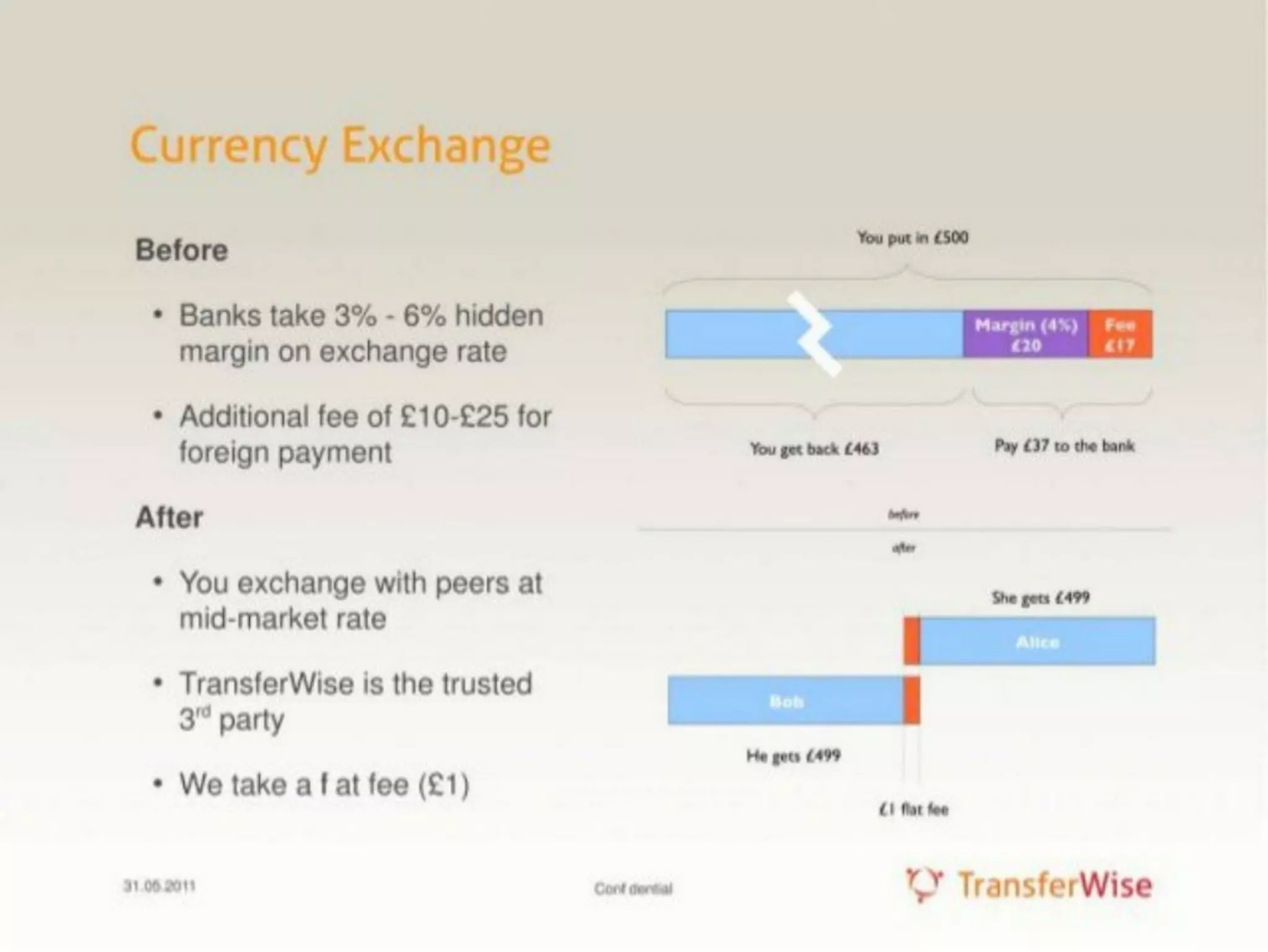
Problem & solution framing: Before vs After (economics-focused)

Problem & solution framing: Before vs After (economics-focused)

Slide 2 visualizes the problem (banks’ hidden FX margins and flat fees) and contrasts it with TransferWise’s peer-to-peer mid-market rate plus a small flat fee. The use of a concrete money example (£500) makes the abstract issue tangible and emotionally relevant: the viewer can immediately see the delta in money kept versus money lost to traditional providers. This slide anchors the rest of the deck with a clear economic incentive for users to switch.

The slide also subtly communicates defensibility: the product isn’t just "cheaper" — it’s a fundamentally different mechanics (matching peers at the mid-market rate) which is harder for incumbents to replicate quickly. Founders should emulate the technique of using a simple numeric example to make cost savings visceral and to highlight how the business model generates a unit-economics advantage.

Key Takeaway: Use a concrete numeric example to make the customer benefit and business model instantly believable and memorable.
Product and operations: How it works

Product and operations: How it works

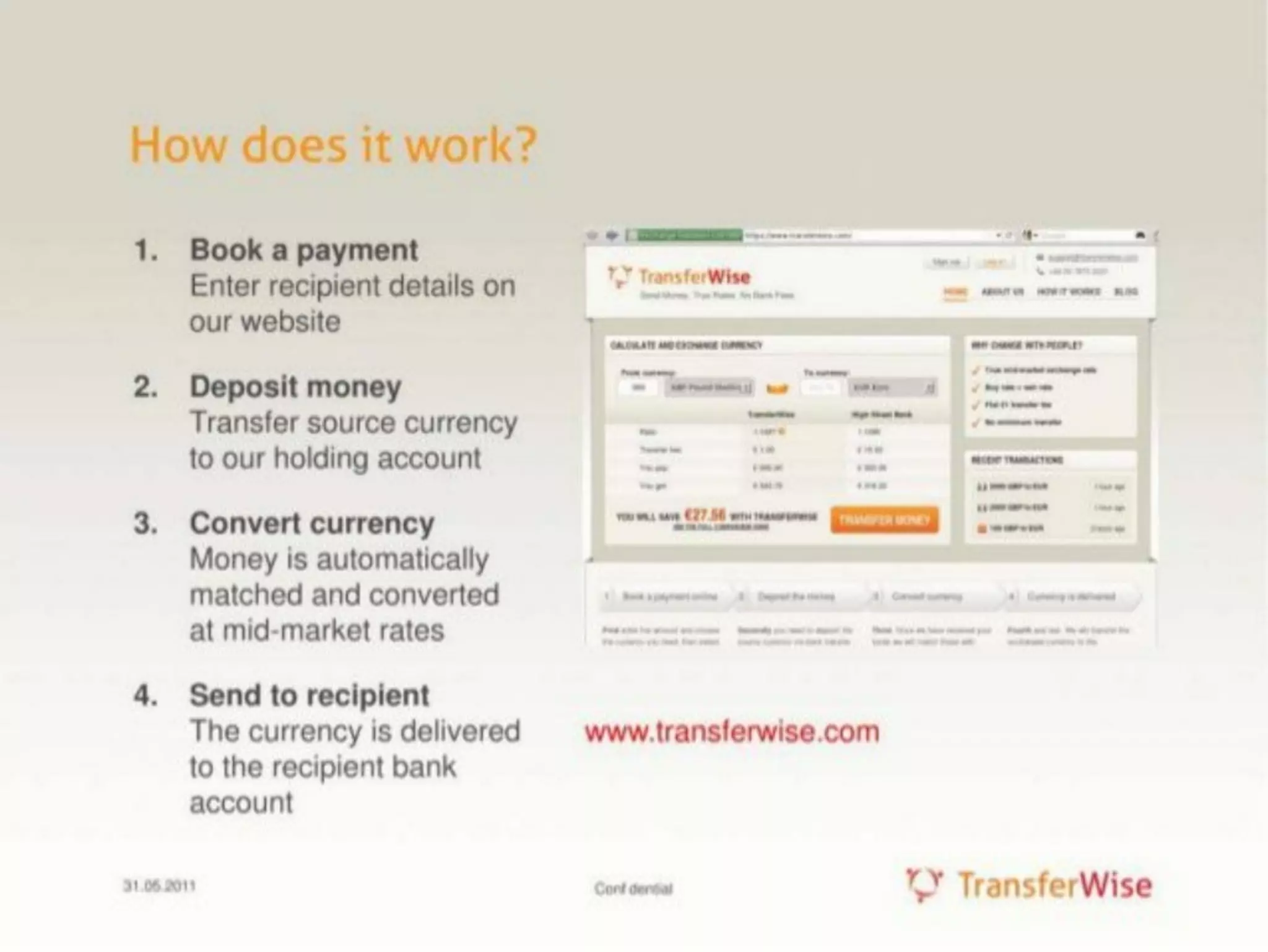
Slide 3 breaks the product into four clear steps: book a payment, deposit money, convert currency (auto-matching), and send to recipient. The stepwise flow demystifies the operational path and reassures investors that the process is straightforward and scalable. The inclusion of the web UI screenshot supports the claim that this is a real, working product and not just a concept.

This operational clarity is essential for fintech where trust and compliance are central; the slide communicates the flow of funds and touches the critical detail that conversion happens at mid-market rates via matching. Founders should emulate this approach by describing not only customer benefit but the end-to-end mechanics, showing they’ve thought through user experience, operational controls and trust signals.

Key Takeaway: Map your customer journey in 3–5 steps and pair it with an interface or operational detail to show the idea is practical and executable.
Traction: Early metrics and credibility

Traction: Early metrics and credibility

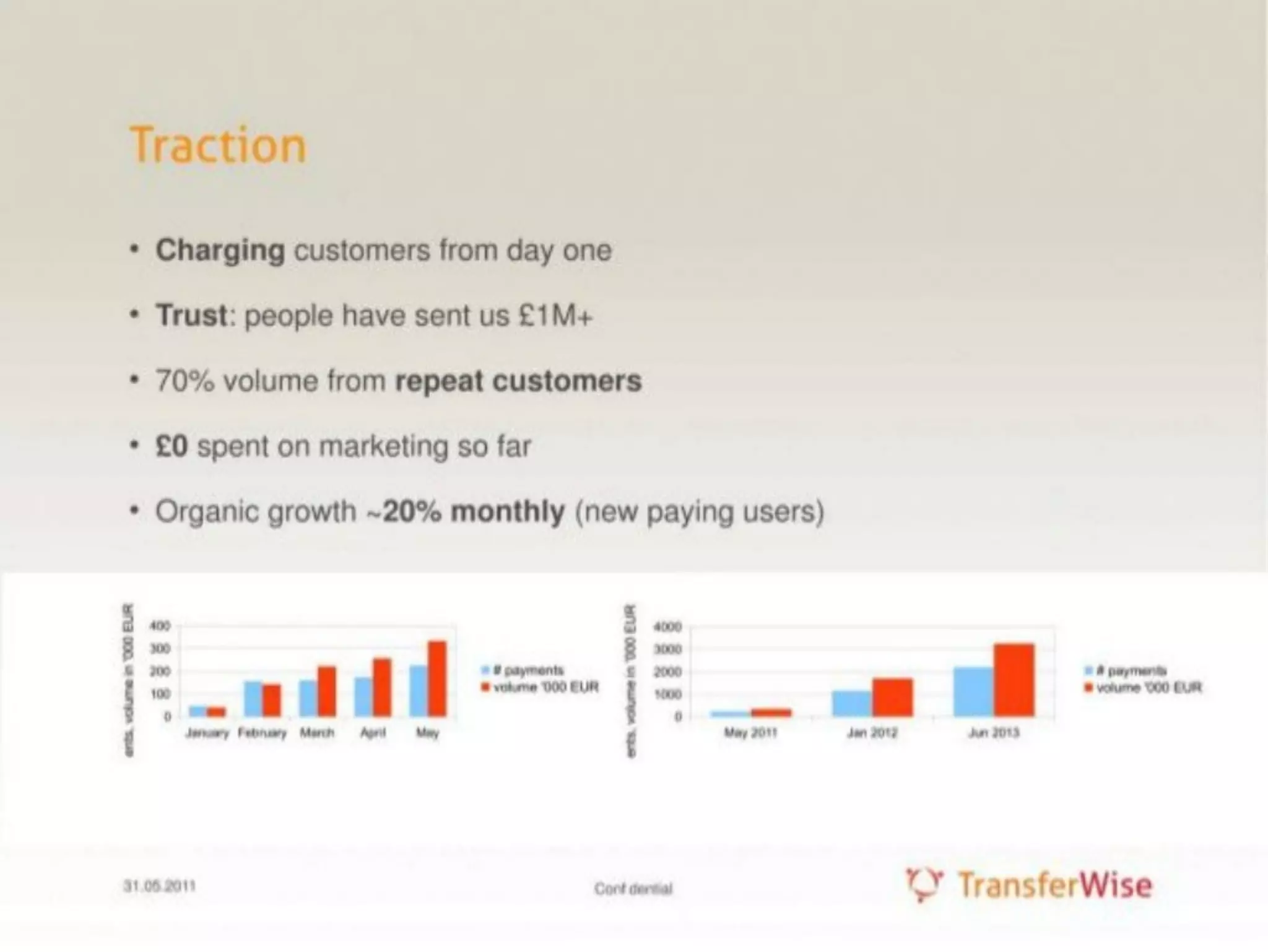
Slide 4 focuses on proof: charging customers from day one, over £1M transacted, 70% volumes from repeat customers, and ~20% monthly organic growth. These quantified signals (revenue, retention, growth rate) are exactly what investors want at seed — proof that the offering meets a real need and that unit economics and virality exist. The note that £0 was spent on marketing further highlights product-led growth.

Visual mini-charts at the bottom show month-over-month increases, reinforcing the narrative. The slide demonstrates how early traction can compensate for limited resources: strong user behavior metrics and retention are more persuasive than polished marketing. Founders should always lead with credible, simple metrics (revenue, repeat rate, growth %) and explain customer acquisition dynamics.

Key Takeaway: Show real, simple metrics that prove product-market fit — revenue, repeat usage, and organic growth beat shiny projections without traction.
Team: Complementary backgrounds and credibility

Team: Complementary backgrounds and credibility

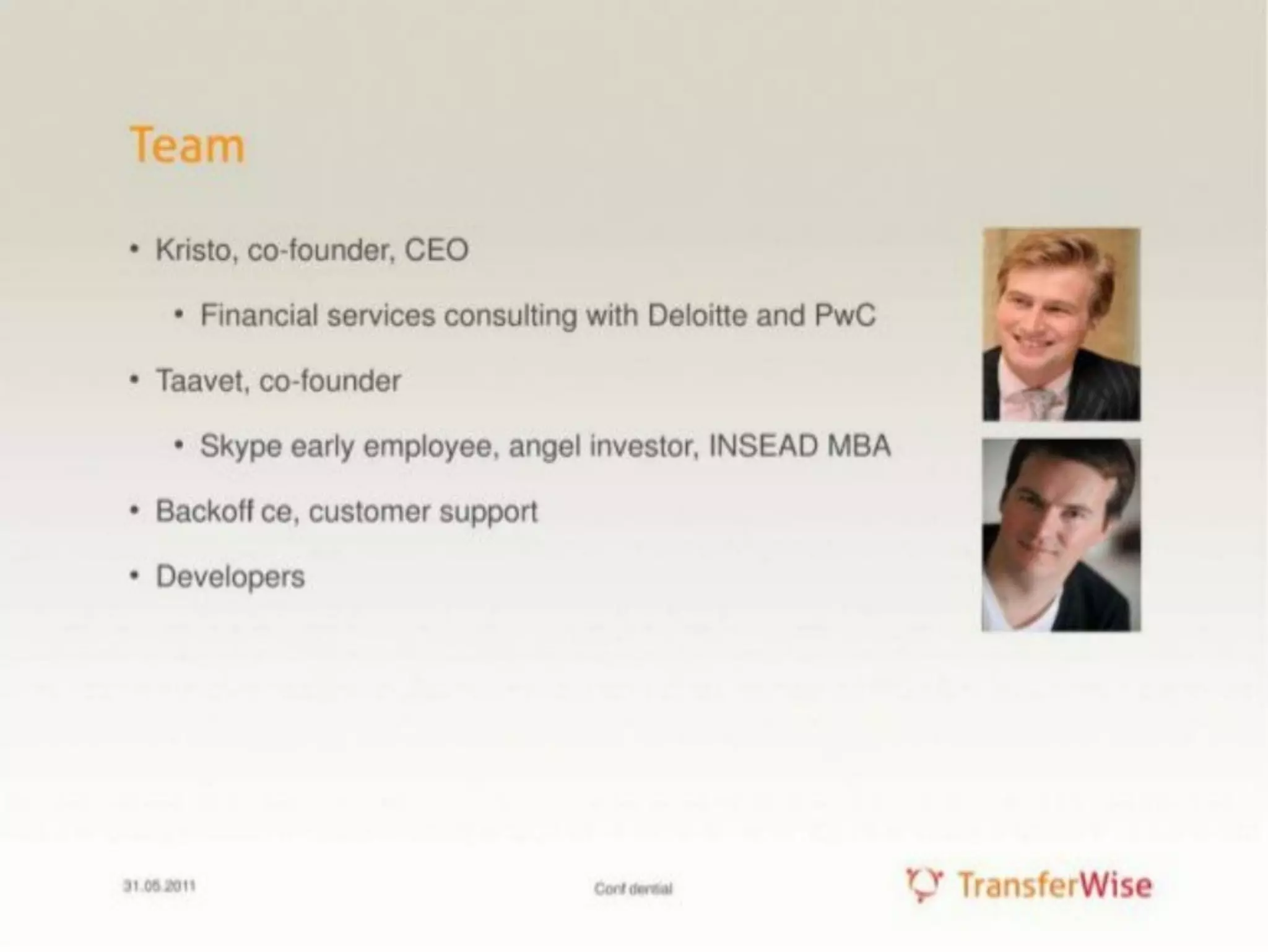
Slide 7 presents the founding team with short bios: a CEO with financial services consulting experience and a co-founder with early Skype experience and an MBA. Photographs add a human touch and the bullet points highlight relevancy to the problem (financial services knowledge, product/tech credibility). The slide also lists early hires (customer support, developers), indicating they’ve allocated resources to growth and operations.

This slide’s effectiveness is its economy — it doesn’t overstate credentials but picks the most relevant past experiences that map to the company’s needs. For founders, the lesson is to present team bios that are explicitly tied to the company’s risk profile (e.g., compliance and payments require finance background; marketplace scaling requires product/tech experience).

Key Takeaway: Match team bios to the startup’s biggest risks; show why this particular team is the right one to execute the plan.
Financing & roadmap: Ask, milestones, and expansion plans

Financing & roadmap: Ask, milestones, and expansion plans

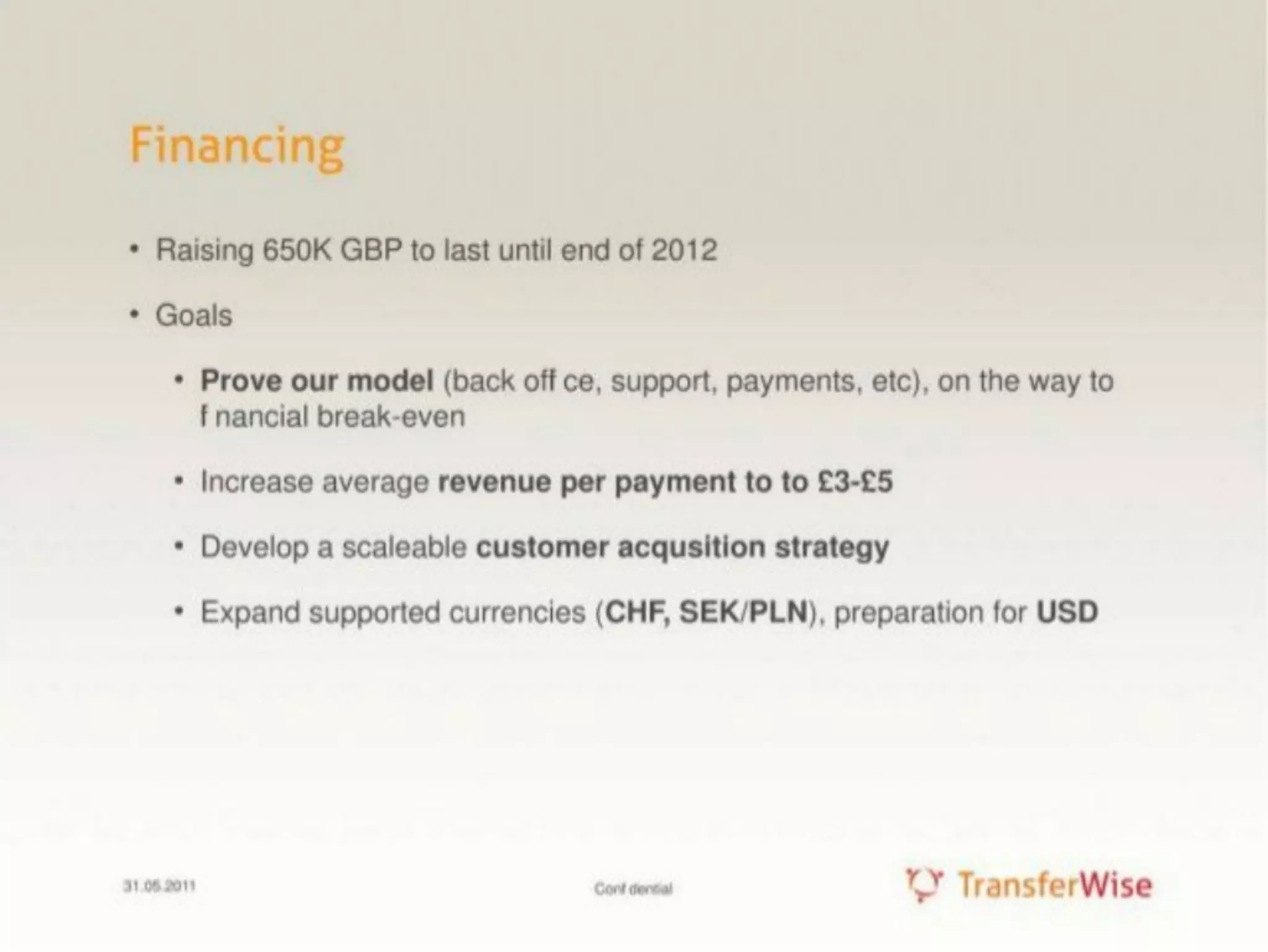
Slide 8 lays out the fundraising target (raising £650K to last until end of 2012) and concrete goals: prove the model, increase revenue per payment, develop scalable customer acquisition, and expand supported currencies (preparing for USD). This slide connects the capital ask to specific milestones and growth levers, which is critical for investors assessing risk and use-of-funds. The explicit revenue-per-payment target shows they’re thinking about monetization levers rather than purely growth metrics.

The roadmap-like clarity — product, market expansion, and customer acquisition — demonstrates a pragmatic plan to reach break-even. Founders should emulate this by tying the funding ask to measurable milestones and by specifying which levers (pricing, channels, product features) will be used to improve unit economics.

Key Takeaway: Tie your funding ask to time-bound milestones and the specific levers you’ll pull to improve unit economics and scale.

Conclusion: Key Lessons

This deck is a strong example of disciplined storytelling: identify a clear customer pain, quantify the economics with a concrete example, explain the product flow, prove traction with simple metrics, show the right team, and tie the fundraising ask to measurable milestones. Its strength lies in simplicity and credibility — no unnecessary slides, just evidence and execution plans.

Actionable advice for founders: use one tangible example to make the problem real, present the end-to-end user and fund flow so investors trust your operations, lead with hard traction metrics that demonstrate retention and organic growth, and connect your capital raise to specific, achievable milestones and revenue levers. Keep slides concise, data-driven, and explicitly mapped to investor concerns (market size, defensibility, traction, team, use of funds).

Full Deck Analysis

11 sections

Overview

Company: Wise (formerly TransferWise)
Round: Seed ($1.3M USD equivalent)
Year: 2012 (presentation dated May 31, 2011)
Outcome: IPO at $11B valuation (2021)
Deck Length: 9 slides

Executive Summary

Wise’s seed pitch deck is a masterclass in problem clarity and traction-driven storytelling. Rather than leading with market size or competitive analysis, the founders open with a concrete £500 transaction example showing how banks extract £37 in hidden fees while Wise charges £1—immediately establishing the value proposition. The deck’s true strength lies in early traction metrics (£1M+ in trust, 70% repeat customers, 20% monthly organic growth, £0 marketing spend) that prove product-market fit before asking for capital. Despite weaknesses in regulatory narrative, unit economics detail, and competitive positioning, the combination of founder credibility (Deloitte/PwC + Skype) and organic growth momentum was sufficient to raise $1.3M and eventually achieve an $11B IPO—demonstrating that strong product-market fit can overcome pitch deck imperfections.


Problem Statement

Slide 2: “Currency Exchange”

The deck articulates a clear, quantified problem affecting anyone sending money internationally:

  • Hidden margin: Banks charge 3-6% on exchange rates without transparency
  • Explicit fees: Additional £10-25 per foreign payment
  • Concrete impact: A £500 transfer results in only £463 received (£37 lost to the bank)

The problem is presented through a visual comparison showing:

  • Traditional bank path: £500 input → £463 received + £37 to bank
  • TransferWise path: £500 input → £499 received + £1 fee

Why this works: The specific pound sterling example makes an abstract financial problem tangible. Investors immediately understand the pain point and can calculate the addressable market (anyone sending money internationally).

Market context: International remittances and cross-border payments represent a multi-trillion-dollar annual market, but the deck doesn’t explicitly state TAM—a notable omission.


Solution

Slides 3-4: “How Does It Work?” + “Traction”

Wise positions itself as a peer-to-peer currency matching service that eliminates the middleman markup:

Mechanism (4-step process):

  1. Book a payment - Enter recipient details on website
  2. Deposit money - Transfer source currency to Wise holding account
  3. Convert currency - Money automatically matched with peers at mid-market rates
  4. Send to recipient - Currency delivered to recipient’s bank account

Value proposition:

  • Exchange at mid-market rates (no hidden margin)
  • £1 flat fee (vs. £10-25 traditional)
  • Trusted 3rd party holds funds during conversion
  • Automatic matching removes friction

Why this works: The solution is simple enough to explain in 4 steps, yet sophisticated enough to suggest technical competence. The “peer-to-peer” framing (matching users with opposite currency needs) is elegant, though the deck doesn’t fully explain the mechanics of what happens when perfect matches don’t exist.

Weakness: The “peer-to-peer” language is somewhat imprecise—Wise is actually a matching and settlement service, not true P2P. The deck doesn’t address regulatory safeguards or how customer funds are protected.


Market Opportunity

Notable absence: The deck does not include explicit TAM/SAM/SOM analysis.

Implied market context:

  • International money transfers: Multi-trillion-dollar annual market
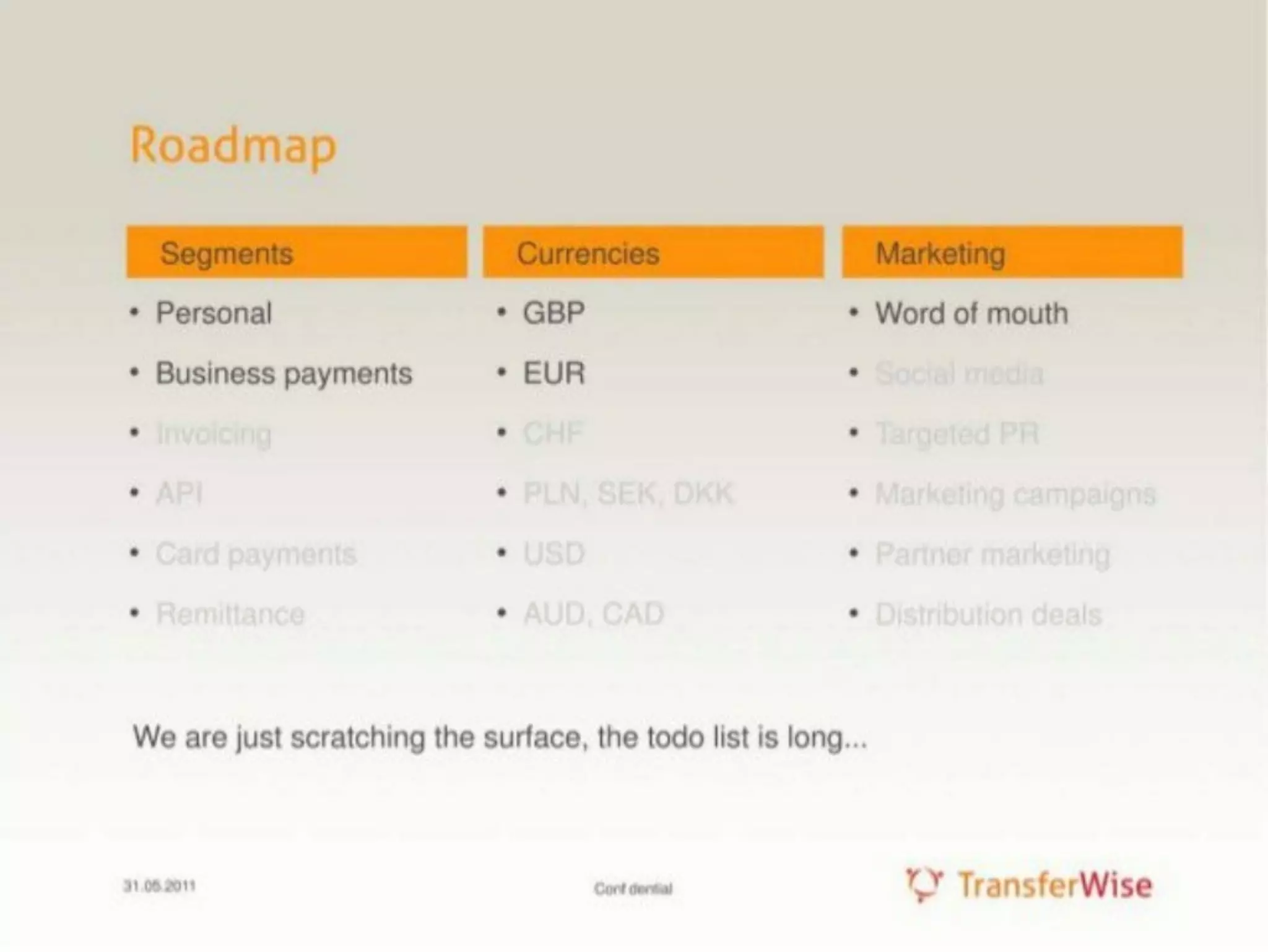
  • Target segments mentioned (Slide 5):
    • Personal transfers
    • Business payments
    • Invoicing
    • Remittance
    • API/Card payments

Currencies targeted:

  • Live: GBP, EUR
  • Planned: CHF, PLN, SEK, DKK, USD, AUD, CAD

Geographic expansion: Roadmap suggests multi-currency support implies UK/EU focus initially, with expansion to North America (USD) and Asia-Pacific (AUD, CAD).

Critical gap: No quantification of addressable market, customer segments, or revenue potential. This is a significant omission for a seed deck, though the strong traction metrics may have compensated during investor conversations.


Business Model

Revenue Model:

  • Primary: £1 flat fee per transaction
  • Secondary: Potential margin on currency conversion (not explicitly stated)

Unit Economics (Target):

  • Revenue per payment: £3-5 (stated as goal on Slide 8)
  • Current fee: £1 (implies significant upside potential)

Monetization approach:

  • Simple, transparent pricing (£1 vs. bank’s 3-6% + £10-25)
  • Scalable fee structure (flat fee works across transaction sizes)
  • Potential for premium services (faster settlement, API access, business accounts)

Critical gaps:

  • No discussion of CAC (Customer Acquisition Cost)
  • No LTV (Lifetime Value) analysis
  • No payback period or unit economics breakdown
  • No mention of how £3-5 revenue target will be achieved (higher fees? volume discounts? premium tiers?)
  • No discussion of profitability timeline beyond “break-even by end of 2012”

Sustainability question: At £1 per transaction, how does Wise cover operational costs (backoffice, support, payment processing, compliance)? The deck doesn’t address this, though the 70% repeat customer rate suggests strong retention could drive profitability.


Traction & Metrics

Slide 4: “Traction”

This is the deck’s strongest section, providing concrete proof of product-market fit:

Metric Value Significance
Trust volume £1M+ sent Demonstrates customer confidence and scale
Repeat customer rate 70% Exceptionally high retention; indicates strong product-market fit
Monthly organic growth ~20% Rapid expansion without paid marketing
Marketing spend £0 Viral/word-of-mouth growth; capital efficient
Time to monetization Day one Revenue from first transaction
Customer acquisition cost Implied low Given organic growth and zero marketing spend

Growth trajectory (Slide 4 charts):

  • Jan-May 2011: Steady month-over-month growth in both # payments and volume
  • May 2011-Jun 2013 projection: Continued upward trajectory (note: right chart appears to be forecast, not actual data)

Why this matters:

  • 70% repeat rate is exceptional for a fintech product (typical SaaS repeat rate is 40-60%)
  • 20% monthly growth is venture-scale growth
  • £0 marketing spend proves product-market fit; customers are acquiring other customers
  • £1M+ trust demonstrates regulatory/operational credibility

Context: These metrics were achieved in the first ~6 months of operation (company founded ~late 2010/early 2011), making the traction even more impressive.


Competitive Positioning

Slide 6: “Competition”

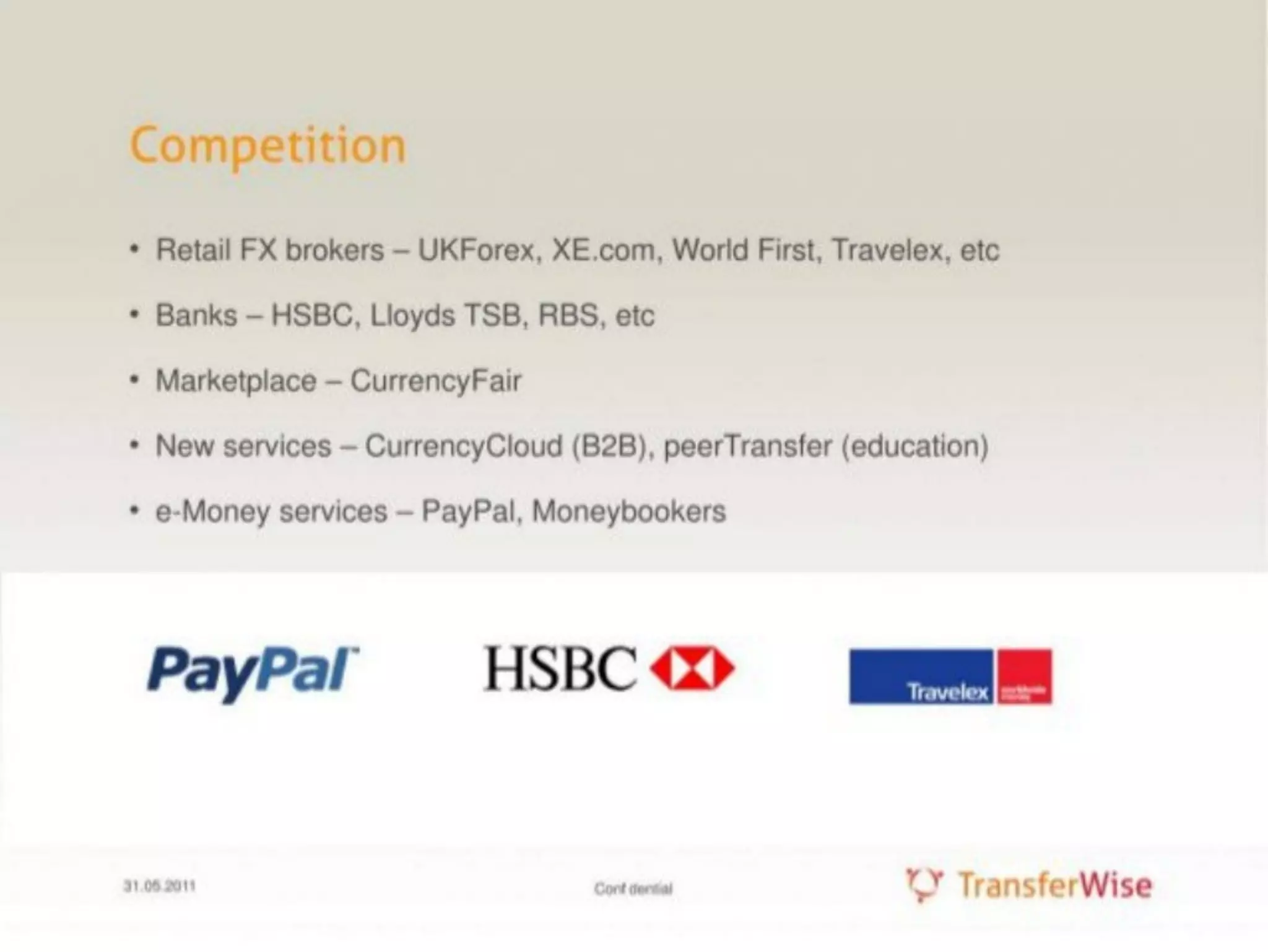
The deck identifies five competitive categories:

  1. Retail FX brokers: UKForex, XE.com, World First, Travelex
  2. Banks: HSBC, Lloyds TSB, RBS
  3. Marketplace: CurrencyFair
  4. New services: CurrencyCloud (B2B), peerTransfer (education)
  5. e-Money services: PayPal, Moneybookers

Competitive positioning:

  • Wise acknowledges diverse competition but doesn’t articulate specific differentiation
  • Logos highlight PayPal, HSBC, Travelex (representing different threat vectors)

Critical weaknesses in competitive narrative:

  • No defensibility discussion: What prevents banks/PayPal from replicating Wise’s model?
  • No moat articulation: Switching costs? Network effects? Regulatory barriers?
  • No competitive advantages stated: Speed? Cost? User experience? Trust?
  • Oversimplified threat assessment: Treats retail FX brokers and banks as equivalent competitors (they’re not)

What the deck should have addressed:

  • Regulatory barriers to entry (FCA licensing, AML/KYC compliance)
  • Network effects (more users = better matching = lower costs)
  • Brand/trust advantage (Wise as transparent alternative to opaque banks)
  • Speed advantage (not mentioned in deck, but likely differentiator)
  • API/integration advantages for business customers

Outcome: Despite weak competitive positioning narrative, Wise’s superior unit economics (£1 vs. 3-6% + £10-25) and customer experience proved defensible. The market was large enough for multiple winners, and Wise’s organic growth momentum gave it first-mover advantage.


Team

Slide 7: “Team”

Founders:

Kristo Käärnann - Co-founder, CEO

  • Background: Financial services consulting with Deloitte and PwC
  • Relevance: Deep understanding of banking operations, regulatory landscape, and financial services business models
  • Strength: Consulting background suggests ability to navigate complex regulatory environment and build institutional relationships

Taavat Hinrikus - Co-founder

  • Background: Early employee at Skype, angel investor, INSEAD MBA
  • Relevance: Product/technology expertise from scaling Skype; entrepreneurial experience as angel investor; business education from top-tier MBA program
  • Strength: Skype pedigree signals ability to build scalable technology and navigate hypergrowth

Supporting Team:

  • Backoffice/Customer support: Mentioned but not named (headcount unclear)
  • Developers: Mentioned but not named (team size unknown)

Team Assessment:

Strengths:

  • Complementary skills: Kristo (business/compliance) + Taavat (product/tech) cover critical functions
  • Credibility: Deloitte/PwC + Skype + INSEAD MBA is strong pedigree for fintech
  • Lean execution: Small team suggests capital efficiency and focus
  • Founder commitment: Both founders have skin in the game (Taavat as angel investor)

Weaknesses:

  • Team depth undefined: No names or headcount for supporting staff
  • Missing expertise: No mention of compliance officer, CFO, or operations lead (critical for fintech)
  • Scalability questions: How will team grow? Who leads hiring?
  • No advisory board: No external expertise or investor involvement mentioned
  • Limited diversity: Both founders appear to be male (limited visibility in photos)

Outcome: Despite team depth concerns, the founder combination proved sufficient. Kristo and Taavat’s complementary skills and strong track records were enough to attract $1.3M in seed funding and build a $11B company.


Go-to-Market Strategy

Slide 5: “Roadmap” - Marketing column

The deck outlines a marketing roadmap with two tiers:

Current (In progress):

  • Word of mouth - Organic customer acquisition (proven by 70% repeat rate and £0 marketing spend)

Planned:

  • Social media
  • Targeted PR
  • Marketing campaigns
  • Partner marketing
  • Distribution deals

Go-to-market approach:

  • Phase 1 (current): Organic growth through product excellence and word-of-mouth
  • Phase 2 (planned): Paid/earned media and partnership-driven growth

Why this works:

  • Validates product-market fit before scaling marketing spend
  • Organic growth proves customer satisfaction and virality
  • Planned expansion to paid channels suggests confidence in unit economics

Weaknesses:

  • Vague execution: No specifics on social media strategy, PR targets, or partnership criteria
  • No CAC targets: Doesn’t specify acceptable customer acquisition cost
  • No channel prioritization: Which channels first? Why?
  • No timeline: When will each marketing initiative launch?

Context: The £0 marketing spend to date is a major strength, but the deck doesn’t explain how Wise will scale beyond organic growth. This is likely a topic for deeper investor conversations.


The Ask

Slide 8: “Financing”

Funding Request:

  • Amount: 650K GBP
  • Timeline: Through end of 2012 (12-month runway)
  • Implied burn rate: ~54K GBP/month

Use of Proceeds (stated):

  • Backoffice infrastructure
  • Customer support
  • Payment processing
  • Etc. (vague)

Goals for the 650K GBP:

  1. Prove the model - Achieve financial break-even
    • Build out backoffice infrastructure
    • Scale customer support
    • Establish payment processing partnerships
  2. Improve unit economics - Increase average revenue per payment from £1 to £3-5
    • Suggests potential for higher fees, premium tiers, or volume-based pricing
  3. Develop scalable customer acquisition - Move beyond organic growth
    • Build marketing infrastructure
    • Test paid channels
    • Establish partnership programs
  4. Expand currency support - Add CHF, SEK/PLN; prepare for USD
    • Regulatory approvals for new currencies
    • Banking partnerships
    • Technical infrastructure

Capital Efficiency Assessment:

Positive signals:

  • 12-month runway is realistic given 20% monthly growth
  • Break-even goal shows capital discipline
  • Lean team suggests low burn rate
  • Specific currency expansion targets

Concerns:

  • Vague use of proceeds: No budget breakdown (how much for team? infrastructure? partnerships?)
  • No headcount plan: How many hires will 650K GBP fund?
  • Revenue per payment target is wide: £3-5 range lacks precision
  • No Series A planning: What happens after 12 months? How much will Series A be?

Actual outcome:

  • Raised $1.3M USD (vs. 650K GBP ask)
  • Suggests strong investor interest and potential for larger round than requested
  • 650K GBP ≈ $1M USD at 2011 exchange rates, so $1.3M represents ~30% oversubscription

Investor Deep Dive

Executive summary, strengths & red flags

Executive Summary

Wise's seed pitch deck is a masterclass in problem clarity and traction-driven storytelling. Rather than leading with market size or competitive analysis, the founders open with a concrete £500 transaction example showing how banks extract £37 in hidden fees while Wise charges £1—immediately establishing the value proposition. The deck's true strength lies in early traction metrics (£1M+ in trust, 70% repeat customers, 20% monthly organic growth, £0 marketing spend) that prove product-market fit before asking for capital. Despite weaknesses in regulatory narrative, unit economics detail, and competitive positioning, the combination of founder credibility (Deloitte/PwC + Skype) and organic growth momentum was sufficient to raise $1.3M and eventually achieve an $11B IPO—demonstrating that strong product-market fit can overcome pitch deck imperfections.

Key Strengths

5 identified

1

Problem Clarity Through Concrete Example

- Slide 2's £500 transaction example immediately demonstrates value proposition

2

Exceptional Traction Metrics

- 70% repeat customer rate + 20% monthly growth + £0 marketing spend

3

Founder Credibility

- Kristo (Deloitte/PwC) + Taavat (Skype, INSEAD MBA) provide complementary expertise

4

Capital Efficiency

- 650K GBP for 12-month runway with path to break-even

5

Simple, Memorable Value Proposition

- "£1 flat fee vs. 3-6% + £10-25" is easy to understand and communicate

Red Flags & Weaknesses

8 identified

1

Missing Regulatory Narrative

- Fintech deck with no mention of FCA licensing, AML/KYC compliance, or regulatory moats

2

Vague Unit Economics

- Revenue per payment target (£3-5) is a wide range; no CAC, LTV, or payback period discussed

3

Weak Competitive Positioning

- Identifies competitors but doesn't articulate defensibility or competitive advantages

4

No Market Size Analysis

- Deck doesn't quantify TAM, SAM, or SOM

5

Vague Use of Proceeds

- 650K GBP allocation not detailed; no budget breakdown or headcount plan

6

Team Depth Undefined

- Supporting team (backoffice, developers) mentioned but not named; headcount unclear

7

Imprecise "Peer-to-Peer" Framing

- Deck describes service as "peer-to-peer" but doesn't explain matching mechanics or what happens when perfect matches don't exist

8

No Summary or Call-to-Action

- Final slide is just "Questions?" with no recap, contact info, or next steps

More Pitch Decks To Study

Compare structure, fundraising context, and investor-facing story across similar startup decks.