Compare your deck to Revolut

Compare Your Deck

Revolut Pitch Deck (2015)

Fintech
Stage: Seed
Raised: £1.5M
Year: 2015
Slides: 12
Outcome: Valued at $33B

Pitch Deck

1 / 12
Revolut pitch deck - The Opening: Brand + Contact (Cover)
Click to expand

Deck Analysis

This seed-era Revolut pitch deck (2015) presents a crisp fintech pitch: a mobile-first product that removes friction and cost from spending, sending and holding money across currencies. The deck is notable because it combines a clear problem statement, quantification of market opportunity, a simple product demonstration, a freemium/viral growth model, early traction, and a modest, concrete ask — all delivered with a consistent visual style and discipline. Founders can learn how clarity, focus on customer pain, and showing early traction and a realistic use of funds creates a compelling early-stage narrative.

The Opening: Brand + Contact (Cover)

The Opening: Brand + Contact (Cover)

The cover slide is visually minimal: a large Revolut logo with the subtitle "personal money cloud" and the founder's contact details. It sets tone and credibility immediately — the brand positioning (money in the cloud) is short and evocative, and including the founder contact on the cover invites direct follow-up and signals confidence.

This is effective because it avoids clutter and communicates identity and ownership at a glance. For seed founders, a strong cover that doubles as a business card helps when decks are shared or viewed quickly; keep it simple, on-brand, and include at least one clear contact or call-to-action.

Key Takeaway: Make the first slide a clear brand introduction and an invitation to engage — keep it minimalist and include founder contact details.
Problem: Clear, Emotional Framing

Problem: Clear, Emotional Framing

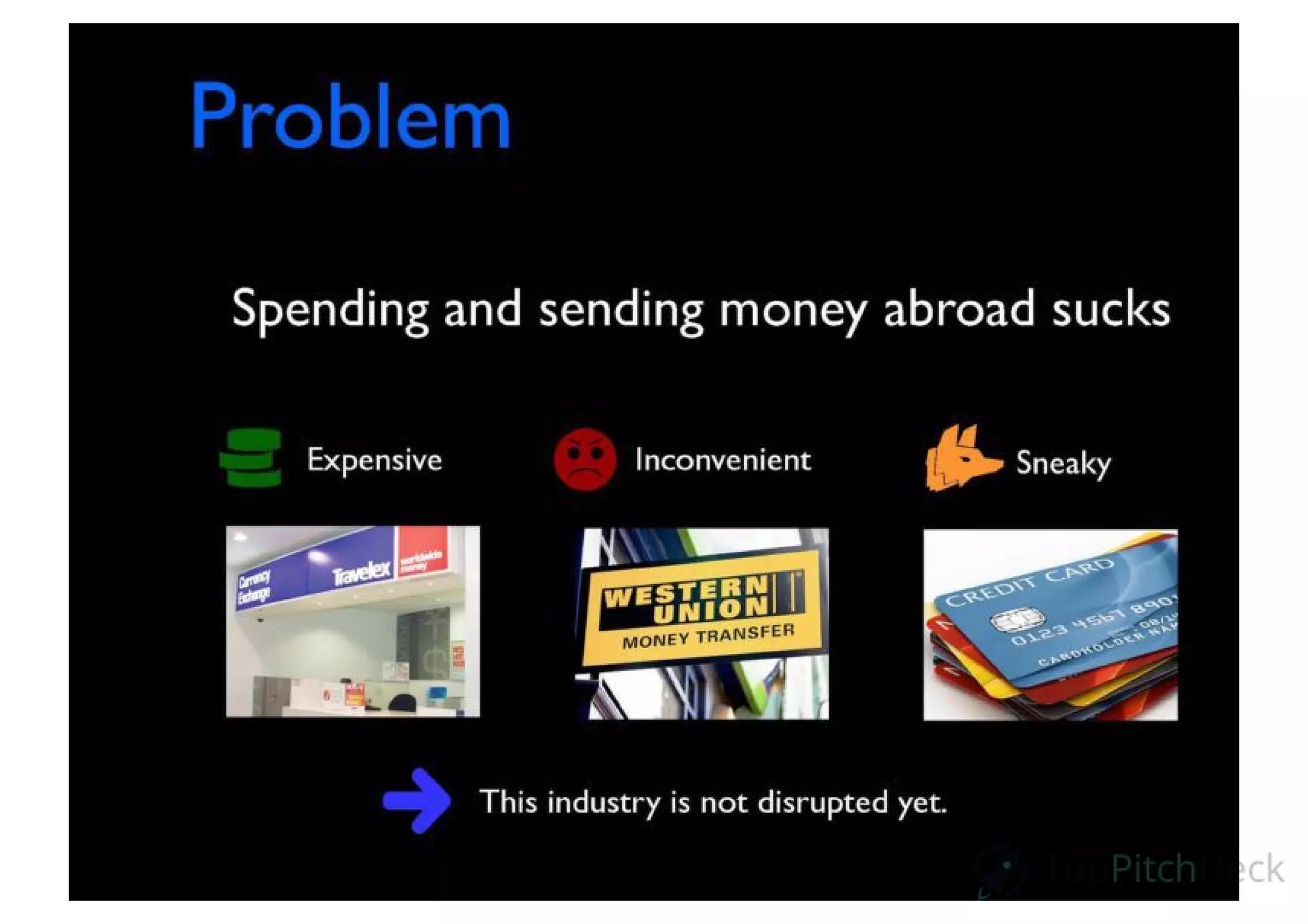
Slide 2 states the problem plainly: "Spending and sending money abroad sucks," then breaks it into three emotional pain points — expensive, inconvenient, sneaky — with familiar brand imagery (Travelex, Western Union, credit cards). This combination of a blunt headline plus visual archetypes quickly makes the issue relatable to anyone who travels or sends money internationally.

Founders should emulate this clarity: lead with a short, memorable statement of customer pain, then back it up with familiar examples and emotional labels. Doing so primes investors to understand why the solution matters and creates a straightforward thread to demonstrate how your product solves each pain point.

Key Takeaway: Lead with one crisp problem sentence and use visuals + emotional labels to make the pain instantly relatable.
Market Size: Quantify Opportunity Concretely

Market Size: Quantify Opportunity Concretely

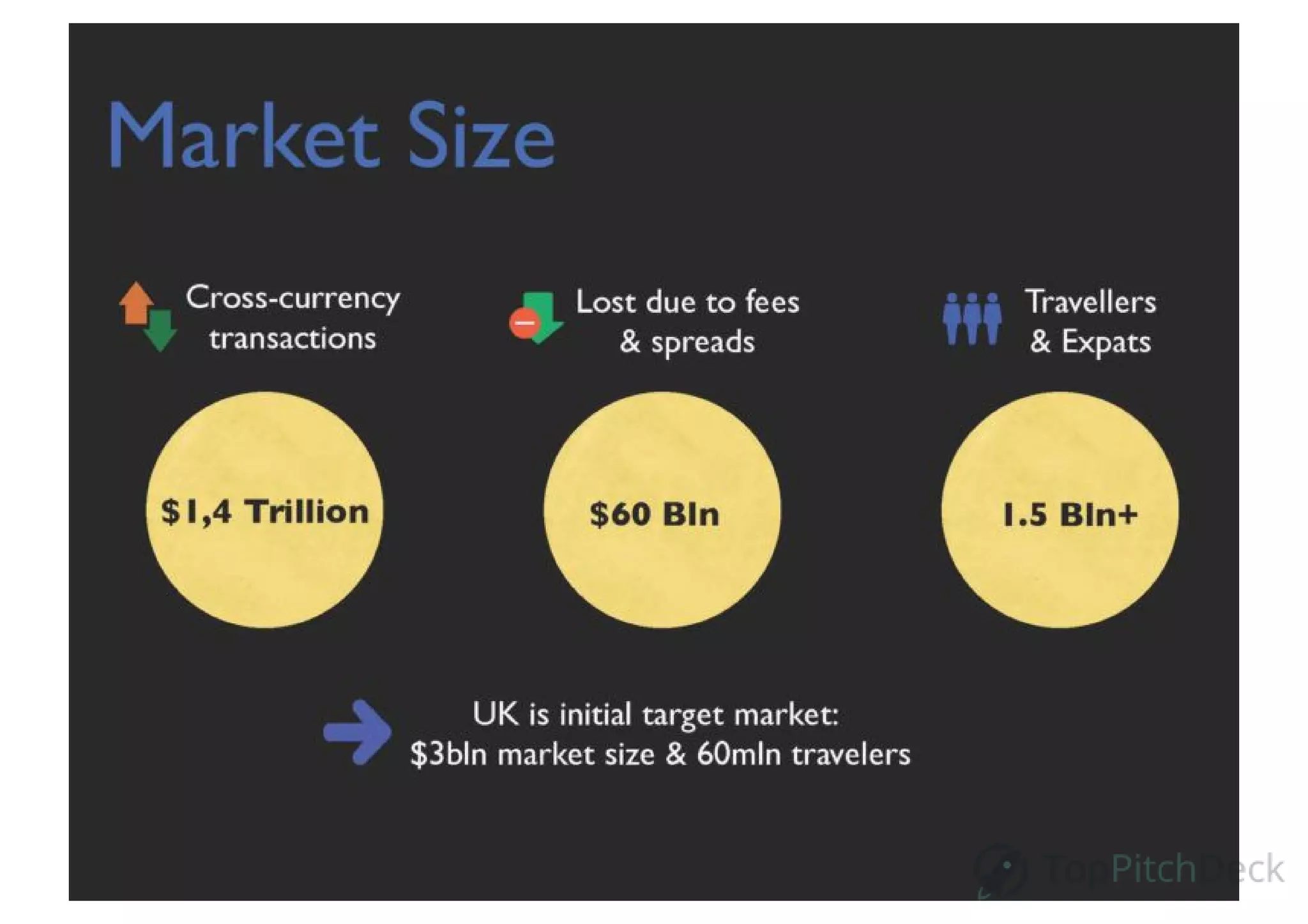
The market slide (Slide 3) quantifies the opportunity with three simple circles: $1.4T cross-currency transactions, $60B lost to fees/spreads, and 1.5B travelers/expats — then narrows to the UK initial target ($3B market and 60M travelers). This structure moves from global TAM to a specific, credible beachhead, which helps justify early traction plans and the ask.

Founders should mirror this approach: present a big-picture number to show upside, then show a realistic initial target market where you can enter and scale. Highlighting the money lost to incumbent inefficiencies (fees/spreads) is especially persuasive for fintechs because it ties user pain to concrete economic value.

Key Takeaway: Show both the large upside and a concrete initial beachhead: big TAM + a realistic first market equals credibility.
Solution & Product: Demonstrate Flow and Simplicity

Solution & Product: Demonstrate Flow and Simplicity

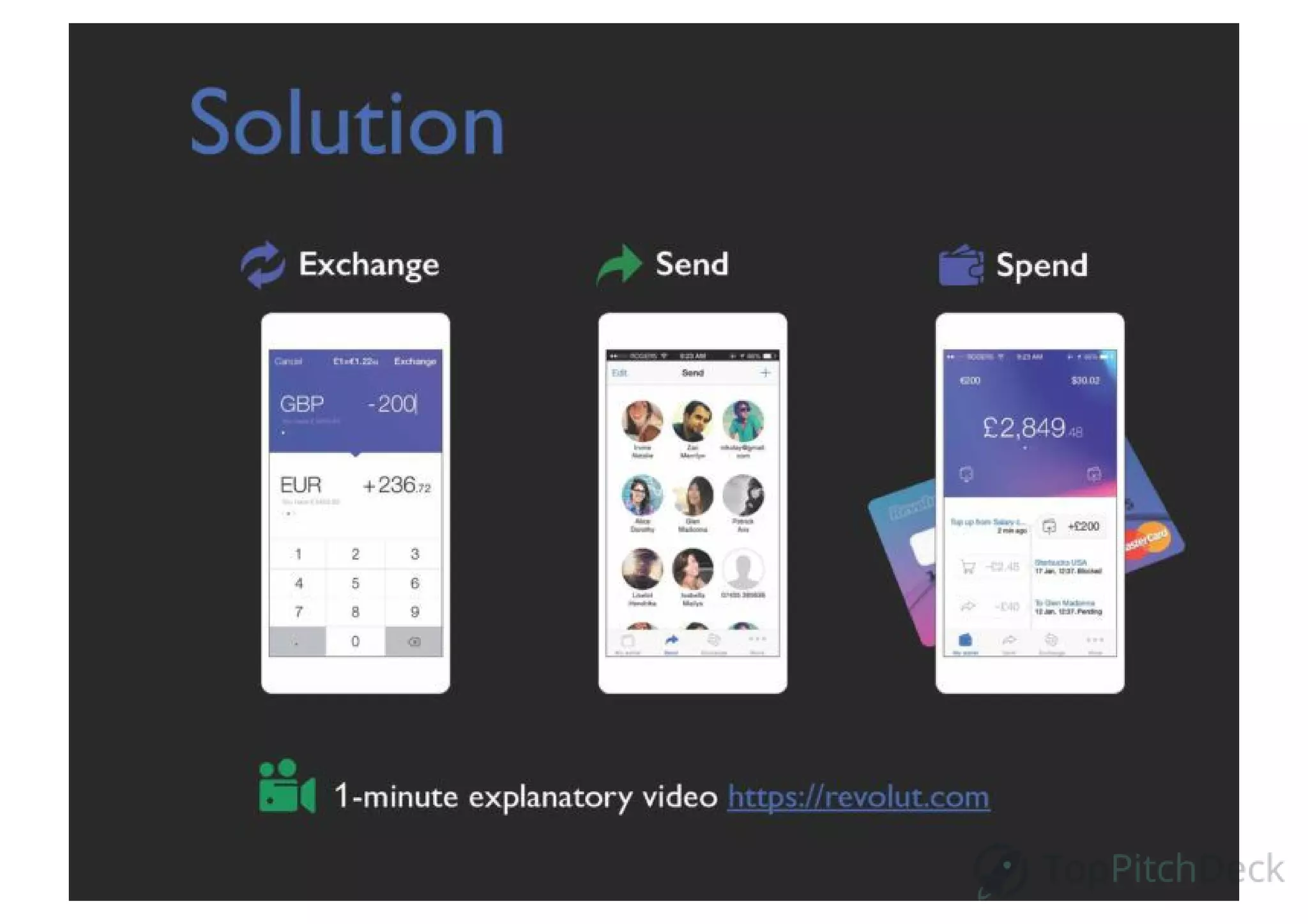
Slides 4 and 5 (Solution and Business Model) focus heavily on product flow: exchange, send, spend — each illustrated with phone screenshots — and then show the freemium/viral pricing tiers. The product is shown doing the exact things the problem described, closing the loop between pain and remedy. The UI screenshots make the solution tangible and help investors picture user experience and onboarding.

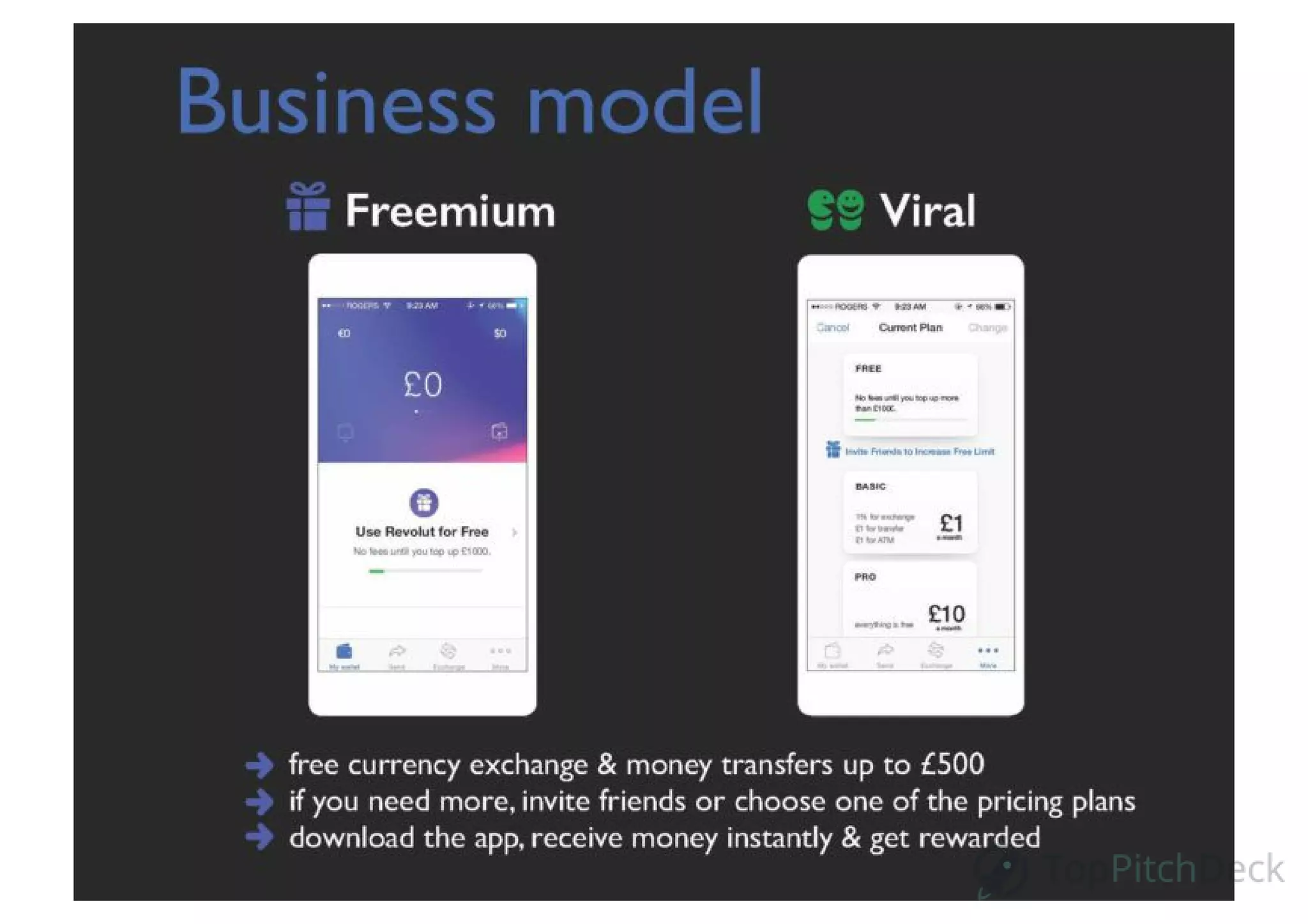
The second slide ties product to monetization: free exchange up to a threshold, invites to increase limits, and paid tiers. That alignment (simple product + clear monetization mechanics) is a model for early-stage decks: show how users experience value and how the company can capture value without confusing or numerous revenue lines.

Key Takeaway: Use real product screenshots to map features directly to stated pains, and pair that with a simple, understandable revenue model.
Go-to-Market & Positioning: Viral + Community Focus

Go-to-Market & Positioning: Viral + Community Focus

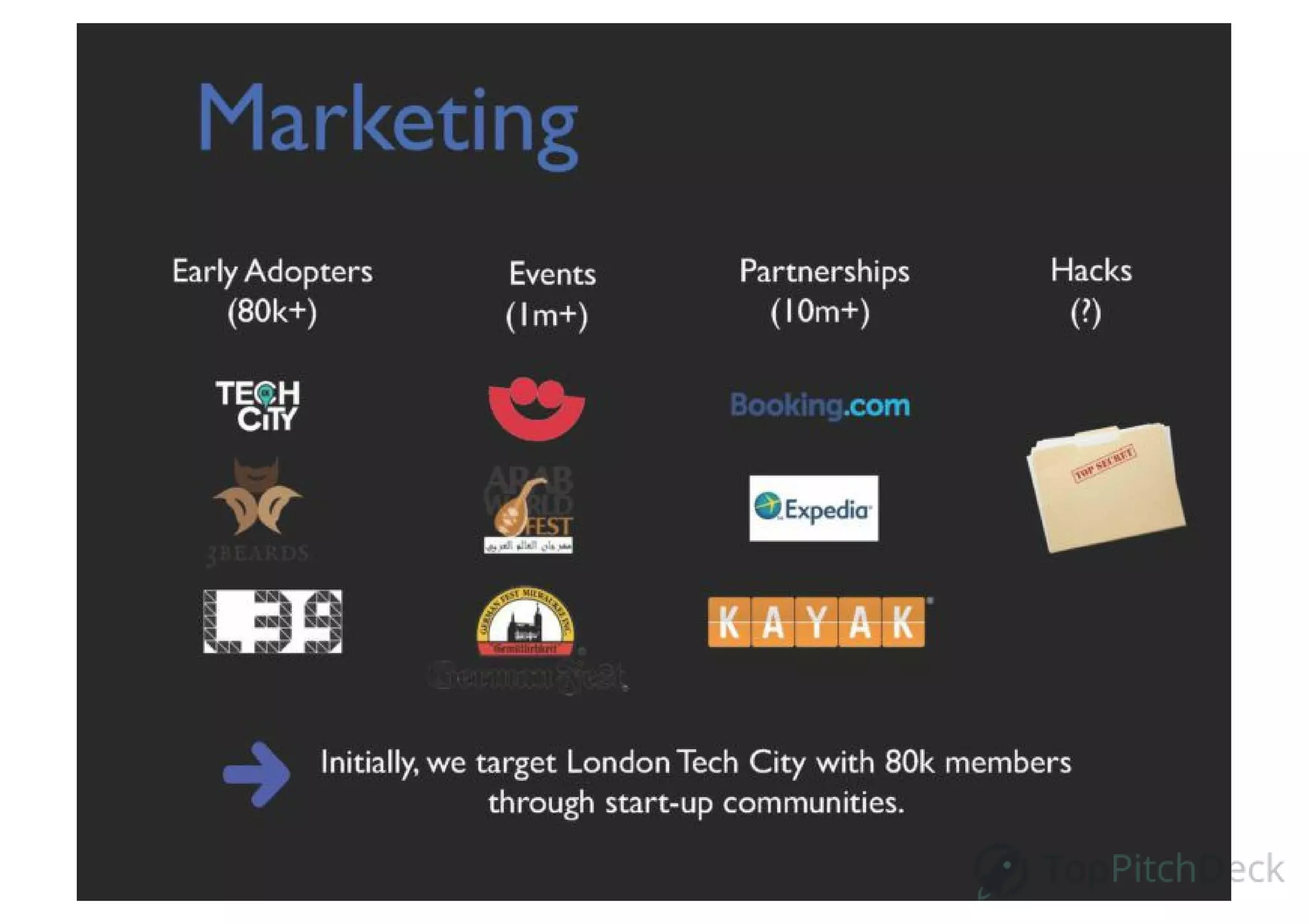
The marketing slide outlines a layered GTM: target early adopters in startup communities (London Tech City), events, partnerships (Booking, Expedia, Kayak), and viral hacks. This demonstrates a thoughtful, low-cost acquisition strategy leveraging partnerships and communities where frequent travelers congregate. The emphasis on specific channels and early communities signals that growth is deliberate, not accidental.

Effective GTM sections in seed decks should specify target segments, concrete channels, and partnerships that can move the needle early. Revolut’s deck does this by naming partners and communities rather than vague marketing platitudes, which improves credibility and suggests measurable KPIs for traction.

Key Takeaway: Detail specific acquisition channels and partners that match your target user behaviors and show how you’ll scale affordably.
Traction: Early Signals and Credibility

Traction: Early Signals and Credibility

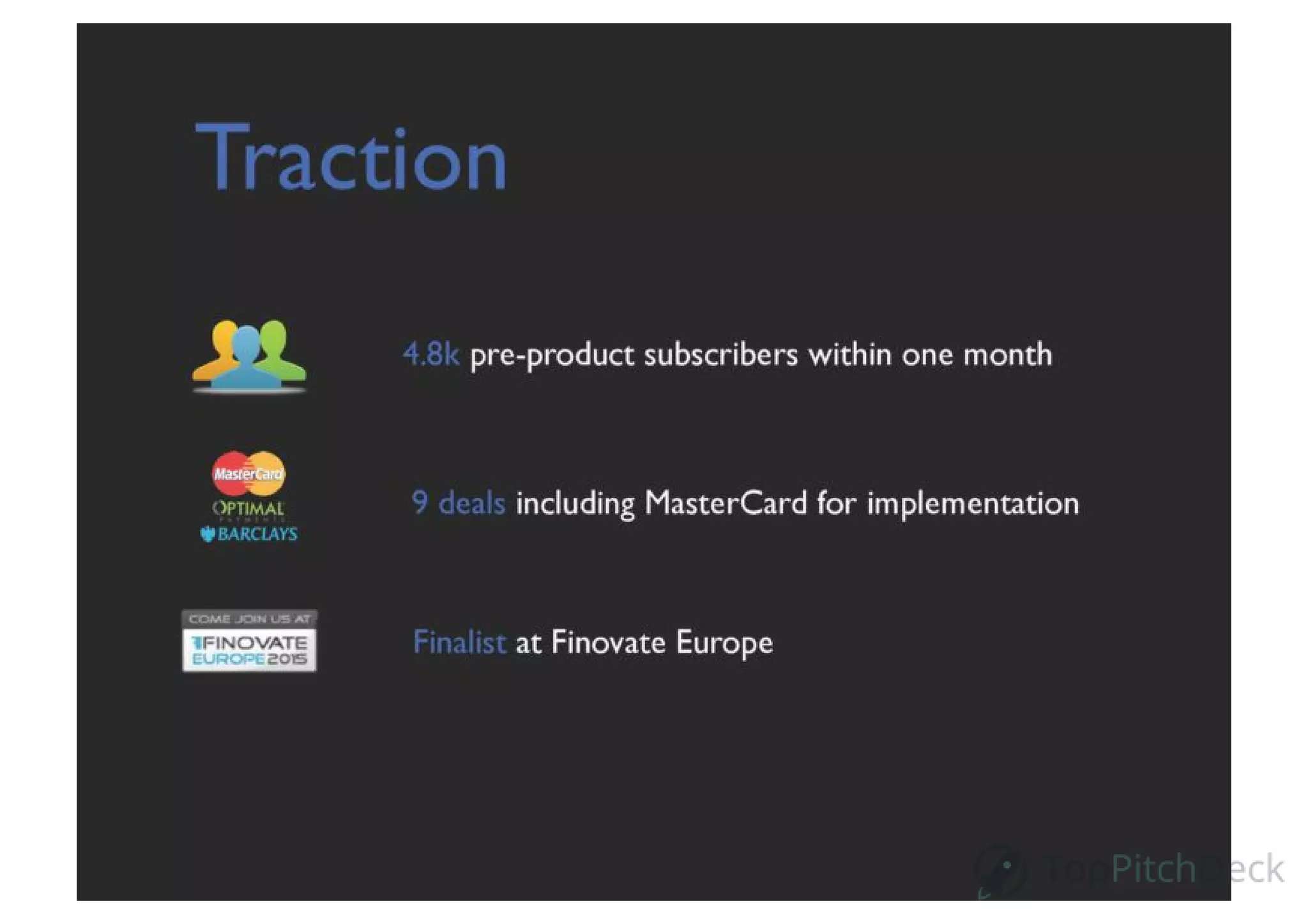
The traction slide highlights 4.8k pre-product subscribers in one month, nine deals including MasterCard for implementation, and a Finovate finalist spot. These are high-signal early metrics: signups, strategic technology/partner deals, and industry recognition. They don’t overclaim but provide concrete indicators that product-market fit is emerging and that partners take the solution seriously.

For founders, show a mix of user demand metrics (users/subscribers), business development progress (partners/deals), and third-party validation (competitions, press) to build credibility. Investors look for evidence that other stakeholders — users, partners, and industry peers — see value in the product.

Key Takeaway: Present a balanced set of early evidence: user interest, strategic partnerships, and third-party validation to reduce perceived execution risk.
Ask & Use of Funds: Specific and Actionable

Ask & Use of Funds: Specific and Actionable

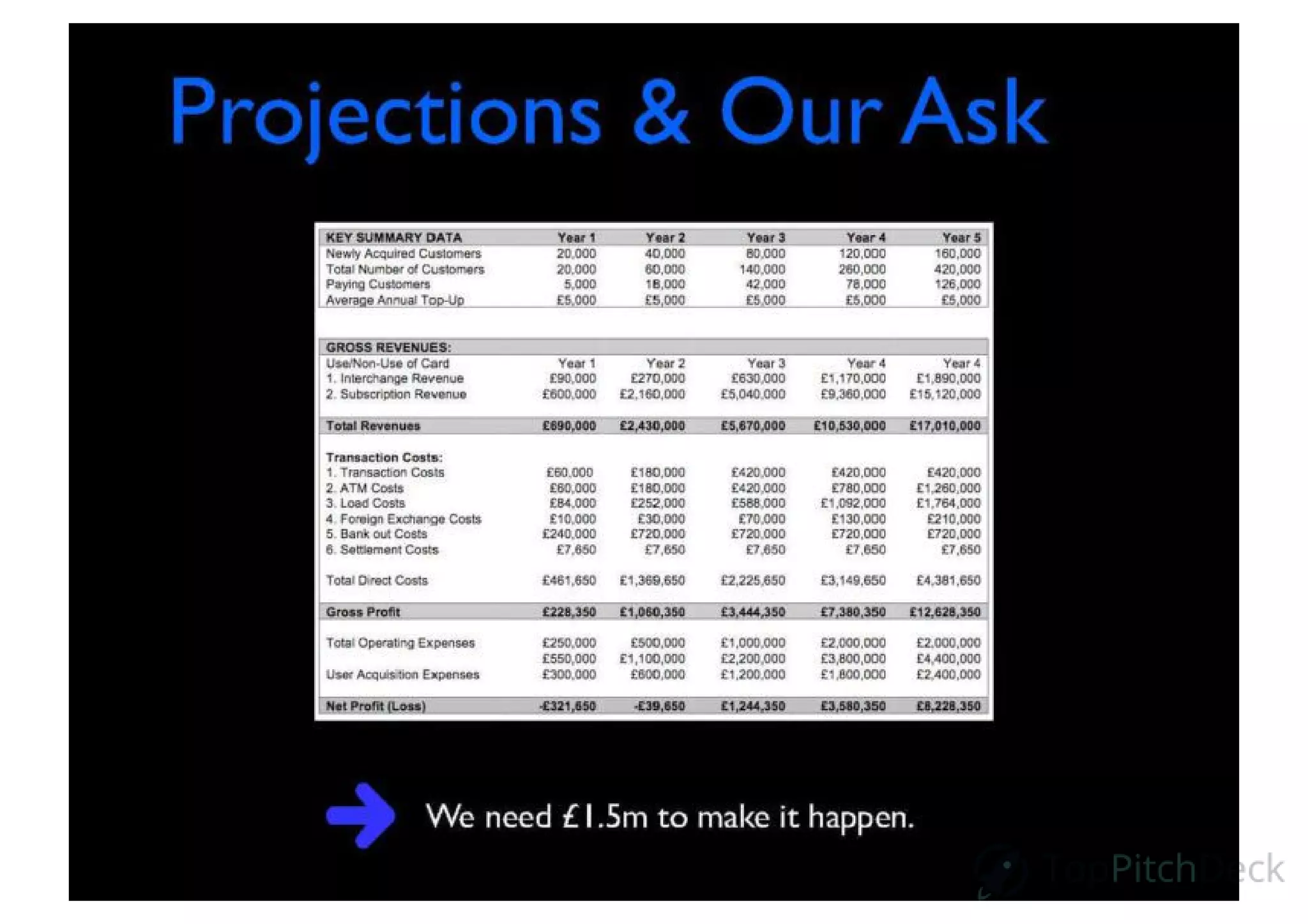
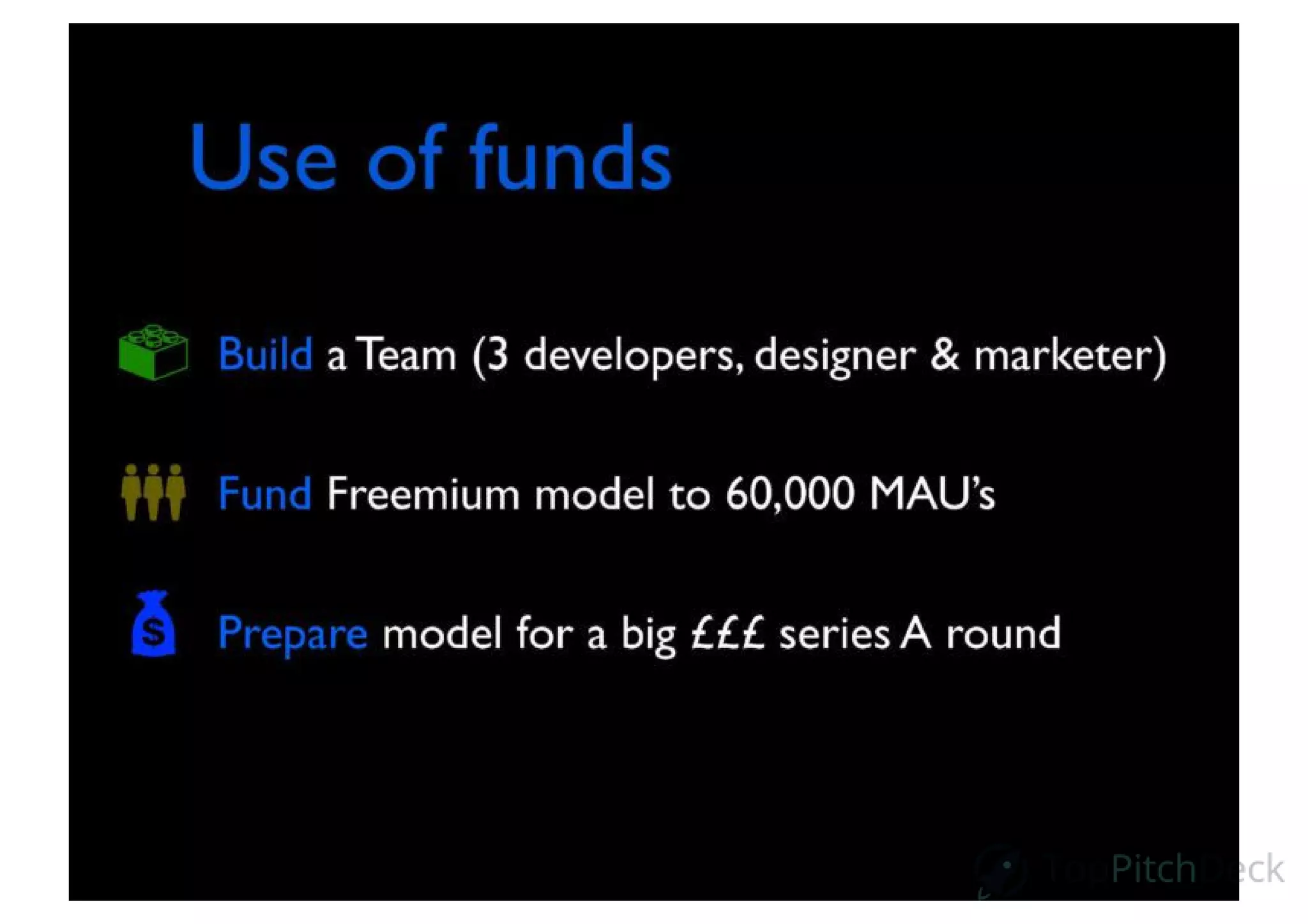
The projections and ask slide says "We need £1.5m to make it happen" and includes a financial summary; the use-of-funds slide breaks down hires (3 developers, designer, marketer), funding the freemium model to 60k MAUs, and preparing for Series A. This is effective because the ask maps directly to milestones and resources — hires and marketing — and ties expenditure to a clear growth target (60k MAU), making it easier for investors to assess runway and dilution.

Seed-era asks should be specific, linked to milestones, and show how the capital will derisk the next funding round. Revolut’s deck demonstrates this: a modest amount, a clear hiring plan, a user target, and a stated Series A preparation goal provide a sensible roadmap that investors can evaluate.

Key Takeaway: State a concrete ask tied to hires and measurable milestones so investors can see exactly what their capital will accomplish.

Conclusion: Key Lessons

This deck succeeds through clarity, focus, and economy: a one-line problem statement, quantified market, product screenshots showing the exact solution, a simple freemium/viral monetization path, early traction signals, and a specific use of funds and ask. Its consistent visual language and disciplined slide count keep attention on the core narrative — pain → product → market → traction → ask.

Actionable advice for founders: 1) Lead with a concise, emotionally resonant problem and connect every slide back to that problem; 2) Quantify both big upside and a realistic beachhead; 3) Use real product images to make benefits tangible; 4) Show early validation from users and partners; and 5) Request an amount tied to hires and measurable milestones so investors can easily judge the investment rationale.

Full Deck Analysis

11 sections

Overview

Company: Revolut
Round: Seed (£1.5M)
Year: 2015
Outcome: Valued at $33B (2021)
Stage at Pitch: Pre-product (4.8k waitlist subscribers)

Executive Summary

Revolut’s 2015 seed pitch deck presents a compelling case for disrupting the $1.4 trillion international money transfer market by solving three critical pain points: expensive fees, inconvenient processes, and hidden charges. The deck combines emotional problem articulation with detailed financial projections, early user validation (4.8k pre-product subscribers), and a credible founding team with deep banking/fintech backgrounds. The narrative arc moves efficiently from problem → solution → market → business model → traction → team → financials, creating a coherent investment thesis that successfully raised £1.5M and ultimately led to a $33B valuation.

Problem Statement

Slides 2-3: The Core Problem

The deck opens with a provocative statement: “Spending and sending money abroad sucks.” This is immediately supported by three specific pain points:

  1. Expensive - Illustrated by Currency Exchange storefronts; users lose money to hidden markups and fees
  2. Inconvenient - Represented by Western Union; transfers take 1-3 days and require complex processes (IBANs)
  3. Sneaky - Shown via credit cards; hidden fees and unfavorable exchange rates erode value

Market Validation:

  • $1.4 trillion in annual cross-currency transactions globally
  • $60 billion lost annually to fees and spreads
  • 1.5 billion+ travelers and expats affected
  • UK target market: $3 billion with 60 million travelers

The problem statement is emotionally resonant (using colloquial language) while backed by substantial market data, creating both empathy and credibility.

Solution

Slide 4: Three-Part Product

Revolut solves the problem through three integrated features:

  1. Exchange - Real-time currency conversion at interbank rates (shown converting £200 to €236.72)
  2. Send - Peer-to-peer money transfers to contacts with no IBAN requirement; social network integration
  3. Spend - Physical Mastercard + digital wallet for international spending without conversion fees

The solution is presented through actual mobile app UI mockups, demonstrating a product-ready approach despite being pre-launch. The visual proof points (real screenshots) add credibility that competitors lack.

Key Innovation: All three features integrated into a single app, solving the “full cycle of customer pain” (Slide 7)

Market Opportunity

TAM/SAM/SOM Analysis (Slide 3):

Market Segment Size Notes
TAM (Total Addressable Market) $1.4 Trillion Global cross-currency transactions
Pain Point Market $60 Billion Annual losses to fees & spreads
User Base 1.5 Billion+ Global travelers & expats
SAM (Serviceable Addressable Market) $3 Billion UK market size (initial focus)
SOM (Serviceable Obtainable Market) Implied 60M UK travelers (initial target)

Market Insight: The deck positions this as “an industry not disrupted yet” (Slide 2), implying first-mover advantage in a massive, underserved market. The progression from global TAM to specific UK SAM shows realistic go-to-market thinking.

Critical Gap: No source attribution for these figures; no growth rate or trend data provided.

Business Model

Slide 5: Freemium + Viral Growth

Revenue Streams

  1. Freemium Tier (FREE)
    • Free currency exchange & money transfers up to £500/month
    • No fees until user tops up £1,000
    • Designed to remove friction and enable rapid user acquisition
  2. Subscription Tiers
    • BASIC (£1/month): 1% exchange fee, £1 transfer fee, £1 ATM fee
    • PRO (£10/month): “Everything is free” (all fees waived)

Growth Mechanism

The viral loop is elegant: users can increase their free limit by inviting friends, creating organic referral incentives. This aligns user acquisition with product usage—a powerful growth lever.

Unit Economics (Slide 11 Projections)

Metric Year 1 Year 2 Year 3 Year 5
Total Customers 20,000 60,000 140,000 420,000
Paying Customers 5,000 18,000 42,000 126,000
Paying % 25% 30% 30% 30%
Avg Annual Top-Up £5,000 £5,000 £5,000 £5,000

Revenue Projections

Revenue Source Year 1 Year 2 Year 3 Year 5
Interchange Revenue £90,000 £270,000 £630,000 £1,890,000
Subscription Revenue £600,000 £2,160,000 £5,040,000 £15,120,000
Total Revenue £690,000 £2,430,000 £5,670,000 £17,010,000

Profitability Path

  • Year 1: -£321,650 loss (heavy investment phase)
  • Year 2: -£39,650 loss (near breakeven)
  • Year 3: £1,244,350 profit (breakeven achieved)
  • Year 5: £8,228,350 profit (strong profitability)

Critical Assumption: Subscription revenue dominates (87% of Year 1 revenue), suggesting the business model heavily depends on premium tier adoption. Interchange revenue is relatively small, implying low transaction volumes or margins in early years.

Traction & Metrics

Slide 9: Early Validation

User Acquisition

  • 4,800 pre-product subscribers acquired within one month
  • No marketing spend disclosed; suggests organic/viral growth or PR-driven
  • Demonstrates strong product-market fit signal despite being pre-launch

Strategic Partnerships

  • 9 deals signed, including:
    • MasterCard - For card implementation (critical for product launch)
    • Optimal - Payment processing partner
    • Barclays - Banking infrastructure partner

Industry Recognition

  • Finovate Europe 2015 Finalist - Third-party validation of innovation

Growth Trajectory

The 4.8k pre-product subscribers in one month suggests strong demand, though this creates a tension with Year 1 projections of 20k total customers (only 4x growth over 11 months). This gap suggests either:

  1. Conservative projections (safe for investors)
  2. Aggressive early growth that slows post-launch
  3. Different definition of “subscriber” vs. “customer”

Competitive Positioning

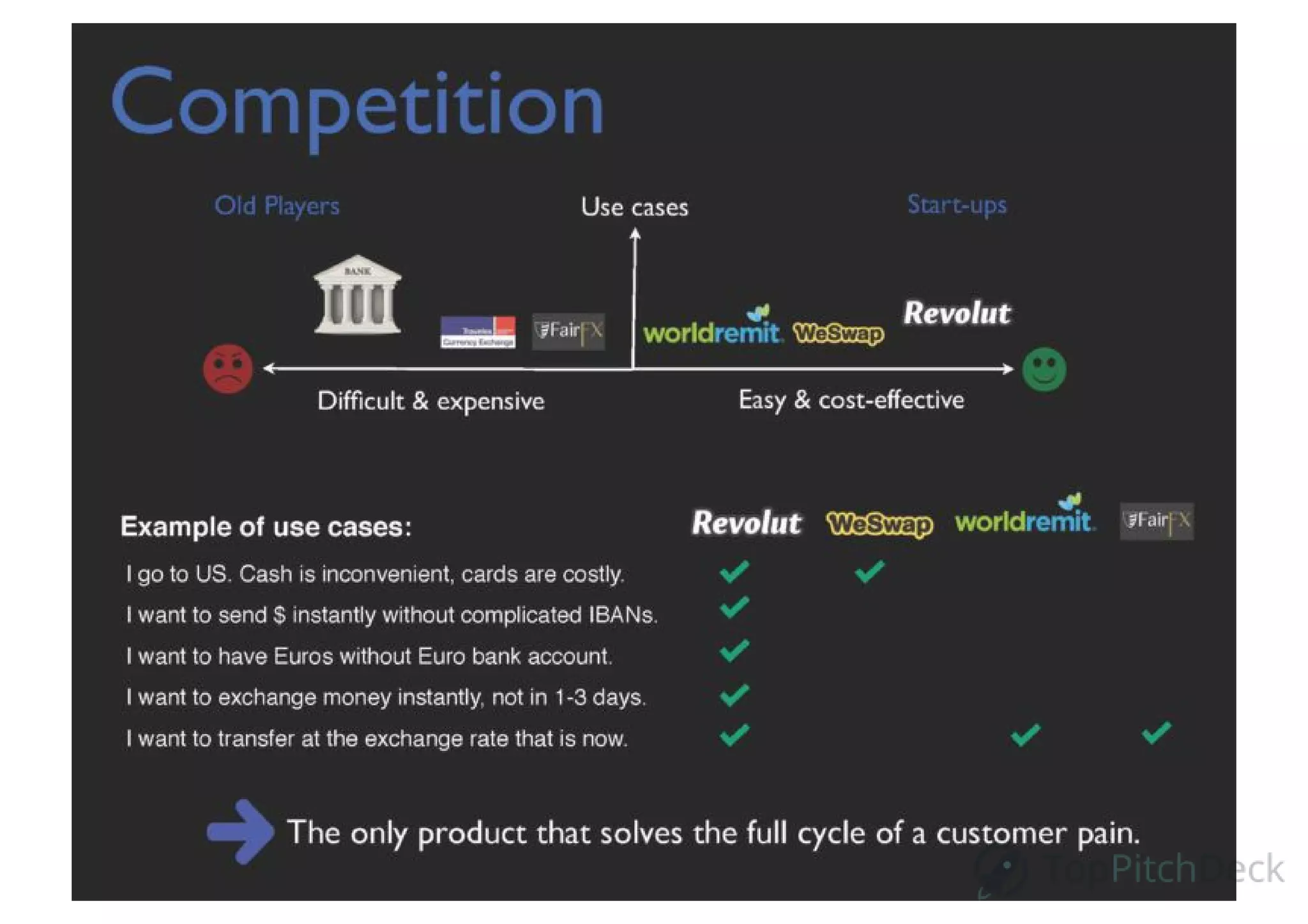
Slide 7: The Competitive Matrix

Positioning Framework

X-Axis: Difficult & Expensive ← → Easy & Cost-Effective
Y-Axis: Use Cases (vertical)

Competitor Landscape

Category Players Position
Old Players Banks, Currency Exchange, Travelex, FairFX Top-left (difficult, expensive)
Emerging Competitors WeSwap, Worldremit Top-right (easier, cost-effective)
Revolut Revolut Top-right (easiest, most cost-effective)

Use Case Comparison (Slide 7)

Revolut claims to be the only product solving all five customer use cases:

  1. ✓ “I go to US. Cash is inconvenient, cards are costly.”
  2. ✓ “I want to send $ instantly without complicated IBANs.”
  3. ✓ “I want to have Euros without Euro bank account.”
  4. ✓ “I want to exchange money instantly, not in 1-3 days.”
  5. ✓ “I want to transfer at the exchange rate that is now.”

Competitor Coverage:

  • Revolut: 5/5 ✓
  • WeSwap: 3/5 ✓
  • Worldremit: 3/5 ✓
  • FairFX: 1/5 ✓

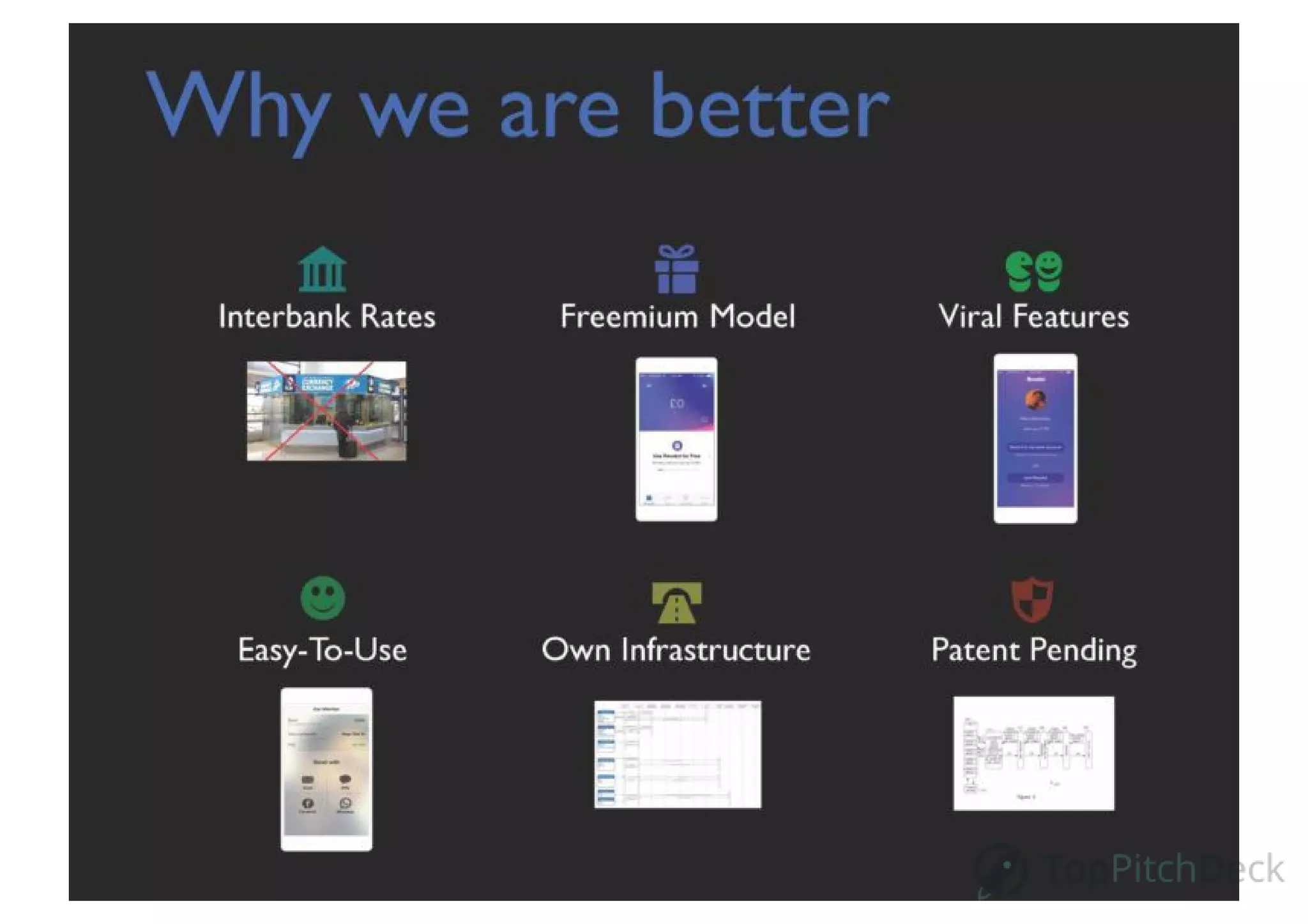
Six Competitive Advantages (Slide 8)

  1. Interbank Rates - Direct cost advantage vs. competitors’ marked-up rates
  2. Freemium Model - Removes friction; enables rapid user acquisition
  3. Viral Features - Referral mechanics drive organic growth
  4. Easy-To-Use - Superior UX vs. legacy competitors
  5. Own Infrastructure - Proprietary technology; reduces third-party dependency
  6. Patent Pending - Defensible innovation (specific claims not detailed)

Weakness: These advantages are claimed but not quantitatively proven. For example:

  • How much cheaper are interbank rates vs. competitors?
  • What specific infrastructure does Revolut own?
  • What does the patent cover?

Team

Slide 10: Core Leadership

Founding Team (3 Members Shown)

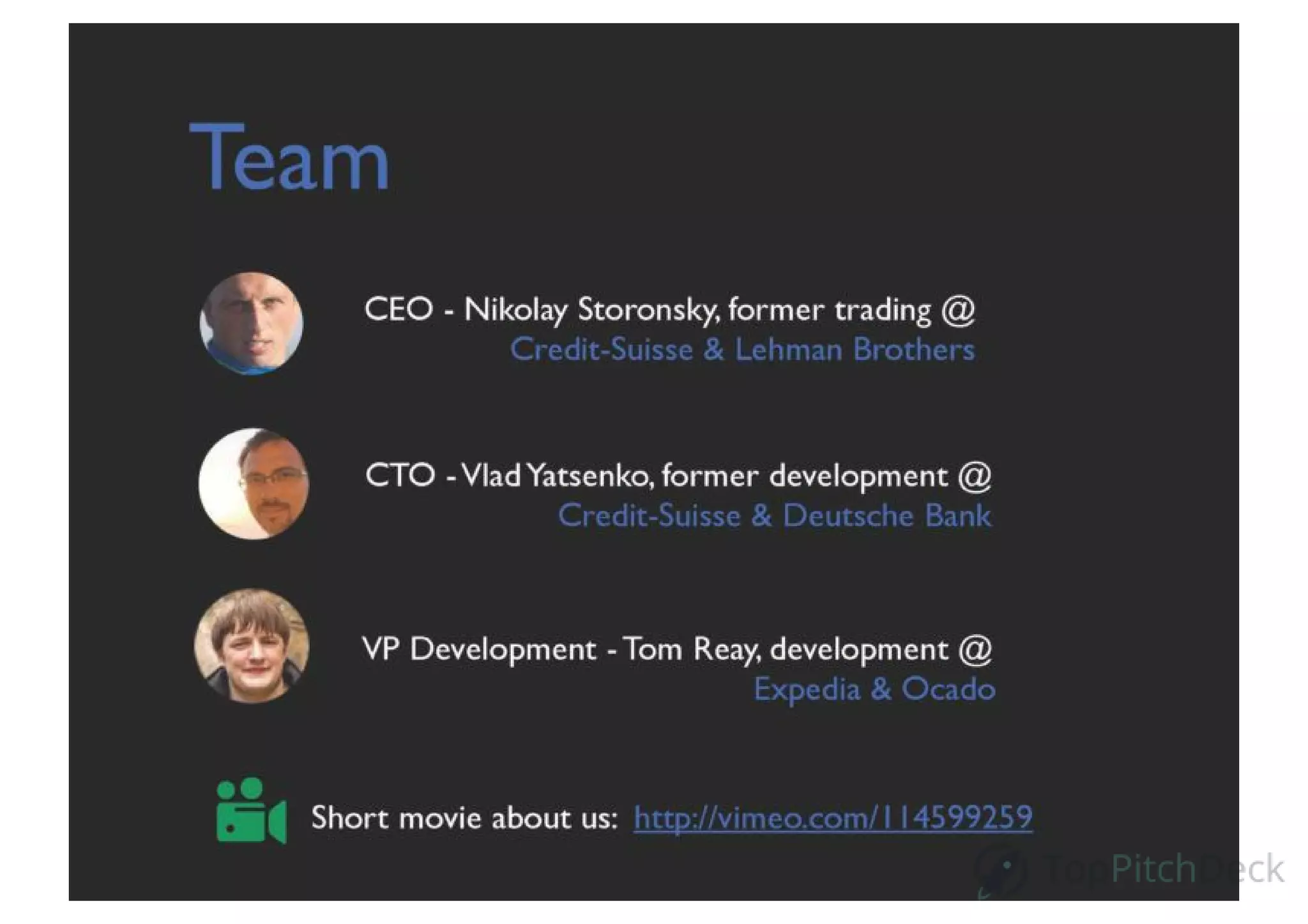
  1. Nikolay Storonsky - CEO
    • Background: Trading @ Credit-Suisse & Lehman Brothers
    • Expertise: FX markets, trading, financial products
    • Relevance: Perfect domain knowledge for international money transfer
  2. Vlad Yatsenko - CTO
    • Background: Development @ Credit-Suisse & Deutsche Bank
    • Expertise: Banking infrastructure, fintech systems
    • Relevance: Can navigate complex banking/payment systems
  3. Tom Reay - VP Development
    • Background: Development @ Expedia & Ocado
    • Expertise: Consumer tech, logistics, scaling
    • Relevance: Expedia connection directly relevant to travel/expat use cases

Team Assessment

Strengths:

  • Tier-1 institution pedigree (Credit-Suisse, Lehman, Deutsche Bank)
  • Complementary skills (trading, infrastructure, consumer tech)
  • Relevant domain experience (FX, banking, travel)

Gaps:

  • Only 3 core members shown; total team size not disclosed
  • No COO/CFO mentioned (critical for regulated fintech)
  • No advisors or board members listed
  • No diversity metrics (all appear male, though 2015 context)

Video Engagement: Vimeo link (http://vimeo.com/11459259) provided for deeper team exploration—adds personality beyond bios.

Go-to-Market Strategy

Slide 6: Multi-Channel Marketing Approach

Four Marketing Channels

Channel Reach Mechanism Partners
Early Adopters 80k+ Tech community targeting Tech City, Founders Factory, L&S
Events 1m+ Large-scale event presence AICB Fest, Arab Fest, London Meetup
Partnerships 10m+ Distribution via travel platforms Booking.com, Expedia, Kayak
Hacks ? Growth hacking tactics (Unspecified - “TOP SECRET”)

Initial Focus

“Initially, we target London Tech City with 80k members through start-up communities.”

This shows:

  • Realistic, achievable initial target (not trying to go global immediately)
  • Community-first approach (early adopters → word-of-mouth → viral)
  • Specific geography (London) and demographic (tech-savvy founders)

Partnership Strategy

The inclusion of Booking.com, Expedia, and Kayak is strategically brilliant—these platforms have millions of travelers who need currency exchange and international transfers. However, the deck provides no details on:

  • How these partnerships would work (co-marketing? Integration? Revenue share?)
  • Commitment level (LOI? Signed? Discussions?)
  • Timeline for activation

The Ask

Slide 11-12: Funding & Use of Funds

Funding Request

  • Amount: £1.5 Million
  • Stage: Seed round
  • Purpose: “To make it happen”

Use of Funds Breakdown (Slide 12)

  1. Build a Team
    • 3 developers
    • 1 designer
    • 1 marketer
    • (Implies ~5 new hires from current 3-person team)
  2. Fund Freemium Model to 60,000 MAU’s
    • User acquisition and growth marketing
    • Specific budget not disclosed
  3. Prepare Model for Series A
    • Infrastructure scaling
    • Regulatory/compliance preparation (implied)
    • International expansion groundwork (implied)

Critical Gap

The £1.5M allocation is not broken down by category. Investors would want to know:

  • Team salaries: £X?
  • User acquisition budget: £X?
  • Infrastructure/tech: £X?
  • Runway: How many months does this fund?

Investor Deep Dive

Executive summary, strengths & red flags

Executive Summary

Revolut's 2015 seed pitch deck presents a compelling case for disrupting the $1.4 trillion international money transfer market by solving three critical pain points: expensive fees, inconvenient processes, and hidden charges. The deck combines emotional problem articulation with detailed financial projections, early user validation (4.8k pre-product subscribers), and a credible founding team with deep banking/fintech backgrounds. The narrative arc moves efficiently from problem → solution → market → business model → traction → team → financials, creating a coherent investment thesis that successfully raised £1.5M and ultimately led to a $33B valuation.

Key Strengths

8 identified

1

Emotional Problem Articulation + Market Data

The deck opens with "Spending and sending money abroad sucks"—colloquial, relatable language that creates empathy. This is immediately backed by $1.4T TAM and $60B annual losses, combining emotiona...

2

Product-First Approach with Real UI

Slide 4 shows actual mobile app screenshots, not wireframes or mockups. This demonstrates:

3

Elegant Business Model with Built-In Virality

The freemium + referral mechanics (Slide 5) are brilliant because:

4

Comprehensive Competitive Positioning

Slide 7's use case comparison is a masterclass in competitive differentiation. Rather than claiming "we're better," the deck shows Revolut solving 5/5 use cases while competitors solve 1-3. This is:

5

Early Traction Despite Pre-Product Status

4.8k pre-product subscribers in one month + MasterCard partnership = real validation. This proves:

6

Detailed Financial Projections with Path to Profitability

Slide 11's 5-year model is unusually detailed for a seed deck, showing:

7

Credible Team with Relevant Banking/Fintech Backgrounds

CEO from Credit-Suisse trading, CTO from banking infrastructure, VP from Expedia—this is a dream team for fintech. Investors can trust this team to:

8

Clean, Consistent Visual Design

Dark background, blue accent color, clear iconography, readable typography. The deck is professional and modern without being distracting. This matters because:

More Pitch Decks To Study

Compare structure, fundraising context, and investor-facing story across similar startup decks.