Compare your deck to Coinbase

Compare Your Deck

Coinbase Pitch Deck (2012)

Fintech
Stage: Seed
Raised: Seed round
Year: 2012
Slides: 11
Outcome: IPO at $86B valuation

Pitch Deck

1 / 11
Coinbase pitch deck - The Opening: Clear Branding and Positioning
Click to expand

Deck Analysis

This deck is Coinbase's 2012 seed presentation positioning the company as a hosted Bitcoin wallet and payments network. It combines a simple product pitch with market education (what Bitcoin is and why it matters), a clear problem statement (existing tools are too hard), a straightforward solution (hosted wallet accessible on web and mobile), and early traction metrics. The deck is notable for how it educates investors new to crypto while simultaneously demonstrating product-market fit with rapid signups and transaction volume.

The Opening: Clear Branding and Positioning

The Opening: Clear Branding and Positioning

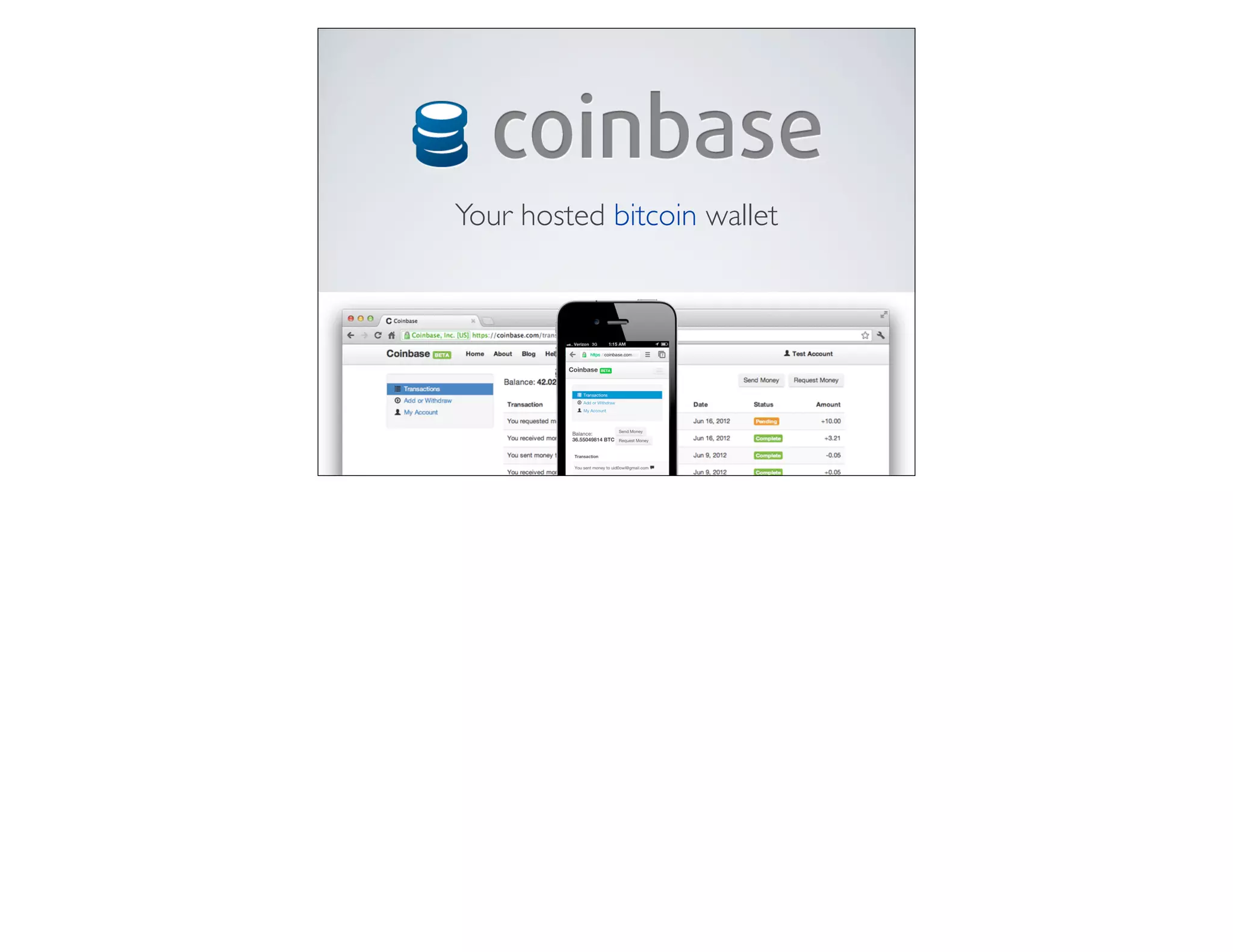
The cover slide presents the Coinbase name, logo, and the short, declarative tagline “Your hosted bitcoin wallet.” It uses a clean visual hierarchy: large brand mark at top, concise value proposition, and a visual of the product on multiple devices. This immediately tells the audience what the company does and suggests credibility (a polished UI and mobile presence) without needing technical explanation.

Founders can learn from the focus and simplicity here. The slide avoids jargon and uses the product image to convey trust and usability, which is especially important for a finance product. The visual cue of both desktop and mobile screens signals that Coinbase is a real product, not just an idea, which helps set expectations for the rest of the deck.
Key Takeaway: Start with a one-line value proposition backed by a concrete product visual to communicate credibility and focus instantly.
Market Education: Explain the Technology and Opportunity

Market Education: Explain the Technology and Opportunity

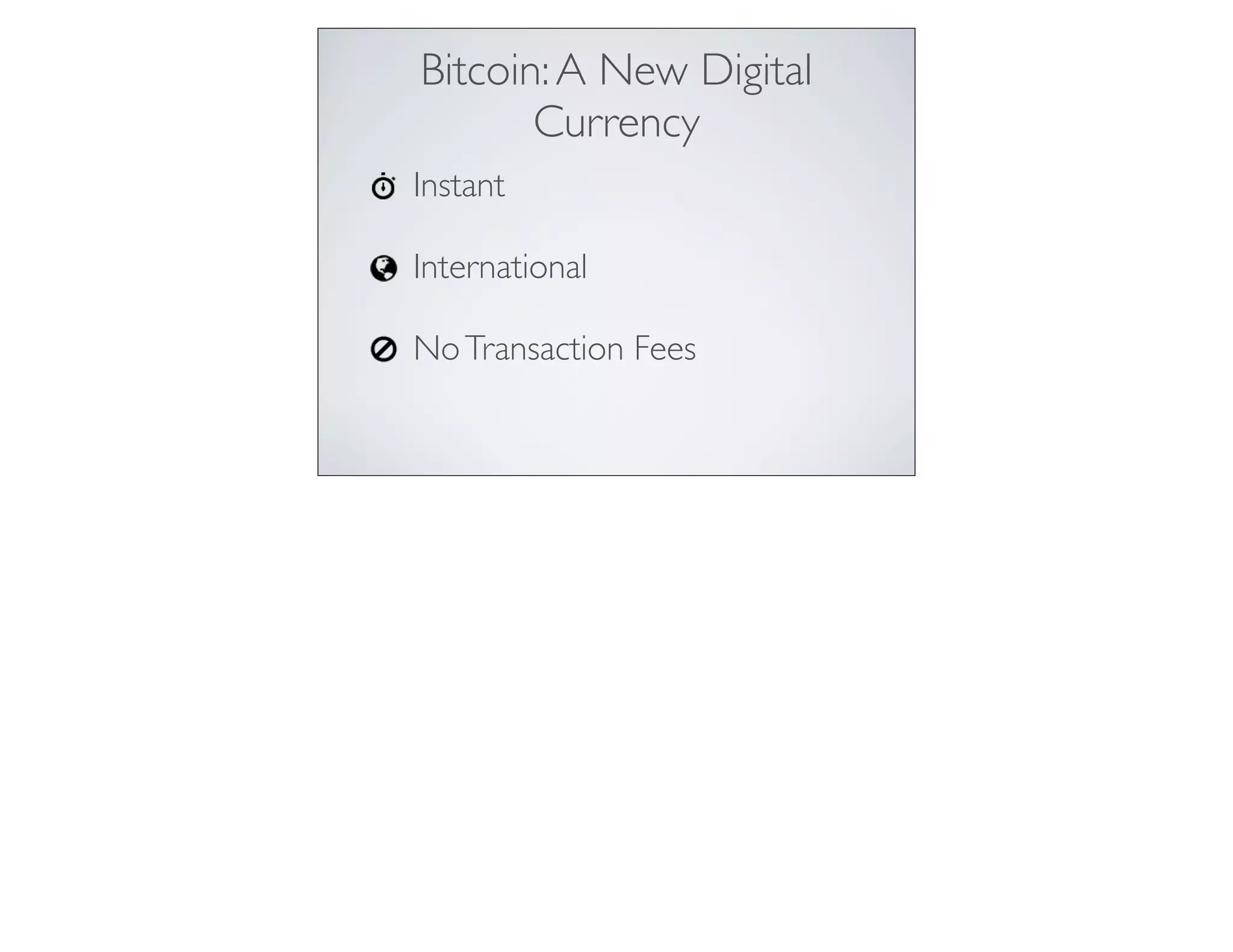
Early slides explain Bitcoin as a new digital currency, listing key attributes (instant, international, no transaction fees) and showing a globe visualization of activity. For 2012 investors who likely had little exposure to cryptocurrencies, these slides teach why Bitcoin could be transformative and what inherent benefits drive adoption. They concisely establish the market opportunity and why a simpler user experience is needed.

This dual approach—educating the audience and illustrating global momentum—reduces friction for investors unfamiliar with the underlying protocol. Founders introducing novel technology should similarly include short, clear education that ties technical advantages to real user value, so the rest of the pitch (product, traction, monetization) lands more effectively.

Key Takeaway: When your product relies on a new technology, briefly teach the core benefits and connect them directly to your product’s value.
Market Momentum: Use Data to Validate Demand

Market Momentum: Use Data to Validate Demand

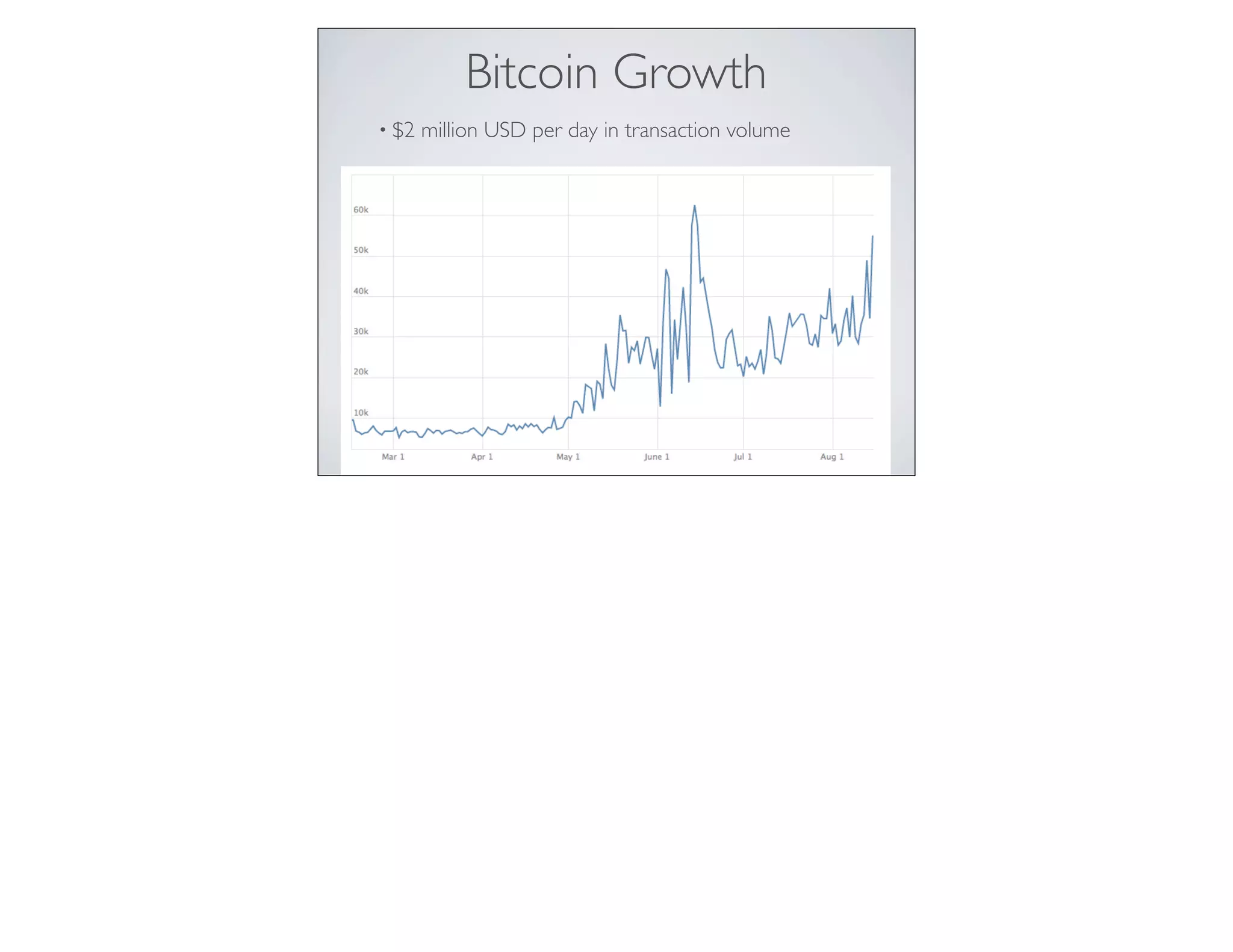
The Bitcoin growth slide presents a time series chart showing increasing daily transaction volume, with a short bullet noting $2M USD/day. This quantitative signal validates the market thesis established earlier: Bitcoin is growing rapidly and is becoming meaningful in economic terms. The graph creates urgency—there is an emergent network and the startup is aiming to capture early-in market share.

Quantitative market metrics are persuasive because they convert an abstract trend into hard evidence of demand. Founders should include simple, relevant market graphs that highlight growth velocity or size while keeping the interpretation explicit (a one-line annotation is enough). That bridges the gap between concept and opportunity for investors.

Key Takeaway: Support your market story with a simple, clearly labeled growth metric that demonstrates real, accelerating demand.
The Problem: Point to Real Friction

The Problem: Point to Real Friction

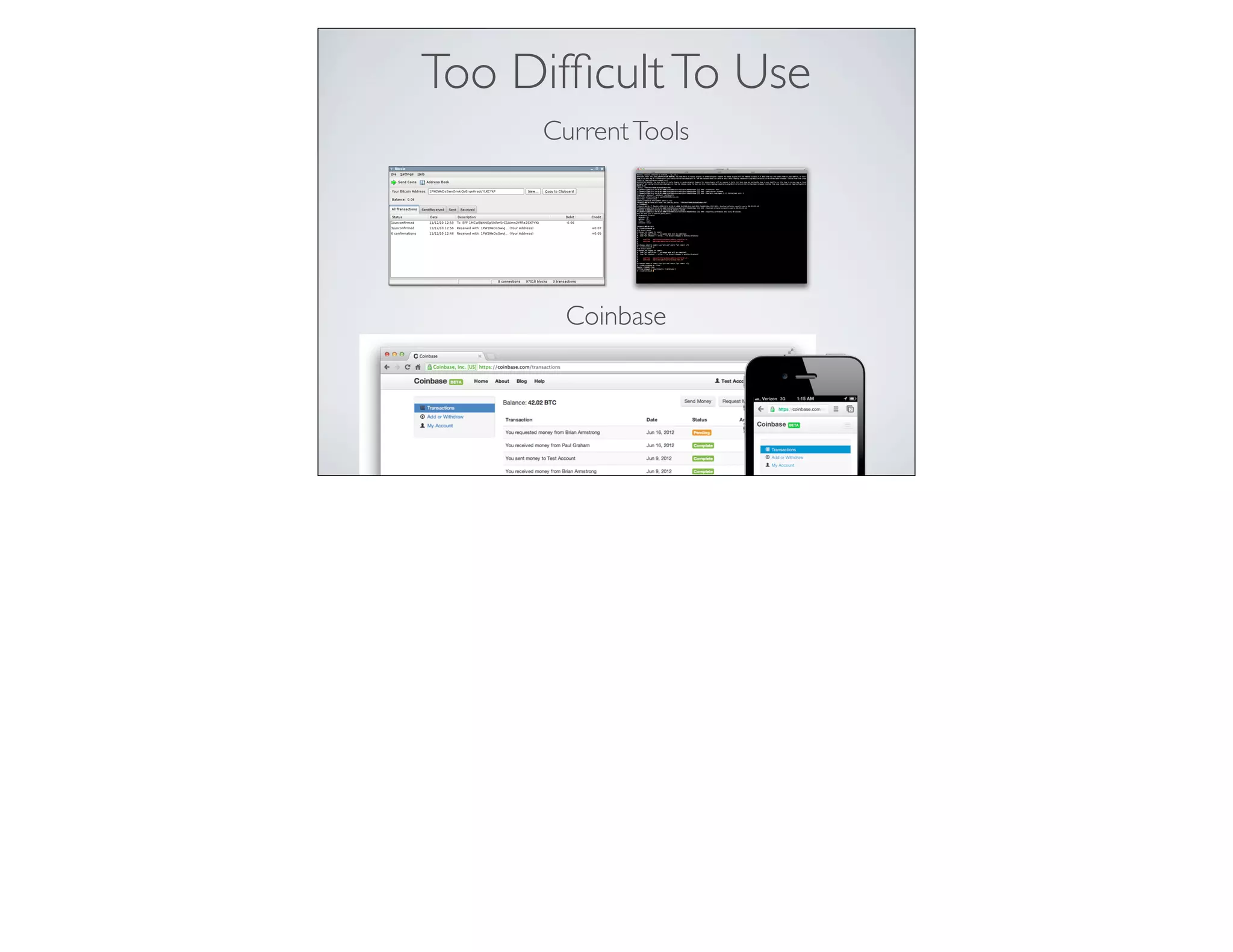
Slide 6 states the problem plainly: existing Bitcoin tools are ‘Too Difficult To Use,’ and it contrasts command-line or complex wallet clients with Coinbase’s simpler web and mobile UI. This is a classic pain-point slide that pairs a concise thesis with visual examples of the incumbent experience. It frames the company’s offering as a usability and trust layer atop a powerful but inaccessible protocol.

Founders should emulate this clarity: define the specific user pain and show how incumbents fail. Concrete contrasts—screens of intimidating tools vs. your friendly UI—make the problem visceral and the solution obvious. This slide makes it easy for investors to understand why people would switch and adopt a hosted solution.

Key Takeaway: Demonstrate the incumbent pain with concrete visuals and a crisp statement so your product’s advantage becomes obvious.
The Solution: Product as Trust and Simplicity

The Solution: Product as Trust and Simplicity

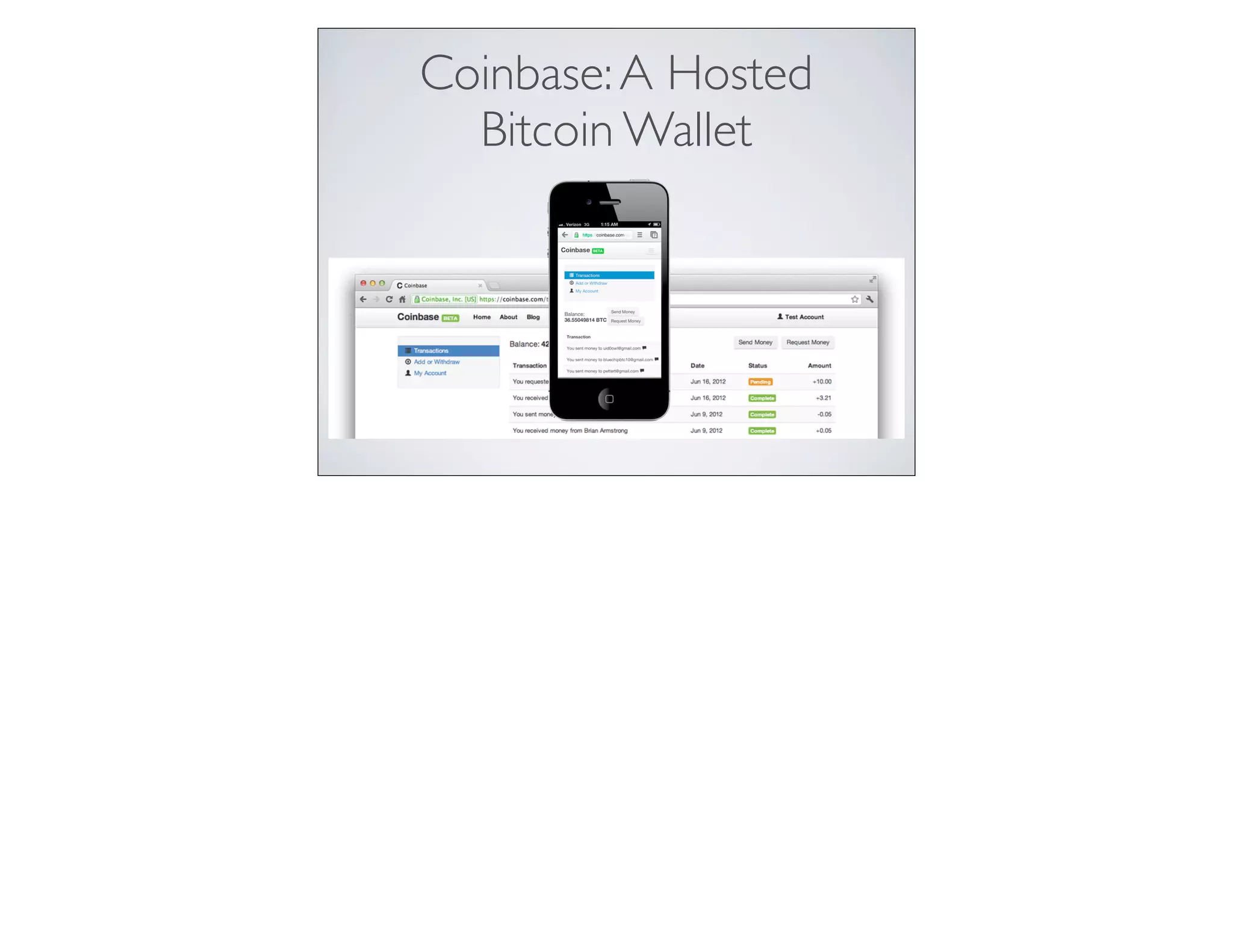
Slide 7 positions Coinbase as a hosted Bitcoin wallet and showcases the product across devices. The imagery emphasizes ease of use, with the mobile interface front-and-center and the desktop view showing clear transaction statuses. The framing is: Bitcoin’s complexity solved via a trusted, accessible service that handles the hard parts for users.

For fintech founders, this slide demonstrates how product design is part of the value proposition—security, simplicity, and cross-platform access are central trust signals. When building financial products, highlight UI elements and flows that reassure users (balances, transaction statuses, familiar web/mobile screens) because trust is a primary adoption hurdle.

Key Takeaway: Show the product in the context users care about (mobile + web) and highlight UI cues that build trust and lower the adoption barrier.
Traction: Rapid User Growth

Traction: Rapid User Growth

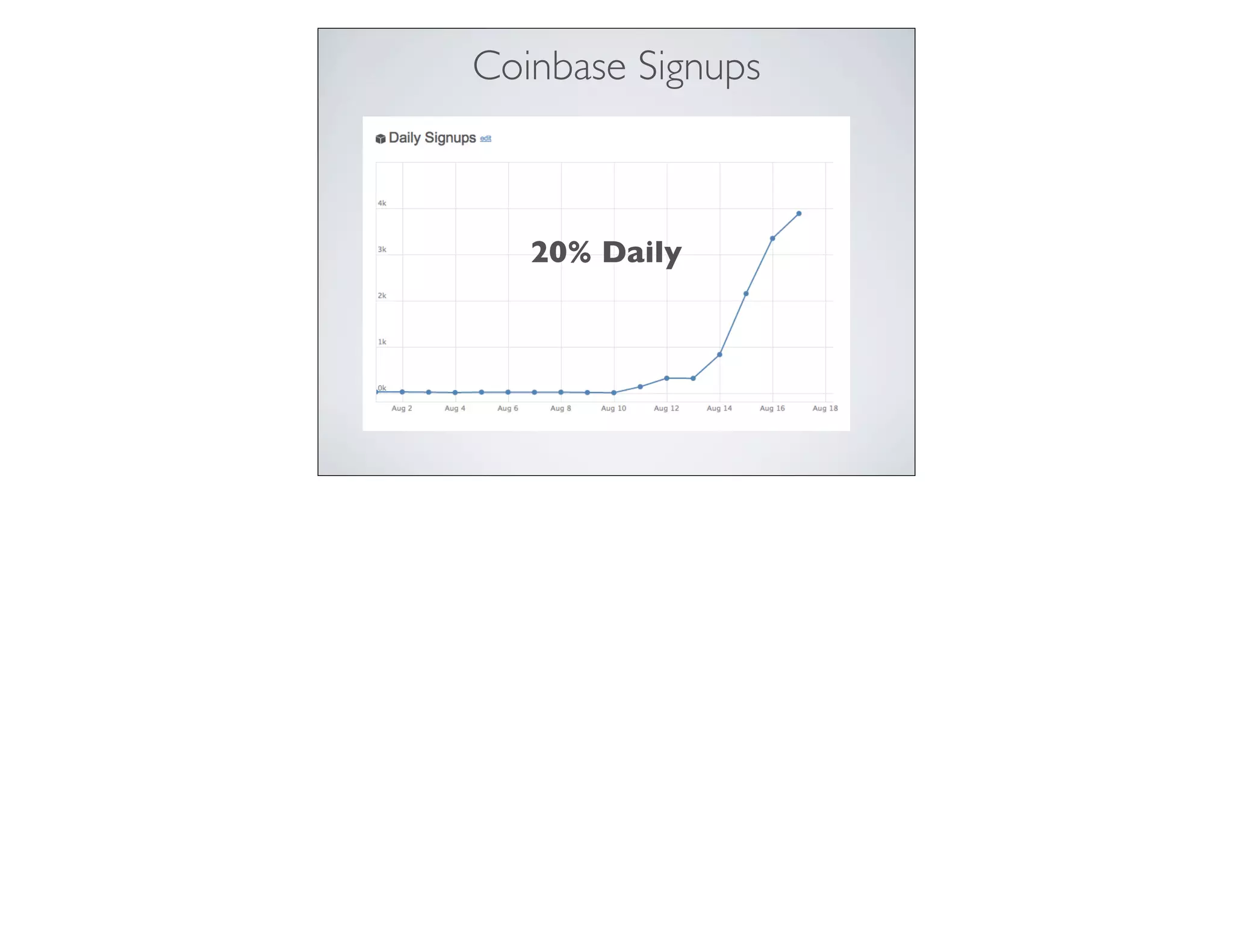
Slide 9 presents a daily signups chart with an annotation of “20% Daily,” showing a dramatic inflection point and clear viral or demand-driven uptake. This is a strong traction narrative: not only are users signing up, but growth is accelerating rapidly. The visual makes the momentum undeniable and ties back to the product-market fit implied earlier.

Founders should use straightforward metrics like signups with growth rates to tell a traction story. Where possible, annotate charts with percent growth or key milestones to help investors immediately grasp the rate of adoption. Traction slides are especially powerful when paired with concrete user acquisition channels or anecdotes, but even a simple, steep growth curve communicates strong momentum.

Key Takeaway: Use clear growth charts with a single annotated metric (e.g., % daily growth) to make momentum obvious and memorable.
Business Momentum: Transaction Volume as Proof of Value

Business Momentum: Transaction Volume as Proof of Value

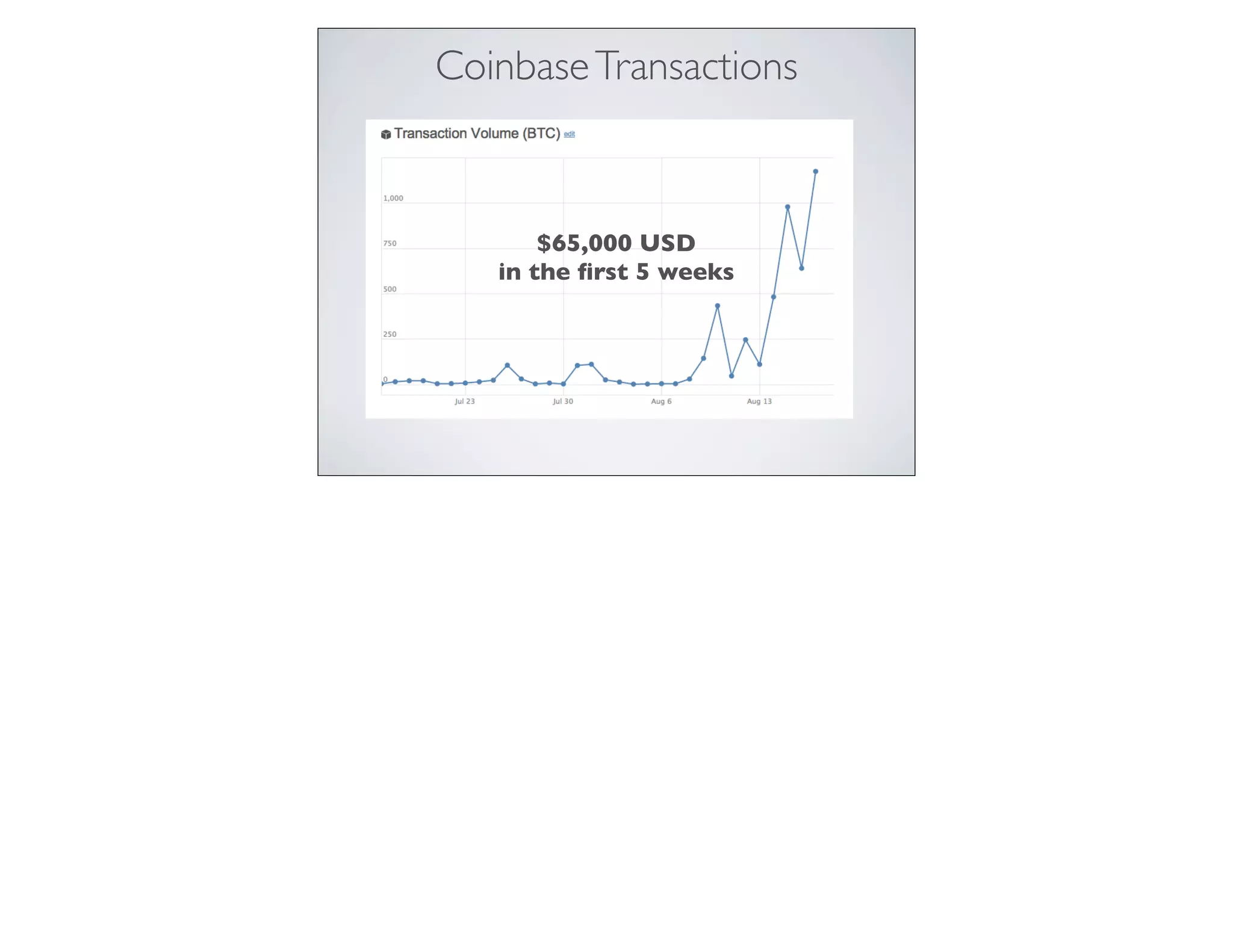
Slide 10 shows transaction volume with a callout: "$65,000 USD in the first 5 weeks." This translates signups into economic activity and validates that users are not only registering but transacting. For a payments business, transaction volume is a direct proxy for future revenue and network effects, making this a crucial slide to include early in a fintech pitch.

Founders should translate user activity into economic terms—highlight transaction volume, average revenue per user, or conversion rates—so investors can model monetization and scalability. Concrete dollar amounts and time-bound windows (first 5 weeks) help quantify early traction and reduce ambiguity about whether usage is meaningful.

Key Takeaway: Convert user growth into monetary activity with clear transaction volume figures to demonstrate immediate economic value.

Conclusion: Key Lessons

Coinbase’s seed deck is a model of clarity: teach the market, define the pain, present a simple product solution, and back it with early traction metrics that translate into economic activity. The deck balances education (Bitcoin basics), product trust signals (clean UI across devices), and quantifiable momentum (signups and transaction volume), which together reduce investor risk and make the opportunity tangible.

Actionable advice for founders: lead with a one-line value prop and product visual, succinctly educate investors unfamiliar with your tech, show the incumbent pain with concrete contrasts, and prioritize simple, annotated metrics that demonstrate both user growth and monetary activity. These elements together create a compelling, low-friction narrative that invites investor confidence.

Full Deck Analysis

11 sections

Overview

Company: Coinbase
Round: Seed
Year: 2012
Outcome: IPO at $86B valuation (2021)
Deck Length: 11 slides

Executive Summary

The Coinbase seed pitch deck is a masterclass in early-stage positioning that combines market education, product validation, and explosive traction metrics to make a compelling case for a nascent Bitcoin infrastructure play. Rather than assuming investor familiarity with cryptocurrency, the deck dedicates the first half to educating investors on Bitcoin’s value proposition (instant, international, low-cost transactions) before pivoting to Coinbase’s solution: a consumer-friendly hosted wallet that makes Bitcoin accessible to mainstream users. The deck closes with concrete proof of product-market fit—20% daily signup growth and $65K in transaction volume in just 5 weeks—positioning Coinbase as the “iTunes of Bitcoin.” Notably, the deck prioritizes traction and vision over team credentials and regulatory clarity, a bet that paid off spectacularly.

Problem Statement

Slides 2-3, 6: Bitcoin Education + Usability Gap

The deck articulates two interconnected problems:

  1. Market Education Problem (Slides 2-3): Bitcoin exists as a transformative technology with clear advantages (instant settlement, international reach, no intermediaries), but mainstream investors and consumers don’t understand it. The deck dedicates two full slides to explaining Bitcoin’s benefits, signaling that the target audience (VCs in 2012) needs foundational education.

  2. Usability Problem (Slide 6): Existing Bitcoin tools are too technical for mainstream adoption. The deck visually contrasts current tools—a cluttered GUI wallet and a command-line terminal—against Coinbase’s clean interface, establishing that the barrier to Bitcoin adoption is not the technology itself, but the user experience.

Key insight: The deck frames the problem as a distribution/accessibility challenge, not a technological one. Bitcoin already works; it just needs a consumer-friendly interface.

Solution

Slides 1, 7: Hosted Bitcoin Wallet

Coinbase is positioned as a “hosted Bitcoin wallet”—a web and mobile application that simplifies Bitcoin transactions for mainstream users.

Core features (visible in product screenshots):

  • Simple dashboard showing balance and transaction history
  • One-click send/receive functionality
  • Multi-platform support (web, iOS)
  • Transaction status tracking with visual indicators (pending/completed)
  • Account management interface

Positioning shift: The deck evolves the positioning from “wallet” (Slide 1) to “payment network” (Slide 11), suggesting ambitions beyond custody to become infrastructure for Bitcoin commerce.

What’s notably absent: No mention of security architecture, cold storage, insurance, or compliance measures—critical concerns for a custodial service in 2012.

Market Opportunity

Slides 2-5: Market Size & Growth

The deck establishes market opportunity through layered evidence:

Bitcoin Network Growth (Slide 4)

  • $2 million USD per day in transaction volume (as of Aug 2012)
  • 6-month growth trajectory: ~10% (Mar 2012) → ~50% (Aug 2012)
  • Peak volatility: ~60% (late June, likely Mt. Gox hack aftermath)
  • Implication: Bitcoin is a real, growing market with measurable transaction volume

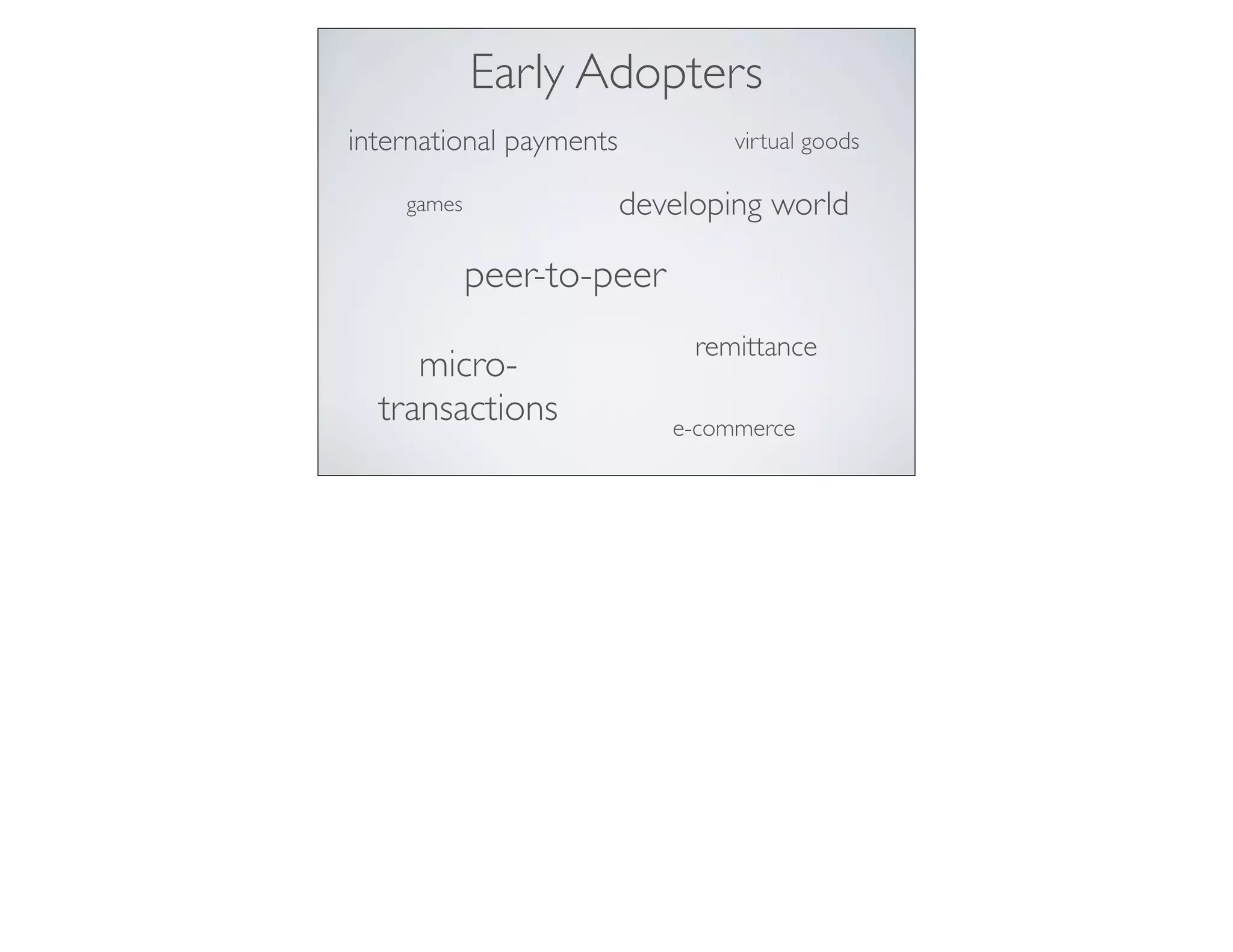
Use Case Breadth (Slide 5)

Nine identified early adopter segments:

  1. Peer-to-peer payments
  2. Developing world remittance
  3. International payments
  4. Virtual goods
  5. Games
  6. Micro-transactions
  7. E-commerce
  8. Remittance (emphasized)
  9. (Implied others)

Market size analysis: The deck does NOT provide explicit TAM/SAM/SOM calculations. Instead, it uses the iTunes analogy (Slide 8) to imply a multi-billion-dollar opportunity by comparison to digital music distribution.

Critical gap: No quantification of addressable market, penetration rates, or competitive share assumptions.

Business Model

Slides 1, 7, 10: Implied Transaction Fee Model

The deck does not explicitly state the business model, but it’s implied through:

  1. Transaction volume tracking (Slide 10): $65,000 USD in transaction volume in the first 5 weeks suggests Coinbase is processing real transactions and likely capturing a fee on each.

  2. “No Transaction Fees” claim (Slide 2): This refers to Bitcoin’s peer-to-peer nature, NOT Coinbase’s service. This is misleading and suggests the founders may not have finalized pricing strategy.

  3. Hosted wallet model: Suggests potential revenue streams:

    • Transaction fees (most likely)
    • Merchant tools (hinted at but not detailed)
    • Future trading/exchange services (not mentioned)

Unit economics: Completely absent. No information on:

  • Take rate per transaction
  • Customer acquisition cost
  • Lifetime value
  • Gross margins
  • Path to profitability

Traction & Metrics

Slides 9-10: Explosive Early Growth

User Acquisition (Slide 9: “Coinbase Signups”)

  • Time period: August 2-18, 2012 (16 days)
  • Growth rate: 20% daily
  • Starting point: Near 0k daily signups (Aug 2)
  • Inflection point: ~August 12
  • Peak: ~4,000 daily signups (Aug 18)
  • Trajectory: Exponential growth with acceleration at the end

Transaction Volume (Slide 10: “Coinbase Transactions”)

  • Time period: July 23 – August 18, 2012 (~5 weeks)
  • Total transaction value: $65,000 USD in the first 5 weeks
  • Peak daily volume: ~1,200 BTC (mid-August)
  • Starting point: ~50-100 BTC (late July)
  • Inflection point: ~August 8 (aligns with signup acceleration)
  • Volatility: Significant daily swings, suggesting market sensitivity to Bitcoin price/news

Interpretation

These metrics demonstrate:

  1. Product-market fit: Users are signing up and immediately transacting
  2. Viral adoption: 20% daily growth suggests organic/word-of-mouth adoption
  3. Real revenue: $65K in 5 weeks proves monetization, not just vanity metrics
  4. Timing alignment: Signup and transaction growth curves align, suggesting cohort consistency

Critical caveats

  • Short time window: 5 weeks is insufficient to establish sustainability
  • No retention data: Doesn’t show if users are repeat transactors or one-time signers
  • No churn metrics: Doesn’t address user retention or lifetime value
  • Volatility concerns: Sharp dips suggest market instability or dependency on Bitcoin price movements

Competitive Positioning

Slide 6: Problem/Solution Comparison
Slide 8: Market Positioning Analogy

Differentiation Strategy

  1. UX/Design as moat: The deck positions simplicity and design as the primary competitive advantage. Existing tools (GUI wallet, command-line) are positioned as too technical; Coinbase is the consumer-friendly alternative.

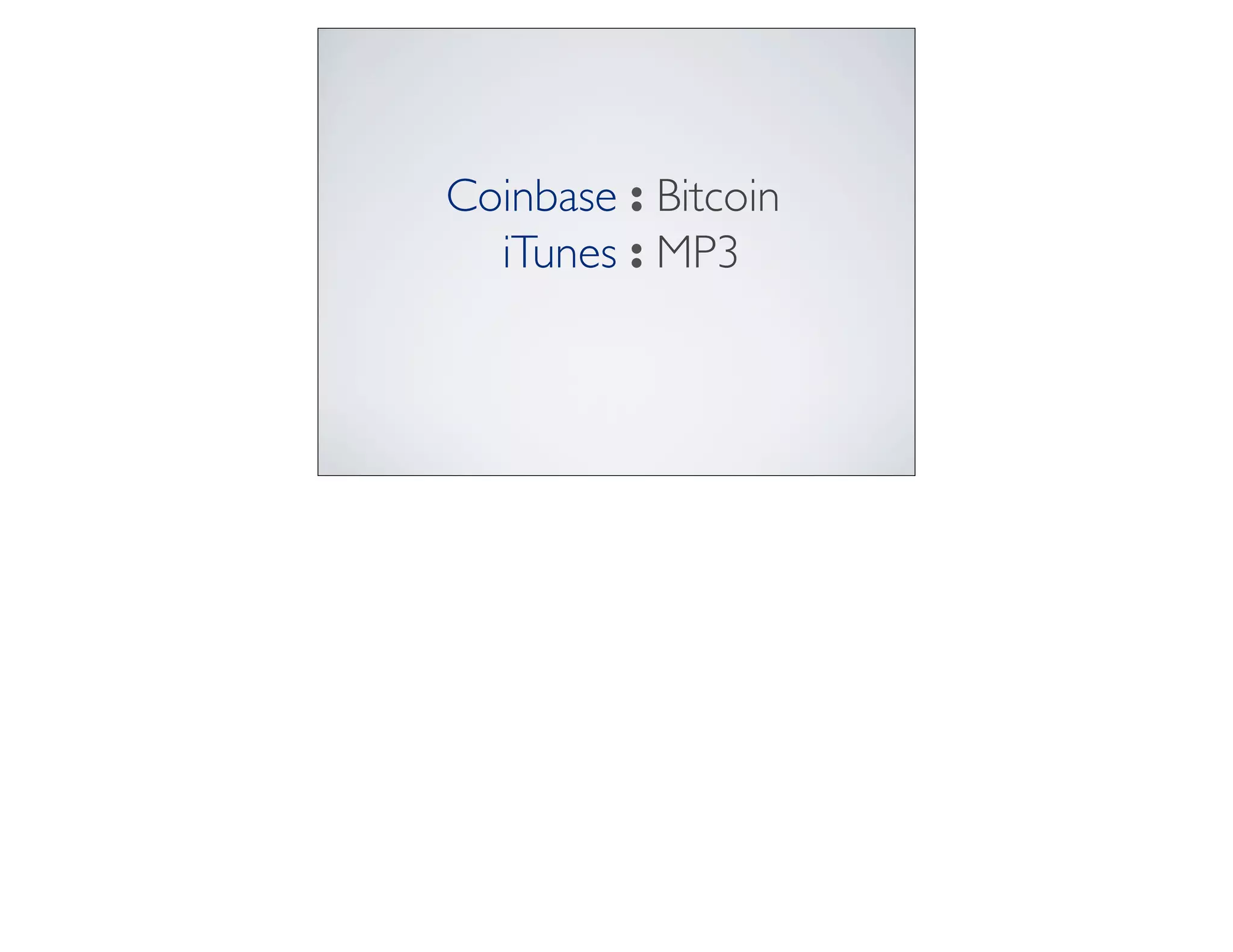
  2. iTunes analogy (Slide 8): “Coinbase : Bitcoin :: iTunes : MP3”

    • Positions Coinbase as the dominant platform for Bitcoin access
    • Implies massive TAM (digital music market size)
    • Suggests first-mover advantage and network effects

Competitive gaps

  • No named competitors: Doesn’t identify Mt. Gox, Blockchain.info, or other existing solutions
  • No defensibility analysis: Doesn’t explain why competitors can’t copy the UX
  • No moat discussion: Design is easily replicated; no mention of network effects, data, or switching costs
  • Regulatory advantage: Doesn’t mention compliance/licensing as a moat (critical in hindsight)

Team

Slides: NONE

Critical omission: The deck contains zero information about the founding team, advisors, relevant experience, or credentials. This is a major red flag for a seed pitch, as investors typically prioritize “people risk” at this stage.

What we know from context:

  • Founded by Brian Armstrong (CEO) and Fred Ehrsam (CTO)
  • Both had relevant experience (Armstrong: Airbnb; Ehrsam: Goldman Sachs)
  • But this information is NOT in the deck

Implication: Either the deck was incomplete, or the founders were betting that traction would speak louder than credentials.

Go-to-Market Strategy

Slides: Minimal Coverage

The deck does not explicitly outline a go-to-market strategy. However, traction metrics suggest:

  1. Organic/viral adoption: 20% daily signup growth indicates word-of-mouth or organic discovery, not paid marketing
  2. Product-led growth: Users are signing up and immediately transacting, suggesting the product itself is the primary acquisition channel
  3. Bitcoin community focus: Early adopters (Slide 5) are concentrated in niche communities (games, remittance, peer-to-peer), suggesting grassroots adoption

Missing elements:

  • No sales strategy
  • No partnership strategy
  • No marketing plan
  • No geographic expansion strategy
  • No merchant acquisition plan

The Ask

Slides: NONE

Critical omission: The deck does not specify:

  • Funding amount being raised
  • Use of proceeds
  • Runway/burn rate
  • Hiring plans
  • Product roadmap
  • Milestones/KPIs for next 12-18 months

Implication: This may have been a presentation deck used in conversations, with the actual ask communicated verbally or in a separate document.

Investor Deep Dive

Executive summary, strengths & red flags

Executive Summary

The Coinbase seed pitch deck is a masterclass in early-stage positioning that combines market education, product validation, and explosive traction metrics to make a compelling case for a nascent Bitcoin infrastructure play. Rather than assuming investor familiarity with cryptocurrency, the deck dedicates the first half to educating investors on Bitcoin's value proposition (instant, international, low-cost transactions) before pivoting to Coinbase's solution: a consumer-friendly hosted wallet that makes Bitcoin accessible to mainstream users. The deck closes with concrete proof of product-market fit—20% daily signup growth and $65K in transaction volume in just 5 weeks—positioning Coinbase as the "iTunes of Bitcoin." Notably, the deck prioritizes traction and vision over team credentials and regulatory clarity, a bet that paid off spectacularly.

Key Strengths

5 identified

1

Market Education + Problem Clarity

The deck dedicates the first half to educating investors on Bitcoin's value proposition before pivoting to Coinbase's solution. This is smart positioning for 2012, when most VCs didn't understand c...

2

Traction as the Primary Narrative

Rather than relying on team credentials or market projections, the deck leads with concrete proof of product-market fit: 20% daily signup growth and $65K in transaction volume in 5 weeks. This is t...

3

Visual Design & Simplicity

The deck is visually clean, minimal, and easy to follow. Each slide has a single clear message. The product screenshots (Slides 1, 7) and before/after comparison (Slide 6) are compelling and memora...

4

Product-First Approach

The deck shows a working product with real users and real transactions. This is not a pitch for a theoretical idea; it's a pitch for a live business.

5

Memorable Positioning

The iTunes analogy (Slide 8) is brilliant. It's simple, memorable, and positions Coinbase as the inevitable winner in a massive market. Investors will repeat this analogy in their investment commit...

Red Flags & Weaknesses

8 identified

1

No Team Information

The complete absence of team credentials is a major red flag. Seed investors typically prioritize people risk. The deck doesn't mention founders, advisors, or relevant experience. This suggests eit...

2

No Regulatory/Compliance Strategy

The deck is silent on money transmission laws, KYC/AML requirements, or regulatory risk. In 2012, this was a critical gap. Coinbase would later face significant regulatory challenges and fines.

3

Misleading "No Transaction Fees" Claim

Slide 2 claims Bitcoin has "No Transaction Fees," which is technically true for peer-to-peer transactions but misleading about Coinbase's service model. This suggests either imprecise thinking or i...

4

Short Time Window for Traction

The growth metrics (Slides 9-10) are based on only 5 weeks of data. While impressive, this is insufficient to establish sustainability. The sharp volatility in transaction volume (Slide 10) raises ...

5

No Unit Economics or Business Model Detail

The deck doesn't explain how Coinbase makes money, what the take rate is, or what the unit economics look like. This is a critical gap for investors evaluating profitability potential.

6

No Competitive Analysis

The deck doesn't name competitors or explain defensibility. While the iTunes analogy is compelling, it doesn't address why competitors can't replicate Coinbase's UX or why Coinbase will maintain ma...

7

Unfair Problem/Solution Comparison

Slide 6 compares Coinbase to a command-line Bitcoin wallet, which is a developer tool, not a consumer product. This is an unfair comparison that may undermine credibility with sophisticated investors.

8

No Funding Ask or Use of Proceeds

The deck doesn't specify how much is being raised or what the money will be used for. This is a critical omission that makes it impossible to evaluate the investment opportunity.

More Pitch Decks To Study

Compare structure, fundraising context, and investor-facing story across similar startup decks.