Compare your deck to Pulley

Compare Your Deck

Pulley Pitch Deck (2020)

Fintech
Stage: Seed
Raised: $10M
Year: 2020
Slides: 23
Outcome: Raised $40M Series B (2022)

Pitch Deck

1 / 23
Pulley pitch deck - Title slide: Clear, minimalist positioning
Click to expand

Deck Analysis

This deck for Pulley (seed, 2020) presents a focused, product-led fintech pitch that targets cap table and equity management for startups. It balances mission-driven language with clear product screenshots, pricing tiers, customer traction and team credibility. Notable elements include a minimalist design that foregrounds the problem and product, credible traction signals (Y Combinator, Stripe backing, customer logos), and concrete pricing and feature breakdowns that make monetization and go-to-market obvious.

Title slide: Clear, minimalist positioning

Title slide: Clear, minimalist positioning

The opening slide (slide_01.jpg) is extremely minimal — just the company name and a one-line descriptor — which quickly establishes brand identity and the product domain without noise. This sets the tone for the rest of the deck: simple, confident, and focused on a single value prop (cap table management for high-growth startups). The sparse design also signals discipline and that the team expects the audience to listen to the founder for detail rather than read a crowded slide.

Founders can learn from this restraint: a clean title slide primes investors to focus on core narrative and removes distraction. It also demonstrates that high-information slides later in the deck will stand out more because the deck invests in whitespace and hierarchy rather than trying to cram everything into the first impression.
Key Takeaway: Open with a clean, focused title slide that establishes domain and tone — let the product and traction do the heavy lifting next.
Mission and value proposition

Mission and value proposition

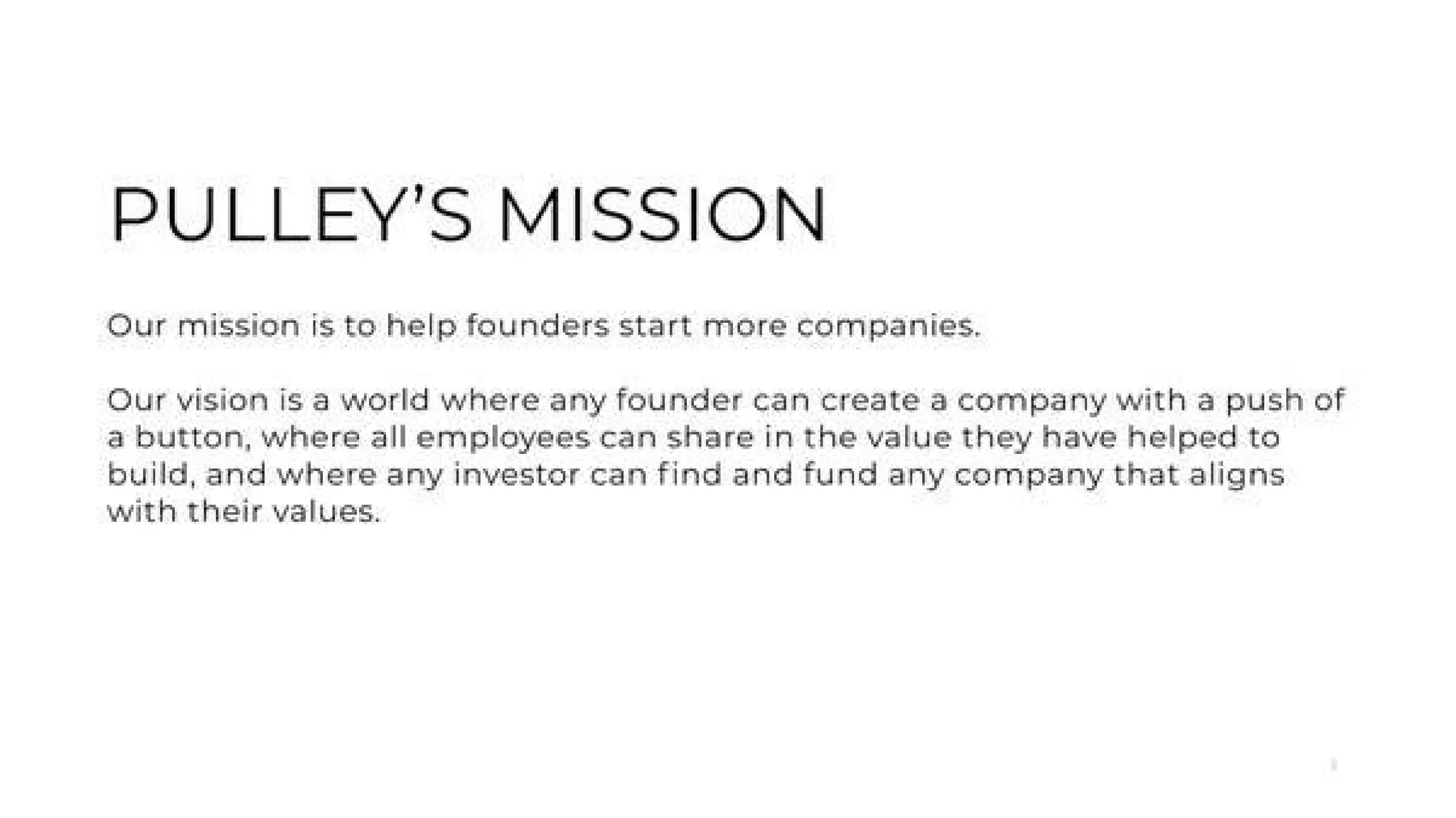
Slides 3 and 4 (slide_03.jpg, slide_04.jpg) lay out a concise mission — helping founders start more companies — and a crisp product value statement positioning Pulley as the platform to manage equity. The mission is aspirational but quickly grounded by the immediate value: managing equity, cap tables, and 409A valuations. This combination of mission + utility makes it emotionally resonant for founders and practical for investors assessing market fit.

The slides effectively move from ‘why we exist’ to ‘what we do’ with one or two sentences each, avoiding long-winded market essays. Founders should note how high-level vision and concrete product capabilities are paired: vision sells the long-term upside, product details demonstrate early traction and feasibility.

Key Takeaway: Pair a short, compelling mission with a clear, concrete statement of product value — vision + utility sells both heart and head.
Team and investor credibility

Team and investor credibility

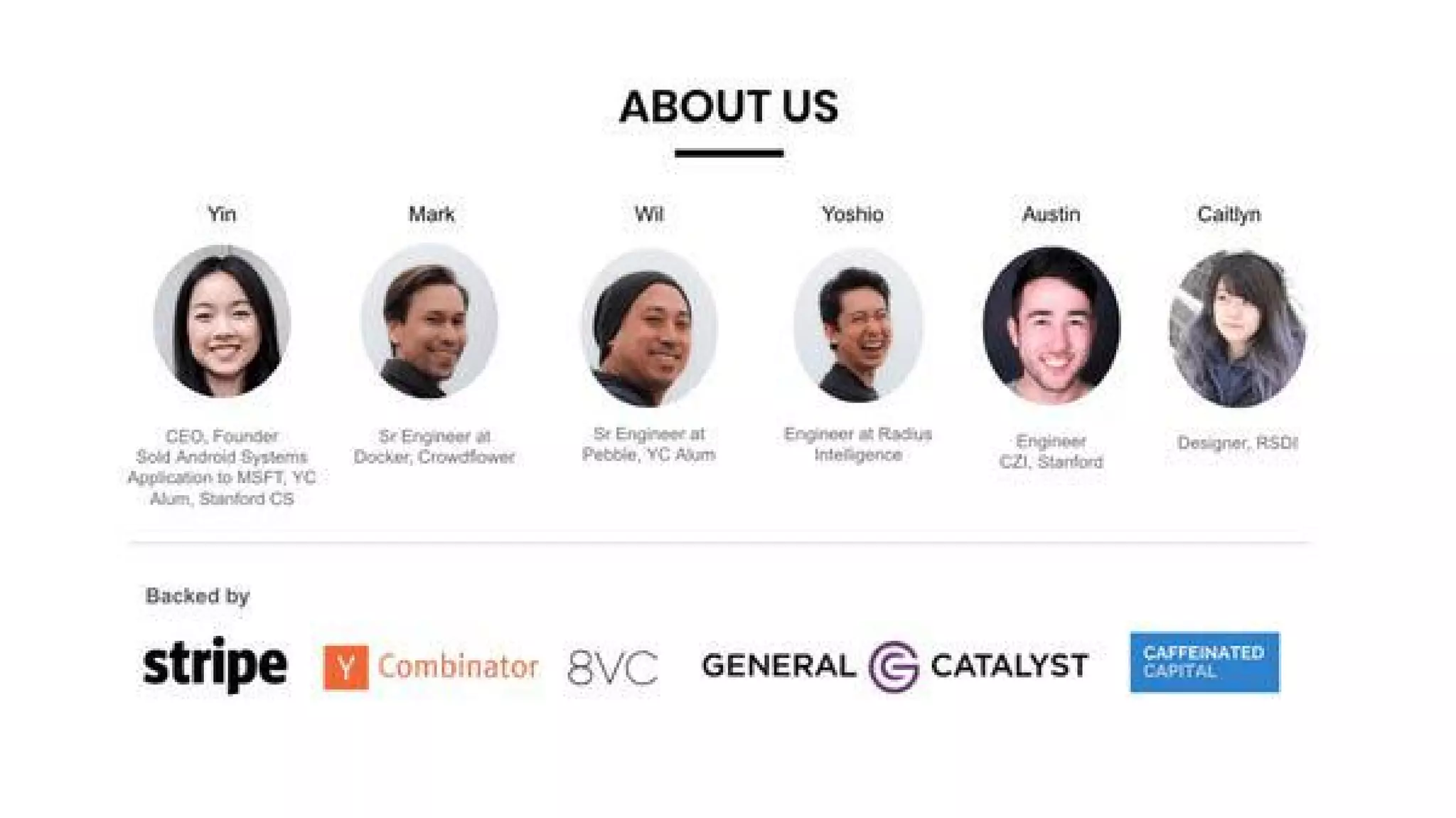
Slide 5 (slide_05.jpg) showcases the founding team headshots and short bios along with prominent backers (Stripe, Y Combinator, 8VC, General Catalyst). Presenting both team experience and high-profile investors on the same slide amplifies credibility: it signals that smart backers have done diligence and that the team has the background to build the product. The visual layout is clean and makes it easy to scan for relevant signals (Y Combinator, Stanford, prior exits, engineering creds).

For founders, this demonstrates how investor logos and concise bios can significantly increase trust without diverting attention from product/traction. If you have strong backers or relevant operator experience, showcase them early and visually to reduce investor friction and build confidence that the venture has both support and execution capability.

Key Takeaway: Use a single slide to combine concise founder bios with recognizable investor logos — the combined signal accelerates credibility.
Traction and word-of-mouth growth

Traction and word-of-mouth growth

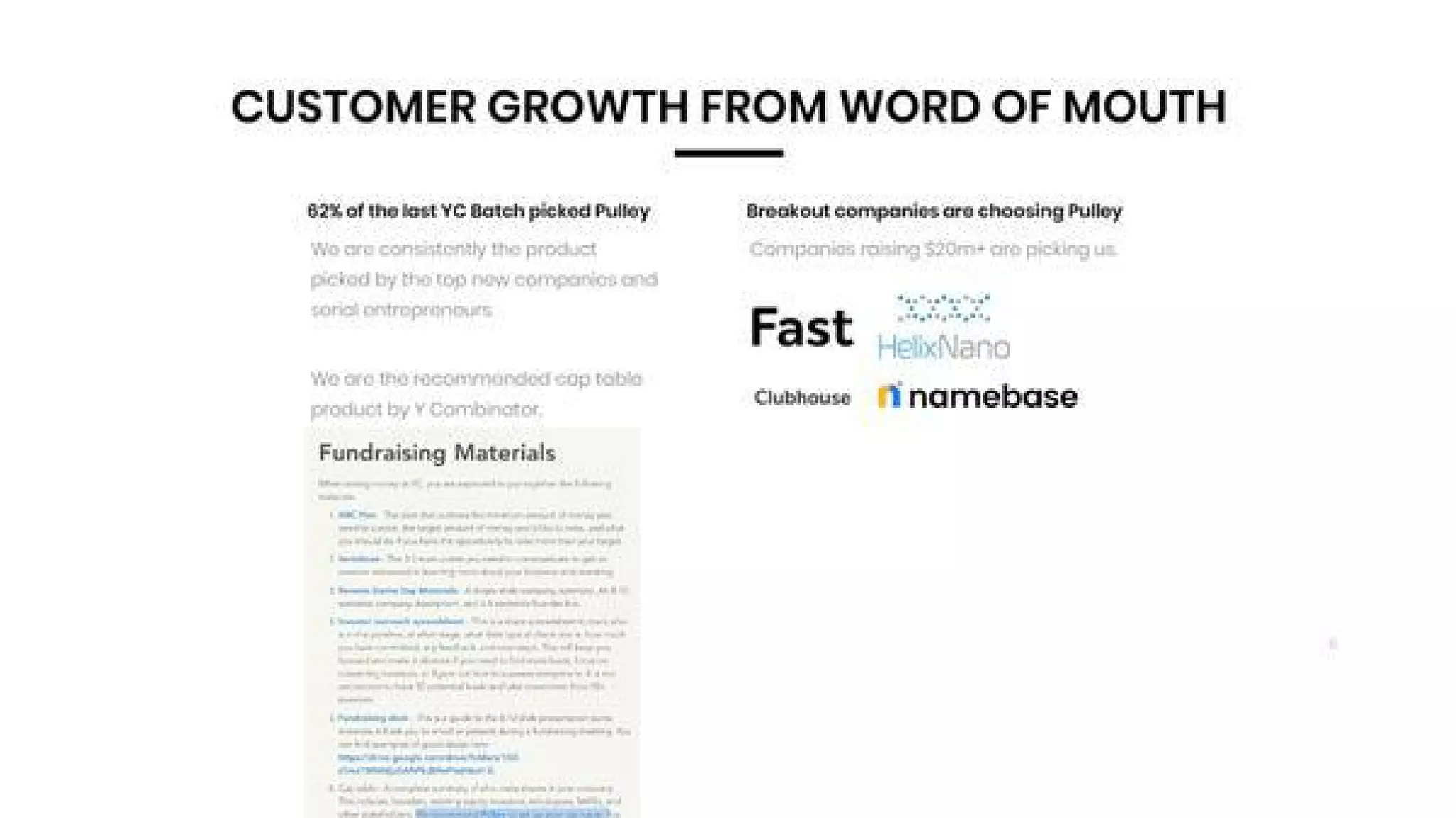
Slide 6 (slide_06.jpg) focuses on customer growth from word of mouth and highlights that a high percentage of YC companies chose Pulley and that breakout companies are customers. The slide uses customer names/logos and a short text explanation to convey organic adoption and product-market fit. This is effective because it shows real-world validation rather than speculative TAM analysis.

Founders should note the importance of showing how customers find you (e.g., word of mouth, inbound from respected accelerators) — especially in early rounds. Demonstrating low-cost, organic channels and notable customer logos gives investors confidence in retention and virality, which are powerful early-growth signals that justify investment.

Key Takeaway: Show concrete evidence of organic traction (customer logos, accelerator adoption) to prove product-market fit and efficient growth.
Product features and clear tiering

Product features and clear tiering

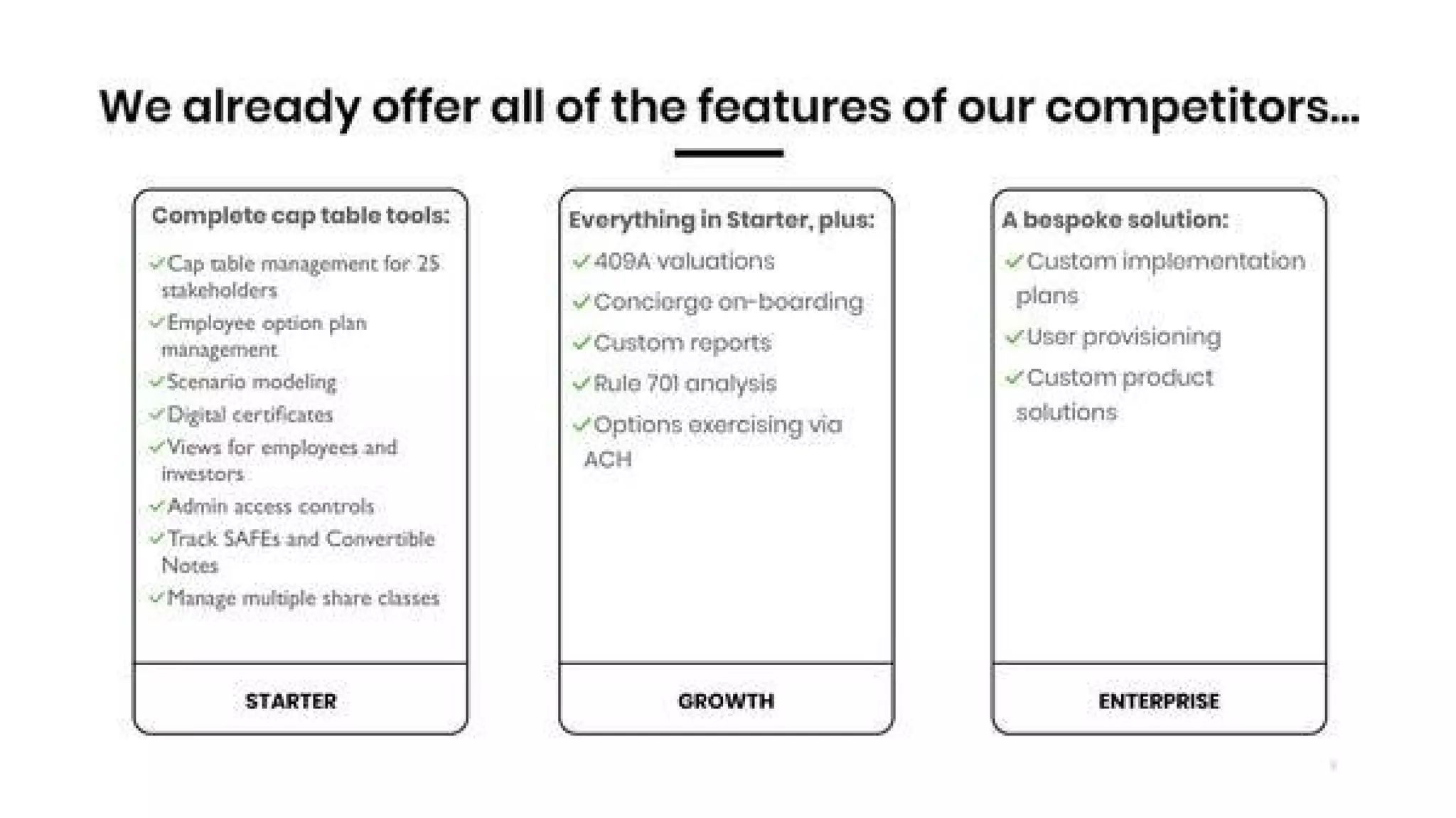
Slide 9 (slide_09.jpg) lays out the product feature set across Starter, Growth, and Enterprise tiers, with checklists and clear differentiators. This demonstrates thoughtful monetization and segmentation: a freemium/entry tier to acquire startups, a paid tier with advanced features, and enterprise packages for custom implementations. The visual three-column layout makes it obvious what customers get at each price point and why they'd upgrade.

Founders can learn how to use packaging to communicate value and capture different customer segments. Clear, feature-based tiering reduces sales friction (buyers can self-select) and gives a logical pathway for upsells. If pricing tiers align with distinct customer jobs-to-be-done, it’s easier to measure conversion and ARR expansion later.

Key Takeaway: Design tiered product packaging that maps features to customer needs and creates a visible upgrade path for monetization.
Pricing: simple, per-stakeholder model

Pricing: simple, per-stakeholder model

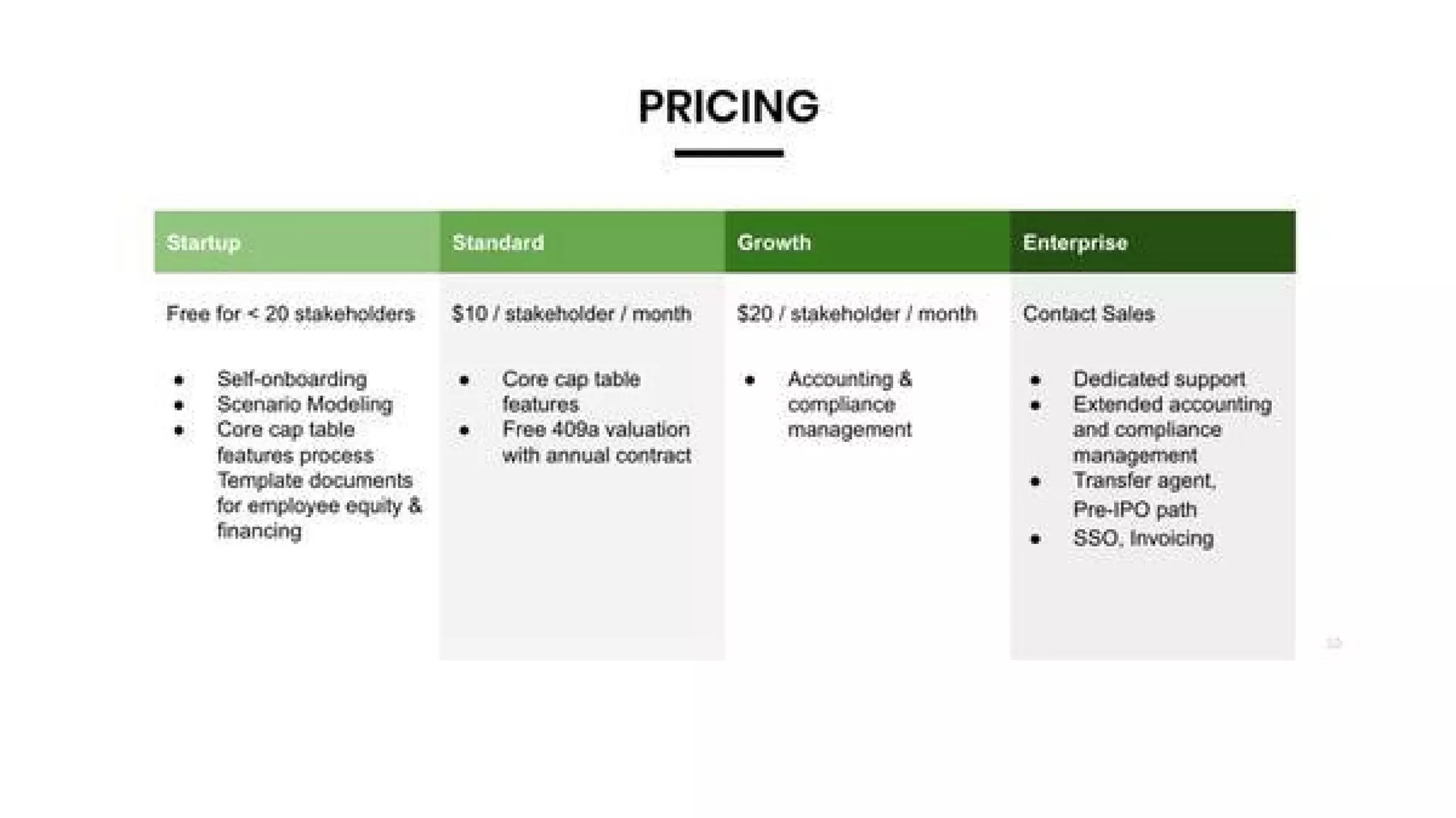
Slide 10 (slide_10.jpg) presents a simple pricing table: Startup free tier for ~20 stakeholders, Standard at $10/stakeholder/month, Growth at $20/stakeholder/month, and Enterprise with contact sales. This per-stakeholder pricing is intuitive for cap table software because the value scales with number of stakeholders; it ties product usage to $$$ directly. The slide is concise and includes callouts for what each plan includes, which helps investors understand unit economics and potential ARR dynamics.

For founders, this is an example of aligning pricing to the product’s unit of value and keeping the structure simple. Simple, usage-linked pricing is easier to justify, explain to customers, and forecast revenue from. Also, reserving an enterprise lane for bespoke work preserves a high-touch revenue channel while keeping self-serve options for smaller customers.

Key Takeaway: Price around a natural unit of value (here, stakeholders) and keep tiers simple: self-serve for acquisition, enterprise for higher-touch ARR.
Regulatory/product depth: 409A valuations and trust signals

Regulatory/product depth: 409A valuations and trust signals

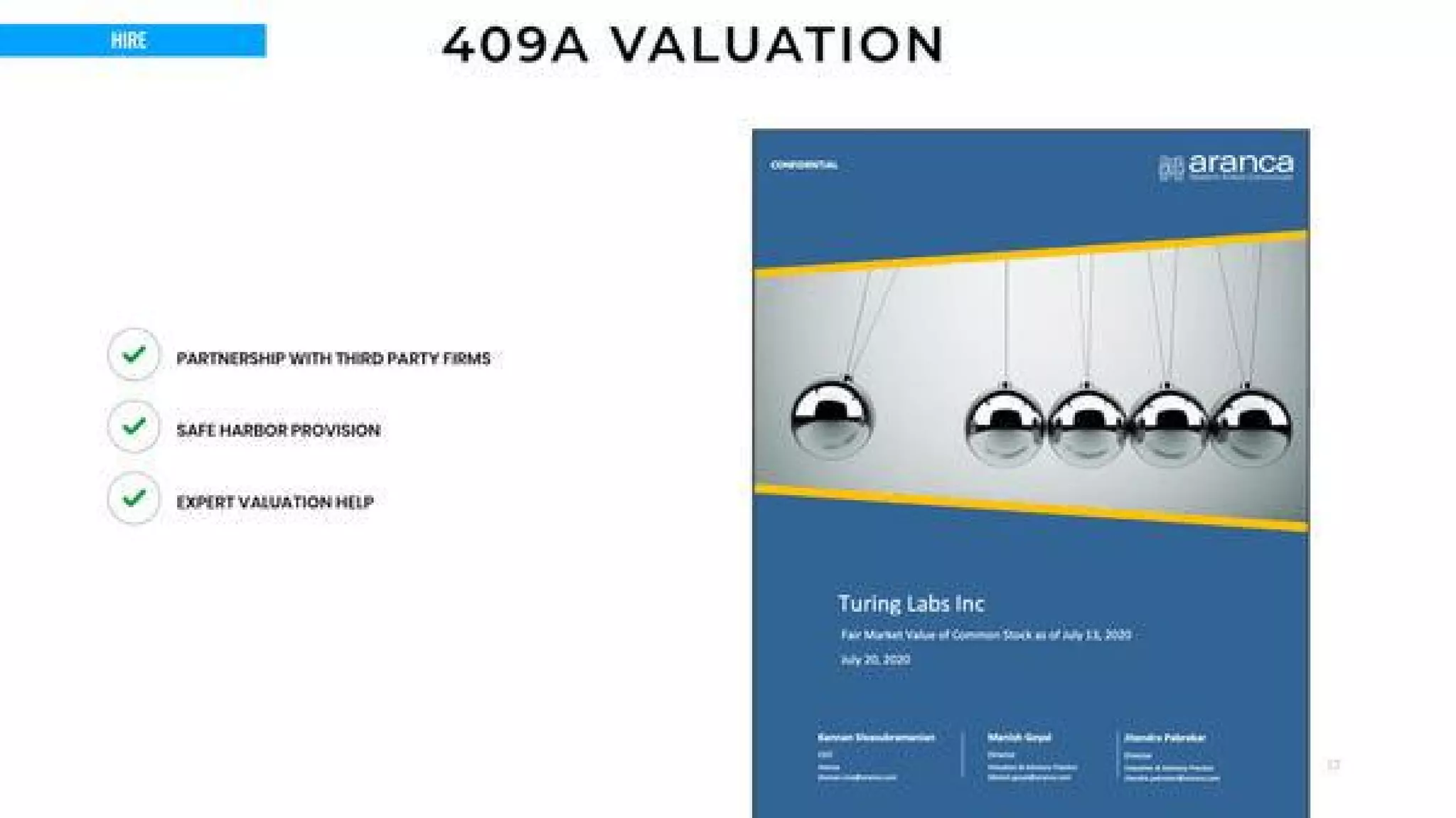
Slide 17 (slide_17.jpg) highlights 409A valuation services with third-party partnerships and safe harbor provision. Including valuation services demonstrates Pulley’s understanding of the legal and compliance needs of their customers — a distinct moat for cap table tools. It also signals a path to higher revenue per customer (paid valuations) and deeper stickiness because valuations and compliance are recurring and sensitive tasks that customers are reluctant to switch away from.

This slide teaches founders the value of showcasing product depth in adjacent, trust-heavy services. When you operate in a regulated or compliance-adjacent space, partnerships with reputable providers and mechanisms like safe harbors are major credibility boosters and can be monetized as premium features.

Key Takeaway: Showcase regulatory/compliance offerings and trusted partnerships to create a defensible, revenue-generating layer beyond core product functionality.

Conclusion: Key Lessons

Pulley’s seed deck is a strong example of concise, product-focused fundraising: it pairs a short mission with clear product screenshots, demonstrates credible traction via logos and customer adoption channels, and presents monetization and compliance depth that justify both growth and enterprise motion. Strengths include visual restraint, logical flow from problem to product to monetization, and trust-building through investors and third-party partnerships. Actionable advice for founders: lead with a clear one-line value proposition, prove organic traction with customer signals, design pricing around a natural unit of value, and highlight regulatory or partner integrations that increase switching costs and upsell opportunities. Keep slides uncluttered and use a mix of narrative, screenshots, and concrete metrics to make your business understandable in minutes.

Full Deck Analysis

11 sections

Overview

Company: Pulley
Round: Seed ($10M)
Year: 2020
Outcome: Raised $40M Series B (2022)

Executive Summary

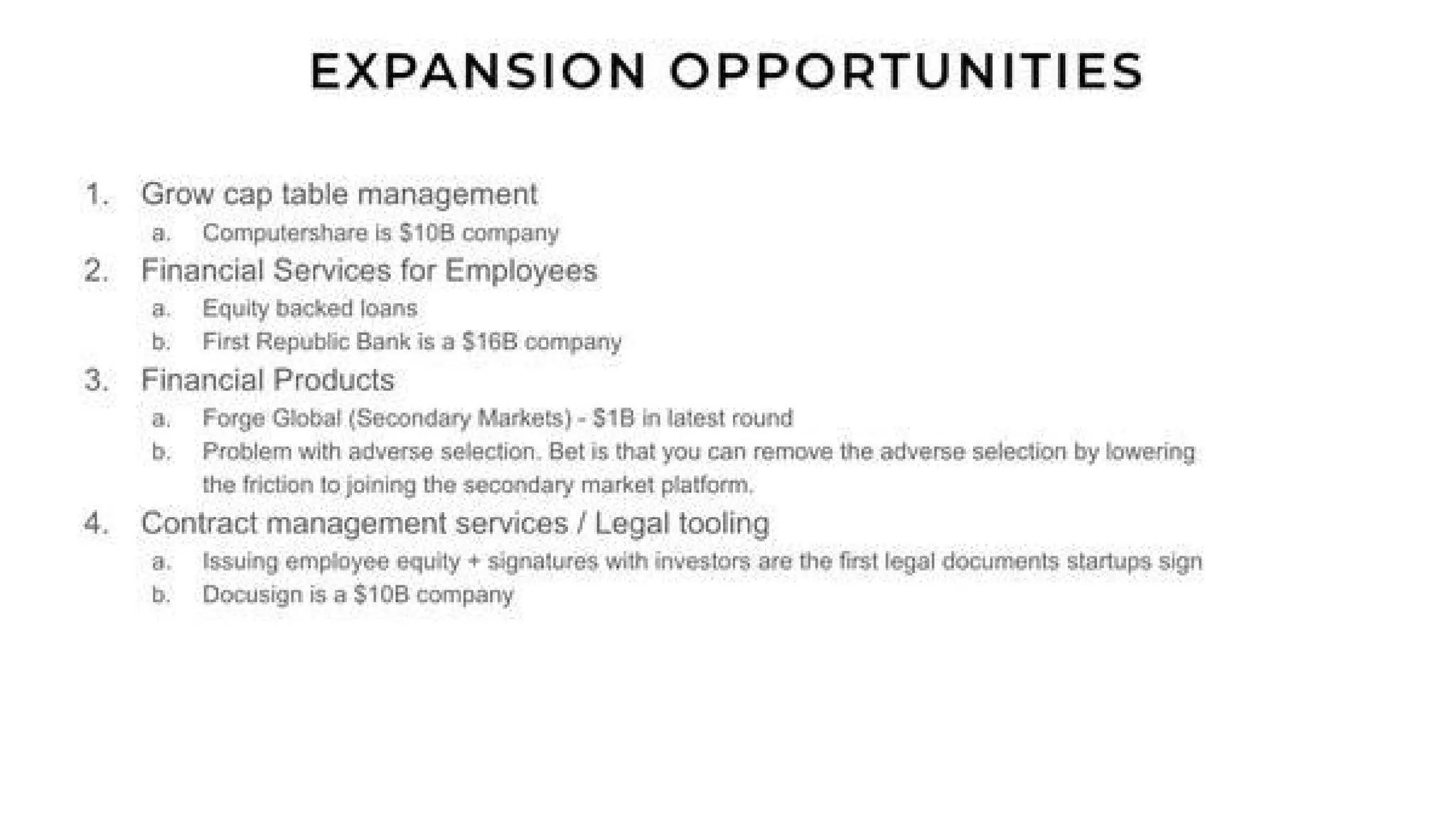
Pulley is a cap-table and equity management platform targeting startups, investors and employees. The 2020 seed deck is concise and product-focused: it states the mission, shows product screenshots, pricing and early traction (YC adoption, notable customers), and outlines straightforward expansion opportunities (financial services, secondary markets, legal tooling). It’s notable for strong customer signals, clean product demos, and credible backers (YC, Stripe, 8VC, General Catalyst).

Problem Statement

How the deck articulates the problem:

  • Core problem: cap tables and employee equity are a company’s most valuable but poorly managed asset — founders need simple, compliant, and shareable equity management (Slides 3–4).
  • Pain points implied: manual or slow onboarding, messy scenario modeling, slow 409A valuations, poor employee visibility into awards and exercising options (Slides 7, 11–17).
  • The deck frames the problem as both operational (time-consuming processes) and strategic (equity as a company’s key asset that needs to be managed and communicated).

Solution

How the deck positions the solution:

  • Pulley positions itself as the platform to manage cap tables, 409A valuations, employee equity plans and compliance (Slide 4, Slide 9).
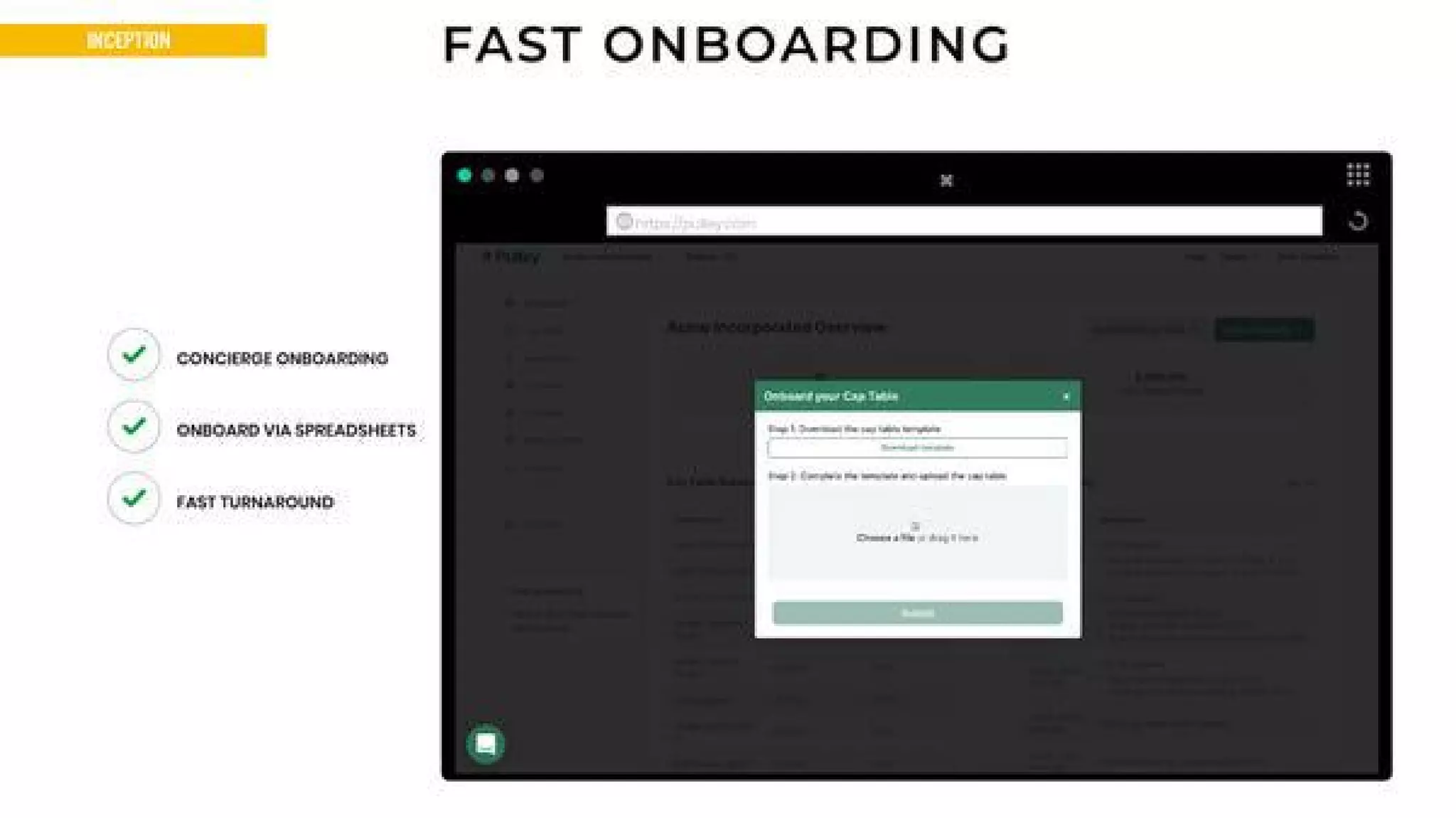
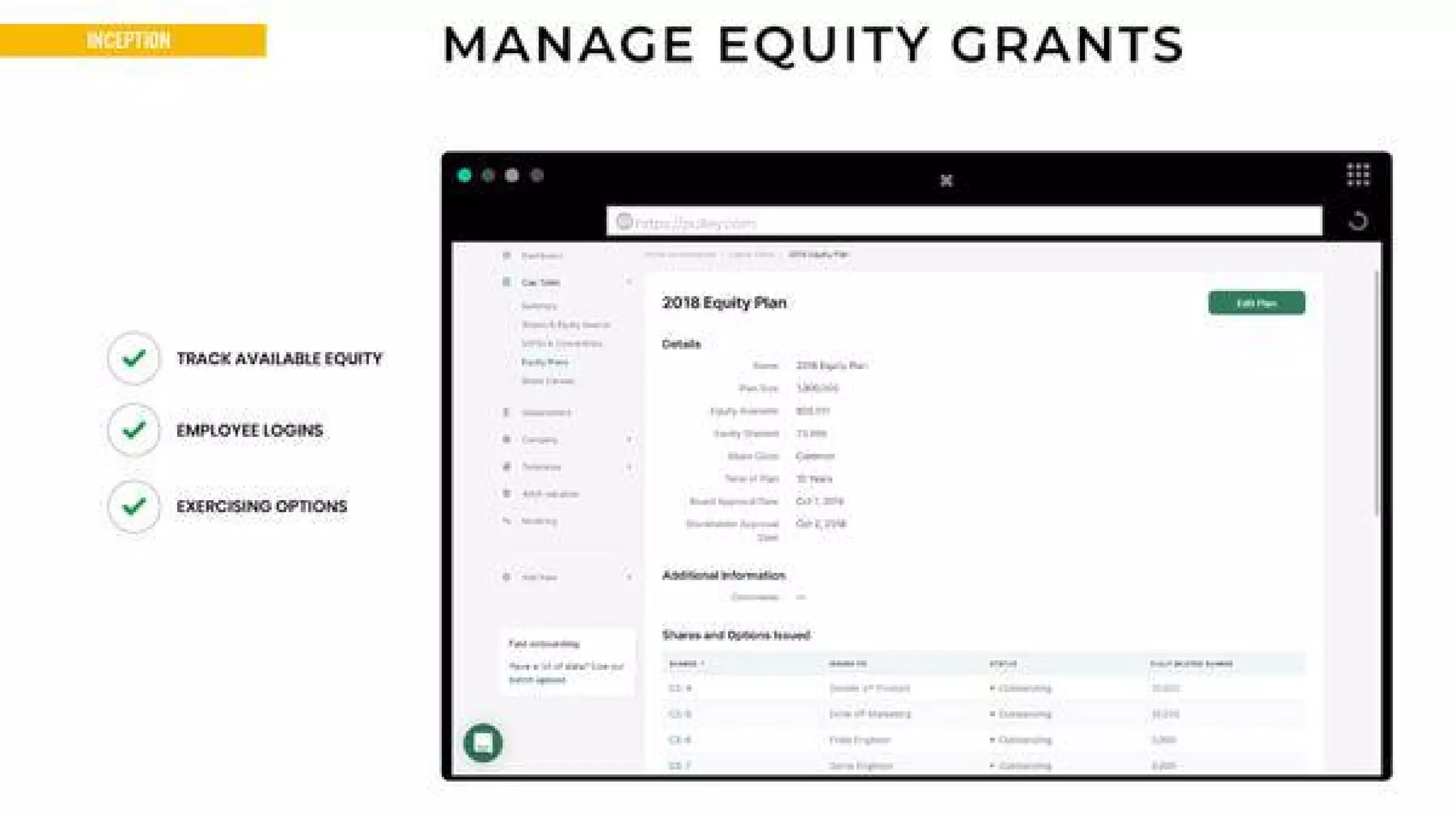
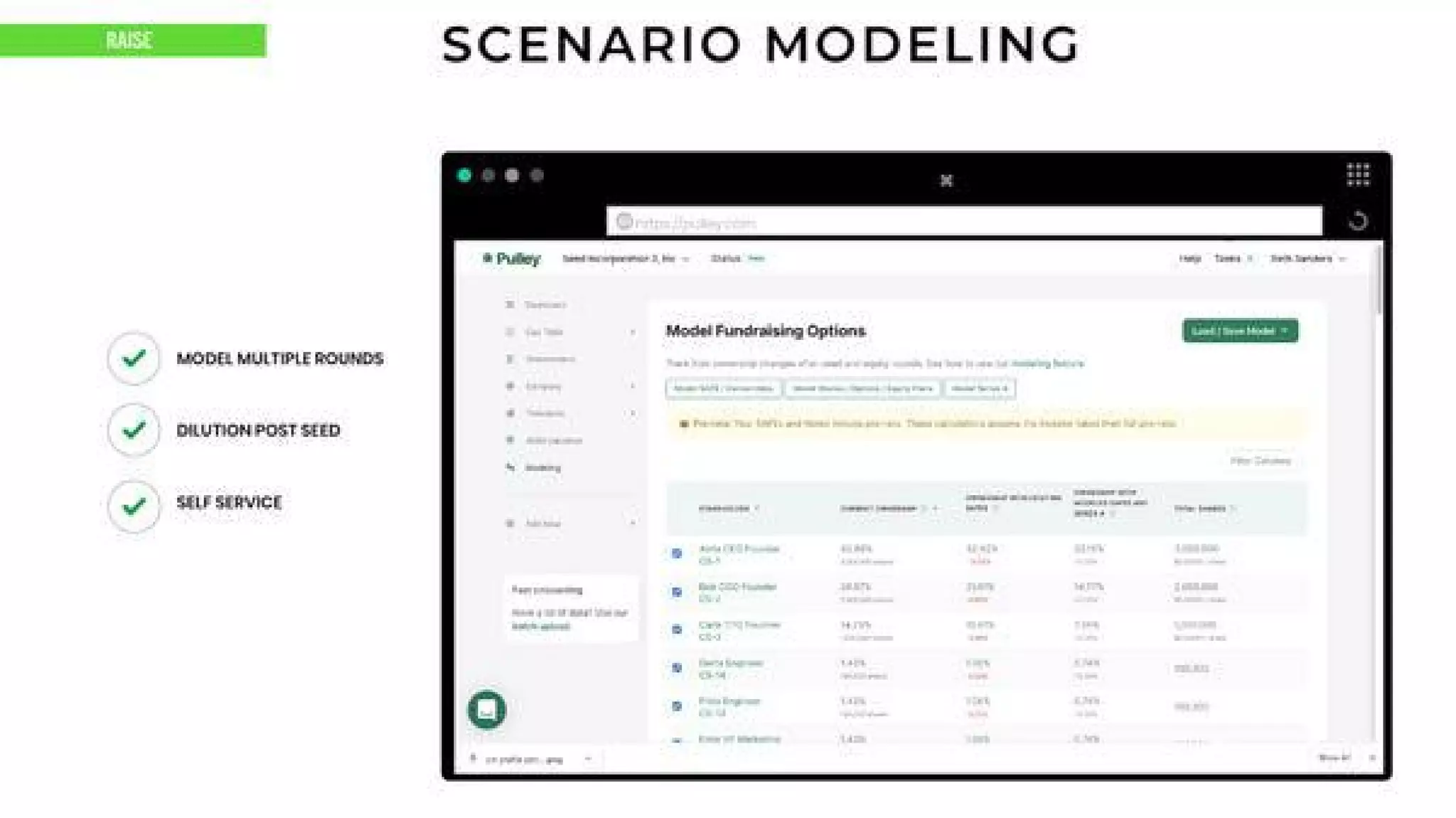
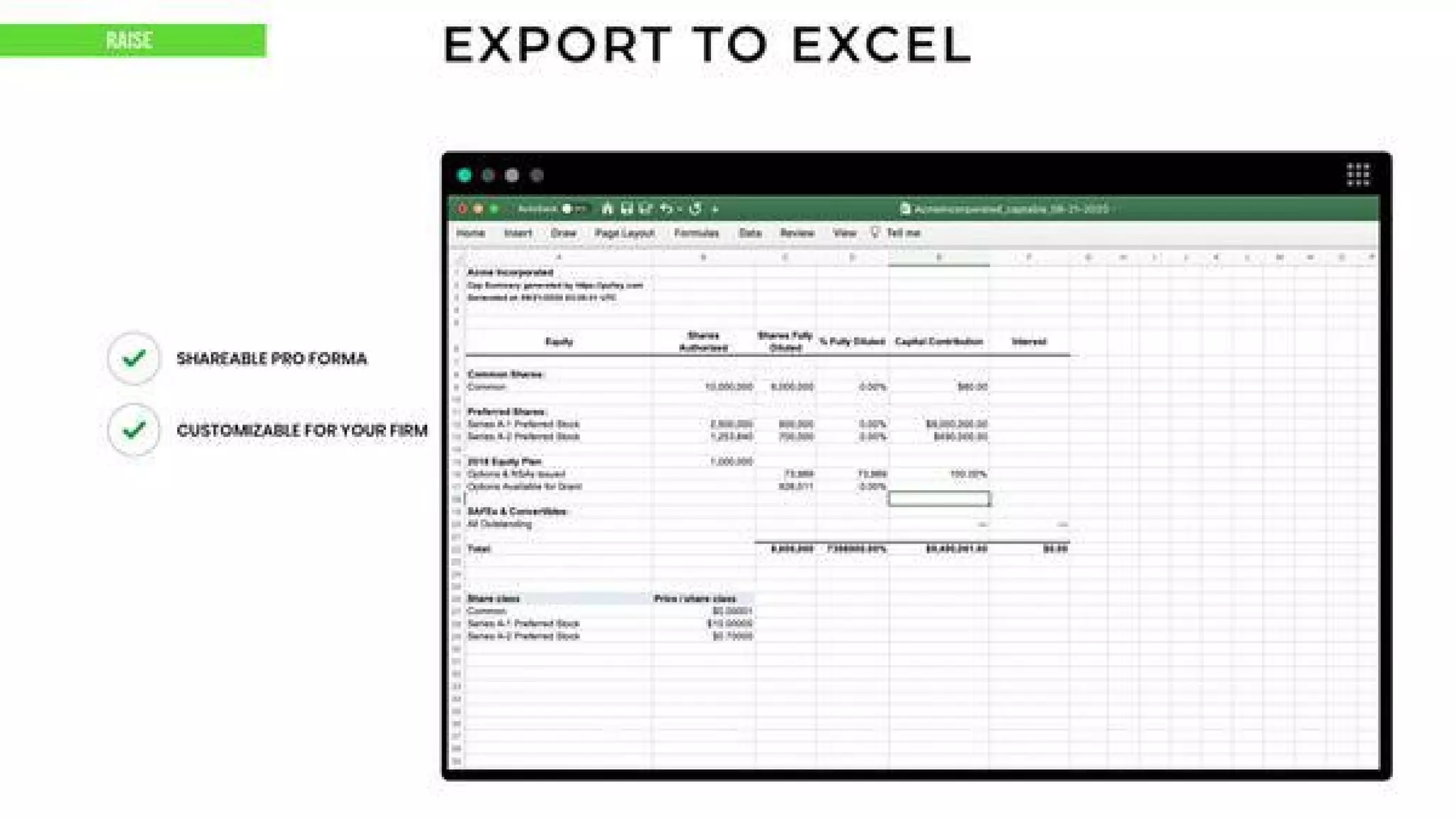
  • Product-first messaging: fast onboarding (15 minutes vs weeks), spreadsheet import, concierge onboarding for growth customers, scenario modeling, export to Excel, employee logins and exercising options (Slides 12–17).
  • Partnerships/third-party integrations (409A via partners) and enterprise capabilities for SSO, invoicing and transfer agent/pre-IPO support are noted for larger customers (Slides 16, 17, 18).

Market Opportunity

TAM/SAM/SOM analysis (numbers shown in deck):

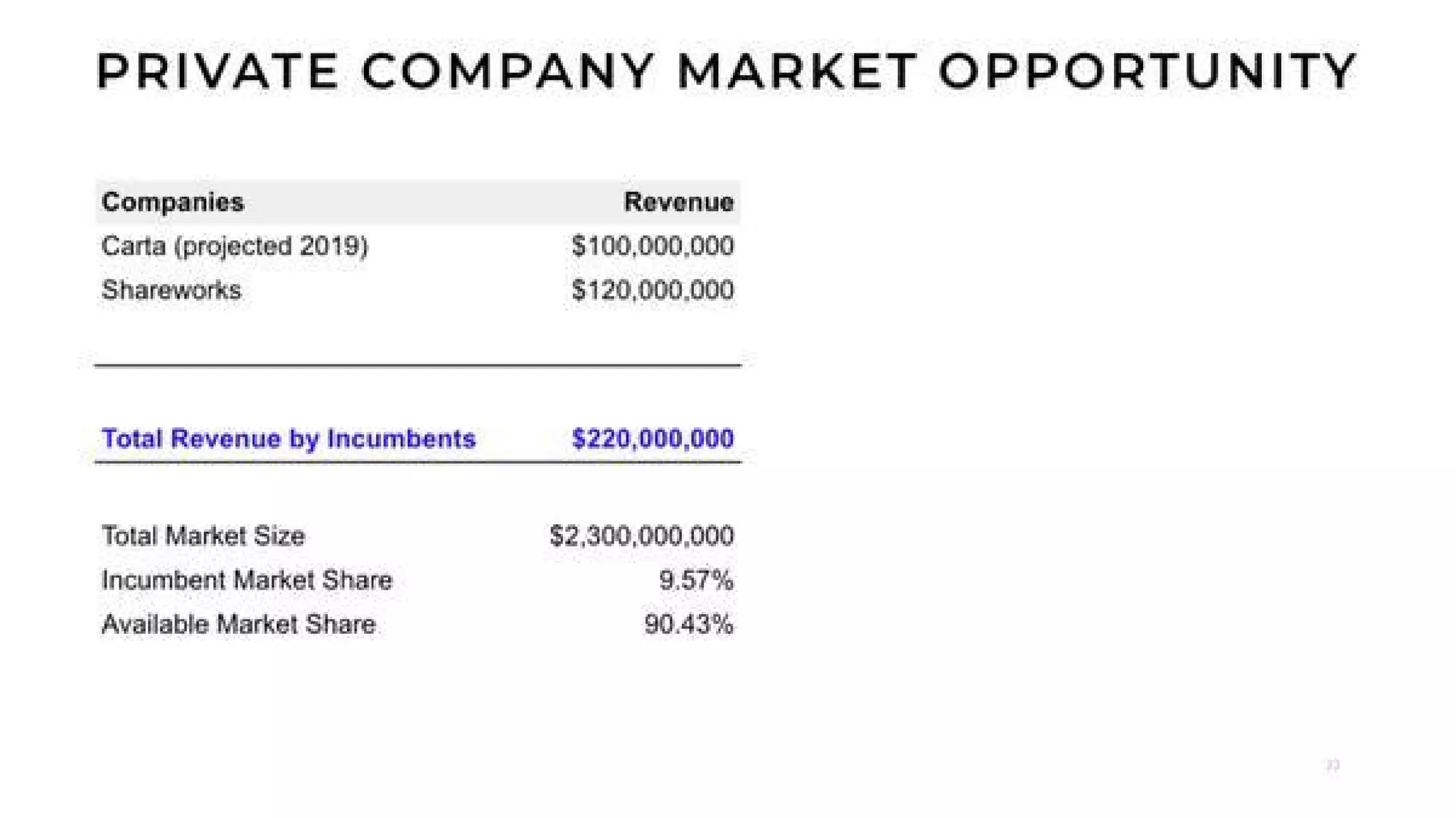
  • Total Market Size (private company market): $2,300,000,000 (Slide 22).
  • Incumbents’ combined revenue: $220,000,000 (Slide 22).
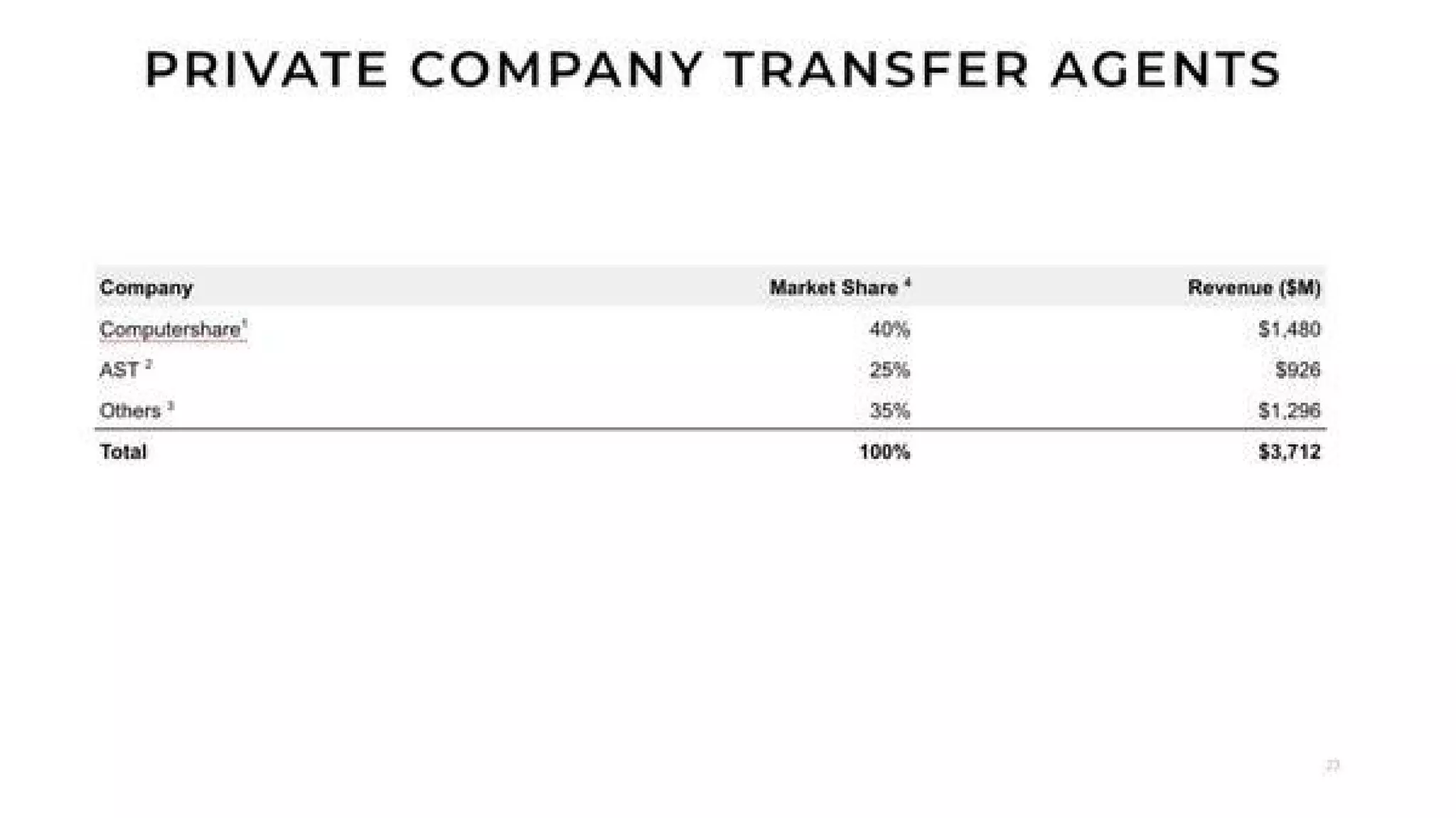
  • Transfer agent market (appendix): total revenue shown ≈ $3,712M with Computershare $1,480M, AST $926M, Others $1,296M (Slide 23).
  • The deck implies a large available market and significant incumbent revenue pools to compete with or displace.

Business Model

Revenue model and unit economics (as presented):

  • Per-stakeholder/month SaaS pricing tiers (Slide 10):
    • Startup: free for <20 stakeholders
    • Standard: $10 / stakeholder / month
    • Growth: $20 / stakeholder / month
    • Enterprise: custom (contact sales)
  • Value-add services (concierge onboarding, 409A valuations, transfer agent / enterprise integrations) imply one-time or services revenue streams for larger customers (Slides 9, 18).
  • The deck does not show explicit unit economics (LTV, CAC, gross margins) or ARR numbers.

Traction & Metrics

Growth metrics and proof points with specific numbers:

  • 82% of the last YC batch picked Pulley (Slide 6) — strong YC cohort penetration claim.
  • Notable customers / logos called out: Fast, HelixNano, Clubhouse, Namebase (Slide 6).
  • Product performance claims: onboarding in 15 minutes (vs weeks) and 409A in five days (vs a month) (Slide 7/12).
  • “Breakout companies are choosing Pulley” (companies raising $20M+ are picking Pulley) (Slide 6).
  • Backers: Stripe, Y Combinator, 8VC, General Catalyst, Caffeinated Capital (Slide 5) — investor validation.

Note: The deck does not present ARR, MRR, net churn, customer count, or clear growth curve numbers.

Competitive Positioning

How they differentiate:

  • Product completeness and speed: they claim to offer all features of competitors plus faster onboarding and concierge service (Slides 9–10, Slide 7 strategy).
  • Focus on early-stage startups with free tier + per-stakeholder pricing to capture seed/YC startups, then upsell to Growth/Enterprise.
  • Partnerships for 409A and potential transfer agents and downstream financial services provide differentiated service offerings (Slides 16–18, Slide 20).
  • Messaging emphasizes “10x more effective” interactions and speed of service as competitive moats (Slide 7).

Team

Team credentials (Slide 5):

  • CEO / Founder: Yin — prior Android systems founder, YC alum, Stanford CS (bio text).
  • Core team includes engineers with backgrounds at Docker, Pebble, Redius Intelligence, Stanford (Mark, Wil, Yoshio, Austin) and a designer (Caitlyn).
  • Solid mix of product/engineering and YC/startup experience; backed by strong investors (Stripe, YC, 8VC, General Catalyst).

Go-to-Market Strategy

Distribution approach (what’s shown):

  • Viral / word-of-mouth within YC and startup community — strong organic adoption in YC cohorts (Slide 6).
  • Product-led growth: free tier for small startups, self-onboarding (Slide 10), fast onboarding via spreadsheets and concierge for larger customers (Slides 12–13).
  • Upsell to Growth/Enterprise with services (409A valuations, transfer agents, SSO) (Slides 9, 16–18).
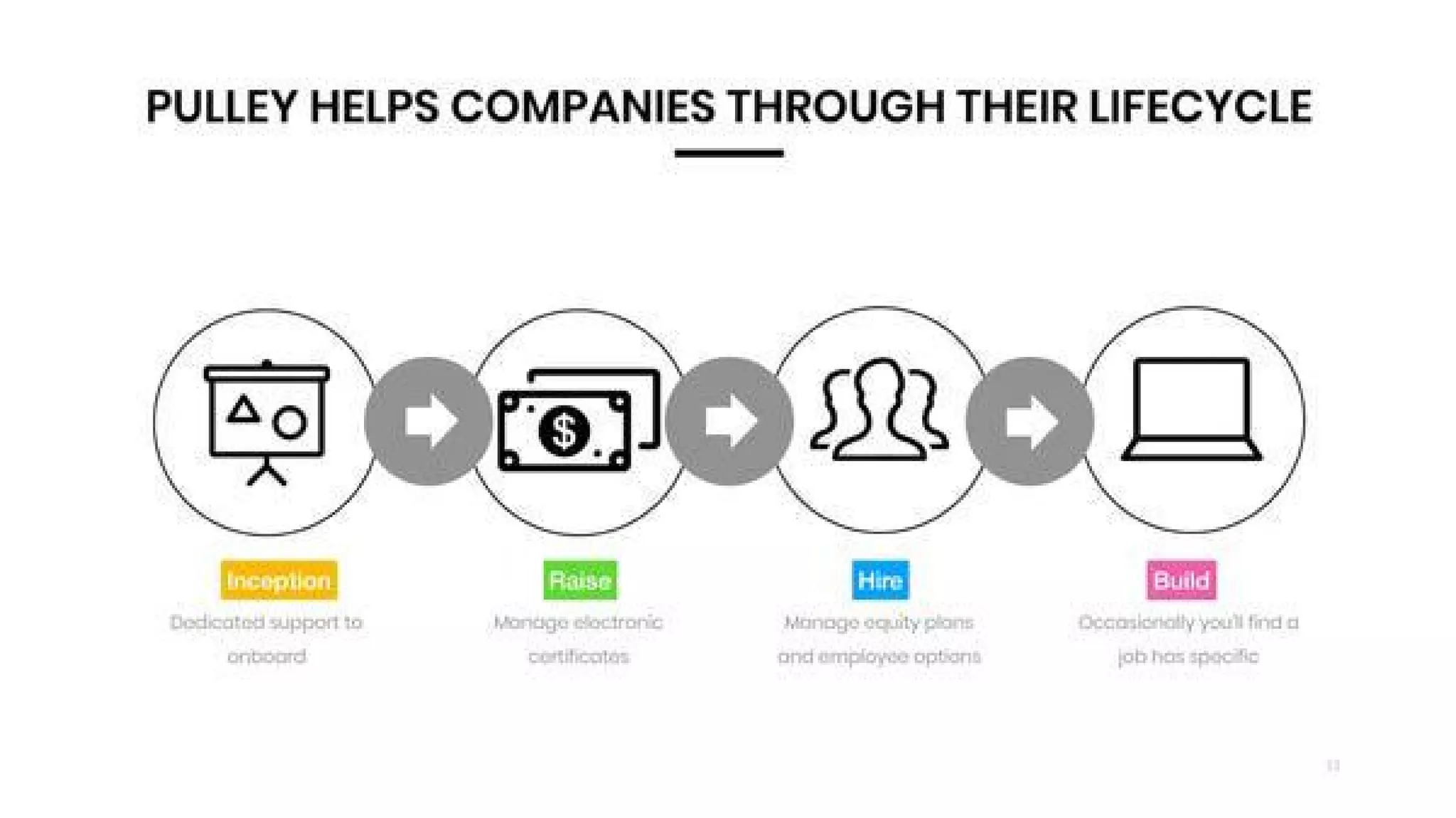
  • Focus on serving the lifecycle (Inception → Raise → Hire → Build) and embedding into startup tooling early (Slide 11).

The Ask

What they were raising and use of funds:

  • Round: Seed — $10M (stated company context). The deck itself emphasizes product development, go-to-market and service expansion but does not provide an explicit slide with a dollarized use-of-funds breakdown. Use-of-funds implied across product scaling, onboarding/concierge services, partnerships and expansion into financial/legal products (Slides 12–20).

Investor Deep Dive

Executive summary, strengths & red flags

Executive Summary

Pulley is a cap-table and equity management platform targeting startups, investors and employees. The 2020 seed deck is concise and product-focused: it states the mission, shows product screenshots, pricing and early traction (YC adoption, notable customers), and outlines straightforward expansion opportunities (financial services, secondary markets, legal tooling). It’s notable for strong customer signals, clean product demos, and credible backers (YC, Stripe, 8VC, General Catalyst).

Key Strengths

3 identified

1

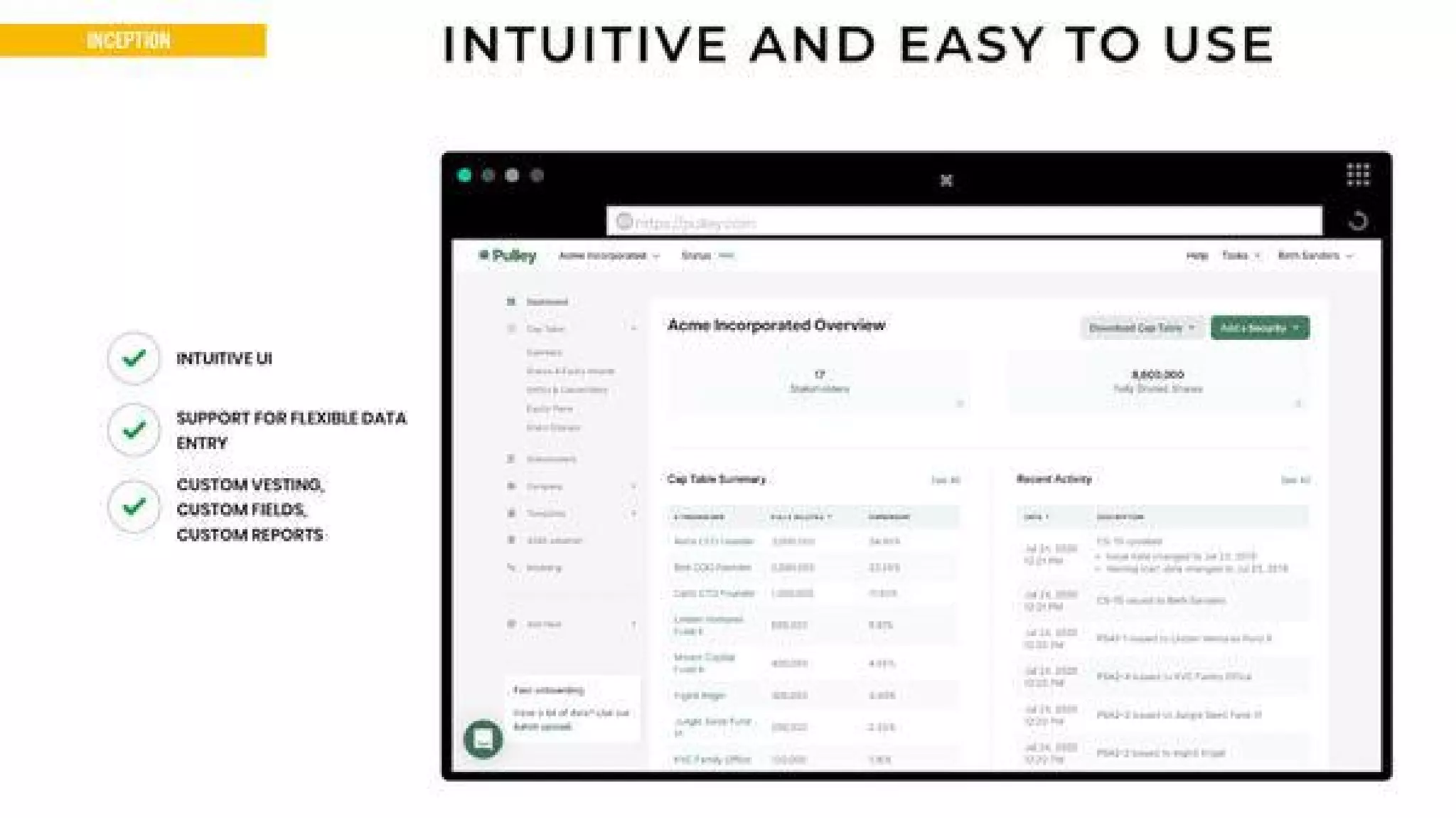
Clear, product-led positioning with strong product screenshots and concrete onboarding/usage claims (Slides 12–17). This instills confidence that the product exists and is usable.

2

Compelling early traction signals and endorsements — YC adoption (82% of last YC batch), logos of recognizable startups and high-quality investors (Slides 5–6). These reduce early-stage risk.

3

Sensible pricing and GTM funnel for startups: free starter tier to capture early companies and clear per-stakeholder monetization and enterprise upsell (Slide 10). The lifecycle view (Slide 11) aligns product value with customer needs.

Red Flags & Weaknesses

3 identified

1

No financial KPIs shown — no ARR/MRR, revenue run-rate, CAC, LTV, gross margin or cohort growth data. That makes valuation and traction assessment difficult.

2

Limited customer / usage metrics — while YC penetration and a few logos are claimed, total paid customers, churn, expansion revenue and case studies are absent.

3

TAM / market slides present top-line numbers but lack derivation detail or segmentation. The deck references large market figures (Slide 22–23) without showing addressable segment assumptions or go-to-market penetration targets.

More Pitch Decks To Study

Compare structure, fundraising context, and investor-facing story across similar startup decks.