Compare your deck to Starburst

Compare Your Deck

Starburst Pitch Deck (2019)

SaaS
Stage: Series D
Raised: $22M
Year: 2019
Slides: 14
Outcome: Valued at $3.35B after Series D (2022)

Pitch Deck

1 / 14
Starburst pitch deck - The Opening: Simple, bold positioning
Click to expand

Deck Analysis

This pitch deck from Starburst (Series D, 2019) positions the company as a performance-focused analytics platform that enables organizations to query data where it lives rather than copying it into a single warehouse. The deck balances a bold product promise — enabling analysis of 'your house' not 'their house' — with market sizing, team credibility, product architecture, and customer evidence. It’s notable for clear positioning against legacy data-warehouse thinking, concise visual storytelling, and a focus on developer and enterprise buyer concerns (performance, security, connectivity).

The Opening: Simple, bold positioning

The Opening: Simple, bold positioning

Slide 1 is a clean title slide that establishes brand (Starburst) and founder credibility in a single frame. The minimalist visual and large logo set tonal expectations: modern, technical, and confident. It functions as a professional framing device for what follows and keeps attention on identity rather than distracting design flourishes.

Founders can learn from how the slide anchors the deck. A simple title slide that includes company name, logo and founder/CEO attribution signals seriousness and allows the following slides to deliver the narrative without repeating basic identity information. It’s an easy way to start with consistent branding and credibility.

Key Takeaway: Open with a clean, branded title slide that communicates professionalism and lets your core narrative take center stage.
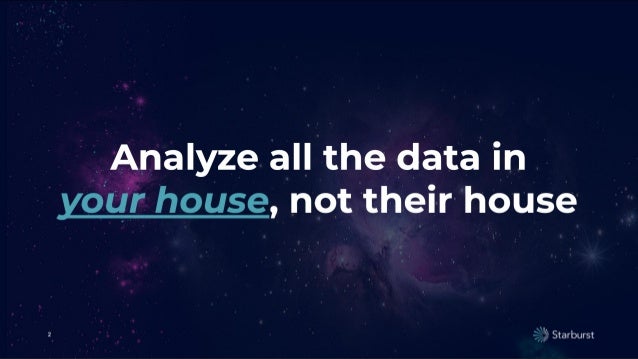
The Hook: Clear customer-centric value prop

The Hook: Clear customer-centric value prop

Slide 2 uses a one-line, customer-centric hook: "Analyze all the data in your house, not their house." This framing immediately contrasts Starburst’s approach with vendors that require data movement into proprietary systems. The sentence is short, memorable, and highlights control and ownership — powerful themes for enterprise buyers concerned about lock-in and compliance.

The design reinforces the message: large type, emphasis on the contrasting phrase, and a space-themed background that feels aspirational. Founders should note how a concise, differentiating hook can be repeated across sales materials and used as a rallying internal message (product, marketing, sales).

Key Takeaway: Lead with a single, memorable differentiator that speaks directly to buyer pain (e.g., avoid vendor lock-in).
Establishing Market Context: Data-driven economy

Establishing Market Context: Data-driven economy

Slide 3 immediately broadens the conversation to market forces: executives want more data-driven organizations. By citing a stat (83% of CEOs) and a recognizable research brand, the deck validates demand rather than relying only on product claims. This positions Starburst as an enabler for a large strategic trend rather than a niche tool.

For founders, this is a reminder to connect product capability to macro market needs. A brief market or trend slide helps investors see upside beyond early adopters and makes it easier to tie product metrics to potential TAM and adoption velocity.

Key Takeaway: Use concise, credible market signals to demonstrate demand and frame your product as part of a broad, strategic trend.
TAM and Market Segmentation: Quantify the opportunity

TAM and Market Segmentation: Quantify the opportunity

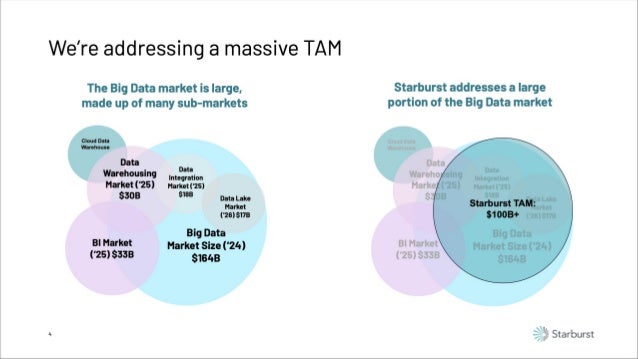
Slide 4 breaks the Big Data market into sub-markets and then overlays the portion Starburst addresses, presenting a defensible TAM. The visual Venn-style approach makes it easy to see overlap and where Starburst sits across data warehouse, data lake, and BI segments. This clarifies that the company is not competing only in a narrow niche but touching multiple adjacent markets.

Founders should note how this slide pairs specificity (market sizes and segments) with visual simplicity. Investors want to see a credible numerical opportunity; show how your solution intersects established markets and quantify that intersection rather than claiming an amorphous 'huge market.'

Key Takeaway: Visually map and quantify the portion of established markets you realistically address — it builds credibility and focus.
Team and Origins: Domain expertise matters

Team and Origins: Domain expertise matters

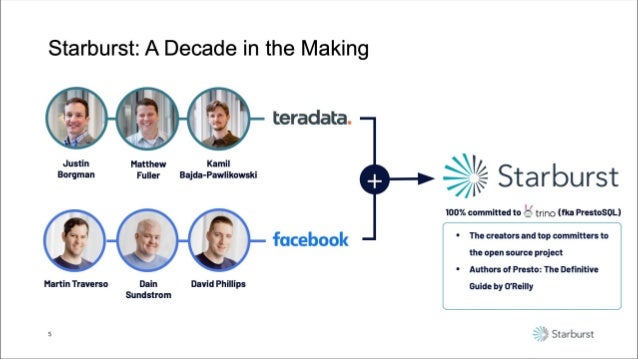
Slide 5 combines founding team photos with traces of their enterprise provenance (Teradata, Facebook) to communicate deep domain experience. The slide calls out open-source commitments (Trino/PrestoSQL) and authorship credibility. This reassures technical buyers and investors that the founders understand both the engineering and the business challenges of large-scale analytics.

For founders, this shows the power of pairing recognizable engineering pedigree with open-source stewardship. In technical categories, demonstrating hands-on leadership in relevant projects and communities accelerates trust and helps recruitment, partnerships, and customer conversations.

Key Takeaway: Showcase domain-specific credentials and open-source leadership to build technical credibility and trust.
Product Architecture: Clear, customer-focused stack

Product Architecture: Clear, customer-focused stack

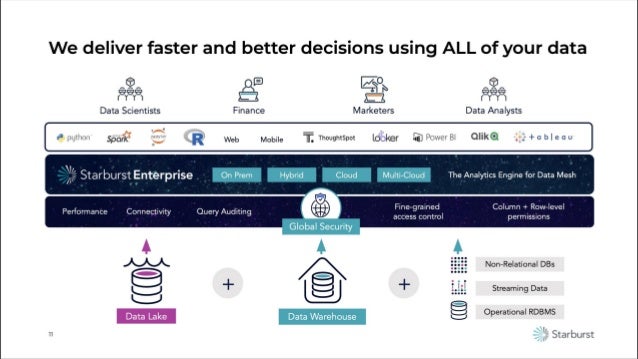
Slide 9 (the tech stack/flow) explains how Starburst sits between users and various data sources, highlighting performance, connectivity, global security, and access patterns. The layered diagram communicates that Starburst integrates across on-prem, cloud, and multi-cloud environments while supporting BI tools and data science workflows. This addresses common buyer concerns—compatibility, security, and flexibility—without heavy technical detail.

Founders should emulate this approach: show where you sit in the customer landscape, how you reduce friction, and what key technical guarantees (security, performance) you provide. A single clear architecture slide can answer many implicit product questions and reduce objections in early conversations.

Key Takeaway: Use a clear architecture diagram to show how your product plugs into existing ecosystems and reduces customer friction.
Customers and Mission: Proof plus purpose

Customers and Mission: Proof plus purpose

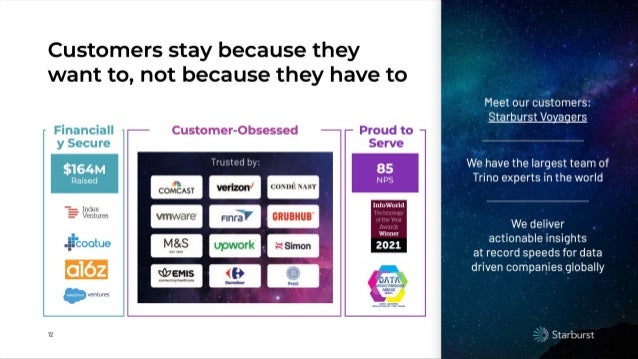
Slide 12 pairs customer logos, financial credibility (funding), and a high NPS (85) with messaging about global expertise and speed of insights. This blend of quantitative social proof and mission-oriented language ('We exist to free our customers' appears later) signals both traction and values. It appeals to investor preference for strong retention and to customers who want proven, mission-aligned partners.

Founders can learn to present both metrics (NPS, raised capital, marquee customers) and an emotional or mission narrative. Metrics alone are persuasive, but coupling them with a concise mission statement helps the brand resonate and creates a memorable narrative for sales and hiring.

Key Takeaway: Combine hard customer metrics and logos with a clear mission statement to convey traction and purpose.

Conclusion: Key Lessons

Starburst’s deck is effective because it pairs a crisp, differentiated value proposition with market context, credible team origins, a clear technical architecture, and concrete customer proof. The narrative moves logically from problem and market demand to product placement, team credibility, and validation — a flow that answers investor and buyer questions in sequence.

Actionable advice: lead with a single memorable differentiator, quantify the market you address, demonstrate technical credibility (especially in infrastructure/enterprise markets), use a simple architecture diagram to reduce objections, and finalize with tangible customer evidence and a mission that connects emotionally. These elements together create clarity, reduce friction in investor and buyer conversations, and position a startup to scale enterprise adoption.

Full Deck Analysis

11 sections

Overview

Company: Starburst
Round: Series D ($22M)
Year: 2019
Outcome: Valued at $3.35B after Series D (2022)

Executive Summary

This 14-slide Series D deck positions Starburst as the enterprise analytics engine that lets customers query and analyze all their data where it lives (data lakes, warehouses, operational stores) without moving it into a vendor lock‑in system. The deck leans on a strong technical origin (Teradata + Facebook, creators/committers of Presto/Trino), a large addressed market (Big Data TAM shown at $164B; Starburst TAM > $100B), and enterprise customer evidence (logos + NPS 85) — but it provides almost no hard financial metrics (ARR, churn, unit economics) or a detailed use-of-funds plan.

Problem Statement

  • Slide 2: “Analyze all the data in your house, not their house” — frames the core problem as vendor lock-in and the need to keep data where it resides.
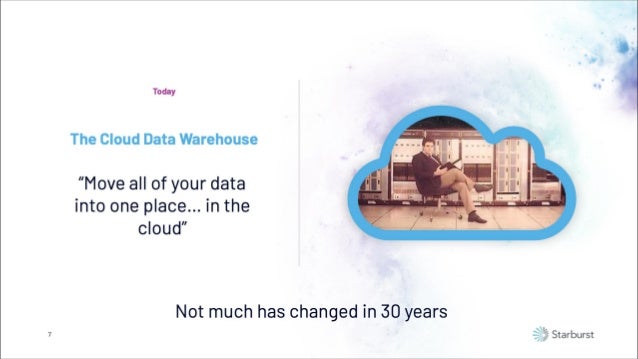
  • Slide 6 & 9: Historical context showing the 30-year-old “move all of your data into one place” mindset (Teradata → cloud DW) and asserting “Not much has changed in 30 years.”
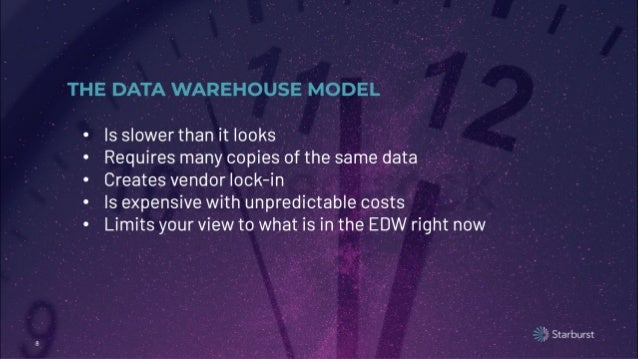
  • Slide 10: Explicit critique of the data warehouse model:
    • Is slower than it looks
    • Requires many copies of the same data
    • Creates vendor lock-in
    • Is expensive with unpredictable costs
    • Limits your view to what’s in the EDW right now
      These slides articulate that current warehouse-centric approaches are slow, costly, duplicative, and cause lock-in — creating a need for a query/analytics approach that accesses distributed data.

Solution

  • Central proposition: Starburst (based on Trino / PrestoSQL) provides an analytics engine that queries data in place across data lakes, warehouses, operational and third-party sources and connects to BI/data science tools (Slide 8 & 11).
  • Slide 8 shows the product positioning (Starburst Enterprise) as deployable on-prem, hybrid, cloud, multi-cloud with features like performance, connectivity, query auditing, fine-grained access control and global security.
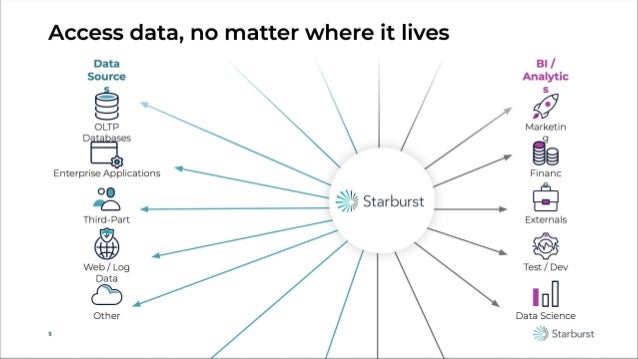
  • Slide 11 visualizes Starburst as a hub connecting many data sources (OLTP, enterprise apps, web/logs, third-party) to many BI/analytic consumers (marketing, finance, data science, external users).
  • Value claim: Faster, better decisions using all of your data, avoiding the cost and lock-in of moving everything to a single cloud data warehouse.

Market Opportunity

  • Slide 4 enumerates the market subsegments and sizes:
    • Big Data Market Size (’24): $164B (primary top-level figure shown)
    • Data Lake Market (’26): $78B (as shown on the slide)
    • Data Warehousing Market (’25): $30B
    • BI Market (’25): $33B
    • Data Integration Market (’25): $18B (visible on the slide)
  • Starburst claims an addressed TAM of $100B+ (Slide 4, right side overlay).
  • Interpretation: Starburst targets a very large, multi‑segment data infrastructure market (data lakes + warehouses + BI + integration) and positions itself as addressing a large portion of that market.

Business Model

  • Enterprise software / commercialized open-source model implied:
    • Starburst Enterprise product (licensed/subscription) vs. open-source Trino/Presto upstream (Slide 5 & 8).
    • Deployment models: On-prem, hybrid, cloud, multi-cloud — suggesting subscription licensing, enterprise support, and services revenue potential.
  • No explicit pricing, ARR, gross margins, CAC, or LTV/CAC provided in the deck.

Traction & Metrics

  • Customers: a sizable set of recognizable enterprise customers shown on Slide 12 (Comcast, Verizon, Condé Nast, VMware, FINRA, Grubhub, M&S, Upwork, Simon, EMIS, etc.).
  • Slide 12 claims $164M raised (displayed as “$164M Raised”), which appears to be cumulative funding (but conflicts with the specific Series D $22M mention in the brief context).
  • NPS: “Proud to Serve — 85 NPS” (Slide 12).
  • Product/technical traction: credible open-source credentials — creators and top committers to Trino (PrestoSQL) and authorship of Presto literature (Slide 5).
  • Missing: No ARR, growth rates, revenue, customer count, average deal size, churn, or unit economics are shown.

Competitive Positioning

  • Core differentiation: query data where it lives (avoid moving into vendor cloud/warehouse), thereby avoiding vendor lock-in and duplicate copies (Slides 2, 10, 11, 13).
  • Technical moat: founders/engineers from Teradata and Facebook, creators/top committers to Trino/Presto — implies deep system-level expertise and community credibility (Slide 5).
  • Product positioning: integrates widely with BI tools and data science stacks (Slide 8), supports multi-cloud and hybrid deployments.
  • The deck does not present direct competitor comparisons by name (e.g., Snowflake, Databricks, BigQuery) or a detailed feature/price matrix.

Team

  • Founding and early team provenance (Slide 5):
    • From Teradata: Justin Borgman (Co‑founder & CEO), Matthew Fuller, Kamil Bajda‑Pawlikowski
    • From Facebook: Martin Traverso, Dain Sundstrom, David Phillips
  • Highlight: creators and top committers to Trino (fka PrestoSQL) and authors of Presto-related materials (technical credibility and open-source leadership).

Go-to-Market Strategy

  • Implied GTM elements:
    • Enterprise sales to large organizations (customer logos, NPS, claim of largest team of Trino experts — Slide 12).
    • Open-source adoption → commercial conversions (product built on Trino/Presto; Slide 5).
    • Integration-led approach: plug into existing BI tools and data stacks (Slide 8 shows many connectors and BI front-ends).
    • Services/consulting expertise (implied by “largest team of Trino experts”).
  • Not shown: specific sales motions, channel partnerships, CAC, or detailed pipeline/segmentation.

The Ask

  • Deck context: Series D raise of $22M (2019).
  • Slide-level detail: the slide set does not explicitly break out a detailed use-of-funds plan or milestones tied to the ask (no burn, runway, hiring plan or GTM expansion specifics included).

Investor Deep Dive

Executive summary, strengths & red flags

Executive Summary

This 14-slide Series D deck positions Starburst as the enterprise analytics engine that lets customers query and analyze all their data where it lives (data lakes, warehouses, operational stores) without moving it into a vendor lock‑in system. The deck leans on a strong technical origin (Teradata + Facebook, creators/committers of Presto/Trino), a large addressed market (Big Data TAM shown at $164B; Starburst TAM > $100B), and enterprise customer evidence (logos + NPS 85) — but it provides almost no hard financial metrics (ARR, churn, unit economics) or a detailed use-of-funds plan.

Key Strengths

3 identified

1

Strong technical credibility and origin story — founders and core engineers from Teradata and Facebook and creators/top committers to Trino/Presto (Slide 5). This gives product credibility and an engineering moat.

2

Clear, crisp positioning versus the incumbent data warehouse model — multiple slides (2, 6, 9, 10, 11) articulate the problem (lock-in, duplication, cost) and the in-place query solution succinctly.

3

High-quality visual design and product framing — coherent visuals (architecture on Slide 8, access diagram on Slide 11) and clear customer/social proof (Slide 12, NPS 85, enterprise logos) make the deck persuasive for enterprise buyers and investors on product-market fit.

Red Flags & Weaknesses

3 identified

1

Lack of financials / unit economics — no ARR, revenue, growth rates, gross margin, LTV/CAC, or customer-level economics are presented; an investor would demand these before writing a check.

2

No explicit use-of-funds or milestone plan for the $22M Series D — the deck doesn’t show how the new capital will be allocated (hiring, R&D, sales expansion, etc.).

3

Limited competitive analysis — the deck criticizes the cloud data warehouse model but does not explicitly name or compare to incumbent competitors (Snowflake, Databricks, cloud DWs), nor does it show defensible go-to-market counters to them.

More Pitch Decks To Study

Compare structure, fundraising context, and investor-facing story across similar startup decks.