Compare your deck to Common Room

Compare Your Deck

Common Room Pitch Deck (2021)

SaaS
Stage: Seed
Raised: $20M
Year: 2021
Slides: 12
Outcome: Raised $52.9M total

Pitch Deck

1 / 12
Common Room pitch deck - The Opening: Establishing mission and tone
Click to expand

Deck Analysis

This deck from Common Room (Seed, 2021) is a concise, design-forward pitch that defines a clear market shift toward community-driven product adoption and positions Common Room as the “community intelligence” platform that aggregates engagement and business data to surface insights and drive action. What makes it notable is the disciplined storytelling arc: a bold mission headline, a crisp problem statement, a product value proposition, concrete day-to-day use cases, and visual diagrams that show how disparate data sources feed a single platform. The deck balances high-level market context with three practical layers—discovery, nurture, measurement—making it easy for investors to see both market timing and product defensibility.

The Opening: Establishing mission and tone

The Opening: Establishing mission and tone

Slide 1 uses a powerful, single-sentence mission — “Common Room brings organizations closer to their communities” — set in oversized type against a dark background. The visual minimalism and large typography immediately communicate confidence and focus: visitors instantly understand what the company does and why it matters. The design choices (negative space, limited copy) keep attention on the mission rather than distracting with metrics or busy visuals.

Key Takeaway: Lead with one clear, memorable mission statement and a clean visual hierarchy so listeners immediately know what you do and why it matters.
Market Context: Demonstrating a structural shift

Market Context: Demonstrating a structural shift

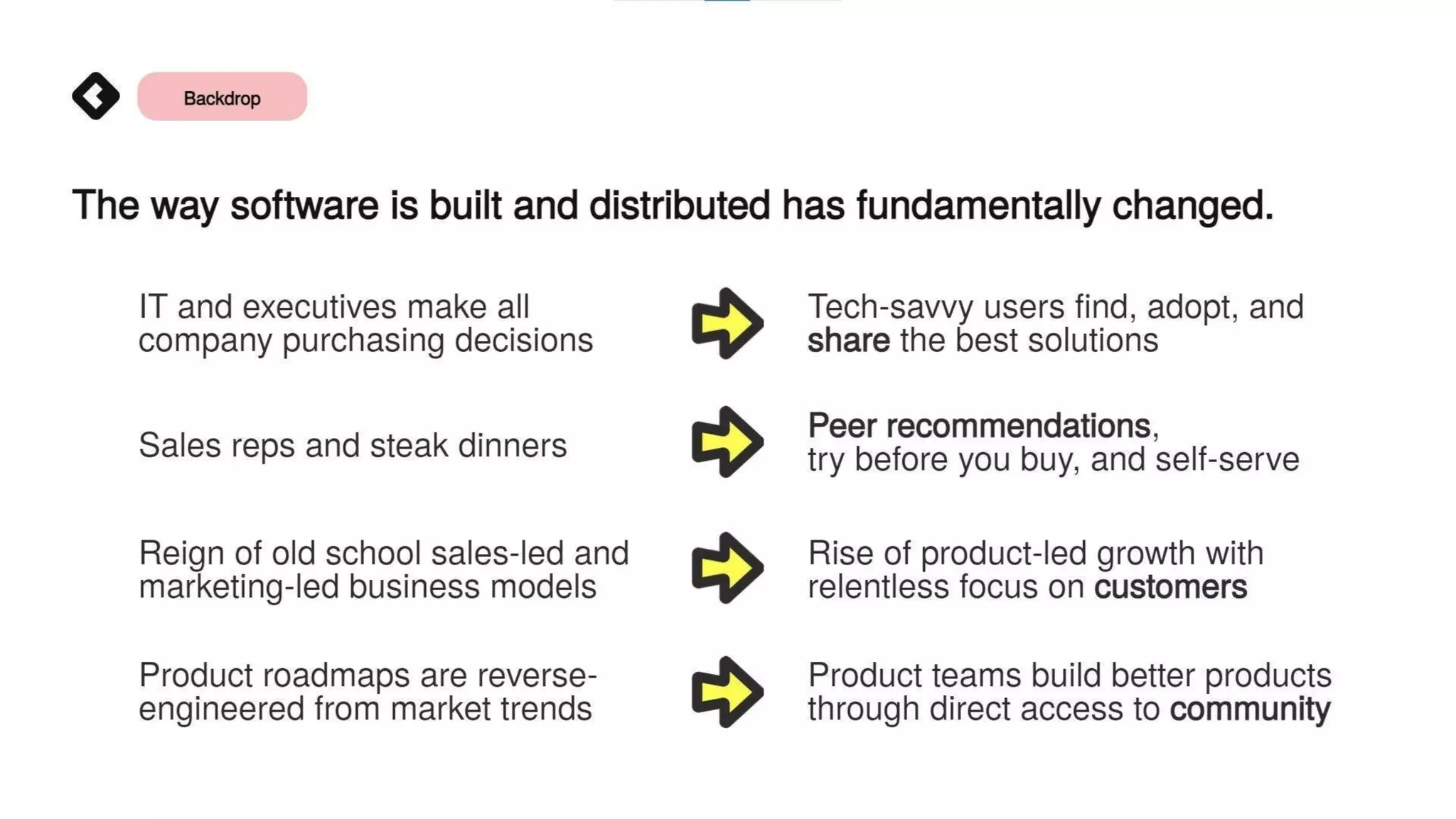
Slide 2 lays out the macro shift in how software is bought and adopted: from executive/IT-led purchases to peer recommendations, product-led growth, and community-driven roadmaps. The left-to-right comparison (old vs new) is a simple rhetorical device that makes the trend self-evident and sets up the product need without heavy data. This is effective because it frames the opportunity as irreversible market evolution rather than a temporary fad.

Key Takeaway: Use clear before/after framing to show why the market has permanently changed and why your solution is timely.
Problem Framing: Specific operational gaps

Problem Framing: Specific operational gaps

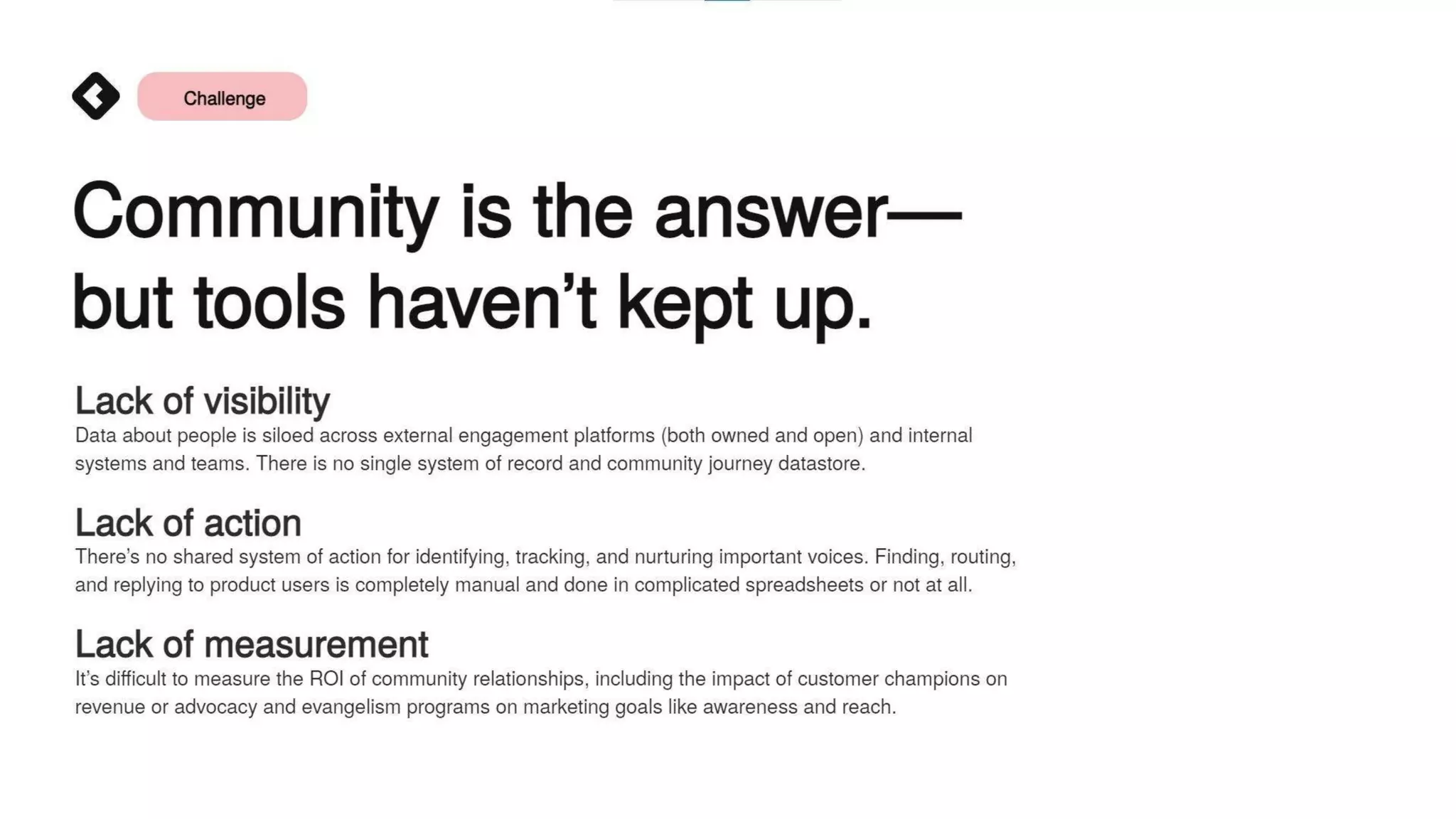
Slide 3 drills into three concrete failures in today’s tooling: lack of visibility, lack of action, and lack of measurement. Each bullet explains the operational pain (siloed data, manual workflows, unclear ROI) that community teams face. This is smart because it translates the high-level market shift into day-to-day headaches that a product can plausibly solve, making the problem both believable and addressable.

Key Takeaway: Map a macro trend to 2–4 tangible, operational pain points so your product solves problems buyers actually live with.
Value Proposition: Clear product positioning

Value Proposition: Clear product positioning

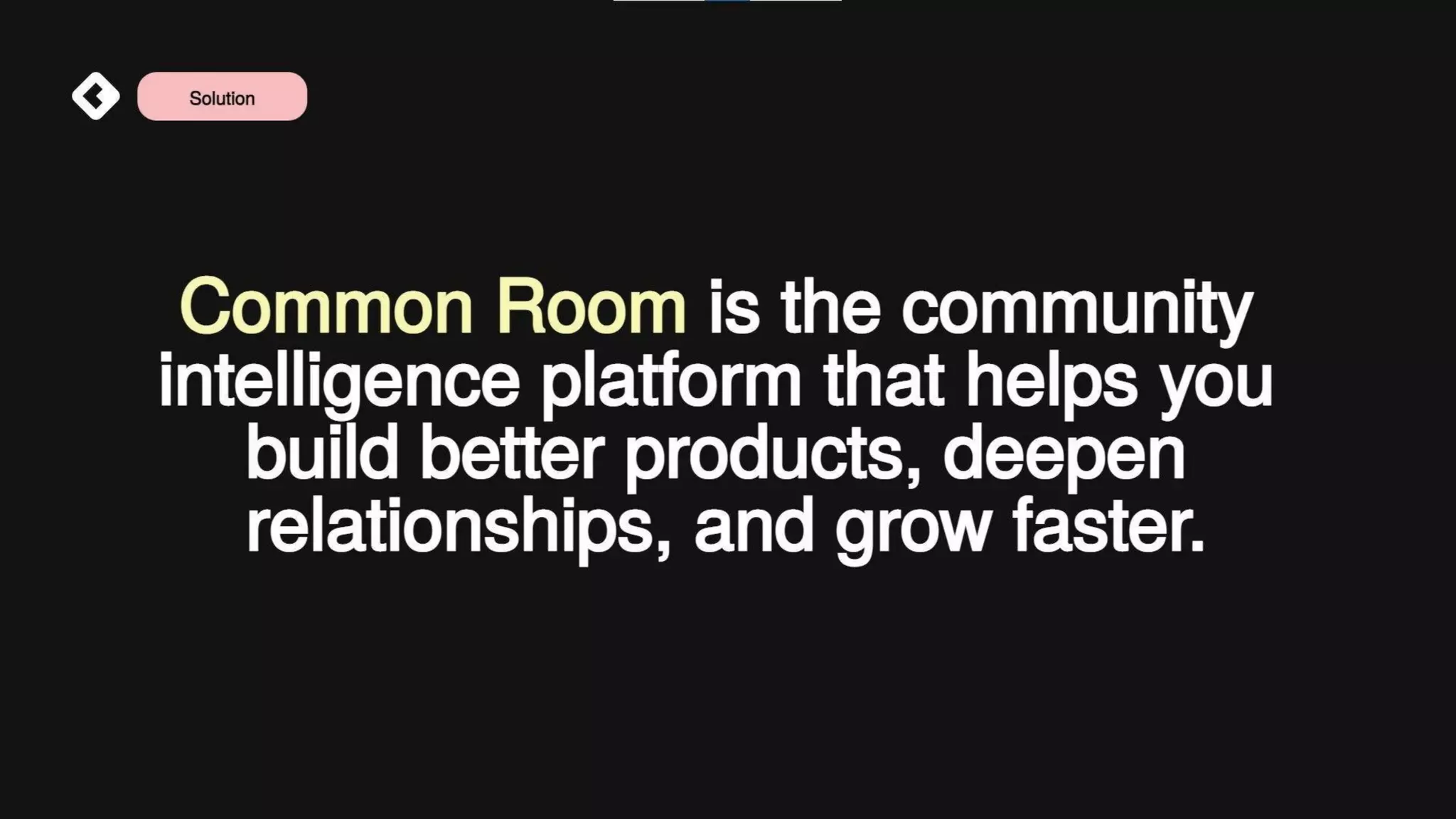
Slide 6 (the stated solution slide) positions Common Room as a community intelligence platform that helps teams build better products, deepen relationships, and grow faster. The headline is benefit-led rather than feature-led, which keeps the focus on outcomes (product quality, relationships, growth) investors and buyers care about. The contrast between the short mission slide and this solution statement shows good pacing: first establish the why, then the what and how.

Key Takeaway: Position your product around measurable outcomes (not features) so every subsequent visual can illustrate how you deliver those outcomes.
Go-to-Market / Customers: Who you’re built for

Go-to-Market / Customers: Who you’re built for

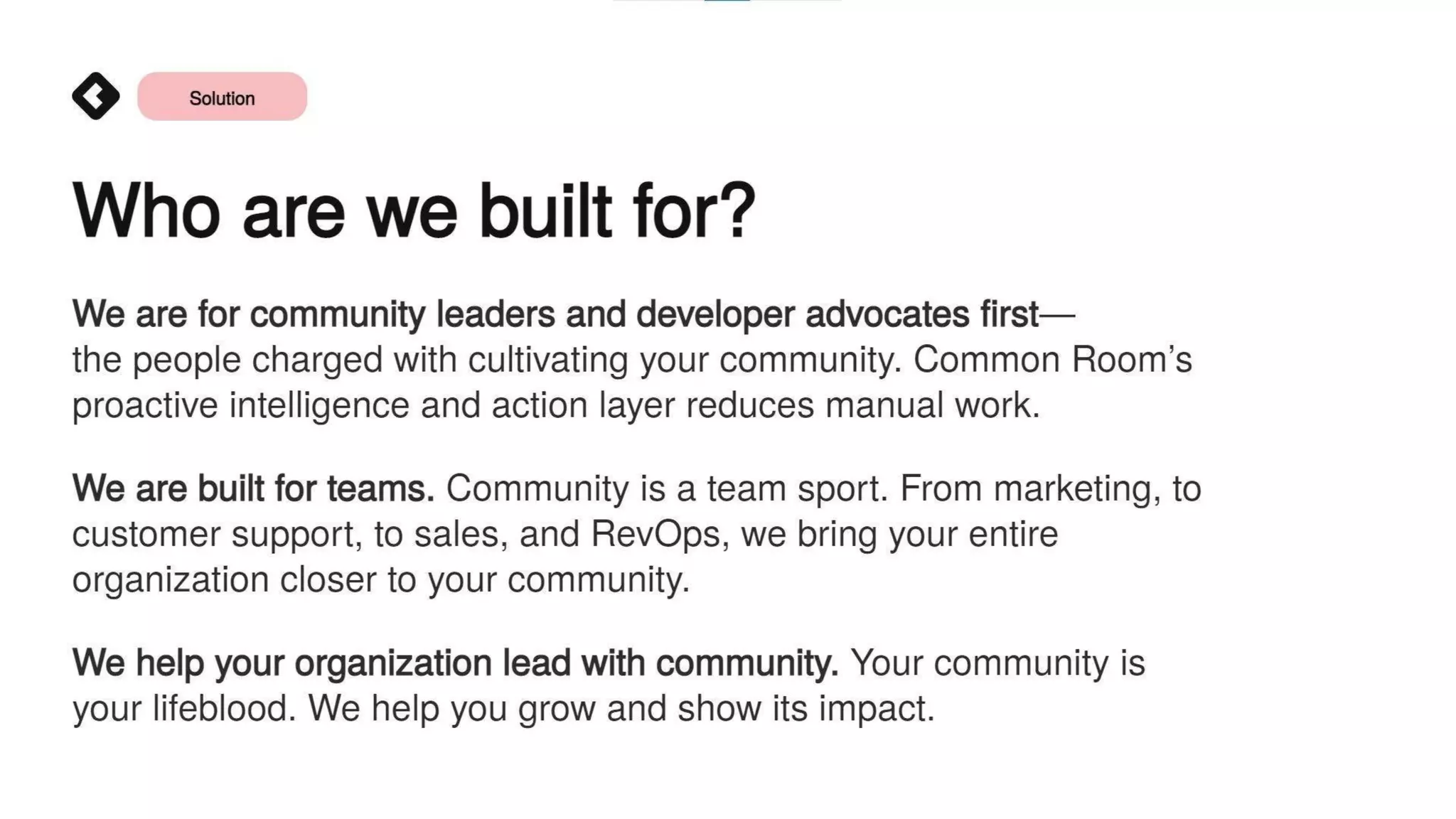
Slide 7 defines the primary users—community leaders and developer advocates—and explains secondary stakeholders across marketing, customer support, sales, and RevOps. This passage is important because it ties product value to specific roles and workflows, clarifying who will buy, who will use, and who will champion the product internally. The narrative also emphasizes that community work is cross-functional, giving the company license to sell both to community teams and to broader customer success or growth teams.

Key Takeaway: Explicitly name your primary user and the adjacent teams you’ll expand into — this helps investors understand your acquisition and expansion motion.
Day-in-the-Life: Demonstrating use cases and workflows

Day-in-the-Life: Demonstrating use cases and workflows

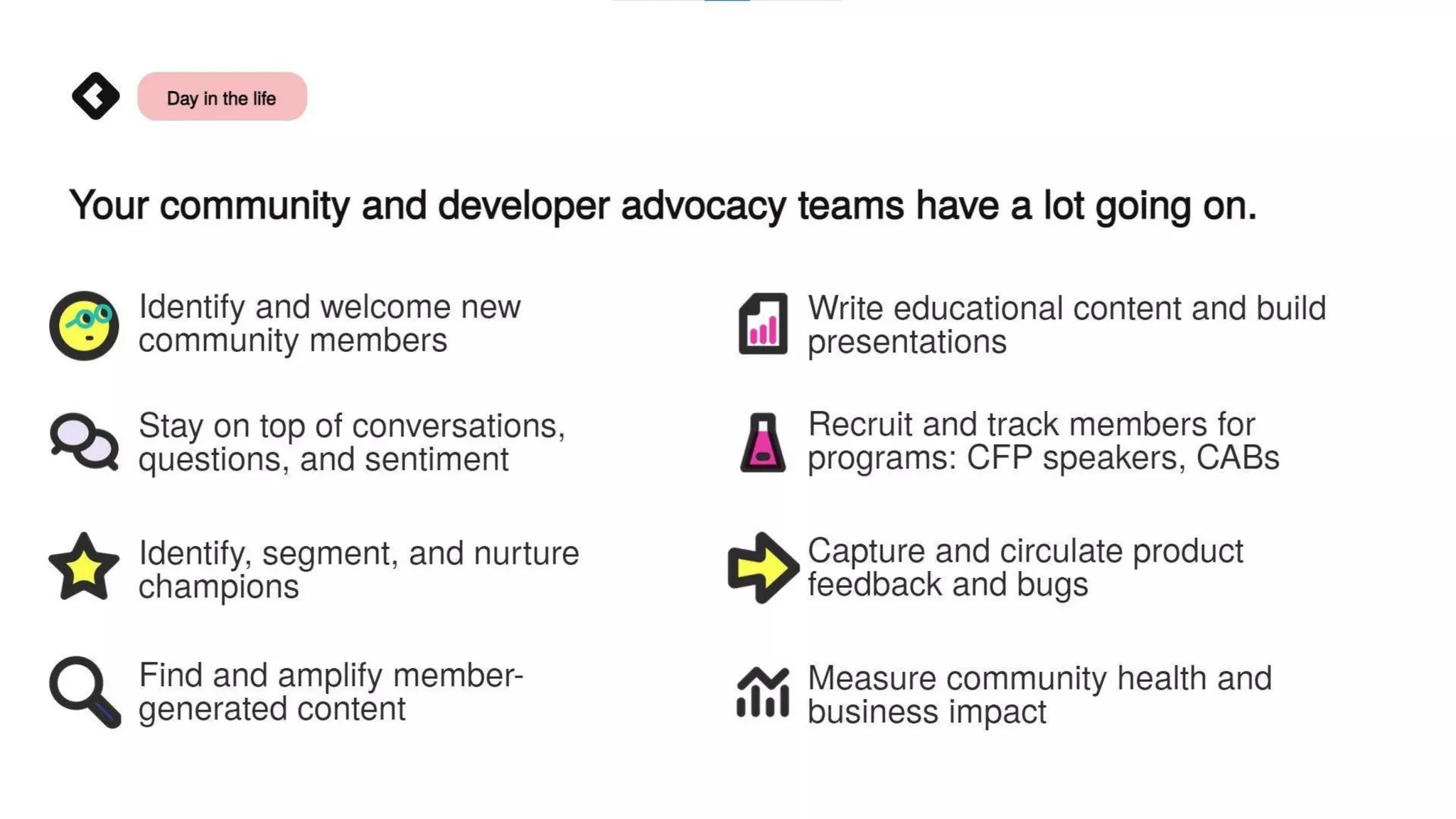
Slide 8 lists concrete tasks community teams handle daily—identifying new members, staying on top of sentiment, recruiting program members, capturing product feedback, and measuring health. These granular use cases translate the earlier problem buckets into product requirements and show where a platform can automate and add leverage. Presenting this list helps buyers imagine operational improvements and creates a checklist the product must pass.

Key Takeaway: Turn strategic value props into a short list of validated day-to-day use cases so prospects can envision integrating your product into their workflow.
Product Stages: How the product supports growth

Product Stages: How the product supports growth

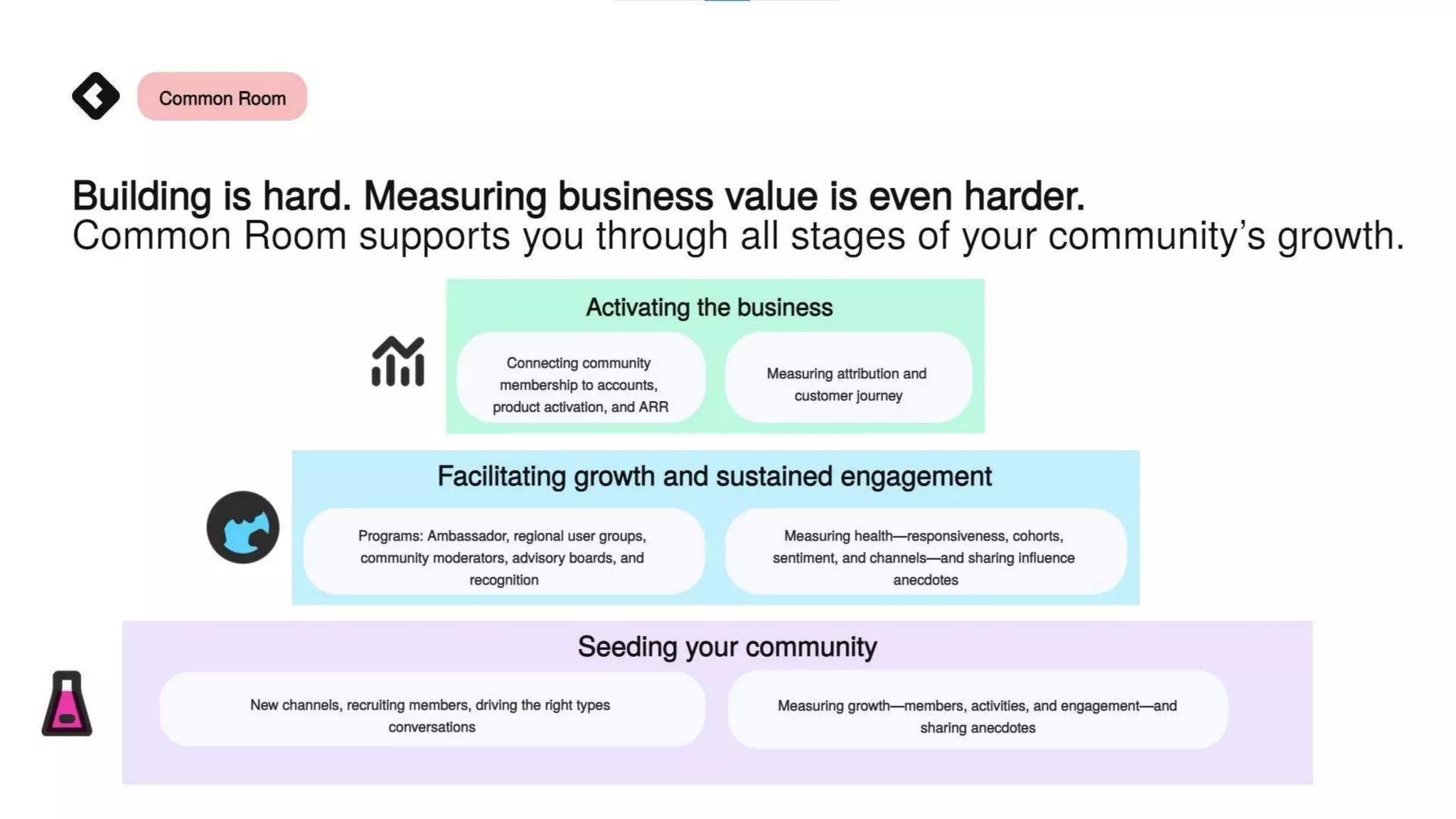
Slide 9 uses a three-tiered model (Seeding your community; Facilitating growth and sustained engagement; Activating the business) to show how Common Room supports different maturity stages. This pyramid communicates product depth and a path to increasing business impact: from recruiting and measuring growth to driving revenue attribution and account activation. For investors, a staged roadmap demonstrates potential for expanding product scope and monetization over time.

Key Takeaway: Show a staged product roadmap that links early adoption features to higher-value business outcomes to justify expansion and pricing tiers.
Product Architecture: Integrations and outputs

Product Architecture: Integrations and outputs

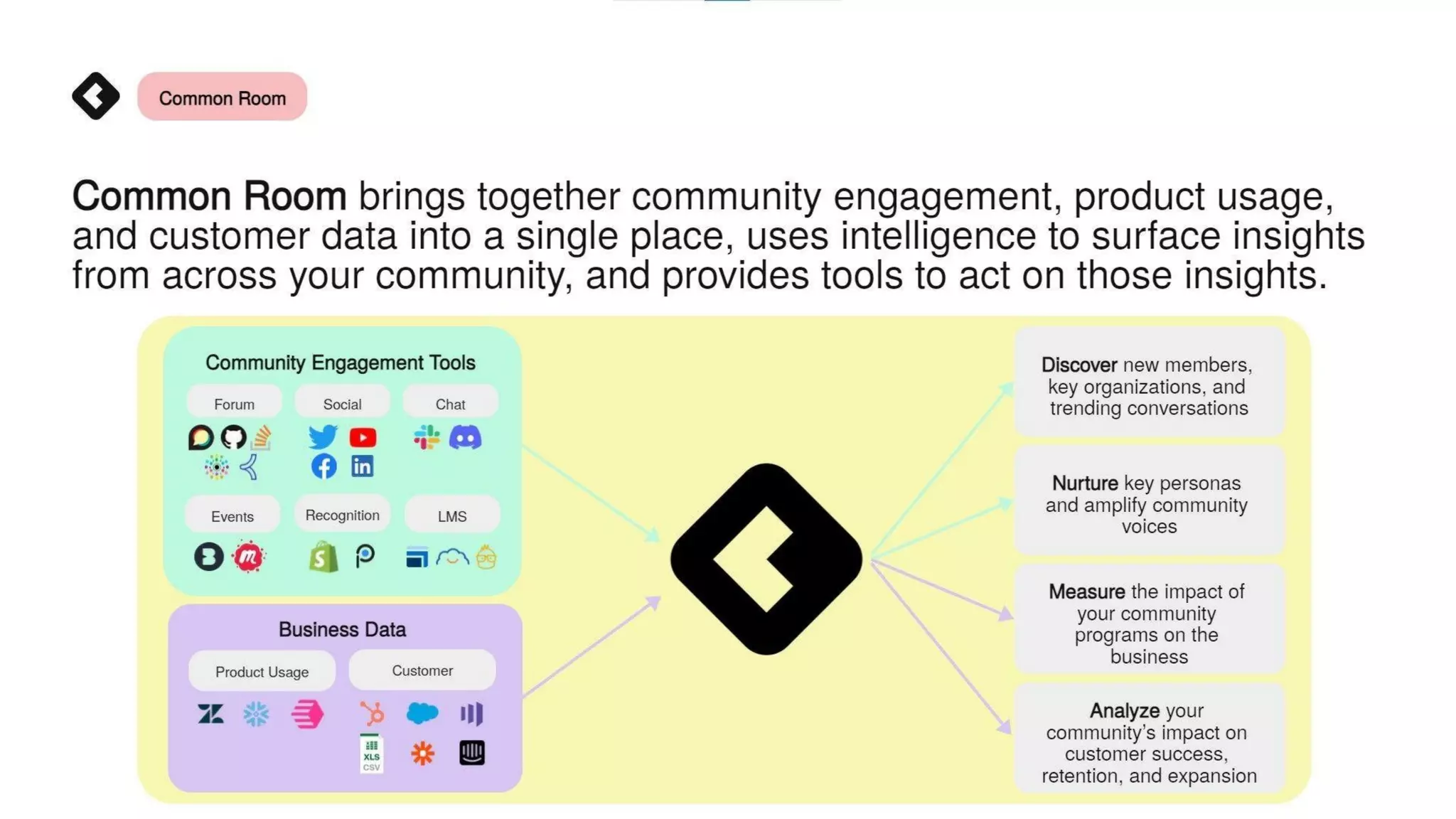
Slide 10 is a systems diagram showing community engagement tools and business data sources funneling into Common Room and producing discover, nurture, measure, and analyze outputs. This diagram does two things: it demonstrates defensibility through integrations (aggregating many data sources is non-trivial) and it clarifies core product flows—ingest, intelligence, action. The visual communicates that Common Room is not another siloed app but an orchestration and insights layer.

Key Takeaway: Include a integrations diagram that shows both data inputs and business outputs—this clarifies technical scope and commercial value to investors and customers.

Conclusion: Key Lessons

Common Room’s deck is a strong example of concise narrative design: it opens with a compelling mission, explains the market shift that creates the opportunity, frames a tangible set of operational problems, and then shows a staged product solution with concrete use cases and integrations. Strengths include disciplined visuals, role-specific buyer targeting, and a clear map from data ingestion to measurable business outcomes. Actionable advice for founders: lead with a single, benefit-focused mission statement; translate market trends into concrete user pain points; show 4–8 validated day-to-day use cases; present a staged roadmap that links to monetization; and include a systems diagram showing integrations and outputs so investors can assess technical defensibility and path to expansion.

Full Deck Analysis

11 sections

Overview

Company: Common Room
Round: Seed ($20M)
Year: 2021
Outcome: Raised $52.9M total

Executive Summary

Common Room’s seed deck presents a focused product for “community intelligence”: a platform that aggregates community engagement and business data, surfaces insights, and provides action tools so product and community teams can measure and act on community-driven signals. The deck is strong on narrative (why communities matter now) and product positioning (integrations + intelligence + action) and uses customer logos and a testimonial to signal early traction — but it omits many of the hard metrics and team details an investor would expect.

Problem Statement

How the deck articulates the problem:

  • Market/context (Slide 2): “The way software is built and distributed has fundamentally changed” — outlines the shift from sales-led to product-led/community-influenced buying.
  • Core problems (Slide 4): “Community is the answer — but tools haven’t kept up.” It calls out three crisp failure modes:
    • Lack of visibility: community data is siloed across external platforms and internal systems (no single system of record).
    • Lack of action: no shared system to identify, track and nurture important voices; tasks are manual and spreadsheet-driven.
    • Lack of measurement: hard to measure ROI of community programs and impact on revenue/marketing goals.
  • These problem statements are concrete and directly tied to pain experienced by community / developer advocacy teams (Slide 8).

Solution

How the deck positions the solution:

  • Product definition (Slide 6): “Common Room is the community intelligence platform that helps you build better products, deepen relationships, and grow faster.” Emphasis on intelligence + action.
  • Architecture & value props (Slides 9–10): Visuals show Common Room ingesting community engagement tools (forums, social, chat, events, LMS) and business data (product usage, CRM), then surfacing Discover / Nurture / Measure / Analyze capabilities for teams. The message is unify data → surface insights → enable action.
  • Target users (Slide 7): Community leaders, developer advocates, and cross-functional teams (marketing, customer support, sales, RevOps).

Market Opportunity

  • The deck does not show explicit TAM / SAM / SOM numbers anywhere in the 12 slides provided. (No slides contain numeric market sizing.)
  • Implied market: platforms and teams that run online communities, developer advocacy, product-led growth organizations, and companies trying to correlate community with ARR — i.e., a B2B SaaS market adjacent to customer data platforms, product analytics, and community tooling.
  • Investor takeaway: market rationale is qualitative and convincing, but lacks quantified TAM/SAM/SOM.

Business Model

  • The deck does not present explicit pricing, packaging, revenue model, or unit economics on the visible slides.
  • Implicit model: enterprise / team SaaS (integrations with product and CRM systems, emphasis on measuring business impact suggests a subscription/seat or seat+usage enterprise model).
  • Missing: customer ARPU, contract lengths, churn, CAC, LTV, or pricing tiers.

Traction & Metrics

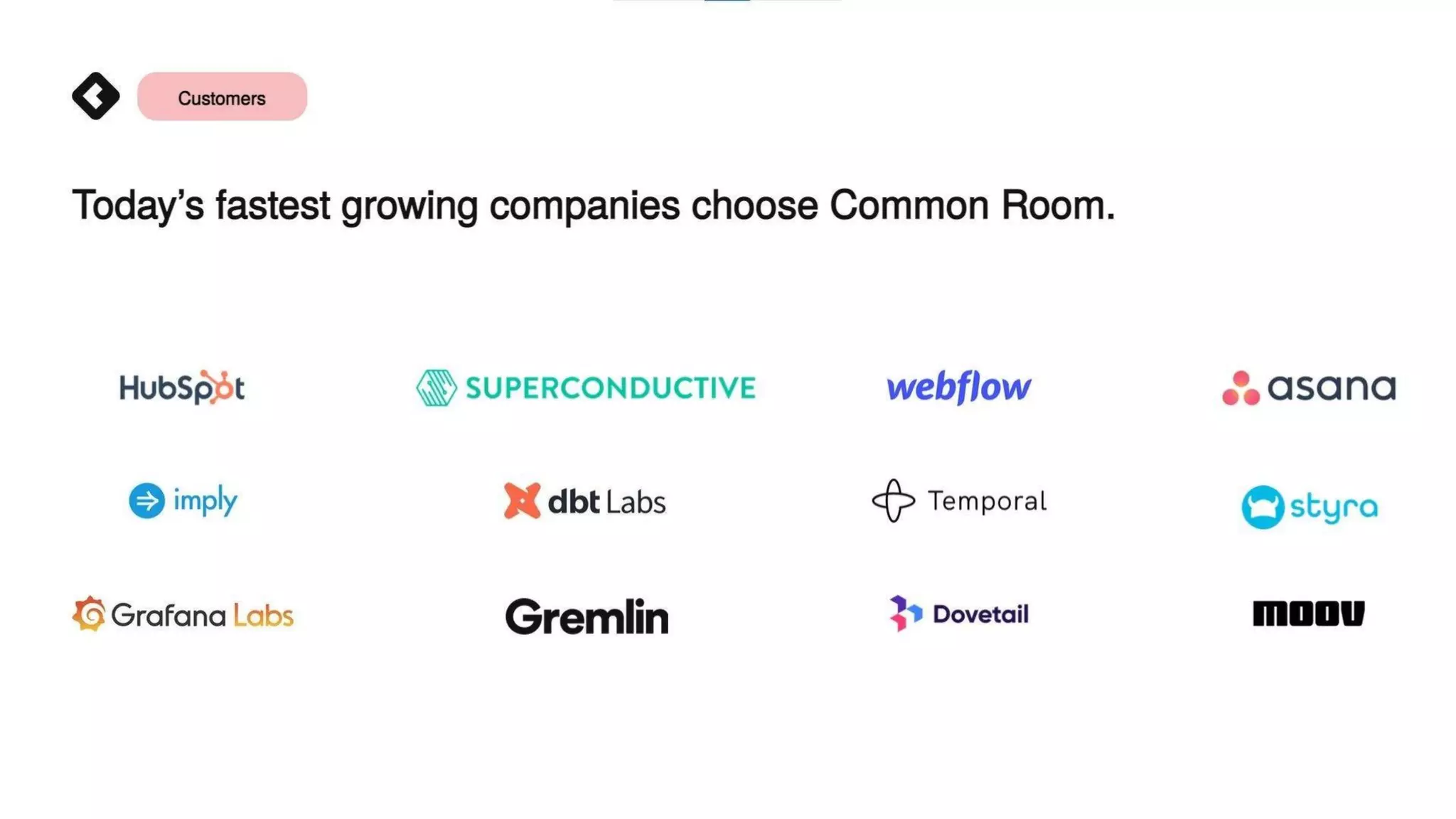
  • The deck includes customer logos (Slide 11) and a customer testimonial (Slide 12):
    • Logos shown include HubSpot, Superconductive, Webflow, Asana, Grafana Labs, Gremlin, Dovetail, Moov, dbt Labs, Temporal, Styra, Imply.
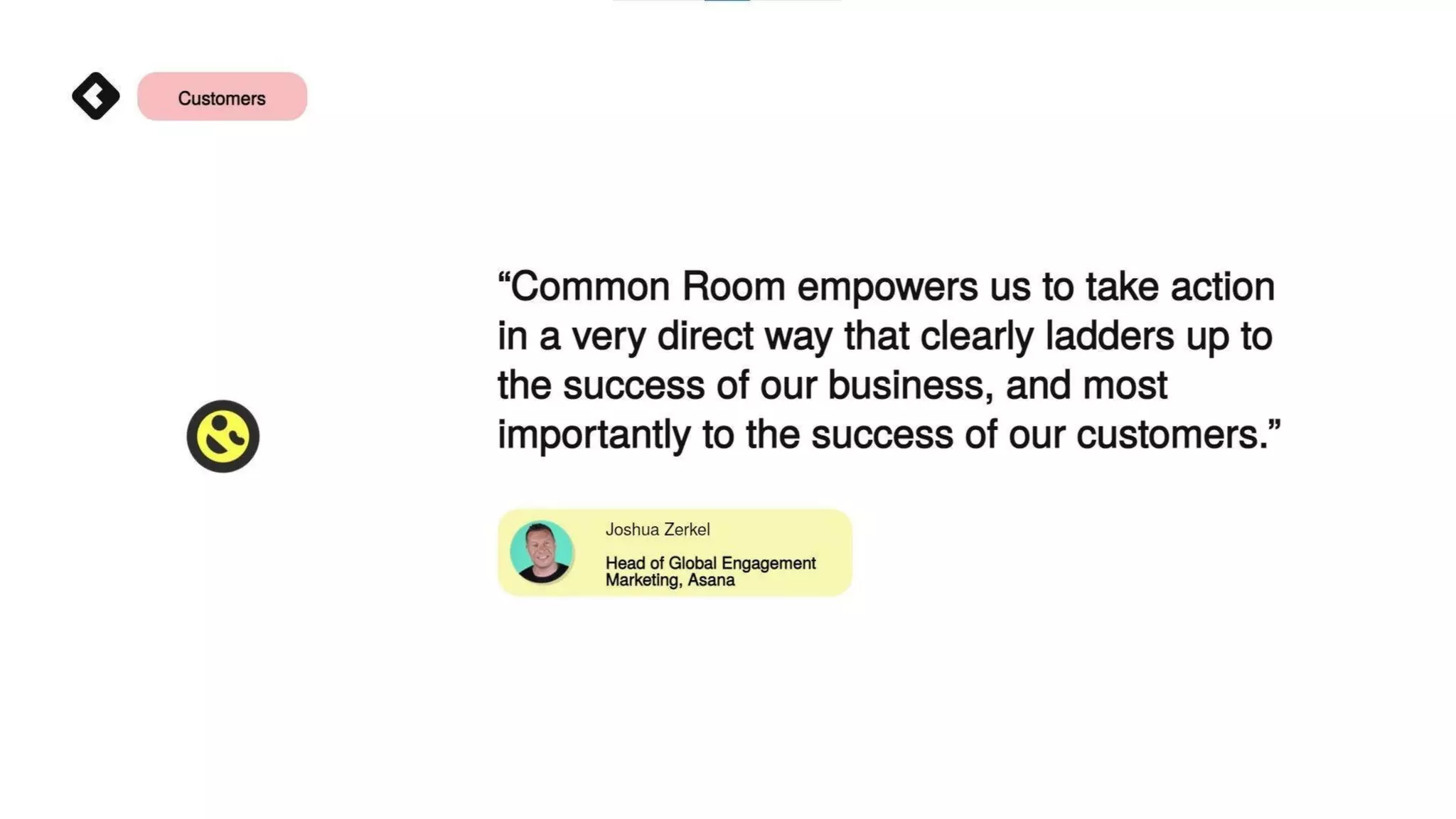
    • Testimonial from Joshua Zerkel, Head of Global Engagement Marketing, Asana (Slide 12).
  • What is missing:
    • No revenue, ARR, MRR, growth rate, number of customers, retention, expansion metrics, or usage stats are shown in the provided slides.
  • Investor interpretation: there is early enterprise/brand validation (notable logos + quote) but no hard traction numbers to quantify business progress.

Competitive Positioning

  • Differentiation called out implicitly:
    • Integrates community engagement channels + business/product data into a single place (Slide 10).
    • Focus on proactive intelligence + action layer (Slide 6, Slide 10).
    • Emphasis on measurement of community impact on business metrics (Slide 4 problem + Slide 9 value).
  • Competitors implied: community platforms (Discourse, Vanilla), chat providers (Discord, Slack), social analytics, product analytics, CDP vendors. The deck does not present a direct competitor slide or matrix.
  • Positioning takeaway: Common Room sells as an “intelligence & action” layer on top of existing community tools and business systems — a higher-level, cross-system product.

Team

  • The 12 slides provided do not include a team slide or founder bios. No credentials are visible in these images.
  • Investor note: team information is absent from the public slide set shown; an investor would request founder backgrounds and key hires as early diligence priority.

Go-to-Market Strategy

  • GTM signals in the deck:
    • Primary users: community leaders and developer advocates (Slide 7).
    • Cross-functional value: marketing, customer support, sales, RevOps (Slide 7).
    • Day-to-day tasks supported (Slide 8): identify/welcome new members, sentiment tracking, nurture champions, recruit for programs, capture product feedback, measure community health.
    • Enterprise logos and testimonial indicate direct sales / enterprise outreach or an inbound motion from community-driven interest.
  • What’s not explicit: specific channel strategy (self-serve vs. enterprise sales), landing motions (content, partnerships), pricing/packaging for adoption, or partner ecosystem strategy.

The Ask

  • The user-provided context indicates the seed round was $20M. The slides themselves do not break down the use of funds.
  • Use of funds is not described in the visible slides — no allocation to engineering, GTM, hiring, or product.

Investor Deep Dive

Executive summary, strengths & red flags

Executive Summary

Common Room’s seed deck presents a focused product for "community intelligence": a platform that aggregates community engagement and business data, surfaces insights, and provides action tools so product and community teams can measure and act on community-driven signals. The deck is strong on narrative (why communities matter now) and product positioning (integrations + intelligence + action) and uses customer logos and a testimonial to signal early traction — but it omits many of the hard metrics and team details an investor would expect.

Key Strengths

3 identified

1

Clear narrative connecting macro shift → problem → solution

2

Product architecture and integrations articulated visually

3

Credibility signals (logos + customer testimonial)

Red Flags & Weaknesses

3 identified

1

Lack of quantitative traction and business metrics

2

No team slide or founder credentials in the shown deck

3

Missing market sizing and financial ask/use details

More Pitch Decks To Study

Compare structure, fundraising context, and investor-facing story across similar startup decks.