Compare your deck to Rippling

Compare Your Deck

Rippling Pitch Deck (2017)

SaaS
Stage: Seed
Raised: $7M
Year: 2017
Slides: 11
Outcome: Valued at $16.8B after Series G (2025)

Pitch Deck

1 / 11
Rippling pitch deck - The Opening: Simple, Bold Thesis
Click to expand

Deck Analysis

This deck from Rippling (Seed, 2017) presents a clear, narrative-driven case for building a unified employee management platform that combines payroll, identity/SSO, and device management. It stands out for its singular thesis—be the system of record for employee data—and then systematically shows product logic, competitive positioning, early performance, and why the timing is right. The memo-style format (long-form narrative plus charts and screenshots) prioritizes conviction and defensibility over flashy slides, which makes it notable as an investor-facing seed pitch that reads like a product-led strategy document.

The Opening: Simple, Bold Thesis

The Opening: Simple, Bold Thesis

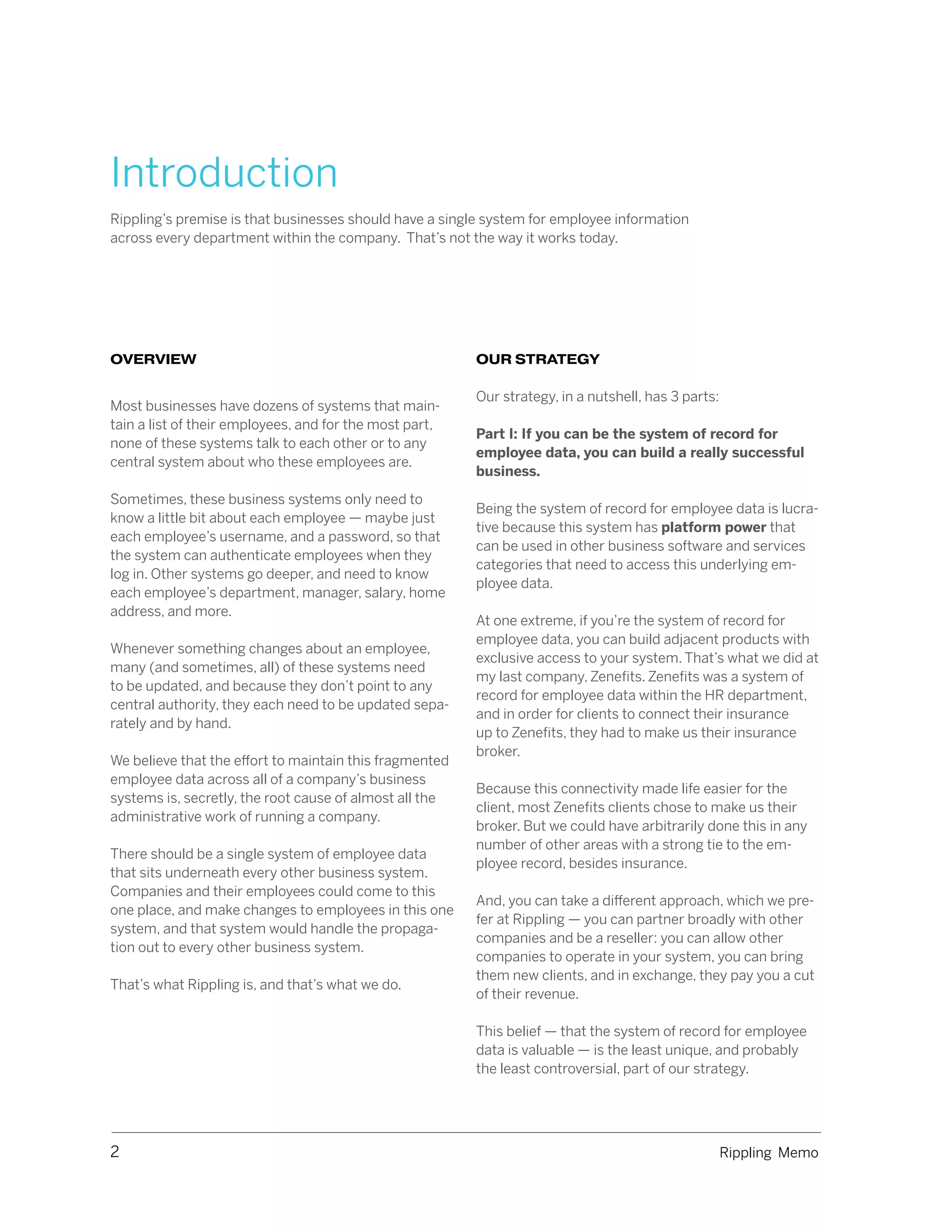
The first slide is a stark, minimal cover that states the company name and high-level premise: businesses should have a single system for employee information. That simplicity signals confidence and orients the reader immediately—rather than burying the thesis in noise, the deck opens with the problem statement and a claim that existing approaches are fractured. This establishes the narrative spine the rest of the memo will follow.

Founders can learn from this restraint: opening with one crisp, memorable idea (the system of record for employee data) makes the rest of the document easier to stitch together. The cover’s minimalism also sets a professional tone and primes investors to expect a disciplined, single-minded argument rather than a feature laundry list.
Key Takeaway: Lead with one clear, defensible thesis and use design simplicity to underscore conviction.
Establishing the Problem & Strategy (Introduction + Overview)

Establishing the Problem & Strategy (Introduction + Overview)

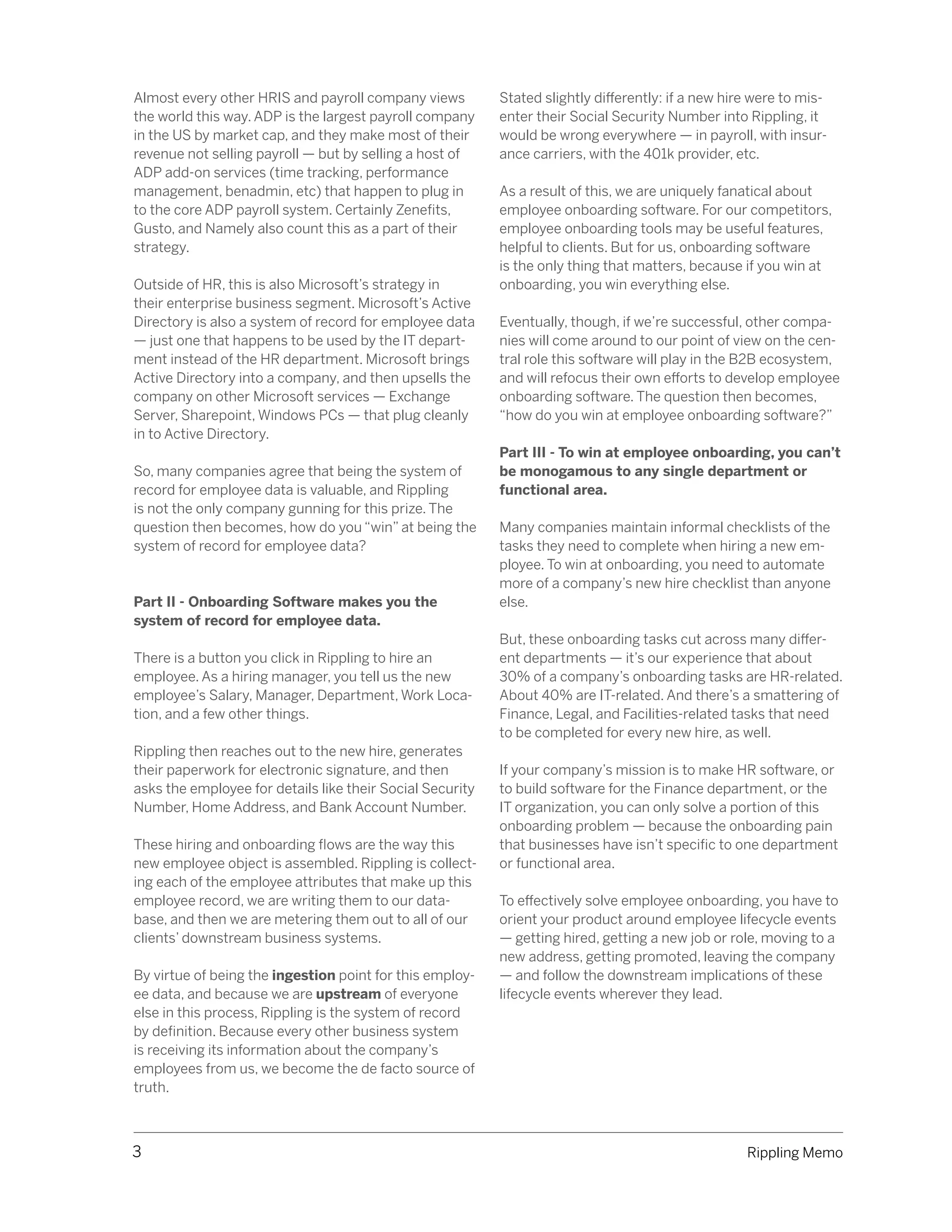
The early slides (introduction/overview) lay out the fragmentation problem across HR, IT, and finance systems and state Rippling’s strategy in three parts: be the system of record, win via onboarding, and avoid being monogamous to a single departmental buyer. The narrative explains not just what’s broken but why solving employee onboarding and downstream plumbing creates platform power and revenue opportunities. The memo format allows the founders to explain trade-offs and strategy nuances that short decks often skip.

This section is effective because it connects product design to business economics—showing that owning the canonical employee record enables adjacent revenue and integrations. Founders should emulate the causal chain here: problem → core product choice (onboarding) → platform effects → GTM implications. That logical flow helps investors understand both product decisions and scale pathways.

Key Takeaway: Map product choices directly to business outcomes—show how a specific workflow (onboarding) becomes the lever for platform growth.
Product Overview: Demonstrating the Hybrid Product

Product Overview: Demonstrating the Hybrid Product

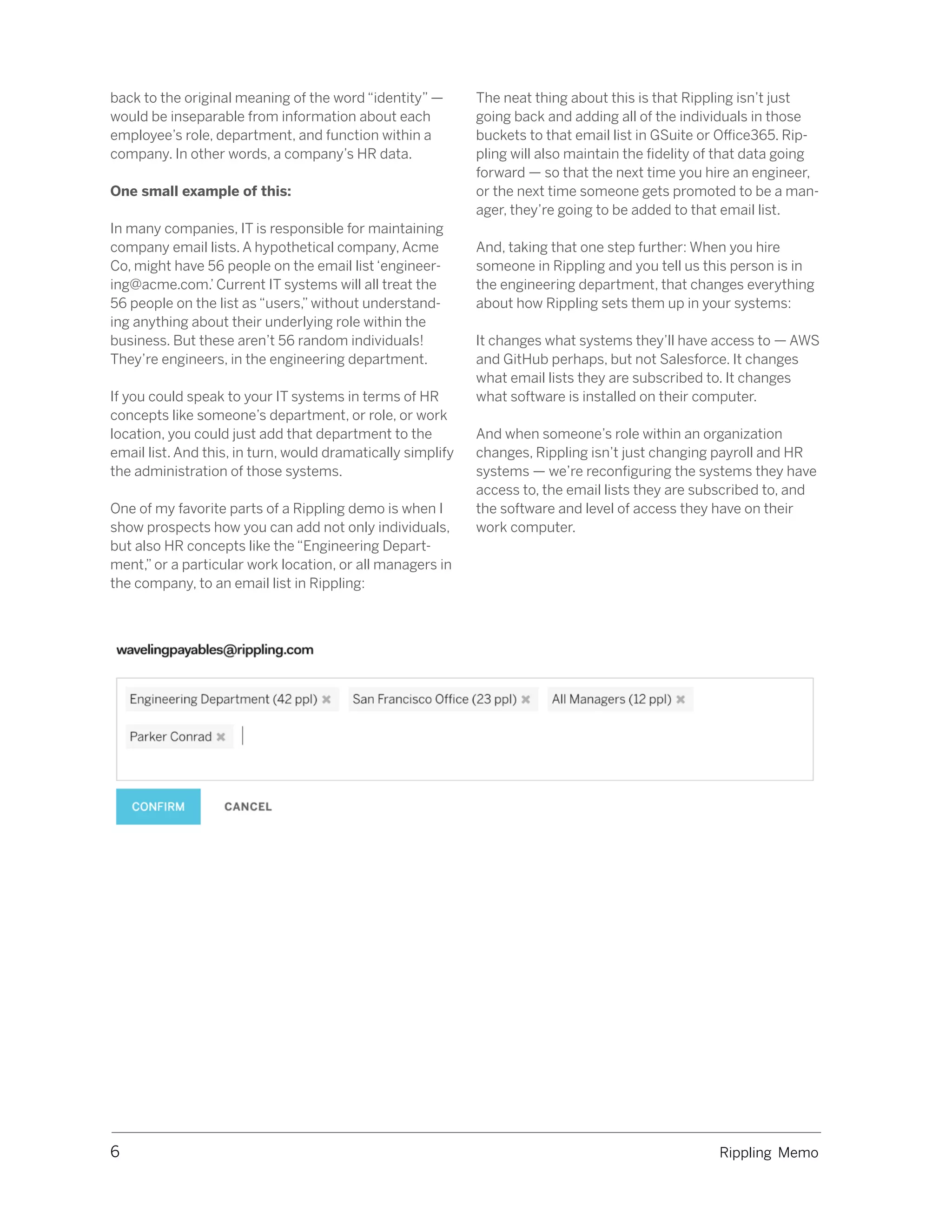
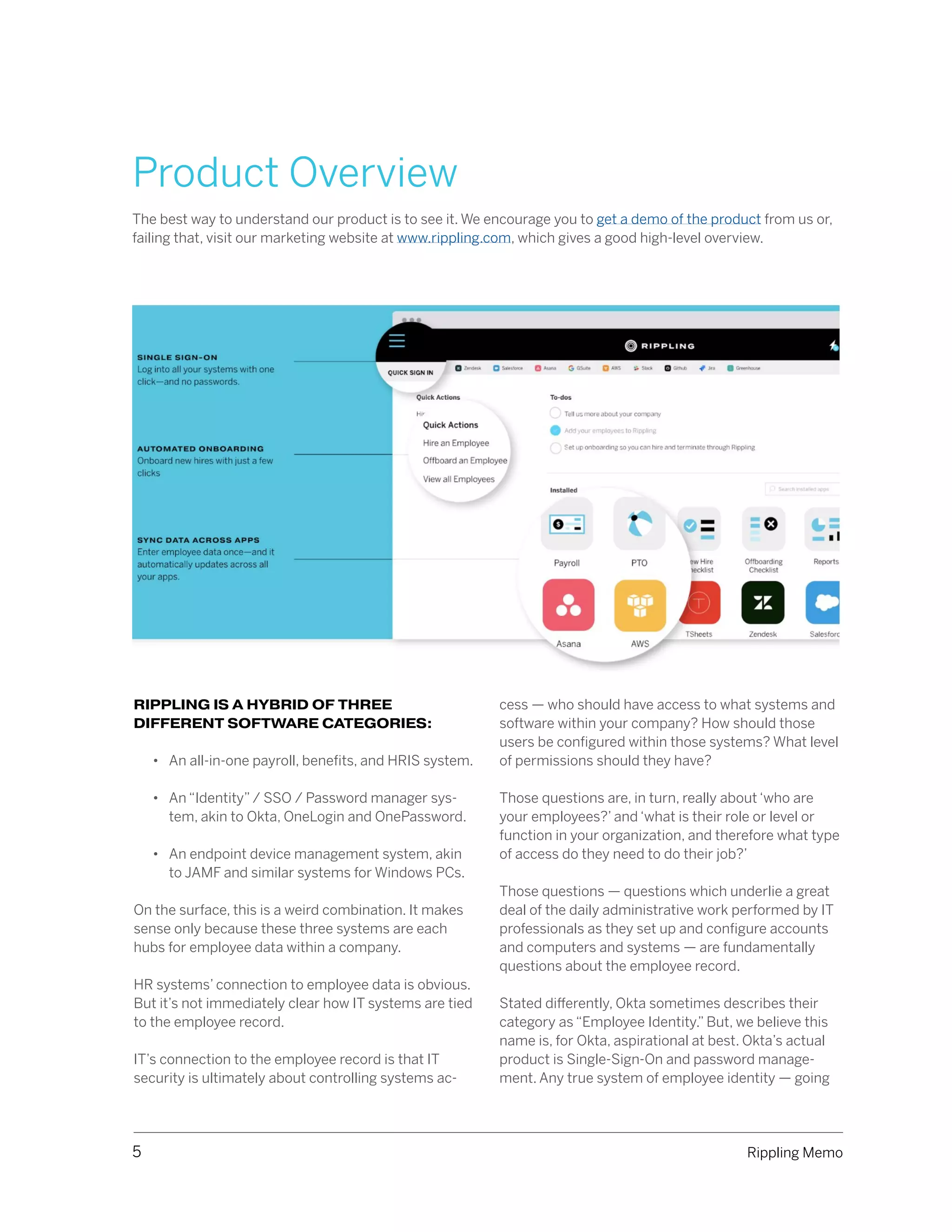
The product overview slide succinctly communicates that Rippling is a hybrid of three software categories: payroll/HRIS, identity/SSO, and device management. A screenshot anchors the value proposition visually, while bullets explain why the combination makes sense (each category acts as a hub for employee data). This blends UI proof with a conceptual taxonomy, reinforcing that the product is both built and thought-through.

The slide is effective because it addresses two investor questions at once: what the product does and why it’s defensible. The visual screenshot gives credibility (“we shipped this”), and the category framing explains the moat rationale. Founders should aim to pair a concrete visual with a crisp conceptual framework—especially when building multi-surface products that could otherwise seem unfocused.

Key Takeaway: Pair an actual UI/UX screenshot with a clear product taxonomy to show both execution and strategic coherence.
Competition & Positioning: Ownable Differentiation

Competition & Positioning: Ownable Differentiation

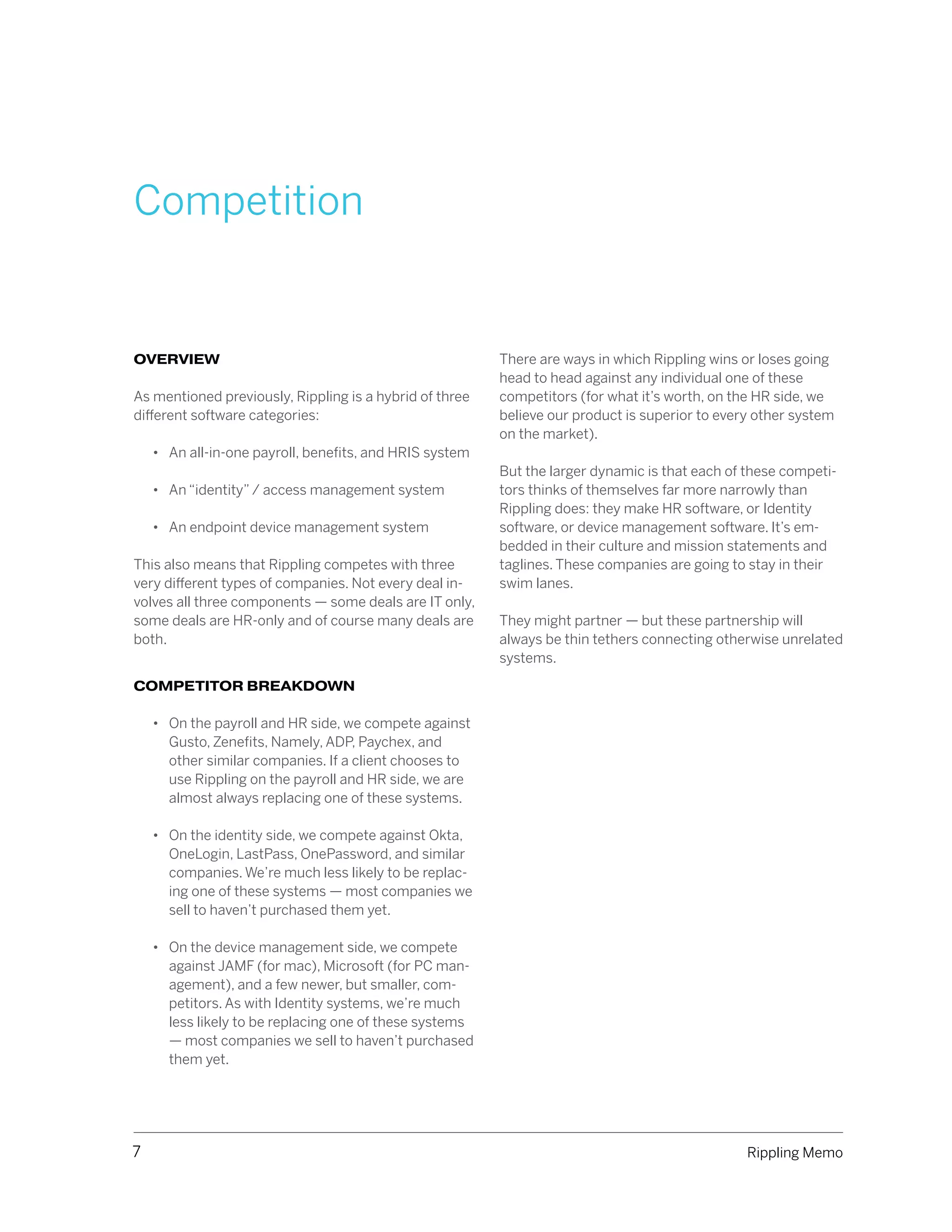
The competition slide organizes competitors into the three verticals Rippling spans (HR/payroll, identity, device mgmt.) and explains the dynamic: incumbents are narrow, and Rippling’s breadth creates a different opportunity. Rather than just listing logos, the deck explains why rival companies will stay in their lanes and why partnerships would be thin tethers—this explains how Rippling could capture cross-departmental share.

This approach works because it moves beyond a superficial competitor matrix and explains competitive dynamics and market behavior. Founders should emulate this by categorizing competitors by the specific value they own, and then articulating why your product’s cross-cutting nature changes customer choice and integration economics.

Key Takeaway: Don’t only name competitors—explain the structural reasons customers would pick a cross-functional platform over narrow incumbents.
Traction & Metrics: Showing Early Growth Momentum

Traction & Metrics: Showing Early Growth Momentum

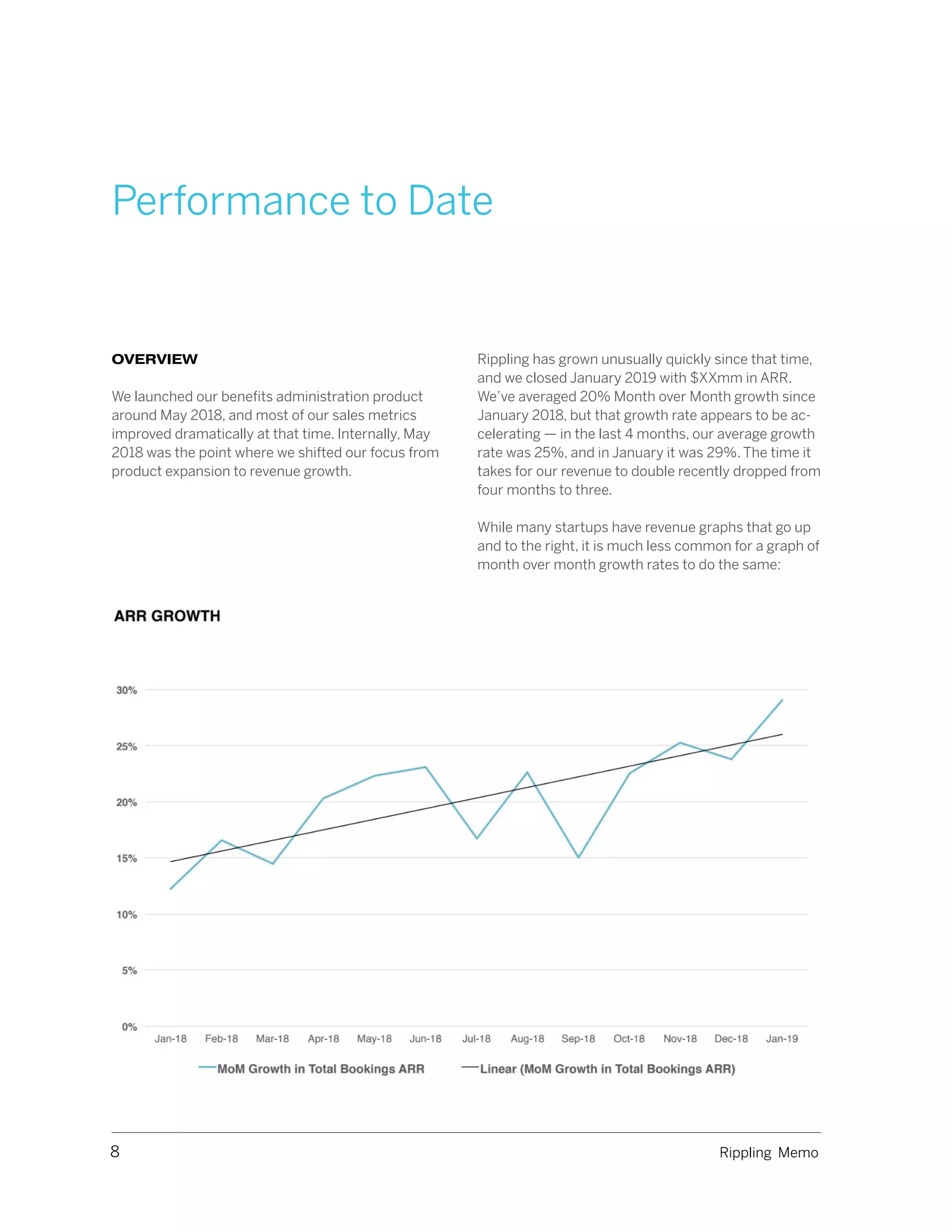
The performance slide presents ARR growth as month-over-month percentages with a trendline—an effective way to show acceleration rather than static revenue snapshots. The accompanying overview text explains when product changes (benefits launch in May 2018) led to metric inflection points. Using growth-rate charts emphasizes repeatability and acceleration—key signals for seed-stage investors evaluating product-market fit.

This slide is effective because it ties product events to measurable impact and shows a clear positive trajectory. Founders should prioritize simple, interpretable charts that highlight momentum and the causal event behind it; context (what changed and when) makes the numbers meaningful and believable.

Key Takeaway: Use simple charts to highlight acceleration and always annotate the product or go-to-market change that caused the inflection.
Why Now & Network Effects: Timing and Moat

Why Now & Network Effects: Timing and Moat

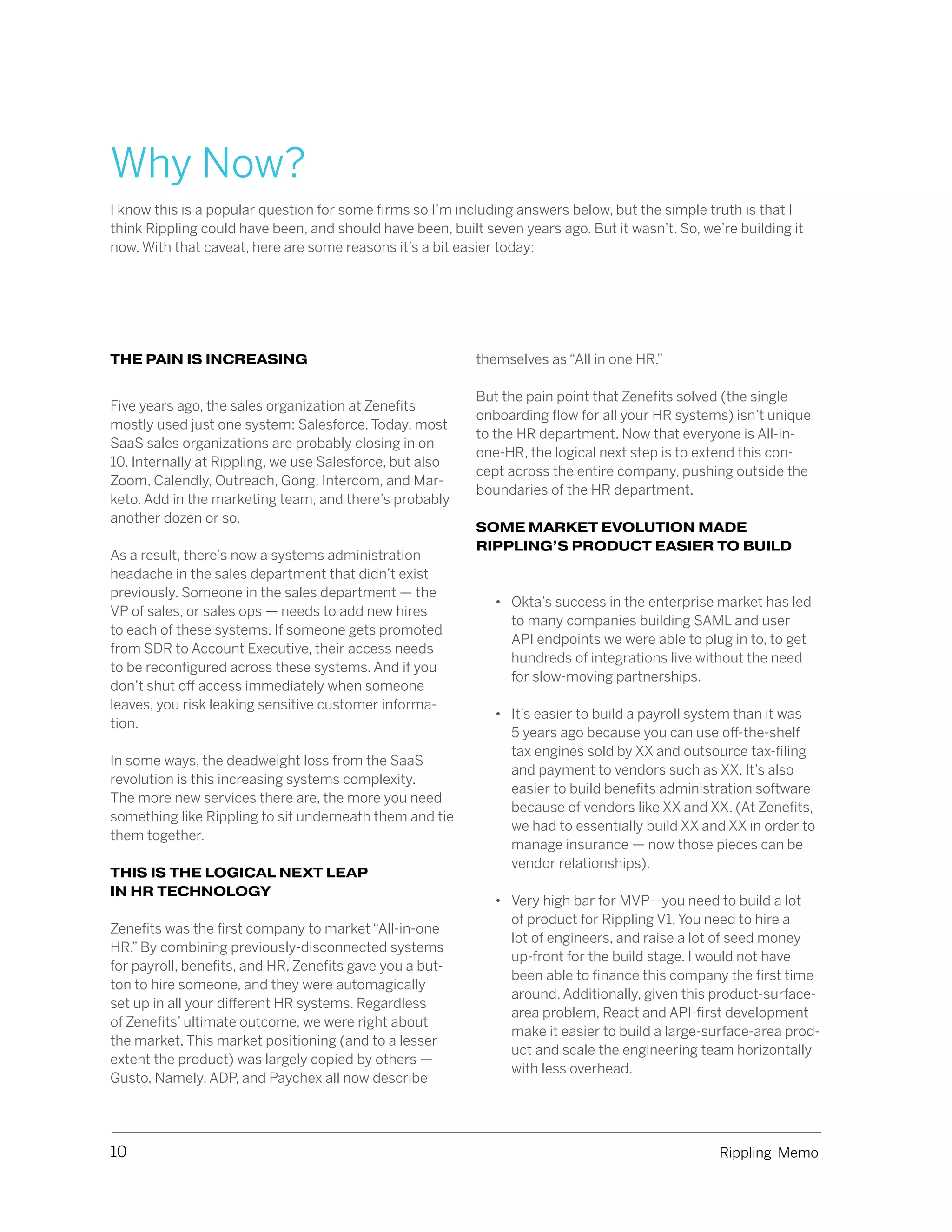
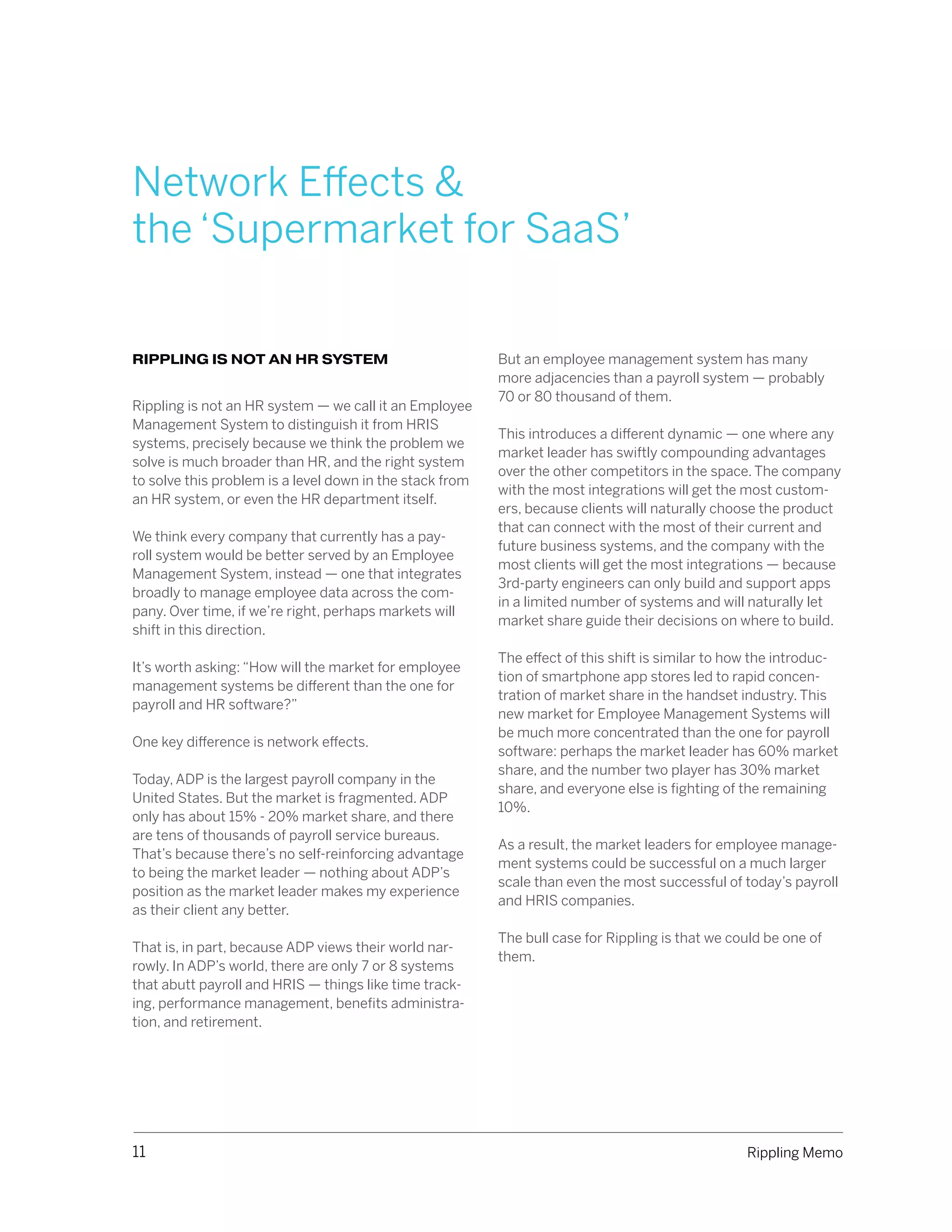
The 'Why Now?' section explains timing drivers—more SaaS apps per company, better integration APIs (SAML, user APIs), and off-the-shelf services that lower product build cost—and ties them back to product strategy. The deck also frames network effects and adjacency-driven concentration: the platform that accumulates the most integrations will attract more customers and integrations in return, similar to app store dynamics.

This is persuasive because it addresses a frequent investor question about timing and defensibility. It shows technical feasibility (APIs exist), demand-side pressure (system administration pain), and an emergent moat (integration density). Founders should explicitly answer 'why today' and connect engineering feasibility to market dynamics to make a compelling case for immediate opportunity.

Key Takeaway: Explicitly justify timing by combining demand-side pain, engineering feasibility, and a clear network-effect pathway to scale.

Conclusion: Key Lessons

Rippling’s seed memo succeeds by building a tight narrative: a single, defensible thesis; product logic that links to business economics; concrete product evidence; competitive framing that explains structural advantages; and metrics that show accelerating traction. The deck favors clarity and depth—using prose to walk investors through trade-offs and charts to validate momentum—rather than relying solely on bullet points or flashy visuals.

For founders creating their own decks: start with one clear thesis, show how product choices unlock revenue or defensibility, pair screenshots with conceptual framing, quantify the impact of product changes, and explain timing with both supply-side (engineering) and demand-side (customer pain) rationales. Those elements together make a persuasive, investor-friendly seed pitch.

Full Deck Analysis

11 sections

Overview

Company: Rippling
Round: Seed ($7M)
Year: 2017
Outcome: Valued at $16.8B after Series G (2025)

Executive Summary

Rippling’s seed deck presents a tightly focused POV: employee data is fragmented across many business systems and the company can be the single system-of-record that powers payroll, HR, identity (SSO), and device management via deep downstream integrations and onboarding flows. The deck is notable for its crisp problem framing, integration-first product positioning, early traction signals (strong MoM ARR growth and high NPS), and an explicit strategy built around onboarding as the wedge to become the canonical “employee management” platform.

Problem Statement

How the deck articulates the problem:

  • Core problem: companies have dozens of disconnected systems that each store employee data, and there is no single canonical system-of-record to propagate updates across systems (Slides 1–3: Introduction / Overview).
  • Operational pain: manual updates across many systems drive administrative overhead and leakage of access/security (Slides 2–4, e.g., “root cause of almost all the administrative work of running a company”).
  • Competitive/market pain: incumbent payroll/HR vendors and identity/device vendors are each siloed and don’t solve cross-functional onboarding and downstream connectivity (Slides 3–4).

Solution

How the deck positions the solution:

  • Rippling is presented as a hybrid Employee Management System: an HRIS/payroll/benefits system + identity/SSO/password manager + endpoint device management system (Slides 5–6).
  • Strategic wedge: win at employee onboarding (single onboarding flow that provision users downstream) so Rippling becomes the ingestion point/upstream source of truth for employee data (Slides 2–4, 6).
  • Product capabilities called out: automated onboarding, single sign-on, sync across apps, and provisioning of software/devices based on role (Slides 5–7).

Market Opportunity

  • The deck argues for a large market opportunity driven by adjacent HR, identity and device-management markets and strong network effects (Slides 11).
  • Explicit TAM/SAM/SOM numbers are not provided in the slides shown. The deck instead reasons qualitatively that the employee management platform could be much larger and more concentrated than existing payroll/H RIS markets because of integration-driven network effects (Slide 11).

Business Model

  • Model: B2B SaaS (annual subscriptions / ARR), with product revenue from payroll/benefits/HR functionality and likely recurring fees for identity and device management integrations (Slides 5–7 describe product categories).
  • Ancillary/adjacent revenue: mentions ability to build adjacent products (e.g., insurance brokering in previous company example) and reseller/partner economics (Slide 2, “partner broadly … be a reseller”).
  • Pricing/unit economics: not explicitly detailed in the deck (no ARPU, CAC, gross margin details shown).

Traction & Metrics

  • Growth: the deck reports strong month-over-month growth in bookings ARR:
    • Average ~20% MoM growth since Jan 2018 (Slide 8).
    • Last 4 months average ~25% MoM, with January at ~29% (Slide 8).
    • The slide also shows a rising linear trendline and month-by-month blue line reaching ~29% in Jan-19 (Slide 8 chart).
  • ARR: slide references “we closed January 2019 with $XXmm in ARR” — the exact ARR figure is redacted in the deck.
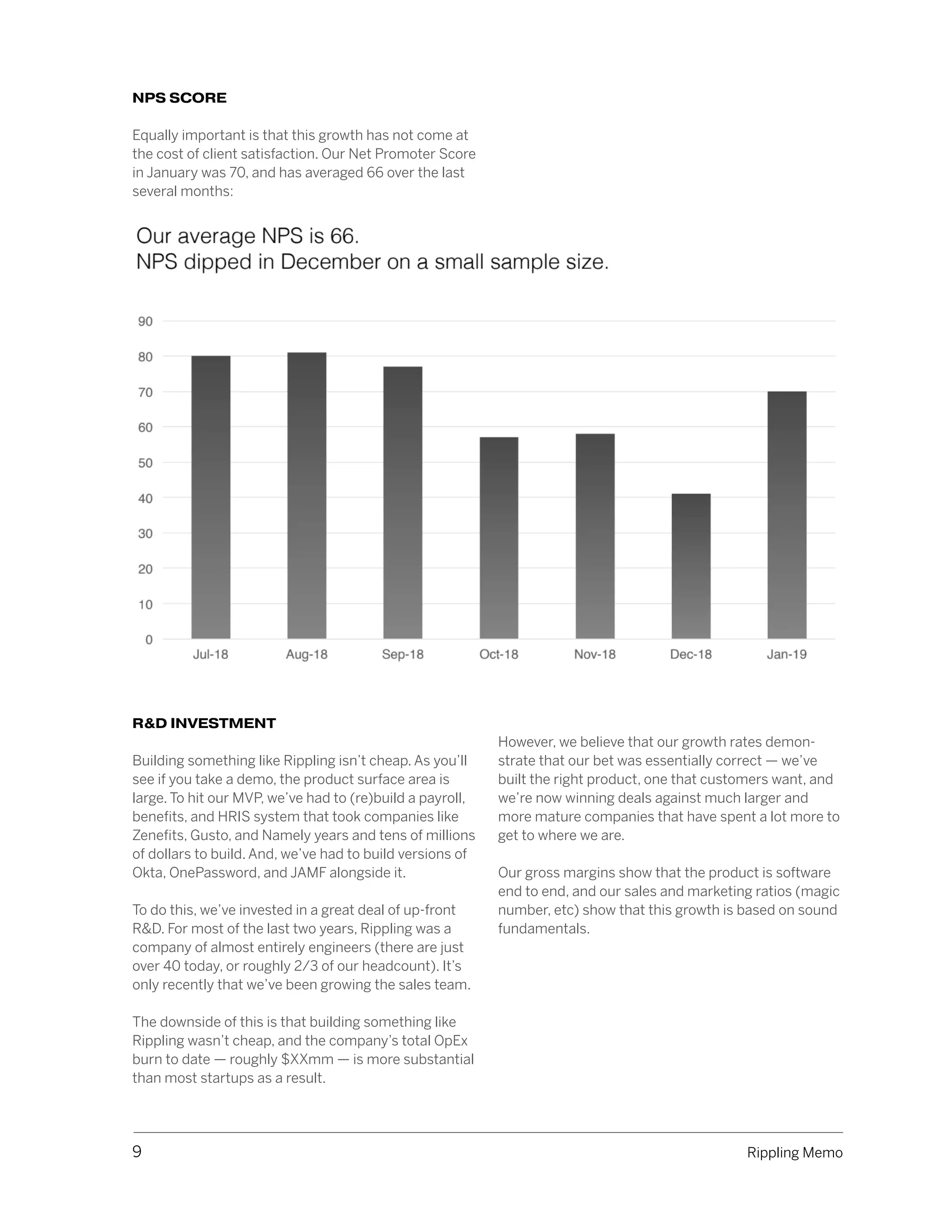
  • Customer satisfaction: Net Promoter Score average = 66; January NPS = 70 (Slide 9).
  • R&D / expense notes: deck notes heavy up-front R&D investment and a non-trivial OpEx burn (“roughly $XXmm” — redacted) (Slide 9).
  • Overall proof points: MoM growth, high NPS, and rapid improvement in sales metrics after May 2018 product launch (Slide 8–9).

Competitive Positioning

  • Competitive landscape: competes across three categories:
    • Payroll/HR: Gusto, Zenefits, Namely, ADP, Paychex (Slide 7).
    • Identity / SSO: Okta, OneLogin, LastPass, OnePassword (Slide 7).
    • Device management: JAMF, Microsoft, smaller competitors (Slide 7).
  • Differentiation:
    • Integration-first “system of record” approach: combining HR/payroll + identity + device management into one platform (Slides 5–6).
    • Onboarding as the strategic wedge to become upstream and to exert platform power (Slides 2–4).
    • Network effects and “supermarket for SaaS” thesis: most integrations and customers cluster around the leader, leading to compounding advantages (Slide 11).

Team

  • The slide set provided does not include a dedicated team slide or bios. The deck references prior experience at Zenefits and the founder’s previous company in the text (Slide 2), but names, roles, and explicit credentials are not present in the slides shown.
  • Investors would want a full founder/team slide and relevant operating experience (not present in this slice).

Go-to-Market Strategy

  • GTM levers described:
    • Product-led / demo-led sales: “get a demo of the product” and marketing website calls-to-action (Slide 5).
    • Enterprise/strategic sales for payroll/HR deals (replacement sellers like ADP/Gusto) and targeted sales into IT for identity/device features (Slides 5–7).
    • Partnerships/resellers: allow partners to operate in the system and resell Rippling (Slide 2).
    • Onboarding-focused positioning: sell onboarding value (time saved and downstream automation) to multiple buyers (HR, IT, Finance) (Slides 2–4, 6).

The Ask

  • Raise: Seed $7M (context provided). The deck content itself references the need for capital to continue R&D and scale sales but does not show a detailed use-of-funds breakdown in the slides provided.
  • Intended use (implied, not explicit): continued product/R&D (big rebuilding of payroll/identity/device components), scaling sales and marketing to capture revenue growth (Slide 9).

Investor Deep Dive

Executive summary, strengths & red flags

Executive Summary

Rippling’s seed deck presents a tightly focused POV: employee data is fragmented across many business systems and the company can be the single system-of-record that powers payroll, HR, identity (SSO), and device management via deep downstream integrations and onboarding flows. The deck is notable for its crisp problem framing, integration-first product positioning, early traction signals (strong MoM ARR growth and high NPS), and an explicit strategy built around onboarding as the wedge to become the canonical “employee management” platform.

Key Strengths

3 identified

1

Clear, focused problem framing with strong narrative pull

2

Integration-first product thesis that credibly connects to durable network effects

3

Early traction with strong growth and customer satisfaction signals

Red Flags & Weaknesses

3 identified

1

Key financials redacted / not shown

2

Missing team slide and go-to-market KPIs

3

No quantified market sizing (TAM/SAM/SOM)

More Pitch Decks To Study

Compare structure, fundraising context, and investor-facing story across similar startup decks.