Compare your deck to Contractbook

Compare Your Deck

Contractbook Pitch Deck (2019)

SaaS
Stage: Seed
Raised: $3.9M
Year: 2019
Slides: 13
Outcome: Raised $30M+ total

Pitch Deck

1 / 13
Contractbook pitch deck - The Opening: Clear brand and value proposition
Click to expand

Deck Analysis

This deck for Contractbook (seed, 2019) presents a concise, founder-first pitch: a modern SaaS product that digitizes contracts as structured data, combines drafting, collaboration, signing and storage, and positions itself as the client-centric legal automation platform for SMEs. The slides balance product screenshots, market sizing and traction metrics with clear problem/solution storytelling; what makes it notable is the emphasis on technical differentiation (storing contracts as JSON/metadata to enable AI) and fast, self-service onboarding targeted at a large, under-served SME market.

The Opening: Clear brand and value proposition

The Opening: Clear brand and value proposition

Slide 1 is a classic cover slide with strong visual identity: clean logo, short tagline (“A smarter way to work with contracts”) and a dated footer (December 2020). It establishes tone and audience (professional, design-savvy SaaS buyers) and signals product focus immediately. The image of a digital contract framed by ethereal UI elements reinforces the product promise without requiring text-heavy explanation.

This slide is effective because it sets expectations quickly and visually; founders can learn the value of a tight, visually consistent cover that communicates the essence of what you do in one line and one image. It prepares investors to receive the rest of the story rather than burying them in details from the first slide.

Key Takeaway: Use a succinct tagline and high-quality visual to communicate product focus and tone immediately — first impressions set the context for the whole deck.
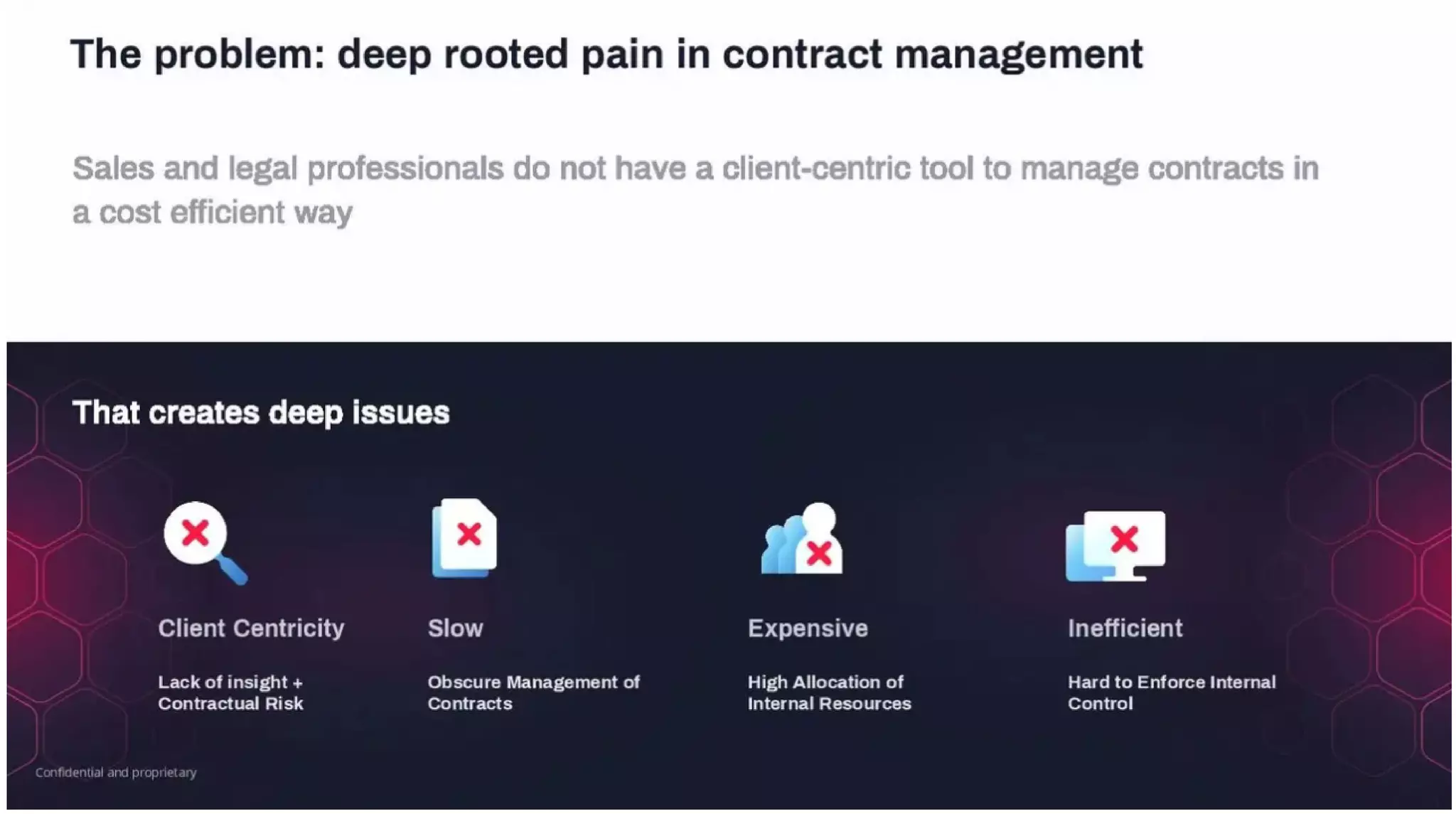
Problem: Framing pain with customer-centric language

Problem: Framing pain with customer-centric language

Slide 2 lays out the pain succinctly: sales and legal professionals lack client-centric, cost-efficient contract tools. The slide breaks the downstream consequences into four clear problems (Client Centricity, Slow, Expensive, Inefficient) with simple icons and one-line supporting points, making it easy to scan and understand the business pain being solved.

What makes this effective is the framing — it ties a common operational issue (contract management) to measurable business impacts (cost, speed, control) and uses language investors and buyers care about. Founders should note how minimal text plus structured visual categories can make a problem feel urgent and solvable while leaving room for the product to be the obvious remedy.

Key Takeaway: Describe the problem in concrete business-impact terms, then break it into a few scannable consequences to make the urgency and market need obvious.
Solution & Product: Unified workflow beats point tools

Solution & Product: Unified workflow beats point tools

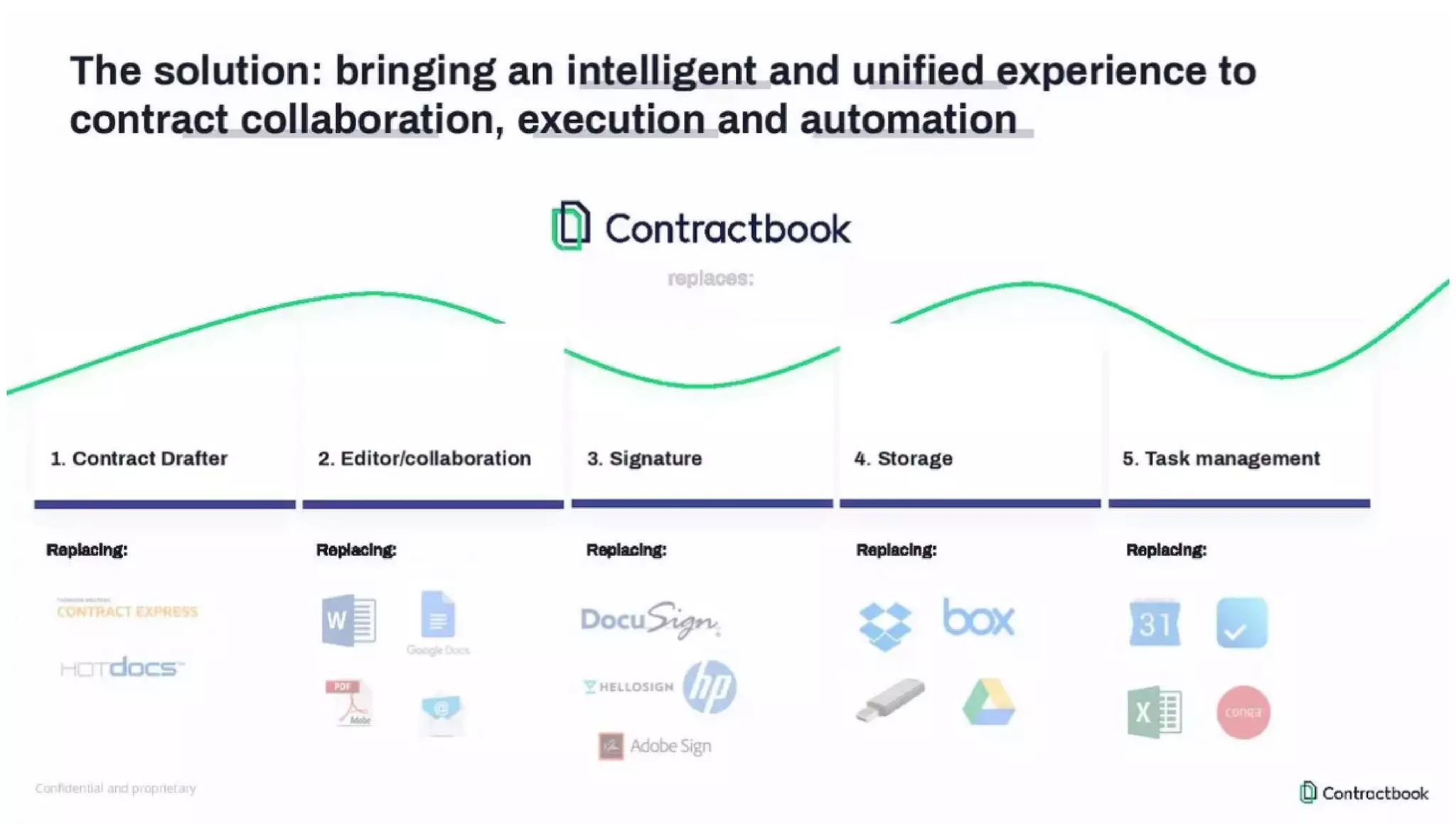
Slide 3 (and Slide 4) present the product as a unified replacement for a fragmented toolchain: contract drafter, editor/collaboration, signature, storage, and task management. Visuals show the single-platform approach and list common incumbents (Word, DocuSign, Dropbox, Google Drive) that Contractbook replaces, clarifying the competitive landscape and positioning the product as an all-in-one alternative.

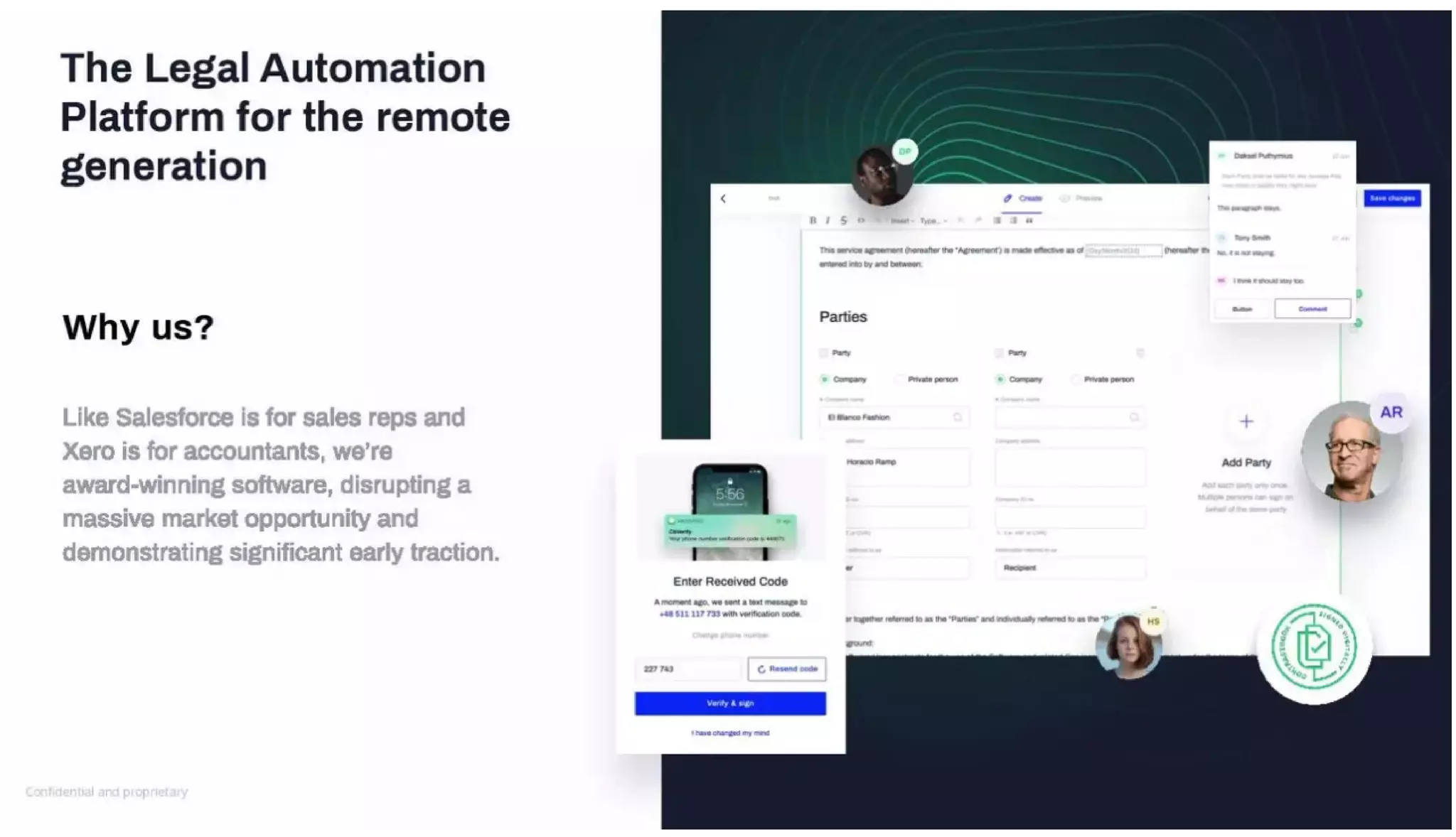
Slides 4–5 complement that message with screenshots of the UI and a user-centric pitch (“The Legal Automation Platform for the remote generation”), showing collaboration, verification steps, and mobile flows. This combination of conceptual diagrams and real UI gives credibility: founders see both the strategy (consolidation) and the execution (clean, usable interface). The lesson: combine an ecosystem map with product proof to make your solution tangible.

Key Takeaway: Demonstrate how your product consolidates adjacent tools and show real product UI to prove usability — map what you replace and why being integrated matters.
Technical differentiation: 'PDF is dead' and metadata-first approach

Technical differentiation: 'PDF is dead' and metadata-first approach

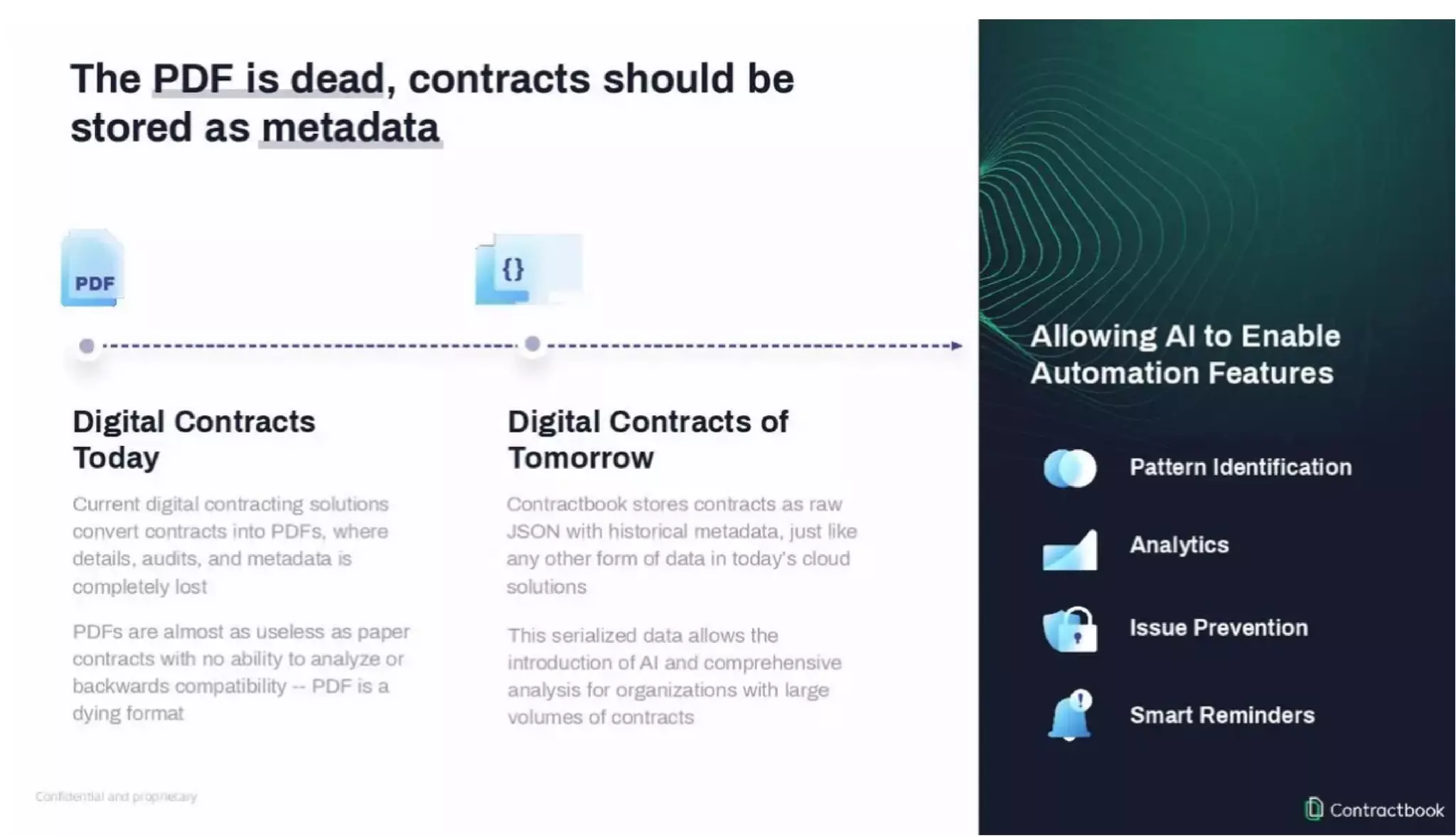
Slide 5 argues a technical differentiator: instead of converting contracts to dead-end PDFs, Contractbook stores contracts as serialized JSON with historical metadata. The slide explains the current limitation (PDFs lose metadata and auditability) and contrasts it with the future state where structured storage enables AI-driven features like pattern identification, analytics, issue prevention, and smart reminders.

This is a strong product-technology narrative because it connects a practical customer pain (cannot analyze PDFs) with a defensible engineering choice (structured data storage) and clear downstream capabilities (automation and AI). Founders should note the power of articulating not just the feature but the enabling technical decision and the future value it unlocks.

Key Takeaway: If you have a technical moat, explain the enabling design choice and show concrete downstream capabilities it unlocks — that’s how product + tech becomes defensible.
Traction: Growth metrics and usage acceleration

Traction: Growth metrics and usage acceleration

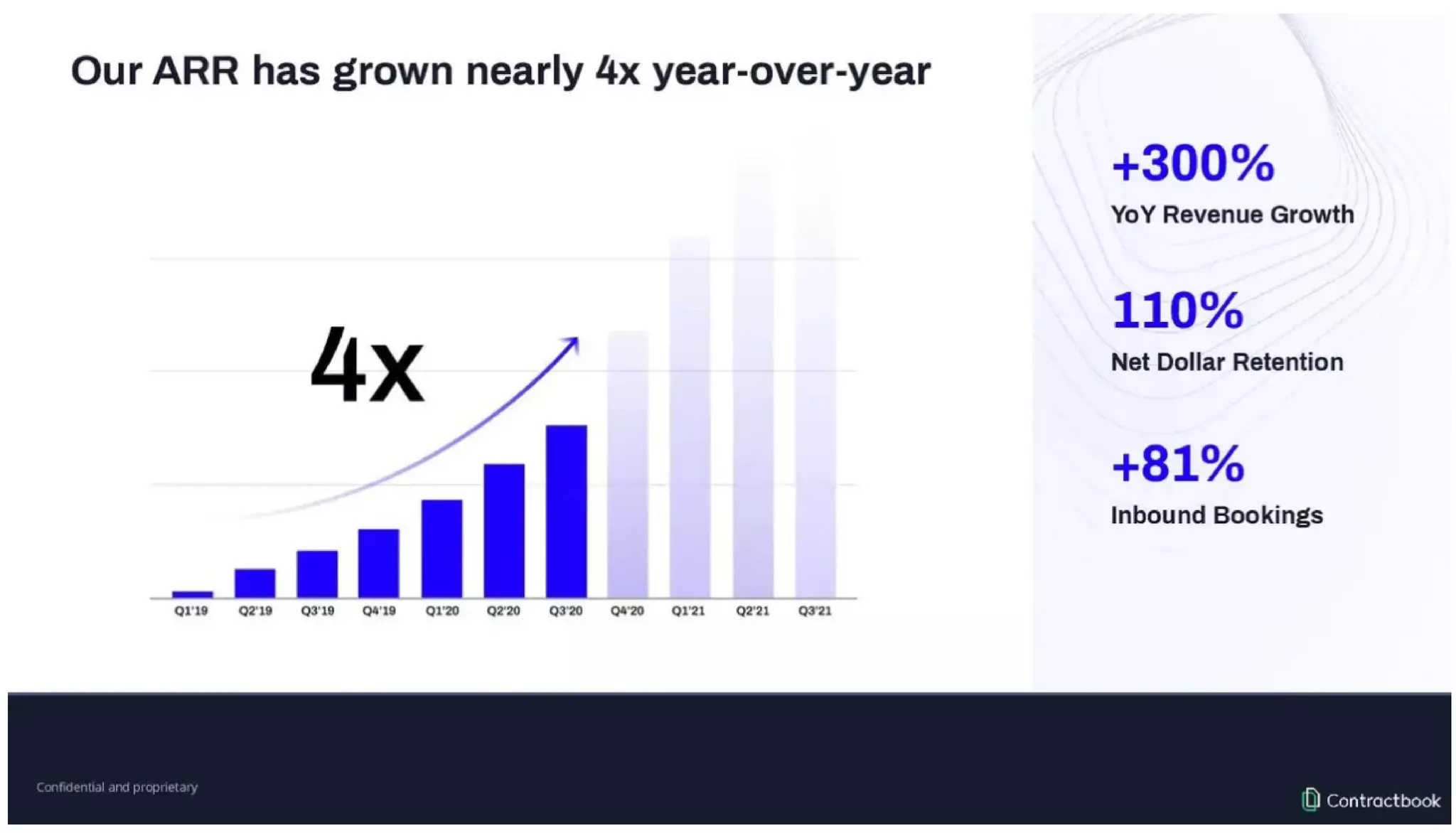
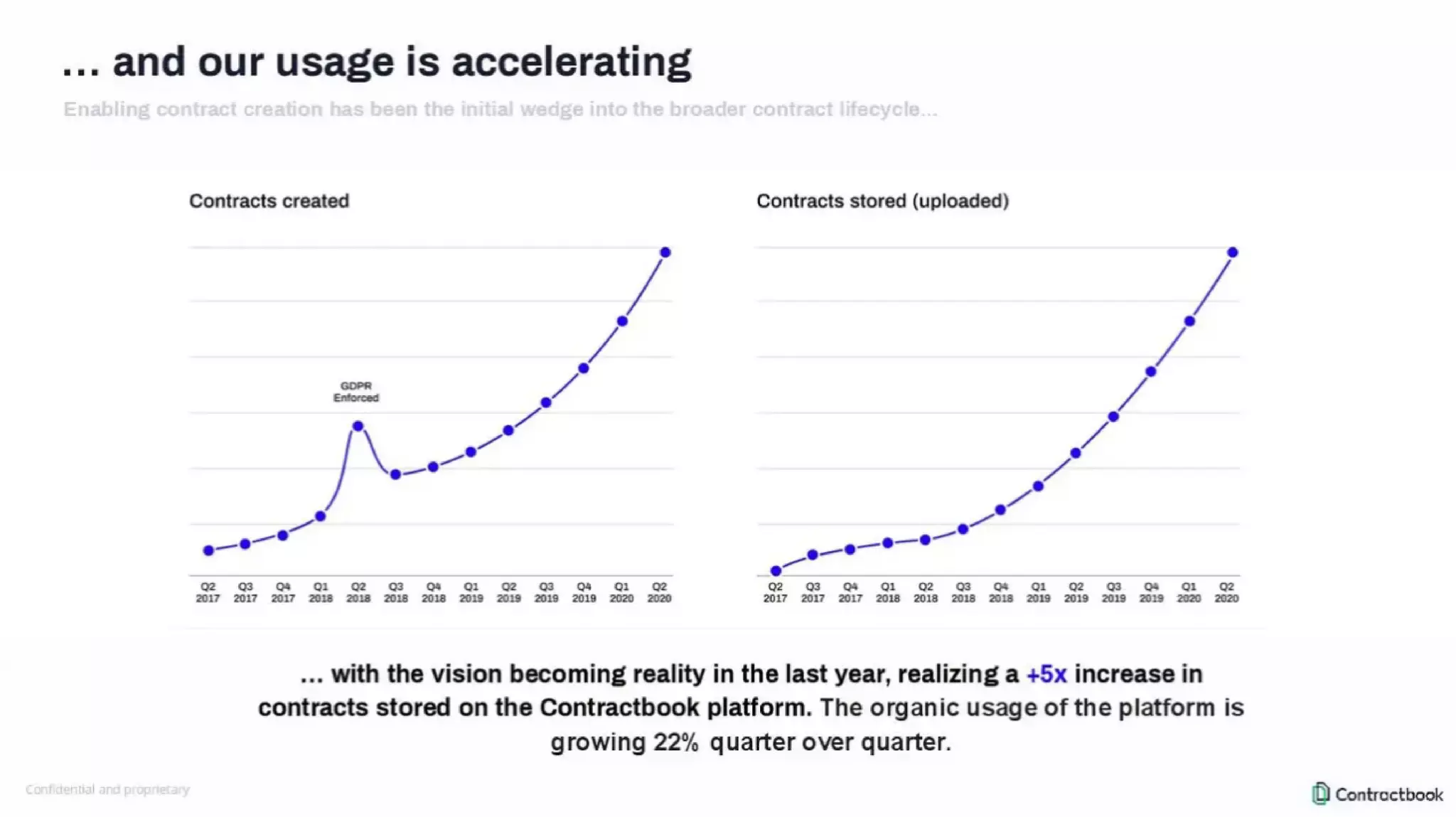
Slides 6 and 7 present quantitative traction: ARR growth (~4x year-over-year), YoY revenue growth (+300%), net dollar retention (110%), and inbound bookings (+81%). Graphs show quarter-by-quarter growth in ARR and contracts created/stored with a notable GDPR inflection, and an accelerating curve for uploads — visual proof of product-market fit and viral usage within customers.

The deck smartly pairs high-level metrics (growth rates, NDR) with usage data (contracts created/stored) to tell a complete traction story: revenue is scaling and the underlying product usage supports that revenue. For founders, this is a reminder to show both commercial metrics and product engagement to persuade investors that growth is sustainable, not just top-line noise.

Key Takeaway: Present revenue growth alongside product usage trends and retention to prove both demand and stickiness — show the engine, not just the result.
Market: TAM built from credible SME assumptions

Market: TAM built from credible SME assumptions

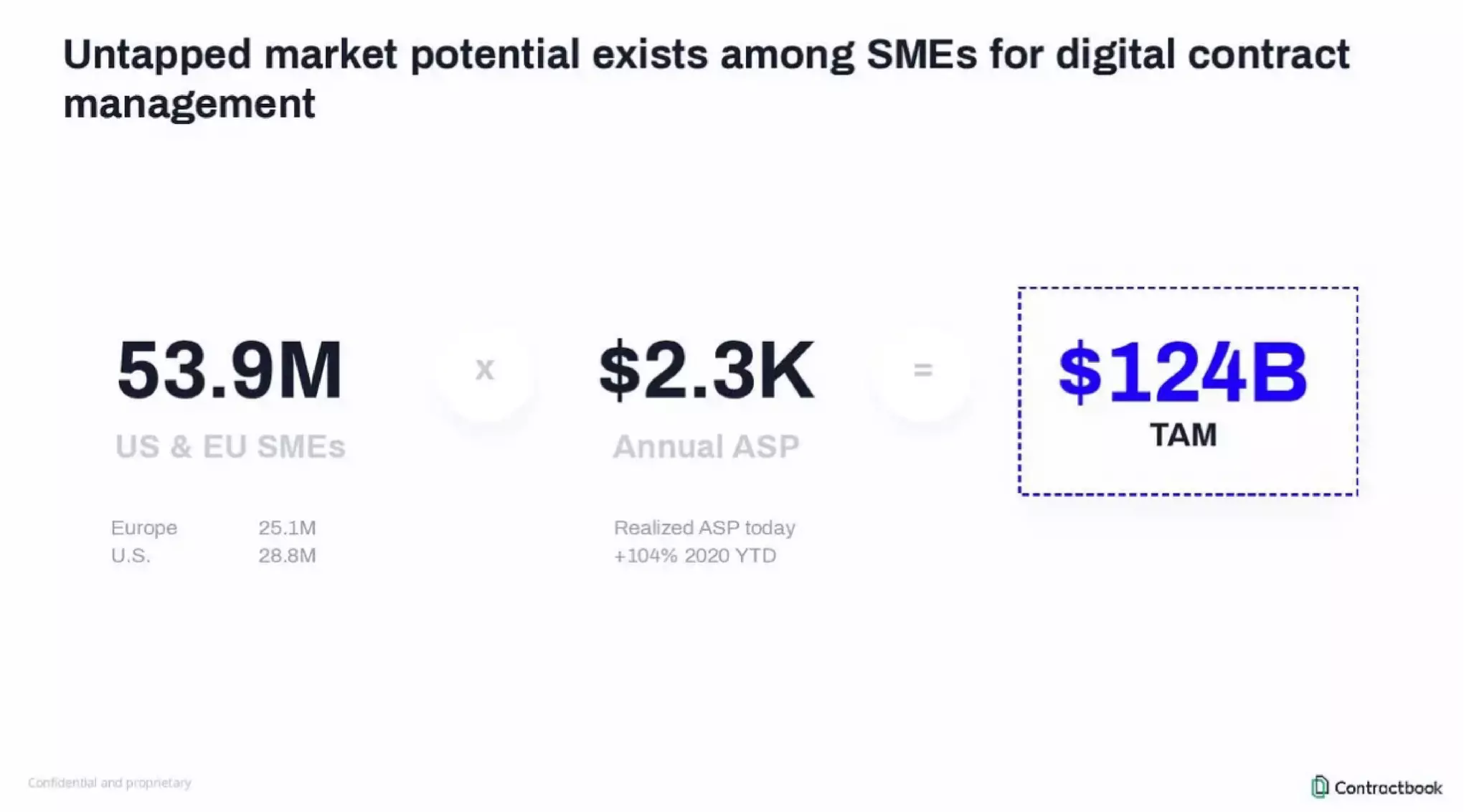
Slide 9 lays out an approachable TAM: 53.9M US & EU SMEs × $2.3K annual ASP = $124B. The slide quickly communicates how the company arrived at the opportunity size and includes a regional breakdown (Europe vs. U.S.), which helps investors understand go-to-market scaling assumptions across geographies.

This is effective because the arithmetic is simple and grounded in realistic unit economics (ASP) rather than overly optimistic macro numbers. Founders should follow this pattern: construct a TAM from tangible, defensible building blocks (target customers × realistic ASP) and call out regional rollout plans so investors can see the path from niche to scale.

Key Takeaway: Build TAM from defensible, unit-level assumptions (addressable customers × realistic ASP) and show regional breakdown to make scaling believable.
Positioning, team and investors: execution credibility

Positioning, team and investors: execution credibility

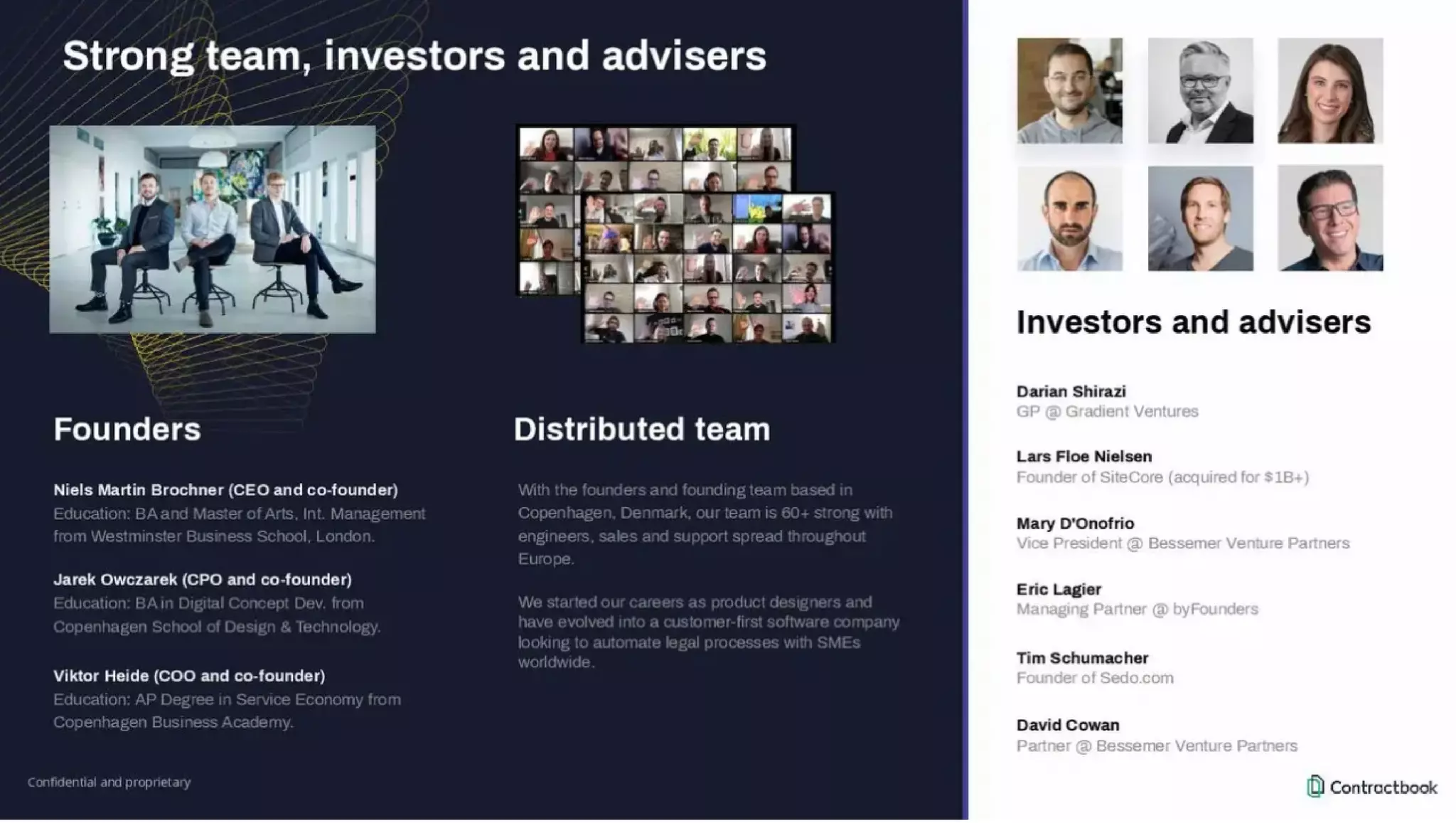
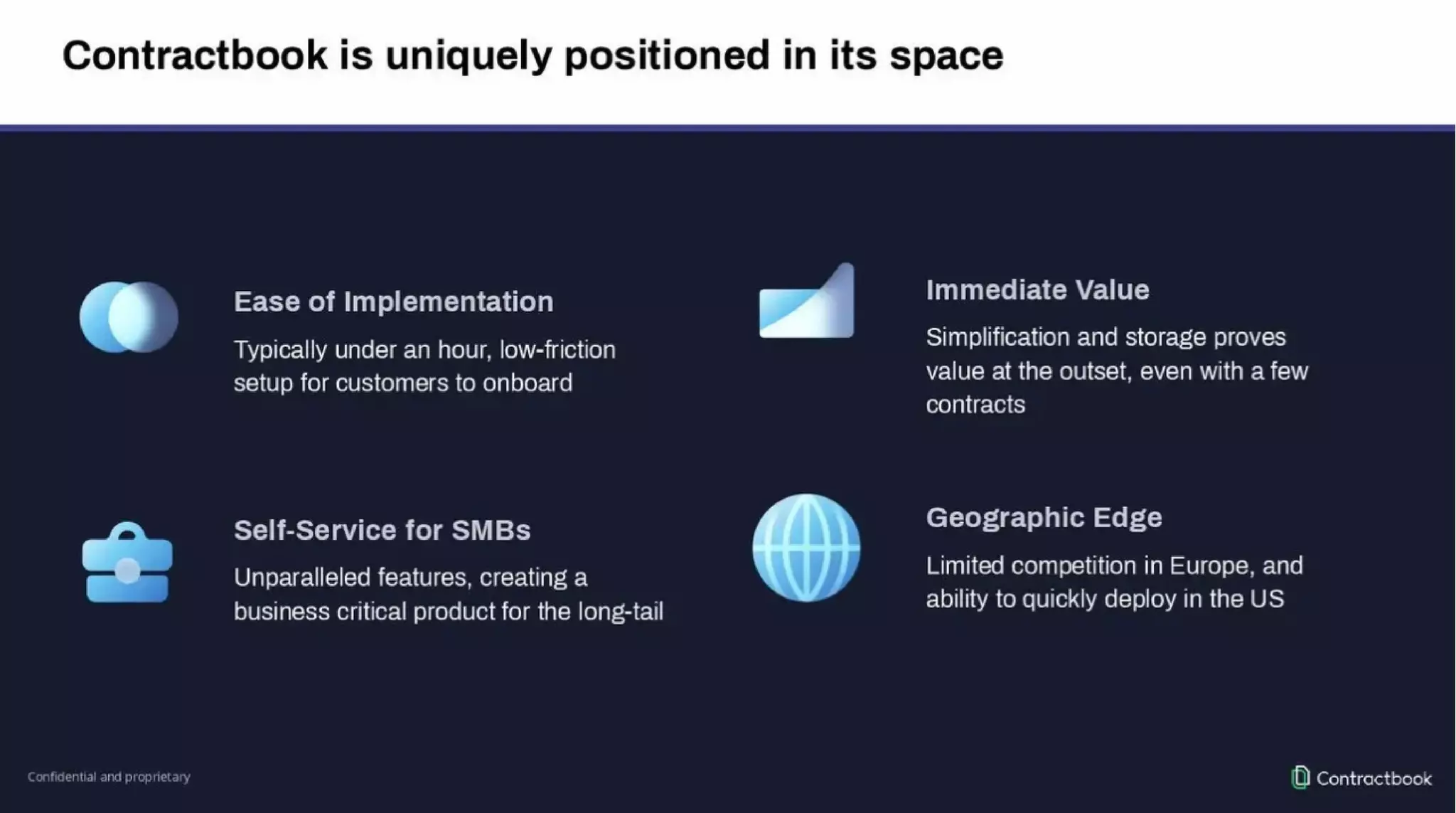
Slides 10–12 combine positioning (ease of implementation, immediate value, self-service for SMBs, geographic edge) with team slides and investor logos. The positioning slide succinctly describes why the product wins: fast onboarding, immediate ROI, and a focus on SMB self-service — a clear GTM play. The team slide highlights founders, a distributed engineering/sales organization, and notable backers/advisers (Gradient Ventures, Bessemer, byFounders), which adds operational and fundraising credibility.

Together these slides close the narrative by proving the team can execute the go-to-market and product roadmap, and that reputable investors have already validated the idea. Founders should ensure their deck finishes with a crisp positioning statement plus team + investor proof to convert product/story momentum into credibility.

Key Takeaway: End with clear positioning and credible execution evidence — show how you’ll win and who’s already backing you to reduce investor friction.
Fundraising snapshot: past rounds and ask clarity

Fundraising snapshot: past rounds and ask clarity

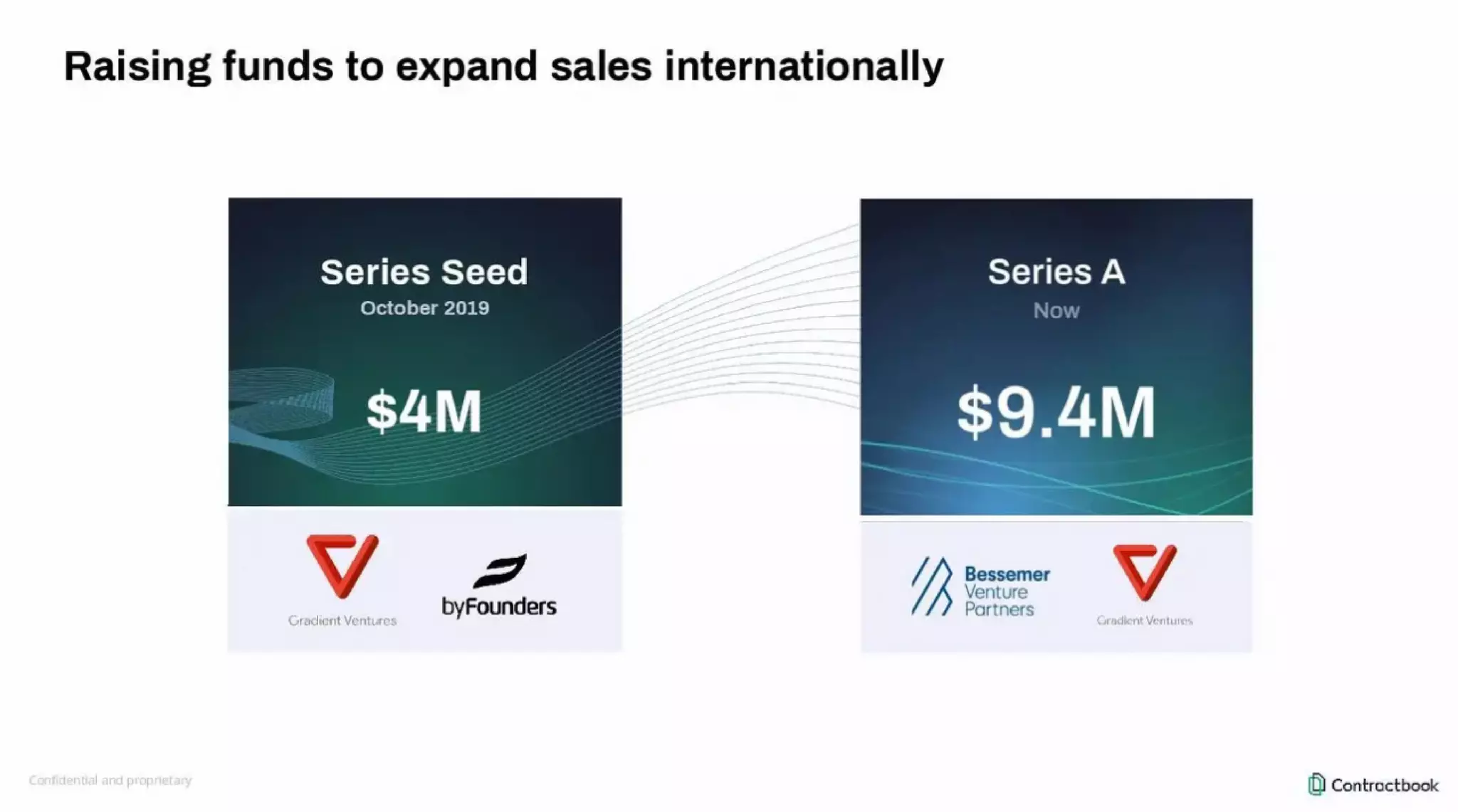
Slide 13 lays out the fundraising history and recent raise design: Series Seed ($4M, Oct 2019) and Series A (Now, $9.4M). Even though the deck metadata notes $3.9M seed and a later $30M+ total, the slide communicates momentum in capital raising and the lead investors. The visual connection between rounds signals progression — from seed proof to scaling with a larger round.

This is an important investor-facing detail because it shows what milestones were achieved with prior capital and signals how the current or future raise will be used (expand sales internationally). Founders should clearly map past capital to achieved milestones and future capital to concrete growth plans — investors want to see where money went and where it will go next.

Key Takeaway: Always show prior raises, investors, and a concise use-of-proceeds for the next round to link capital to measurable milestones and future growth.

Conclusion: Key Lessons

Contractbook’s deck effectively combines a crisp problem statement, a defensible technical approach (metadata-first contracts enabling AI), clear product proof, and measurable traction and market sizing — all presented with strong, consistent visuals. Strengths include the simple problem/solution framing, the demonstration of product-led growth via usage charts, and the defensible technical narrative that ties engineering choices to future automation features.

For founders building pitch decks: be concise and visual; show what you replace and why integration matters; back claims with both product usage and business metrics; translate technical decisions into future business capabilities; and close with team credibility and prior capital milestones. Those elements together make a persuasive, investable story that is easy to scan in an initial meeting and deep enough to justify follow-up conversations.

Full Deck Analysis

11 sections

Overview

Company: Contractbook
Round: Seed (~$3.9–4.0M shown on slides)
Year: 2019
Outcome: Raised $30M+ total (subsequent rounds)

Executive Summary

Contractbook’s Seed deck pitches a modern contract lifecycle platform that replaces fragmented point solutions (Word, PDFs, DocuSign, Dropbox, calendars, spreadsheets) with a single, metadata-first contract product that enables automation and AI. The deck is notable for clear problem framing, simple product positioning (store contracts as structured JSON), explicit TAM math, and strong early traction metrics (large YoY growth, high net dollar retention).

Problem Statement

How the deck articulates the problem:

  • Slide 2: “The problem: deep rooted pain in contract management.” Key pain points listed:
    • Lack of client centricity / lack of insight and contractual risk
    • Slow / obscure contract management
    • Expensive / high internal resource allocation
    • Inefficient / hard to enforce internal control
  • Framing is SME-focused: sales and legal professionals lack a client-centric, cost-efficient tool for contracts.

Solution

How the deck positions the solution:

  • Slide 3: Presents Contractbook as an “intelligent and unified experience” covering the full lifecycle: contract drafter, editor/collaboration, signature, storage, and task management — explicitly calling out which point solutions are replaced (Word/Google Docs, Adobe/DocuSign/HelloSign, Box/Dropbox/Drive, calendars/Excel/Concur).
  • Slide 4: Brand positioning — “The legal automation platform for the remote generation” — and product screenshots showing collaborative drafting and verification flows.
  • Slide 5: Technical/product thesis — “The PDF is dead. Contracts should be stored as metadata.” Contracts are serialized as JSON enabling analysis, AI, pattern detection, issue prevention, and smart reminders.

Market Opportunity

TAM / SAM / SOM and inputs shown on slides:

  • Slide 10 presents the TAM calculation:
    • 53.9M US & EU SMEs (Europe 25.1M; U.S. 28.8M)
    • Annual ASP (average selling price) shown: $2.3K
    • Resulting TAM = $124B
  • The deck frames the opportunity as the digital contract management spend among SMEs across US & EU with a realized ASP and growth in that realized ASP (+104% 2020 YTD noted).

Business Model

  • Implied SaaS subscription model targeted at SMEs with an Annual ASP ~ $2.3K (Slide 10).
  • Self-service onboarding and SMB pricing focus (Slide 11: “Self-Service for SMBs”).
  • Revenue sources shown implicitly: subscription / product licenses, inbound bookings (Slide 6: +81% inbound bookings). No explicit breakdown of tiers, % of revenue by product, or professional services shown.
  • Unit economics (CAC, LTV, gross margin) are not provided on the deck.

Traction & Metrics

Key growth metrics and proof points shown across slides:

  • Slide 6 (headline): “Our ARR has grown nearly 4x year-over-year.”
    • +300% YoY Revenue Growth
    • 110% Net Dollar Retention (NDR)
    • +81% Inbound Bookings
  • Slide 7: Usage acceleration graphs:
    • Contracts created and contracts stored trending strongly upward from Q2 2017 → Q2 2020.
    • Noted +5x increase in contracts stored on platform in last year.
    • Organic usage growth: 22% quarter-over-quarter.
    • Graph annotation: spike around GDPR enforcement (illustrative churn/impact and recovery).
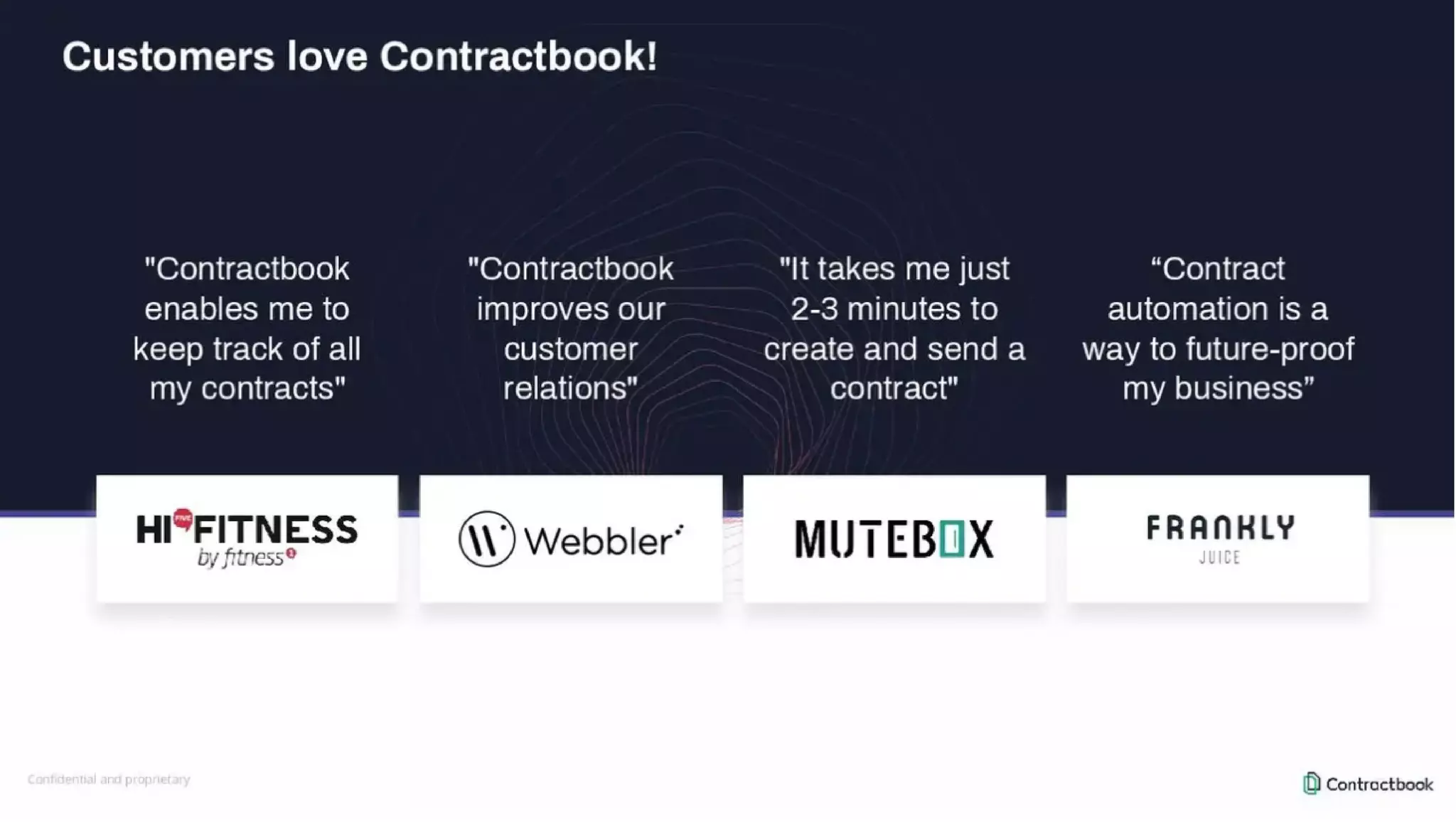
  • Slide 8: Customer testimonials and logos (Hi5 Fitness, Webbler, Mutebox, Frankly Juice) with quotes such as “enables me to keep track of all my contracts” and “2–3 minutes to create and send a contract.”
  • Slide 13: Funding history: Series Seed Oct 2019 $4M (and a Series A target $9.4M shown on slide — raises timeline).

Competitive Positioning

How they differentiate:

  • Product-first differentiation: store contracts as structured data (JSON) rather than PDFs — enabling analytics, AI, automated reminders, and issue prevention (Slide 5).
  • Replaces multiple single-purpose tools with a unified workflow (Slide 3).
  • Ease-of-onboarding and immediate value (Slide 11): “Typically under an hour” to implement; provides value even with a few contracts.
  • Focus on SMB/self-service and a geographic edge in Europe (limited competition in Europe, ability to deploy quickly in US).
  • Claims high retention (110% NDR) suggesting strong product-market fit for paying customers.

Team

  • Founders (Slide 12):
    • Niels Martin Brochner — CEO and co-founder (education: BA & Master of Arts, Int. Management)
    • Jarek Owczarek — CPO and co-founder (education: BA in Digital Concept Dev)
    • Viktor Heide — COO and co-founder (education: AP Degree in Service Economy)
  • Company: distributed team 60+ (engineers, sales, support across Europe).
  • Investors / advisers listed on Slide 12 include Bessemer/Venture partners and known angels/advisers (several names shown).

Go-to-Market Strategy

  • SMB self-service focus (Slide 11).
  • Emphasis on inbound growth (+81% inbound bookings on Slide 6) and product-led onboarding (under an hour).
  • Geographic expansion: primarily Europe with plans/edge to deploy in the US (Slide 11 and Slide 13 “Raising funds to expand sales internationally”).
  • No explicit channel partnerships, enterprise sales motions, pricing tiers, or CAC figures shown.

The Ask

  • The deck indicates prior financing and the next round:
    • Series Seed (Oct 2019): $4M (Slide 13) — consistent with the Seed in context (~$3.9M reported elsewhere).
    • Slide 13 also shows a Series A fundraising target of $9.4M labeled “Now” (used in the deck to show fundraising trajectory).
  • Use of funds: explicitly stated objective — expand sales internationally (Slide 13). Presumed investment in go-to-market / sales expansion given the text/visuals.

Investor Deep Dive

Executive summary, strengths & red flags

Executive Summary

Contractbook’s Seed deck pitches a modern contract lifecycle platform that replaces fragmented point solutions (Word, PDFs, DocuSign, Dropbox, calendars, spreadsheets) with a single, metadata-first contract product that enables automation and AI. The deck is notable for clear problem framing, simple product positioning (store contracts as structured JSON), explicit TAM math, and strong early traction metrics (large YoY growth, high net dollar retention).

Key Strengths

3 identified

1

Clear product thesis and differentiation (metadata-first contracts): The “PDF is dead” argument is concise and drives home a defensible technical/product angle that enables AI and automation (Slide 5).

2

Strong, tangible traction metrics: 4x ARR YoY, +300% YoY growth, 110% NDR, +81% inbound bookings, +5x contracts stored, and 22% q/q organic usage growth (Slides 6–7). These are the type of metrics investors want to see early.

3

Clean TAM math and SMB focus: explicit TAM calculation ($124B) with clear inputs (53.9M SMEs × $2.3K ASP) gives credibility to the market opportunity (Slide 10).

Red Flags & Weaknesses

3 identified

1

Lack of concrete financials and ARR dollar amounts: The deck boasts % growth (4x ARR, +300% YoY) but does not disclose actual ARR, revenue figures, gross margins, or burn rate — makes it hard to assess scale and capital efficiency.

2

Missing unit economics and GTM metrics: No CAC, LTV, payback, conversion funnel, or channel mix data. GTM is described in high-level terms (inbound, self-service) but lacks the operational detail investors typically seek.

3

Customer concentration and enterprise proof: Customer logos are SMB-sized and anonymous; no marquee enterprise customers or case studies showing dollarized ROI. This leaves questions about expansion into larger accounts and how pricing scales.

More Pitch Decks To Study

Compare structure, fundraising context, and investor-facing story across similar startup decks.