Compare your deck to Intercom

Compare Your Deck

Intercom Pitch Deck (2011)

SaaS
Stage: Seed
Raised: $600K
Year: 2011
Slides: 8
Outcome: Valued at $1.3B

Pitch Deck

1 / 8
Intercom pitch deck - The Opening: Brand + Simple Identity
Click to expand

Deck Analysis

This seed pitch deck from Intercom (2011) concisely presents a product that reimagines customer communication for SaaS companies. It is notable for clear problem framing, a simple product explanation, a strong founding team slide, and an ask that matches early-stage needs. The deck’s combination of product screenshots, competitive positioning, and early social proof (beta feedback) helped the company secure a $600K seed and ultimately scale to a large outcome — useful as a template for founders who need to tell a focused product-market story quickly.

The Opening: Brand + Simple Identity

The Opening: Brand + Simple Identity

Slide 1 is a minimalist title slide that pairs a distinctive logo with the company name in a clean composition. This simplicity immediately communicates confidence and a clear brand identity without distracting from the pitch. Using whitespace and a single visual makes the deck feel polished and establishes a professional tone before any text-heavy slides appear.

Founders can learn from this restraint: the opening page sets expectations. An effective, uncluttered cover primes investors for a focused narrative and signals that the team understands design and product sensibility — both important for a UX-driven SaaS product.

Key Takeaway: Start with a clean, on-brand cover that communicates product sensibility and sets an expectation of clarity for the rest of the deck.
The Team: Credibility and complementary roles

The Team: Credibility and complementary roles

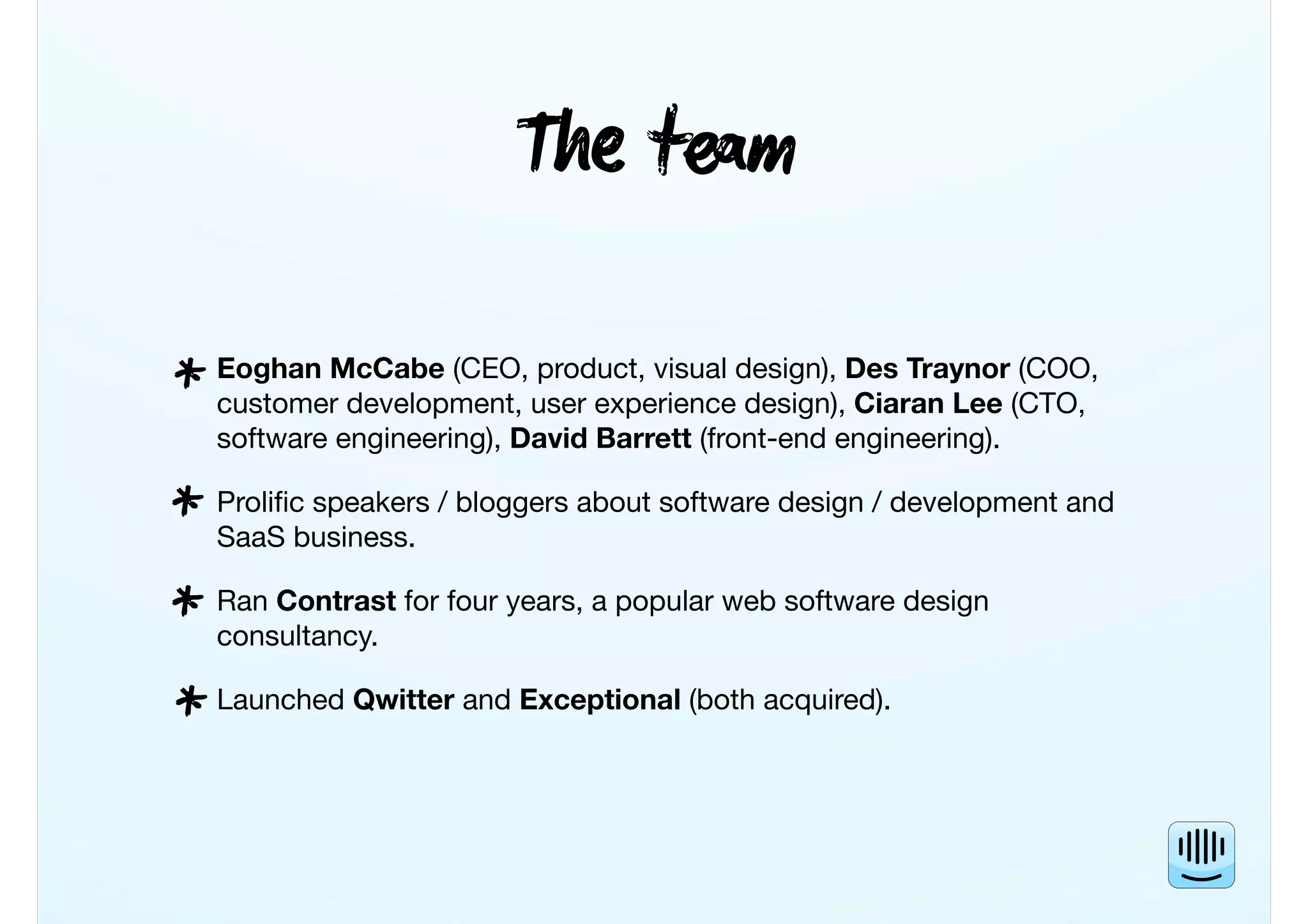
Slide 2 highlights the founding team, listing names, roles, and prior relevant accomplishments (consultancy, prior products). The slide uses bolding to emphasize key names and companies, which helps investors quickly parse who does what and why they matter. It also calls out public-facing credibility (speaking, blogging) and previous exits/acquisitions, which are powerful signals at seed stage.

This slide balances brevity and signal: it doesn’t try to tell every CV detail but focuses on exactly the credentials that matter for trust — product/design strength, engineering chops, and startup experience. For founders, this illustrates how to present a team: show complementary skills, relevant track record, and early signals of domain expertise rather than long bullet lists.

Key Takeaway: Show complementary roles and highlight prior, relevant wins concisely to build early trust with investors.
The Problem: Clear, customer-centric pain

The Problem: Clear, customer-centric pain

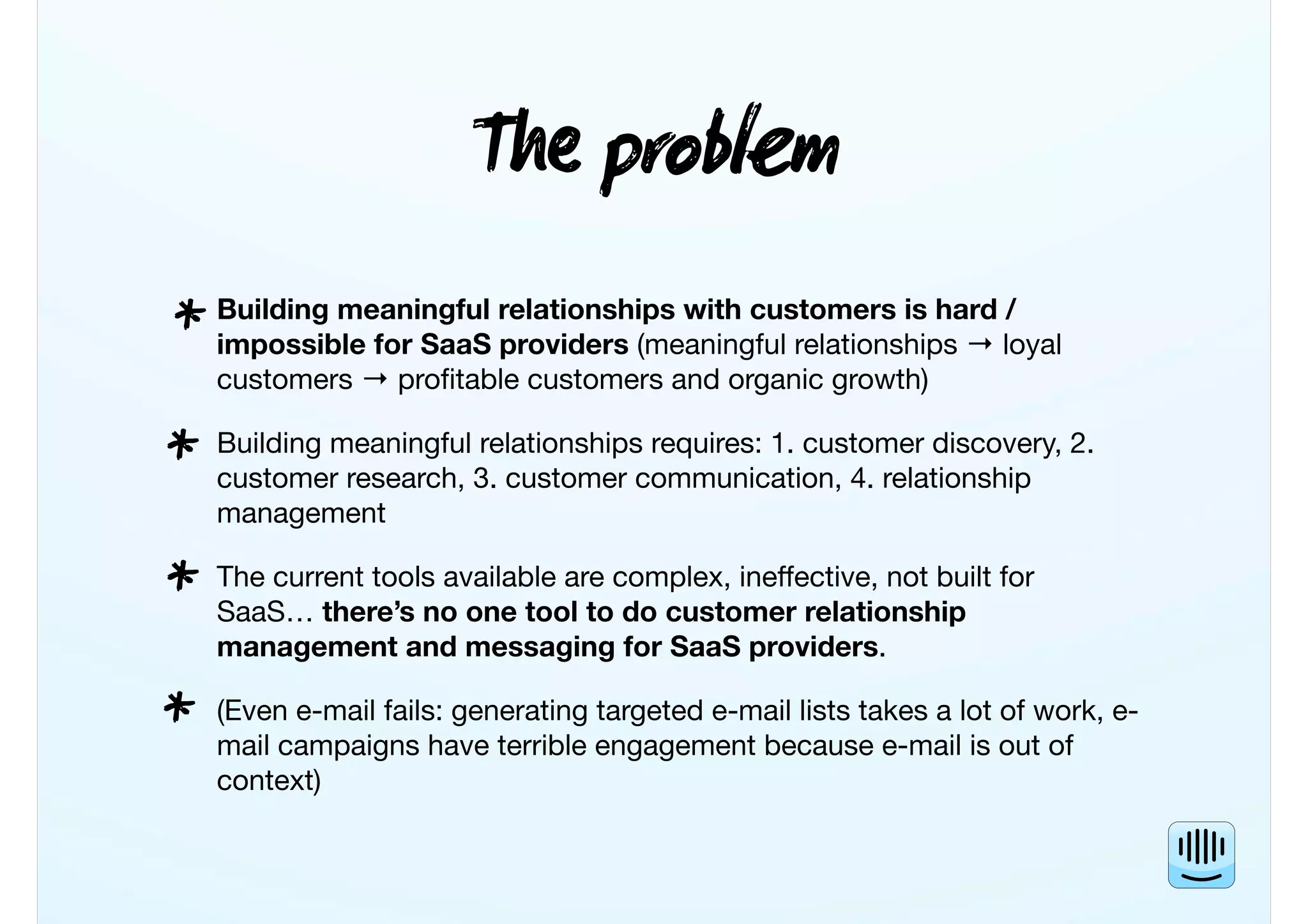
Slide 3 frames the problem crisply: SaaS companies struggle to build meaningful customer relationships and existing tools are fragmented or ineffective. The slide breaks the problem into why it matters (loyal, profitable customers) and the tasks required (discovery, research, communication, management), making the scope and complexity of the problem tangible.

The slide also points out a specific shortcoming of common solutions (email, complex tooling), which creates a natural segue to the product. Founders should note how this slide pairs emotional language (“meaningful relationships”) with operational specifics — it shows the pain and explains why current solutions fail, which primes investors to see the product as both necessary and defensible.

Key Takeaway: Define the customer pain in both emotional and operational terms and explicitly explain why existing solutions fail.
The Solution: Product capabilities and simple positioning

The Solution: Product capabilities and simple positioning

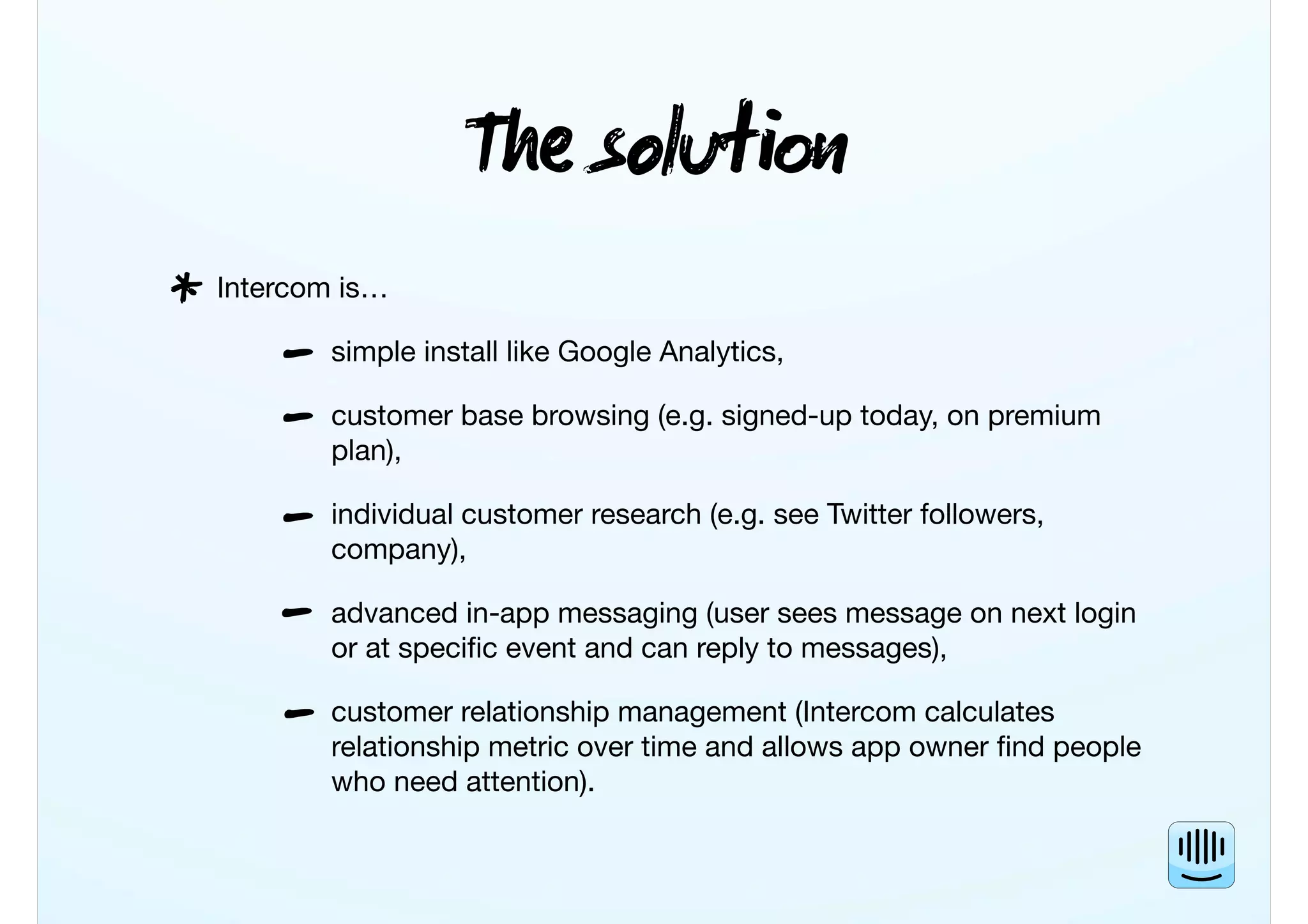
Slide 4 lists Intercom’s core features as the direct answer to the problem: easy install, customer browsing, individual research, in-app messaging, and a relationship metric. The slide uses plain language and short bullets so an investor can immediately map features to the previously stated problems. Positioning the product as a simple install like Google Analytics is an effective analogy that communicates low friction.

This is a good example of product storytelling — each feature is tied to a clear use case (e.g., messaging at specific events, identifying customers who need attention). Founders should aim to show the minimum set of features that deliver core value and use familiar analogies to convey adoption friction and integration simplicity.

Key Takeaway: Describe core features in plain terms tied to specific use cases and use familiar analogies to convey ease of adoption.
Landscape: Competitive map and white space

Landscape: Competitive map and white space

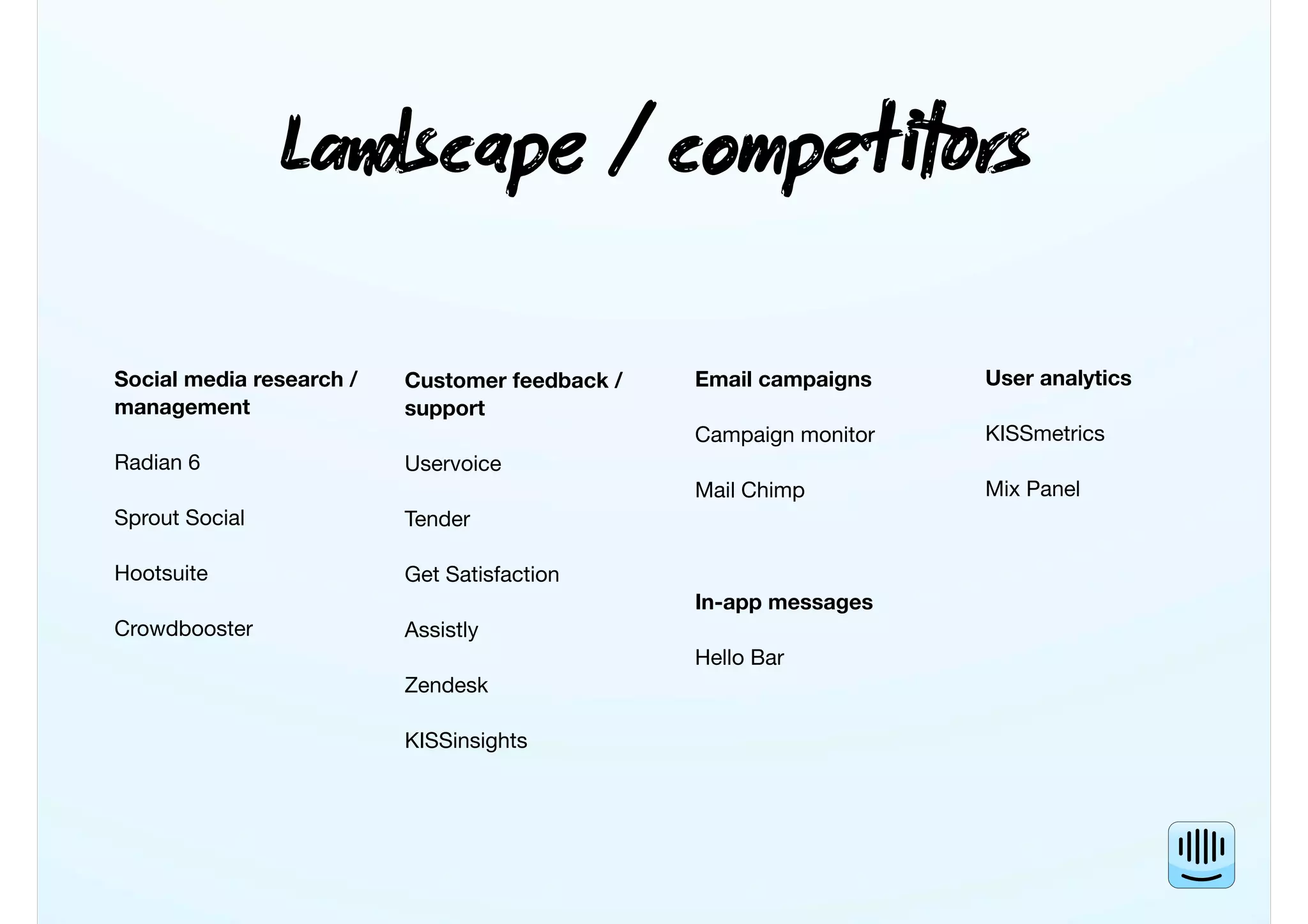
Slide 6 lays out the competitive landscape by category (social research, customer feedback/support, email campaigns, in-app messages, user analytics) and lists representative competitors. This categorization makes it easy to see fragmentation — many point solutions exist but none cover the whole problem. By showing players in adjacent categories, the slide implicitly defines Intercom’s positioning as a unifying product.

For founders, this slide demonstrates how to turn a crowded market into an opportunity: instead of claiming a monopoly, show how incumbents are siloed and where your product integrates or replaces multiple tools. The visual organization helps investors quickly grasp both competition and differentiation without deep technical detail.

Key Takeaway: Map competitors by category to show fragmentation and clearly position your product as the integrator or better alternative.
Progress: Traction, beta feedback, and social proof

Progress: Traction, beta feedback, and social proof

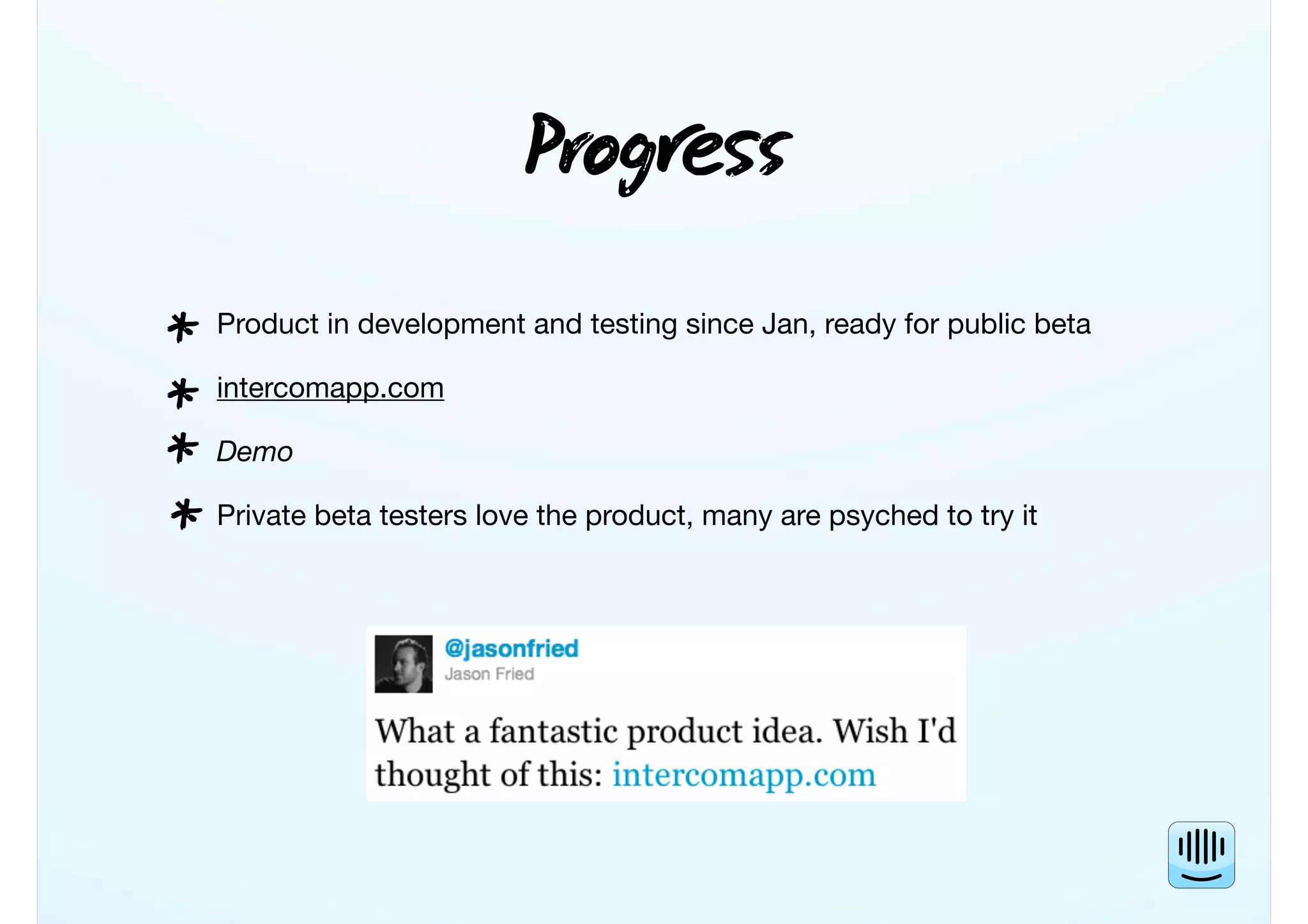
Slide 7 communicates product progress (in development, heading to public beta), a domain (intercomapp.com), and strong early social proof (a positive tweet screenshot). The combination of roadmap status and third-party praise demonstrates both momentum and market interest. Including a short list of development milestones plus a real quote adds credibility without overclaiming.

Founders should use this pattern to validate early traction: show what’s built, what’s coming, and include one or two pieces of genuine external validation (user quotes, beta testers, press) rather than inflated metrics. Authentic endorsements from respected people or customers can amplify investor confidence at seed stage.

Key Takeaway: Show concrete progress and include authentic social proof to convert product development into perceived traction.
The Ask: Reasonable capital plan and milestone-focused use of funds

The Ask: Reasonable capital plan and milestone-focused use of funds

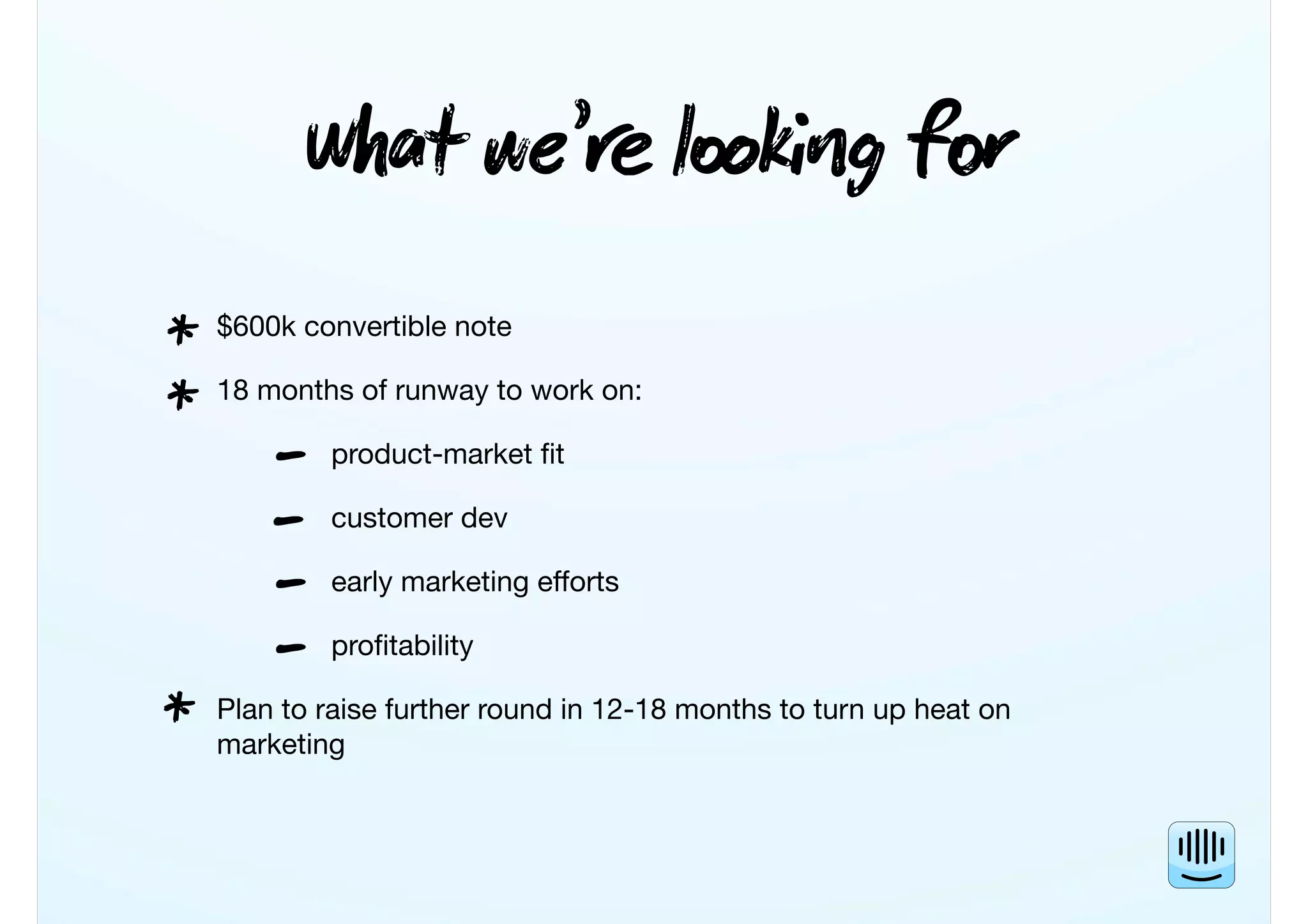
Slide 8 states the ask ($600K convertible note) and explains the runway use: product-market fit, customer development, early marketing, and path to profitability, with a plan to raise later to accelerate growth. This aligns the capital requested with measurable, stage-appropriate objectives and a timeline, which reduces investor uncertainty. It’s candid about next steps and shows fundraising discipline (seeking an amount to reach specific milestones, not to scale prematurely).

Founders can learn to make their asks specific, justified, and milestone-driven. Investors prefer to see how funds will move the company to the next inflection point and what the follow-up plan is — that transparency builds credibility and helps investors evaluate risk and upside.

Key Takeaway: Ask for an amount tied to clear 12–18 month milestones and explain how the capital will de-risk the next stage.

Conclusion: Key Lessons

This deck succeeds through clarity, economy, and direct mapping between problem, solution, team, competition, traction, and ask. Its strengths are a tight narrative (pain → product → differentiation), strong founder credibility, and an ask that is matched to measurable short-term milestones. The visuals are intentionally simple, letting the text-driven story and a single piece of social proof carry the case.

Actionable advice: keep the story focused on a single compelling problem, show how your product uniquely solves it with concrete examples, present a small set of features that deliver disproportionate value, and align your funding ask to explicit milestones. Finally, include credible early validation (beta feedback, customer quotes, or pilots) — it can shift a seed conversation from hypothetical to tangible.

Full Deck Analysis

11 sections

Overview

Company: Intercom
Round: Seed ($600K convertible note)
Year: 2011
Outcome: Valued at $1.3B (as of analysis date)
Time to Unicorn: ~10 years from seed

Executive Summary

Intercom’s 2011 seed pitch deck presents a tightly focused solution to a specific SaaS pain point: the fragmentation of customer relationship management and messaging tools. The deck demonstrates strong founder credibility (prior exits from Contrast consultancy), clear problem articulation grounded in market dynamics, and early product validation through private beta enthusiasm. Rather than chasing a massive TAM, the founders strategically identified an underserved niche (SaaS providers) with a phased expansion roadmap to adjacent markets (mobile/desktop apps). The deck’s strength lies in its clarity and specificity—each slide directly supports the investment thesis without unnecessary fluff.

Problem Statement

Slide 3: “The Problem” articulates a sophisticated understanding of SaaS economics:

  • Core insight: Meaningful customer relationships → loyal customers → profitable customers → organic growth
  • Market gap identified: No integrated tool combining four critical functions:
    1. Customer discovery
    2. Customer research
    3. Customer communication
    4. Relationship management

Specific pain point: Email campaigns fail because they lack context—users receive messages disconnected from their in-app behavior, resulting in poor engagement.

Why this matters: The deck frames the problem not as a feature gap but as a business outcome problem. SaaS providers lose revenue through churn and missed upsell opportunities due to inability to build meaningful relationships at scale.

Weakness: The deck provides no quantitative validation of the problem (e.g., churn rates, lost revenue, customer acquisition cost impact). It relies on logical inference rather than market research data.

Solution

Slide 4: “The Solution” positions Intercom as a unified platform with five core capabilities:

  1. Simple installation (like Google Analytics)—removes friction for adoption
  2. Customer base browsing—segment users by signup date, plan type, and other attributes
  3. Individual customer research—integrate social data (Twitter followers, company info) for context
  4. Advanced in-app messaging—event-triggered, two-way communication visible on next login or at specific moments
  5. Relationship management—calculates a relationship metric over time and surfaces customers needing attention

Key positioning: Intercom is not a CRM replacement; it’s a lightweight, SaaS-native tool that combines customer intelligence with contextual messaging. The emphasis on “simple install” and “in-app” messaging directly addresses the email context problem.

Weakness: The deck lacks product screenshots, mockups, or visual demonstrations. For a product-focused pitch, this is a significant gap. Investors see only text descriptions, not the actual UX that makes Intercom compelling.

Market Opportunity

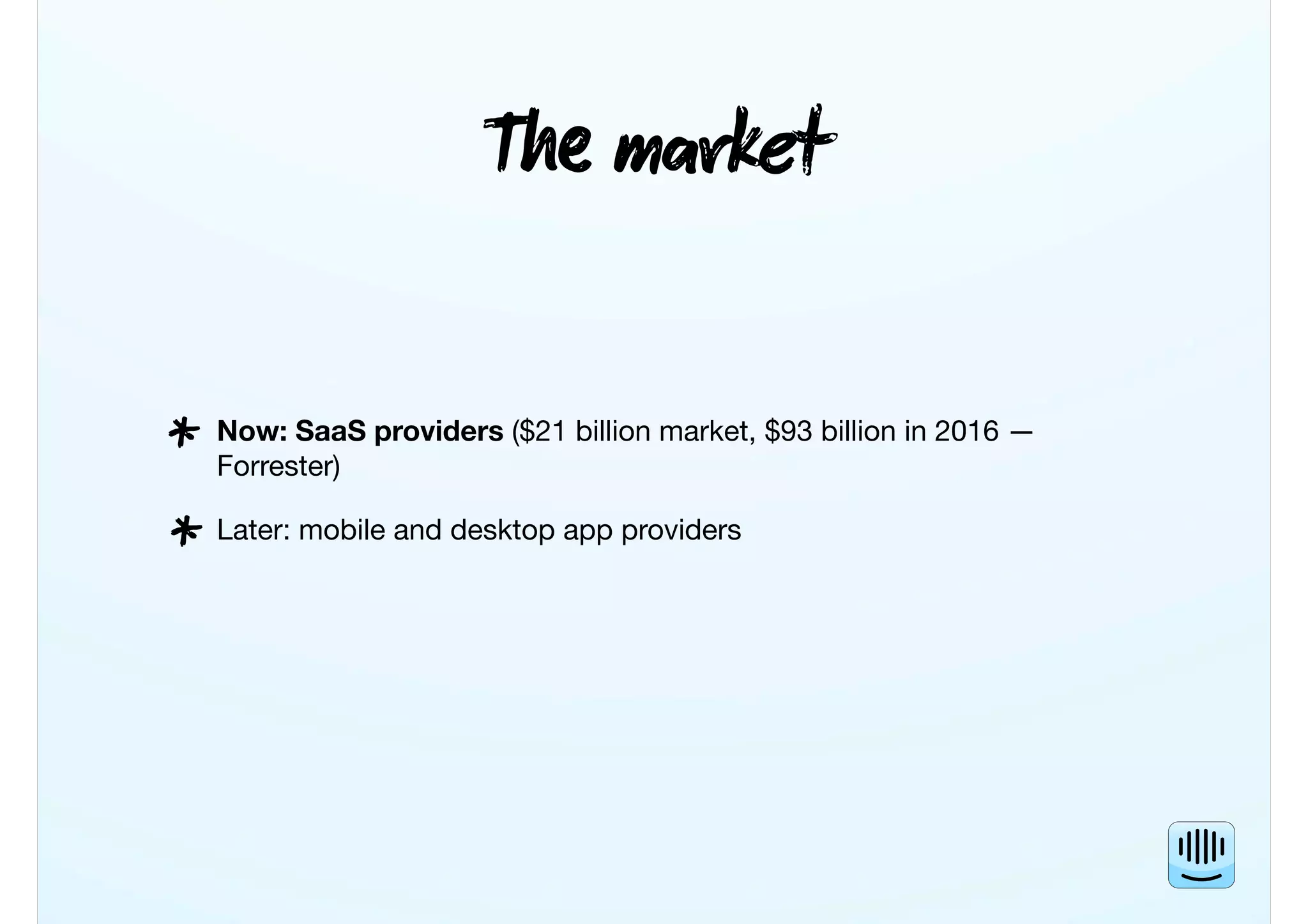
Slide 5: “The Market” provides explicit TAM sizing:

Metric Value Source
Current SaaS market (2011) $21 billion Forrester
Projected 2016 market $93 billion Forrester
Growth rate (5-year CAGR) 4.4x Implied
Initial target SaaS providers Explicit
Future expansion Mobile & desktop app providers Explicit

Strategic framing: Rather than claiming the entire $21B market, the deck acknowledges a phased approach. This demonstrates realistic thinking—the founders understand they’ll start with SaaS, then expand to adjacent categories.

Weaknesses:

  • No SAM (Serviceable Addressable Market) breakdown by company size, geography, or vertical
  • No SOM (Serviceable Obtainable Market) or realistic year-1 revenue targets
  • The 2016 projection feels distant and speculative from a 2011 perspective
  • No discussion of market dynamics, growth drivers, or competitive intensity

Business Model

Not explicitly stated in the deck. This is a notable omission.

Inferred from context:

  • Likely model: SaaS subscription (freemium or paid tiers)
  • Pricing signal: The emphasis on “simple install like Google Analytics” suggests self-serve, low-friction onboarding—consistent with a freemium model
  • Unit economics: Not discussed; no mention of CAC, LTV, payback period, or gross margin targets

Critical gap: A seed deck should address business model, even briefly. The absence suggests either:

  1. The founders hadn’t finalized pricing strategy
  2. The deck prioritizes product/market fit over monetization (reasonable for early stage)
  3. This is an internal draft (note the “DRAFT” watermark on Slide 1)

Traction & Metrics

Slide 7: “Progress” provides limited but meaningful traction signals:

Metric Evidence
Development timeline In development and testing since January 2011 (~6 months at pitch time)
Product status Ready for public beta
Private beta feedback “Love the product,” “many are psyched to try it”
Third-party validation Jason Fried (@jasonfried, founder of 37signals) endorsement: “What a fantastic product idea. Wish I’d thought of this.”
Website live intercomapp.com accessible
Demo available Yes

Strengths of this approach:

  • Demonstrates execution velocity (6 months from concept to beta-ready)
  • Leverages influencer credibility (Jason Fried is highly respected in SaaS community)
  • Provides proof of concept (working product, not just an idea)

Critical weaknesses:

  • No quantitative metrics: Missing number of beta signups, daily active users, retention rates, NPS, or usage patterns
  • Single testimonial: One tweet is insufficient social proof; should include multiple customer quotes or aggregated feedback
  • No revenue signals: No mention of early paying customers, MRR, or pricing validation
  • Vague language: “Love the product” and “psyched to try it” are qualitative and unverifiable

For context: By 2011 standards, this level of traction was acceptable for a seed round. Today, investors expect more rigorous metrics even at seed stage.

Competitive Positioning

Slide 6: “Landscape / Competitors” maps the fragmented market into four categories:

Category Competitors Intercom’s Angle
Social media research/management Radian 6, Sprout Social, Hootsuite, Crowdbooster Integrated customer research
Customer feedback/support Uservoice, Tender, Get Satisfaction, Assistly, Zendesk, KISSinsights Unified relationship management
Email campaigns Campaign Monitor, Mail Chimp In-app messaging (contextual, not email)
User analytics KISSmetrics, Mix Panel Relationship scoring & prioritization

Competitive strategy: Rather than claiming superiority over any single competitor, the deck positions Intercom as the only unified solution combining all four functions. This is a “best-of-breed integration” strategy.

Strengths:

  • Clearly identifies market fragmentation as the core problem
  • Shows deep competitive awareness
  • Implicitly argues for consolidation (customers prefer one tool over four)

Weaknesses:

  • No direct comparison: Doesn’t articulate specific feature advantages (e.g., “faster setup than Zendesk,” “better analytics than KISSmetrics”)
  • No pricing comparison: Doesn’t address cost positioning
  • In-app messaging gap: “Hello Bar” is the only listed competitor for in-app messaging, suggesting either a white space or incomplete competitive analysis
  • No moat discussion: Doesn’t explain why competitors can’t copy Intercom’s integration approach

Team

Slide 2: “The Team” introduces four founders with complementary expertise:

Name Title Functional Area Credentials
Eoghan McCabe CEO Product, visual design Contrast co-founder (4 years)
Des Traynor COO Customer development, UX design Contrast co-founder; prolific speaker/blogger
Ciaran Lee CTO Software engineering Contrast co-founder
David Barrett Engineer Front-end engineering Contrast co-founder

Prior exits: Launched Qwitter and Exceptional (both acquired)

Credibility signals:

  • Founder experience: All four worked together at Contrast for 4 years—proven ability to collaborate
  • Thought leadership: Des Traynor noted as “prolific speaker/blogger” on software design and SaaS business
  • Exit experience: Previous product launches and acquisitions demonstrate ability to ship and exit
  • Complementary skills: CEO/product, COO/customer dev, CTO/engineering, front-end engineer—well-rounded team

Weaknesses:

  • No photos: Investors can’t put faces to names; reduces personal connection
  • Limited individual detail: No mention of specific accomplishments, awards, or domain expertise depth
  • No advisors/board: Doesn’t mention external advisors or board members (though this may not have been finalized at seed stage)
  • No diversity note: All four names suggest male founders (though this wasn’t a major investor focus in 2011)

Assessment: This is a strong founding team for a SaaS product company. The Contrast background is particularly valuable—they’ve built and sold a successful consultancy, giving them deep SaaS customer understanding.

Go-to-Market Strategy

Not explicitly detailed in the deck. This is a notable gap.

Inferred from available information:

  • Initial target: SaaS providers (B2B SaaS)
  • Distribution channel: Self-serve (implied by “simple install like Google Analytics”)
  • Launch approach: Public beta (Slide 7)
  • Early marketing: Mentioned as a use of seed capital (Slide 8) but not detailed
  • Influencer leverage: Jason Fried endorsement suggests organic/word-of-mouth strategy

Missing details:

  • No discussion of sales strategy (self-serve vs. enterprise sales)
  • No customer acquisition channels (content marketing, partnerships, paid ads, etc.)
  • No pricing tiers or packaging strategy
  • No retention/expansion strategy

For a seed deck, this is acceptable—GTM strategy often evolves based on early customer feedback. However, the COO (Des Traynor) has “customer development” in his title, suggesting this was a focus area not fully articulated in the deck.

The Ask

Slide 8: “What We’re Looking For” provides explicit funding details:

Item Detail
Funding amount $600K
Instrument Convertible note
Runway 18 months
Use of funds (priority order) 1. Product-market fit
2. Customer development
3. Early marketing efforts
4. Profitability
Series A timeline 12-18 months
Series A purpose “Turn up heat on marketing”

Strengths:

  • Specific ask: $600K is concrete and actionable (not a range)
  • Realistic runway: 18 months is appropriate for a seed-stage company
  • Outcome-focused: Priorities are milestones, not just line items
  • Future funding signal: Shows growth ambitions and realistic fundraising timeline
  • Convertible note structure: Appropriate for seed stage (avoids early valuation disputes)

Weaknesses:

  • No valuation/terms: Doesn’t specify discount rate or valuation cap for the convertible note
  • Vague use of funds: “Early marketing efforts” lacks specificity on channels or budget allocation
  • Profitability claim unclear: Doesn’t define what “profitability” means (unit economics? company-wide? timeline?)
  • No financial projections: Missing revenue targets, customer acquisition costs, or growth assumptions
  • No contingency planning: Doesn’t address what happens if milestones aren’t met

Investor Deep Dive

Executive summary, strengths & red flags

Executive Summary

Intercom's 2011 seed pitch deck presents a tightly focused solution to a specific SaaS pain point: the fragmentation of customer relationship management and messaging tools. The deck demonstrates strong founder credibility (prior exits from Contrast consultancy), clear problem articulation grounded in market dynamics, and early product validation through private beta enthusiasm. Rather than chasing a massive TAM, the founders strategically identified an underserved niche (SaaS providers) with a phased expansion roadmap to adjacent markets (mobile/desktop apps). The deck's strength lies in its clarity and specificity—each slide directly supports the investment thesis without unnecessary fluff.

Key Strengths

5 identified

1

Problem-Solution Fit is Crystal Clear

The deck establishes a specific, SaaS-native problem (fragmented customer relationship tools) and positions Intercom as the unified solution. Each slide builds logically on the previous one: Proble...

2

Founder Credibility is Exceptional

Four co-founders with 4 years of shared experience at a successful consultancy (Contrast), plus prior product exits (Qwitter, Exceptional). They've already proven they can build, ship, and sell sof...

3

Market Timing and Positioning are Shrewd

Rather than claiming the entire $21B SaaS market, the founders identify a specific beachhead (SaaS providers) and articulate a phased expansion strategy (mobile/desktop apps later). This shows stra...

4

Early Validation from Respected Influencer

Jason Fried's endorsement ("What a fantastic product idea. Wish I'd thought of this.") is powerful because Fried is a respected voice in the SaaS community. This isn't a random user testimonial—it'...

5

Minimalist Design Reflects Product Philosophy

The deck's clean, simple aesthetic mirrors the product positioning ("simple install like Google Analytics"). This consistency between pitch and product is subtle but effective—it demonstrates that ...

More Pitch Decks To Study

Compare structure, fundraising context, and investor-facing story across similar startup decks.