Compare your deck to Incredible Health

Compare Your Deck

Incredible Health Pitch Deck (2019)

Health
Stage: Seed
Raised: $15M
Year: 2019
Slides: 11
Outcome: Raised $50M+ total; 500+ hospital partners

Pitch Deck

1 / 11
Incredible Health pitch deck - The Opening: Clean, confident cover that sets the theme
Click to expand

Deck Analysis

This deck for Incredible Health (Seed, 2019) presents a concise, visually-driven pitch that frames a large, urgent problem (nurse shortages and slow hiring) and pairs it with a marketplace solution that flips the traditional recruiting flow. The company uses sharp statistics, a simple value proposition, fast time-to-hire metrics and strong customer logos/testimonials to communicate product-market fit and early traction — the combination likely helped the team scale to 500+ hospital partners and raise further funding.

The Opening: Clean, confident cover that sets the theme

The Opening: Clean, confident cover that sets the theme

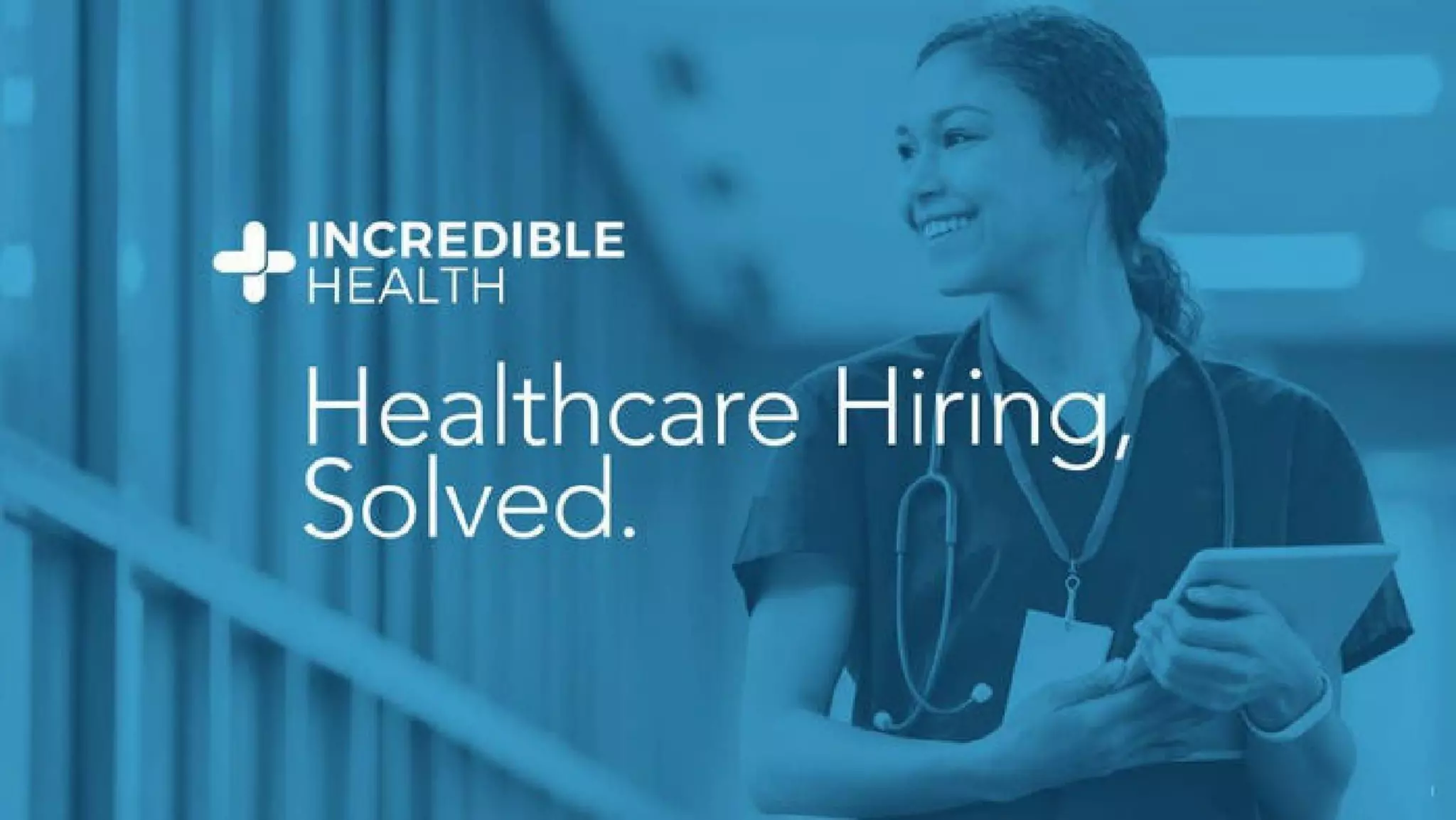
The title slide (brand-forward image, logo and one-line promise) uses simple language — “Healthcare Hiring, Solved.” — and a professional photograph to set tone and audience expectation. It establishes the company’s positioning immediately: this is a product that fixes recruiting for healthcare. The design choice (large type, single statement) is effective because it leaves no ambiguity about the deck’s purpose and primes the audience for a problem->solution narrative.

Key Takeaway: Start with a single, strong positioning line and a professional visual that signals the market and tone; clarity up-front helps investors and customers quickly understand what you do.
Company background: quick credibility and team composition

Company background: quick credibility and team composition

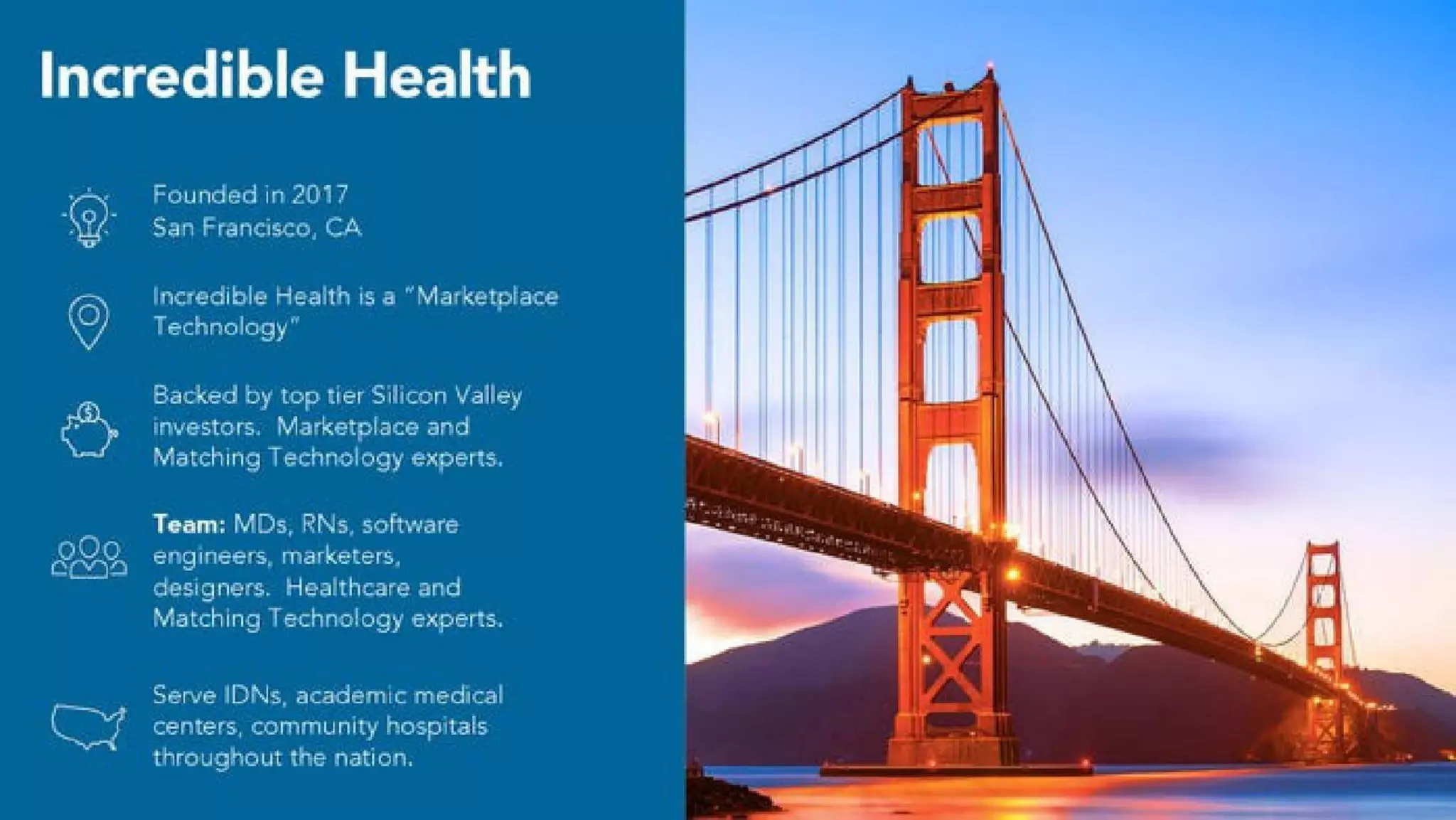
Slide 2 packs compact company metadata — founding year, location, product category (marketplace tech), investor and team signals — alongside a prominent San Francisco image. This is a smart use of an early slide: it signals the company’s origin, the type of product and that the team includes healthcare professionals and engineers. The icons and short bullets make the information scannable and credible without bogging the reader in detail. The slide also hints at go-to-market scope (IDNs, academic centers, community hospitals) which suggests a large addressable market and an enterprise sales motion, positioning the company as B2B with healthcare domain expertise.

Key Takeaway: Use an early slide to convey origin, product category, and team credibility in a scannable format — highlight domain expertise and early customer types to imply GTM fit.
The Problem: quantify urgency with simple, memorable metrics

The Problem: quantify urgency with simple, memorable metrics

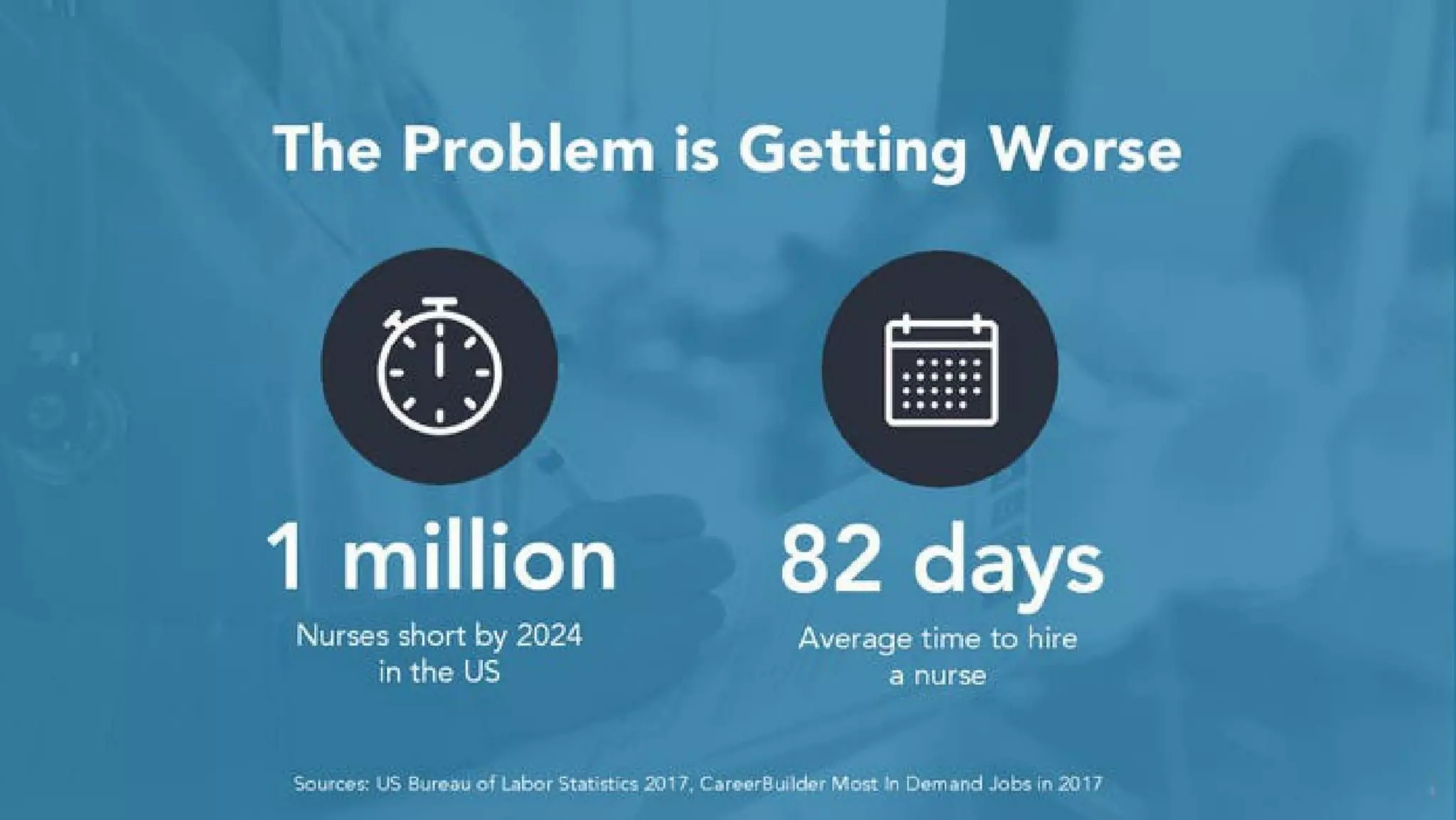
The ‘Problem is Getting Worse’ slide pairs two headline numbers (1 million nurses short by 2024; 82 days average time to hire) with clean icons and hierarchy. Those two stats work because one shows scale of the labor shortage and the other shows the operational pain (slow hires). The slide is effective because it uses a small amount of high-impact data rather than a long laundry list — that makes the issue digestible and alarming. The source line at the bottom adds credibility and demonstrates the team did their homework, which is critical for healthcare audiences who require evidence.

Key Takeaway: Lead the problem section with two or three crisp metrics that show scale and pain; credible sources amplify impact and reduce investor skepticism.
The Solution: a simple, role-reversing marketplace narrative

The Solution: a simple, role-reversing marketplace narrative

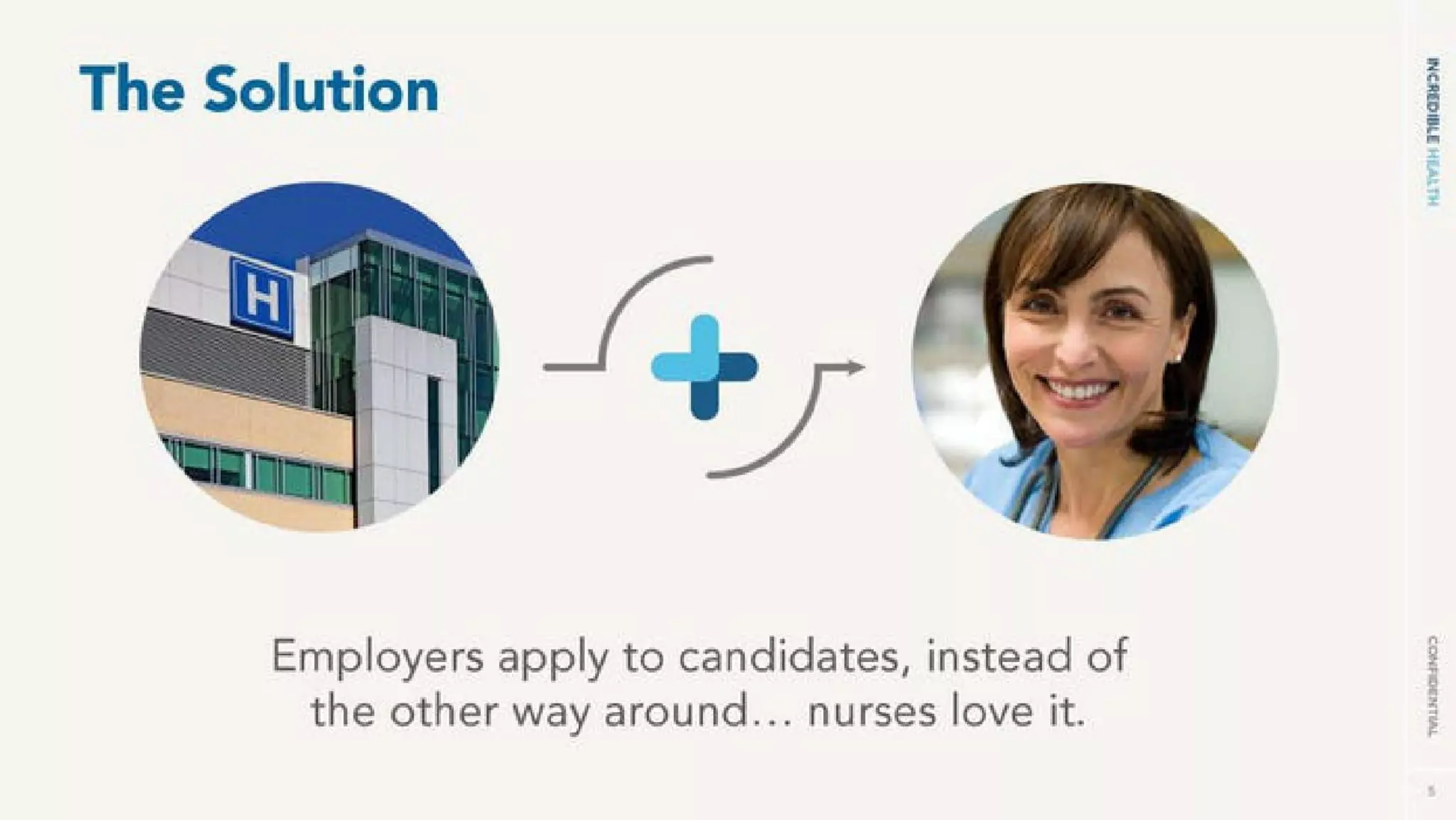
Slide 5 (The Solution) communicates the product with a simple visual metaphor: hospitals -> platform -> nurses, summarized as “Employers apply to candidates instead of the other way around.” That reversal is a compelling behavioral insight — emphasizing candidate control in nursing hiring resonates with the audience and differentiates from job-board dynamics. The slide keeps text to a minimum and uses imagery to explain flow, which is ideal for conveying a marketplace mechanic quickly. This clarity helps investors and customers imagine the UX and business model without needing deep product screenshots at this stage.

Key Takeaway: Explain the core product mechanic in one line plus a single visual — if your model flips an existing workflow, emphasize that behavioral difference as the core differentiator.
Traction & outcomes: fast hiring and efficiency metrics

Traction & outcomes: fast hiring and efficiency metrics

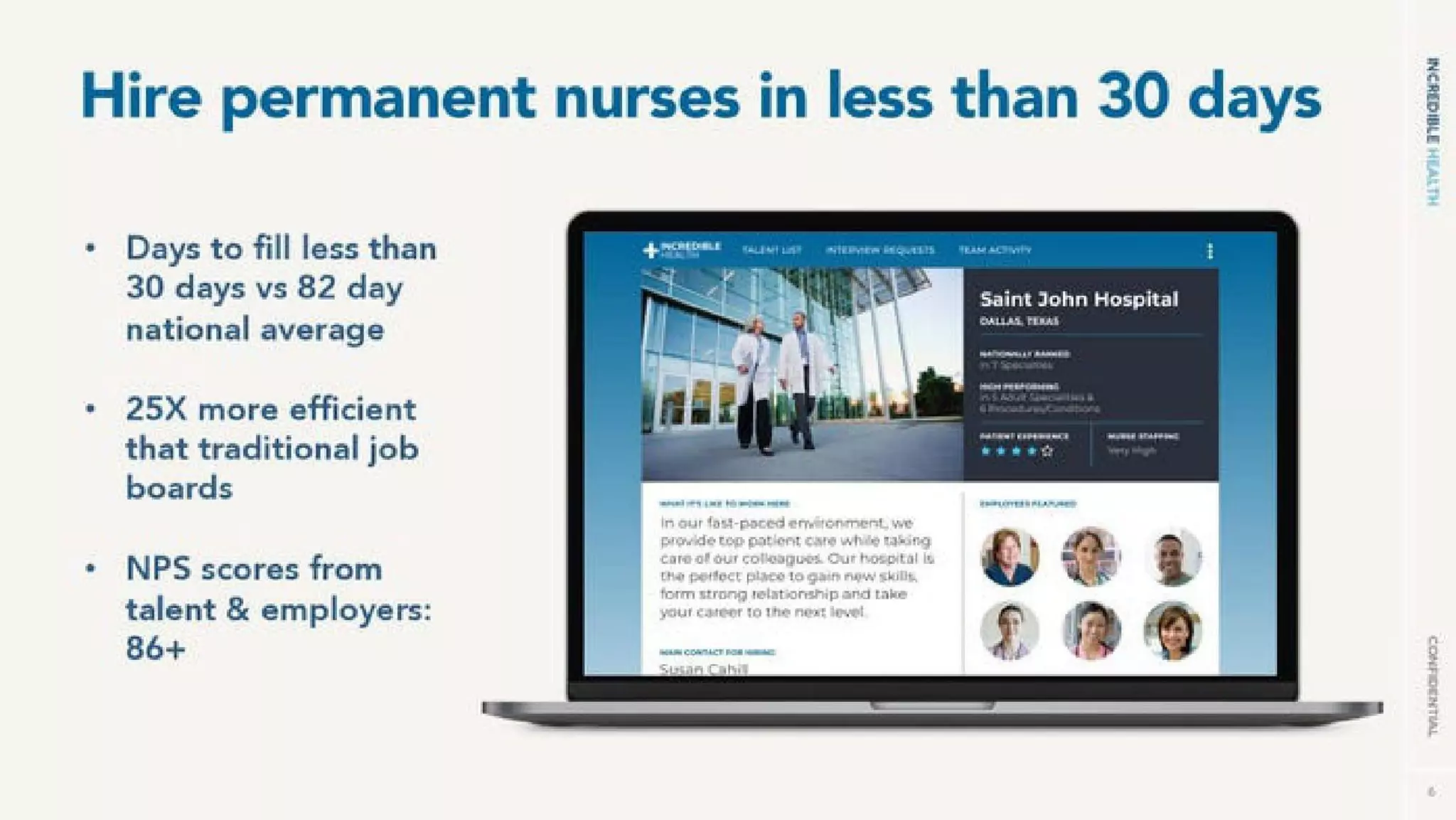
The ‘Hire permanent nurses in less than 30 days’ slide (slide 6) presents quantifiable outcomes: days-to-fill <30 vs. 82-day national average, 25x efficiency vs. job boards, and NPS 86+. Those are excellent traction signals because they map directly to the buyer’s KPIs (time-to-fill, recruiter efficiency, candidate satisfaction). The inclusion of NPS is especially powerful in talent marketplaces — it demonstrates product satisfaction on both sides of the market. The laptop mockup gives some visual sense of the product while keeping emphasis on business outcomes.

Key Takeaway: Lead with outcome metrics meaningful to buyers (time to fill, efficiency multipliers, NPS). Buyers buy outcomes — show them early and use concrete comparators against status quo.
Customers & scale: logos and geography to prove reach

Customers & scale: logos and geography to prove reach

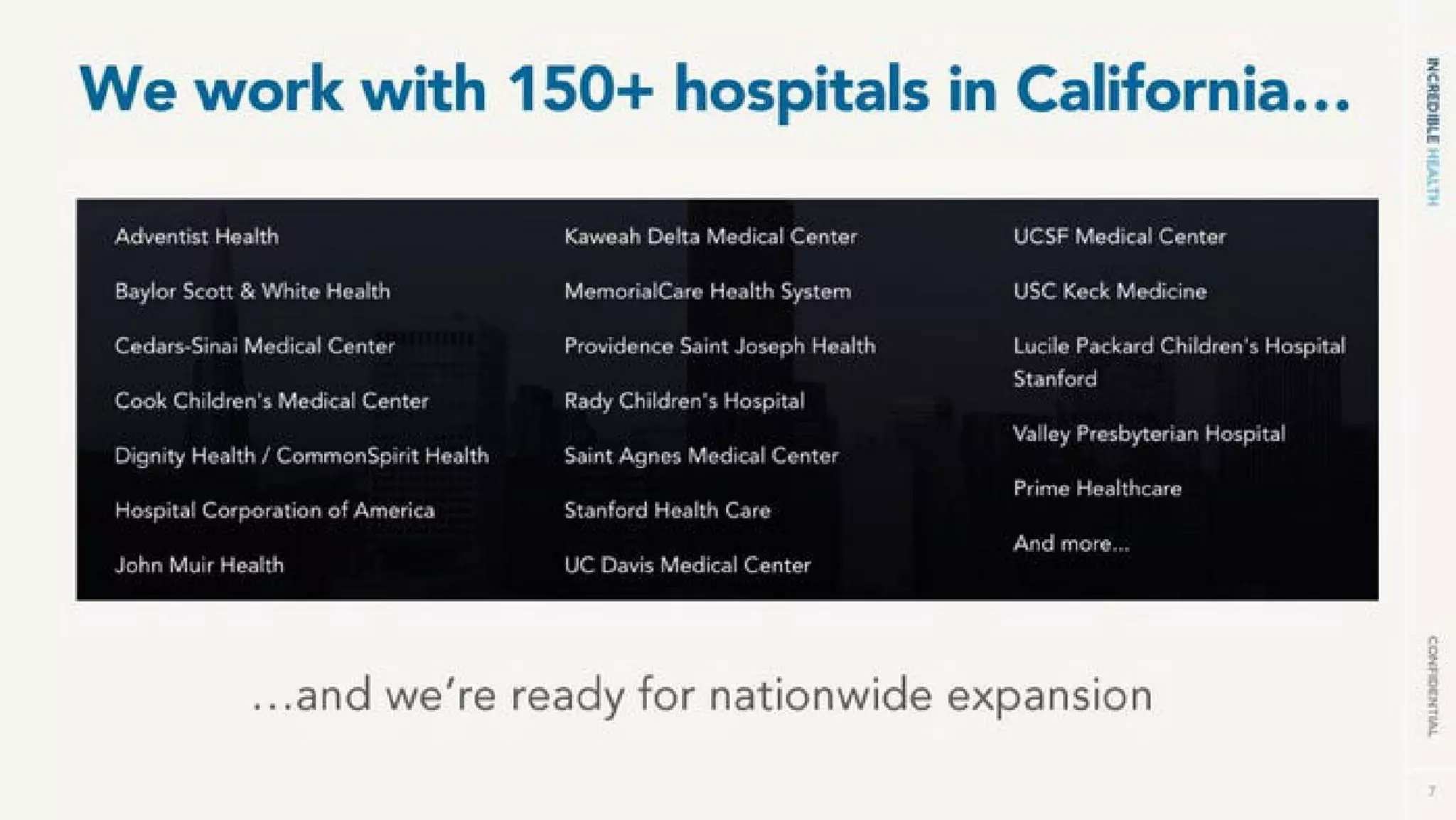
The ‘We work with 150+ hospitals in California’ slide uses name recognition and breadth to convey traction and a beachhead strategy. Listing well-known systems (Cedars-Sinai, Stanford, UCSF, etc.) gives immediate social proof and signals enterprise credibility — very important in selling into health systems. The copy “…and we’re ready for nationwide expansion” signals the next phase and helps justify the raise. This slide frames growth as both validated locally and ready to scale.

Key Takeaway: Showcase a concentrated, credible customer footprint and recognizable logos to prove enterprise trust; use that to justify a clear, staged expansion plan.
Social proof & testimonials: behavioral proof from candidates and customers

Social proof & testimonials: behavioral proof from candidates and customers

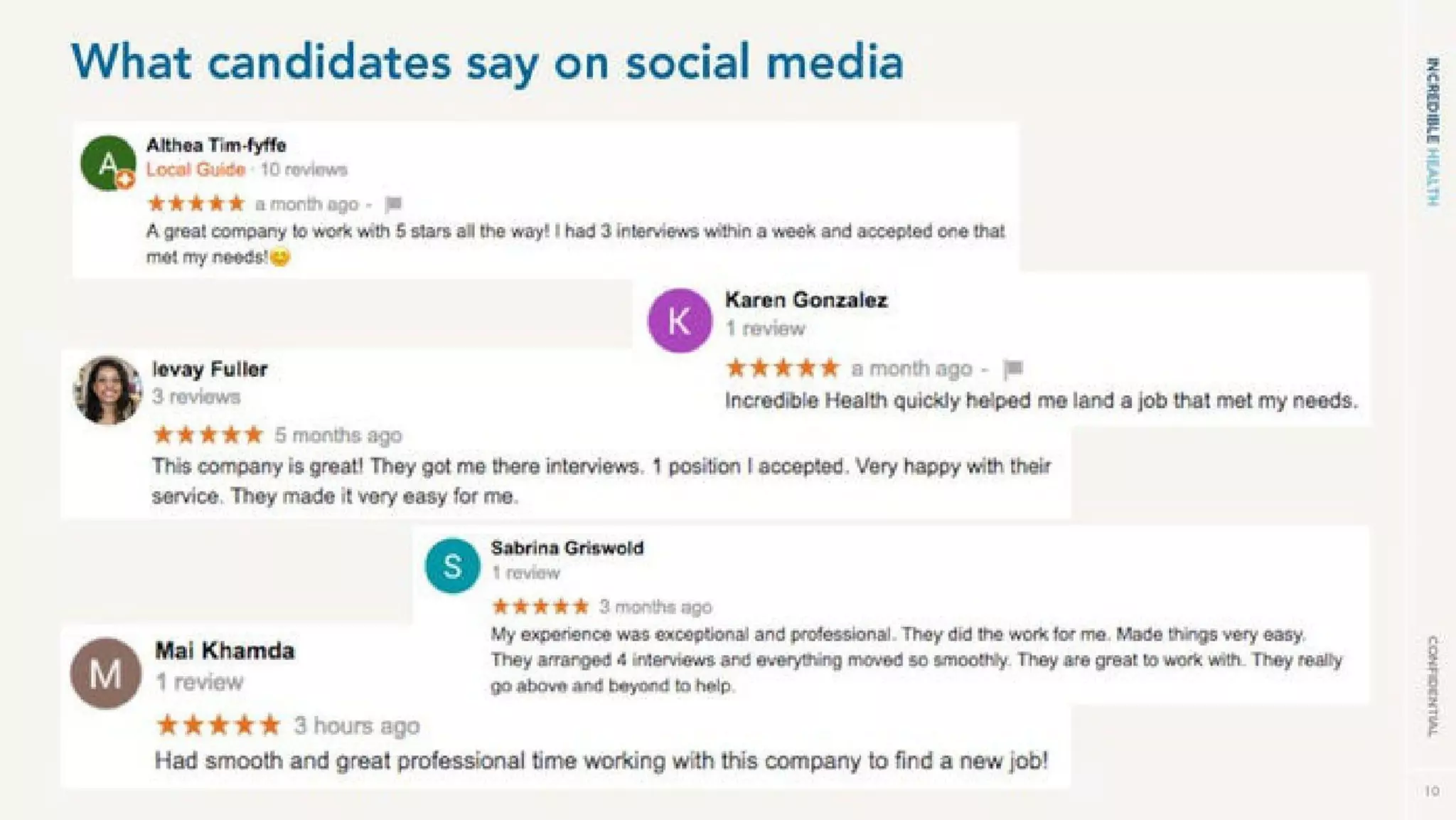
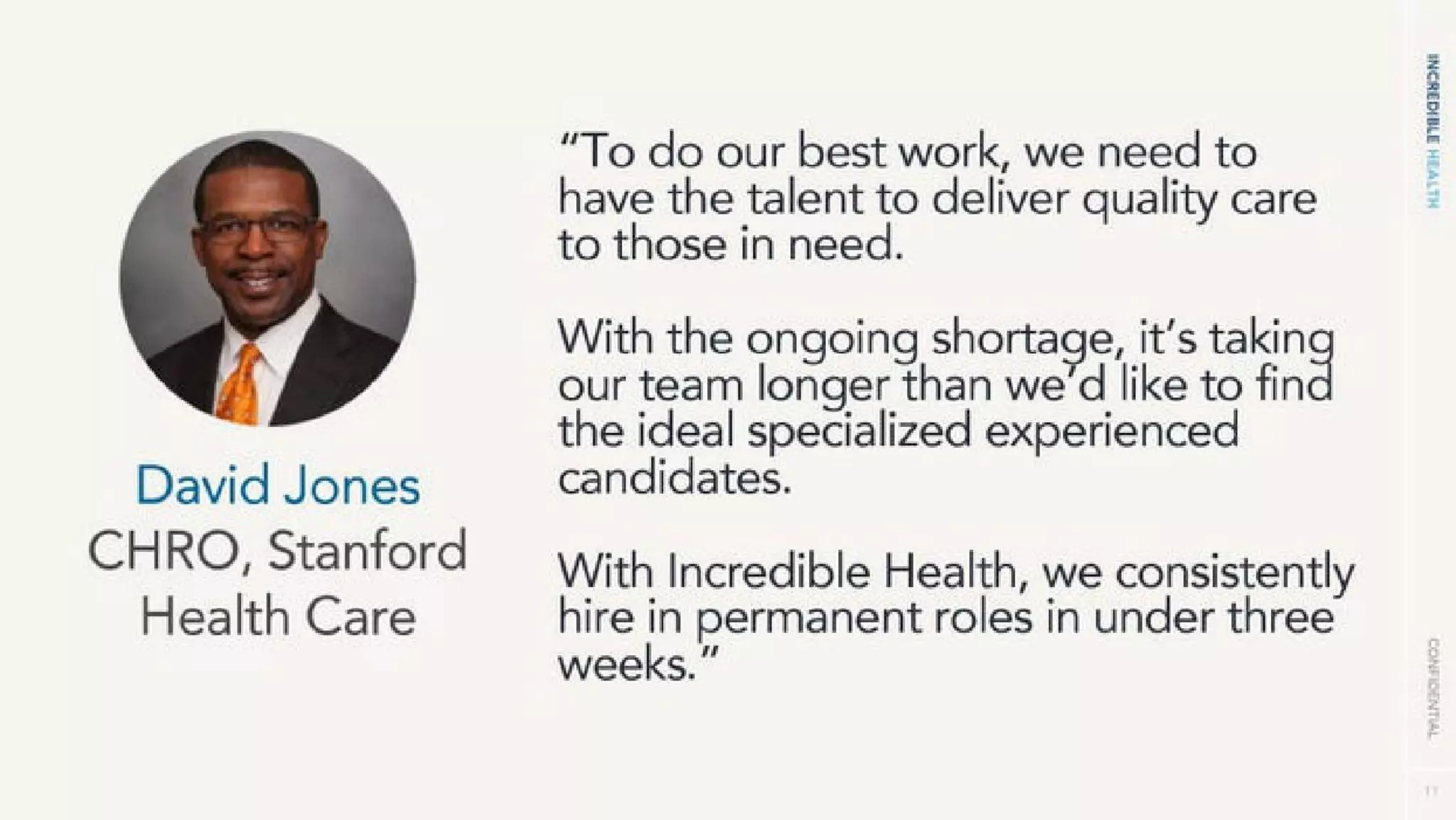
The deck closes supporting claims with candidate behavior stats (slide 8: 68% accept first offer; 61% accept first offer despite higher later pay) and social media reviews (slide 10), plus an executive testimonial (slide 11 from a CHRO). Together, these elements demonstrate both demand-side economics (candidates value the experience enough to accept) and supply-side endorsement from a high-level customer. That combination — quantitative candidate behavior, public reviews and a named executive endorsement — is persuasive because it addresses investor concerns about both retention and enterprise satisfaction.

Key Takeaway: Pair behavioral user metrics with public reviews and at least one named executive endorsement to cover both demand-side economics and enterprise credibility.

Conclusion: Key Lessons

This deck is strong in clarity, problem/solution framing, and traction storytelling. It uses a tight narrative arc: urgent market problem → simple differentiated solution → measurable outcomes → customer proof. The visuals are clean and scannable, and the team underscores domain expertise. For founders: lead with the one-line positioning, use 2–3 headline metrics to quantify the problem, demonstrate buyer outcomes (time/cost improvements), show concentrated customer logos to prove enterprise fit, and finish with mixed-format social proof (behavioral metrics + quotes). Areas to improve for future decks: include a brief slide on unit economics (CAC, LTV, revenue model and pricing), more explicit growth metrics and retention, and a concise team slide that highlights relevant operator experience — these details help underwriters and investors move from interest to commitment.

Full Deck Analysis

11 sections

Overview

Company: Incredible Health
Round: Seed ($15M)
Year: 2019
Outcome: Raised $50M+ total; 500+ hospital partners

Executive Summary

Incredible Health is a marketplace that reverses the traditional hiring flow for nurses — employers apply to vetted candidates — to dramatically shorten time-to-hire for permanent RN roles. The 11-slide seed deck clearly frames a large labor shortage problem, shows early traction with health systems in California, and uses simple metrics (days-to-fill, NPS, conversion stats) and social proof to demonstrate product-market fit.

Problem Statement

How the deck articulates the problem:

  • Slide 4: “The Problem is Getting Worse” — sharp, quantifiable pain points:
    • 1 million nurses short by 2024 (US Bureau of Labor / forecast).
    • 82 days = average time to hire a nurse (career/job board benchmark).
  • The deck frames hiring speed and supply shortage as the core issue for hospitals and for patient care, implying high operational and quality costs from lengthy hiring cycles.

Solution

How the deck positions the solution:

  • Slide 5: “The Solution” — product is a marketplace / matching platform where employers apply to candidates instead of the reverse; positioned as nurse-friendly.
  • Slide 6: Product benefit claims: hire permanent nurses in less than 30 days vs 82-day national average; 25x more efficient than traditional job boards; high NPS (86+).
  • Messaging focuses on speed-to-hire, candidate experience (nurses “love it”), and improved employer efficiency.

Market Opportunity

  • The deck does not present an explicit TAM / SAM / SOM breakdown or dollar-market sizing.
  • Implied market size signals:
    • 1 million nurse shortage by 2024 (slide 4) — used as a supply-side justification for large addressable demand.
    • Target customers: hospitals and health systems (150+ hospitals in California shown; slide 7).
  • Conclusion: large and growing market (healthcare labor/hospital staffing), but explicit numeric TAM/SAM/SOM not provided on these slides.

Business Model

  • Marketplace model: employers pay to access and apply to candidates (slide 5 describes employers applying to candidates).
  • Primary customer is hospitals / health systems (employer pay model).
  • No explicit pricing, ARPU, take rate, or unit economics are provided in the deck slides.
  • Revenue drivers implied: number of hires placed, subscription or placement fees from employers, possibly premium employer features.

Traction & Metrics

Notable traction and KPIs shown:

  • Customers / partners: “We work with 150+ hospitals in California” (slide 7) — includes major systems and academic centers (list of hospital names shown).
  • Time-to-hire: Days to fill less than 30 days vs 82 day national average (slide 6).
  • Efficiency claim: “25X more efficient than traditional job boards” (slide 6).
  • NPS: “NPS scores from talent & employers: 86+” (slide 6).
  • Candidate behavior metrics (slide 8):
    • 68% of RN candidates accept their 1st offer.
    • 61% of RN candidates accept their first offer even when their 2nd or 3rd offer has higher compensation — indicates strong match quality and speed advantage.
  • Social proof: multiple high-star reviews / testimonials and a quoted testimonial from a CHRO at a leading health system asserting hires in under three weeks (slides 10–11).
  • Fundraising: seed raise of $15M (context provided) and eventual raise to $50M+ total.

Competitive Positioning

  • Differentiation: nurse-centric marketplace that flips the application flow (employer-applies-to-candidate) to provide better candidate experience and faster placements.
  • Product claims: superior speed (sub-30 days), higher conversion/acceptance rates, high NPS, and explicit enterprise adoption within California.
  • The deck does not provide a competitor matrix or detailed comparison to staffing agencies, job boards, or contingent labor platforms, but positions itself against “traditional job boards” on speed and efficiency.

Team

  • Slide 2 lists team composition and expertise: MDs, RNs, software engineers, marketers, designers — described as healthcare and matching-technology experts.
  • The deck emphasizes domain expertise (clinical + marketplace engineering) rather than detailed founder biographies on the presented slides.
  • No full founder resumes, prior exits, or detailed leadership bios are included in these slides.

Go-to-Market Strategy

  • Focused regional rollout: heavy penetration in California (150+ hospitals) with statement of readiness for nationwide expansion (slide 7).
  • GTM appears enterprise sales / account-based for hospitals and health systems, plus candidate acquisition (nurses) to create two-sided liquidity.
  • Use of testimonials, NPS and hospital logos as proof points to drive expansion into additional geographies.

The Ask

  • The presented deck is a seed deck; the round was $15M (seed).
  • Slides do not show a detailed “use of funds” slide. Likely uses (not explicitly stated): scale sales and expansion nationwide, product development, hiring, and market development.

Investor Deep Dive

Executive summary, strengths & red flags

Executive Summary

Incredible Health is a marketplace that reverses the traditional hiring flow for nurses — employers apply to vetted candidates — to dramatically shorten time-to-hire for permanent RN roles. The 11-slide seed deck clearly frames a large labor shortage problem, shows early traction with health systems in California, and uses simple metrics (days-to-fill, NPS, conversion stats) and social proof to demonstrate product-market fit.

Key Strengths

3 identified

1

Clear problem-definition with quantified urgency

2

Strong early traction and social proof

3

Simple, focused positioning and value prop

Red Flags & Weaknesses

3 identified

1

Lack of explicit financials, unit economics, or pricing

2

No TAM / go-to-market sizing model

3

Limited competitive analysis and defensibility detail

More Pitch Decks To Study

Compare structure, fundraising context, and investor-facing story across similar startup decks.