Compare your deck to Alan

Compare Your Deck

Alan Pitch Deck (2017)

Health
Stage: Seed
Raised: $28M
Year: 2017
Slides: 42
Outcome: Valued at $4.5B+ (2024)

Pitch Deck

1 / 42
Alan pitch deck - Cover & Positioning: Clear, confident brand promise
Click to expand

Deck Analysis

This deck is Alan's 2017 investor presentation for their seed round — a clean, design-forward pitch that explains a modern health-insurance company rebuilt for the digital age. It combines simple brand positioning, a clear product demo of onboarding and customer workflows, concise market sizing, and a practical go-to-market plan. What makes it notable is the emphasis on product experience (fast online onboarding, a card-based payment/reimbursement model, and an integrated dashboard) combined with an explicit operational strategy and a strong product/engineering team — a combination that helped Alan scale and later achieve very large valuation.

Cover & Positioning: Clear, confident brand promise

Cover & Positioning: Clear, confident brand promise

Slide 1 is a minimal, on-brand cover that immediately establishes Alan as a consumer-focused health insurance product — the mascot and the tagline “L’assurance santé simple” set a friendly, differentiated tone. The design choice (large whitespace, single bold identity) telegraphs modernity and product-led intent rather than a finance-heavy, corporate insurance pitch.

Founders can learn from this disciplined cover: make your brand promise obvious up front and use visual restraint to signal product quality. A memorable name + clear one-line positioning buys focus and primes investors for the narrative to follow.

Key Takeaway: Open with a single, clear brand promise that sets the tone — simple is persuasive when paired with confident, consistent design.
Product Demonstration: Show the customer experience

Product Demonstration: Show the customer experience

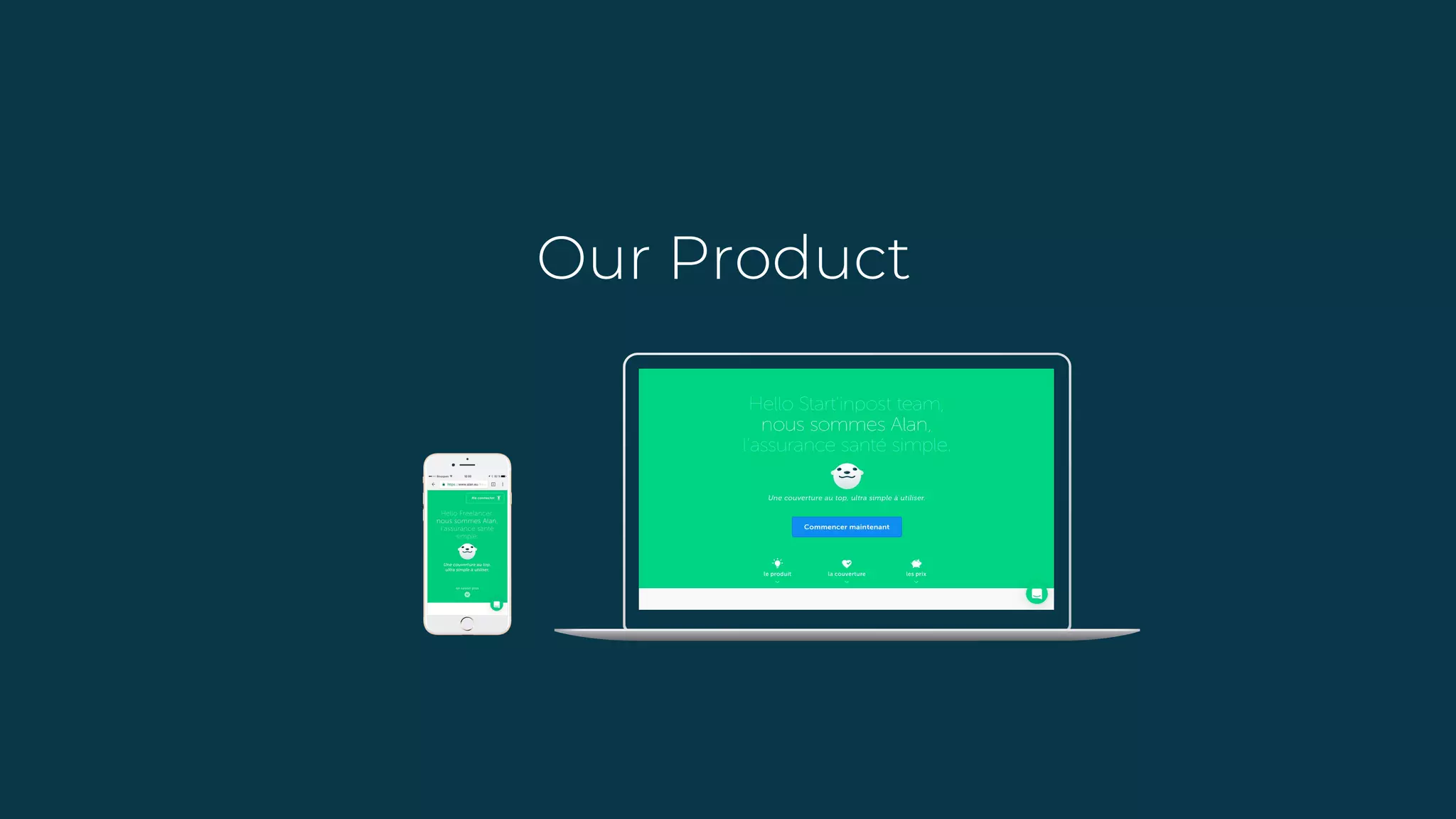
Slide 5 (Our Product) uses device mockups to show the core experience — mobile + desktop — which immediately demonstrates that Alan is built as a digital-first product. The visual communicates usability and accessibility: a prospective customer can see where they would interact with the product and infer speed and simplicity.

This approach focuses on user-facing features rather than technical infrastructure or insurance jargon, which is critical for consumer-focused startups. Founders should emulate showing real user flows (onboarding, dashboard, card usage) early in the deck so listeners understand the product tangibly rather than conceptually.

Key Takeaway: Demonstrate the core user journey quickly with device mockups or screenshots so investors instantly understand the product's value and usability.
Onboarding & Operations: Make complexity look simple

Onboarding & Operations: Make complexity look simple

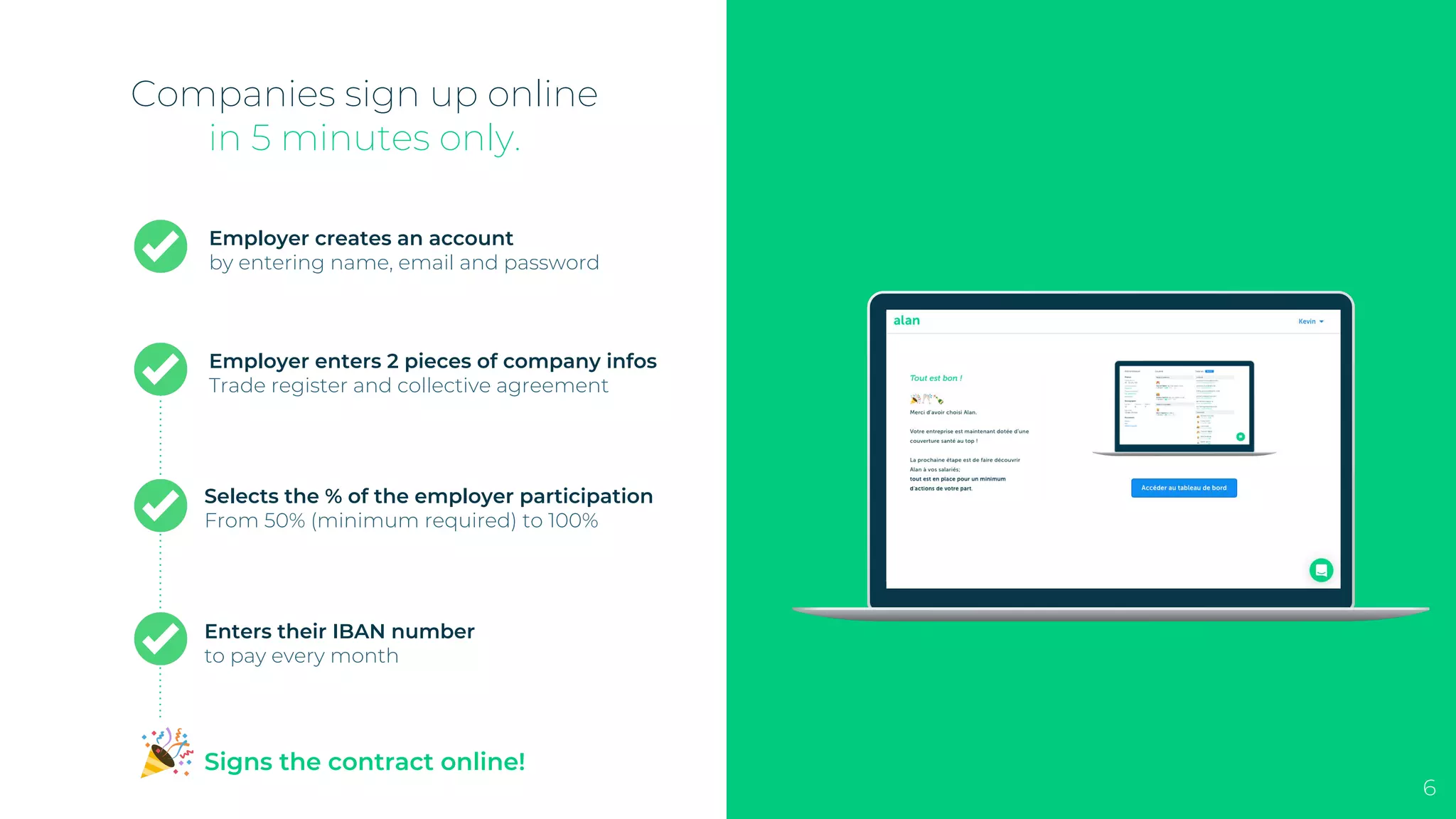
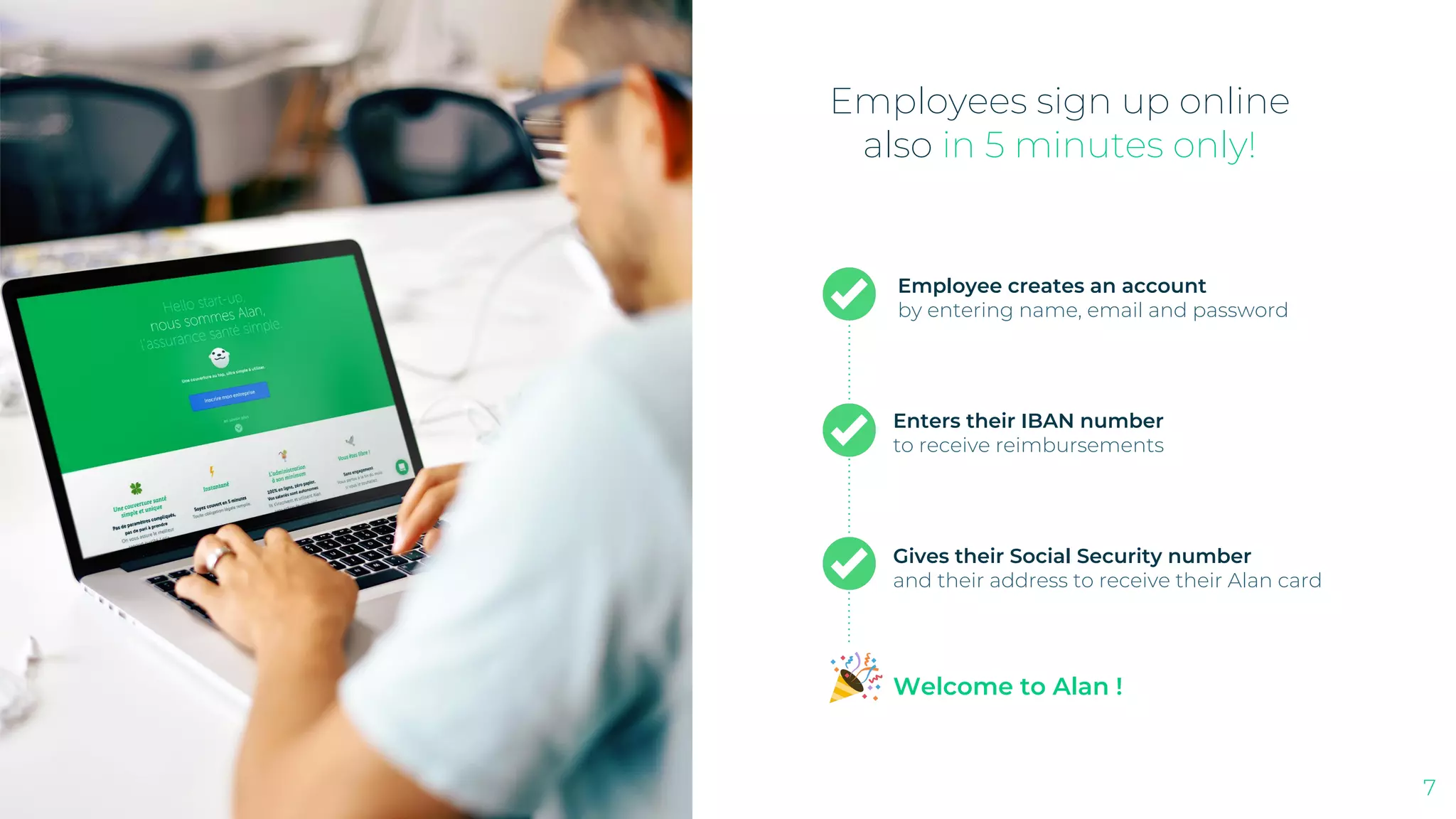
Slide 6 breaks down the company signup process into a concise, step-by-step flow that claims ‘5 minutes only’ — accompanied by simple green check icons and a screenshot of the admin interface. It conveys two messages simultaneously: the product is fast for customers and the backend is usable for employers (reducing friction for adoption).

Slide 7 continues with employee signup steps. Together these slides are effective because they translate operational complexity into a short, repeatable playbook. For founders in complex regulated spaces, showing a clear, friction-minimized flow for customer activation is essential: it reduces investor concerns about adoption and operational burden.
Key Takeaway: Map and show the exact onboarding steps — if you can make a complex regulated flow look simple, investors will trust your go-to-market execution more.
Product Value & Pricing: Simple, comparative pricing and coverage

Product Value & Pricing: Simple, comparative pricing and coverage

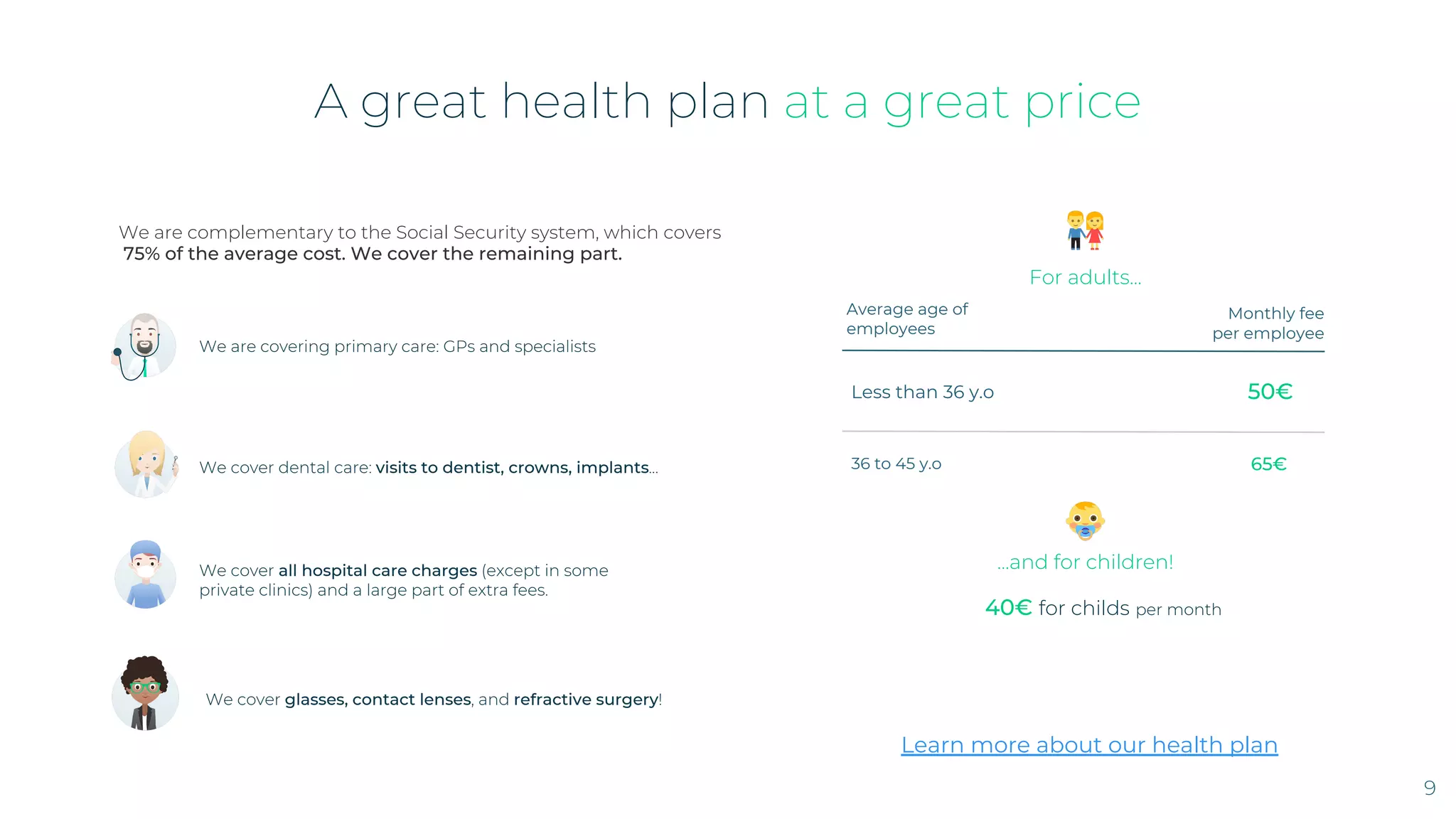
Slide 9 outlines what the plan covers (primary care, dental, hospital care, optical) and shows simple monthly prices by age band. This is a smart move: it anchors value with concrete numbers and shows the product is competitive and thoughtfully designed for real purchasing decisions. The slide also clarifies how Alan fits with the French social security system (complementary coverage), which addresses an important regulatory and reimbursement context.

Presenting pricing transparently reassures investors about unit economics and customer value. Startups selling services should include a clear, real-world price comparison or ARPU estimate early to avoid vague revenue assumptions during follow-up questions.

Key Takeaway: Include clear coverage bullets plus example pricing to anchor value and make unit economics discussion concrete.
Market Opportunity: Size the market and show room to scale

Market Opportunity: Size the market and show room to scale

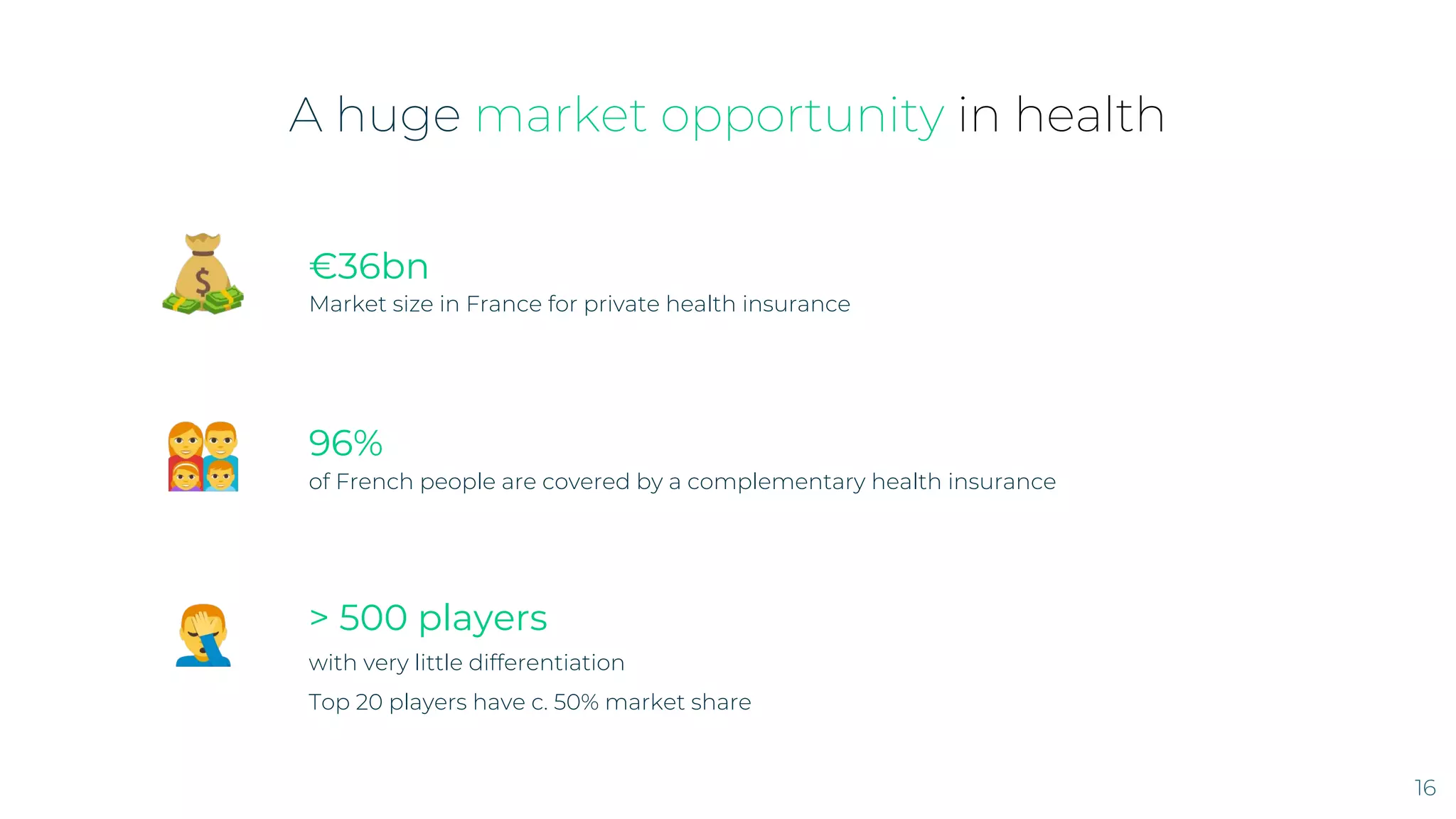
Slide 16 gives a concise market overview: market size (€36bn for private health in France), high penetration of complementary insurance, and fragmentation (>500 players). This provides the macro justification for a challenger; it shows a large addressable market, near-universal consumer need, and clear space for disruption.

The best market slides combine credible numbers with structural reasons for change (fragmented incumbents, weak differentiation). Founders should present both the quantitative opportunity and qualitative reasons why incumbents can be challenged — regulation, distribution model, or user experience — to justify why a startup can gain market share.

Key Takeaway: Pair a credible market size with structural rationale (fragmentation, poor UX) to explain why incumbents are vulnerable and how you can scale.
Go-to-Market & Acquisition: Early channels and seasonal dynamics

Go-to-Market & Acquisition: Early channels and seasonal dynamics

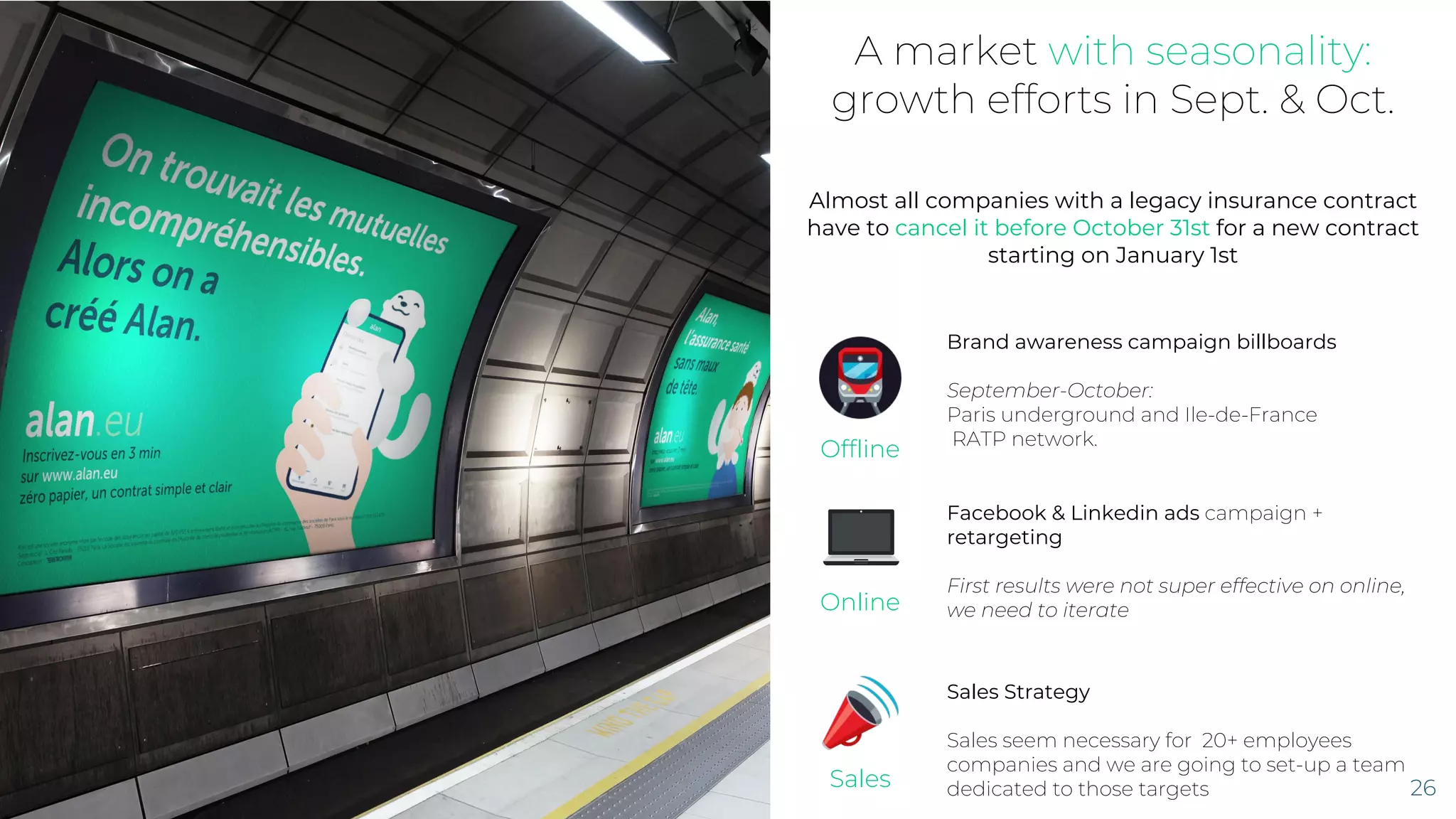
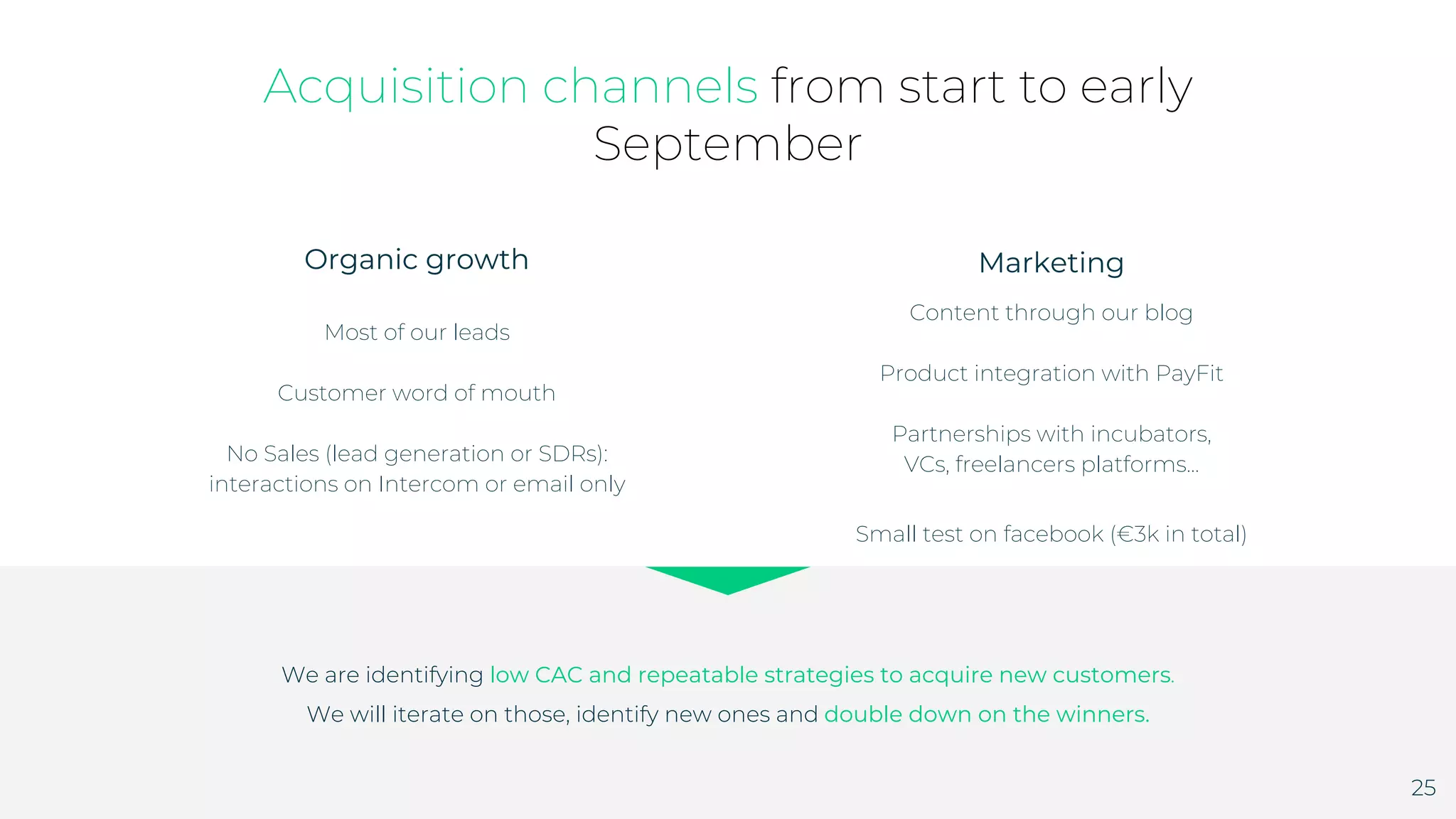
Slide 26 details acquisition channels (organic, content, partnerships, tests on Facebook, offline brand awareness via billboards) and highlights seasonality tied to contract renewal cycles. It’s an honest GTM slide: it lays out what they tried, where they expect lift, and why timing matters (September/October sales push for contracts starting January 1). This demonstrates practical, test-driven growth thinking rather than relying on optimistic CAC assumptions.

Investors value specificity: list your top channels, early spend/tests, and any calendar-driven seasonality. Founders should also be transparent about what worked and what didn’t, and show an iterative plan to double down on winners.

Key Takeaway: Be explicit about the channels you’re testing, the seasonality of your market, and how you’ll iterate on CAC — specificity builds credibility.
Team & Execution: Product + engineering leadership

Team & Execution: Product + engineering leadership

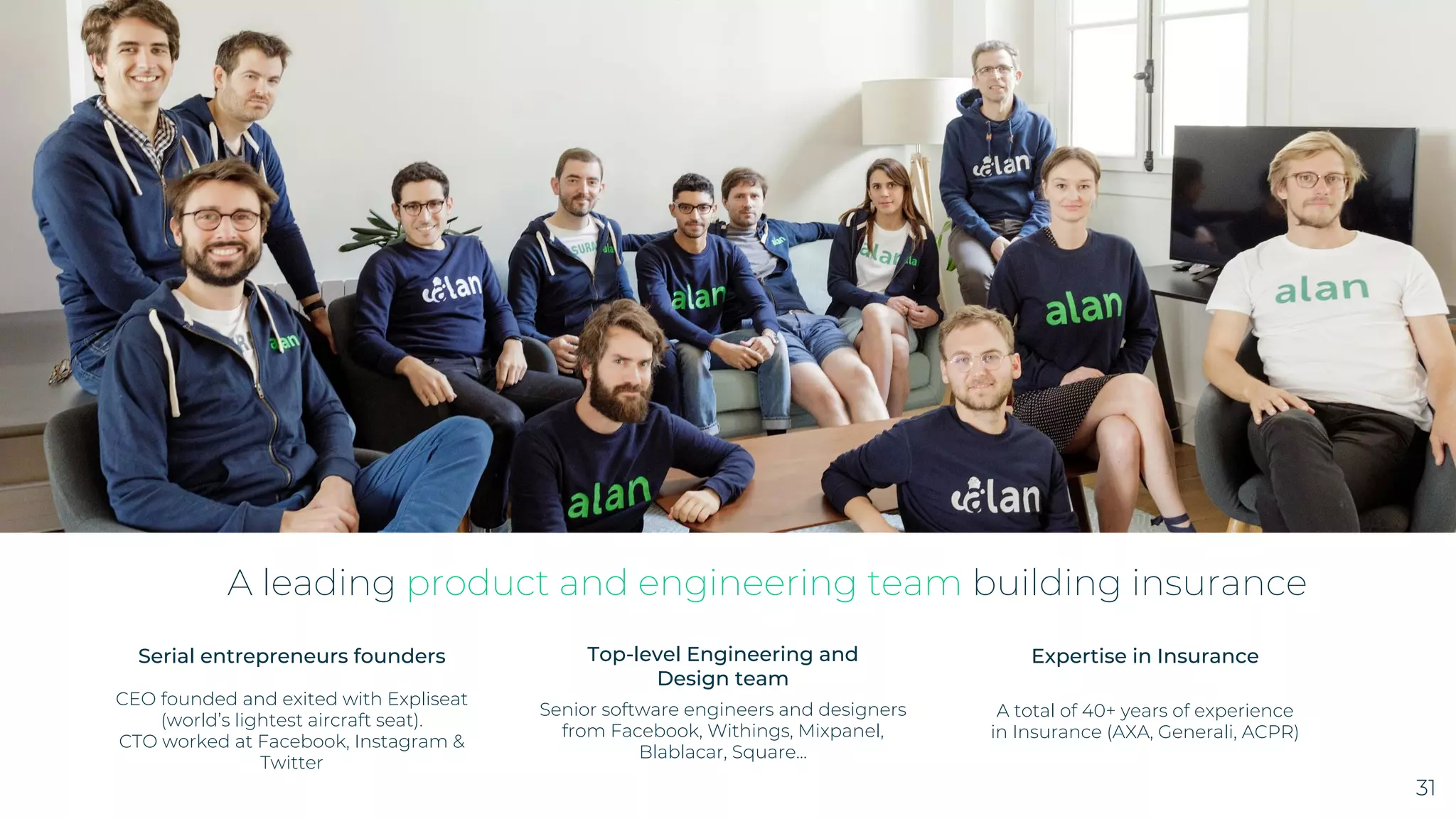
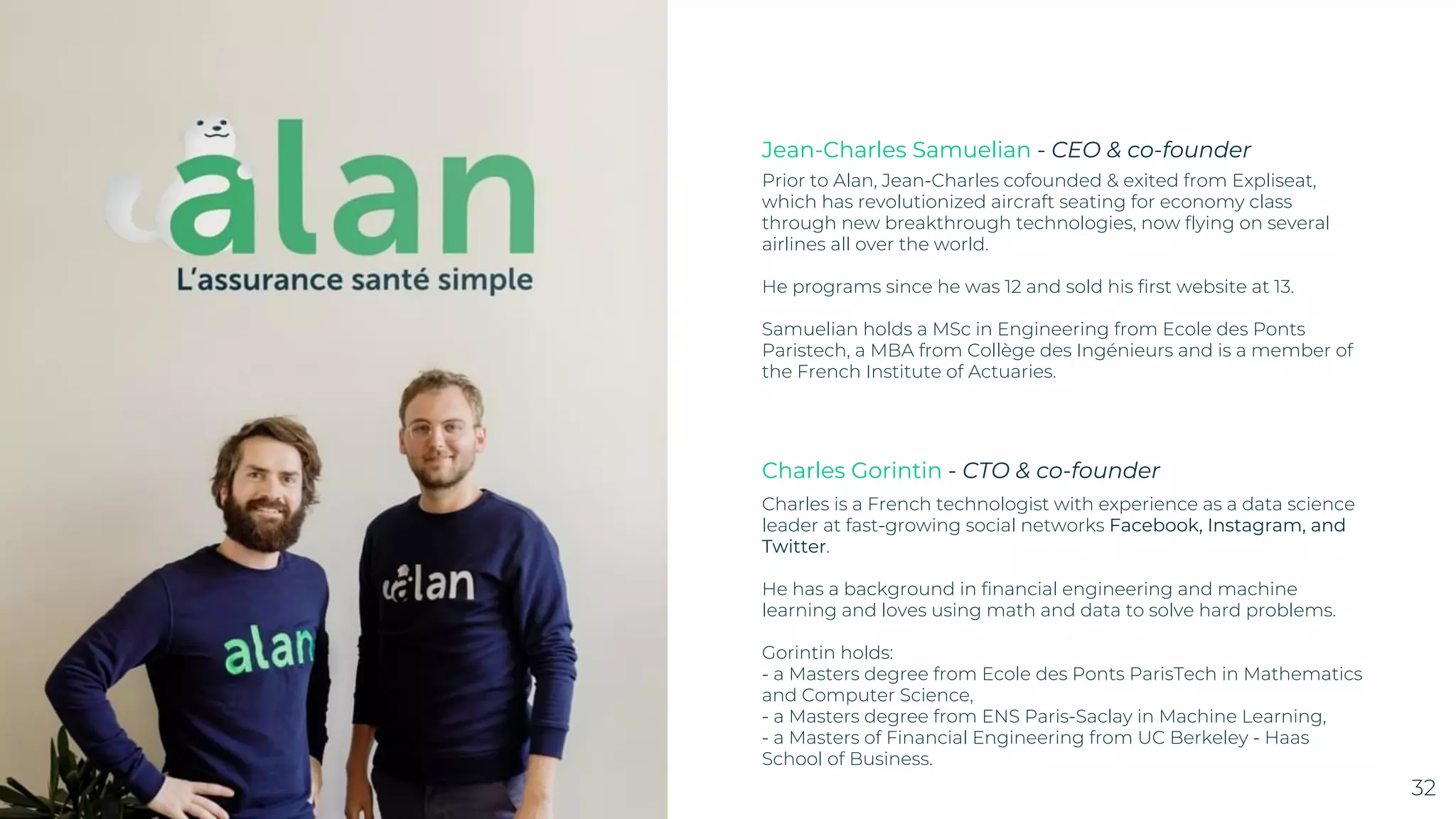
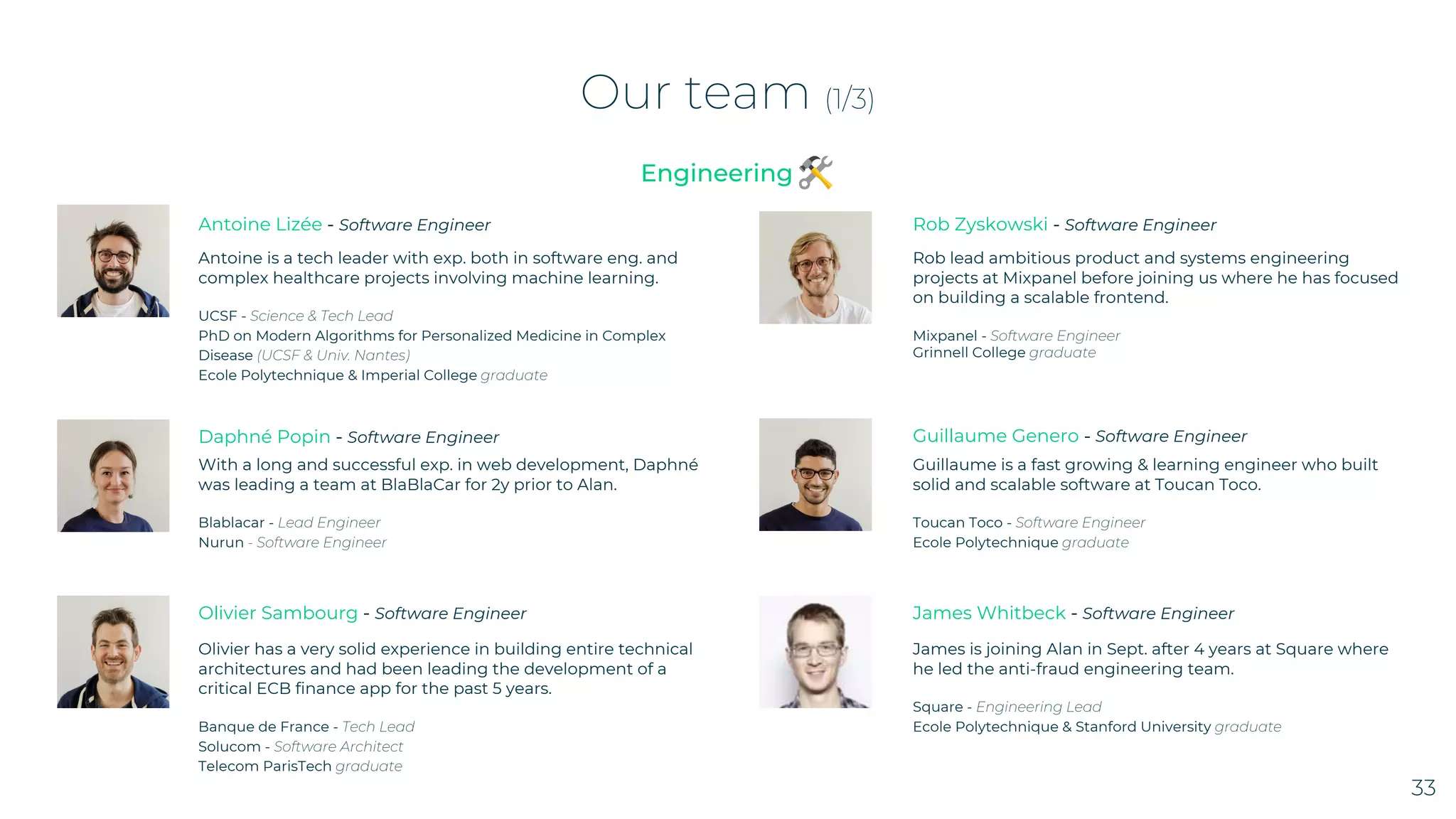
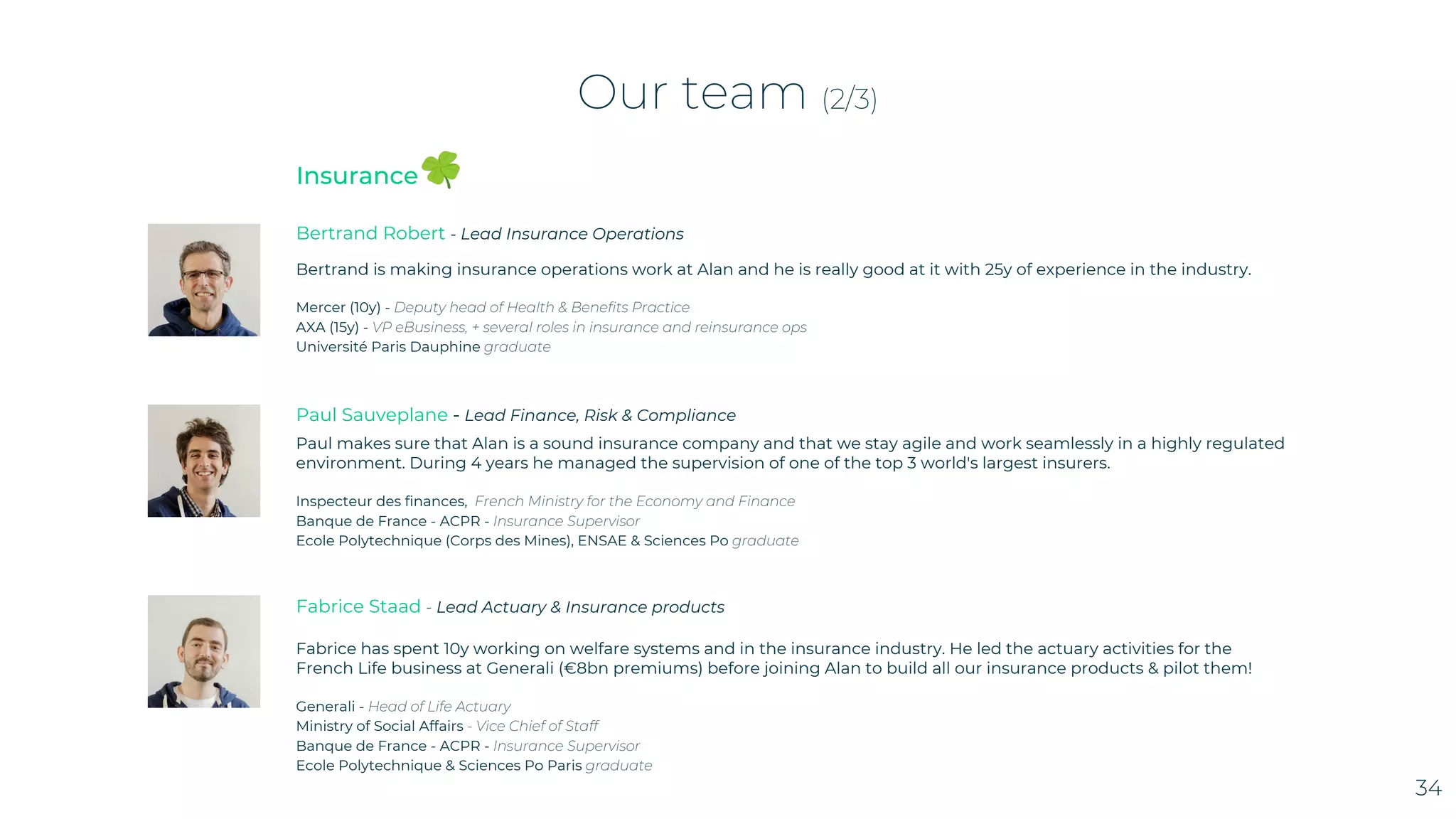
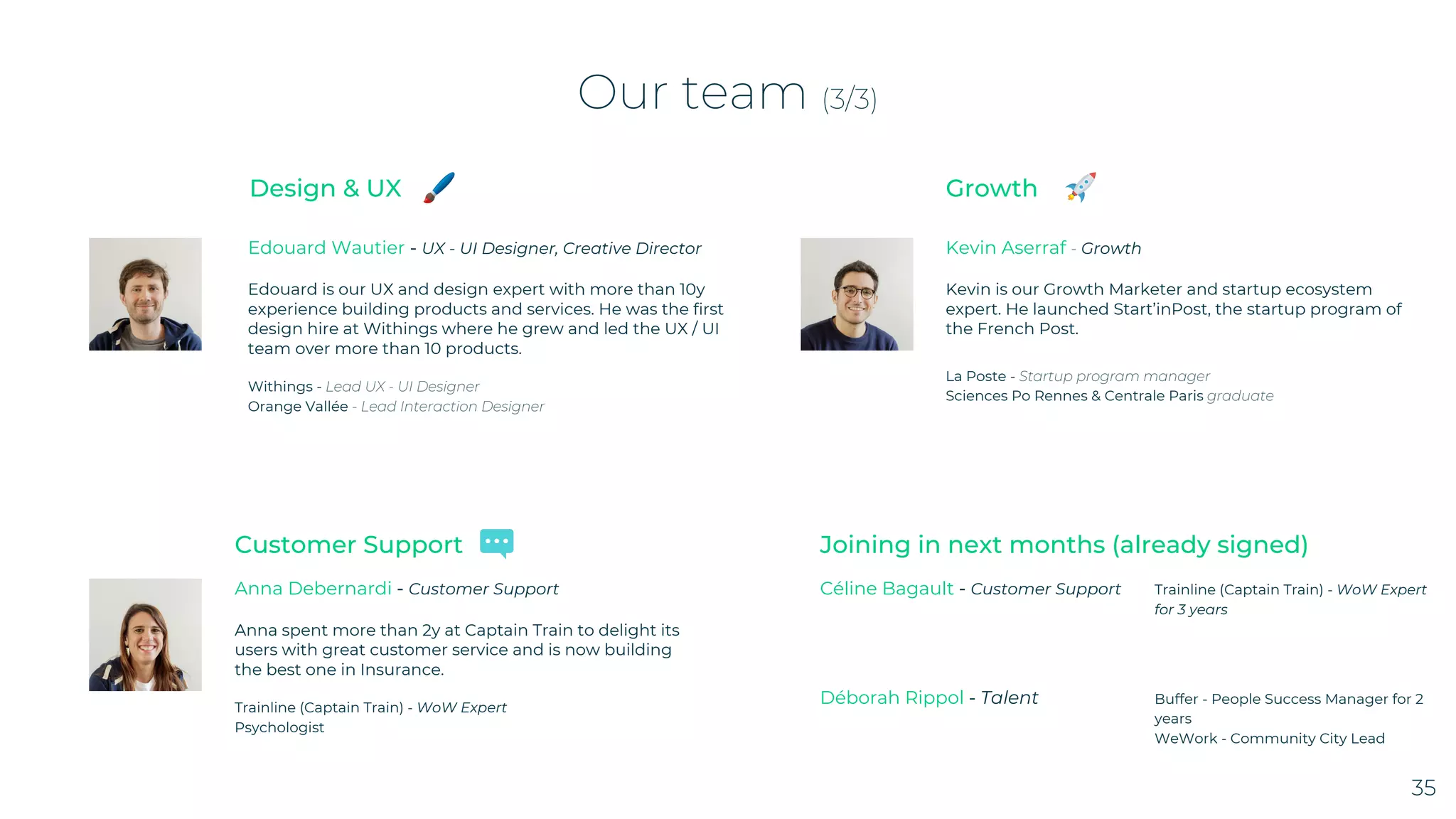
Slide 31 is a team photo backed by a short summary of product and engineering strengths, and subsequent slides (32–36) list founders’ backgrounds and key hires. The emphasis is on technical credibility (engineers from Facebook, Instagram, Square, and insurance expertise), which is critical for a product-led, regulated startup. Showcasing a balanced team (product/tech + insurance ops + growth) demonstrates preparedness for both product development and regulatory/commercial execution.

For founders, this is a reminder that investors invest in teams as much as ideas. A combined photo + concise bios communicates culture and capability; include clear role-related credibility (where they came from and what they’ll do next) rather than long, generic résumés.

Key Takeaway: Present a balanced founding team with complementary skills (product/engineering + domain ops) and use photos + short bios to convey credibility and culture.
Fundraising & Validation: Early capital and investor mix

Fundraising & Validation: Early capital and investor mix

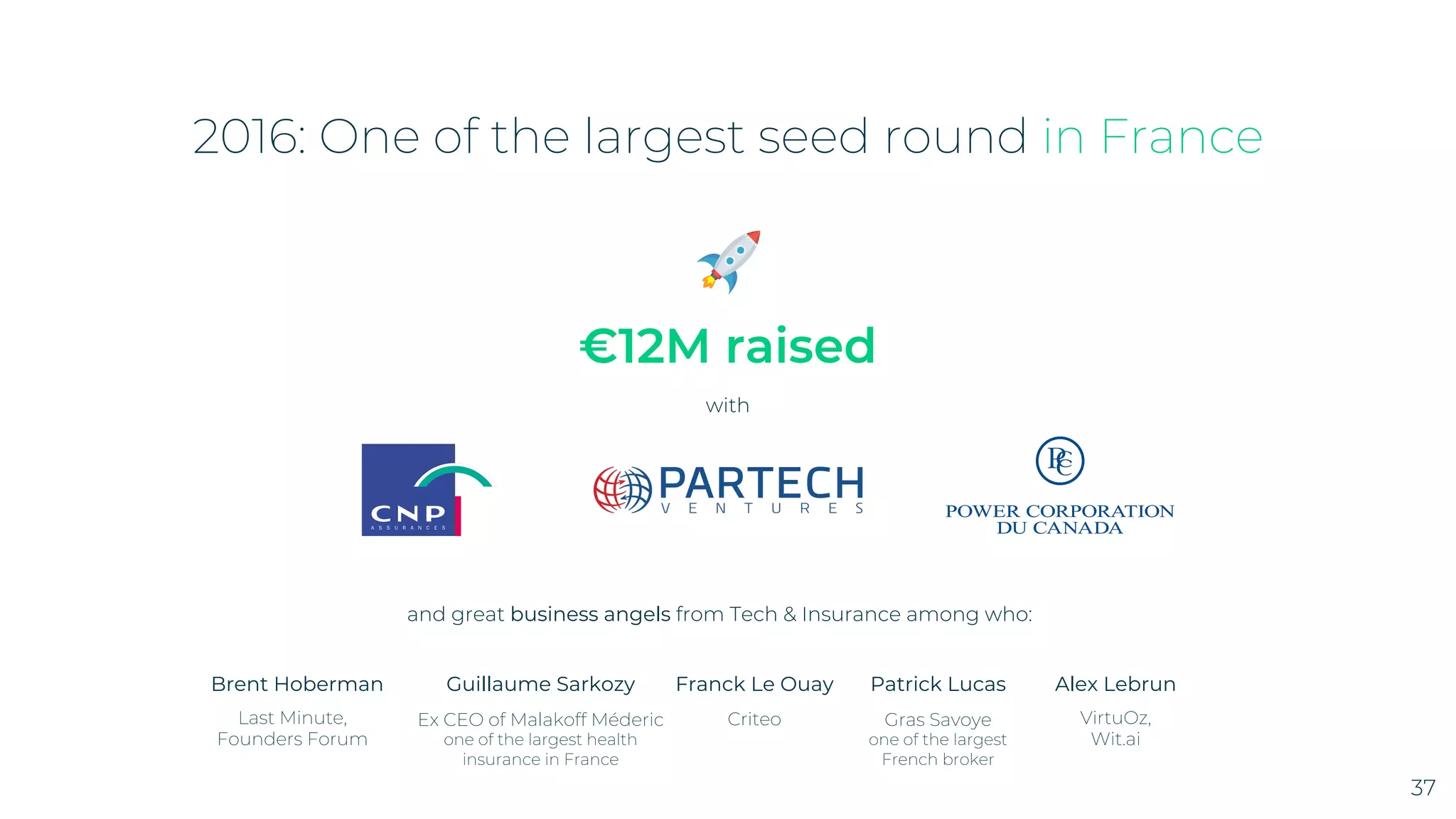
Slide 37 shows the seed raise (€12M raised) and lists strategic investors (CNP, Partech, Power Corporation) and notable angels. This signals investor validation and strategic alignment with both VC and industry partners — particularly important in insurance where incumbents/partners matter for distribution and risk sharing. It also highlights that Alan secured substantial capital early which would fuel product development and GTM.

Founders should highlight both the amount raised and the investor mix: strategic corporate investors or industry angels can be as valuable as pure financial backers because they lend distribution, credibility, or regulatory access. Be explicit about how the funding will be used to de-risk the next milestones.

Key Takeaway: Show not just the amount raised but who invested and why — strategic investors can validate market fit and open distribution or regulatory doors.

Conclusion: Key Lessons

Alan’s 2017 seed deck is a strong example of a product-led, category-defining pitch for a regulated consumer business. Strengths include clear brand positioning, concrete product demos that explain user flows, transparent pricing, thoughtful market sizing, a realistic go-to-market plan that acknowledges seasonality, and a balanced team with both product/engineering and industry expertise. The deck avoids long walls of text and instead uses visuals and short bullets to make each point memorable.

Actionable advice for founders: (1) Lead with a single, memorable brand promise and show the product experience early; (2) Make onboarding and unit economics concrete — show how customers sign up and what they pay; (3) Be explicit and specific about your go-to-market experiments and seasonal dynamics; (4) Highlight a complementary team and strategic investor validation to reduce execution risk. Combine these elements and you’ll have a compelling narrative that addresses product, market, model, and team — the core things investors care about.

Full Deck Analysis

11 sections

Overview

Company: Alan
Round: Seed (context notes $28M total seed raise) — deck itself references a €12M raise in 2016
Year: 2017
Outcome: Valued at $4.5B+ (2024)

Note: the pitch deck (slide 37) states “€12M raised” as the seed round; the brief uses the provided context ($28M) while citing the deck’s number where relevant.


Executive Summary

Alan is a digitally‑native, employer‑facing health insurance provider that launched a clean, mobile-first product to simplify onboarding, reimbursements and admin for employers and employees. The deck highlights fast regulatory progress (insurance license), a crisp product (Alan card, mobile reimbursements, admin dashboard), clear pricing for employers, and early traction/operational efficiency — all used to justify a Series A focused on leading France, expanding in Europe and building a healthcare platform.


Problem Statement

How the deck articulates the problem:

  • Health insurance is complex, slow and poorly served by incumbents — navigation/paperwork and poor digital experiences are repeated themes (Slides 1–3, 8, 13).
  • Employers and employees face painful onboarding and admin processes; legacy contracts create seasonal churn windows (slide 26).
  • The deck frames incumbents as numerous but undifferentiated (>500 players; top 20 hold ~50% market share — slide 16).

Referenced slides:

  • Slides 1–3 (positioning + “health insurance made simple”)
  • Slide 16 (market fragmentation)
  • Slide 26 (seasonality and legacy contract friction)

Solution

How the deck positions the solution:

  • A fully digital, employer‑admin and employee experience: 5‑minute online signup for companies and employees (slides 6–8).
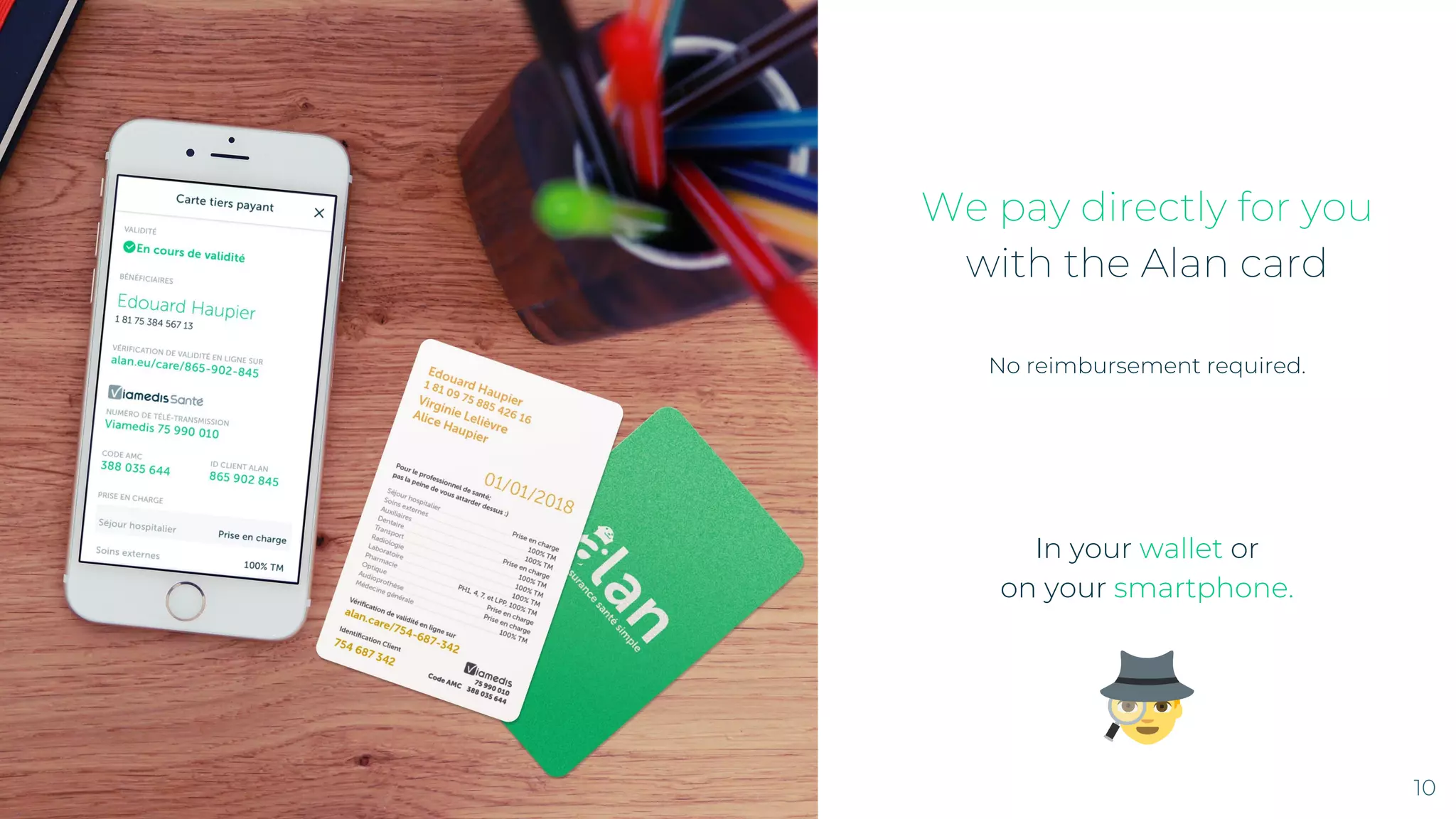
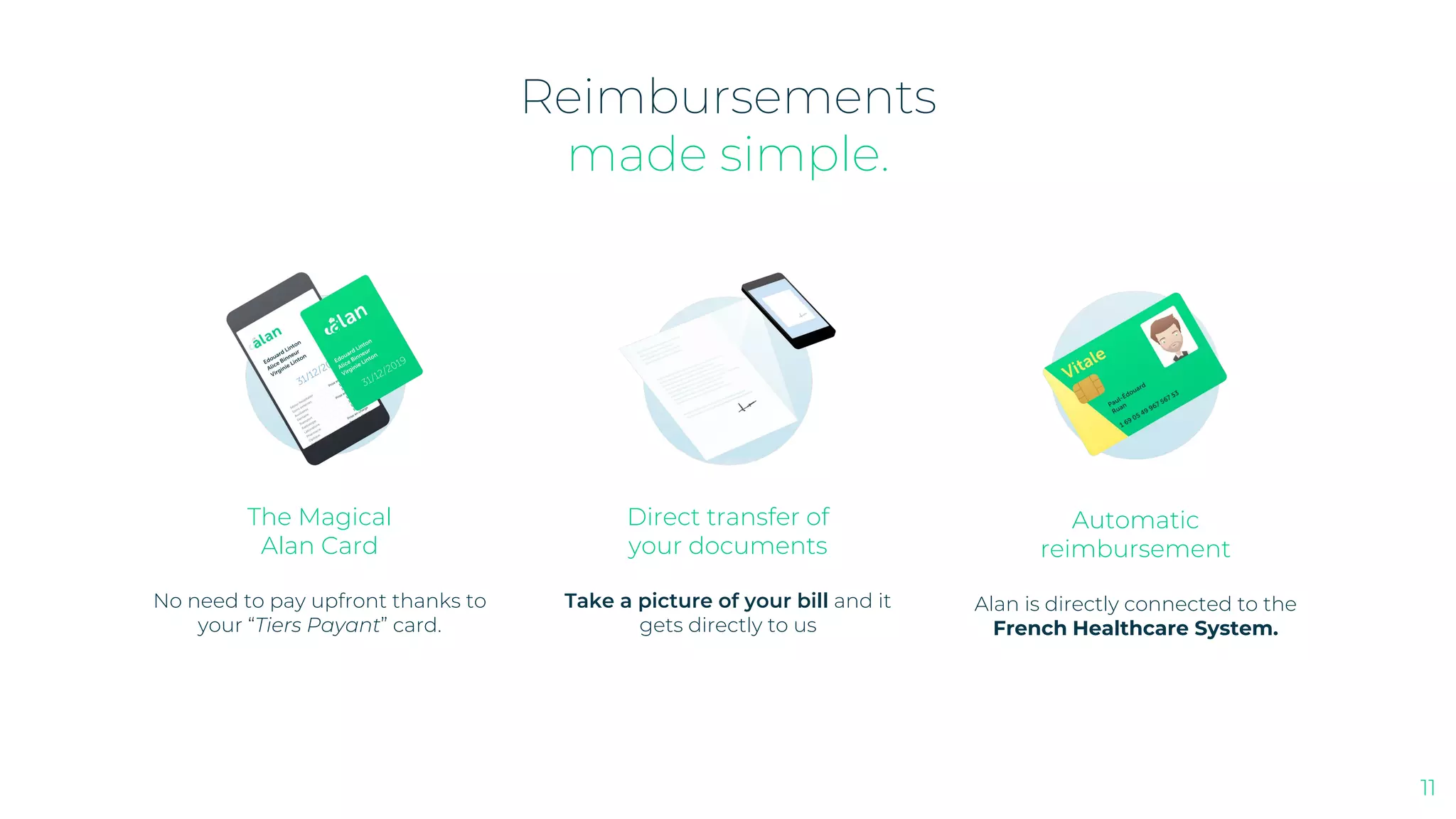
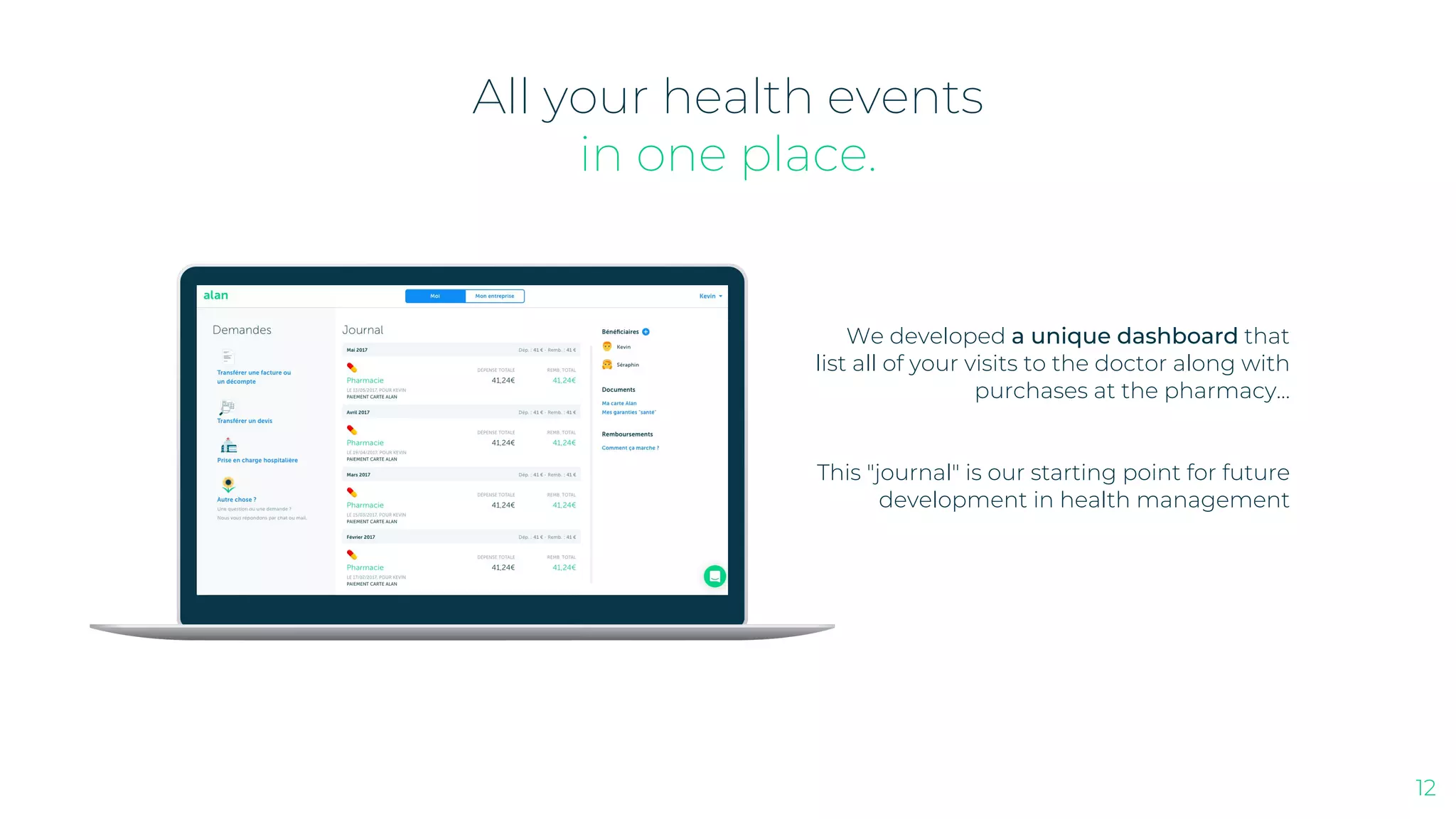
  • Product features: admin dashboard, employee onboarding, pay‑with‑Alan card to avoid reimbursements, photo upload for bills, direct transfers and automatic reimbursement via French healthcare rails (slides 5, 10–12).
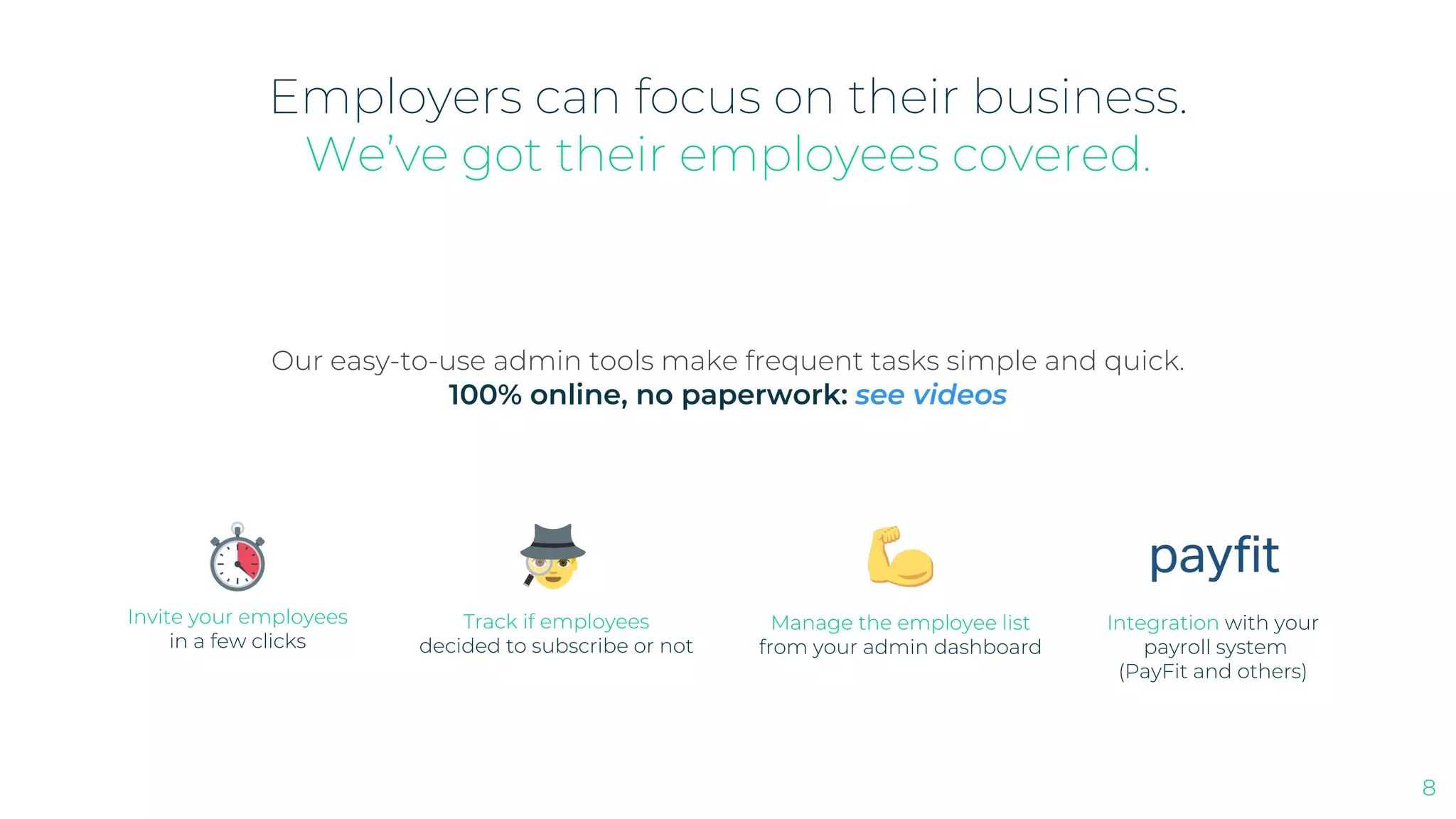
  • Built for employers (B2B2C) with employer contribution settings, payroll integrations (PayFit), and self‑service tools to reduce admin (slides 4, 8).
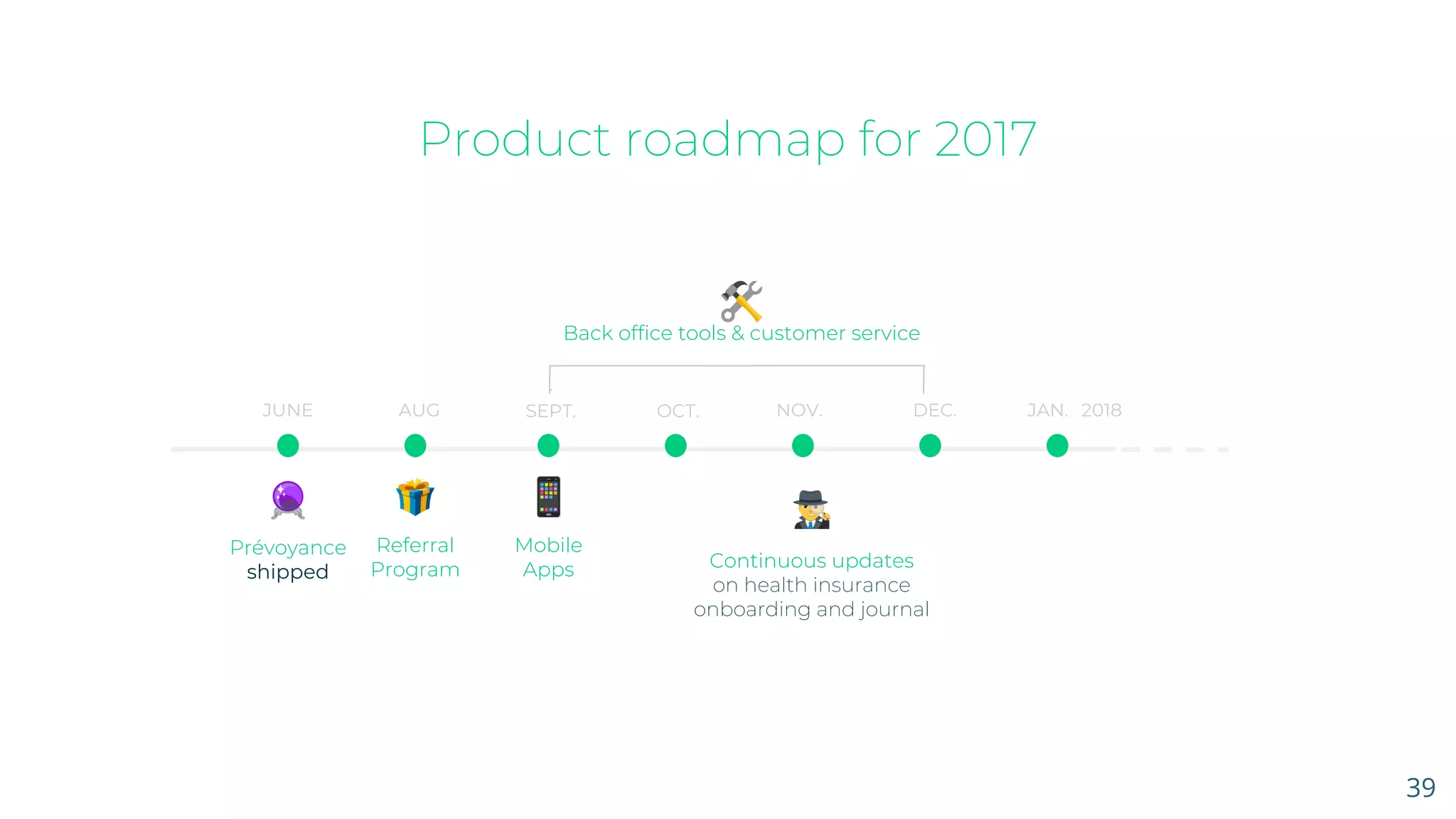
  • Roadmap includes mobile apps, continuous product improvements and expansions like disability insurance (Prévoyance) as upsell (slides 39–40).

Key product claims:

  • “No reimbursement required” via Alan card (slide 10).
  • “The Magical Alan Card” + phone-based bill transfers and automatic reimbursements (slides 10–11).
  • Fast onboarding (5 minutes) for both employers and employees (slides 6–8).

Market Opportunity

Extracted numbers and positioning:

  • Market size (France private health insurance): €36bn (slide 16).
  • Penetration: 96% of French people covered by complementary insurance (slide 16).
  • Competitive landscape: >500 players; top 20 ≈ 50% market share (slide 16).
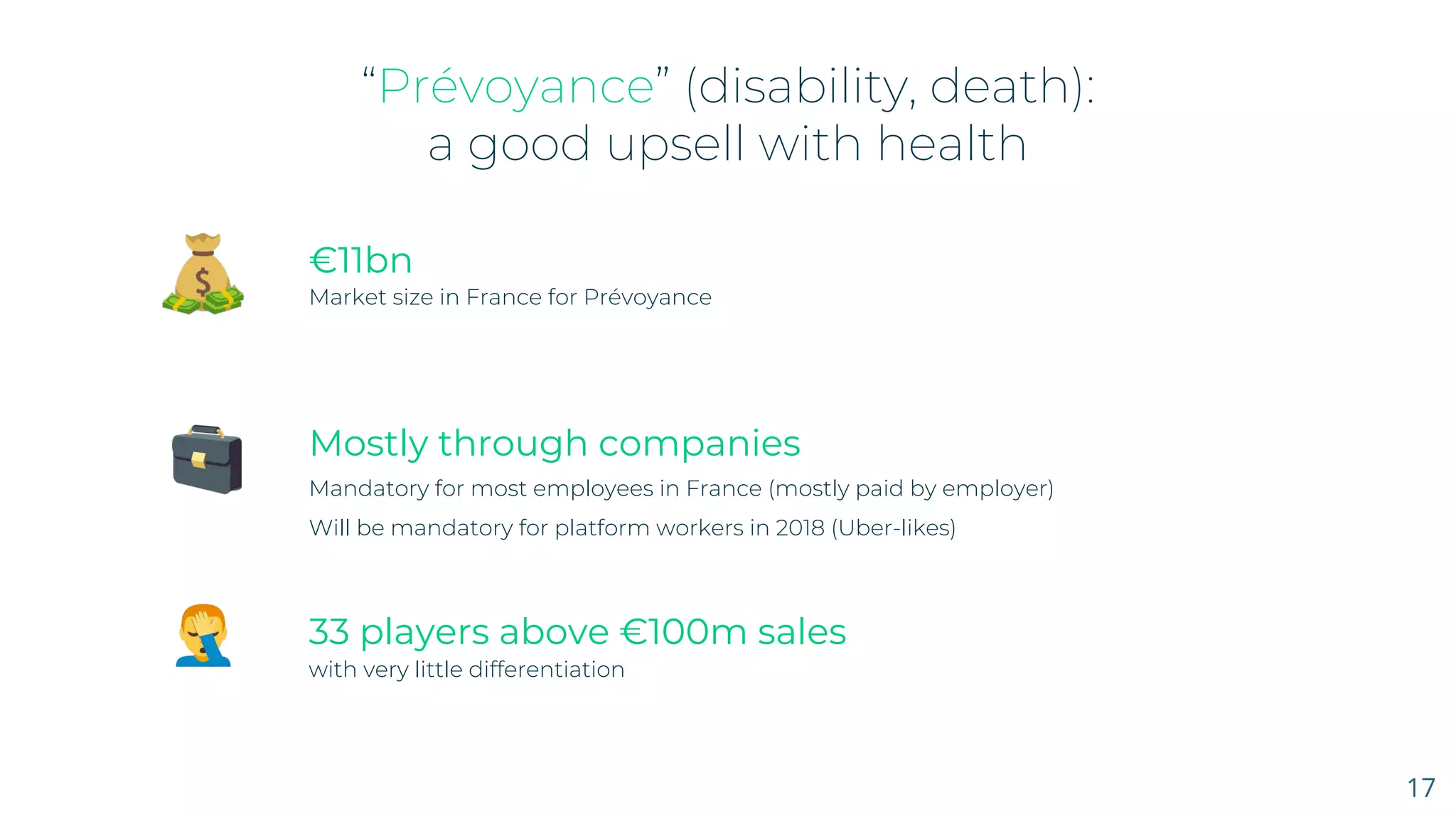
  • Prévoyance (disability/death) market in France: €11bn (slide 17).
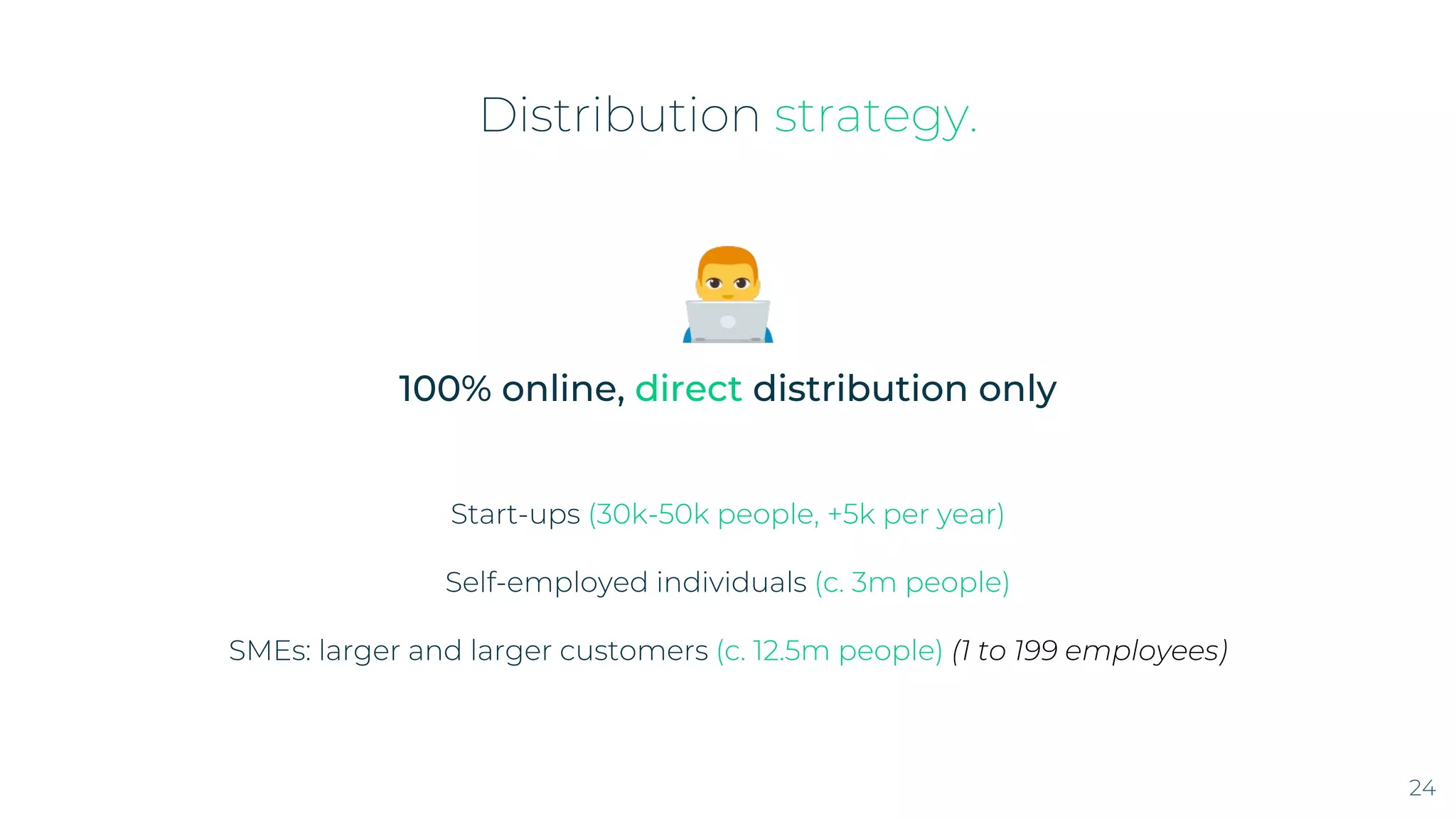
  • Target segments: startups, self‑employed (≈3m people), SMEs (c.12.5m people) (slide 24).

TAM/SAM/SOM (implied by deck):

  • TAM (France private health insurance): €36bn (explicit).
  • SAM (employer-sponsored market + SMEs/startups + self‑employed): not quantified explicitly, but deck targets SMEs/startups/self‑employed as initial SAM (slides 4, 24).
  • SOM: not provided — deck focuses on product fit, pricing and rapid rollouts rather than a stepdown SOM calculation.

Business Model

Revenue model and unit economics as presented:

  • B2B employer‑paid subscription (employer pays a % of premium). Employers choose participation rate (50% minimum to 100%) (slide 6).
  • Per‑employee monthly pricing examples (slide 9, right side):
    • Less than 36 y.o. — €50 / month per employee
    • 36–45 y.o. — €65 / month per employee
    • Children — €40 / child per month
  • Upsell product: Prévoyance (disability/death) — additional revenue stream (slides 17, 39).
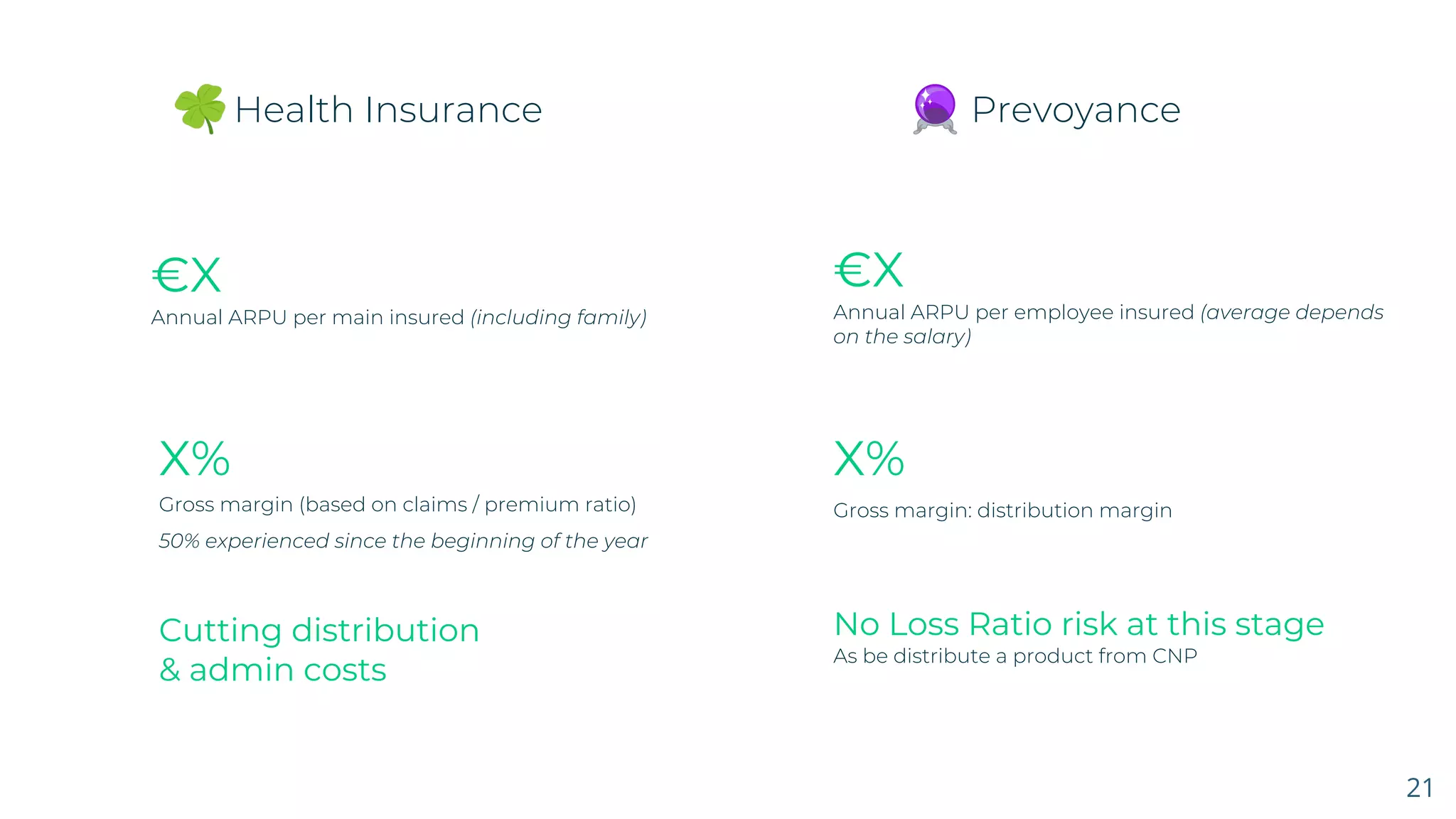
  • Distribution margin / insurance gross margin discussed at a high level (slide 21) but no explicit loss ratios shown; slide claims “No Loss Ratio risk at this stage” for distribution of a CNP product.
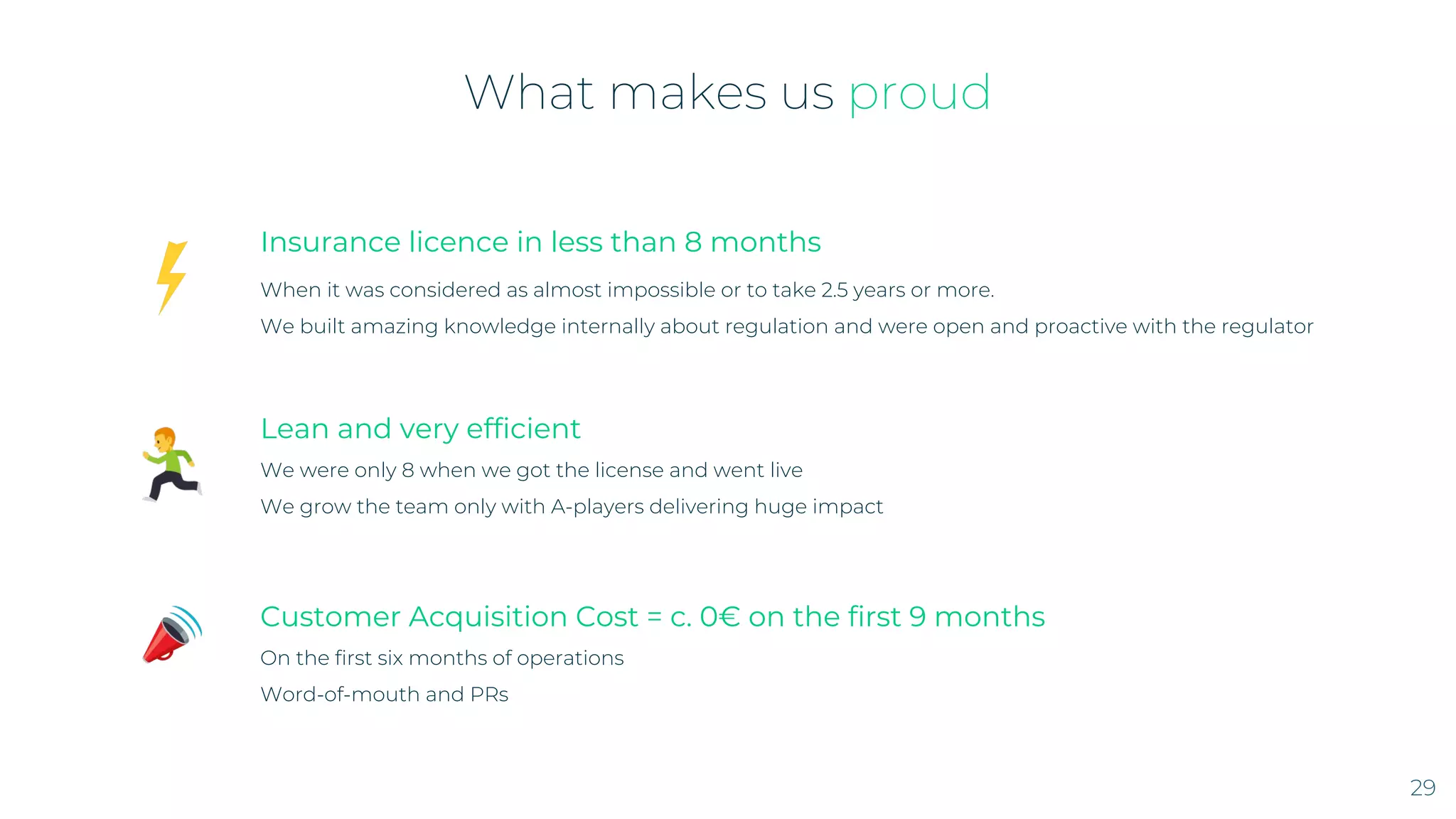
  • CAC: deck claims “Customer Acquisition Cost = c. €0 on the first 9 months” (slide 29) — reflects word‑of‑mouth / PR driven early traction (but this is not modeled with LTV).

Unit economics visibility: limited. The deck notes gross margin guidance (X%) and that ~50% gross margin has been experienced since the beginning of the year (slide 21) — but no explicit LTV, CAC, payback period, or LTV/CAC ratios beyond the qualitative CAC claim.


Traction & Metrics

Growth metrics and proof points shown (many slides contain placeholders or high‑level claims):

  • Licensing & operational milestones:
    • Insurance license acquired quickly (claims “insurance licence in less than 8 months” — slide 29/31).
  • Financial/metric claims:
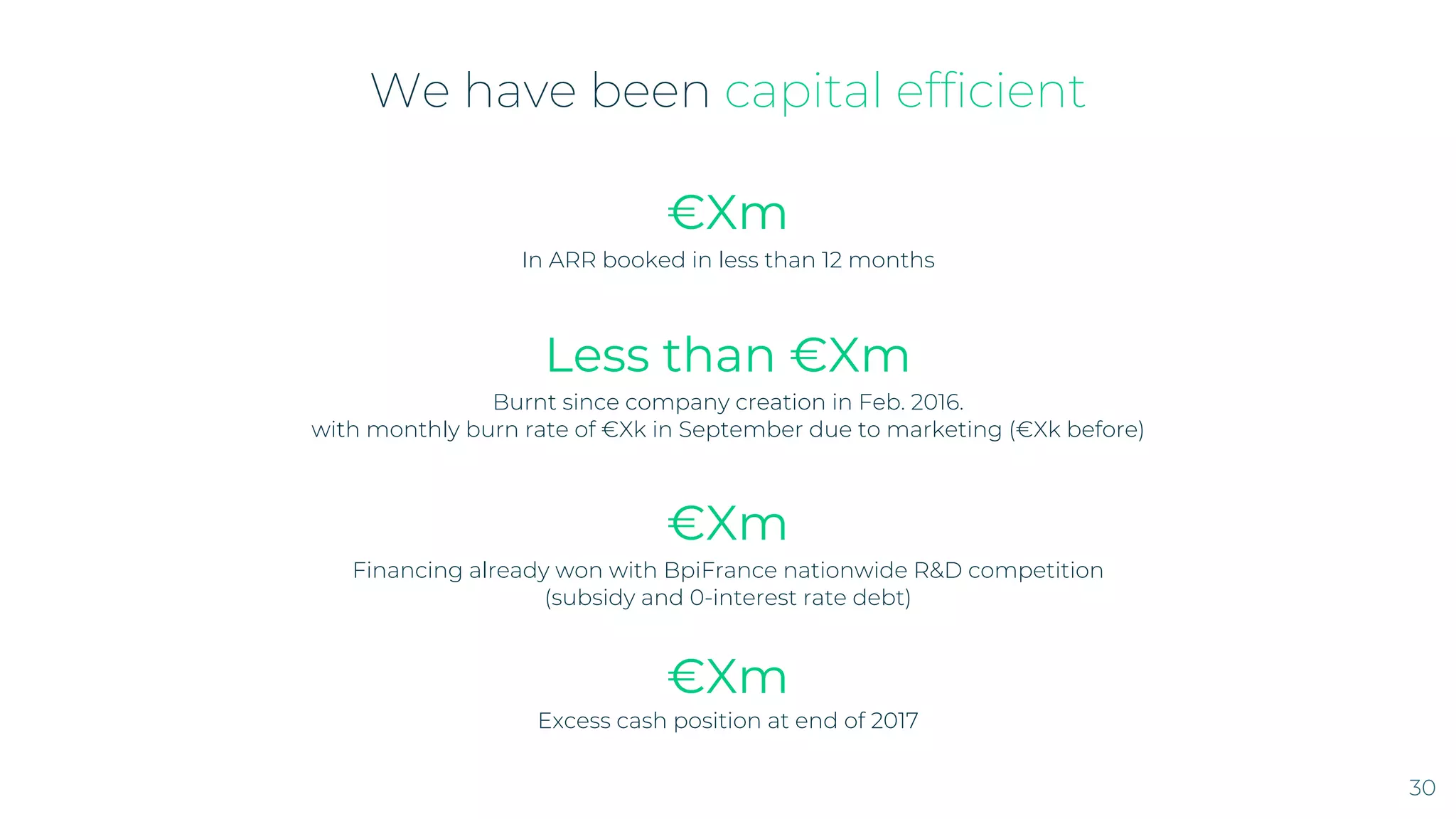
    • “In ARR booked in less than 12 months” (slide 30) — the exact ARR amount is redacted as “€Xm” in the deck.
    • 59% of the portfolio signed for disability insurance (slide 23 note).
    • “Customer Acquisition Cost = c. €0 on the first 9 months” (slide 29).
  • Fundraising: Deck shows prior raise of €12M (slide 37).
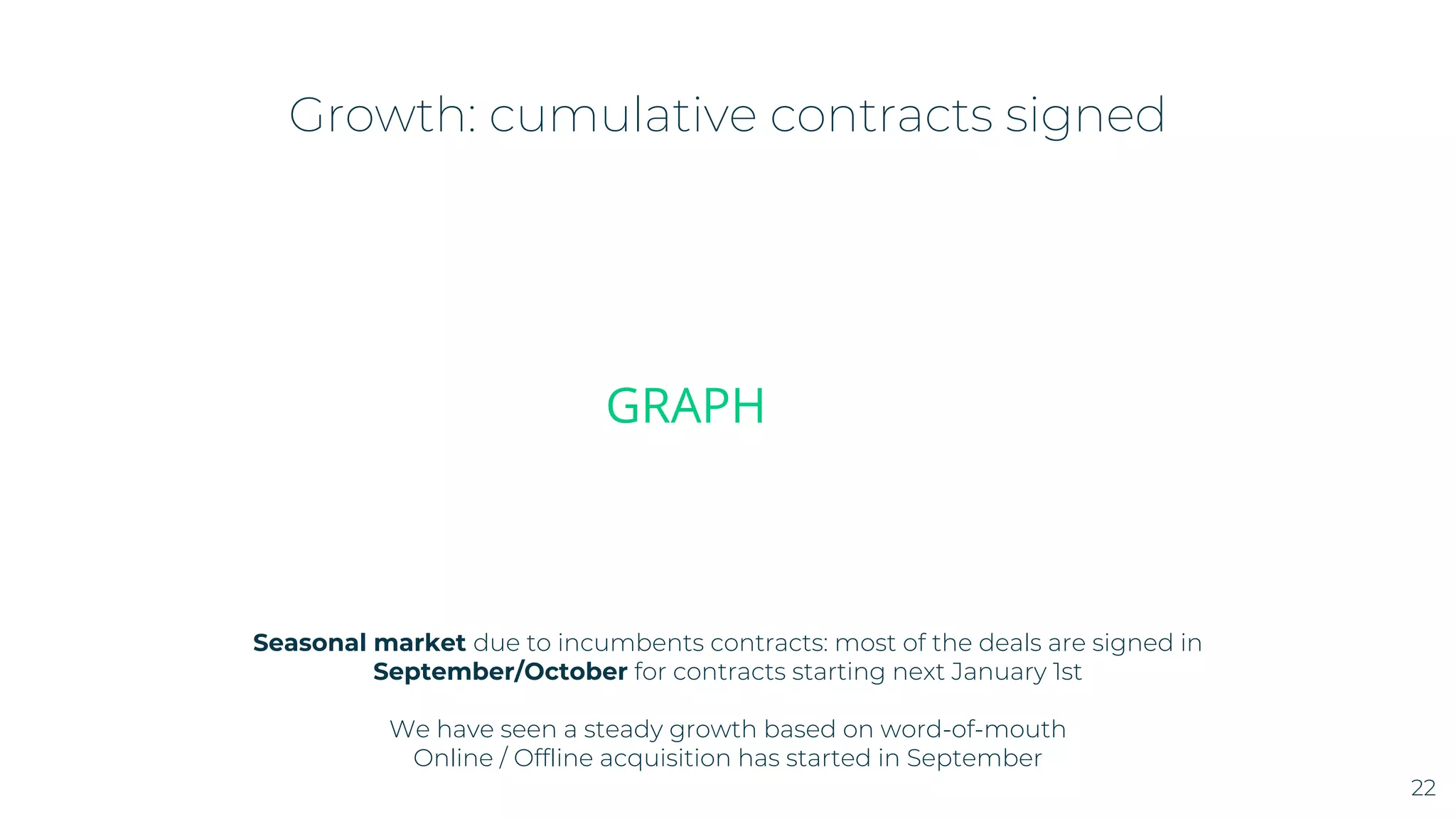
  • Distribution: steady growth primarily via word-of-mouth with seasonal peak activity in Sept/Oct (slides 22, 25, 26).
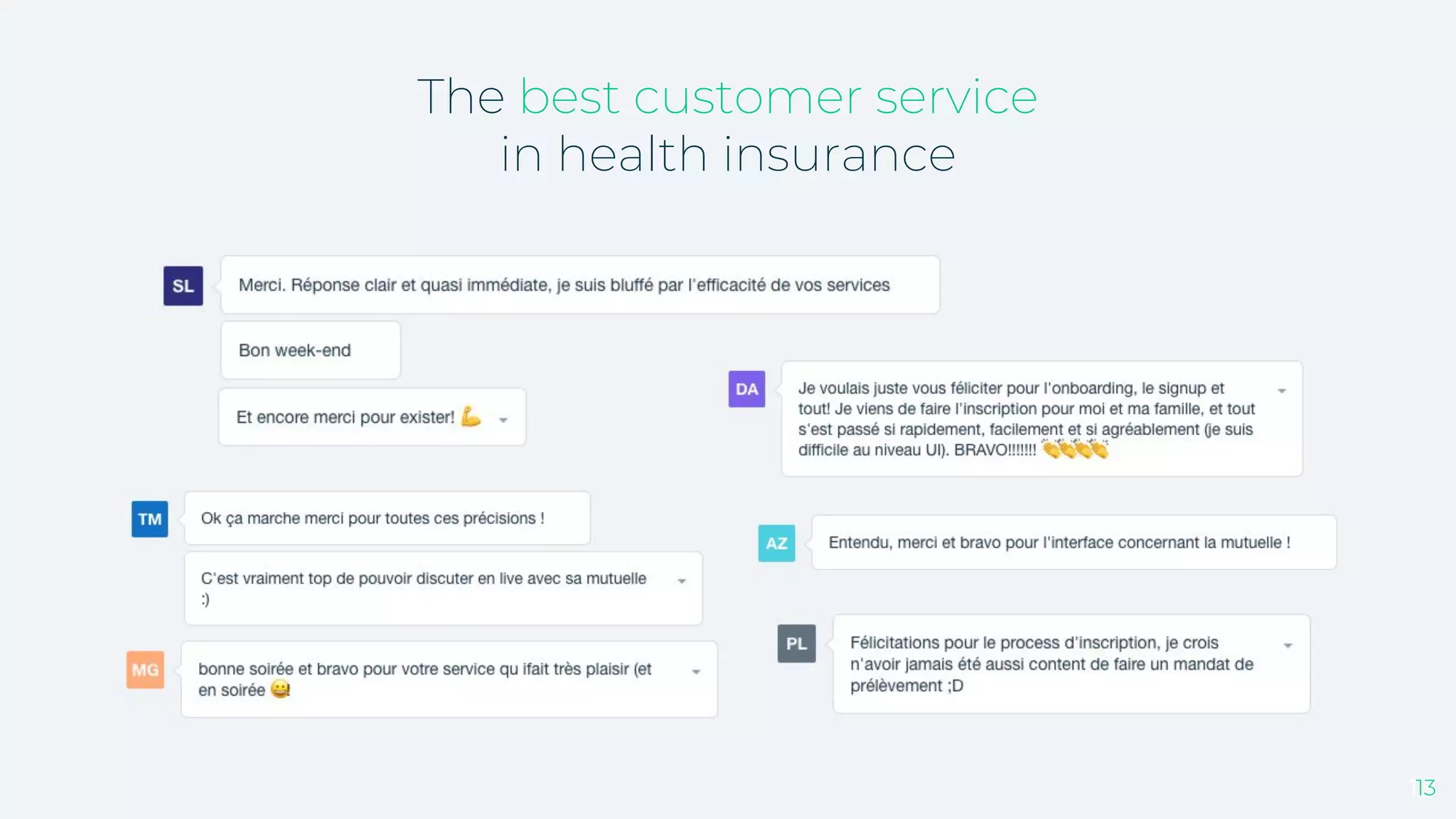
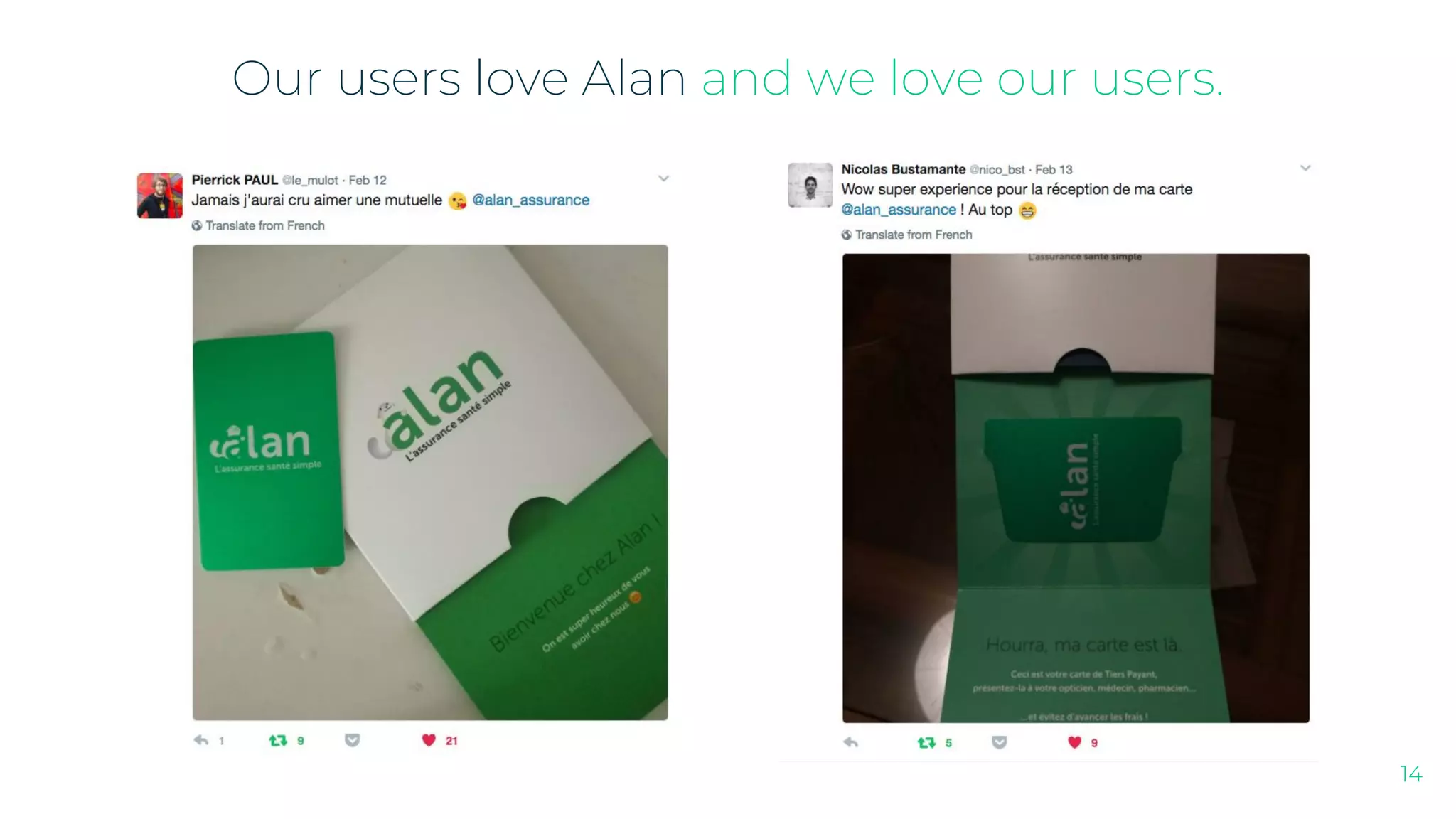
  • Customer satisfaction & brand: lots of positive customer quotes, social posts and screenshots (slides 13–15).

Missing / weakly evidenced traction:

  • No explicit customer count, revenue figures, monthly recurring revenue (MRR) or concrete ARR numbers shown in the visible slides — placeholders (“GRAPH”, “€Xm”) indicate these were left out or presented verbally.

Competitive Positioning

How they differentiate:

  • Product & UX focus: fast digital onboarding, mobile-first reimbursements, Alan card, and a unified “journal” for medical events (slides 5, 10–12).
  • Customer service: claims “The best customer service in health insurance” with live chat and positive user quotes (slide 13).
  • Vertical focus on employer‑based plans for startups, freelancers and SMEs with integration into payroll systems (PayFit) (slides 4, 8, 24).
  • Regulatory advantage: licensed insurer (quickly achieved) and product distribution partnership(s) (slide 21 mentions distribution with CNP).
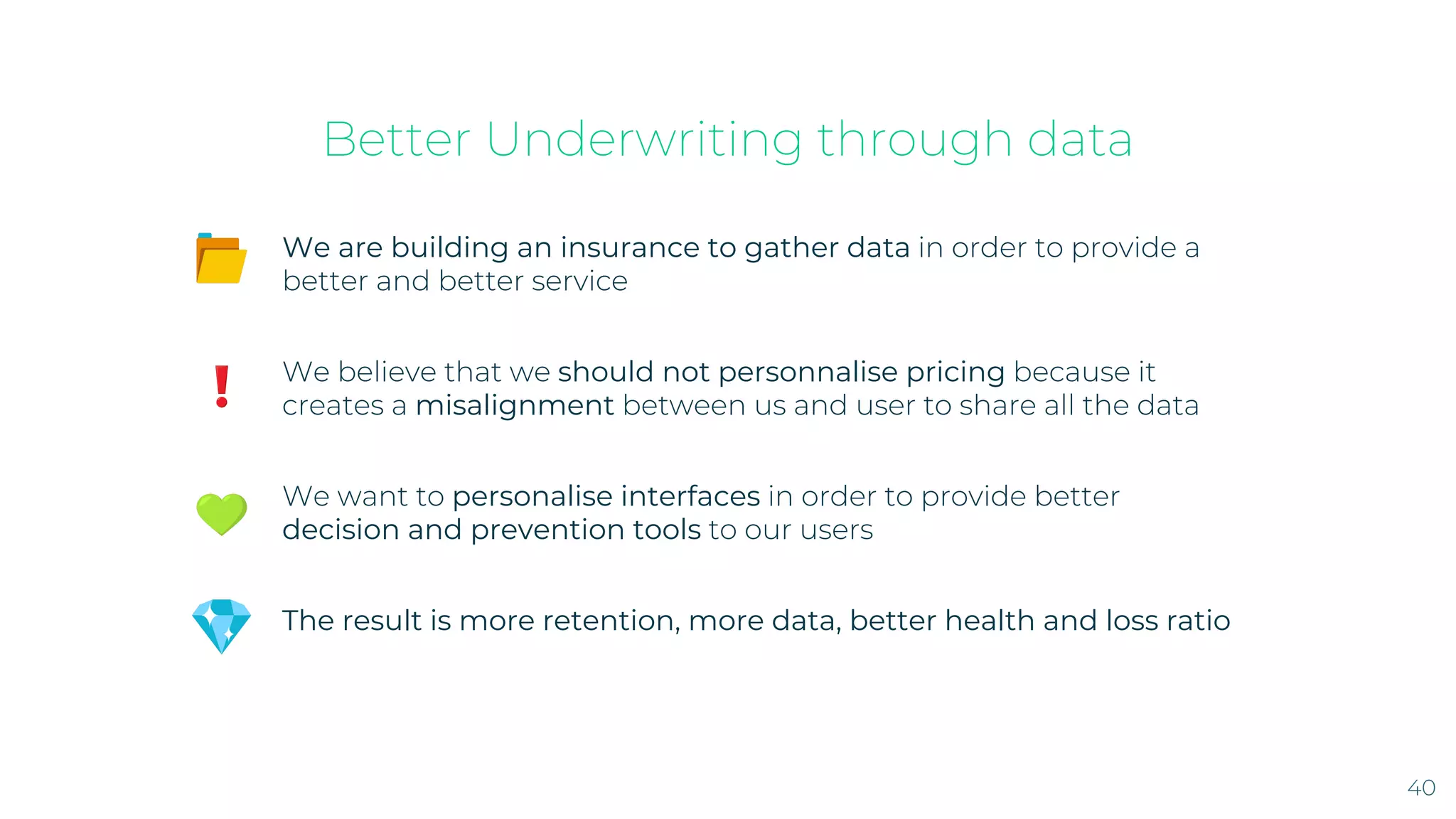
  • Data/underwriting vision: plan to gather health events data to improve service and retention (slide 40).

Competitors: deck positions incumbents as numerous but undifferentiated; explicit direct-startup competitors are not listed (competitive landscape slide placeholders).


Team

Core credentials highlighted:

  • Jean‑Charles Samuelian — CEO & co‑founder (serial entrepreneur; prior exit with Expliseat; engineering background, MSc + MBA; early programmer) (slide 32).
  • Charles Gorintin — CTO & co‑founder (machine learning and financial engineering background; experience at Facebook/Instagram/Twitter; degrees from ENS Paris‑Saclay and UC Berkeley) (slide 32).
  • Senior hires with insurance/regulatory experience: Bertrand Robert (Lead Insurance Ops), Paul Sauveplane (Lead Finance, Risk & Compliance), Fabrice Staad (Lead Actuary) — each with significant industry backgrounds (slides 34–35).
  • Engineering & product talent from Facebook, Mixpanel, BlaBlaCar, Withings, Square, Toucan Toco, etc. (slides 31–35).
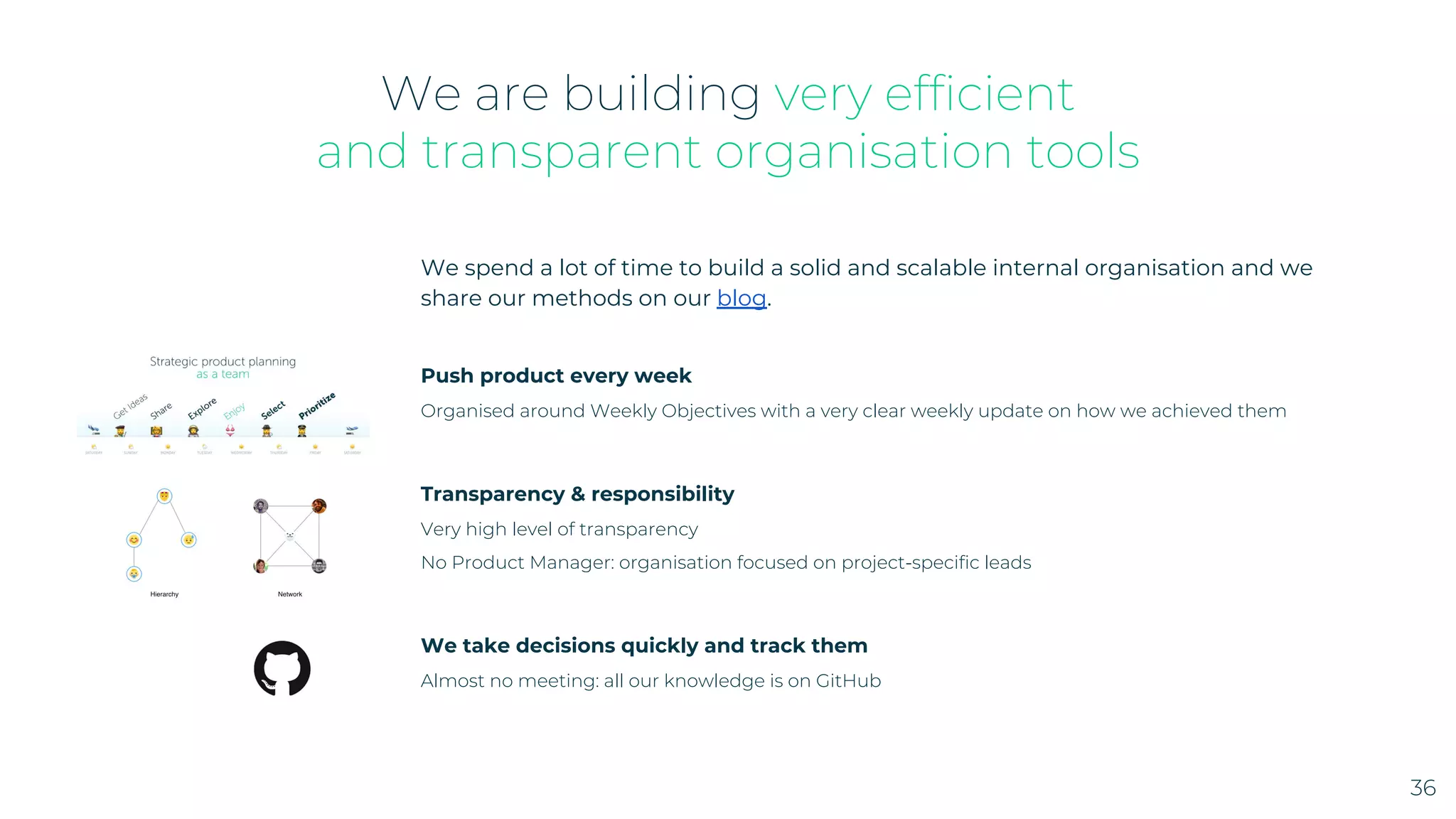
  • Team photos and cultural slides emphasize a product/engineering-driven organization (slides 31, 33).

Overall: strong mix of tech and insurance veterans, with demonstrated ability to execute (license, product).


Go-to-Market Strategy

Distribution approach:

  • 100% online, direct distribution (slide 24).
  • Target segments: startups (30k–50k people), self‑employed (~3m), SMEs (1–199 employees; c. 12.5m people) (slide 24).
  • Acquisition channels: organic/word‑of‑mouth, content (blog), partnerships with incubators/VCs, PayFit integration; small paid tests on Facebook (slide 25).
  • Offline push: brand awareness billboards in Paris / RATP during September/October seasonal sales window (slide 26).
  • Sales strategy: recognize need for salespeople for companies >20 employees and plan to set up a team (slide 26).

Key operational note: market seasonality — many employer contracts must be cancelled by Oct 31 for Jan 1 start; Alan uses this to concentrate acquisition in Sept/Oct (slides 22, 26).


The Ask

What they were raising and intended uses (as presented):

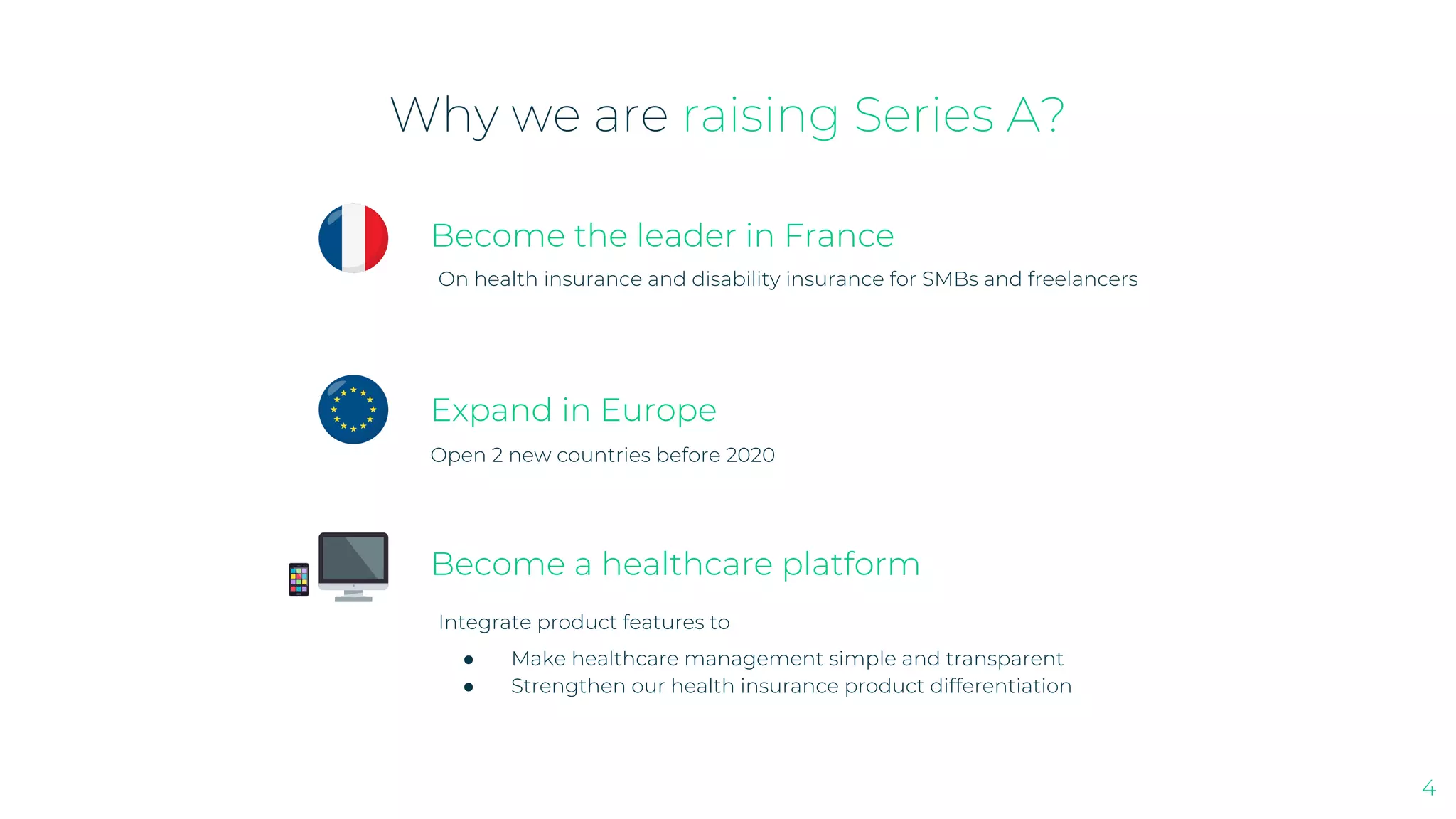
  • Deck explicitly asks “Why we are raising Series A?” with three objectives:
    1) Become the leader in France (health & disability insurance for SMBs/freelancers)
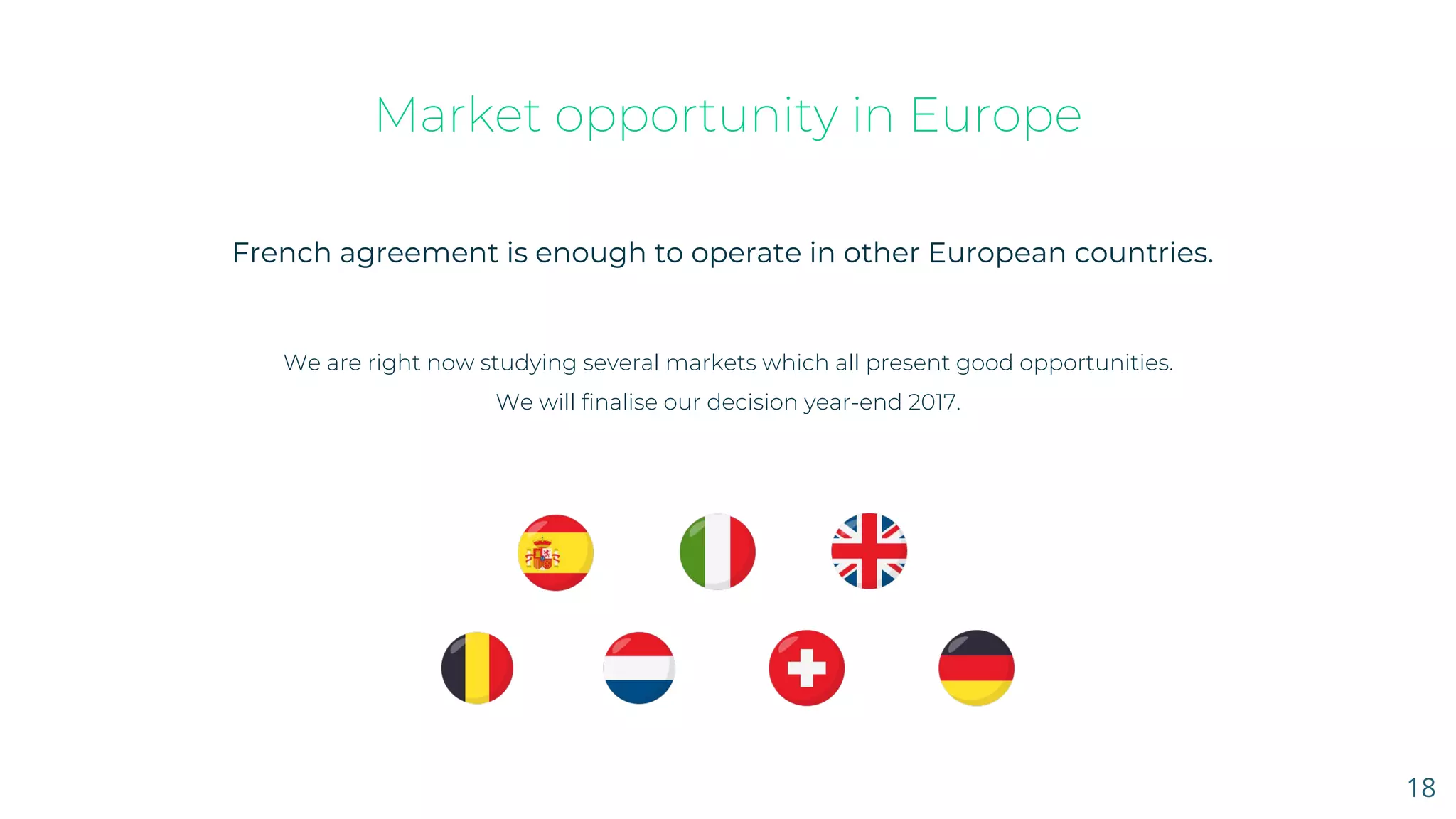
    2) Expand into Europe (open 2 new countries before 2020)
    3) Become a healthcare platform — integrate product features, create differentiated health management (slide 4)
  • The deck does not show a slide with the precise dollar amount requested, cap table, valuation target, or detailed use‑of‑funds breakdown. Uses implied: market expansion, product development (mobile apps, platform), sales & marketing (seasonal push), and internationalization (slides 4, 39).

Investor Deep Dive

Executive summary, strengths & red flags

Executive Summary

Alan is a digitally‑native, employer‑facing health insurance provider that launched a clean, mobile-first product to simplify onboarding, reimbursements and admin for employers and employees. The deck highlights fast regulatory progress (insurance license), a crisp product (Alan card, mobile reimbursements, admin dashboard), clear pricing for employers, and early traction/operational efficiency — all used to justify a Series A focused on leading France, expanding in Europe and building a healthcare platform.

Key Strengths

3 identified

1

Product + UX focus with operational execution

2

Regulatory progress & insurance credibility

3

Clear go‑to‑market realism and seasonal play

Red Flags & Weaknesses

3 identified

1

Sparse hard traction & financial details

2

Underwriting & loss exposure not quantified

3

Overly optimistic CAC / unit economics claims without backup

More Pitch Decks To Study

Compare structure, fundraising context, and investor-facing story across similar startup decks.