Compare your deck to Pearpop

Compare Your Deck

Pearpop Pitch Deck (2022)

Social
Stage: Seed
Raised: $18M
Year: 2022
Slides: 19
Outcome: Growing; $15M ARR (2025)

Pitch Deck

1 / 19
Pearpop pitch deck - The Opening: Strong brand and visual positioning
Click to expand

Deck Analysis

This deck from Pearpop (Seed, 2022) presents a focused narrative: the creator economy is ripe for a technology-first solution that makes influencer collaborations measurable, performant, and instant. The slides move quickly from market sizing and the current pain points for brands and creators, to Pearpop’s product (Challenges/Ovations), traction and metrics, and a vision that ties platform data to Web3 primitives for long-term creator value. Notable strengths include a clear problem→solution→traction arc, bold visual identity that reinforces brand, and concrete metrics that validate early product-market fit.

The Opening: Strong brand and visual positioning

The Opening: Strong brand and visual positioning

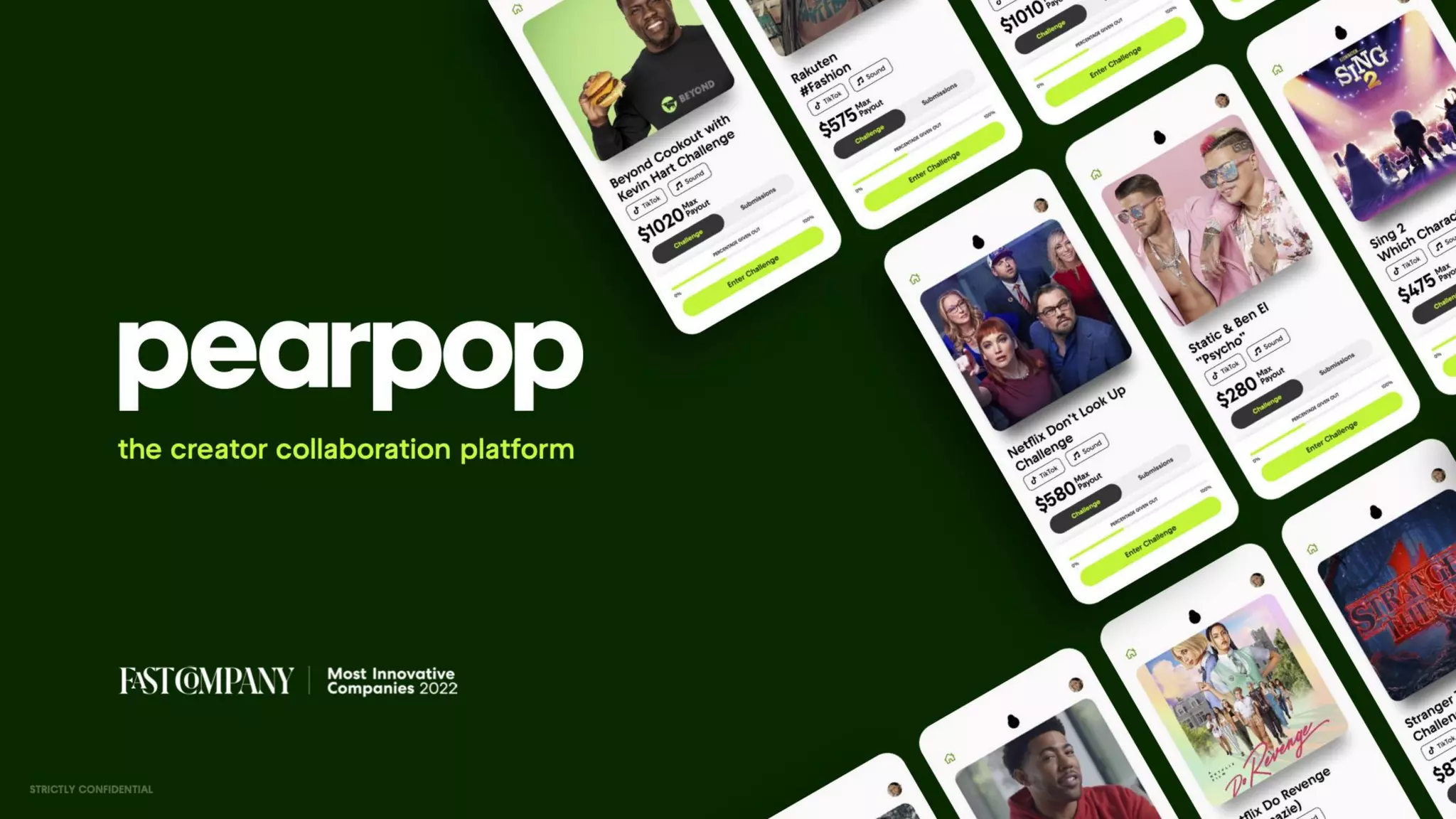
Slide 1 (cover) sets the tone: a bold logo, a tightly worded tagline (“the creator collaboration platform”), and a product-flavored visual that implies mobile-first, creator-driven interactions. It’s effective because it immediately communicates category and product focus while showing a living product interface, signalling the company is beyond just concept stage. The large whitespace and confident typography give the impression of a modern consumer brand, important for a company selling to marketers and creators.

Founders can learn from the clarity and design confidence here: use the cover to stake your category position and display product context. A cover that hints at actual UI or use cases reduces cognitive load for investors and primes them for the story that follows.
Key Takeaway: Use your opening slide to declare category, show product context, and convey brand personality — this frames investor expectations before you dive into details.
Market opportunity: concise, credible sizing

Market opportunity: concise, credible sizing

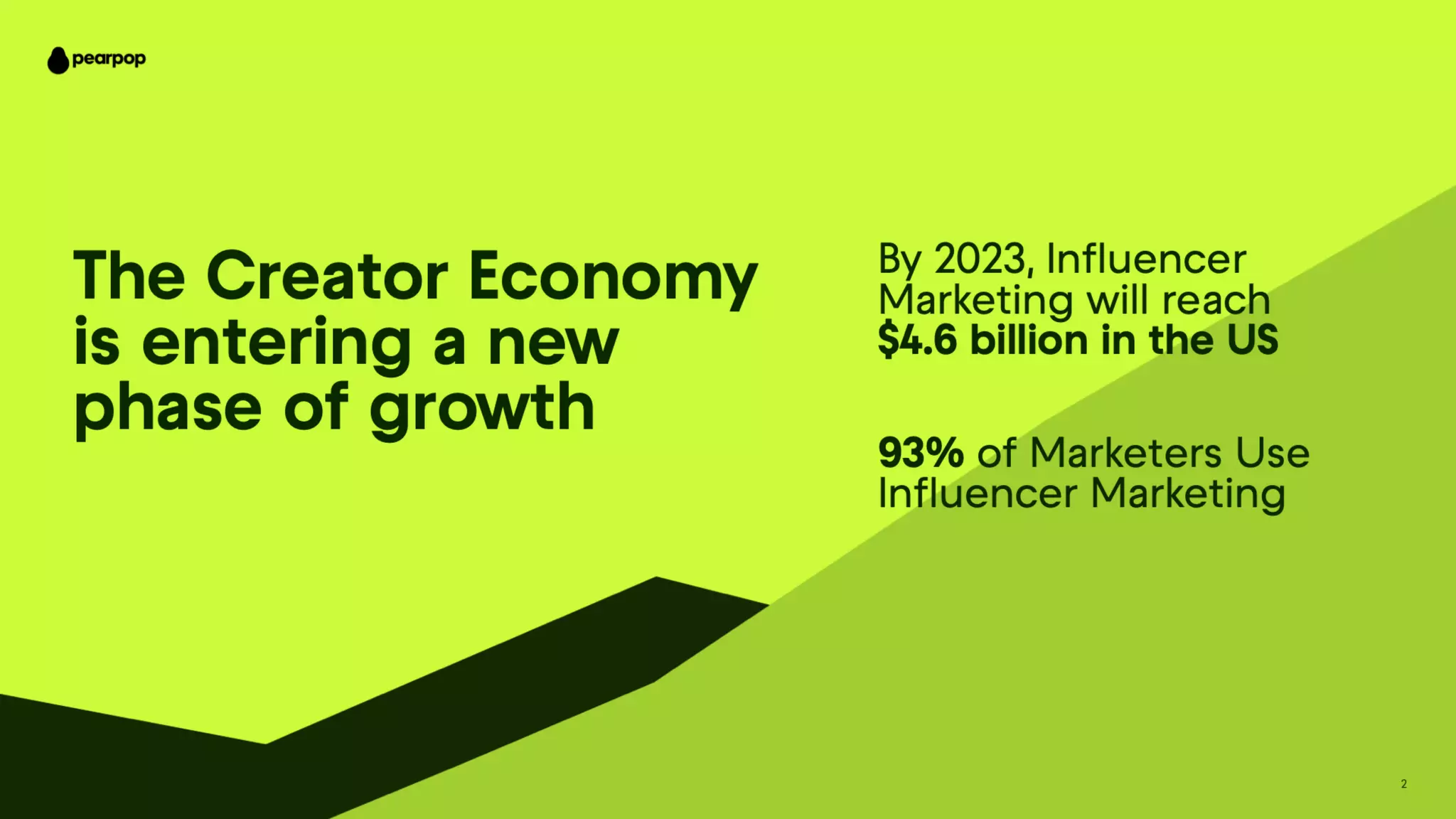
Slide 2 lays out the market: the creator economy is entering a new growth phase, with a headline stat about influencer marketing reaching billions and a high percent of marketers already using influencer channels. These two facts establish urgency (big and growing market) and demand (widespread adoption by marketers). The slide is visually simple — large type and a bright color palette — which helps the numbers stick without clutter.

The slide is effective because it pairs macro growth with immediate adoption signals, the combination investors want to see. For founders, this is a reminder to prioritize a few high-quality stats that together establish both the size and the current momentum of the market rather than overloading with multiple, small datapoints.

Key Takeaway: Lead with two complementary market datapoints — total market size and current adoption — to prove both scale and near-term demand.
Problem articulation: human, manual, and broken

Problem articulation: human, manual, and broken

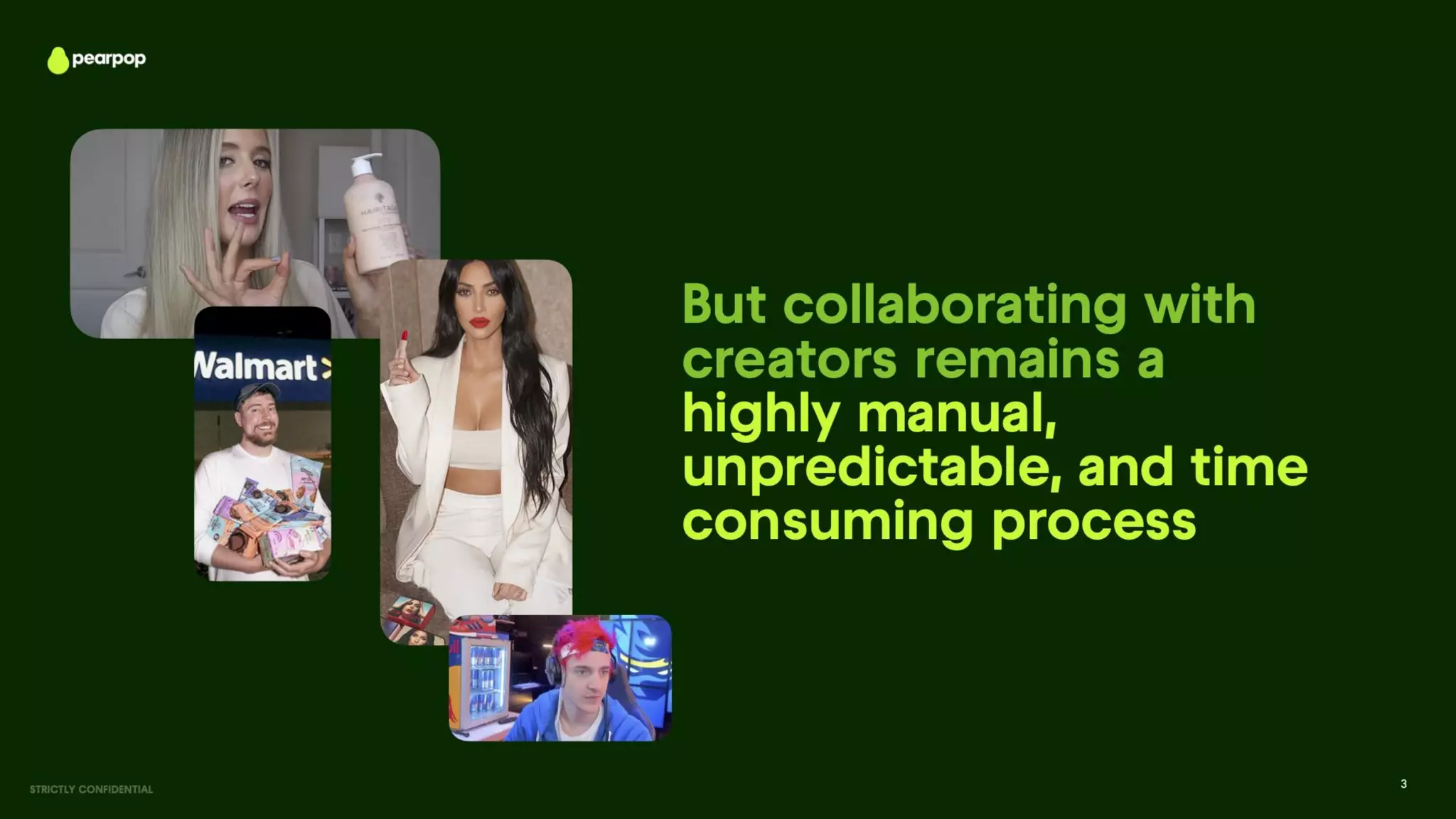
Slide 3 explicitly shows the problem: collaborating with creators is still a manual, unpredictable, and time-consuming process. The designers use imagery of creators and influencers to humanize the problem and large copy to reduce cognitive friction. By directly calling out the pain points experienced by brands (manual workflows, unpredictability), they make the case for a platform solution obvious.

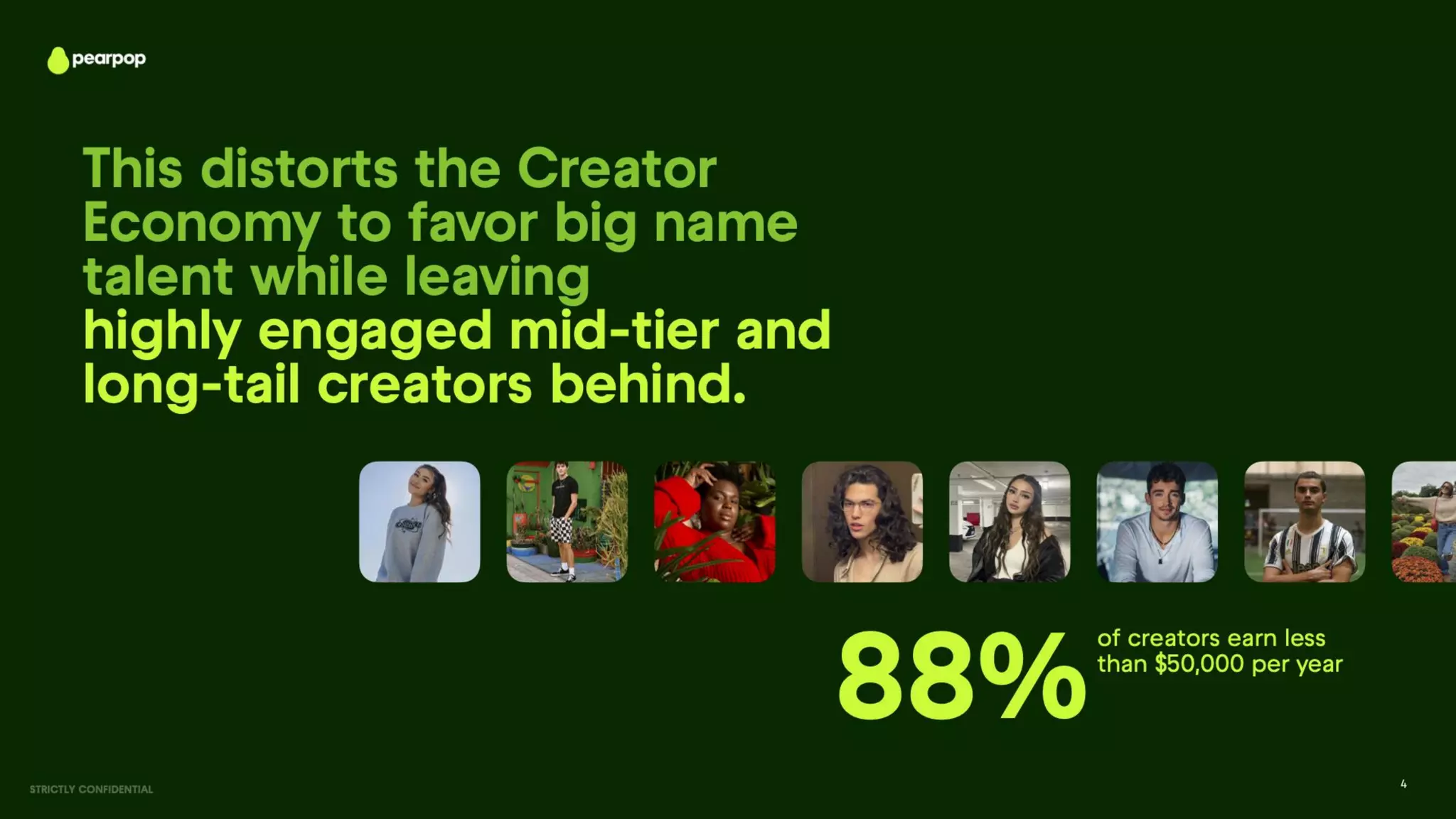
Slide 4 deepens the problem by framing industry imbalance: the current system favors big-name talent and leaves mid-tier and long-tail creators behind, supported by the statistic that 88% of creators earn less than $50k per year. Together these slides do the cognitive work of convincing the audience there is both a market inefficiency and a social/financial issue to solve, broadening the appeal beyond ROI into fairness and distributional opportunity.

Key Takeaway: Describe the problem in human terms and quantify the market inefficiency — tie emotional pain points to supporting data to make the need for a solution indelible.
Solution & early product: Challenges and instant influence

Solution & early product: Challenges and instant influence

Slide 6 introduces Pearpop Challenges — a clear productized feature that turns influencer marketing into an on-demand, measurable product. The slide combines a hero product UI with the value prop tagline “Influence, On-Demand,” showing how campaigns are structured, measured, and visualized. This reduces abstraction: investors can see how brands might create a challenge, how creators participate, and how the platform measures outcomes.

The visual emphasis on the mobile UI and the concentric circles implying reach cleverly communicates network effects and distribution. Founders should note how concrete product artifacts (screens, metrics like views/submissions) reduce investor skepticism — showing an operational workflow often carries more weight than a long list of features.

Key Takeaway: Show a concrete product workflow and early metrics on the same slide to make the concept real and demonstrate initial product-market fit.
Traction: credible, well-chosen metrics

Traction: credible, well-chosen metrics

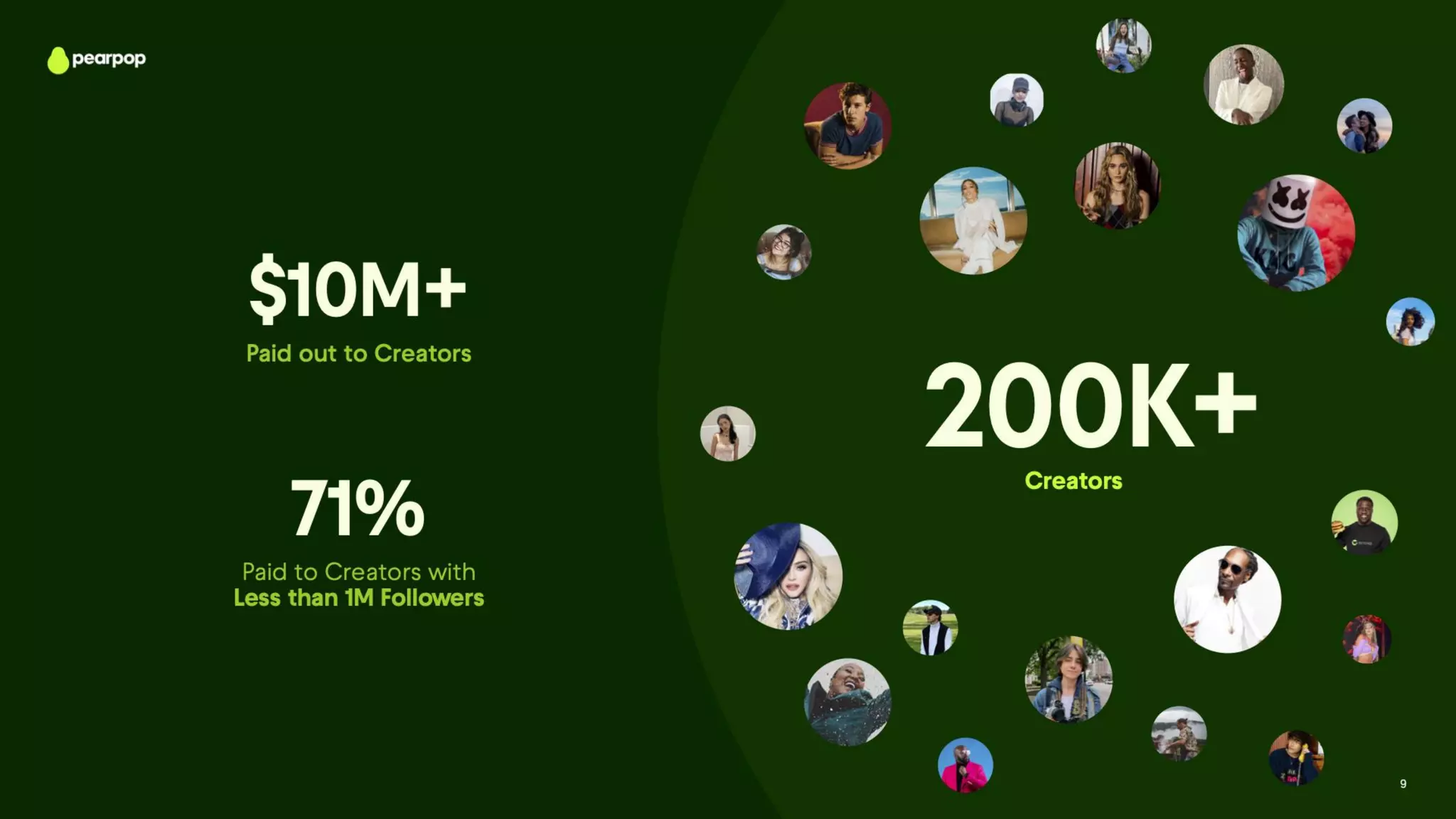
Slide 9 displays the company’s early traction with headline numbers: $10M+ paid out to creators, 200K+ creators in the network, and 71% of payouts to creators with under 1M followers. These metrics are high-leverage because they speak to both scale (dollars and users) and a strategic advantage (serving mid-tail creators). By surfacing dollar payouts, Pearpop demonstrates both demand from brands and meaningful creator monetization — a proof point for both sides of the marketplace.

The slide’s design — sparse copy, big numerals, and creator imagery — highlights the story without overwhelming. Founders should emulate this approach: choose a small set of metrics that demonstrate liquidity, unit economics or network depth, and present them in a visually dominant way so they land with the audience.

Key Takeaway: Prioritize a few high-impact metrics (dollars transacted, active creators, distribution of payouts) and present them prominently to prove marketplace momentum.
Long-term vision: data, Passport Protocol, and Web3 integration

Long-term vision: data, Passport Protocol, and Web3 integration

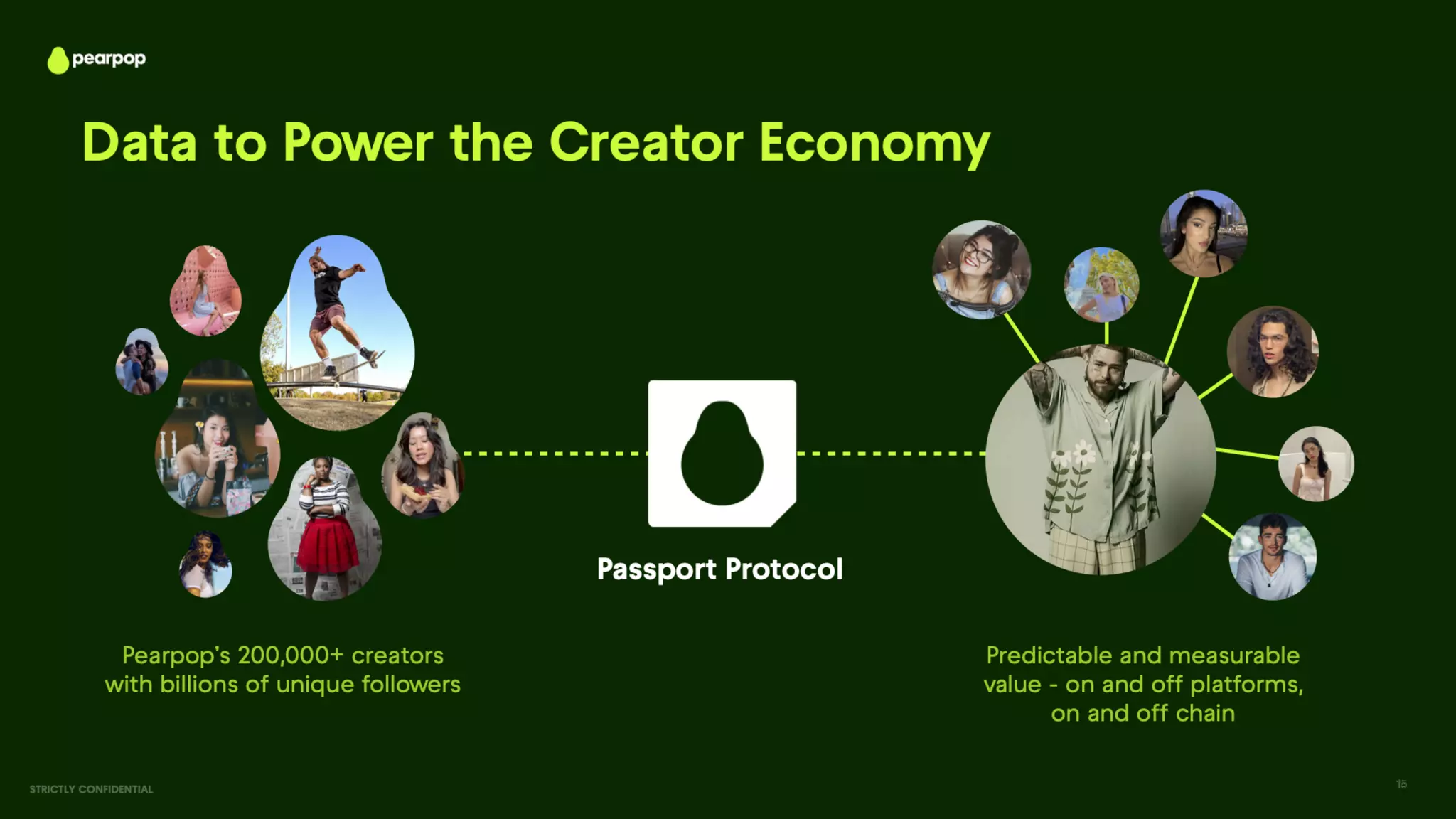
Slide 15 articulates a strategic next step: transforming platform activity into a data layer (Passport Protocol) that can map creators to their audiences and create predictable, measurable value 'on and off chain.' This positions Pearpop not just as a campaign product but as an identity and value-layer for the creator economy, suggesting defensibility through proprietary data and potential monetization via APIs or tokens/credentials.

This slide is important because it signals ambition and an understanding of future competitive moats — data ownership and cross-platform identity. For founders, it’s a lesson in staging: use early traction to justify a credible roadmap that moves from product to platform and explains how you’ll capture more of the long-term value created on your system.

Key Takeaway: After demonstrating product-market fit, present a defensible vision (data/identity layer or protocol) that explains how you’ll own long-term value and create a durable moat.
Team & credibility: founders and operator hires

Team & credibility: founders and operator hires

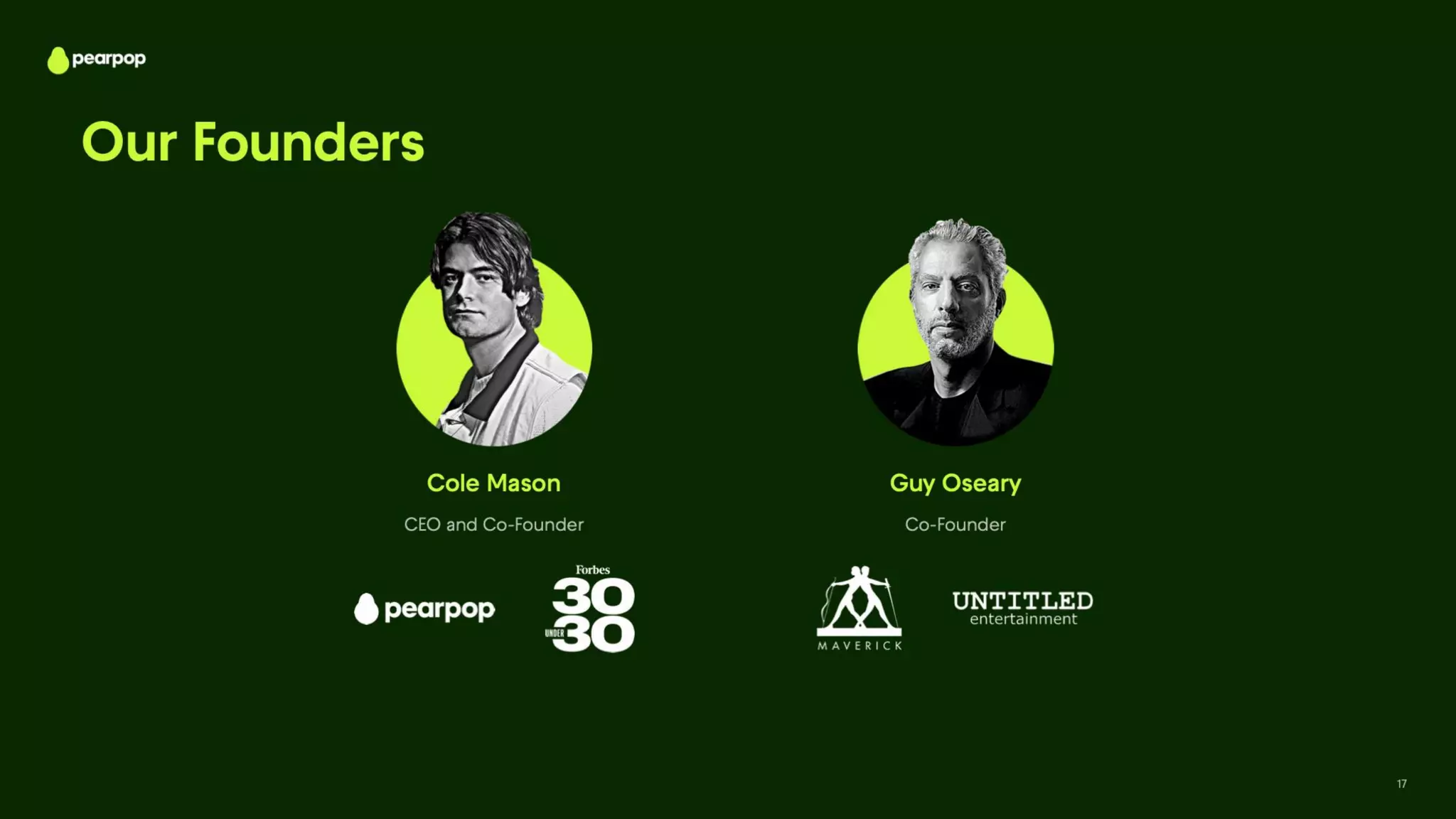
Slide 17 highlights the founding team (Cole Mason and Guy Oseary) and pairs each name with recognizable logos and short cred badges. This balances product/market storytelling with the human capital necessary to execute. By foregrounding a founder with entertainment industry ties alongside a younger operator, Pearpop communicates both access to top talent/brands and the product/tech capability to build a platform.

Investors bet on teams as much as ideas; this slide places experienced operators and relevant domain expertise front-and-center without overloading the deck with CVs. Founders should ensure their team slide addresses complementary skills (product, industry access, ops) and illustrates why this team uniquely can capture the stated opportunity.

Key Takeaway: Put complementary founder strengths on display (domain access + product/ops execution) to convert vision into credibility.

Conclusion: Key Lessons

Pearpop’s deck succeeds by combining a clear problem statement, a tangible and visual product solution, and targeted traction metrics that validate both supply (creators) and demand (brands). The narrative arc — market size, broken status quo, product that fixes the problem, early results, and a long-term data/protocol vision — is tightly executed and paced. Design choices (bold typography, product screenshots, and dominant metrics) keep the story readable and memorable.

Actionable advice for founders: 1) Open by staking category and showing product context; 2) Use two complementary market stats to prove scale and current demand; 3) Humanize the problem and back it with one strong supporting stat; 4) Show concrete product workflows and early metrics together to demonstrate PMF; 5) Present a credible roadmap to a defensible business (data/protocol) and round out with a team slide that proves you can execute. Keep slides minimal, visual, and focused on the single insight each should convey.

Full Deck Analysis

11 sections

Overview

Company: Pearpop
Round: Seed ($18M)
Year: 2022
Outcome: Growing; $15M ARR (2025)

Executive Summary

Pearpop’s 2022 seed deck presents a creator-collaboration platform that turns brand briefs into on‑demand creator campaigns and performance‑based payouts. The deck is notable for clear problem framing (manual, follower‑based influencer buying), early traction (200K+ creators, $10M+ paid to creators), a performance pricing model (CPM/CPV/CPA), and a high-profile team (Cole Mason + Guy Oseary) supported by recognizable enterprise customers.


Problem Statement

How the deck articulates the problem:

  • Influencer marketing is large and growing but fragmented and manual (Slide 2: “By 2023 Influencer Marketing will reach $4.6 billion in the US” and “93% of Marketers Use Influencer Marketing”).
  • Collaboration with creators remains “highly manual, unpredictable, and time consuming” (Slide 3).
  • Market dynamics favor big-name talent and leave mid‑tier / long‑tail creators behind (Slide 4), with 88% of creators earning less than $50k/year (Slide 4).
  • Summary takeaway: brands want scalable, measurable, and fast influencer activation, not manual outreach and follower-count pricing.

Solution

How the deck positions the solution:

  • Pearpop provides a tech platform that automates and measures creator collaborations (“Influence, On‑Demand”, Slide 6–7).
  • Two product/offerings highlighted:
    • Pearpop Challenges (launched 2021) — crowdsourced creator submissions tied to campaign budgets and performance metrics (Slide 6).
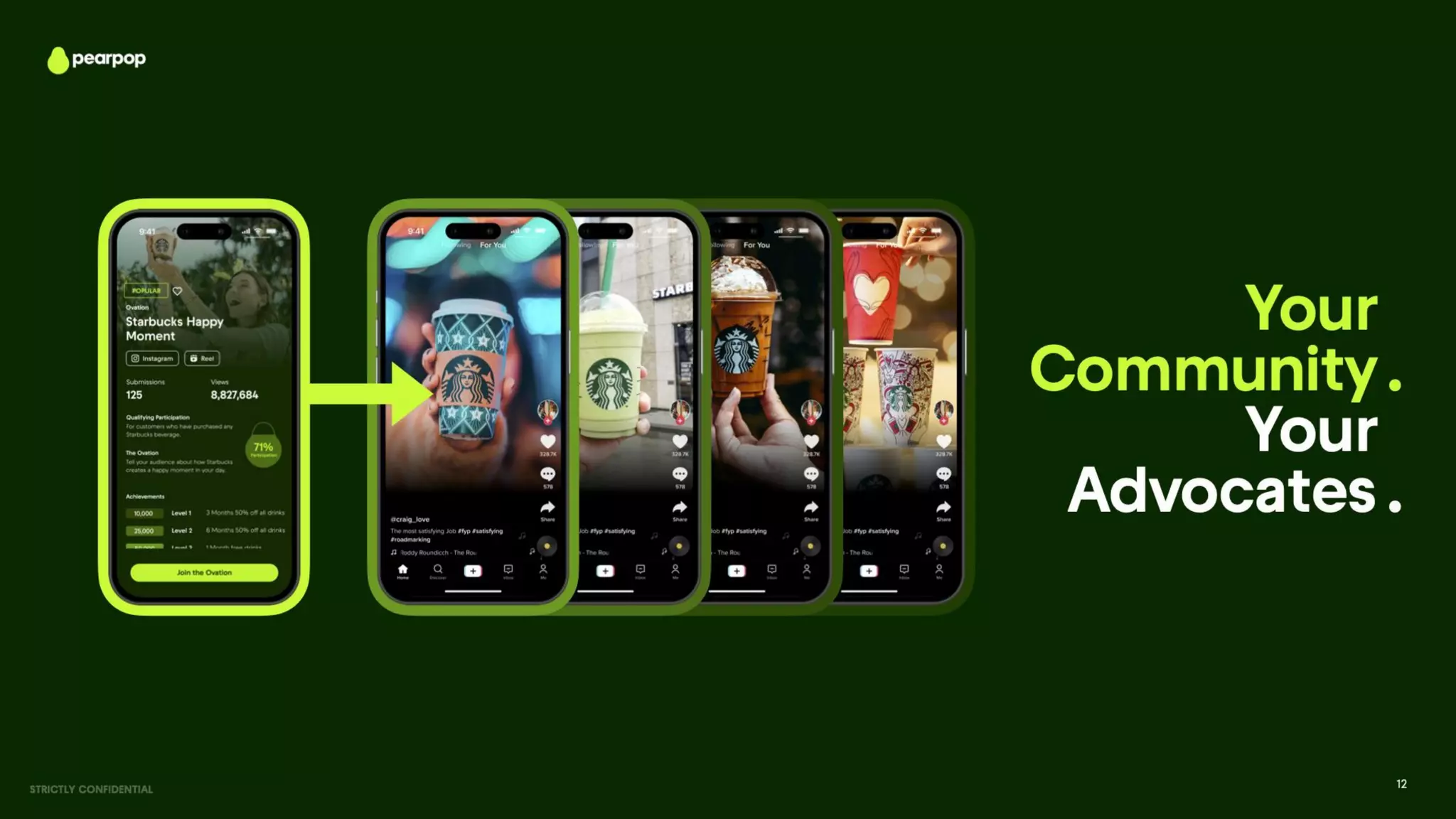
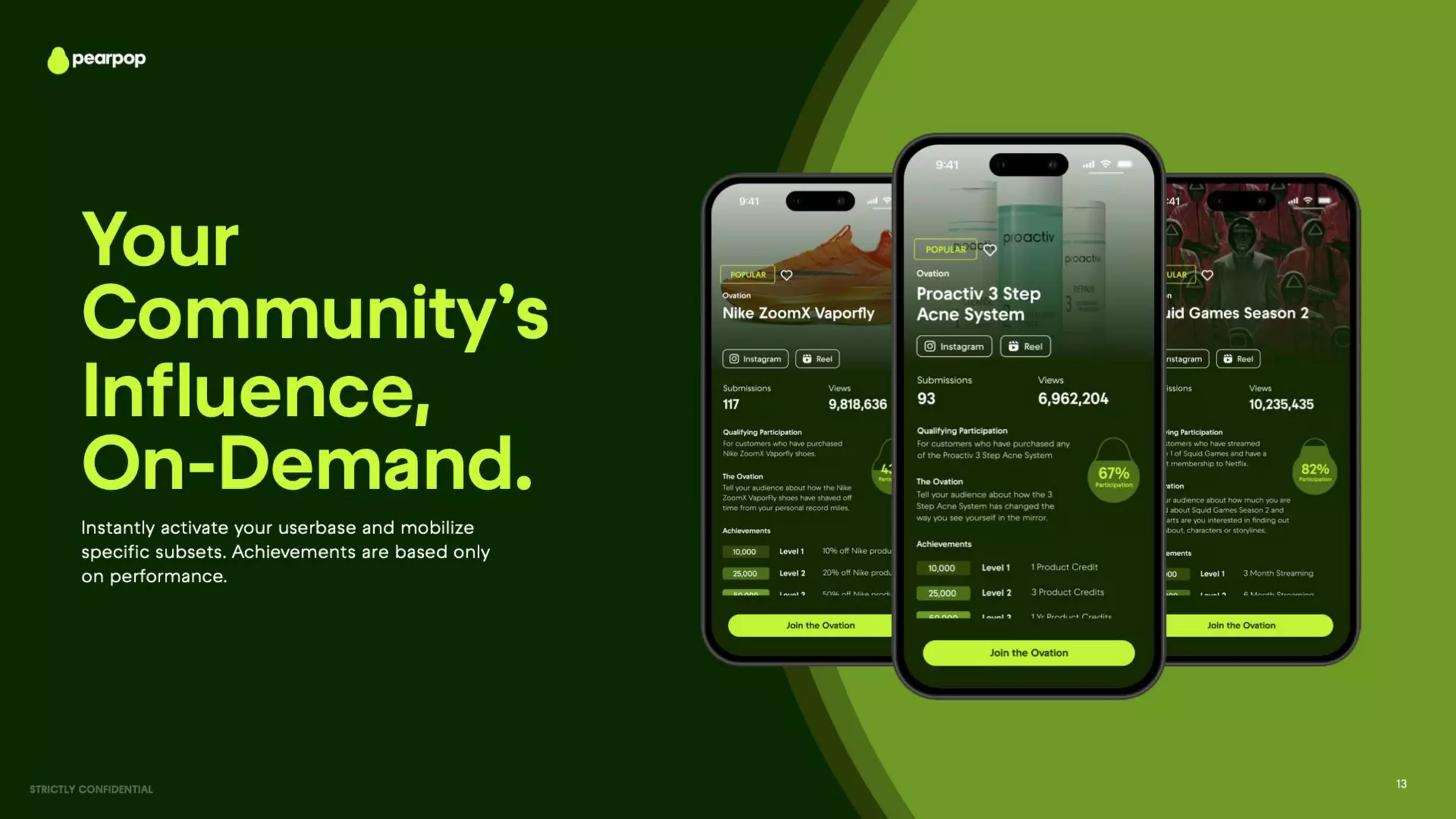
    • Ovation / “Your Community. Your Advocates.” — mobilize a brand’s community or userbase to produce content on performance terms (Slides 11–14).
  • Performance-based pricing: brands pay for verified outcomes (views/engagements) rather than follower counts — CPM/CPV/CPA (Slide 7).
  • Roadmap to data/web3: Passport Protocol to tie creator data/value on/off chain for predictable & measurable value (Slide 15).

Market Opportunity

  • Explicit deck data:
    • Influencer Marketing market in US: $4.6B by 2023 (Slide 2).
    • 93% of marketers use influencer marketing (Slide 2).
  • The deck does not present a full TAM/SAM/SOM breakdown beyond the $4.6B US figure. No global TAM or category segmentation is given in the slides shown.
  • Implied opportunity: large, growing spend from brands + opportunity to monetise long‑tail creators and convert brand communities into creators.

Business Model

  • Primary model: performance-based campaigns where brands pay for verified views/engagements (CPM, CPV, CPA) and creators are paid based on those verified outcomes (Slide 7).
  • The deck implies platform revenue comes from campaign fees/commissions or markups between brand budgets and creator payouts, though exact take rate is not shown.
  • Enterprise & brand partnerships (Slide 8 with brand logos) suggest additional revenue via managed services or larger enterprise campaigns.
  • No explicit pricing matrix, average order value, or margins shown in the deck.

Traction & Metrics

Directly presented proof points:

  • Creators: 200K+ creators on the platform (Slide 9).
  • Payouts: $10M+ paid out to creators (Slide 9).
  • Creator mix: 71% of payouts went to creators with less than 1M followers (Slide 9) — supports long‑tail focus.
  • Campaign examples (product screenshots): campaigns achieving millions of views and hundreds of submissions (examples on Slides 12–14 show submissions in the 90–125 range, views in the millions — e.g., Nike example ~9.8M views, Proactiv ~6.9M views).
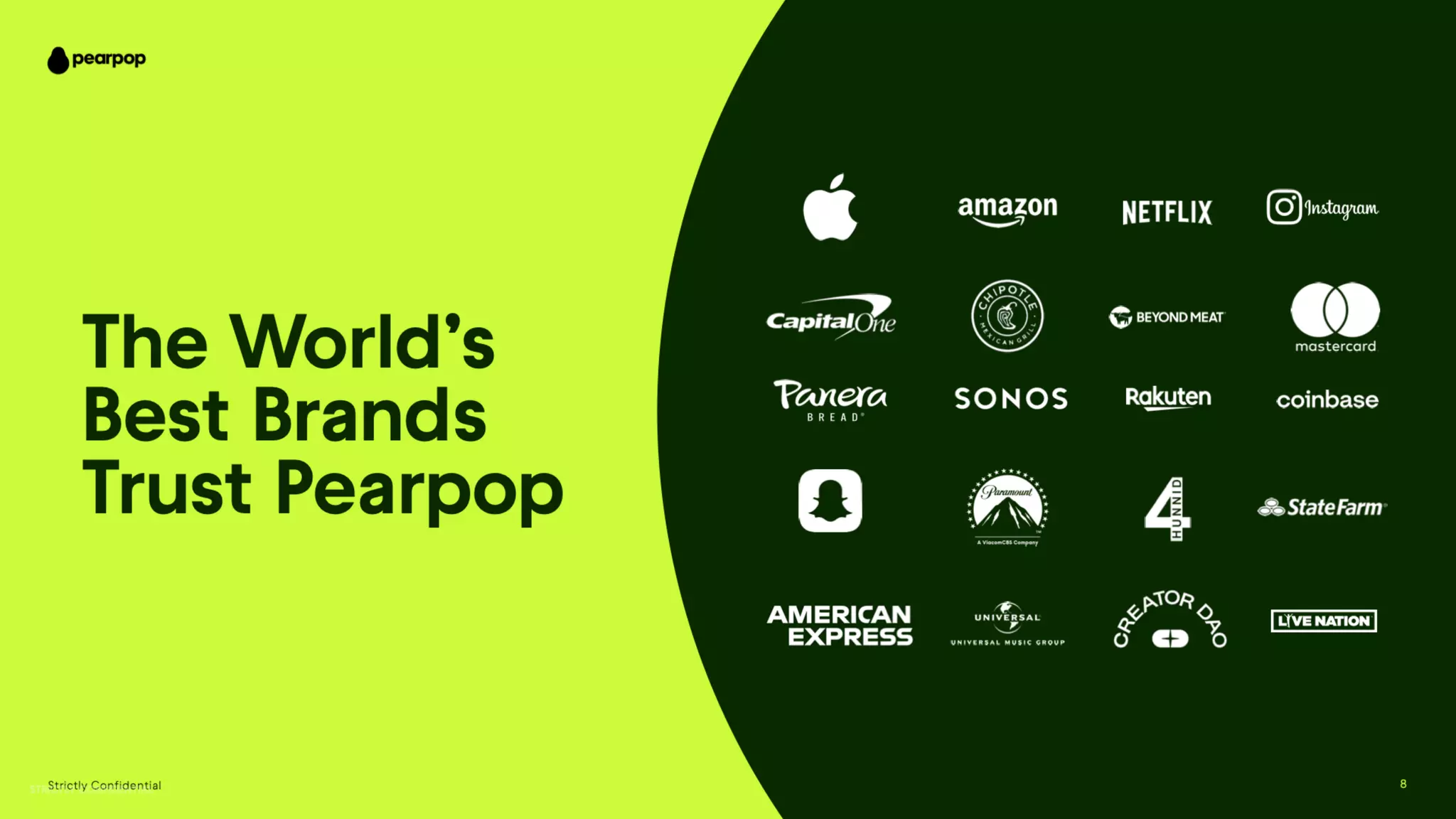
  • Client roster: logos of major brands (Apple, Amazon, Netflix, Instagram, CapitalOne, Panera, Sonos, Coinbase, American Express, etc.) on Slide 8.
  • The deck does not show revenue, ARR at time of seed, MAU, churn, LTV/CAC, or unit economics.

Competitive Positioning

How Pearpop differentiates:

  • Performance-first pricing (pay for results, not follower counts) — direct anti‑status‑quo vs. traditional influencer agencies and talent marketplaces (Slide 7).
  • Productized “Challenges” and “Ovation” workflows that scale campaigns and mobilize communities (Slides 6, 11–14).
  • Focus on long‑tail and mid‑tier creators (71% payouts to <1M followers, Slide 9) vs. platforms/agencies that focus on top talent.
  • Enterprise adoption and brand trust reinforced by an extensive logo roster (Slide 8).
  • Forward-looking data strategy using Passport Protocol to measure on/off platform and on/off chain value (Slide 15).

Missing from the deck: explicit competitor map or direct comparison vs. platforms (e.g., Creator marketplace platforms, agencies, in‑platform organic/paid tools).


Team

  • Founders: Cole Mason (CEO & Co‑Founder) and Guy Oseary (Co‑Founder) — Slide 16.
    • Cole Mason: noted in deck as Forbes 30 Under 30 (visual hint).
    • Guy Oseary: high-profile music/management/entertainment experience (Maverick/Untitled Entertainment).
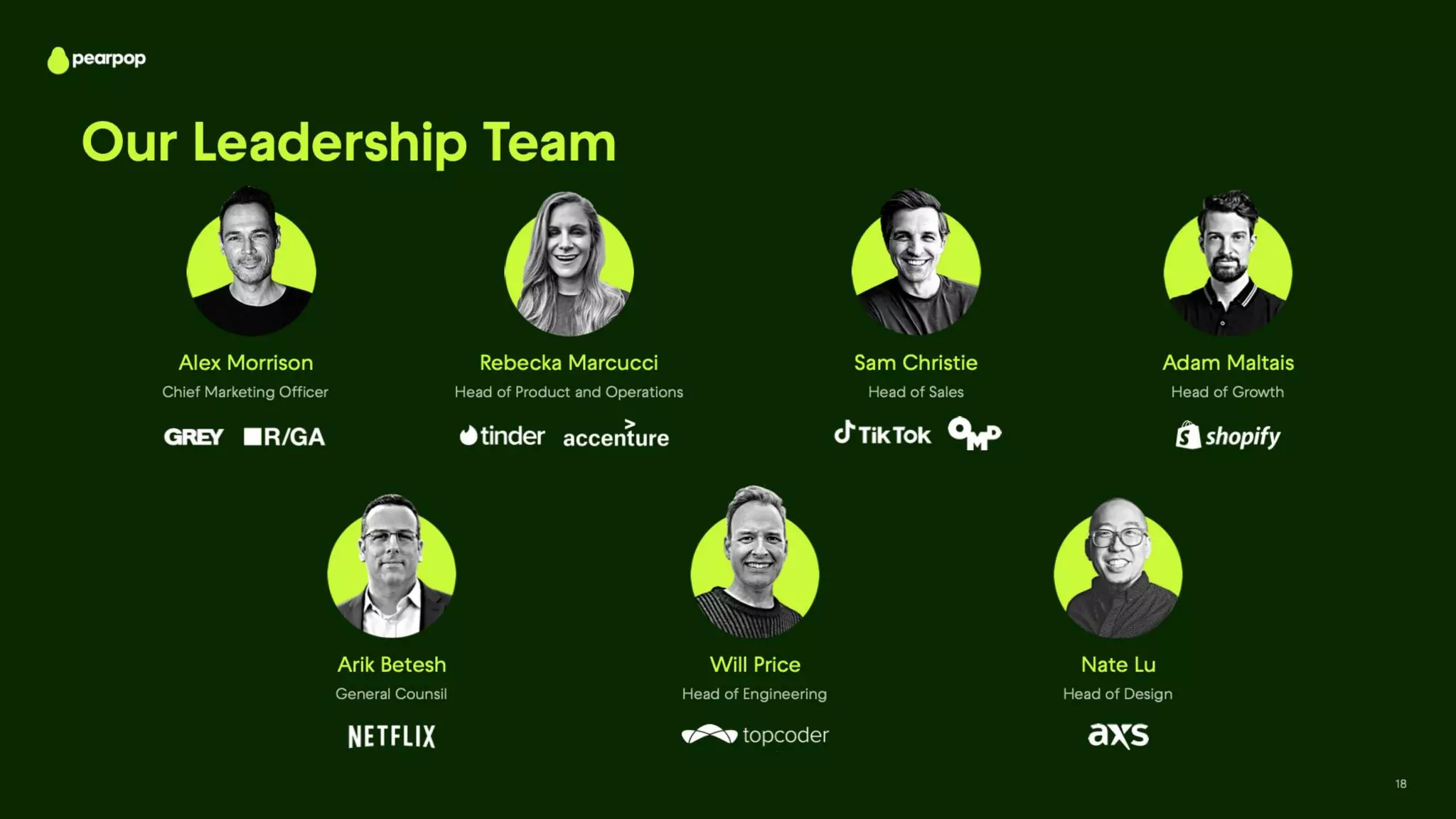
  • Leadership (Slide 18): cross‑functional executives with experience from TikTok, Netflix, Shopify, Tinder, Accenture, R/GA, Topcoder, AXS, etc. (roles include CMO, Head Product, Head Sales, Head Growth, General Counsel, Head Engineering, Head Design).
  • Board/advisory implied via Guy Oseary’s involvement and industry relationships.

Go-to-Market Strategy

  • Two GTM levers visible:
    1. Brand partnerships & enterprise deals (Slide 8 brand logos + enterprise campaign examples).
    2. Platform‑driven campaigns (Challenges) that recruit creators and deliver measurable outcomes (Slides 6–7, 12–14).
  • Productized “Ovation” to activate existing userbases/communities for brands (Slides 11–14) — suggests inbound/retention channel via brands’ customers.
  • Sales team presence (Head of Sales with TikTok experience shown on team slide) implies direct sales to enterprise/brand clients.
  • The deck does not provide CAC, sales cycle length, or channel mix effectiveness.

The Ask

  • The deck represents a Seed round; company raised $18M at Seed (user provided).
  • The slides shown do not break down use of funds or a detailed allocation (product, go‑to‑market, hires, engineering), so the deck either omitted it or it was not among the 19 slides provided.

Investor Deep Dive

Executive summary, strengths & red flags

Executive Summary

Pearpop’s 2022 seed deck presents a creator-collaboration platform that turns brand briefs into on‑demand creator campaigns and performance‑based payouts. The deck is notable for clear problem framing (manual, follower‑based influencer buying), early traction (200K+ creators, $10M+ paid to creators), a performance pricing model (CPM/CPV/CPA), and a high-profile team (Cole Mason + Guy Oseary) supported by recognizable enterprise customers.

Key Strengths

3 identified

1

Clear problem → product fit narrative: The deck concisely links a large market problem (manual, follower‑driven influencer buying) to a simple product solution (performance campaigns and community activation) with examples (Slides 2–7, 11–14).

2

Strong early traction & client proof: 200K+ creators, $10M+ paid out, and a long list of recognizable brand logos lend credibility to adoption (Slides 9 and 8).

3

Compelling visuals and product storytelling: High‑quality, consistent design and product mockups that illustrate campaigns, verification metrics, and the user journey (Slides 1, 6, 12–14). This helps investors immediately grasp the product.

Red Flags & Weaknesses

3 identified

1

Financial / unit economics missing: No ARR, revenue breakout, margin, LTV/CAC, or CAC payback is shown — hard for investors to assess scalability or capital efficiency.

2

Verification & fraud prevention not detailed: The platform promises verified views/engagements but the technical approach to verification (anti‑fraud, platform APIs, sampling) isn’t explained (Slides 7, 15 mention verification/data but not mechanics).

3

Limited TAM breakdown and competitive landscape: Only a US influencer spend figure ($4.6B) is shown; no global TAM, SAM/SOM, or direct competitor map to justify market capture assumptions.

More Pitch Decks To Study

Compare structure, fundraising context, and investor-facing story across similar startup decks.