Compare your deck to Snapchat

Compare Your Deck

Snapchat Pitch Deck (2014)

Social
Stage: Business Deck
Raised: N/A
Year: 2014
Slides: 14
Outcome: IPO at $24B valuation

Pitch Deck

1 / 14
Snapchat pitch deck - Cover & Brand: Instant recognition and tone-setting
Click to expand

Deck Analysis

This 2014 Snapchat business pitch deck positions the company as an ephemeral, mobile-first communications platform with a clear product philosophy, early user metrics, and practical playbooks for brands. Notable for its strong visual identity (the ghost + vivid yellow), simple user-centric explanations, and concrete examples of how publishers and brands used the product, the deck doubles as a tactical manual and a narrative about why ephemeral storytelling matters. Founders can learn how a differentiated product philosophy, crisp UX explanations, and real-world use cases help turn early traction into convincing business conversations.

Cover & Brand: Instant recognition and tone-setting

Cover & Brand: Instant recognition and tone-setting

The cover (slide 1) uses Snapchat’s iconic yellow and ghost logo with a bold “FOR BUSINESS” headline. It’s not trying to overwhelm with numbers or features — it immediately communicates brand identity and signals that the deck is targeted at commercial partners rather than consumers. The minimalism is powerful: the color and symbol do the heavy lifting, creating instant recognition and emotional association before any words are read.

For founders, this is a reminder that the first impression should set tone and audience expectations. If your product has strong visual equity, lead with it; it communicates confidence and focuses the reader on what matters next in the deck.

Key Takeaway: Start with a memorable, audience-specific cover that leverages brand assets to set tone and focus before diving into features or metrics.
Company Overview & Early Traction: Narrative + stats

Company Overview & Early Traction: Narrative + stats

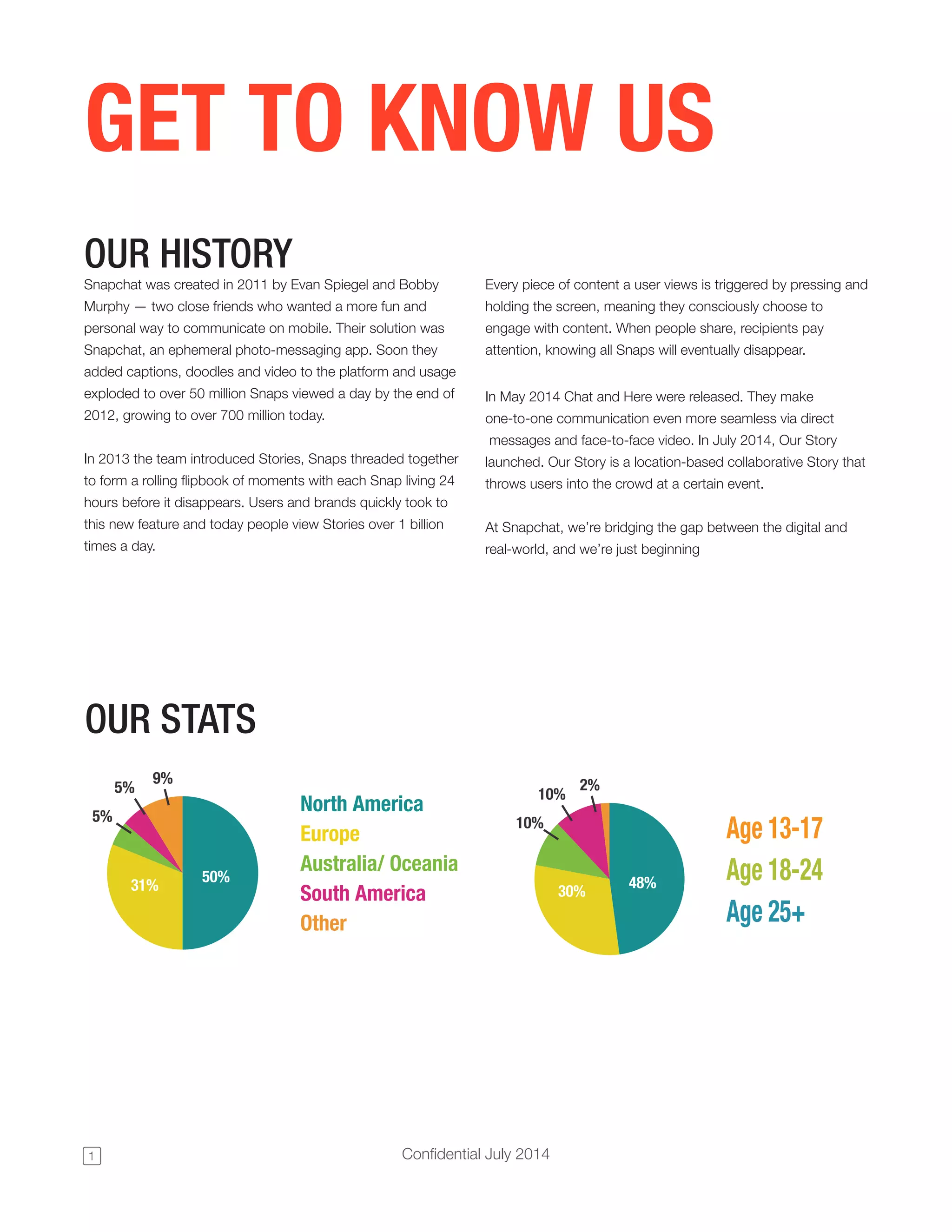
Slide 2 combines a concise origin story with simple regional and age pie charts that show rapid adoption and a youthful skew. The history paragraph narrates the founders’ intent and product evolution, while the pie charts visually validate scale and demographic fit without overwhelming the viewer. Pairing qualitative backstory with quantitative proof is effective: it humanizes the product and then anchors claims with data.

The lesson for founders is to balance storytelling and validation early in the deck. Explain why the product exists and then provide a few clear metrics or demographic facts that explain market opportunity and product-market fit. Keep charts simple and labeled clearly so they reinforce — not distract from — the narrative.

Key Takeaway: Lead with a crisp origin story plus two or three easily digestible metrics that validate adoption and audience fit.
Philosophy: a single differentiating product principle

Philosophy: a single differentiating product principle

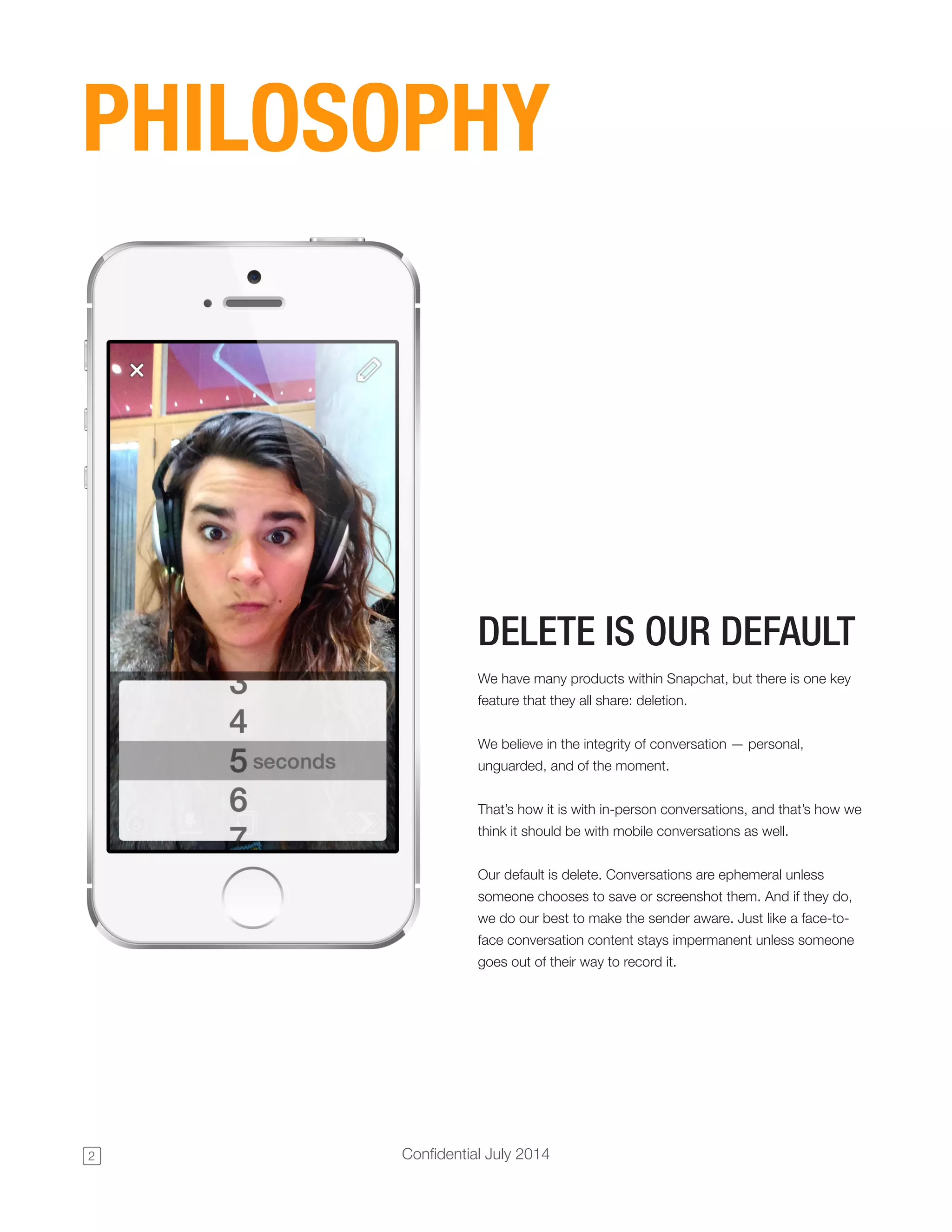
Slide 3 centers Snapchat’s core philosophy — “Delete is our default” — and uses a strong visual (phone with a snap UI) to make the concept tangible. This slide is effective because it articulates a single, defensible product principle that explains user behavior, privacy expectations, and the emotional value proposition: candid, in-the-moment sharing. By foregrounding a principle rather than a feature list, Snapchat frames product decisions and future features under a coherent rationale.

Founders should emulate this clarity: define one or two core product principles that explain why your product exists and how it changes user behavior. These principles become north stars for product design and compelling hooks for partners who want to understand the platform’s unique affordances.

Key Takeaway: Distill your product into one clear philosophical statement that explains user value and guides product choices.
Product Overview & UX: show, don't just tell

Product Overview & UX: show, don't just tell

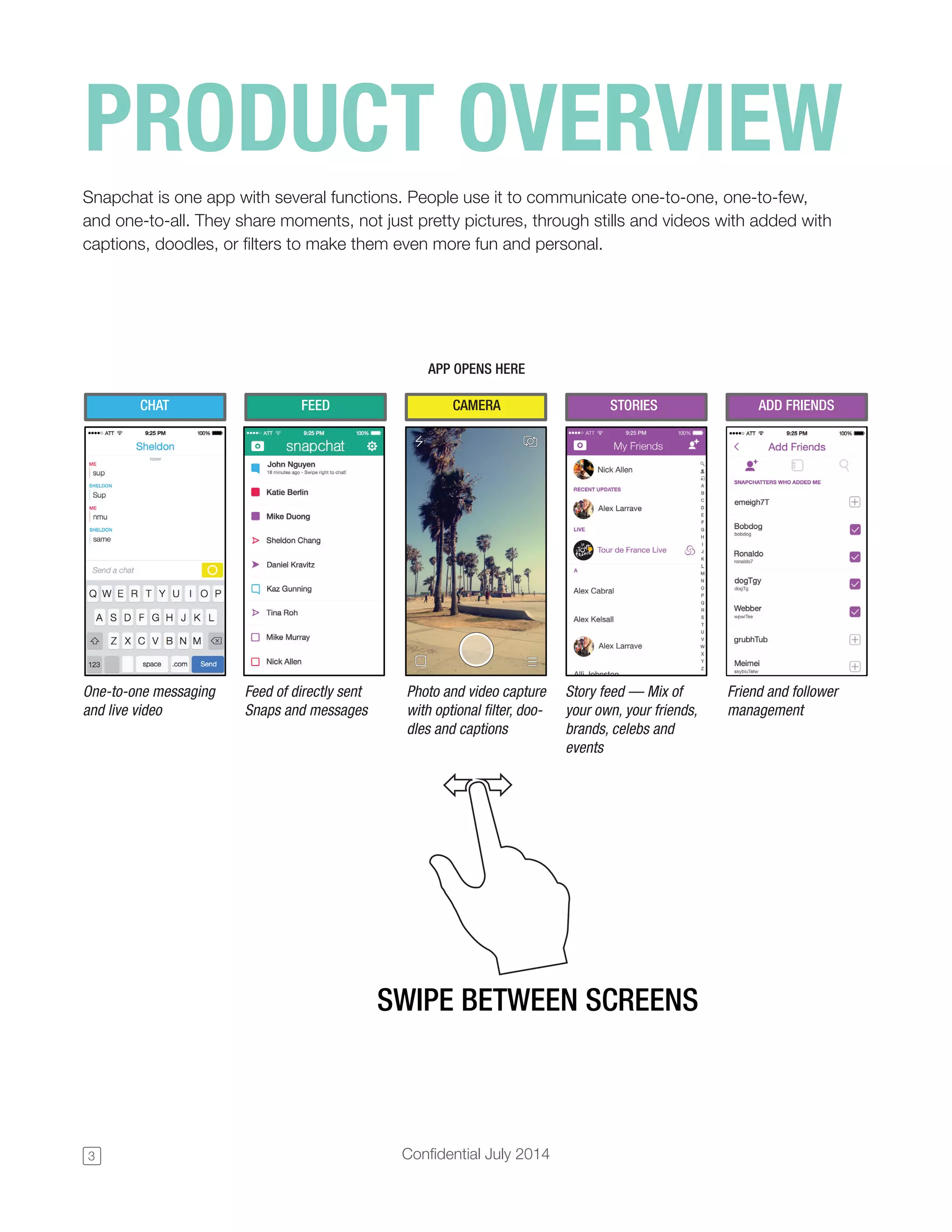
Slide 4 lays out the app’s primary screens (Chat, Feed, Camera, Stories, Add Friends) with short captions and a literal swipe illustration. This is an exemplary product slide: it maps the user journey and interface in a single glance and explains how users move between modes (swipe). The combination of real UI screenshots and a simple interaction diagram demystifies the experience for business partners who may not be familiar with mobile-first UX conventions.

For founders, prioritize visual walkthroughs of core flows — not exhaustive feature lists. Show where users land, how they move, and what the key interactions feel like. A concise UI map reduces cognitive friction and helps investors or partners quickly understand product mechanics and potential integrations.

Key Takeaway: Use annotated UI screenshots and simple flow diagrams to make your product immediately understandable to non-technical stakeholders.
Stories Product: demonstrating new formats with examples

Stories Product: demonstrating new formats with examples

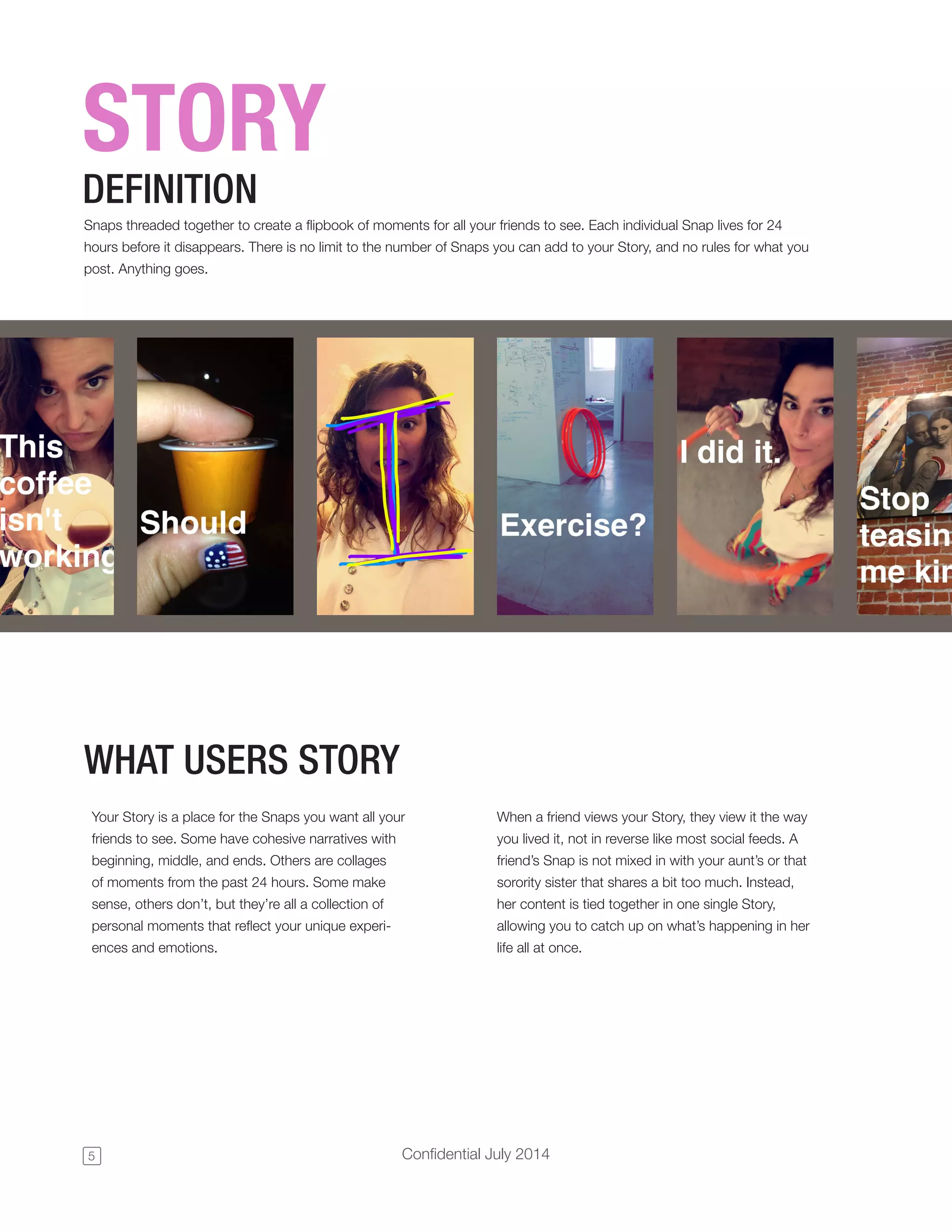
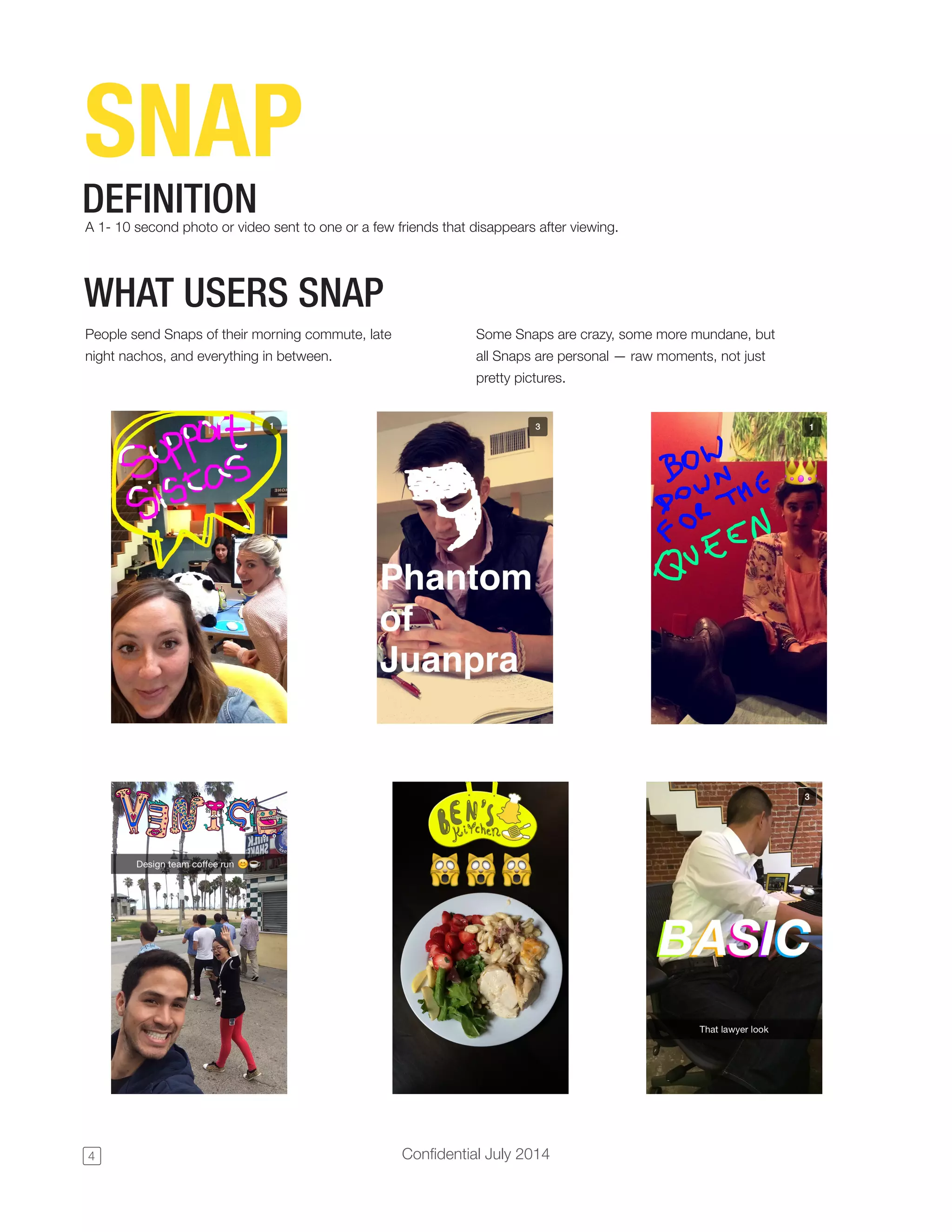
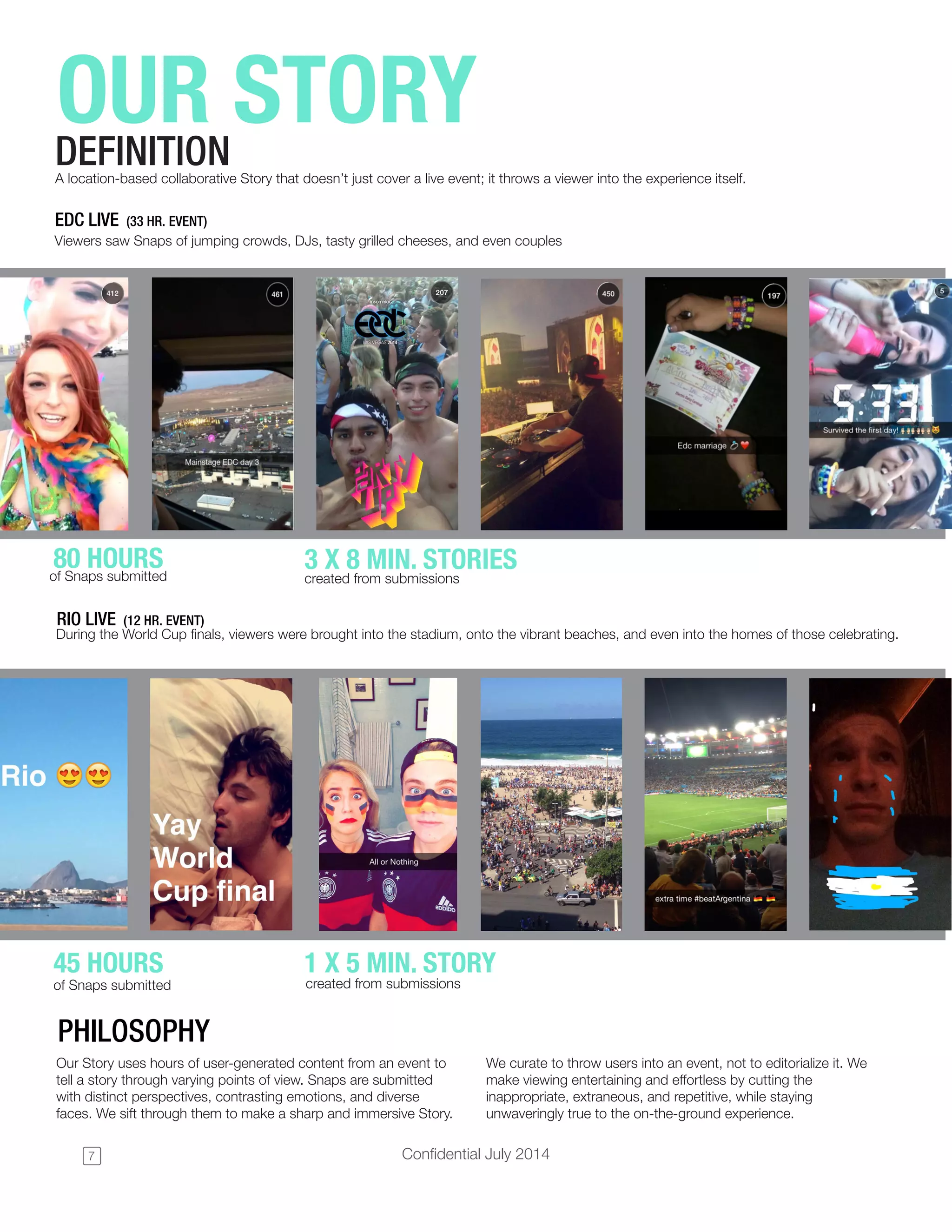
Slide 6 explains Stories (24-hour flipbook of moments) with a visual strip of content and a description of the format’s creative freedom. The slide demonstrates both form and function: users can create narrative arcs or collage-like streams, and the examples show how that content looks in practice. By including examples rather than abstract claims, Snapchat shows how the product manifests culturally and visually.

Founders launching new content formats should mirror this approach: accompany the feature definition with authentic examples showing how users or creators actually use it. This helps potential partners and advertisers imagine use cases and creative opportunities, accelerating buy-in.

Key Takeaway: When introducing a novel content format, pair the definition with real examples so partners can visualize use cases and creative possibilities.
How It Works: step-by-step mechanics for mass participation

How It Works: step-by-step mechanics for mass participation

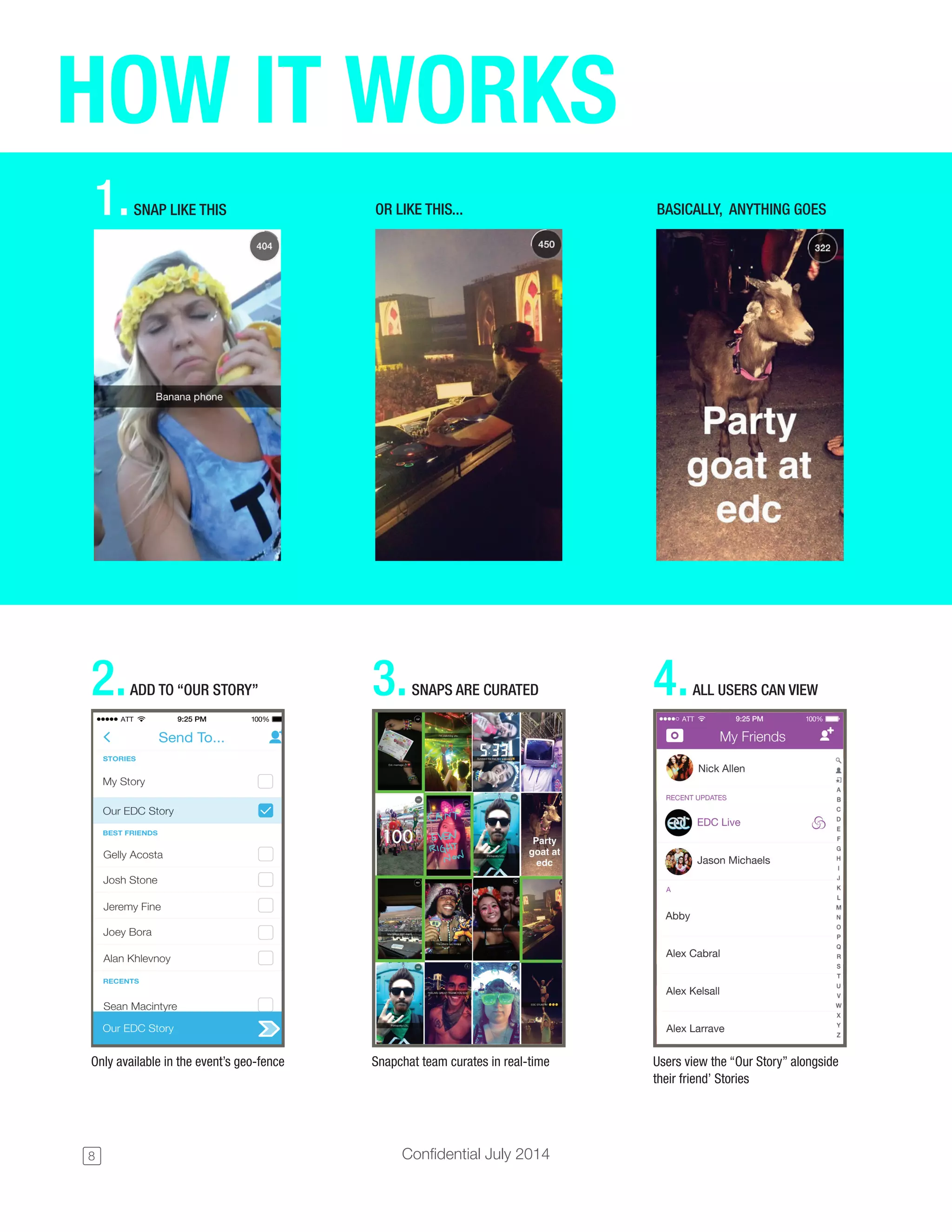
Slide 9 breaks down the mechanics of geo-fenced live Stories in four clear steps with strong imagery: snap, add to Our Story, curation, and distribution. The numbered flow and screenshots explain how user-generated content becomes a curated broadcast, making the operational model clear for brands and event partners. This operational transparency is crucial for commercial adoption because it answers practical questions about how content is gathered, moderated, and surfaced.

Founders should include a simple operations slide like this when pitching platform features that rely on user participation. Show the end-to-end process and indicate what’s manual vs. automated — partners need to know how content quality and brand safety will be handled.

Key Takeaway: Provide a clear end-to-end process diagram for features that rely on user participation, highlighting curation and distribution mechanics.
Monetization & Brand Playbook: tactical advice for partners

Monetization & Brand Playbook: tactical advice for partners

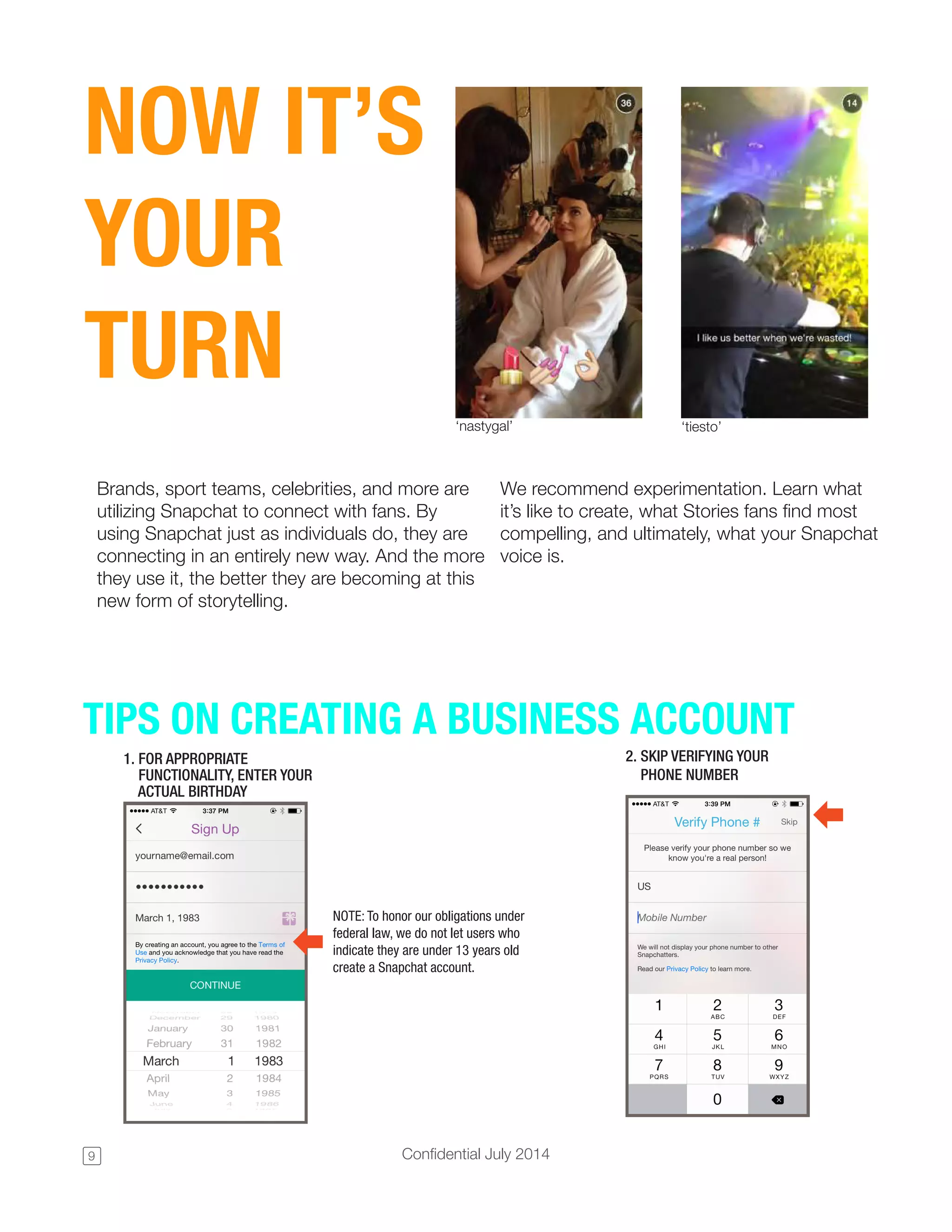
Slide 10 (Now It’s Your Turn) and slide 11 (Tips on Creating a Business Account) pivot from product to playbook: how brands, celebrities, and teams can use Snapchat, with practical tips (e.g., verifying phone number, entering birthday). These slides are playbooks rather than revenue models, showing Snapchat’s strategy to lower the activation barrier for brands and coax creative experimentation. The inclusion of concrete, actionable steps is smart — it reduces friction for first-time brand users and signals that the company expects and supports commercial usage.

For founders, including a tactical partner guide in the deck can accelerate adoption. Show not only why partners should use your product but also how to get started, common content ideas, and quick technical tips that remove early obstacles to use.

Key Takeaway: Include a short operational playbook for partners that covers setup, best practices, and creative ideas to lower activation friction.

Conclusion: Key Lessons

Snapchat’s 2014 business deck is effective because it combines a strong, recognizable brand identity with a concise product philosophy, simple UX walkthroughs, real user examples, and tactical partner playbooks. The deck balances narrative and evidence: it explains why ephemeral sharing matters, shows how the product works, proves early traction with clean metrics, and removes barriers for commercial partners through step-by-step guidance.

Actionable advice for founders: open with a bold brand statement, articulate one clear product philosophy, use annotated UI images to explain core flows, include real examples of user-generated content, and finish with a brief operational playbook for partners. These elements together make a deck not just persuasive but practically useful — accelerating both investor understanding and commercial adoption.

Full Deck Analysis

11 sections

Overview

Company: Snapchat
Round: Business Deck (N/A)
Year: July 2014
Outcome: IPO at $24B valuation (March 2017)
Confidentiality: Marked “Confidential July 2014”


Executive Summary

This is a product-focused pitch deck designed to introduce Snapchat’s business opportunities to brands and potential partners, not a traditional venture capital fundraising deck. The deck brilliantly articulates Snapchat’s core value proposition—ephemeral, authentic, real-time communication—and demonstrates early product-market fit through concrete brand adoption examples (HBO, GrubHub, Tiësto, McDonald’s). However, it notably fails to articulate an explicit business model, financial metrics, or revenue strategy, suggesting this was either a preliminary deck or one designed for brand partnerships rather than investor fundraising. The deck’s strength lies in its product storytelling and ecosystem demonstration; its weakness lies in the complete absence of financial fundamentals that would be critical for venture investors.


Problem Statement

Implicit Problem Articulation (Not Explicitly Stated):

The deck does not formally state a problem statement, but it implicitly addresses several issues:

  1. Digital Permanence Anxiety (Slide 3: Philosophy)
    • “We believe in the integrity of conversation — personal, unguarded, and of the moment.”
    • Problem: Existing social platforms (Facebook, Instagram, Twitter) create permanent digital records that discourage authentic sharing
    • Solution: Ephemeral messaging that mirrors real-world conversation norms
  2. Feed Clutter & Algorithm Fatigue (Slide 6: Story)
    • “A friend’s Snap is not mixed in with your aunt’s or that sorority sister that shares a bit too much.”
    • Problem: Algorithmic feeds on Facebook/Instagram create noise and reduce meaningful connection
    • Solution: Chronological, unfiltered Stories that let users catch up on friends’ lives “all at once”
  3. Inauthentic Brand Communication (Slide 10-11: Brand Positioning)
    • “By using Snapchat just as individuals do, they are connecting in an entirely new way.”
    • Problem: Brands struggle to connect authentically with audiences on traditional social platforms
    • Solution: Snapchat enables brands to use the same authentic, casual communication style as individuals

Key Insight: The deck positions Snapchat as solving a cultural/behavioral problem (desire for authentic, ephemeral communication) rather than a technical problem. This is a sophisticated positioning choice that appeals to both users and brands.


Solution

Core Solution: Ephemeral, Authentic Communication Platform

The deck presents Snapchat as a multi-function communication platform with five core modules:

Product Architecture (Slide 4: Product Overview)

Module Function Use Case
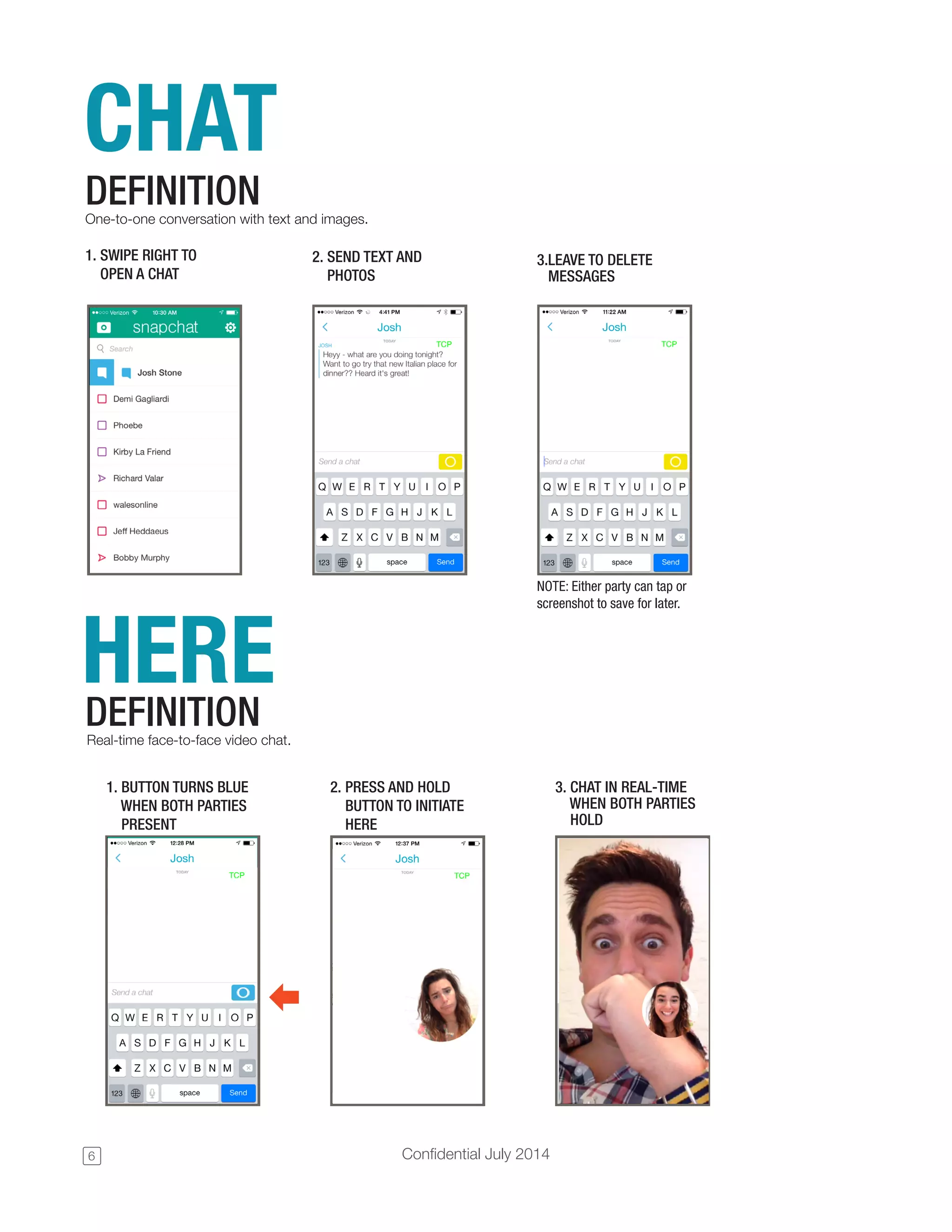
Chat One-to-one messaging with text/images Private, ephemeral conversations
Feed Feed of directly sent Snaps Inbox-like message management
Camera Photo/video capture with filters/doodles Content creation
Stories 24-hour chronological flipbook Sharing moments with friends
Add Friends Friend/follower management Social graph building

Key Innovation: Ephemeral-by-Default (Slide 3)

  • Core mechanic: All content disappears after viewing (or 24 hours for Stories)
  • Screenshot notification: Users are notified if content is saved/screenshotted
  • Philosophy: Mirrors real-world conversation norms where moments are fleeting and unguarded

Feature Evolution Timeline (Slide 2)

  • 2011: Founded; ephemeral photo-messaging app
  • 2012: Added captions, doodles, video; 50M+ Snaps/day → 700M+ Snaps/day
  • 2013: Introduced Stories (24-hour disappearing flipbook); 1B+ Story views/day
  • May 2014: Chat and Here (live video) released
  • July 2014: Our Story launched (location-based collaborative Stories)

Our Story: The Business Model Bridge (Slides 8-9)

  • Definition: Location-based collaborative Story that immerses viewers in events
  • Mechanics:
    • Geo-fencing restricts submissions to event location
    • Snapchat team curates submissions in real-time
    • Curated Story appears in main feed alongside friend Stories
  • Examples:
    • EDC Live: 80 hours of Snaps submitted → 3 x 8-minute Stories created
    • Rio Live (World Cup): 45 hours of Snaps submitted → 1 x 5-minute Story created

Market Opportunity

TAM/SAM/SOM Analysis:

The deck does not explicitly state market size, TAM, SAM, or SOM. However, we can infer from the data provided:

User Base (Slide 2: Our Stats)

Geographic Distribution:

  • North America: 50%
  • Europe: 31%
  • Australia/Oceania: 9%
  • South America: 5%
  • Other: 5%

Age Demographics:

  • Age 18-24: 48% (core demographic)
  • Age 25+: 30%
  • Age 13-17: 10%
  • Age [unspecified]: 2%

Engagement Metrics:

  • 700M+ Snaps viewed per day (end of 2012 → 2014)
  • 1B+ Story views per day (as of 2014)

Critical Gap: The deck does not state total user count, which is a significant omission for a business pitch. This suggests either:

  1. User numbers were modest (not impressive enough to highlight)
  2. Snapchat was deliberately vague to avoid comparisons to Instagram/Facebook
  3. The deck was designed for brand partnerships, not investor fundraising

Implied Market Opportunity

Based on the brand adoption shown (Slide 11-13), the addressable market includes:

  • Sports teams (MLB, NBA, Saints, etc.)
  • Music artists (Tiësto, Becky G, etc.)
  • Fashion brands (VS Pink, Nastygal, Karmaloop, etc.)
  • Entertainment companies (HBO, NBC, MTV, etc.)
  • QSR/Food brands (Taco Bell, McDonald’s, GrubHub, Coca-Cola, etc.)
  • Influencers (Logan Paul, Shonduras, Ryan Seacrest, etc.)
  • News organizations (NowThis News, Mashable)

44 brand accounts across 7 categories (Slide 14) demonstrate ecosystem depth, but no metrics on brand spending or revenue generated.


Business Model

Status: IMPLICIT AND UNEXPLAINED

This is the deck’s most significant weakness. The business model is never explicitly stated, but several revenue opportunities are implied:

Implied Revenue Streams

1. Sponsored Our Stories (Slides 8-9)

  • Brands/events can sponsor location-based Stories
  • Example: EDC Live, Rio Live (World Cup)
  • Likely pricing: CPM or flat fee per event
  • Status: Not explicitly monetized in deck

2. Promo Codes & Direct Response (Slide 11, 13)

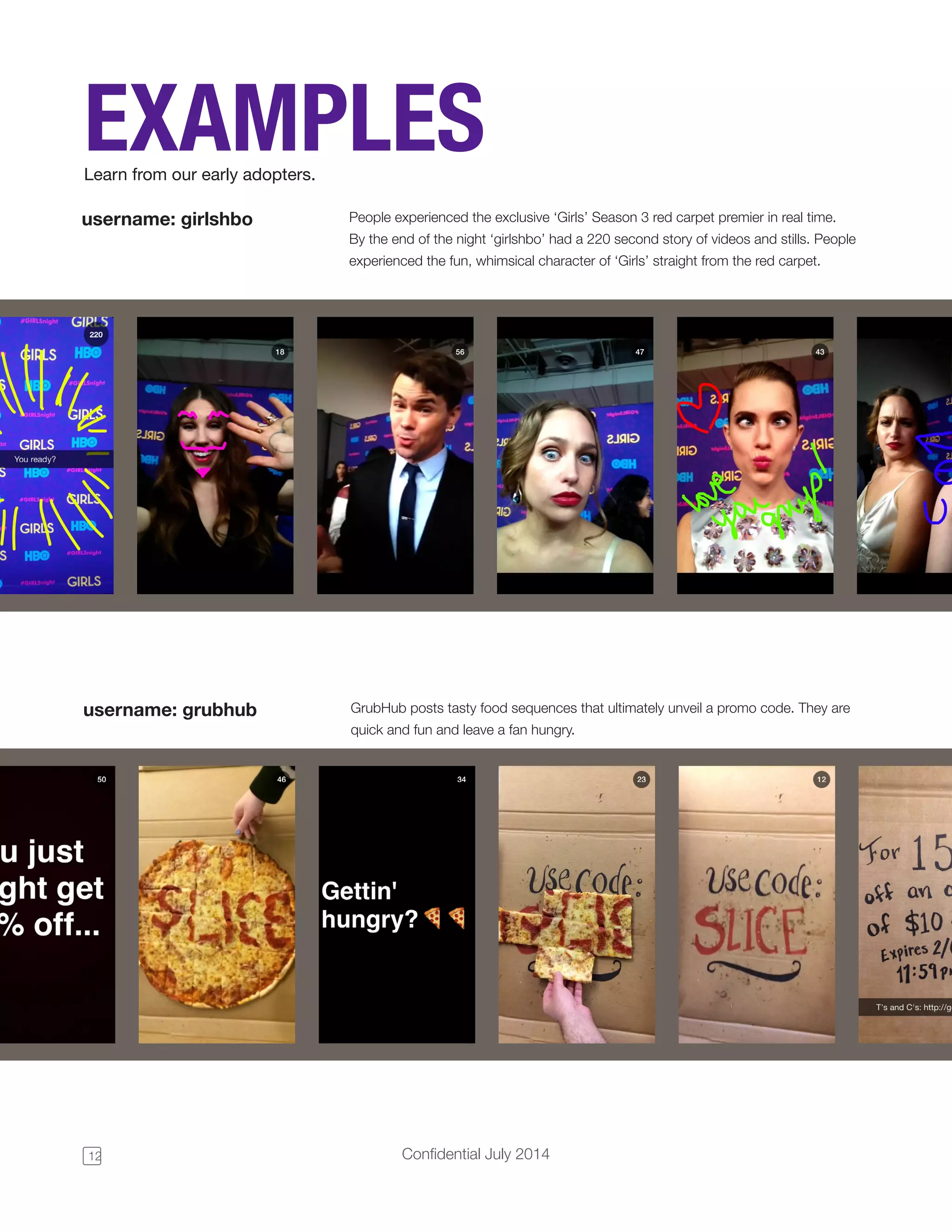
  • Brands embed promo codes in Stories (e.g., GrubHub “USE CODE: SLICE”)
  • Potential revenue: Affiliate commission or revenue share
  • Status: Shown as working but no revenue model explained

3. Brand Accounts & Organic Reach (Slides 10-14)

  • Brands create free accounts and build followers organically
  • Potential monetization: Premium features, analytics, or paid reach
  • Status: Shown as free in deck; no paid features mentioned

4. Advertising (Not Mentioned)

  • No mention of display ads, sponsored content, or ad network
  • Suggests advertising was not yet part of the business model in July 2014
  • Note: Snapchat later introduced Discover (2015) and Sponsored Filters/Lenses (2015+)

Unit Economics: NOT PROVIDED

The deck provides zero information on:

  • Revenue per brand
  • Customer acquisition cost (CAC)
  • Lifetime value (LTV)
  • Pricing tiers or models
  • Revenue growth rate
  • Profitability or path to profitability

Monetization Philosophy

The deck emphasizes experimentation and authenticity over explicit monetization:

  • “We recommend experimentation. Learn what it’s like to create, what Stories fans find most compelling, and ultimately, what your Snapchat voice is.” (Slide 10)
  • This suggests Snapchat was still figuring out how to monetize without compromising the user experience

Traction & Metrics

User Engagement Metrics (Slide 2)

Metric Value Context
Snaps viewed per day 700M+ As of 2014 (up from 50M in 2012)
Story views per day 1B+ As of 2014
Growth rate 14x in 2 years 50M → 700M Snaps/day

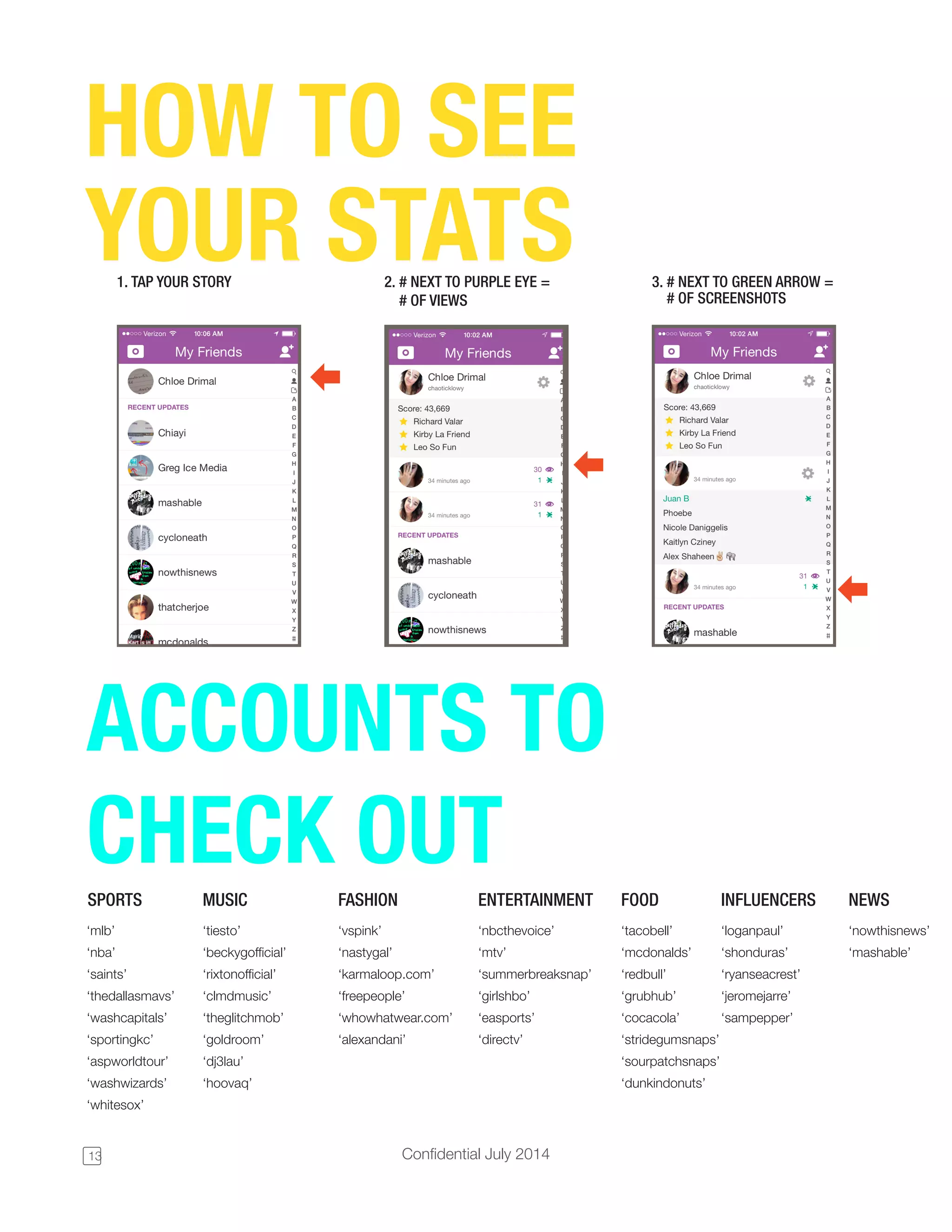
Brand Adoption (Slide 14)

44 brand accounts across 7 categories:

  • Sports: 9 accounts (MLB, NBA, Saints, etc.)
  • Music: 8 accounts (Tiësto, Becky G, etc.)
  • Fashion: 6 accounts (VS Pink, Nastygal, etc.)
  • Entertainment: 6 accounts (HBO, MTV, etc.)
  • Food: 8 accounts (Taco Bell, McDonald’s, etc.)
  • Influencers: 5 accounts (Logan Paul, Shonduras, etc.)
  • News: 2 accounts (NowThis News, Mashable)

Our Story Engagement (Slides 8-9)

Event Duration Snaps Submitted Stories Created Duration
EDC Live 33 hours 80 hours 3 x 8 min 24 min total
Rio Live (World Cup) 12 hours 45 hours 1 x 5 min 5 min total

Interpretation: Users are creating massive amounts of content (80+ hours of submissions for a single event), and Snapchat’s curation team is distilling it into consumable Stories.

Brand Engagement Example (Slide 13)

HBO ‘Girls’ Season 3 Premiere (girlsbo account):

  • Story length: 220 seconds (3 min 40 sec)
  • Outcome: “People experienced the fun, whimsical character of ‘Girls’ straight from the red carpet”
  • Missing: View count, engagement rate, follower growth

Analytics Available to Brands (Slide 14)

Metrics shown:

  • Views (purple eye icon)
  • Screenshots (green arrow icon)
  • Individual viewer names and engagement

Example: Chloe Dirmal Story - Score: 43,669 (metric undefined)

Critical Gaps in Metrics

The deck does not provide:

  • Total user count (DAU, MAU)
  • User retention rate
  • Churn rate
  • User acquisition cost
  • Lifetime value
  • Revenue (total or per user)
  • Revenue growth rate
  • Profitability metrics
  • Conversion rates for brand campaigns
  • ROI for brand partnerships

Competitive Positioning

Explicit Competitive Comparison: NONE

The deck does not mention competitors (Facebook, Instagram, Twitter, WhatsApp, etc.) by name. However, implicit competitive positioning is clear:

Differentiation vs. Facebook/Instagram (Implied)

Dimension Snapchat Facebook/Instagram
Content Permanence Ephemeral (24 hrs) Permanent
Feed Algorithm Chronological Algorithmic/curated
Content Authenticity Raw, unfiltered moments Curated, polished
Brand Communication Casual, authentic Corporate, formal
Real-time Events Our Story (live coverage) Delayed/edited coverage
User Demographics 48% age 18-24 Older demographic

Key Positioning Statements (Implicit)

Slide 3 (Philosophy):

  • “Delete is our default”
  • “Integrity of conversation — personal, unguarded, and of the moment”
  • Contrasts with Facebook’s permanent record model

Slide 5 (Snap Definition):

  • “Raw moments, not just pretty pictures”
  • Direct jab at Instagram’s curated aesthetic

Slide 6 (Story):

  • “Chronological viewing (not reversed like most social feeds)”
  • Contrasts with Facebook’s algorithmic feed

Slide 10 (Brand Positioning):

  • “By using Snapchat just as individuals do, they are connecting in an entirely new way”
  • Suggests Instagram/Facebook brand communication feels inauthentic

Competitive Advantages

  1. Ephemeral-by-default - Creates psychological safety for authentic sharing
  2. Real-time event coverage - Our Story captures live moments as they happen
  3. Chronological feed - No algorithm fatigue; users see what they want
  4. Gesture-based navigation - Swipe right for Chat, swipe left for Stories (vs. tab-based competitors)
  5. Screenshot notification - Users know when content is saved (privacy feature)
  6. Young demographic - 48% age 18-24 (vs. Facebook’s older user base)

Competitive Vulnerabilities (Implied)

  1. No explicit monetization - Unclear how Snapchat will compete on revenue
  2. Limited brand tools - No mention of analytics, targeting, or ad formats
  3. Smaller user base - Deck doesn’t state total users (likely smaller than Facebook/Instagram)
  4. Ephemeral content - Harder to build lasting brand presence vs. permanent posts
  5. Younger demographic - Limits advertiser appeal vs. Facebook’s broader reach

Team

Team Information: COMPLETELY ABSENT

The deck provides zero information about:

  • Founders (names mentioned only in Slide 2 history: Evan Spiegel, Bobby Murphy)
  • Executive team
  • Board of directors
  • Key hires or organizational structure
  • Team credentials or experience
  • Advisors

Only Reference:

  • Slide 2: “Snapchat was created in 2011 by Evan Spiegel and Bobby Murphy — two close friends who wanted a more fun and personal way to communicate on mobile.”

Implication: This deck was designed for brand partnerships, not venture capital fundraising. A traditional VC pitch deck would prominently feature team credentials to build investor confidence.


Go-to-Market Strategy

User Acquisition (Slide 12: Get the Word Out)

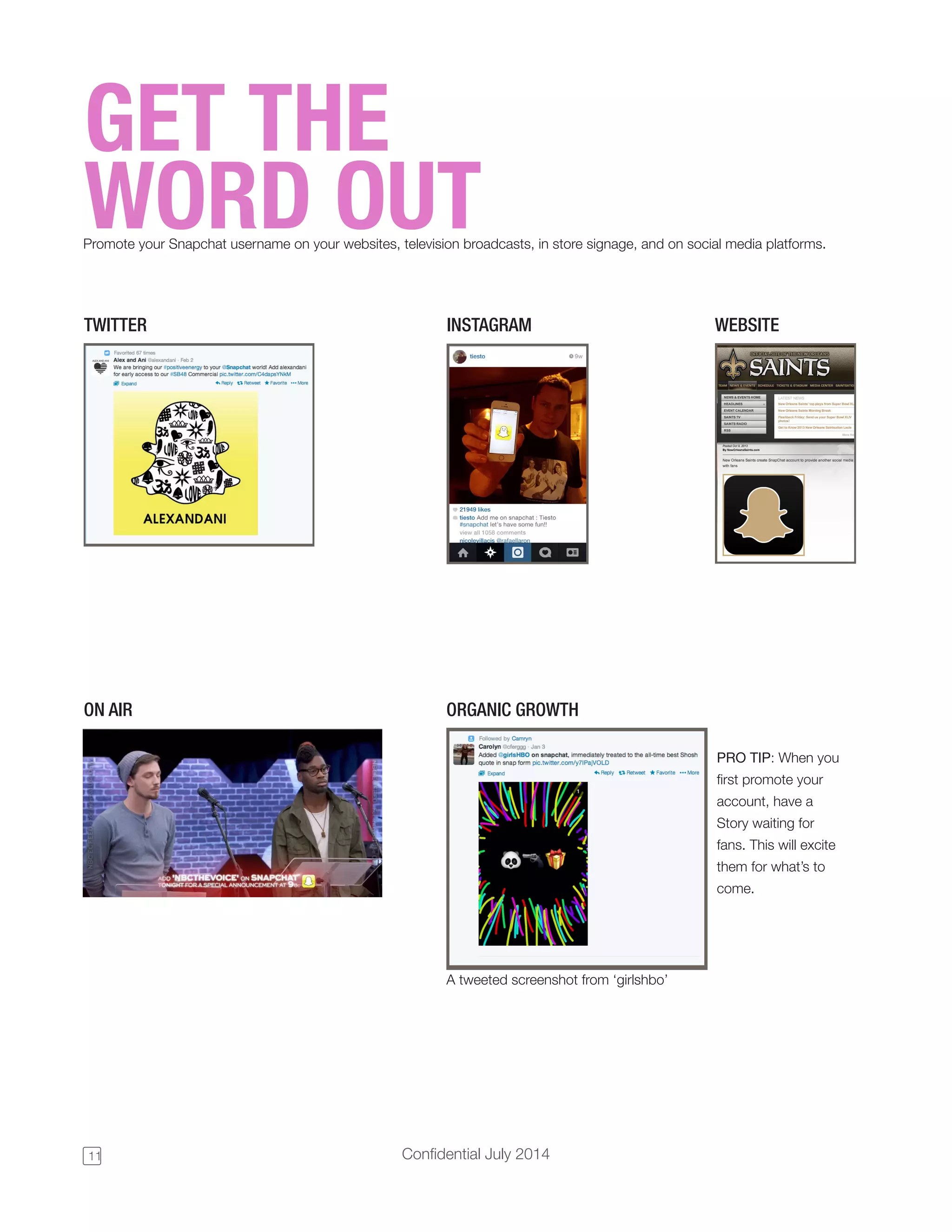
Multi-channel promotion strategy:

  1. Twitter - Brands promote Snapchat username in tweets
    • Example: Alexandani tweet with Snapchat ghost logo and username
  2. Instagram - Brands promote Snapchat username in Instagram posts
    • Example: Saints Instagram post showing phone with Snapchat open
  3. Website - Brands display Snapchat username on official websites
    • Example: Saints website with Snapchat ghost icon
  4. Television - Brands promote Snapchat username on TV broadcasts
    • Example: Lower third graphic with “#SNAPCHAT” during live show
  5. Organic Growth - Users voluntarily share Snapchat content on social media
    • Example: “Addicted to Denim” tweet with Snapchat Story screenshot

Brand Onboarding (Slide 10: Now It’s Your Turn)

Account creation process:

  1. Enter email and password
  2. Enter actual birthday (13+ age requirement for legal compliance)
  3. Optional: Skip phone verification

Brand guidance provided:

  • “We recommend experimentation”
  • “Learn what it’s like to create, what Stories fans find most compelling”
  • “Find your Snapchat voice”

Content Strategy Framework (Slide 11: What Do I Snap?)

Six content strategies for brands:

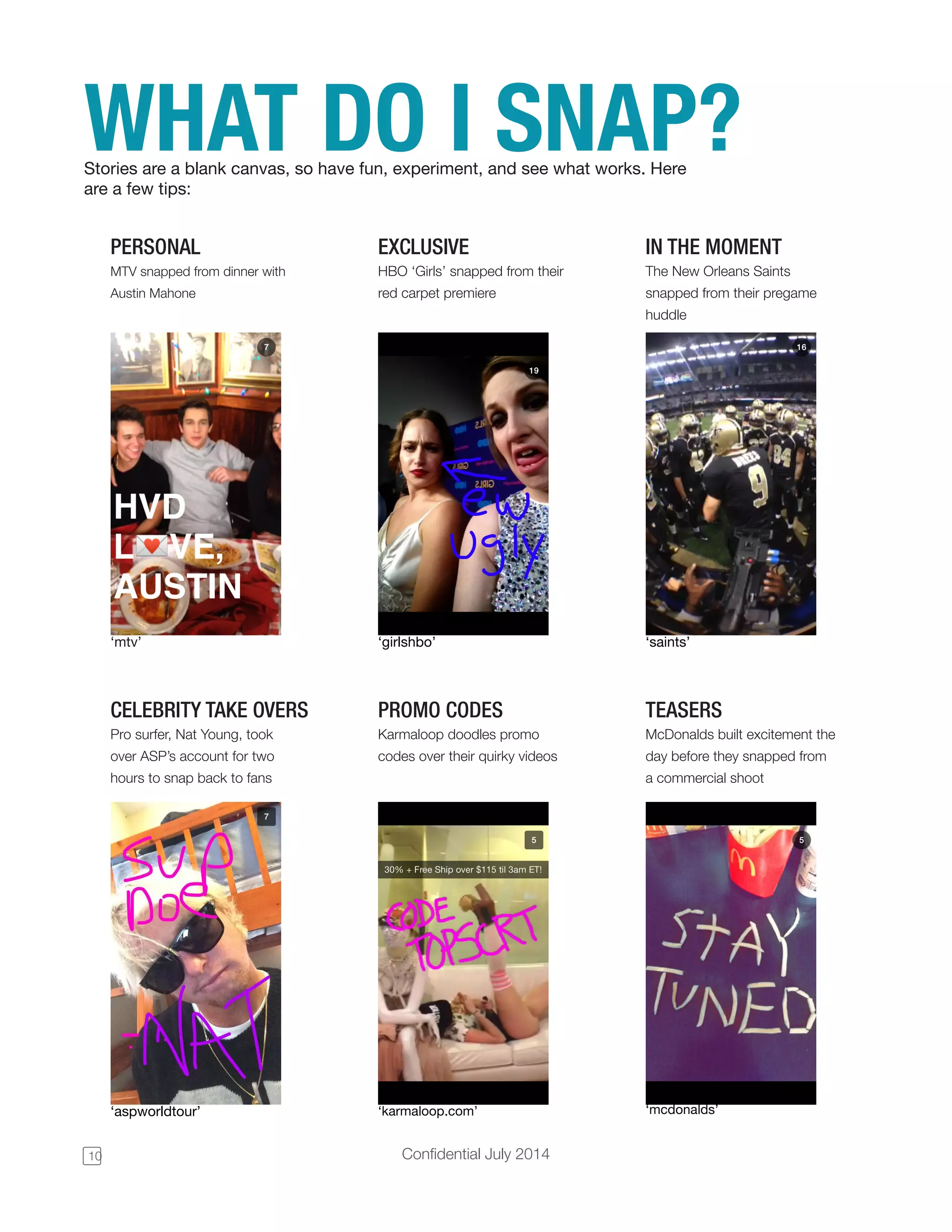
  1. Personal - Behind-the-scenes moments (MTV + Austin Mahone)
  2. Exclusive - VIP/exclusive access (HBO Girls premiere)
  3. In the Moment - Real-time event coverage (Saints pregame huddle)
  4. Celebrity Takeovers - Guest takeovers by personalities (Nat Young on ASP)
  5. Promo Codes - Direct promotional offers (Karmaloop discount codes)
  6. Teasers - Pre-launch hype (McDonald’s commercial teaser)

Distribution Mechanics

How brands reach audiences:

  • Organic followers (users add brand account)
  • Our Story (location-based, curated Stories)
  • Sponsored Our Stories (implied but not explicit)
  • Direct messaging (Chat feature)

Key insight: Snapchat relies heavily on organic distribution and cross-platform promotion rather than paid advertising or algorithmic feed placement.


The Ask

Funding Request: NOT STATED

The deck does not specify:

  • Amount being raised
  • Use of funds
  • Valuation
  • Funding round (Series A, B, C, etc.)

Context from external sources:

  • July 2014: Snapchat had raised ~$60M in Series A (2012) and Series B (2013)
  • Snapchat was likely raising Series C in mid-2014 (raised $200M at $2B valuation in May 2014)
  • This deck may have been created for that Series C round or for brand partnerships

Implication: This deck was designed for brand partnerships and ecosystem building, not as a primary fundraising document. The lack of financial ask suggests it was either:

  1. A supplementary deck to a more detailed financial pitch
  2. A deck designed to attract brands, not investors
  3. A deck created after fundraising was already complete

Investor Deep Dive

Executive summary, strengths & red flags

Executive Summary

This is a **product-focused pitch deck** designed to introduce Snapchat's business opportunities to brands and potential partners, not a traditional venture capital fundraising deck. The deck brilliantly articulates Snapchat's core value proposition—ephemeral, authentic, real-time communication—and demonstrates early product-market fit through concrete brand adoption examples (HBO, GrubHub, Tiësto, McDonald's). However, it notably **fails to articulate an explicit business model, financial metrics, or revenue strategy**, suggesting this was either a preliminary deck or one designed for brand partnerships rather than investor fundraising. The deck's strength lies in its product storytelling and ecosystem demonstration; its weakness lies in the complete absence of financial fundamentals that would be critical for venture investors.

Key Strengths

6 identified

1

Exceptional Product Storytelling

- The deck brilliantly explains Snapchat's core value proposition through narrative, not bullet points

2

Concrete Proof of Product-Market Fit

- The deck demonstrates that real users and brands are actively using Snapchat

3

Authentic Brand Examples

- The deck shows brands using Snapchat authentically, not as a marketing gimmick

4

Visual Design & Brand Consistency

- The deck uses Snapchat's signature yellow color, ghost logo, and casual aesthetic throughout

5

Real UI Screenshots

- The deck shows actual product interfaces, not wireframes or mockups

6

Clear Competitive Differentiation

- The deck implicitly positions Snapchat as fundamentally different from Facebook/Instagram

Red Flags & Weaknesses

10 identified

1

No Explicit Business Model

- Investors need to understand how the company will make money

2

Missing Financial Metrics

- Investors need to see revenue, growth rate, and unit economics

3

No Total User Count

- User base is the primary metric for social networks

4

Incomplete Analytics

- Brands need robust analytics to justify spending

5

No Competitive Analysis

- Investors need to understand the competitive landscape

6

No Team Credentials

- Investors invest in teams, not just products

7

Vague Our Story Curation Process

- Our Story is the key to monetization, but the process is unclear

8

Promo Code Strategy is Risky

- GrubHub's promo code approach (Slide 13) is clever but has limitations

9

No Market Sizing

- Investors need to understand the total addressable market (TAM)

10

Implicit Assumption: Brands Will Adopt Organically

- The deck assumes brands will create accounts and use Snapchat without paid incentives

More Pitch Decks To Study

Compare structure, fundraising context, and investor-facing story across similar startup decks.