Compare your deck to Bumble

Compare Your Deck

Bumble Pitch Deck (2014)

Social
Stage: Growth
Raised: Multiple
Year: 2014
Slides: 12
Outcome: IPO at $7.7B valuation

Pitch Deck

1 / 12
Bumble pitch deck - Cover / Brand Positioning
Click to expand

Deck Analysis

This deck for Bumble (2014, Growth stage) presents a marketing-driven growth plan rather than product specs or financials. It positions Bumble as a distinctive dating app — female-first and values-driven — and then pivots quickly to a concrete user acquisition strategy centered on content and Snapchat activations. Notable here is the focus on storytelling and distribution (content site + ephemeral social activation) to build brand and retention, which foreshadowed the app's later scale and cultural resonance leading to an eventual IPO.

Cover / Brand Positioning

Cover / Brand Positioning

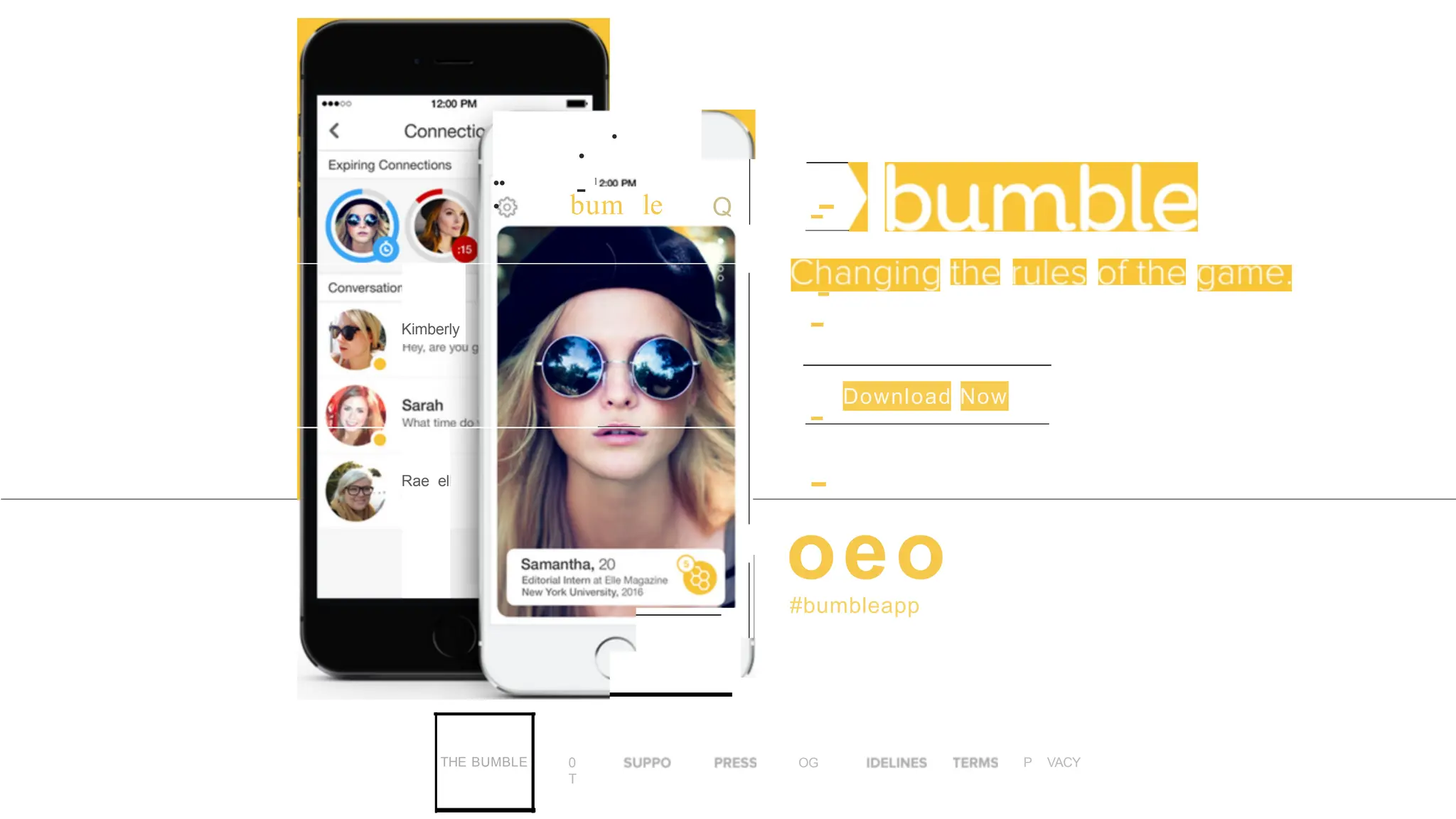
The opening slide (clean Bumble wordmark with phones showing the app) functions as a lightweight brand moment: it immediately establishes the product category (dating app), the visual identity (yellow, modern), and shows real UI and user photos. That combination of logo + UI gives investors instant clarity on what the company does and what the product looks like without needing text-heavy explanation.

This is effective because it trades exposition for visual clarity. Founders can learn that a strong, uncluttered cover that communicates category, brand, and product imagery builds immediate credibility and sets the tone for a marketing-focused pitch. It primes reviewers to focus on positioning and growth rather than technical complexity.

Key Takeaway: Use a single clear visual that shows brand + product immediately — let the audience know category and aesthetics in one glance.
Value Proposition: What is Bumble?

Value Proposition: What is Bumble?

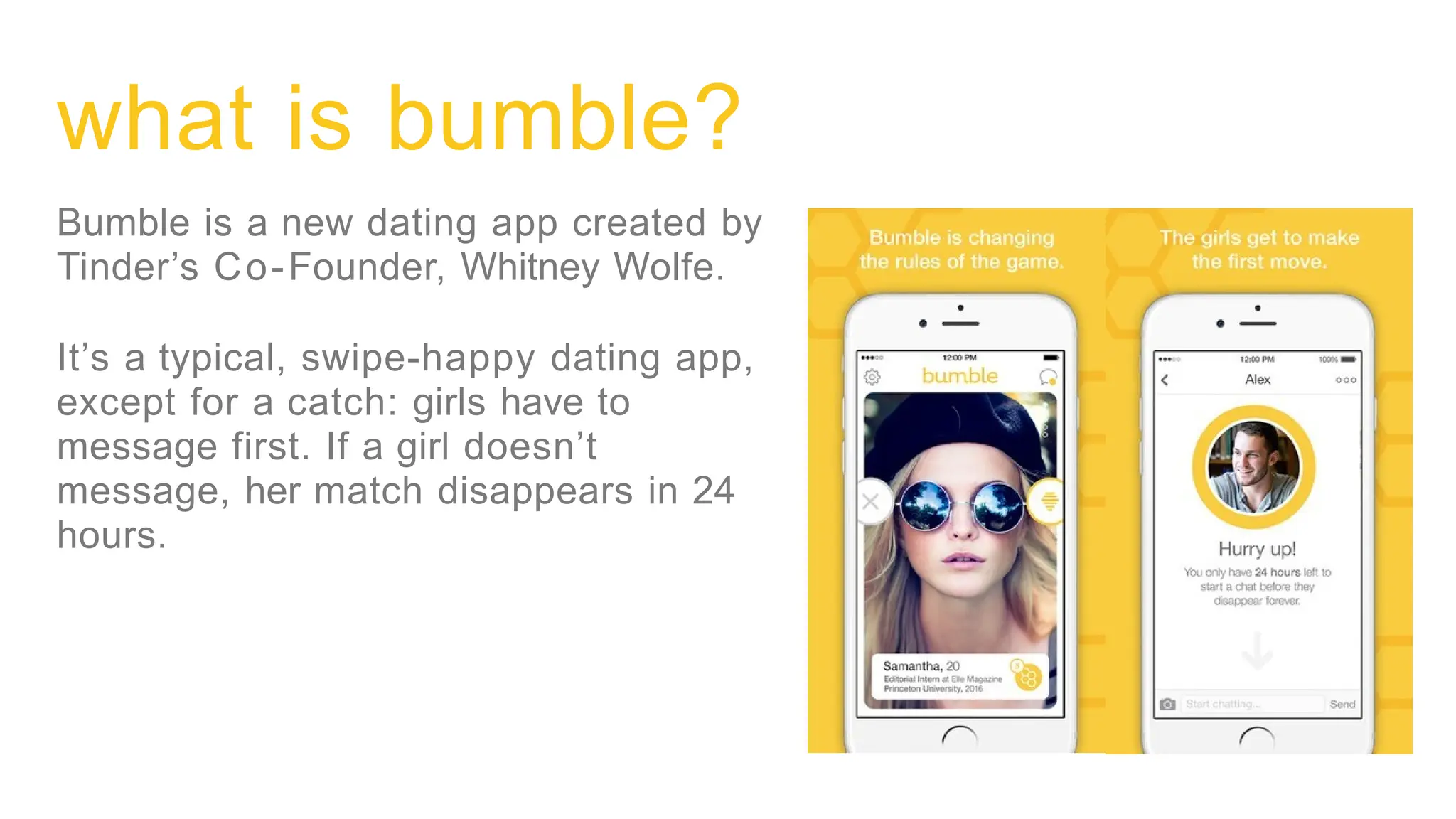
Slide 2 succinctly explains the product and its unique rule: women must message first and matches expire after 24 hours. It frames the product in plain language and highlights the behavioral mechanic that differentiates Bumble from competitors. The slide balances founder provenance (Whitney Wolfe, Tinder co-founder) with a crisp product differentiator, which helps justify both credibility and product-market fit.

This is a textbook example of leading with a one-line thesis plus a single supporting detail that illustrates defensibility. Founders should emulate this structure: name the category, state the one-line differentiator, then add a short operational detail that shows how the differentiator works in practice.

Key Takeaway: State the category, the single unique rule or mechanic that sets you apart, and a short how-it-works detail — in one slide.
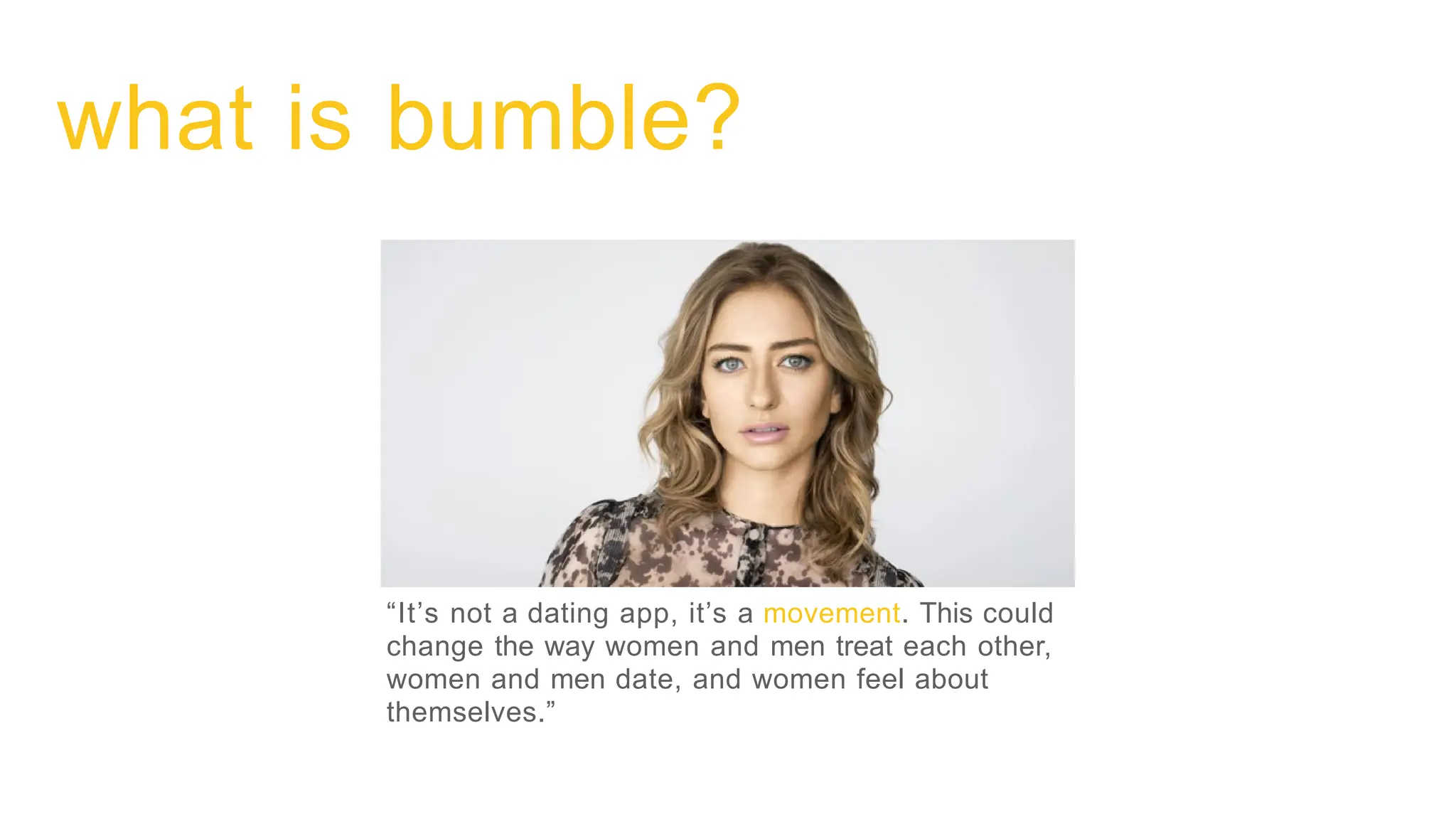
Mission Framing: 'Not a dating app, it's a movement'

Mission Framing: 'Not a dating app, it's a movement'

Slide 3 elevates the product to a movement, with a quote about changing how women feel and how people treat each other. This is an emotional framing play: it turns a utility product into a cultural project. For investors, that signals potential for brand loyalty, PR virality, and higher lifetime value from emotional engagement rather than mere transactional matching.

The lesson for founders is strategic: if your product can credibly claim social impact or empowerment, use that positioning to justify differentiated marketing channels, partnerships, and higher engagement expectations. But be prepared to back the claim with concrete programs and metrics — which the rest of the deck seeks to do via content and Snapchat activations.

Key Takeaway: If you can credibly claim cultural or mission-driven impact, make it a central positioning lever — but pair it with tactical plans to prove it.
Problem / Go-to-Market Gap: Low awareness

Problem / Go-to-Market Gap: Low awareness

Slide 5 states the core challenge plainly: the app is new and needs awareness beyond word-of-mouth. The slide introduces agency partners (Group SJR and Truffle Pig), which signals that the founders understand they need marketing infrastructure and outside creative expertise. The messaging is pragmatic: awareness first, then retention and growth.

This is effective because it acknowledges the real constraint (distribution) instead of hiding behind product features. Founders should be explicit about their biggest bottleneck — fundraising and partnerships are easier to justify when the problem is clearly articulated and paired with a proposed channel or partner.

Key Takeaway: Name your single biggest growth constraint and show you’ve engaged partners or a plan to tackle it — clarity about bottlenecks builds investor confidence.
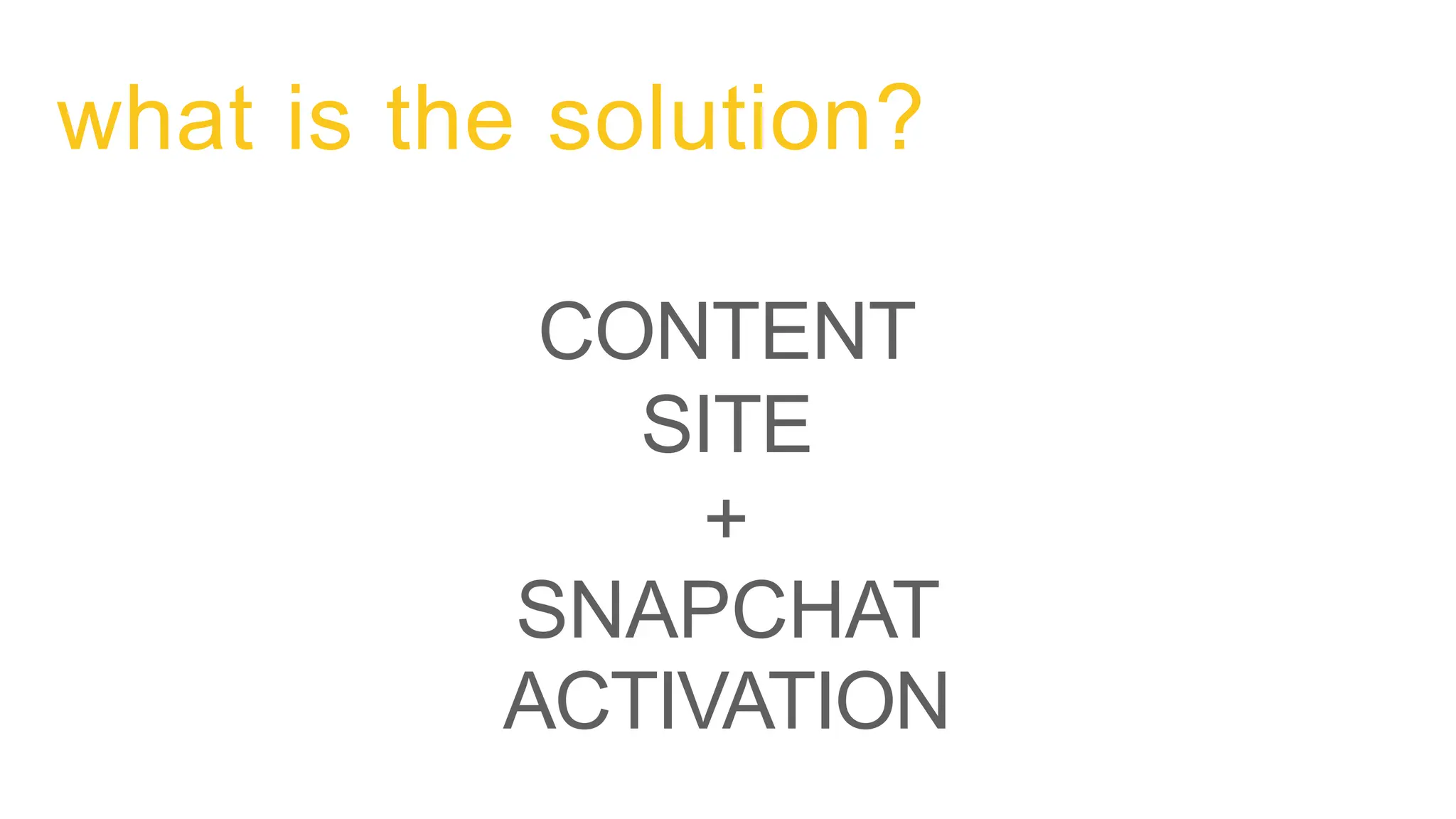
Solution Overview: Content + Snapchat Activation

Solution Overview: Content + Snapchat Activation

Slide 6 offers a clear, two-part growth solution: build a content site and run Snapchat activations. That combination ties owned media (content site to retain users and build SEO/brand authority) to paid/earned social distribution (Snapchat stories to reach young, mobile-first audiences). The simplicity of "CONTENT SITE + SNAPCHAT ACTIVATION" makes the strategy memorable and easy to evaluate.

Founders can learn the power of pairing an owned asset with a high-reach distribution channel. The owned asset drives retention and depth; the distribution channel drives acquisition and scale. The deck’s strength is its specificity — it doesn’t promise vague virality, it prescribes concrete channels.

Key Takeaway: Pair owned media (content hub) with a targeted social activation that reaches your audience — own the conversation and then amplify it.
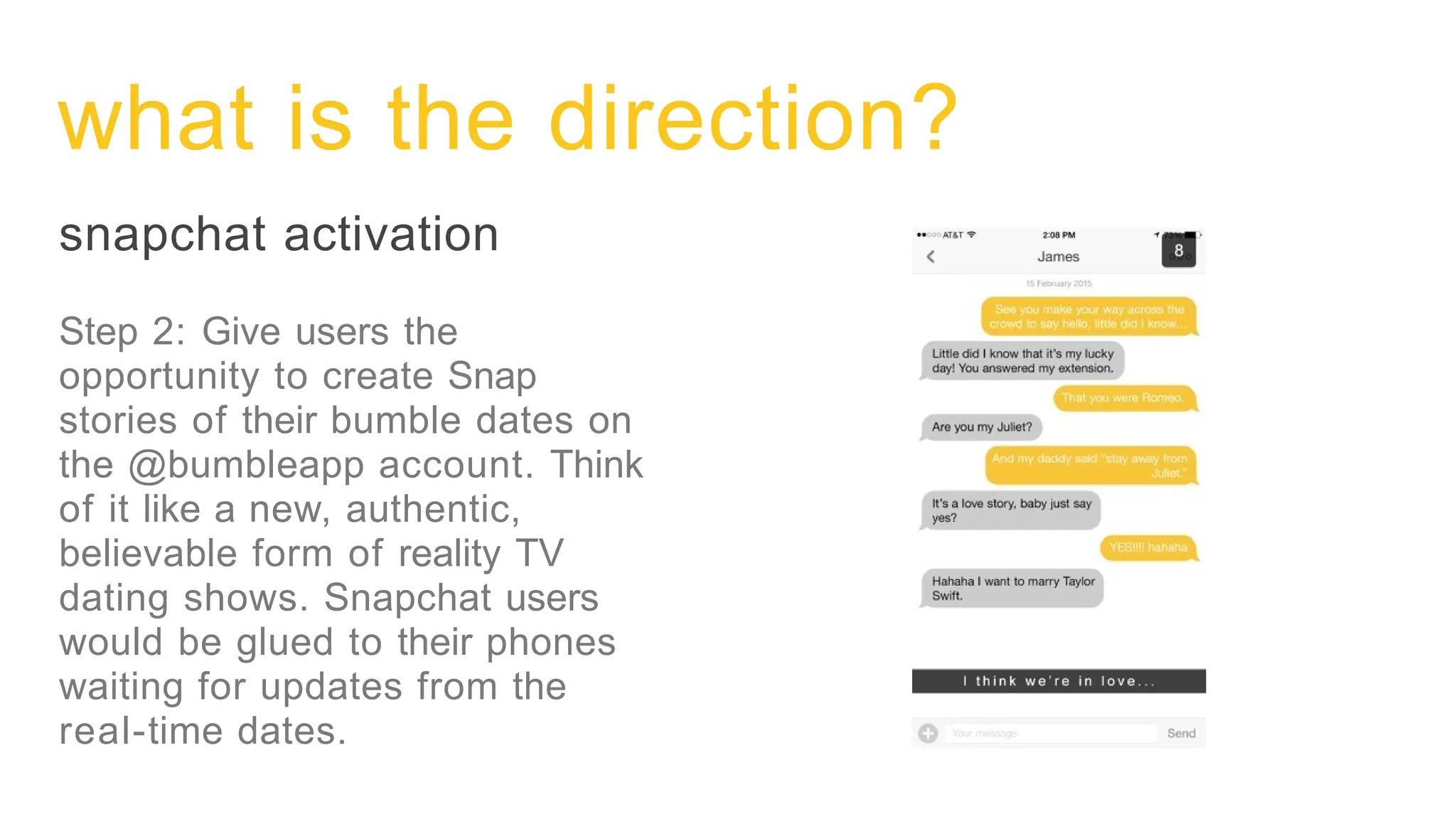
Channel Tactics: Snapchat Featured Story & User-Generated Content

Channel Tactics: Snapchat Featured Story & User-Generated Content

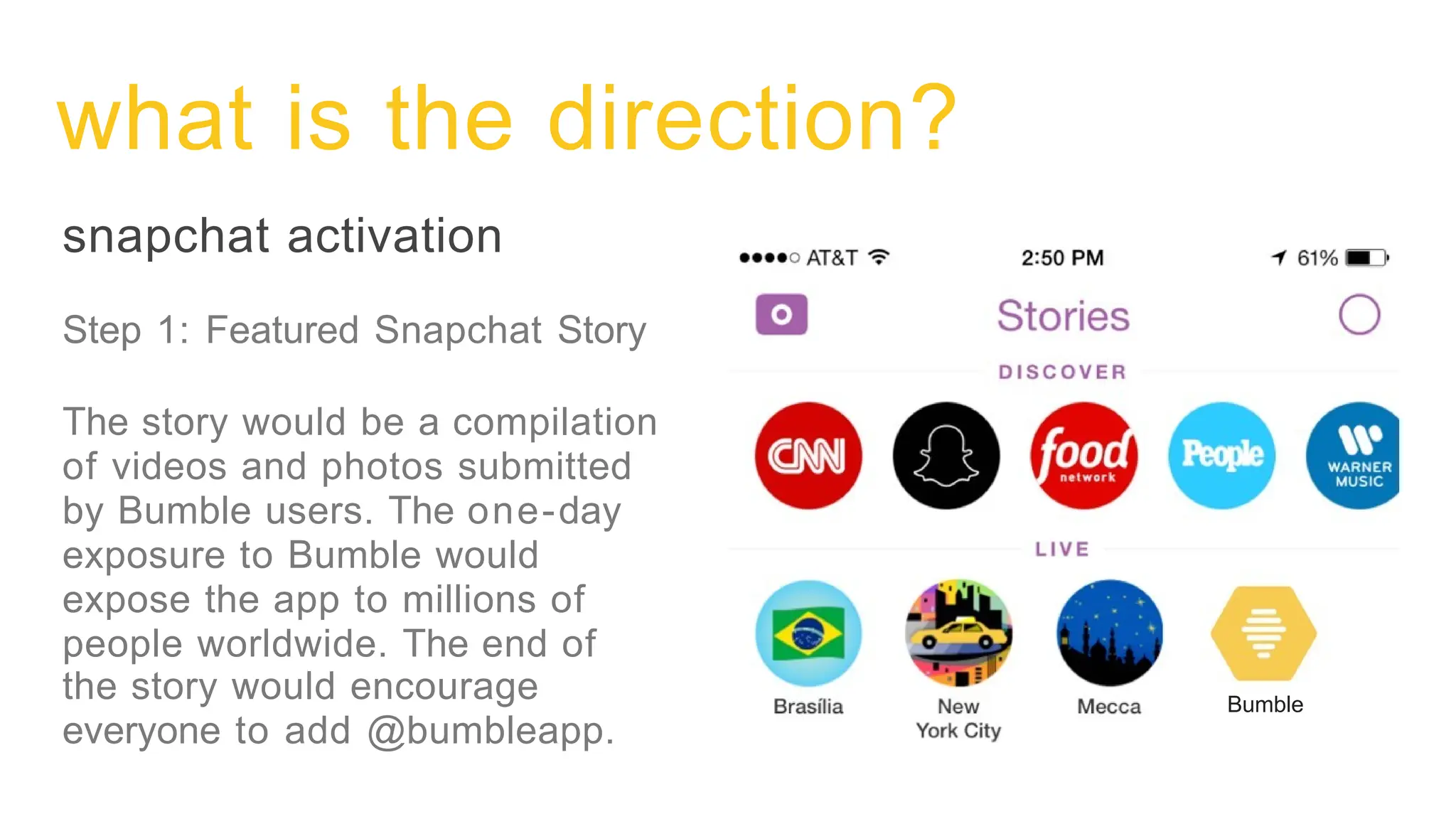
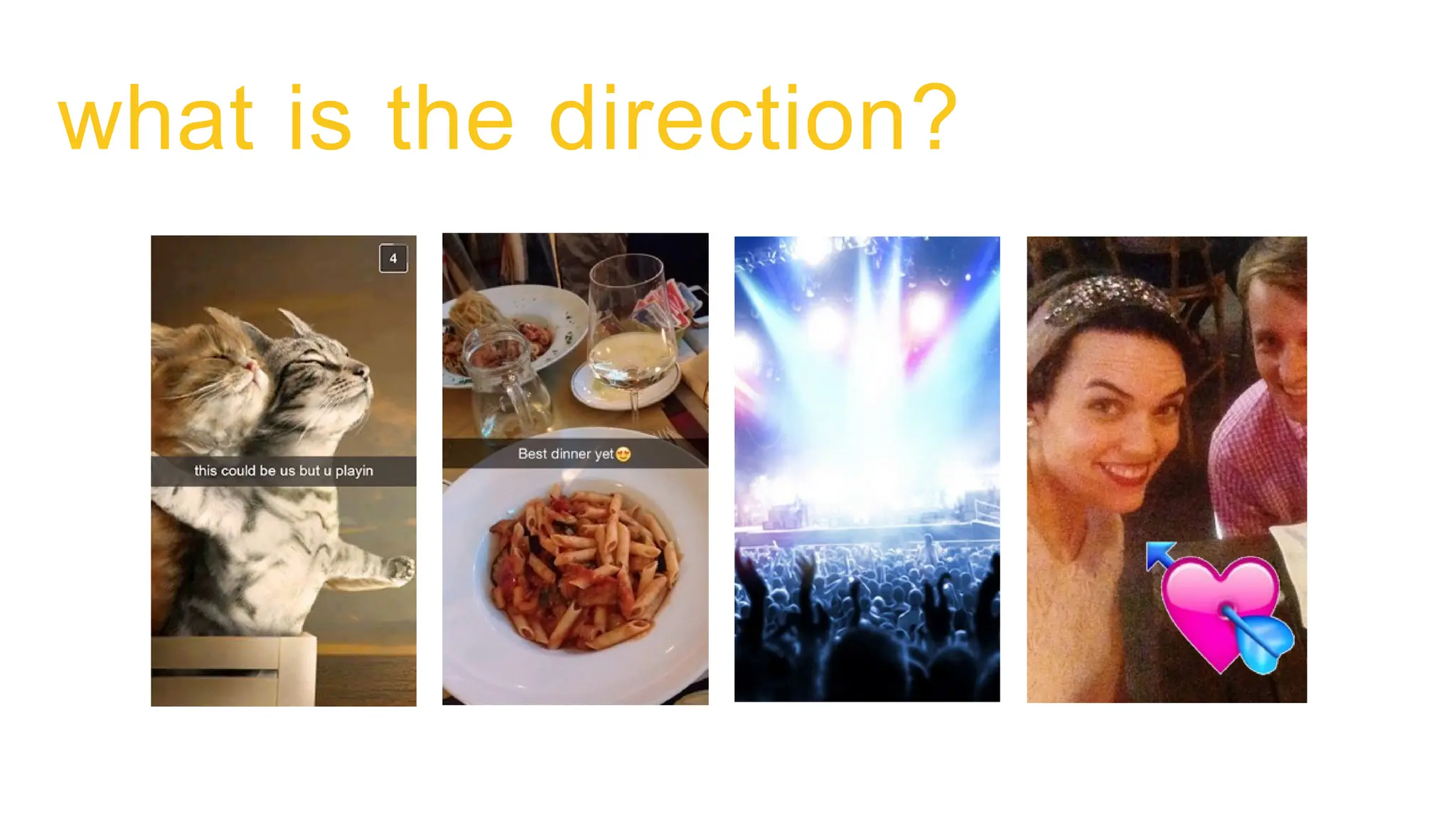
Slide 10 drills into the Snapchat plan: buy/earn a Featured Story slot to compile user-submitted videos/photos and push one-day exposure driving users to @bumbleapp. The follow-up slides (not selected here) expand on giving users the chance to create Snap stories of their Bumble dates, effectively turning ephemeral content into a serialized, reality-TV–style feed.

This tactic shows intelligent audience-first thinking: Snapchat’s user base matches Bumble’s demo and the ephemeral nature creates urgency and shareability. It also leverages UGC to scale content cheaply while increasing authenticity. For founders, the lesson is to design growth tactics that align product behavior with platform mechanics — a native approach beats generic ad buys.

Key Takeaway: Design campaign mechanics that are native to the chosen platform and that turn users into content creators — authenticity scales reach and reduces production cost.
Outcome & Positioning: From disposable app to destination brand

Outcome & Positioning: From disposable app to destination brand

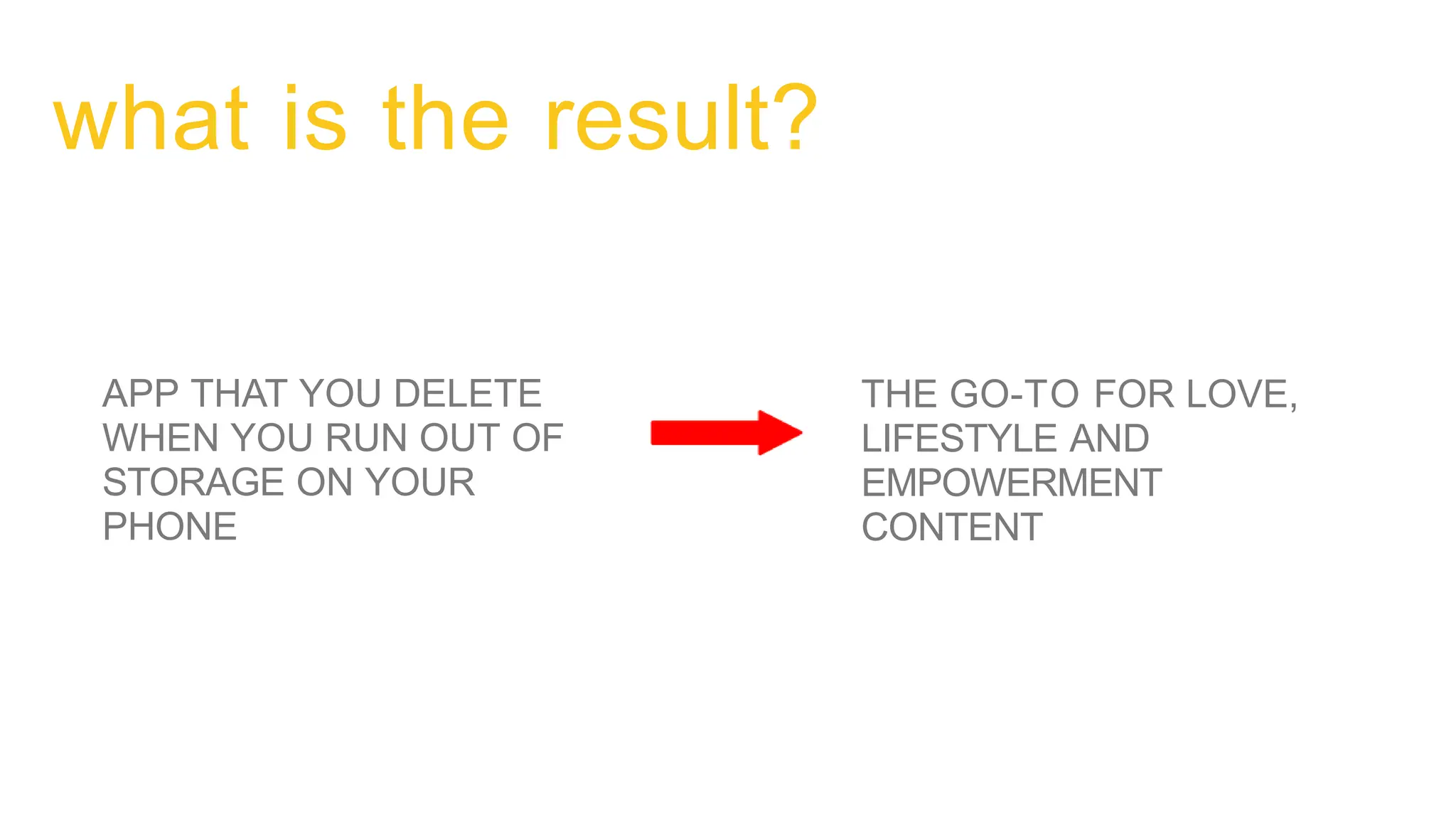
The final slide ("what is the result?") contrasts the app-as-disposable (deleted when you need storage) with the goal of becoming a go-to source for love, lifestyle, and empowerment content. This frames the desired long-term outcome — transform short-term app usage into an enduring brand and content destination. It’s a crisp articulation of retention and brand strategy rather than only acquisition.

That future-state framing helps investors imagine exit-path and defensibility beyond just downloads (i.e., content brand, partnerships, diversified revenue). Founders should similarly articulate how short-term product hooks will evolve into persistent value propositions — it’s a narrative that links early user acquisition to long-term monetization and brand equity.

Key Takeaway: Move beyond acquisition metrics and articulate the long-term brand vision and how retention/owned content will turn a transient user into a loyal audience.

Conclusion: Key Lessons

This deck succeeds because it is lean, visual, and marketing-focused: it establishes brand and product quickly, names a single differentiator, calls out the core growth constraint, and lays out a concrete, native-channel strategy (content + Snapchat) to solve it. The narrative moves logically from identity and mission to the practical tactics that will grow and retain users.

Actionable advice for founders: 1) Lead with one clear differentiator and back it with a simple mechanic that investors can understand instantly. 2) Identify the single biggest growth bottleneck and present a paired owned+distribution solution. 3) Design activations to be native to the chosen platform and to generate user-created content to lower costs and increase authenticity. Finally, frame short-term acquisition in service of a long-term brand destination — that’s how a product can evolve from an app people delete into a lasting media-enabled business.

Full Deck Analysis

11 sections

Overview

Company: Bumble
Round: Growth (Multiple)
Year: 2014
Outcome: IPO at $7.7B valuation
Founder: Whitney Wolfe (Tinder Co-Founder)

Executive Summary

Bumble’s 2014 growth pitch deck positions the company as a “movement” rather than just a dating app, leveraging founder credibility and a differentiated core mechanic (women message first) to build a lifestyle and empowerment platform. The deck emphasizes content marketing and Snapchat activation as the primary growth levers, targeting young women through aspirational messaging about gender dynamics and self-empowerment. While the deck excels at brand positioning and visual design, it notably lacks quantitative traction metrics, market size data, and detailed financial projections—relying instead on founder vision and strategic partnerships to justify investment.

Problem Statement

Articulated Problem (Slide 5):

  • App is new with low awareness/brand recognition
  • Word-of-mouth alone is insufficient for growth
  • Need for content marketing strategy to “attract, grow, and maintain a loyal audience”

Implicit Problems:

  • Dating app market dominated by Tinder (established player)
  • Women’s safety and harassment concerns in dating apps (not explicitly stated but implied by women-first mechanic)
  • Generic dating app positioning doesn’t differentiate

Assessment: The deck identifies awareness as the primary challenge but doesn’t quantify the problem (no TAM data, user acquisition costs, churn rates, or competitive threat analysis). The deeper problem—why women should prefer Bumble over Tinder—is implied but not explicitly articulated with data.

Solution

Core Product Differentiation (Slides 2-3):

  • Women must message first; matches expire in 24 hours if woman doesn’t initiate
  • Positions as addressing gender dynamics in dating (“changing the rules of the game”)
  • Frames as a “movement” for women’s empowerment, not just a transactional dating app

Growth Strategy (Slides 4-11):

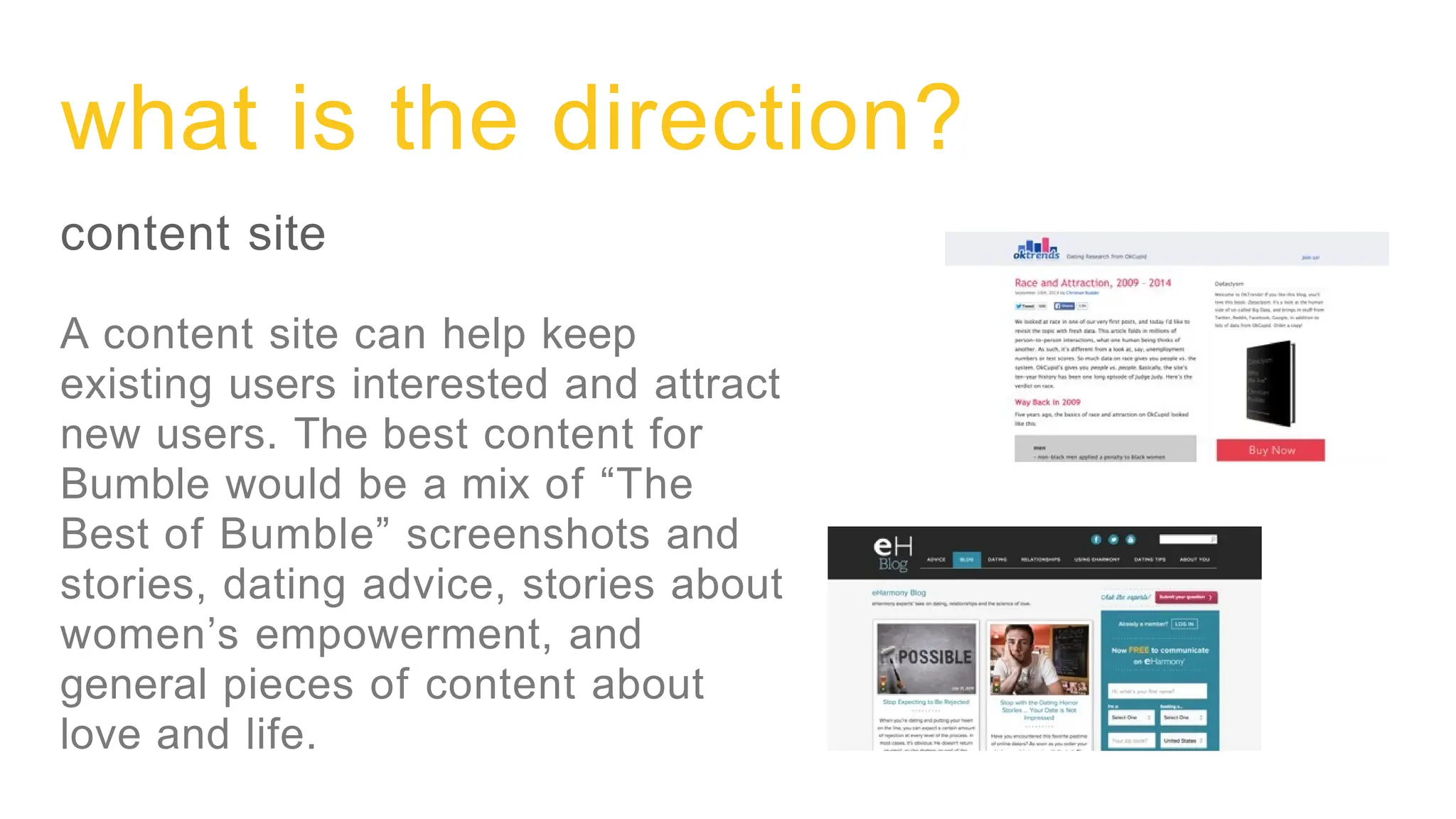
  • Content Marketing: Build owned media (content site) with user stories, dating advice, women’s empowerment content
  • Snapchat Activation: Two-step strategy
    • Step 1: Featured Snapchat Story with user-generated content compilation
    • Step 2: User-generated stories of Bumble dates on @bumbleapp account
  • Strategic Partners: Group SJR and Truffle Pig for execution

Content Pillars (Slide 7):

  1. “The Best of Bumble” user screenshots and stories
  2. Dating advice
  3. Women’s empowerment stories
  4. Love and life content
  5. General lifestyle pieces

Assessment: The solution is well-positioned emotionally but lacks operational specificity. No details on content production cadence, budget allocation, expected conversion rates, or how content site traffic converts to app downloads.

Market Opportunity

Market Size Data: NONE PROVIDED

The deck contains no TAM (Total Addressable Market), SAM (Serviceable Addressable Market), or SOM (Serviceable Obtainable Market) analysis. This is a significant omission for a growth-stage pitch.

Implied Market:

  • Snapchat users: “Millions of people worldwide” (Slide 9)
  • Target demographic: Young women (18-30) interested in dating and relationships
  • Geographic focus: Multi-city activation (Brasilia, New York City, Mecca mentioned)

Assessment: The deck assumes investors understand the dating app market opportunity but provides no quantification. For a 2014 growth round, this is a notable gap—investors would expect market sizing, TAM projections, and addressable user base calculations.

Business Model

Revenue Model: NOT DISCLOSED

The deck contains no information about:

  • Monetization strategy (freemium, premium features, subscriptions)
  • Unit economics (CAC, LTV, payback period)
  • Pricing strategy
  • Revenue projections

Assessment: This is a critical omission. While the deck focuses on user acquisition and brand building, it provides no clarity on how Bumble will generate revenue or achieve profitability. For a growth-stage investment, investors would require detailed financial modeling.

Traction & Metrics

Quantitative Metrics Provided: NONE

The deck contains zero hard metrics on:

  • User base size or growth rate
  • Daily/monthly active users (DAU/MAU)
  • Engagement metrics (matches, messages, retention)
  • Geographic distribution
  • User acquisition costs
  • Conversion rates from content to app downloads

Qualitative Proof Points:

  • Founder credibility: Whitney Wolfe (Tinder Co-Founder)
  • Strategic partnerships: Group SJR and Truffle Pig
  • Platform validation: Featured in Snapchat Discover alongside CNN, Food Network, People, Warner Music
  • User testimonials: Sample conversations and user-generated content examples

Assessment: This is the deck’s most significant weakness. A growth-stage pitch in 2014 should include traction metrics to justify the investment thesis. The absence of numbers suggests either: (1) metrics were weak and discussed verbally, (2) the deck prioritized narrative over data, or (3) this was an early-stage growth round where traction was secondary to founder vision and market opportunity.

Competitive Positioning

Explicit Competitors: NONE NAMED

The deck does not mention Tinder, Match, OkCupid, or other dating apps by name.

Implicit Differentiation:

  • Women-first mechanic: Women message first (vs. Tinder’s mutual swipe model)
  • 24-hour expiration: Creates urgency and reduces ghosting
  • Lifestyle positioning: Positions as “movement” for women’s empowerment, not just dating
  • Content strategy: Plans to own lifestyle/empowerment content space (vs. Tinder’s app-only focus)
  • Founder credibility: Whitney Wolfe’s Tinder background lends legitimacy

Assessment: The deck avoids direct competitive comparison, which is both a strength (doesn’t validate competitors) and weakness (doesn’t quantify competitive advantage). The women-first mechanic is clearly differentiated, but the deck doesn’t explain why this drives superior retention, engagement, or monetization compared to alternatives.

Team

Identified Team Members:

  • Whitney Wolfe - Founder/CEO (Tinder Co-Founder)

Team Credentials:

  • Tinder co-founder experience (implies product, fundraising, and scaling expertise)
  • Founder vision for women’s empowerment (personal mission alignment)

Assessment: The deck heavily leverages founder credibility but provides minimal team information. No mention of:

  • Executive team (COO, CFO, CTO)
  • Board members or advisors
  • Key hires or organizational structure
  • Team size or hiring plans

For a growth-stage company, this is a notable gap. Investors typically want to understand the full leadership team and organizational capability to execute the growth strategy.

Go-to-Market Strategy

Primary GTM Channels (Slides 4-11):

  1. Content Marketing (Owned Media)
    • Content site with user stories, dating advice, empowerment content
    • Reference models: OkTrends, eH Blog
    • Objective: Attract new users and retain existing users through editorial content
  2. Snapchat Activation (Social/Viral)
    • Step 1: Featured Snapchat Story with user-generated content compilation
    • Step 2: User-generated stories of Bumble dates on @bumbleapp account
    • Reach: “Millions of people worldwide”
    • Engagement mechanic: Real-time date updates (reality TV format)
  3. Strategic Partnerships
    • Group SJR (creative/strategy)
    • Truffle Pig (execution)

GTM Metrics/Targets: NONE PROVIDED

The deck does not specify:

  • Expected reach or impressions from Snapchat activation
  • Content site traffic targets
  • Conversion rates from content to app downloads
  • Timeline for launch or campaign duration
  • Budget allocation across channels

Assessment: The GTM strategy is creative and platform-appropriate for the target demographic (young women on Snapchat in 2014), but lacks rigor in execution planning and measurement. The strategy assumes content marketing + Snapchat will drive awareness and downloads, but doesn’t quantify the expected impact or provide contingency plans if initial tactics underperform.

The Ask

Funding Amount: NOT SPECIFIED

The deck does not state:

  • How much capital is being raised
  • Valuation or post-money valuation
  • Use of funds breakdown
  • Runway or milestones funded by the round

Assessment: This is unusual for a pitch deck. Typically, the final slide would include the ask, valuation, and use of funds. The absence suggests either: (1) this was a preliminary deck used in early conversations, (2) the ask was discussed verbally, or (3) the deck was designed to focus on vision/strategy rather than financial terms.

Investor Deep Dive

Executive summary, strengths & red flags

Executive Summary

Bumble's 2014 growth pitch deck positions the company as a "movement" rather than just a dating app, leveraging founder credibility and a differentiated core mechanic (women message first) to build a lifestyle and empowerment platform. The deck emphasizes content marketing and Snapchat activation as the primary growth levers, targeting young women through aspirational messaging about gender dynamics and self-empowerment. While the deck excels at brand positioning and visual design, it notably lacks quantitative traction metrics, market size data, and detailed financial projections—relying instead on founder vision and strategic partnerships to justify investment.

Key Strengths

5 identified

1

Founder Credibility & Personal Mission Alignment

- Whitney Wolfe's Tinder co-founder background provides immediate credibility and product expertise

2

Clear, Differentiated Product Mechanic

- Women-message-first rule is simple, memorable, and genuinely different from Tinder

3

Exceptional Brand Positioning & Visual Design

- Consistent yellow branding is distinctive and memorable

4

Platform-Appropriate Growth Strategy

- Snapchat activation in 2014 was forward-thinking and highly relevant to target demographic

5

Concrete Execution Examples

- Slides 8-11 provide visual mockups of actual campaign creative and user-generated content

Red Flags & Weaknesses

8 identified

1

Complete Absence of Quantitative Traction Metrics

- No user base size, growth rate, DAU/MAU, engagement metrics, or retention data

2

No Revenue Model or Financial Projections

- Monetization strategy not disclosed

3

Vague GTM Execution & Measurement

- No specific metrics on expected reach, impressions, or conversion rates

4

Minimal Team Information

- Only founder mentioned; no executive team, board, or advisor information

5

No Competitive Analysis

- Tinder not mentioned by name despite being the obvious competitor

6

Incomplete Growth Strategy

- Snapchat activation described as "Step 1" and "Step 2" but no Steps 3, 4, etc.

7

No Ask/Funding Details

- Funding amount not specified

8

Aspirational Vision Without Proof

- "Go-to for love, lifestyle, and empowerment content" is ambitious but unsupported

More Pitch Decks To Study

Compare structure, fundraising context, and investor-facing story across similar startup decks.