Compare your deck to Dropbox

Compare Your Deck

Dropbox Pitch Deck (2007)

SaaS
Stage: Seed
Raised: $1.2M
Year: 2007
Slides: 17
Outcome: IPO at $9.2B valuation

Pitch Deck

1 / 17
Dropbox pitch deck - The Opening: Clear brand and one-line positioning
Click to expand

Deck Analysis

This is Dropbox's 2007 seed pitch deck: a compact, visual, product-first presentation that crisply frames a universal pain (file storage and sharing), demonstrates a working product, and highlights technical and team strengths. Notable for its simplicity and demo emphasis, the deck avoids heavy market spreadsheets and instead shows a real problem, a clear product experience, and why the founders were uniquely suited to execute — a combination that helped the company raise $1.2M and later reach a multibillion-dollar IPO.

The Opening: Clear brand and one-line positioning

The Opening: Clear brand and one-line positioning

The first slide is minimal: the Dropbox logo, the tagline “Moving the world’s files,” and a straightforward URL. It sets a confident, consumer-friendly tone and establishes what the product does in one short phrase. That brevity makes it instantly memorable and places emphasis on product rather than buzzwords or hyperbole.

Founders can learn from how this slide uses simplicity to convey clarity. Instead of overloading the audience with metrics or jargon, it leads with a brand promise that frames the rest of the deck. For early-stage pitches that rely on product intuition, a concise opening that communicates mission and focus is more effective than dense slides of background detail.

Key Takeaway: Open with a single memorable line that encapsulates your product’s core value — clarity beats complexity at seed stage.
Problem: Visualizing the pain

Problem: Visualizing the pain

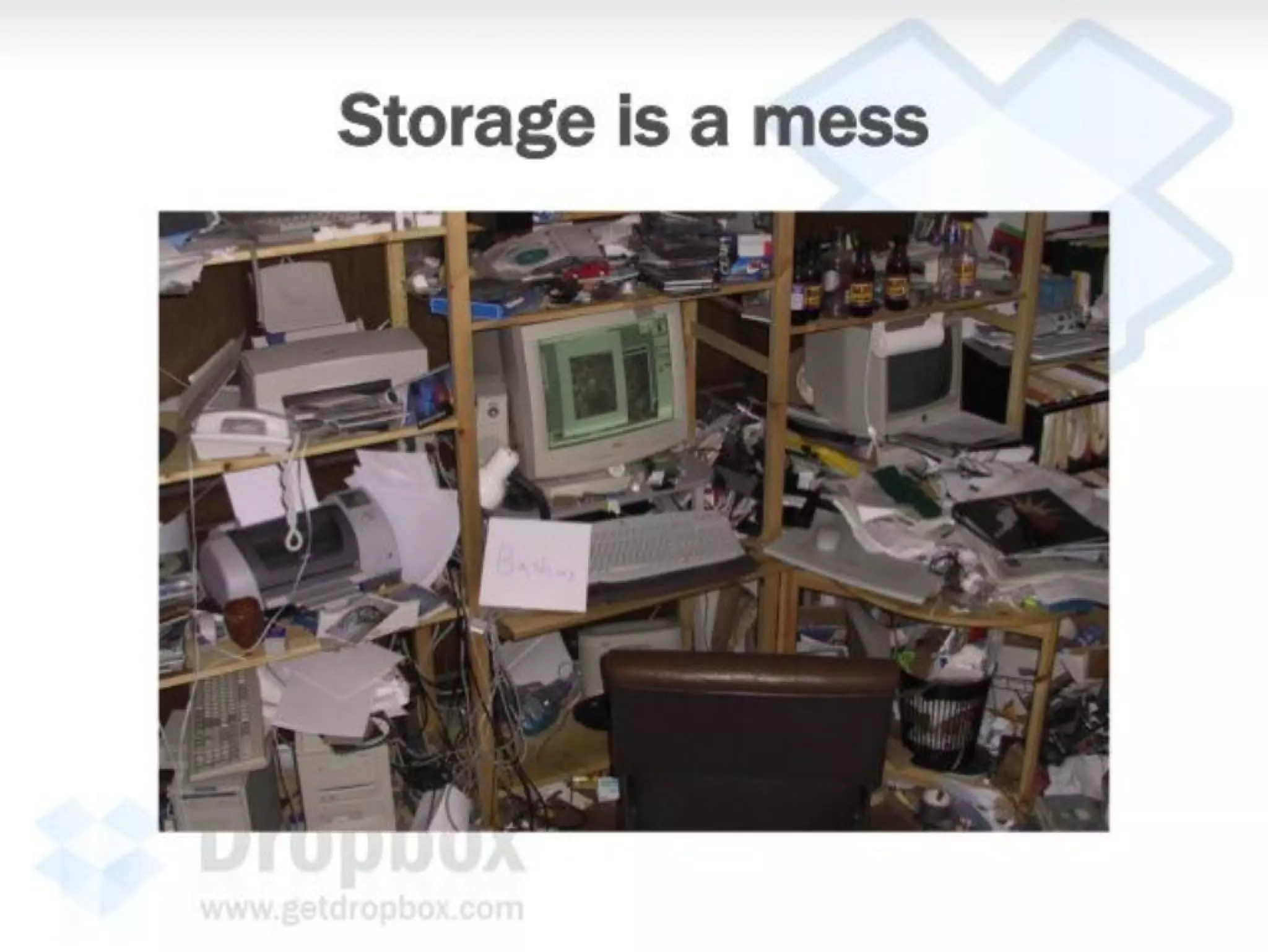
Slide 2 uses a single, relatable photo of a chaotic desk with the headline “Storage is a mess.” The visual metaphor instantly communicates the real-world frustration Dropbox aims to solve, making the problem visceral rather than abstract. This drives empathy and primes the audience to accept the product solution that follows.

This approach teaches founders the power of pairing a short, bold headline with a single evocative image. Rather than enumerating statistics, the slide makes the problem tangible. When pitching, concrete visuals that your audience can instantly relate to often beat long lists of market data, especially when your product solves a common, everyday pain.

Key Takeaway: Make the problem feel real with one powerful image and a short headline — it builds instant empathy and focus.
Detailing the pain and current workarounds

Detailing the pain and current workarounds

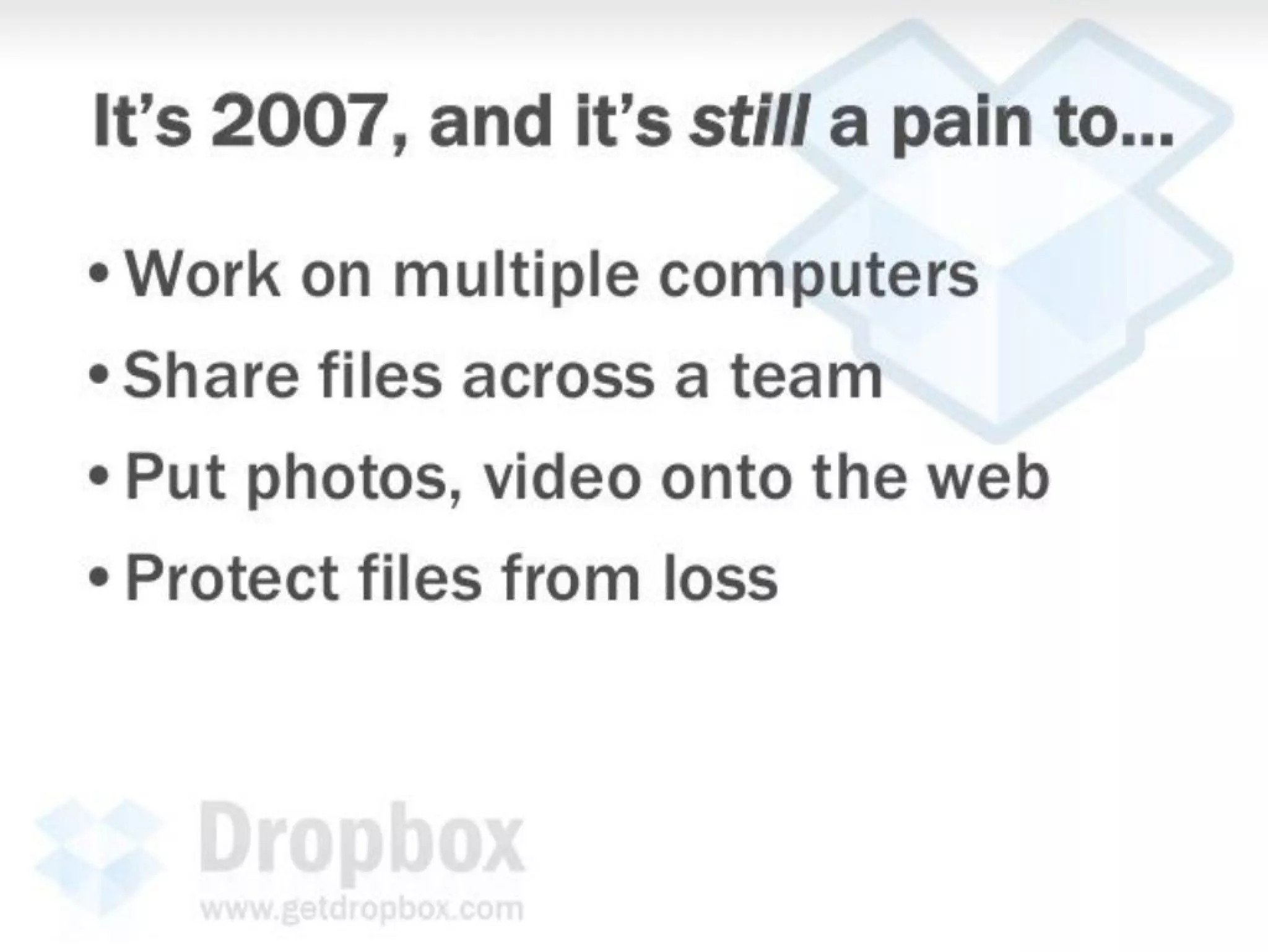
Slide 3 lists specific pain points: working on multiple computers, sharing files across a team, putting media online, and protecting files from loss. It translates the messy visual into actionable, product-oriented problems — the exact jobs users need done. That specificity makes it easier to map product features to customer needs in later slides.

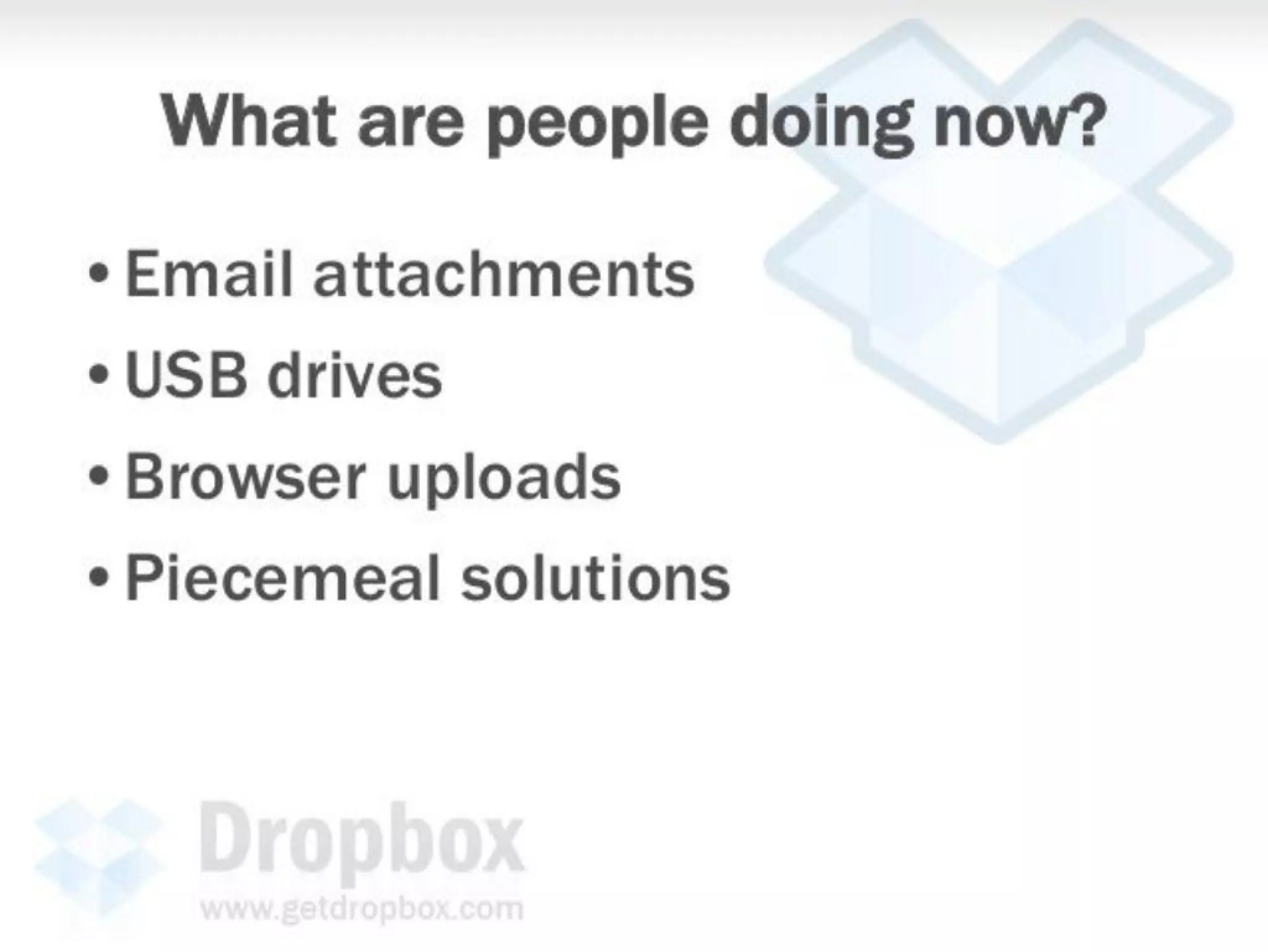
Following the pain list, slide 4 (covered conceptually here) details how people currently cope — email attachments, USB drives, browser uploads, piecemeal solutions. This contrast is effective because it shows incumbents are fragmented and awkward, creating a clear opening for an elegant single-app solution. Founders should emulate this structure: document user pains, then show the clumsy alternatives to underscore product-market fit.

Key Takeaway: List precise user jobs-to-be-done and contrast them with clumsy existing solutions to make the opportunity obvious.
Vision and product promise

Vision and product promise

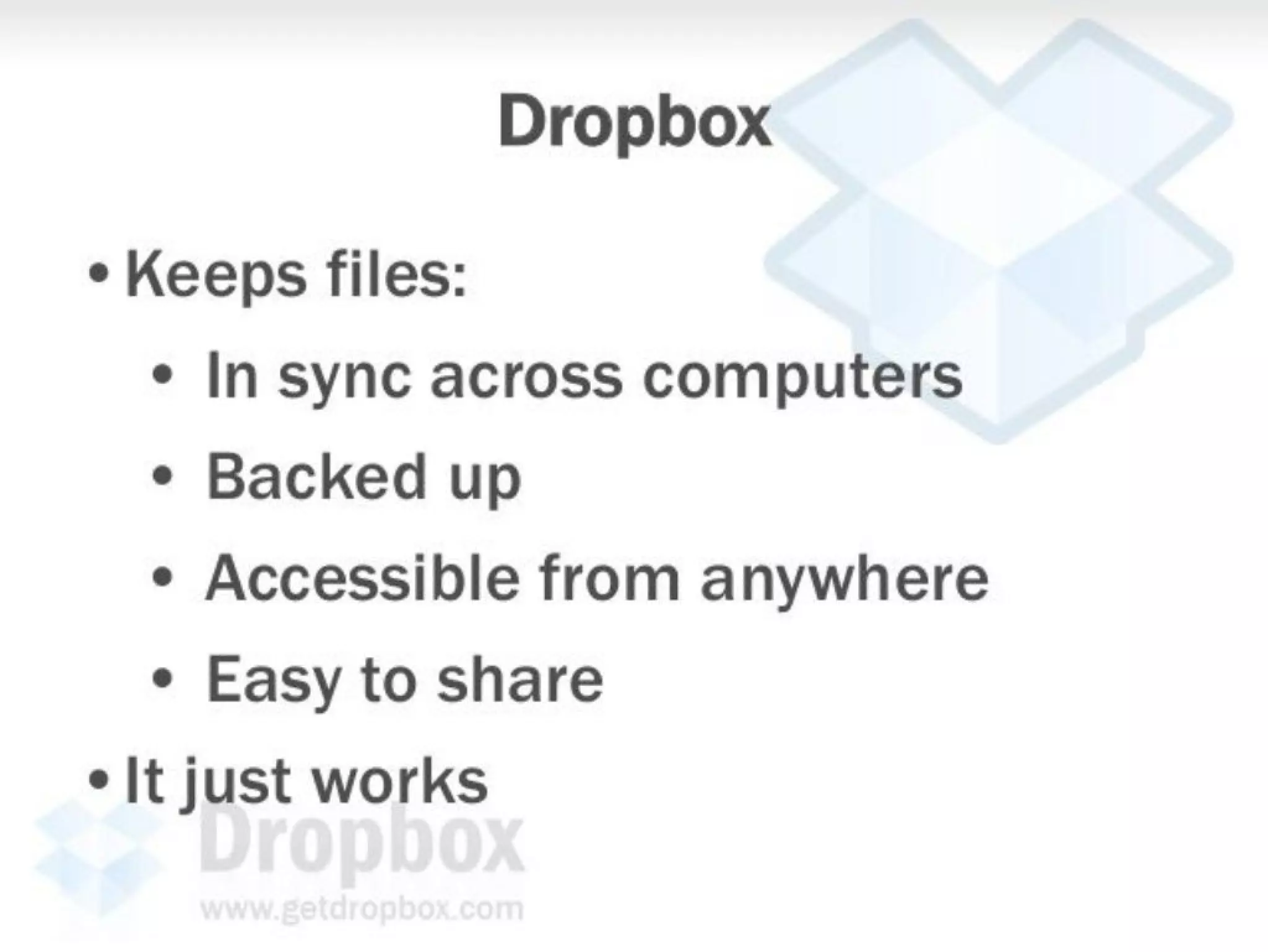
Slide 6 (and nearby slides) lays out a concise product promise: sync across computers, backed up, accessible anywhere, easy to share — and ends with “It just works.” These are simple, tangible outcomes rather than technical specs, which makes the value easy to grasp for non-technical investors and early users alike. The slide balances aspiration (available anywhere) with pragmatic benefits (backup, sharing).

For founders, this demonstrates that product positioning should translate features into human outcomes. The phrase “It just works” is powerful because it promises reliability, a key emotional trigger for users frustrated with brittle tools. When describing your product, lead with the benefits users will feel, not the internal mechanics.

Key Takeaway: Frame features as direct user outcomes (access, backup, sharing) and finish with a short emotional promise like “It just works.”
Demo-first execution and timing

Demo-first execution and timing

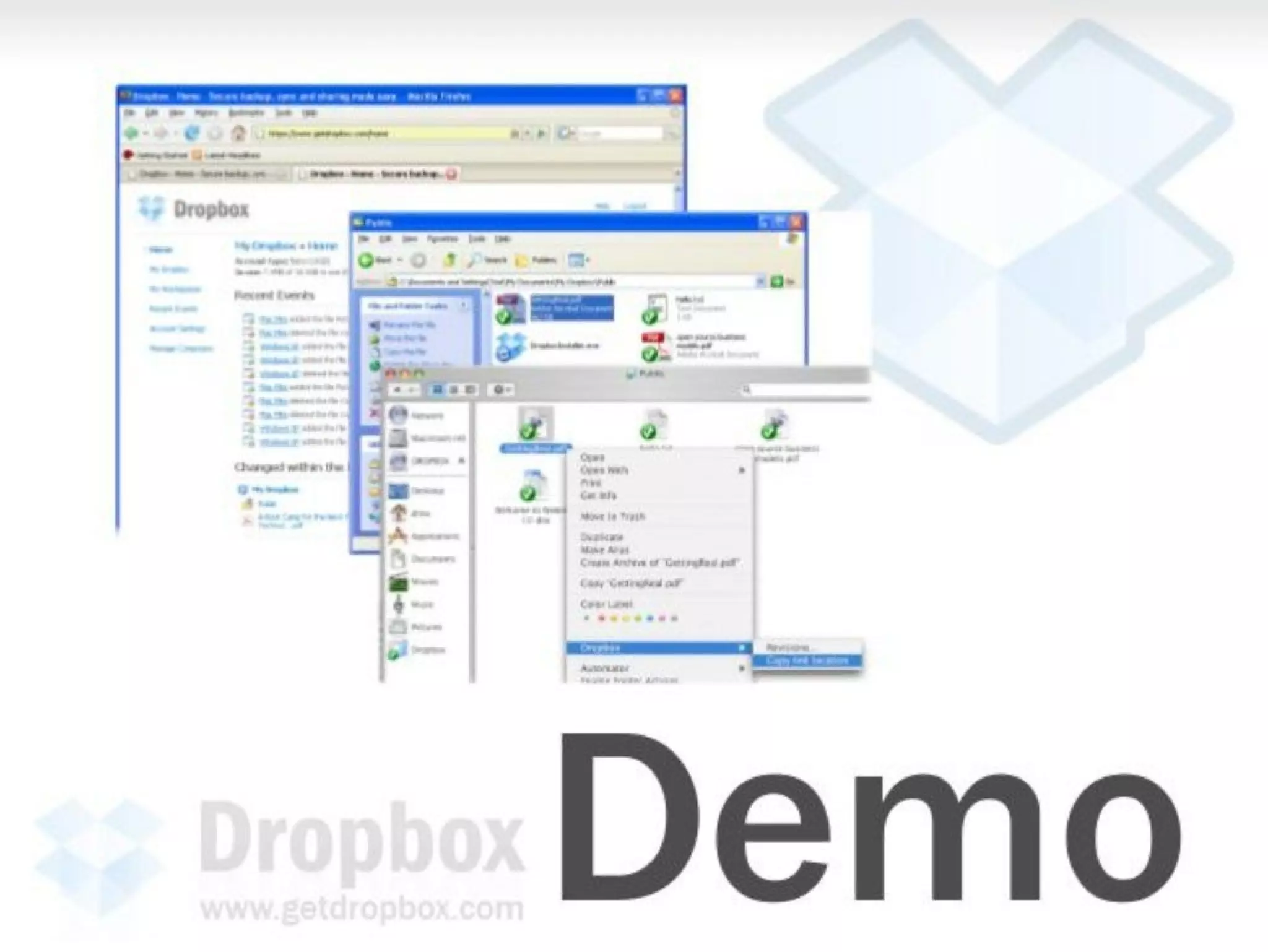
Slide 7 is a visual ‘Demo’ slide showing screens and a right-click flow — the team prioritized demonstrating actual product behavior over hypotheticals. Pairing a live (or screenshot) demo with the pitch signals confidence that the product already exists and works, which is crucial at seed stage. It reduces perceived risk by proving technical feasibility early.

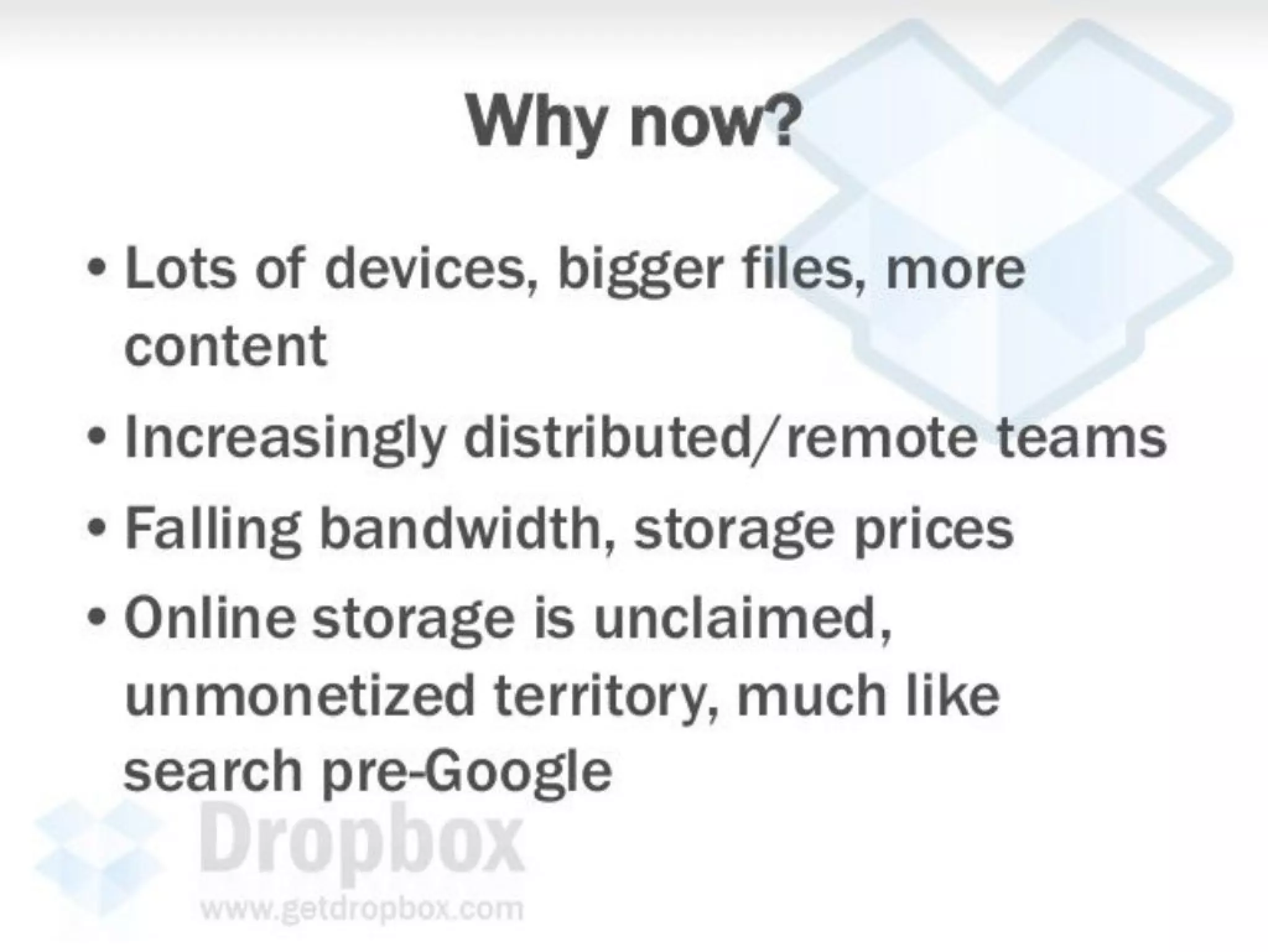
Complementing the demo, Slide 9 explains why 2007 was the right time — more devices, bigger files, distributed teams, falling bandwidth and storage costs. This combination (working demo + timing thesis) is a strong Go-to-Market argument: not only does the product work, but market conditions are aligning to accelerate adoption. Founders should bring a working demo and a crisp timing thesis to show both readiness and market tailwinds.

Key Takeaway: Show the product in action and pair it with a concise timing thesis to prove both feasibility and market opportunity.
Competitive positioning: simple, focused differentiation

Competitive positioning: simple, focused differentiation

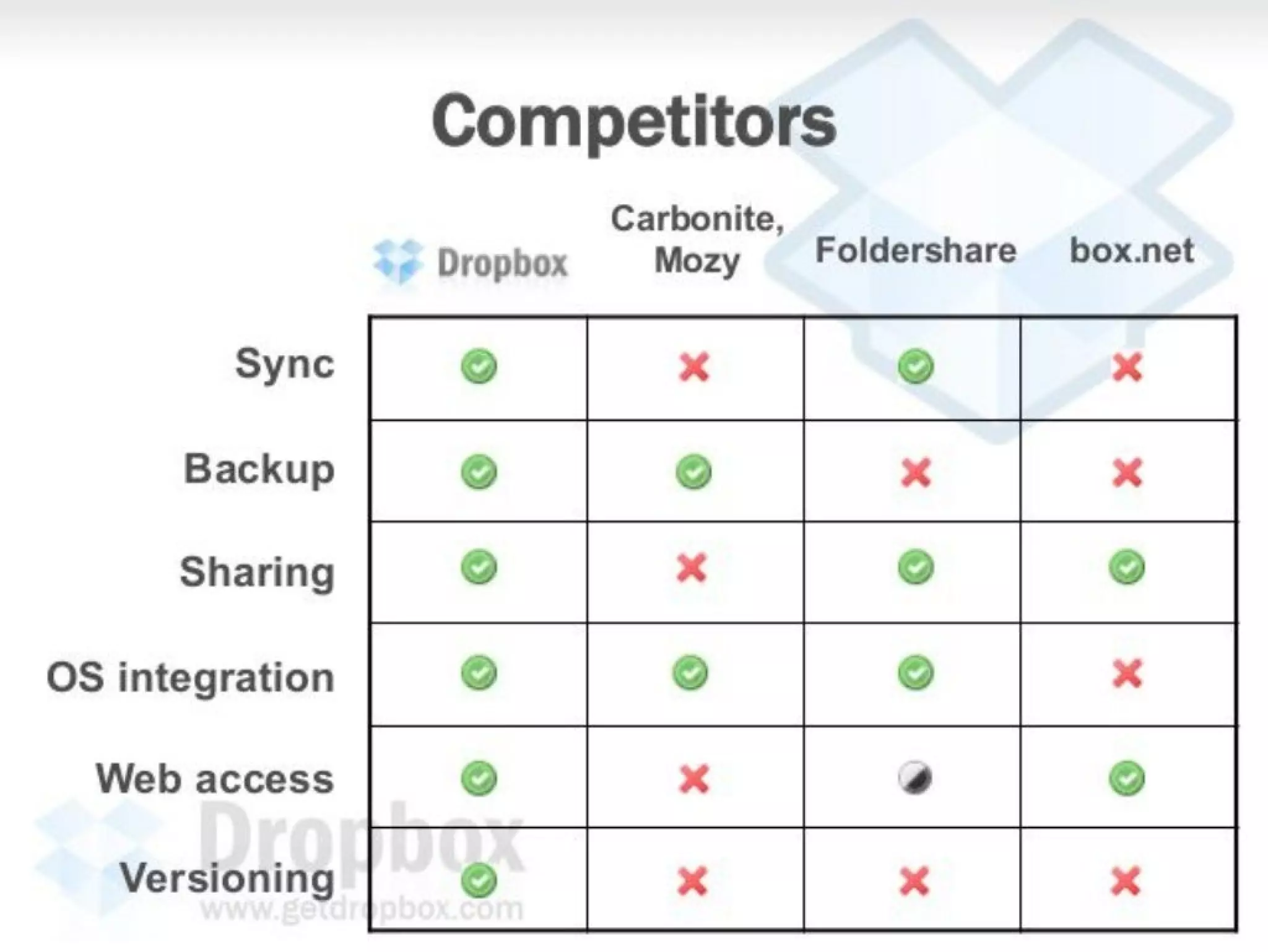
Slide 10 presents a clean competitive matrix comparing Dropbox to incumbents on sync, backup, sharing, OS integration, web access, and versioning. The table highlights Dropbox’s strengths across multiple axes and shows that competitors only solved parts of the problem. This clarifies a full-spectrum advantage rather than a narrow edge — essential when claiming market leadership.

The slide’s clarity offers a lesson: use comparisons to emphasize completeness and integration. Rather than attacking features in isolation, the matrix frames Dropbox as the integrated solution. Founders should build concise competitor matrices that spotlight where incumbents are fragmented and how their product unifies those gaps.

Key Takeaway: Use a simple matrix to show comprehensive differentiation — emphasize how you solve the whole problem, not just a piece.
Technical credibility and the founding team

Technical credibility and the founding team

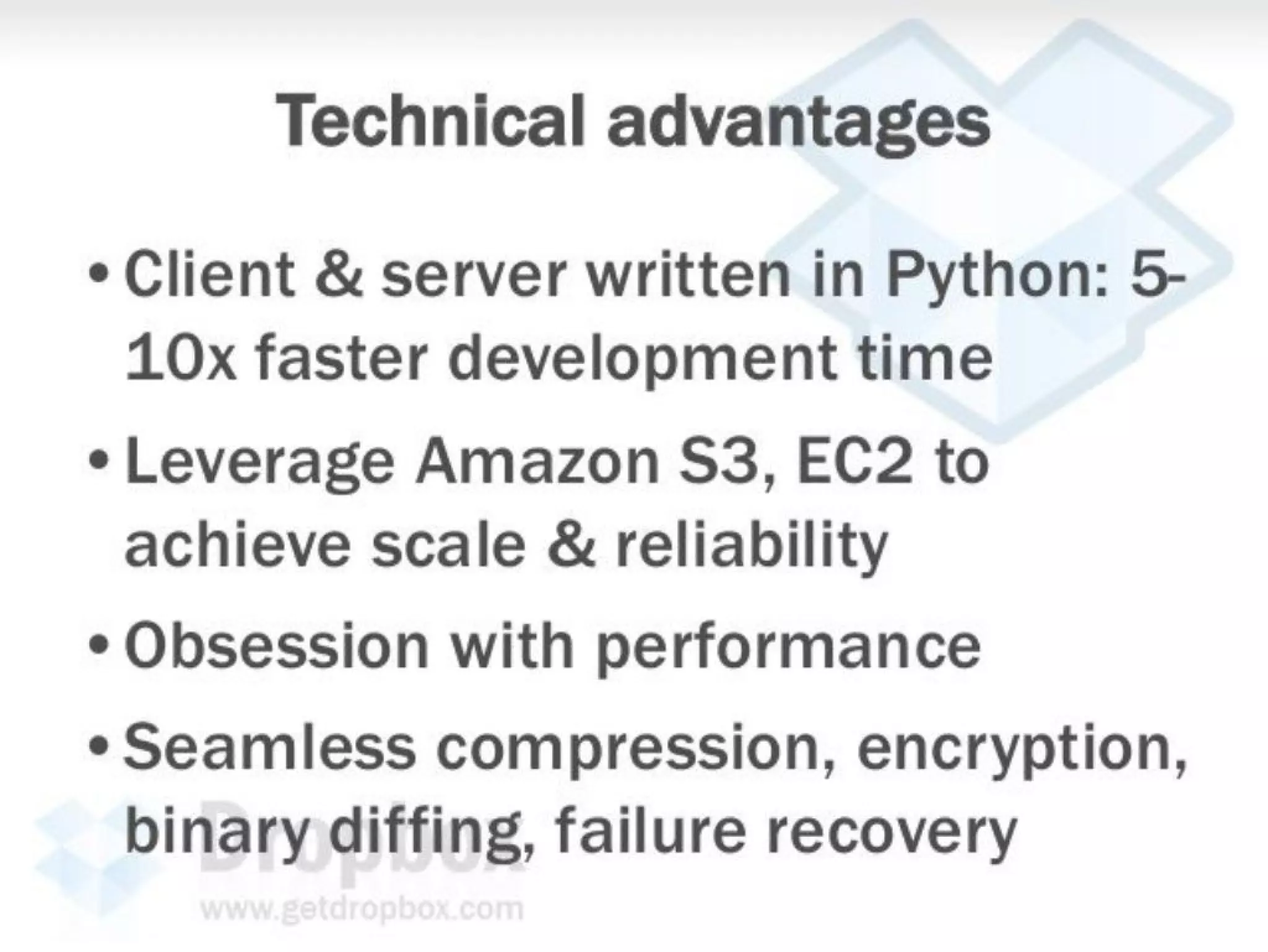
Slide 13 lists technical advantages — Python codebase for rapid development, leveraging Amazon S3/EC2 for scale, performance focus, and clever engineering (compression, diffing, recovery). It signals that the team isn’t just describing a problem but has a concrete, scalable technical approach. This technical transparency builds investor confidence that the product can be executed and scaled.

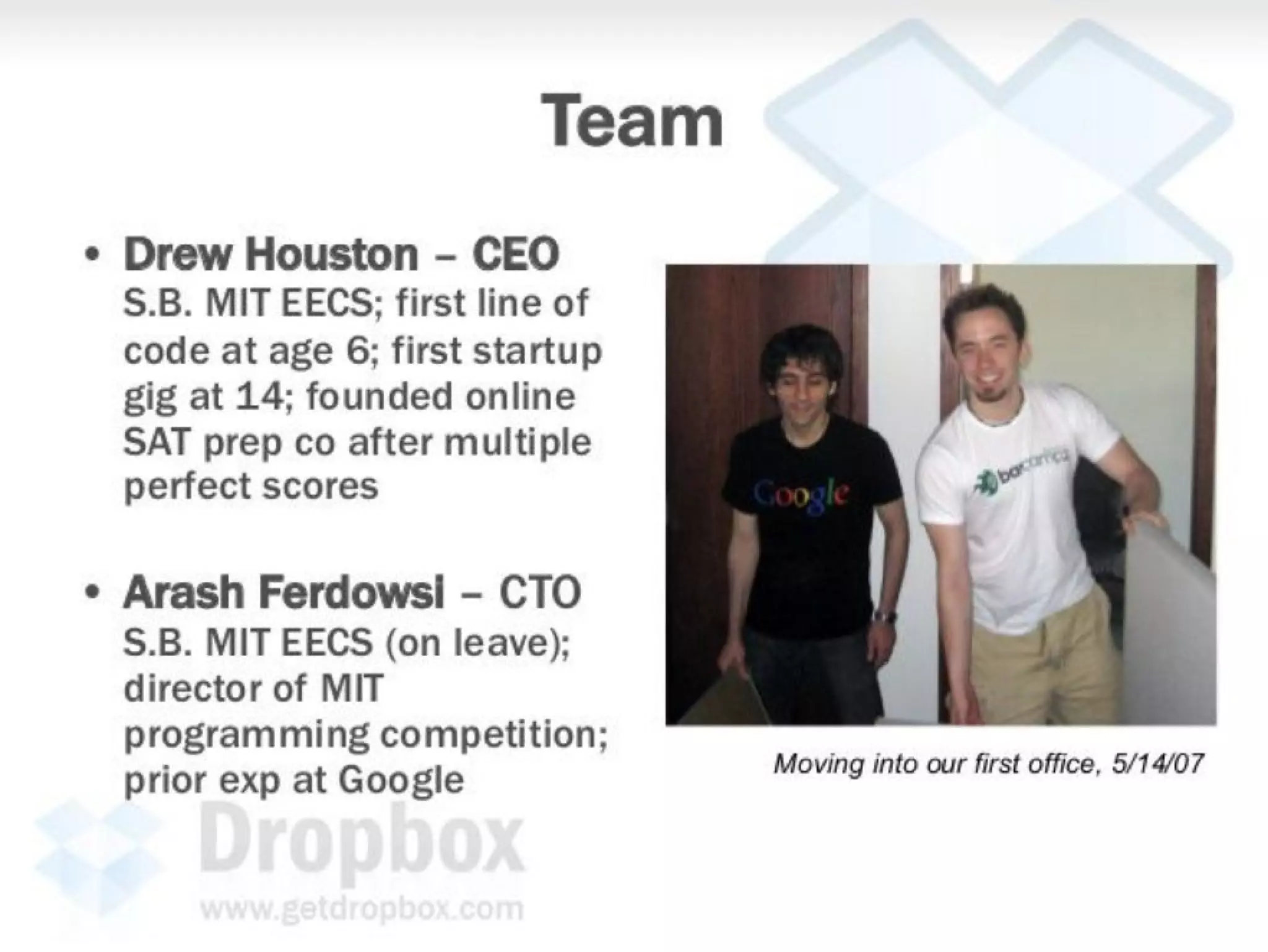
Slide 14 (team) reinforces that credibility with founder backgrounds (MIT, Google experience). Together these elements show why the founders could build the product and handle growth. For founders, the takeaway is to pair technical execution details with team credibility: show how your stack, architecture choices, and people uniquely position you to solve the problem and scale.

Key Takeaway: Combine clear technical choices with founder credentials to demonstrate both how you will build the product and who will execute it.

Conclusion: Key Lessons

Dropbox’s seed deck is a masterclass in product-first pitching: a simple opening, a visceral problem visual, concrete pain points, a working demo, a compact competitive matrix, and clear technical and team credibility. It focuses on outcomes for users rather than technical jargon or long market slides, which makes the deck accessible to non-technical investors and compelling to those who value product intuition.

Actionable advice for founders: lead with a memorable one-line value proposition; make the problem tangible with a single image; map specific user jobs-to-be-done to product outcomes; demonstrate a working product or screenshots; explain why now with concise market signals; and pair a defensible technical approach with founder credentials. Keep slides visual and economical — clarity and demonstration of execution often trump lengthy business modeling at seed stage.

Full Deck Analysis

12 sections

Overview

Company: Dropbox
Round: Seed ($1.2M)
Year: 2007
Outcome: IPO at $9.2B valuation (2018)
Valuation Multiple: 7,667x return on seed capital


Executive Summary

The Dropbox seed pitch deck is a masterclass in problem-solution fit and simplicity. Rather than leading with technology or market size, the deck opens with a visceral problem statement (“Storage is a mess”), articulates four specific pain points that resonate universally, and positions Dropbox as a comprehensive solution that “just works.” The deck’s strength lies in its focus on user experience and behavioral compatibility—emphasizing that Dropbox doesn’t force users to change their workflows. With only two MIT-credentialed founders and a product that had just moved into its first office (May 2007), the deck relies heavily on product elegance, competitive differentiation, and the emerging tailwinds of device proliferation and falling bandwidth costs to justify a seed investment.


Problem Statement

Slides 2-3: The Problem

The deck articulates the problem in two layers:

  1. Emotional/Visceral (Slide 2): “Storage is a mess” with a chaotic image of cluttered computer equipment
  2. Specific Pain Points (Slide 3): “It’s 2007, and it’s still a pain to…”
    • Work on multiple computers
    • Share files across a team
    • Put photos, video onto the web
    • Protect files from loss

Current Workarounds (Slide 4): The deck acknowledges what people are doing instead:

  • Email attachments
  • USB drives
  • Browser uploads
  • Piecemeal solutions

Effectiveness: The problem statement is relatable and specific enough to resonate with multiple user personas (mobile workers, teams, content creators, backup-conscious users), but broad enough to suggest a large addressable market. The “It’s 2007” framing creates urgency—implying that this problem should have been solved by now.

Weakness: The deck provides no quantitative data on problem severity (frequency, cost, user frustration levels) or market size estimates.


Solution

Slides 5-7: The Solution

The deck positions Dropbox through three lenses:

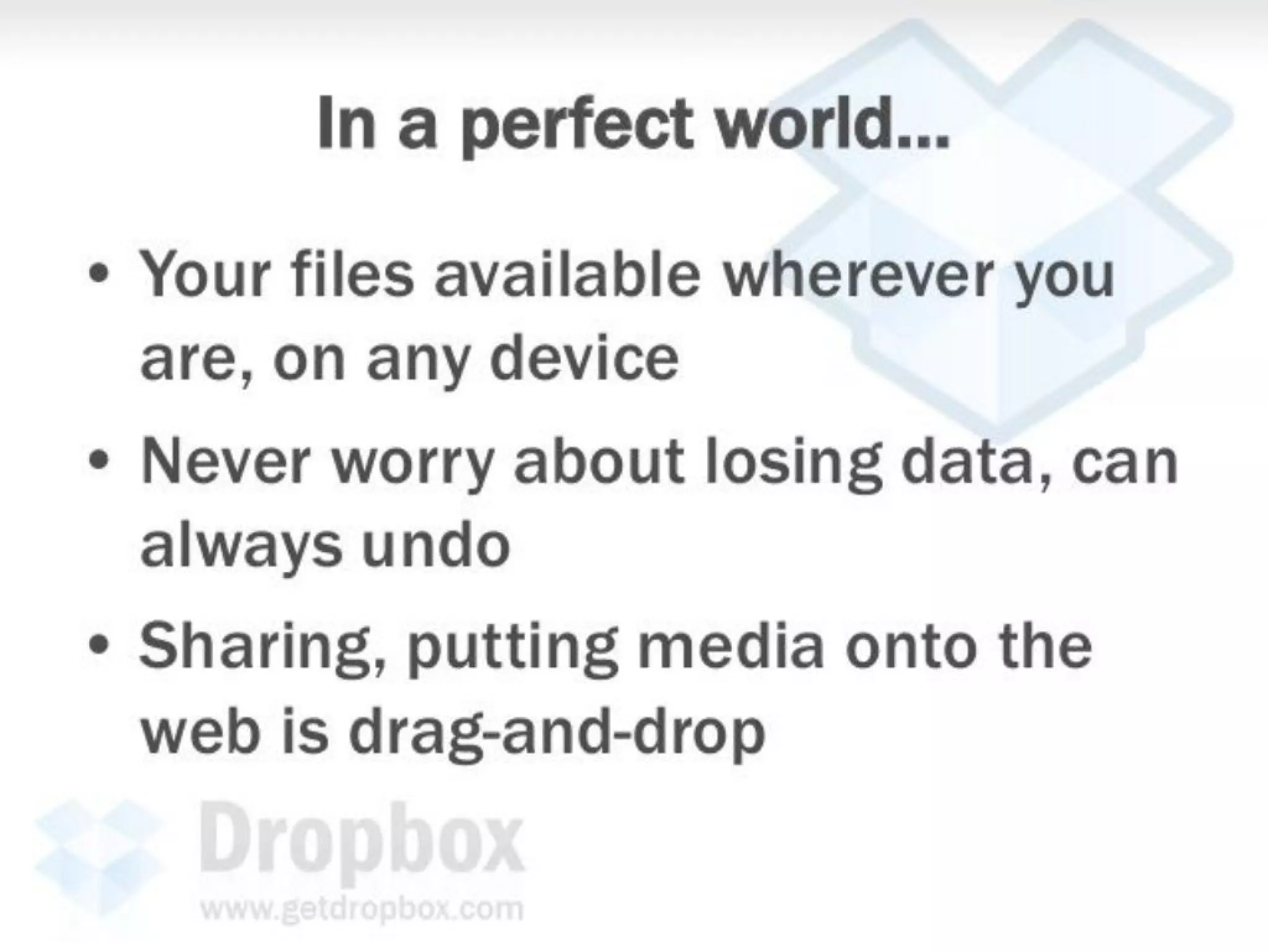
Vision (Slide 5): “In a perfect world…”

  • Your files available wherever you are, on any device
  • Never worry about losing data, can always undo
  • Sharing, putting media onto the web is drag-and-drop

Product (Slide 6): “Dropbox”

Keeps files:

  • In sync across computers
  • Backed up
  • Accessible from anywhere
  • Easy to share
  • Tagline: “It just works”

Demo (Slide 7): Visual proof

Screenshots showing:

  • Web dashboard interface
  • Desktop sync client with green checkmarks
  • File sharing interface
  • Context menu operations

Key Positioning: The solution is framed as comprehensive (solves entire genre of problems with one app) rather than point-solution focused. The emphasis on “doesn’t make you change the way you work” and “just works” suggests the core innovation is ease of use and behavioral compatibility, not just technical capability.

Weakness: The demo screenshots are low-resolution and lack annotations explaining key features or workflows.


Market Opportunity

Slide 8: “Why now?”

The deck identifies four macro tailwinds enabling the market:

  1. Device proliferation + larger files + more content
    • Multiple computers becoming standard
    • File sizes growing (video, media)
    • Content creation increasing
  2. Increasingly distributed/remote teams
    • Work-from-anywhere trend emerging
    • Collaboration tools fragmented
  3. Falling bandwidth and storage prices
    • Economics becoming favorable for cloud storage
    • Infrastructure costs declining
  4. Unclaimed, unmonetized territory
    • Online storage exists but is fragmented
    • Comparison: “Much like search pre-Google”

Market Size Analysis: The deck provides no explicit TAM/SAM/SOM estimates. This is a notable omission for a seed pitch, though common for 2007-era decks. The “search pre-Google” analogy suggests the founders believe the market is large and nascent, but no numbers are provided.

Strength: The macro tailwinds are well-articulated and prescient (device proliferation, remote work, falling costs all proved true). The Google analogy is powerful positioning.

Weakness: No quantitative market sizing, no addressable market estimates, no revenue projections.


Business Model

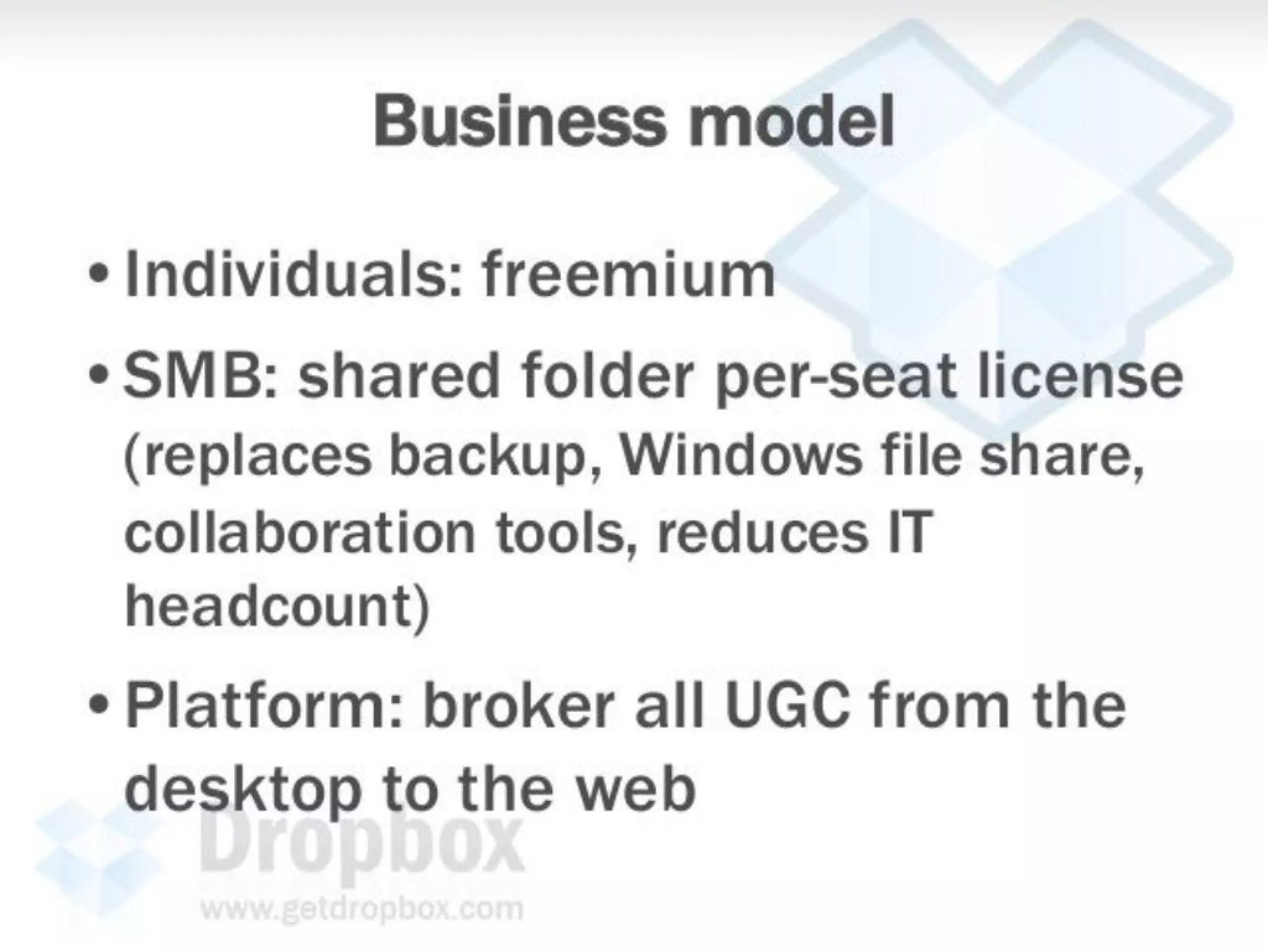
Slide 14: “Business model”

Three-segment monetization strategy:

1. Individuals: Freemium

  • Free tier to drive adoption
  • Premium tier for paid conversion (pricing not specified)

2. SMB: Per-seat license for shared folders

  • Replaces: backup, Windows file share, collaboration tools
  • Value prop: Reduces IT headcount
  • Pricing model: Per-seat licensing (standard B2B)

3. Platform: Desktop-to-web UGC brokerage

  • Onramp for user-generated content from desktop to web
  • Enables web apps to receive files via drag-and-drop
  • Monetization mechanism: Not specified

Strengths:

  • Multi-segment approach addresses different buyer personas
  • SMB value prop is clear (cost replacement + IT savings)
  • Freemium model is proven for consumer adoption

Weaknesses:

  • No pricing specified for any tier
  • No revenue projections or unit economics
  • No conversion assumptions (free-to-paid rates)
  • Platform monetization unclear (how does Dropbox benefit from web app integrations?)
  • No mention of customer acquisition cost or lifetime value
  • Enterprise/vertical market strategy absent

Traction & Metrics

Notable Absence: The deck contains zero traction metrics.

No mention of:

  • User numbers (beta, active, paying)
  • Growth rates
  • Conversion rates (free-to-paid)
  • Revenue or MRR
  • Churn rates
  • NPS or user satisfaction
  • Feature adoption rates

Timeline Evidence:

  • First office move: May 14, 2007
  • VentureBeat ranking: August 16, 2007 (ranked #1 among summer YC startups)
  • Pitch timing: Likely late 2007 (3+ months after office move)

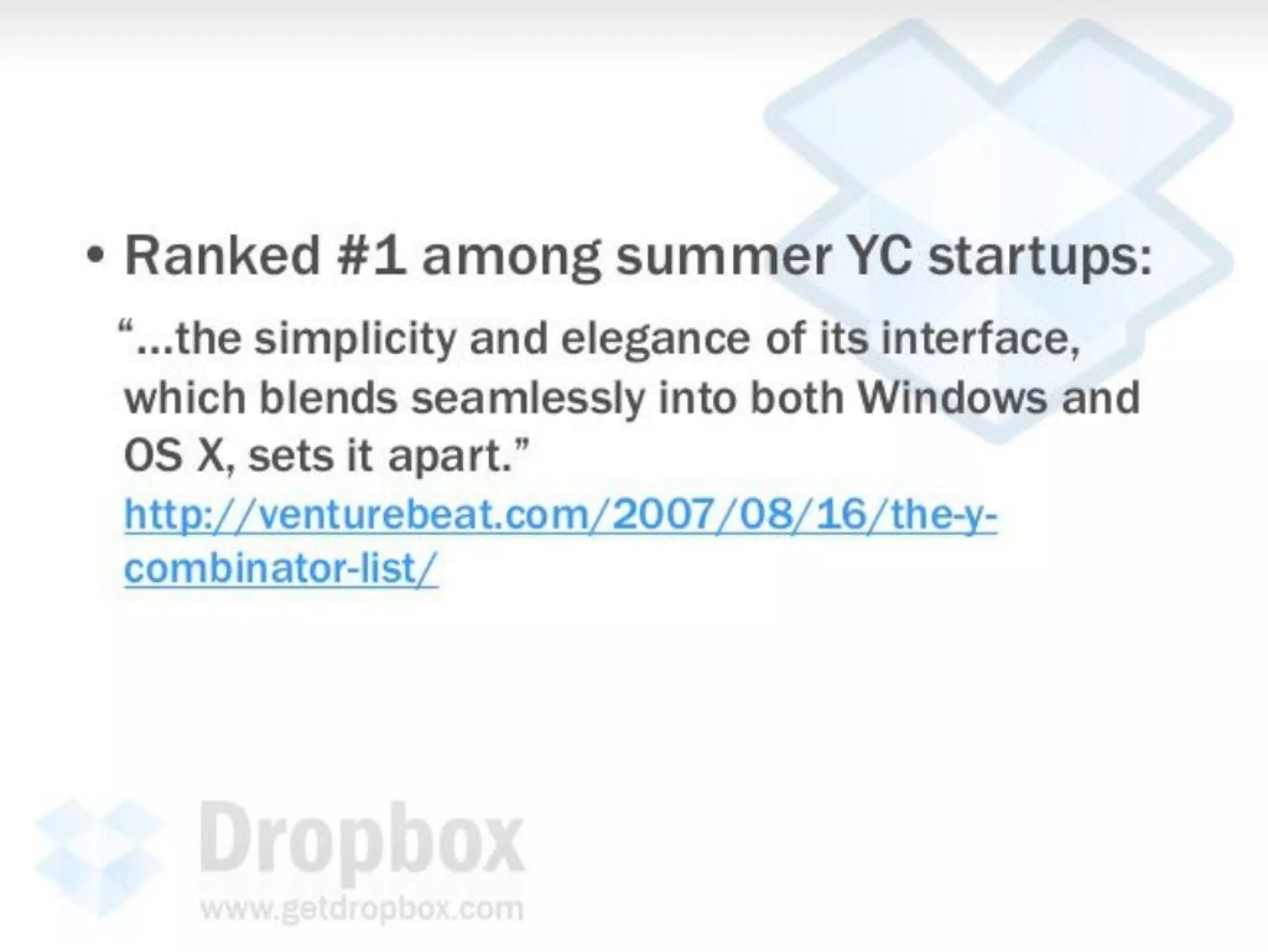
Third-Party Validation (Slide 17):

  • Ranked #1 among summer YC startups
  • VentureBeat quote: “…the simplicity and elegance of its interface, which blends seamlessly into both Windows and OS X, sets it apart.”

Analysis: The deck relies entirely on product quality and market opportunity rather than demonstrated traction. This suggests either:

  1. The product was too early for meaningful metrics
  2. The founders chose to emphasize product/market fit over growth metrics
  3. Metrics were weak and deliberately omitted

For a seed round in 2007, this was likely acceptable (seed rounds were smaller, earlier-stage), but it’s a notable gap by modern standards.


Competitive Positioning

Slide 10: Competitive Comparison Matrix

Competitors analyzed:

  • Carbonite (backup-focused)
  • Mozy (backup-focused)
  • Foldershare (file sharing)
  • box.net (enterprise file sharing)

Features compared (6 total):
| Feature | Dropbox | Carbonite | Mozy | Foldershare | box.net |
|———|———|———–|——|————-|———|
| Sync | ✓ | ✗ | ✗ | ✓ | ✗ |
| Backup | ✓ | ✓ | ✓ | ✗ | ✗ |
| Sharing | ✓ | ✗ | ✗ | ✓ | ✓ |
| OS integration | ✓ | ✓ | ✓ | ✓ | ✗ |
| Web access | ✓ | ✗ | ✗ | ◐ | ✓ |
| Versioning | ✓ | ✗ | ✗ | ✗ | ✗ |

Dropbox Score: 6/6 (only product with all features)

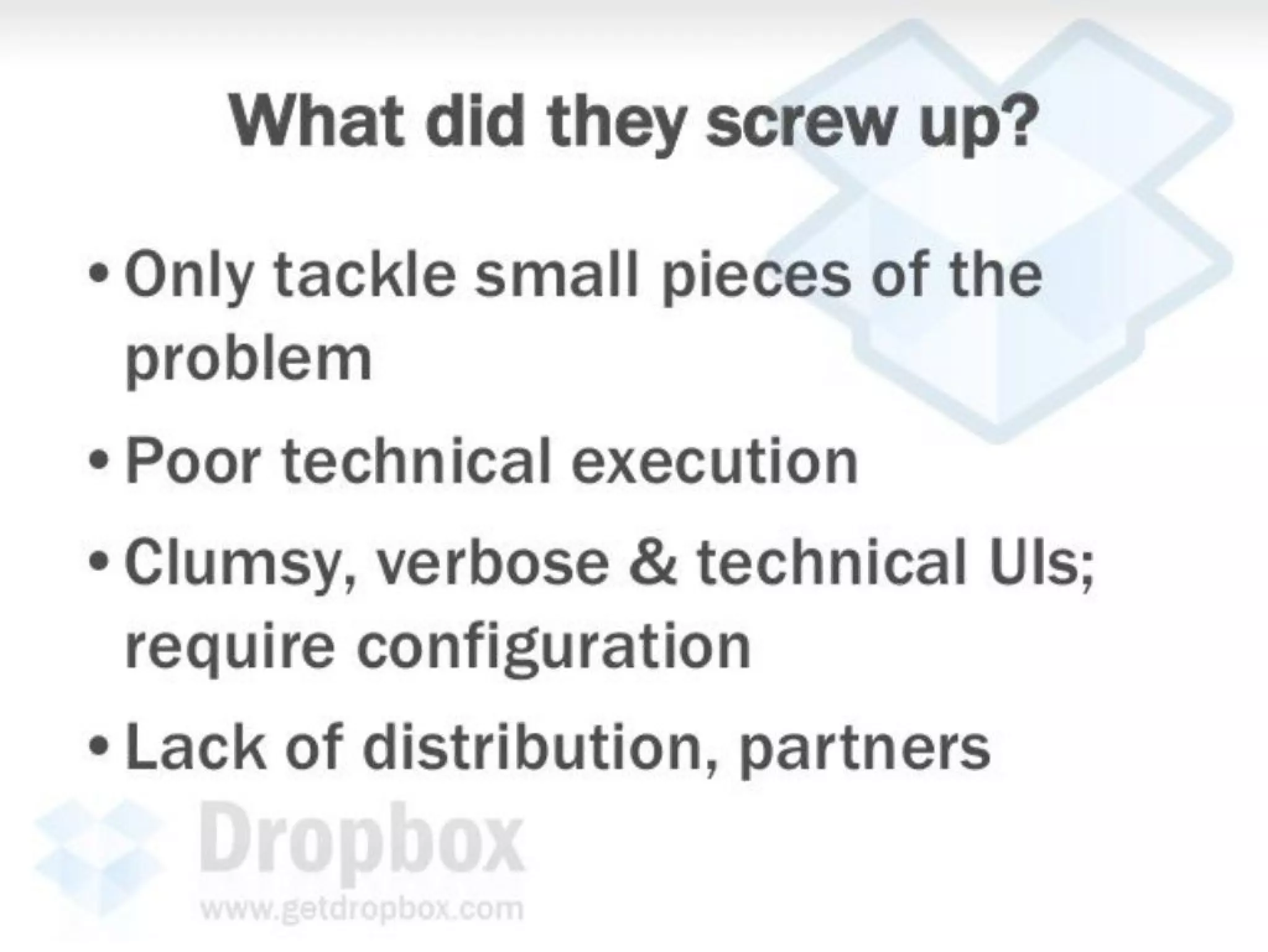
Slide 11: Why Competitors Failed

The deck critiques competitors on four dimensions:

  1. Scope: Only tackle small pieces of the problem
  2. Execution: Poor technical execution
  3. UX: Clumsy, verbose, technical UIs; require configuration
  4. Go-to-market: Lack of distribution and partnerships

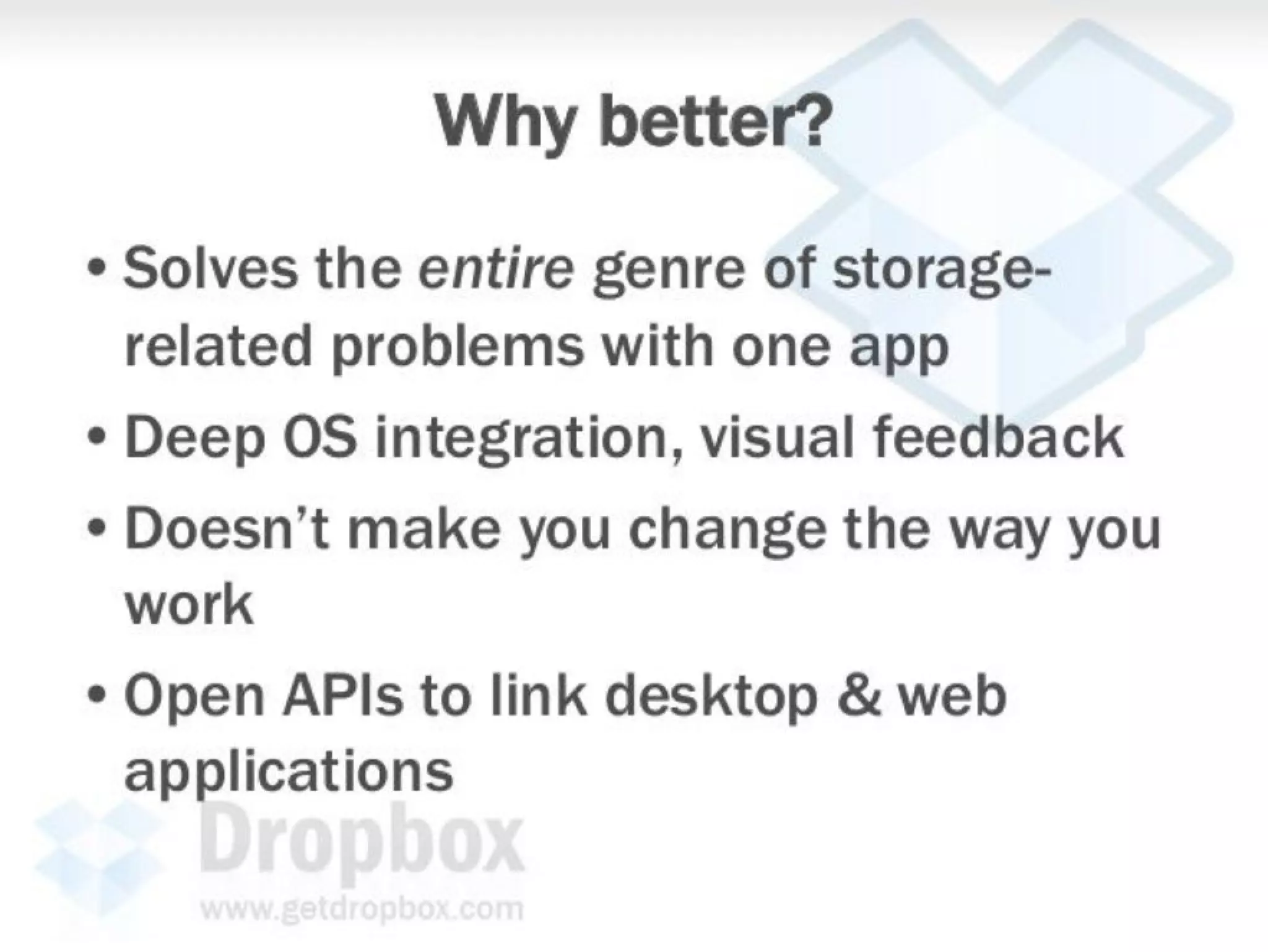
Slide 9: Why Better?

Dropbox’s differentiation:

  1. Comprehensive solution - Solves entire genre with one app
  2. Deep OS integration - Visual feedback, seamless integration
  3. Behavioral compatibility - Doesn’t make you change the way you work
  4. Open APIs - Link desktop & web applications

Slide 12: Technical Advantages

  1. Python stack - 5-10x faster development time
  2. AWS infrastructure - Leverage S3, EC2 for scale & reliability
  3. Performance obsession - Core engineering focus
  4. Advanced features - Compression, encryption, binary diffing, failure recovery

Strengths of Positioning:

  • Clear feature parity + superiority matrix
  • Specific competitor names (not generic “competitors”)
  • Multi-dimensional differentiation (scope, UX, execution, go-to-market)
  • Technical credibility (Python, AWS, binary diffing)

Weaknesses:

  • Competitor selection is somewhat dated (Carbonite/Mozy were backup-focused, not direct sync competitors)
  • No pricing comparison
  • Oversimplified binary yes/no matrix (doesn’t capture nuance)
  • Claims about “poor technical execution” lack supporting evidence
  • Missing some relevant competitors (Amazon S3, iDisk, etc.)
Team

Slide 13: Founding Team

Drew Houston – CEO

  • Education: S.B. MIT EECS (Electrical Engineering and Computer Science)
  • Background:
    • First line of code at age 6
    • First startup at age 14
    • Founded online SAT prep company after multiple perfect scores
  • Entrepreneurial track record: One prior startup (SAT prep)

Arash Ferdowsi – CTO

  • Education: S.B. MIT EECS (on leave from MIT)
  • Background:
    • Director of MIT programming competition
    • Prior experience at Google
  • Technical credibility: MIT competition leadership, Google experience

Team Composition:

  • 2 founders (no other team members mentioned)
  • Both MIT EECS (elite technical pedigree)
  • Complementary skills: CEO (business/product) + CTO (technical)
  • Combined experience: Entrepreneurship + Google + MIT

Strengths:

  • MIT EECS is gold standard for technical credibility
  • Early coding passion (age 6) suggests lifelong commitment
  • Prior startup experience (Drew)
  • Google credential (Arash)
  • Complementary skill sets

Weaknesses:

  • Very small team - Only 2 founders; no mention of other engineers, designers, or business team
  • Limited business experience - Drew’s SAT prep company is only business reference; no enterprise sales/ops background
  • Arash on leave from MIT - Suggests part-time commitment or uncertainty about full-time focus
  • No advisors mentioned - Seed stage typically has strong advisor network
  • No diversity - Both male, both MIT EECS (homogeneous background)
  • No hiring plan - Doesn’t mention how they’ll scale the team

Go-to-Market Strategy

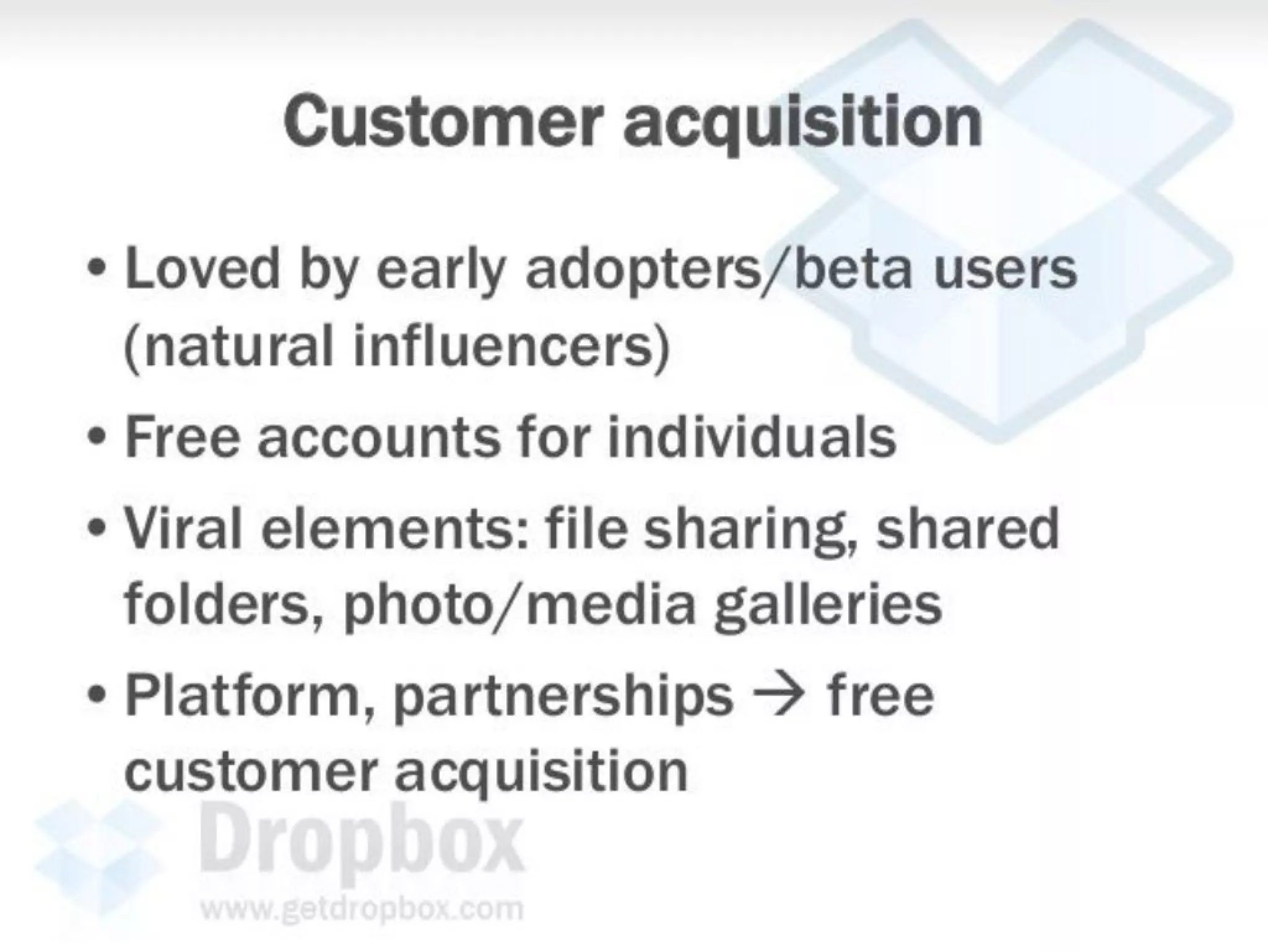
Slide 16: Customer Acquisition

Four acquisition channels:

  1. Early adopters/beta users (natural influencers)
    • Seeding product with influential early users
    • Relying on word-of-mouth
  2. Free accounts for individuals
    • Freemium model drives adoption
    • Low friction to try
  3. Viral elements
    • File sharing (users invite others to access shared files)
    • Shared folders (team collaboration creates network effects)
    • Photo/media galleries (content sharing drives invites)
  4. Platform & partnerships
    • Web app integrations reduce CAC
    • Partner channels for distribution

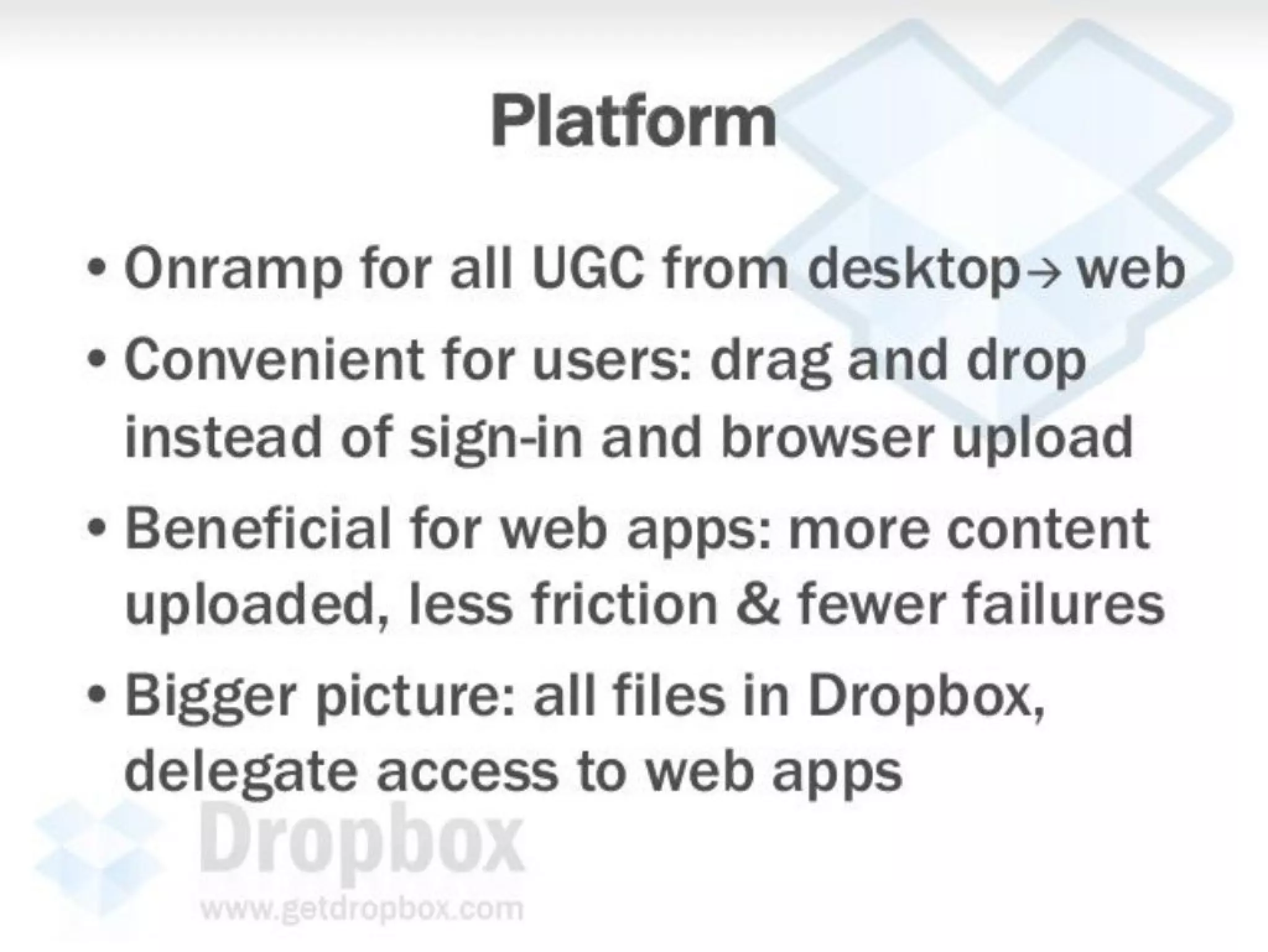
Slide 15: Platform Strategy

The platform vision is designed to drive viral adoption:

  • For users: Drag-and-drop convenience (vs. sign-in + browser upload)
  • For web apps: More content uploaded, less friction, fewer failures
  • Long-term vision: All files in Dropbox, delegate access to web apps

Strengths:

  • Recognizes built-in virality through sharing mechanics
  • Multi-channel approach (organic, free tier, partnerships)
  • Specific viral features identified (file sharing, shared folders, galleries)
  • Platform strategy creates ecosystem lock-in

Weaknesses:

  • No paid acquisition mentioned - No marketing budget, paid channels, or CAC targets
  • No partnership details - Which partners? What’s the incentive structure?
  • No traction data - Current user numbers, growth rates, or viral coefficient
  • Enterprise strategy missing - How to acquire SMB customers? Sales team? Resellers?
  • No retention metrics - Focuses on acquisition, not lifetime value
  • Vague on “natural influencers” - Which early adopters? How to reach them?

The Ask

Notable Absence: The deck does not explicitly state the funding ask or use of proceeds.

What we know:

  • Round: Seed ($1.2M raised)
  • Timing: 2007
  • Context: Y Combinator summer 2007 cohort (YC likely provided $20-30K)
  • Burn rate: Not mentioned

Implied use of proceeds (inferred from context):

  • Engineering team expansion (only 2 founders)
  • Infrastructure/AWS costs
  • Office space (just moved in May 2007)
  • Possibly some marketing/partnerships

Analysis: The absence of an explicit ask is notable. Modern pitch decks typically include a clear “The Ask” slide stating:

  • Funding amount
  • Use of proceeds (with allocation percentages)
  • Runway/burn rate
  • Hiring plan

This omission suggests either:

  1. The ask was discussed verbally, not in the deck
  2. The deck was designed for general circulation, not specific investor meetings
  3. 2007 norms didn’t require explicit asks in written decks

Key Takeaways

What Dropbox Did Right

  1. Lead with the problem, not the solution - The deck opens with a relatable problem that makes the solution feel inevitable
  2. Focus on user experience as differentiation - Rather than technical features, emphasize ease of use and behavioral compatibility
  3. Use specific, named competitors - Provide a feature matrix and explain why competitors failed
  4. Identify macro tailwinds - Show why the market is ready for this solution now
  5. Tell a coherent story - Each slide builds on the previous one; the narrative feels inevitable
  6. Demonstrate founder credibility - MIT EECS + prior startup + Google experience creates confidence

What Dropbox Did Poorly (or Omitted)

  1. No traction metrics - Zero user numbers, growth rates, or revenue data
  2. No market sizing - Qualitative opportunity but no TAM/SAM/SOM estimates
  3. No financial details - No pricing, no revenue projections, no unit economics
  4. No explicit ask - Doesn’t state funding amount or use of proceeds
  5. Very small team - Only 2 founders; no indication of hiring plan or team scaling
  6. Vague business model - Three segments outlined but no financial detail
  7. Missing enterprise strategy - SMB is a segment but go-to-market is unclear
  8. No security/privacy emphasis - Critical for file storage but barely mentioned

Contextual Factors

  • 2007 seed stage norms - Seed rounds were smaller, earlier-stage; traction expectations were lower
  • Y Combinator pedigree - Being ranked #1 among YC startups provided significant credibility
  • Product quality - The product demo and VentureBeat validation suggest the product was genuinely impressive
  • Market timing - The deck was pitched at an ideal moment (device proliferation, falling costs, emerging remote work)

Lessons for Modern Pitch Decks

  1. Problem clarity is foundational - Spend time making the problem visceral and relatable
  2. Traction matters - Even pre-revenue startups should show some proof of product-market fit (beta signups, engagement, growth rate)
  3. Market sizing is expected - Provide TAM/SAM/SOM estimates, even if rough
  4. Business model should be detailed - Include pricing, revenue projections, and unit economics
  5. Be explicit about the ask - State funding amount and use of proceeds clearly
  6. Address investor concerns proactively - Acknowledge risks and explain how you’ll mitigate them
  7. Show team depth - Highlight not just founders but also key hires, advisors, and board members

Investor Deep Dive

Executive summary, strengths & red flags

Executive Summary

The Dropbox seed pitch deck is a masterclass in problem-solution fit and simplicity. Rather than leading with technology or market size, the deck opens with a visceral problem statement ("Storage is a mess"), articulates four specific pain points that resonate universally, and positions Dropbox as a comprehensive solution that "just works." The deck's strength lies in its focus on user experience and behavioral compatibility—emphasizing that Dropbox doesn't force users to change their workflows. With only two MIT-credentialed founders and a product that had just moved into its first office (May 2007), the deck relies heavily on product elegance, competitive differentiation, and the emerging tailwinds of device proliferation and falling bandwidth costs to justify a seed investment.

Key Strengths

8 identified

1

Problem-Solution Fit is Crystal Clear

The deck opens with a relatable, visceral problem ("Storage is a mess") and articulates four specific pain points that resonate across multiple user personas. The solution directly addresses each p...

2

UX/Simplicity as Core Differentiation

Rather than leading with technical features or market size, the deck emphasizes that Dropbox "doesn't make you change the way you work" and "just works." This is a powerful positioning that acknowl...

3

Comprehensive Competitive Positioning

The deck doesn't just claim superiority—it provides a feature comparison matrix (Slide 10) showing Dropbox as the only product with all six key features. It then explains why competitors failed (Sl...

4

Technical Credibility Without Jargon

The deck demonstrates engineering depth (Python, AWS, binary diffing, encryption) without overwhelming non-technical investors. The claim of "5-10x faster development time" with Python is quantifie...

5

Prescient Market Timing

The deck identifies four macro tailwinds (device proliferation, larger files, distributed teams, falling costs) that all proved accurate. The "search pre-Google" analogy is powerful and suggests th...

6

Founder Credibility

Both founders are MIT EECS graduates with complementary skills (CEO + CTO). Drew's early coding passion and prior startup experience, combined with Arash's Google background and MIT competition lea...

7

Viral Growth Mechanics

The deck recognizes that file sharing, shared folders, and media galleries create natural virality. Rather than relying on paid acquisition, the business model is designed around organic growth thr...

8

Visual Design Consistency

The deck maintains consistent branding (Dropbox logo, light blue geometric shapes, clean typography) throughout. The design is professional without being overly polished, which is appropriate for a...

Red Flags & Weaknesses

10 identified

1

Zero Traction Metrics

The deck contains no user numbers, growth rates, conversion rates, revenue, or other quantitative proof points. For a product that had been in development for months and moved into its first office...

2

No Market Size Estimates

The deck identifies market tailwinds but provides no TAM/SAM/SOM analysis, no addressable market estimates, and no revenue projections. The "search pre-Google" analogy is evocative but not quantita...

3

Vague Business Model

The business model (Slide 14) outlines three segments but provides no pricing, no revenue projections, no unit economics, and no conversion assumptions. The "platform" segment's monetization is com...

4

Very Small Team

Only two founders are mentioned, with no indication of other team members, hiring plans, or organizational structure. For a product that requires infrastructure, client development, and business de...

5

Unsubstantiated Technical Claims

The claim that Python enables "5-10x faster development time" is quantified but not substantiated. There's no evidence provided, and competitors using different languages (C++, Java) might dispute ...

6

Competitor Analysis is Somewhat Dated

The competitors listed (Carbonite, Mozy) were primarily backup-focused, not direct sync competitors. The matrix oversimplifies by treating all features as equally important (sync vs. backup are dif...

7

No Explicit Ask or Use of Proceeds

The deck doesn't state how much they're raising or how they'll use the funds. While the $1.2M seed round is known from external sources, the deck itself is silent on this.

8

Missing Enterprise/SMB Go-to-Market Details

While the freemium consumer strategy is clear, the SMB go-to-market strategy is vague. How will they acquire SMB customers? Sales team? Resellers? Direct sales? No details provided.

9

Platform Strategy is Vague

The "platform" vision (Slides 14-15) of brokering UGC from desktop to web is interesting but poorly explained. What does this mean? How do web apps integrate? What's the incentive structure? How do...

10

No Mention of Security/Privacy

Encryption is mentioned casually (Slide 12) but there's no discussion of security, privacy, compliance, or data protection. For a product storing users' files, this is a notable omission.

More Pitch Decks To Study

Compare structure, fundraising context, and investor-facing story across similar startup decks.