Compare your deck to Deepgram

Compare Your Deck

Deepgram Pitch Deck (2018)

Ai
Stage: Seed
Raised: $12M
Year: 2018
Slides: 19
Outcome: Raised $229M total; valued at ~$600M

Pitch Deck

1 / 19
Deepgram pitch deck - The Opening: Clear positioning and contact
Click to expand

Deck Analysis

This pitch deck from Deepgram (Seed, 2018) presents a focused, data-driven story: speech recognition for enterprise is broken, Deepgram has a technical approach that measurably improves accuracy, and a repeatable data flywheel will scale the solution. The company leans heavily on clear before/after metrics, product differentiation (trained models per customer), and operational details (labeling, training, GPU inference) to build investor confidence. Notable strengths include crisp problem framing, strong quantitative claims, a defensible technical flywheel, and a compact team slide that highlights relevant domain expertise.

The Opening: Clear positioning and contact

The Opening: Clear positioning and contact

Slide 1 is a minimal, brand-forward title slide that immediately communicates the company's focus: "Next Gen Speech Recognition for Enterprise." It includes a contact block, which signals readiness for follow-up and makes the deck feel like a professional sales/raise document rather than an academic presentation. The design is stark and consistent with the rest of the deck — dark background, strong logo, and a single clear line of value.

As a founder lesson, this shows the value of a succinct headline and accessible contact info up-front. You don't need to cram the first slide with a long manifesto; instead, use it to orient the audience and set a professional tone that the rest of the deck will support.

Key Takeaway: Start with a single, unambiguous positioning statement and make it easy for investors to follow up by including contact details on the opening slide.
Problem: Quantify the market pain

Problem: Quantify the market pain

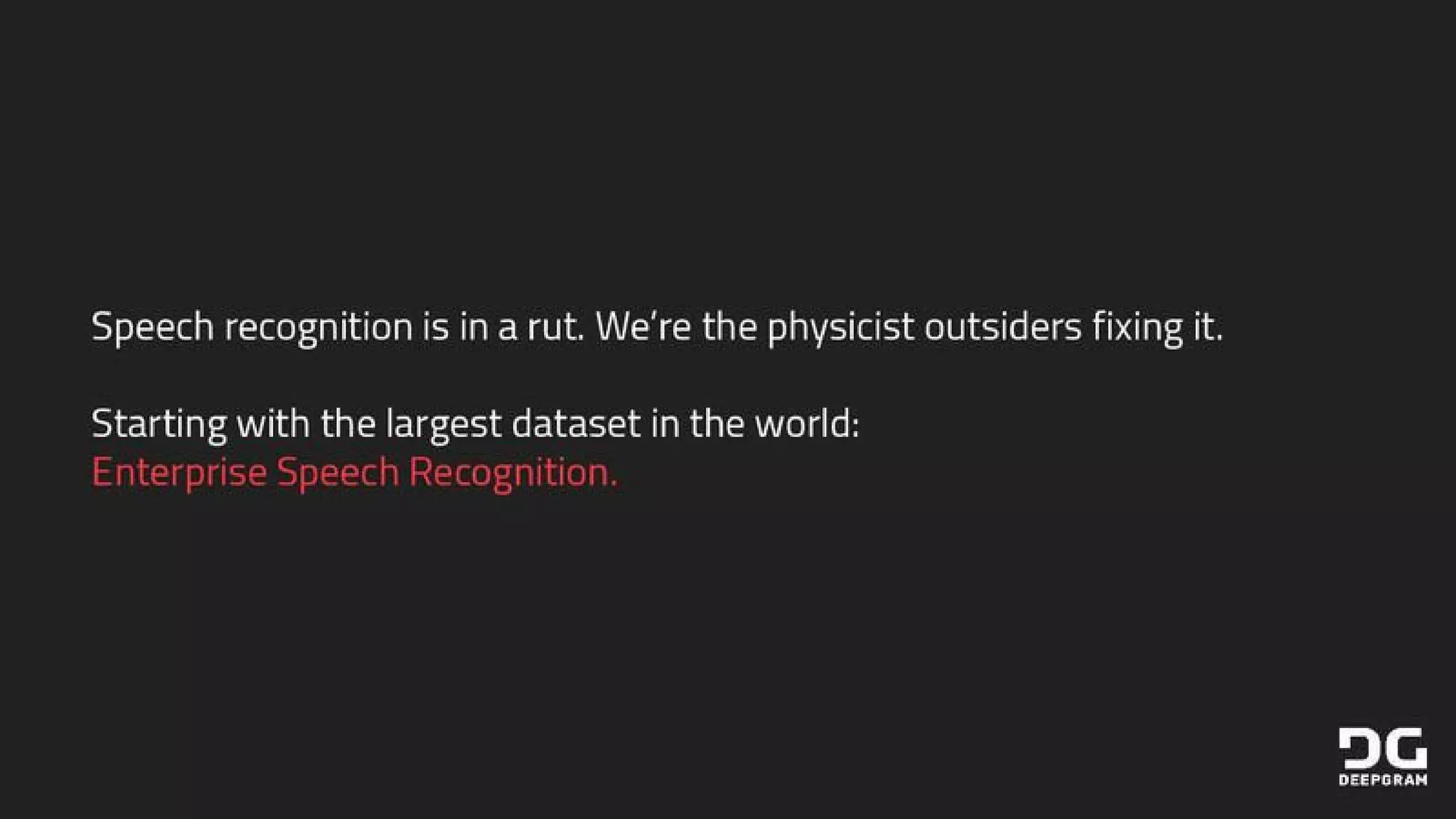
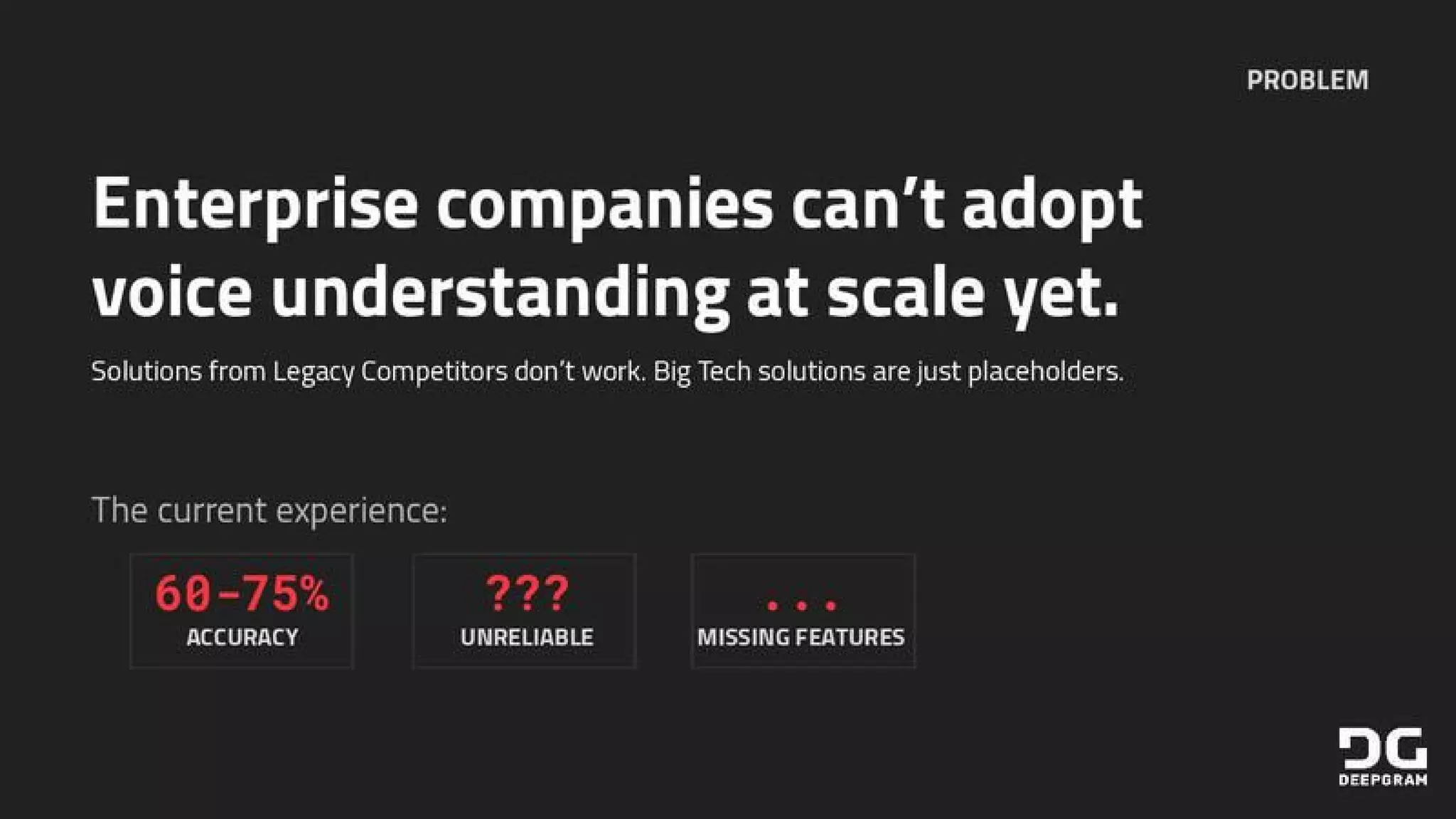
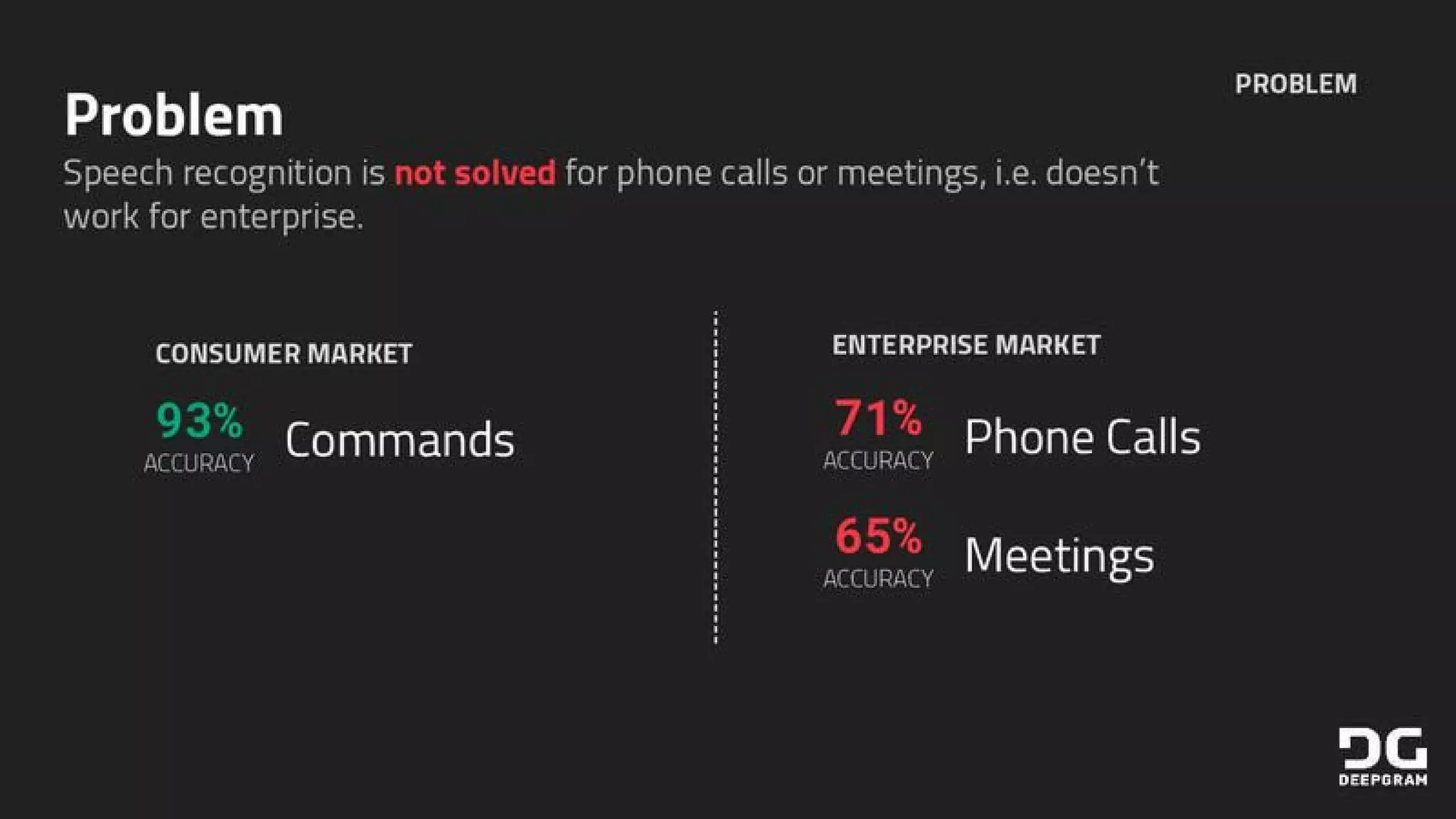
Slides grouped around the problem (notably slide 4 and surrounding slides) quantify why existing speech solutions fail for enterprise use cases: consumer command recognition is high (93%) but phone calls and meetings hover in the 65–71% accuracy range. The deck uses stark contrasts (green for consumer, red for enterprise shortfalls) to drive home that current technology isn't fit for purpose. The problem statement is tightly linked to the financial and adoption barriers — enterprises can’t adopt voice understanding at scale because legacy and big tech solutions are inaccurate, unreliable, and missing features.

This approach is effective because it combines a crisp articulation of the unmet need with hard numbers. For founders, this is a reminder that a compelling problem slide needs both a concrete human/business consequence and quantifiable evidence showing the gap your product will close.

Key Takeaway: Don’t just say the market is broken — show the numeric gap between current solutions and what customers actually need to justify why your product matters.
Solution: Demonstrate measurable gains and the method

Solution: Demonstrate measurable gains and the method

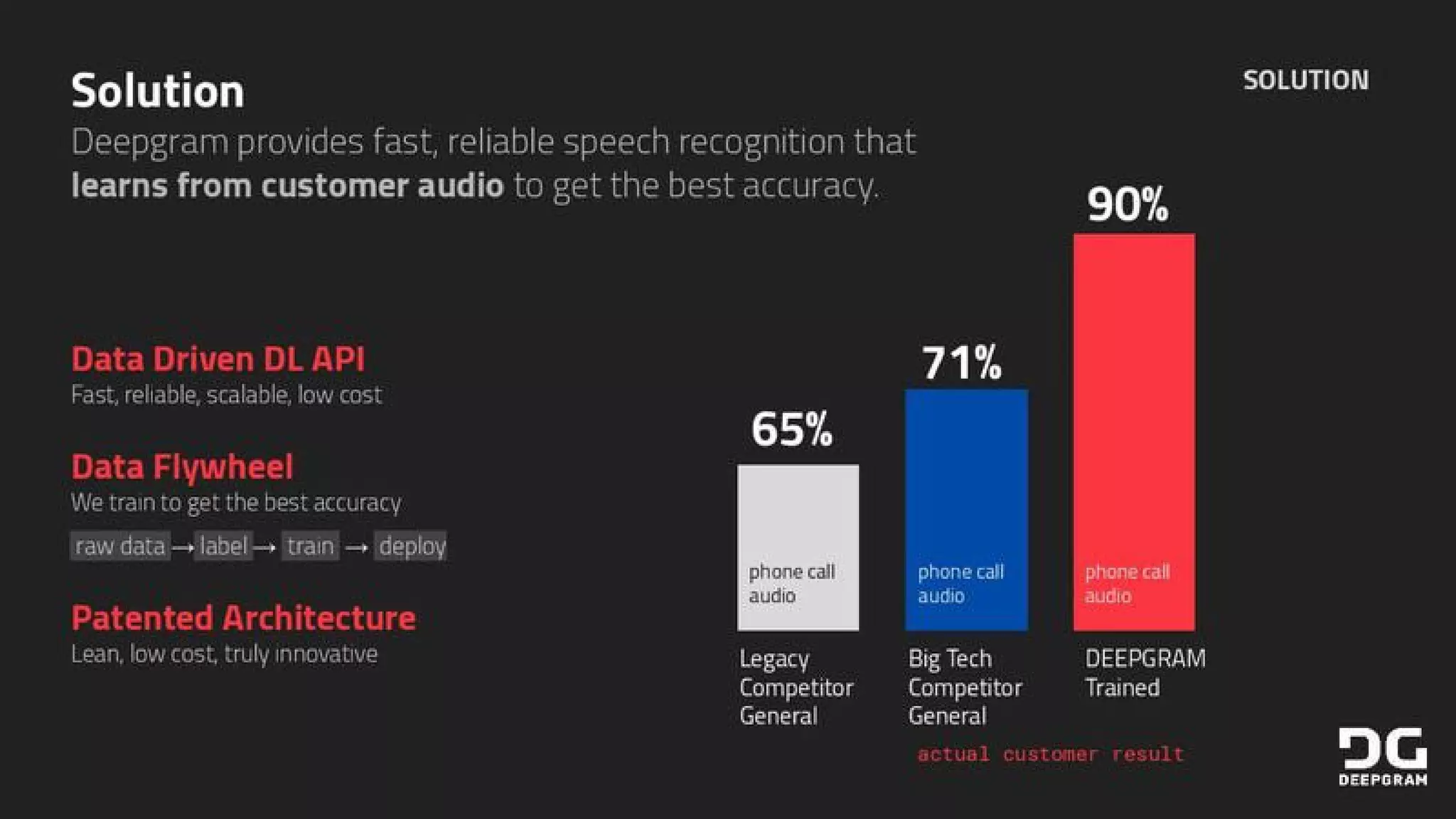
Slide 6 pairs a short description of the approach (data-driven DL API, data flywheel, patented architecture) with a clear bar chart showing real accuracy improvements: from legacy (65%) to big tech (71%) up to Deepgram trained (90%). The slide balances technical credibility (patented architecture, training loop) with business relevance (accuracy numbers). The visual emphasis on percentages and the step-up progression makes the value tangible and simple to grasp.

Founders should note how this slide ties the 'how' to the 'so what': the technical levers (data + model + compute) map directly to customer-facing outcomes (accuracy and cost). When possible, use concrete performance comparisons to competitors and explain the operational mechanism (flywheel/training) that will sustain the advantage.

Key Takeaway: Connect your technical differentiators directly to customer outcomes and use real comparative metrics to make the benefits obvious.
Differentiation: Show the improvement curve and the 'dial'

Differentiation: Show the improvement curve and the 'dial'

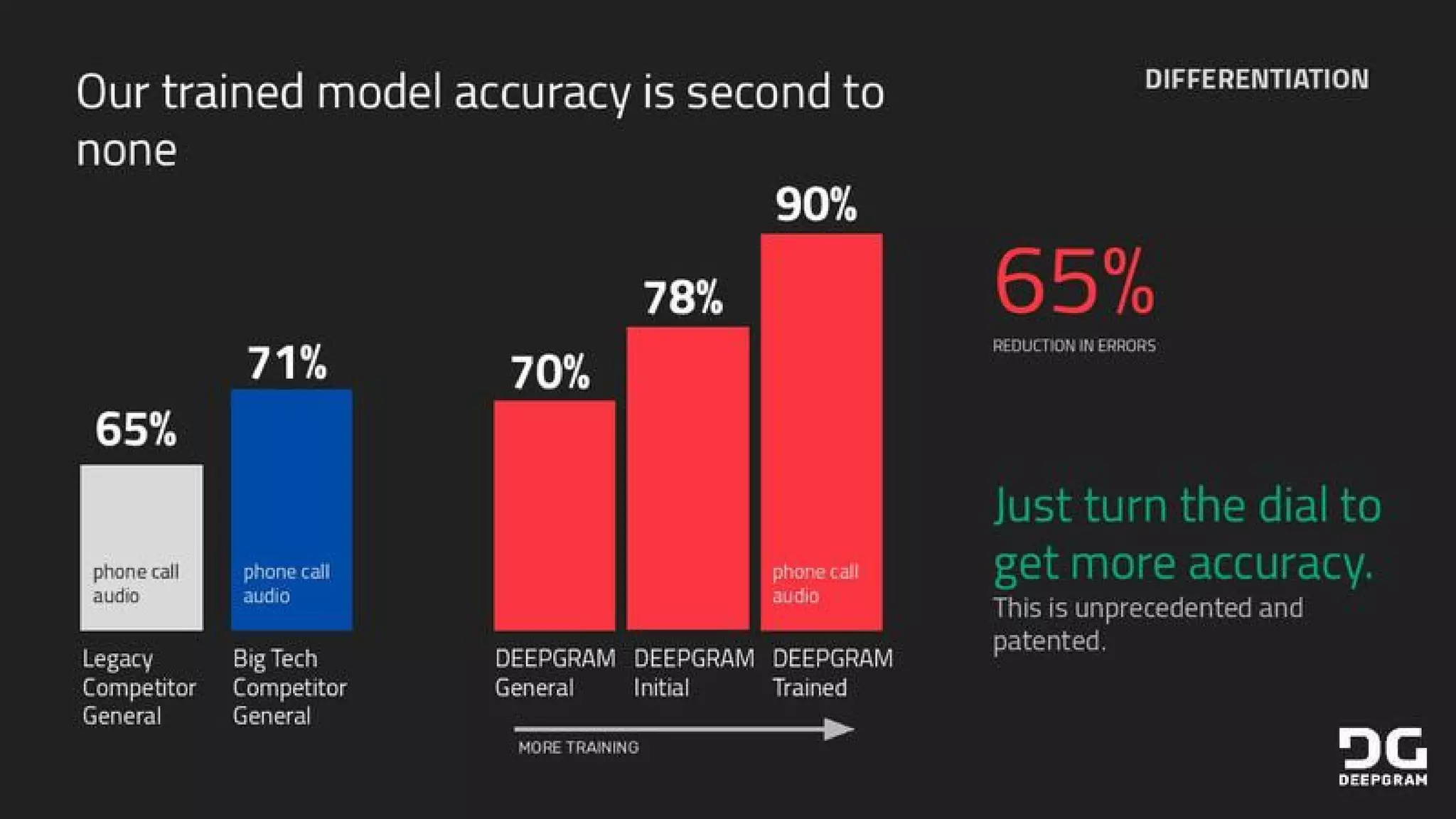
Slide 11 (differentiation/accuracy progression) emphasizes that Deepgram isn’t just incrementally better — it’s tunable via training, moving from a general model to an initial customer model to a trained bespoke model (70% → 78% → 90%). They also quantify "65% reduction in errors," which is a strong, investor-friendly metric. The slide explains the strategic advantage: a trained expert model approach beats one-size-fits-all models on enterprise call and meeting audio.

This is a strong example of how to present defensibility: instead of abstract claims, show a progression of performance that stakeholders (customers and investors) can understand and believe in. For founders, showing a path to continuous improvement (and that customers can improve accuracy by providing data) helps justify enterprise pricing and stickiness.

Key Takeaway: Make your competitive edge tangible by showing the stepwise improvement curve and how customers can increase value by feeding the flywheel.
Flywheel & Go-to-Market: Data labeling, training, and attraction

Flywheel & Go-to-Market: Data labeling, training, and attraction

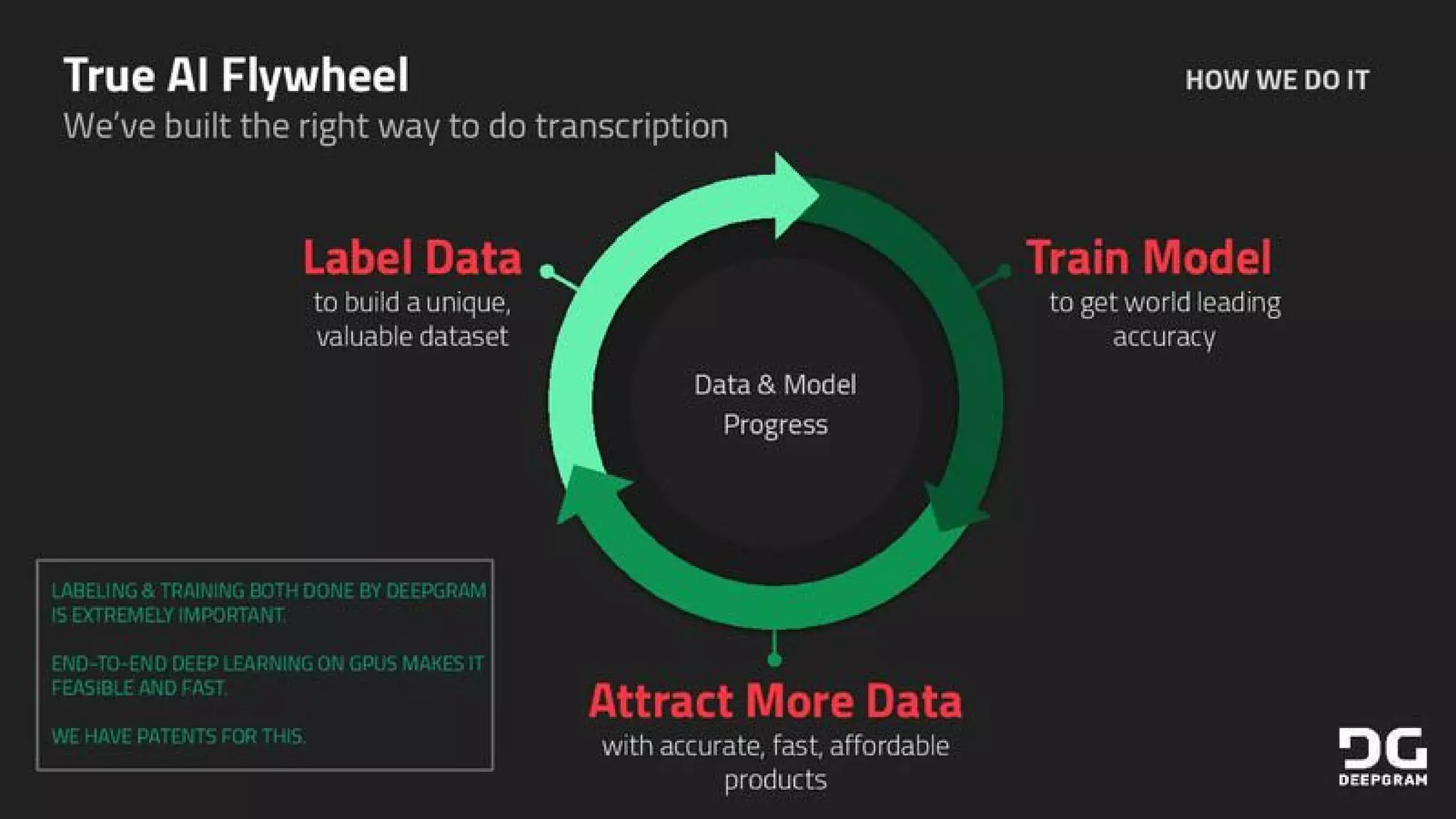
Slide 15 lays out the AI flywheel: label data → train model → attract more data. It’s visually clean and communicates a virtuous cycle that scales accuracy and defensibility as more enterprise customers onboard. The accompanying notes emphasize that labeling and training are performed by Deepgram (not outsourced), and that end-to-end deep learning on GPUs makes this economically feasible. This operational detail is crucial — it explains how progress happens and why it’s repeatable.

Founders should mimic this clarity: a defensible machine learning business needs a clear, operational flywheel that explains how customer interactions create proprietary assets. Present both the steps and why you control them (in-house labeling, proprietary infra) so investors understand why the advantage is sustainable.

Key Takeaway: Explain not just the model but the operational flywheel — who does the labeling, how training happens, and how customers feed the loop to create a defensible asset.
Training Workflow: From raw data to a deployable trained model

Training Workflow: From raw data to a deployable trained model

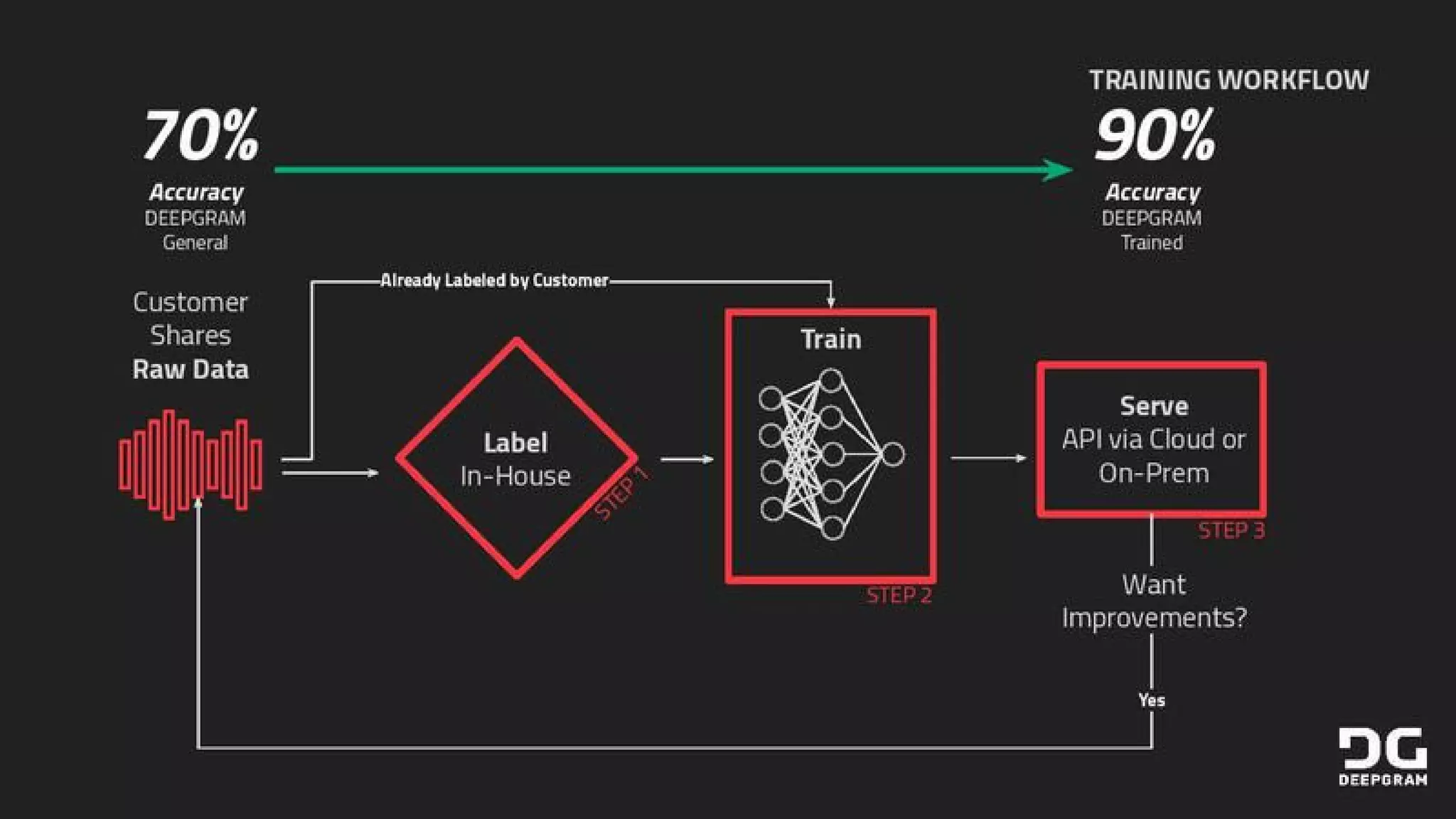
Slide 17 converts the flywheel into a pragmatic three-step workflow: customer shares raw data → label in-house → train → serve via cloud or on-prem. The slide also highlights the numeric uplift (70% general → 90% trained) which ties the process back to customer value. The depiction of the feedback loop (customers request improvements and feed more labeled data) clarifies how iterative improvements occur in production.

This slide’s strength is operational transparency: investors and enterprise buyers both benefit from a clear, repeatable process for getting from deployment to measurable improvement. Founders should include a simple workflow slide showing the integration points with customers and the feedback mechanisms that drive product maturation.

Key Takeaway: Map your end-to-end customer-to-model workflow simply and show how iterative customer inputs convert into measurable product improvements.
Team & Traction: Technical credibility and next steps

Team & Traction: Technical credibility and next steps

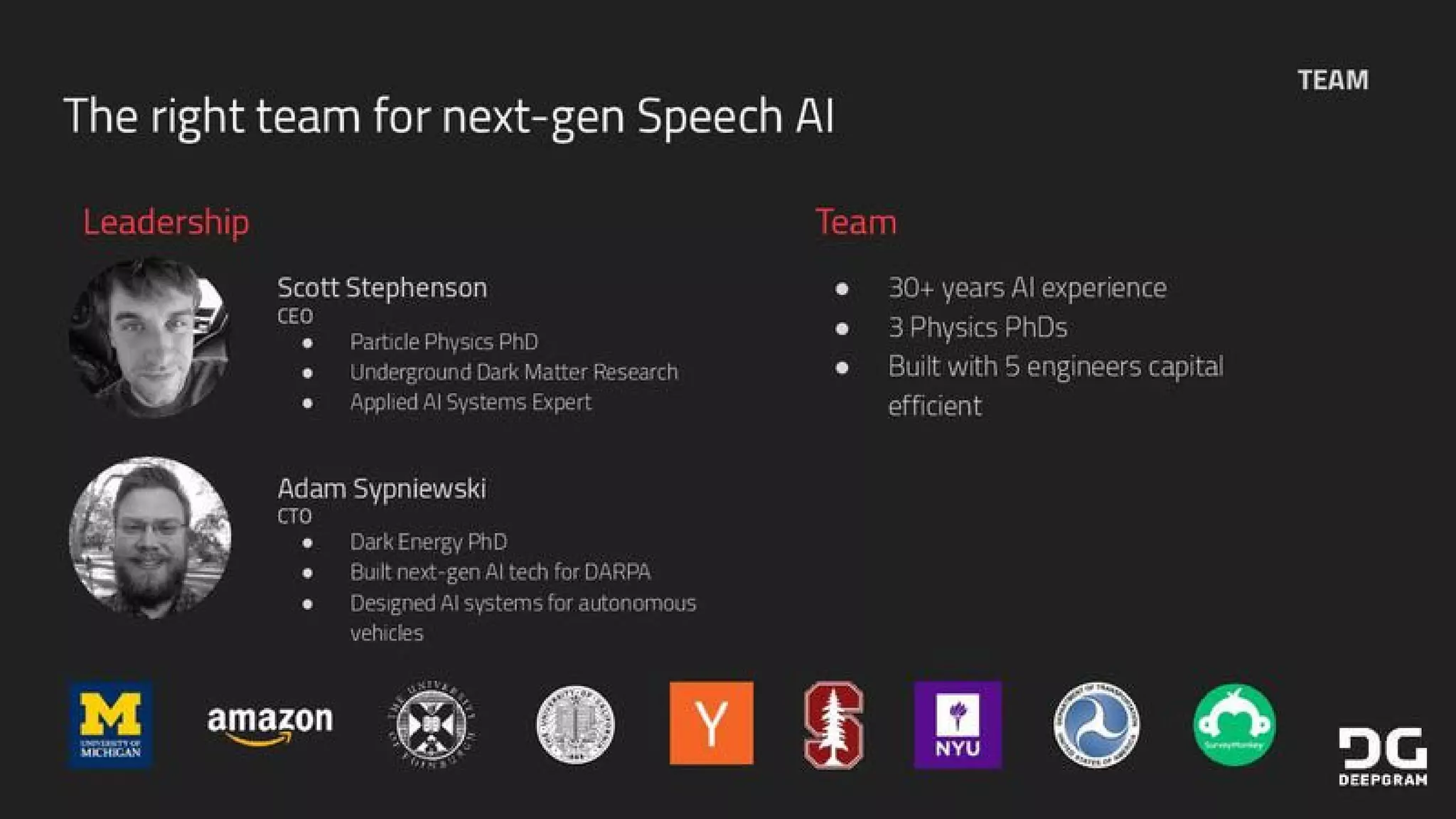
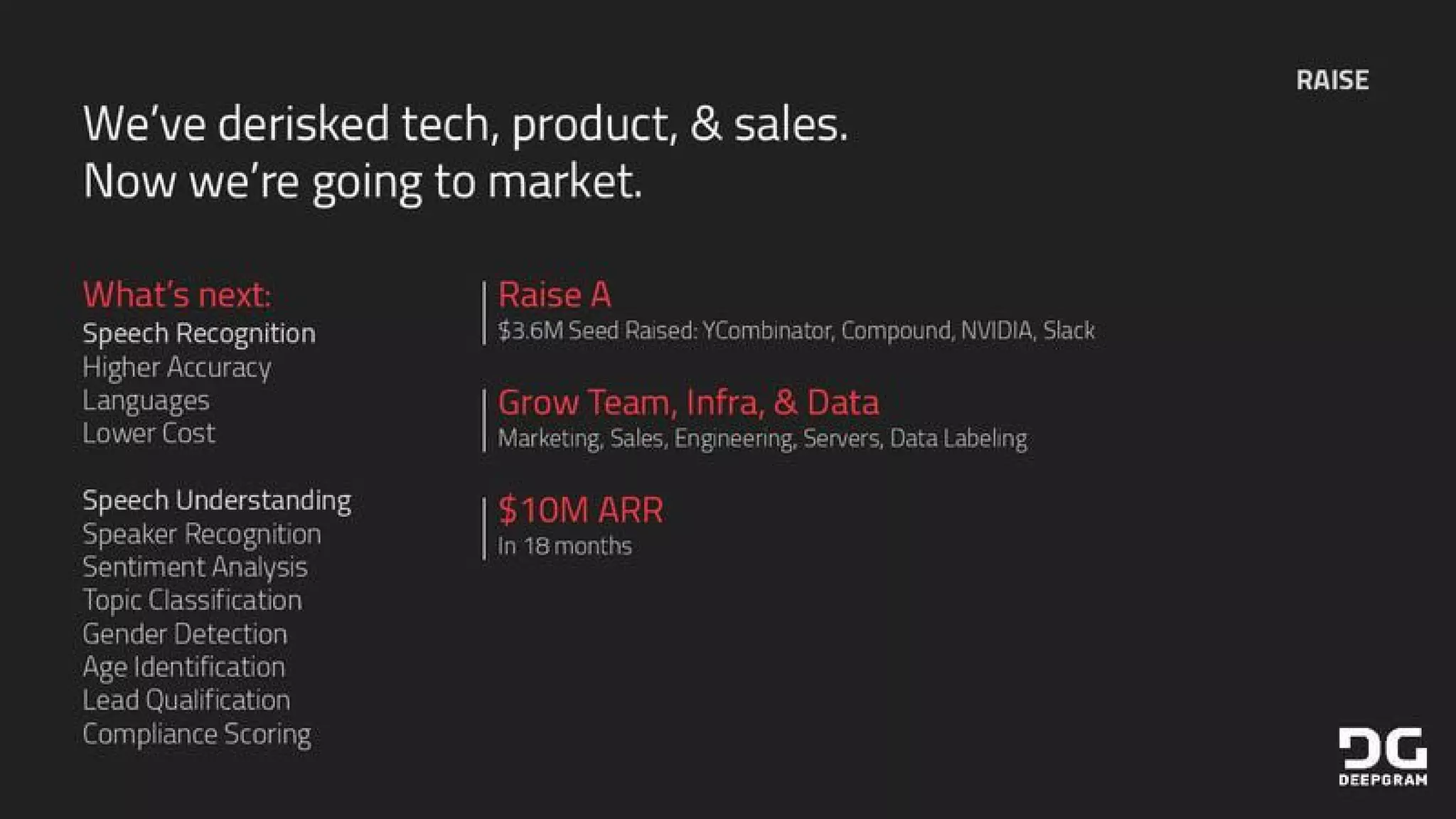
Slide 18 highlights leadership (particle physics and dark energy PhDs) and relevant cores of expertise (applied AI systems, DARPA experience), then shows institutional logos that imply validation and relationships. This combines technical pedigree with distribution/credibility signals. The adjacent raise/roadmap slide (19 in the sequence) outlines the next milestones (Raise A, grow team/infra/data, $10M ARR target) — pairing team strength with a clear business plan.

For founders, this is a reminder to balance technical credentials with a concrete plan and visible early traction or endorsements. Showing both domain expertise and practical milestones (funding needs, ARR targets) helps investors see the bridge from R&D to commercial scale.

Key Takeaway: Pair strong technical resumes with explicit go-to-market milestones and traction signals so investors can connect capability to execution and revenue goals.

Conclusion: Key Lessons

Deepgram’s deck succeeds by combining crisp problem framing, quantifiable before/after metrics, a defensible technical flywheel, and transparent operational workflows. Strengths to emulate: (1) quantify the customer pain and the competitive gap, (2) show concrete performance comparisons and a path to improvement, (3) explain the data/model/compute flywheel and who controls it, and (4) pair technical credibility with clear commercial milestones. Actionable advice for founders: lead with a single positioning line, back claims with measurable comparisons, map the operational steps customers will take to realize value, and present the team and roadmap that will execute the plan. Together these elements make a technical startup's pitch both believable and investable.

Full Deck Analysis

11 sections

Overview

Company: Deepgram
Round: Seed ($12M)
Year: 2018
Outcome: Raised $229M total; valued at ≈$600M


Executive Summary

Deepgram’s 2018 seed deck presents a tightly focused B2B transcription/voice-understanding company built around a data-driven deep learning stack and a “trained expert” approach for enterprise audio (phone calls, meetings). The deck is notable for clear technical differentiation (per-customer trained models, GPU inference speed), concrete accuracy claims versus incumbents, and an early enterprise traction story (90% accuracy, 4M minutes transcribed).


Problem Statement

How the deck articulates the problem:

  • Consumer speech recognition (voice commands) is largely solved, but enterprise scenarios (phone calls, meetings) are not — consumer accuracy ≈93% vs enterprise phone/meeting accuracy much lower (Slides 4–6).
    • Slide 4: “Speech recognition is not solved for phone calls or meetings” with numbers: Consumer/Commands 93% vs Enterprise Phone Calls 71% and Meetings 65%.
    • Slide 6: “Enterprise companies can’t adopt voice understanding at scale yet” — current experience boxes show 60–75% accuracy, unreliability, missing features.
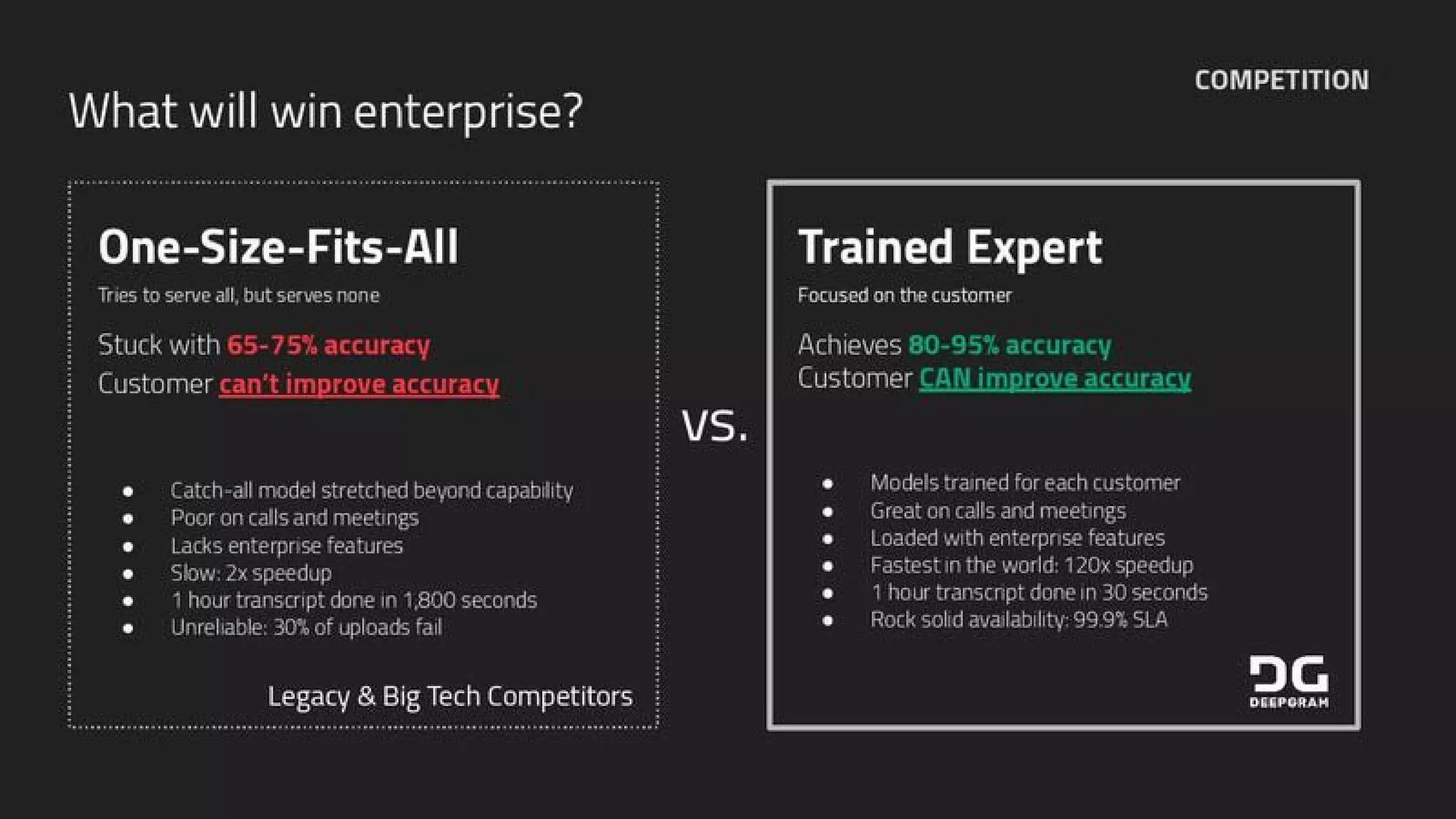
  • Legacy and big-tech “one-size-fits-all” models are insufficient for enterprise needs (features, reliability, accuracy) and customers need higher accuracy + enterprise features to pay (Slides 10–11).

Solution

How the deck positions the solution:

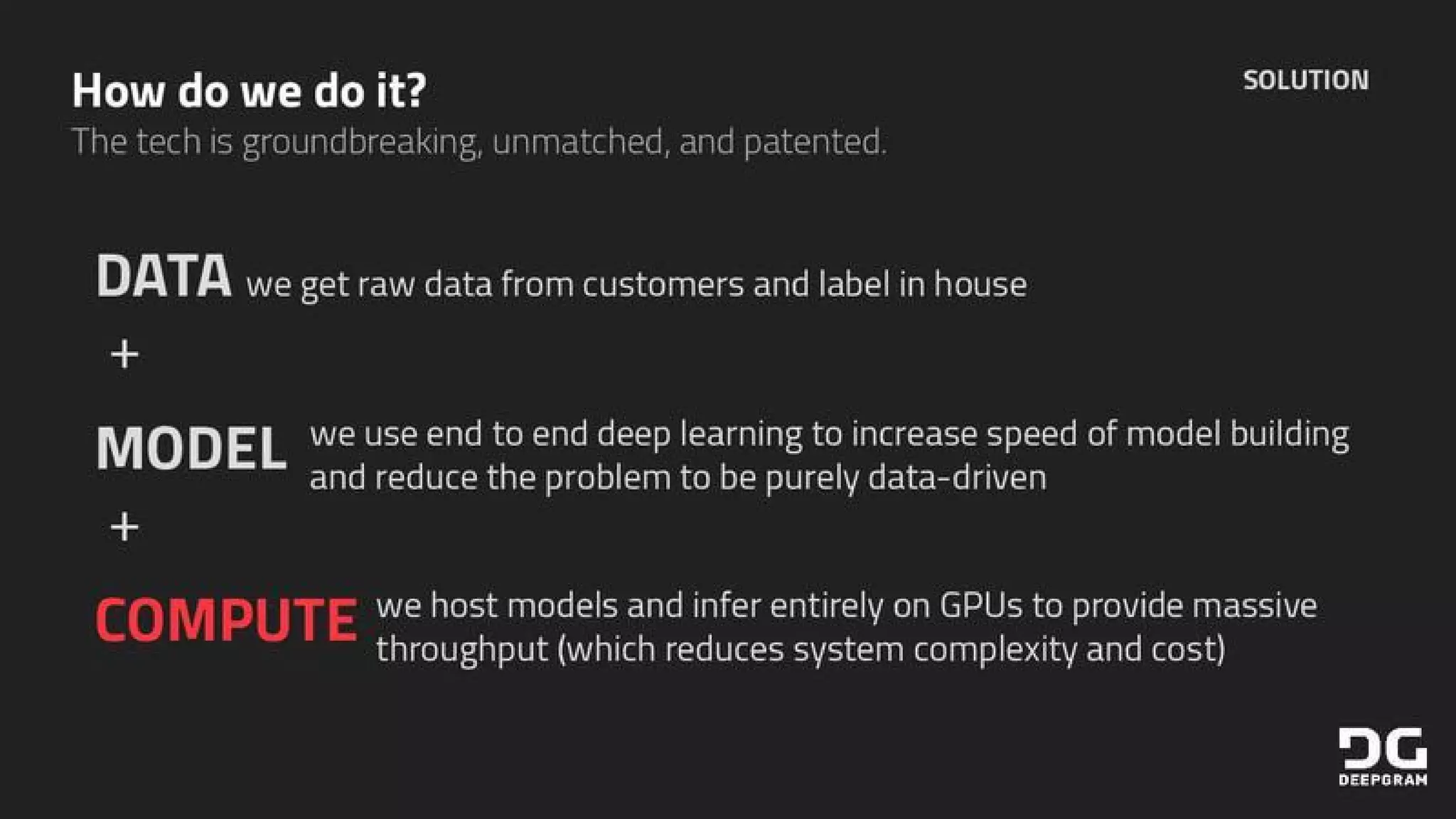
  • A data-driven deep learning API + “data flywheel”: ingest raw enterprise audio, label in-house, train per-customer models, and deploy (Slides 7, 15–16).
  • Patented architecture and GPU-only inference to deliver speed and lower system complexity/cost (Slide 7).
  • Demonstrated accuracy improvements from legacy/big tech baselines (65%/71%) to DEEPGRAM General → Initial → Trained (70% → 78% → 90%) for phone call audio (Slides 7, 11, 16).
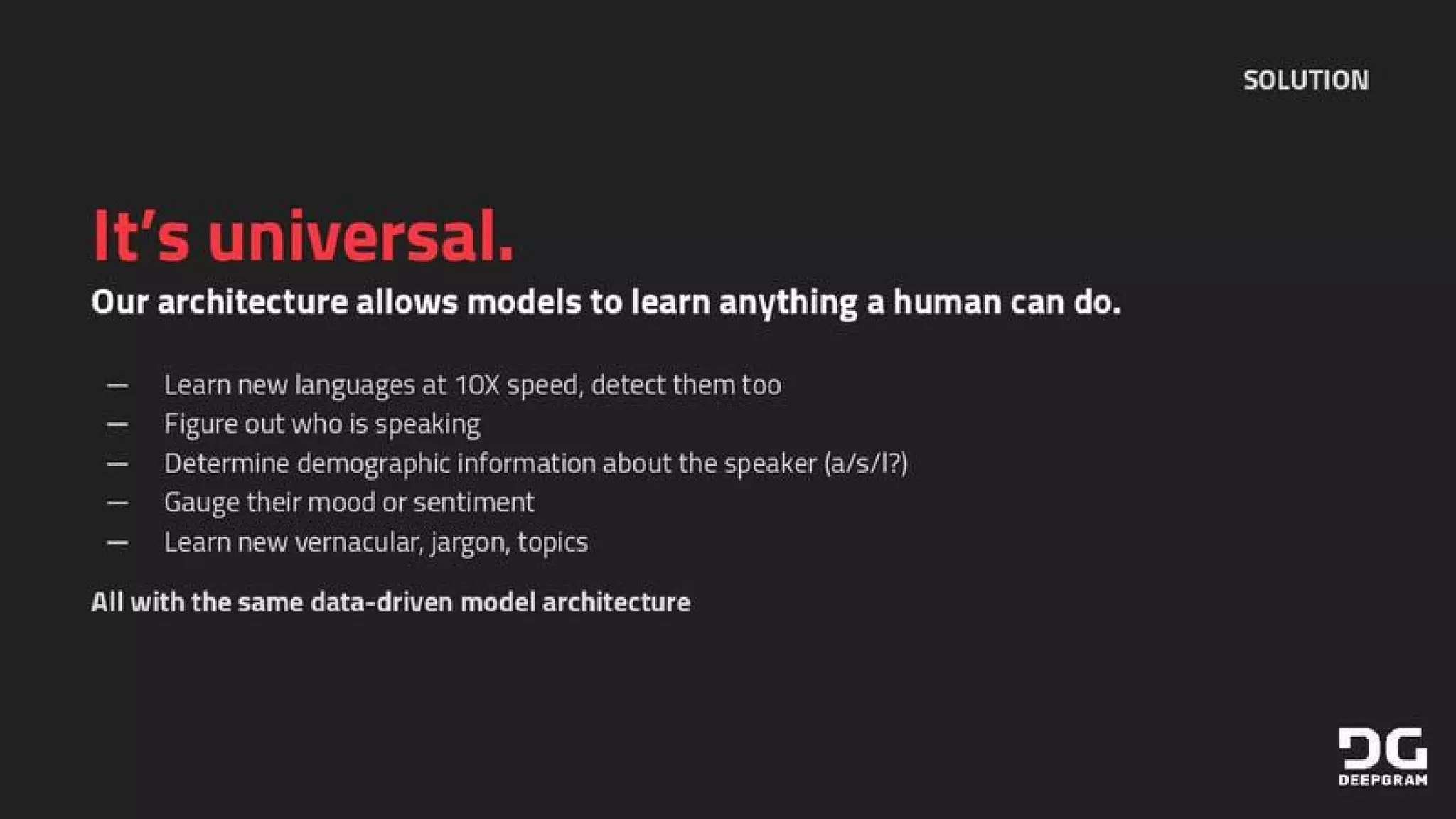
  • Universal architecture claims: learn languages fast, speaker ID, sentiment/mood, jargon, etc. — all with same model architecture (Slide 9).
  • Deployment flexibility for enterprise: Cloud API, dedicated VPC or on-prem (Slides 12, 16).

Market Opportunity

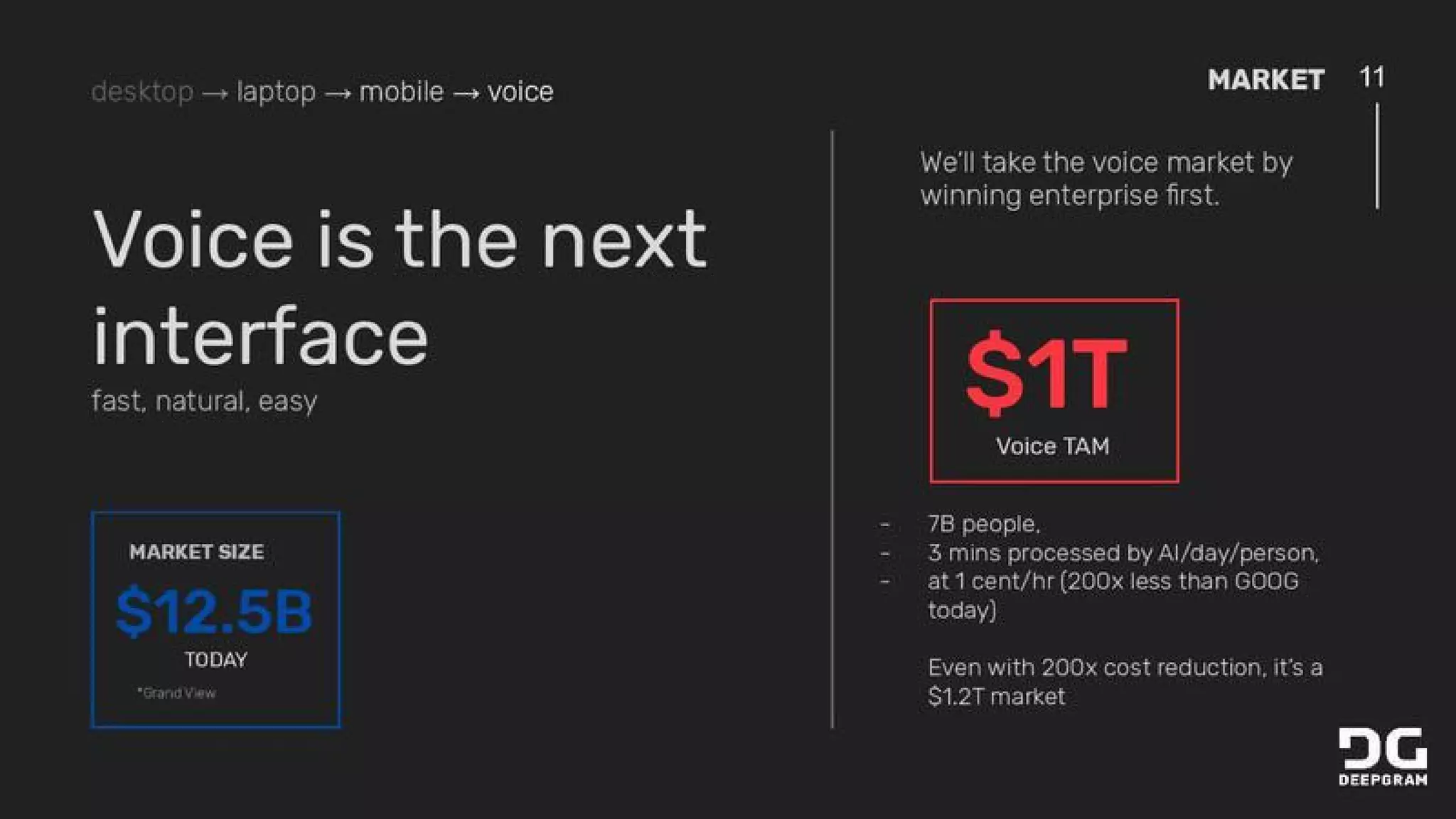
  • Immediate TAM shown: market size today $12.5B (Slide 19 left).
  • Larger voice TAM asserted: $1T Voice TAM (Slide 19 right) with supporting assumptions (7B people, minutes processed, cost reductions).
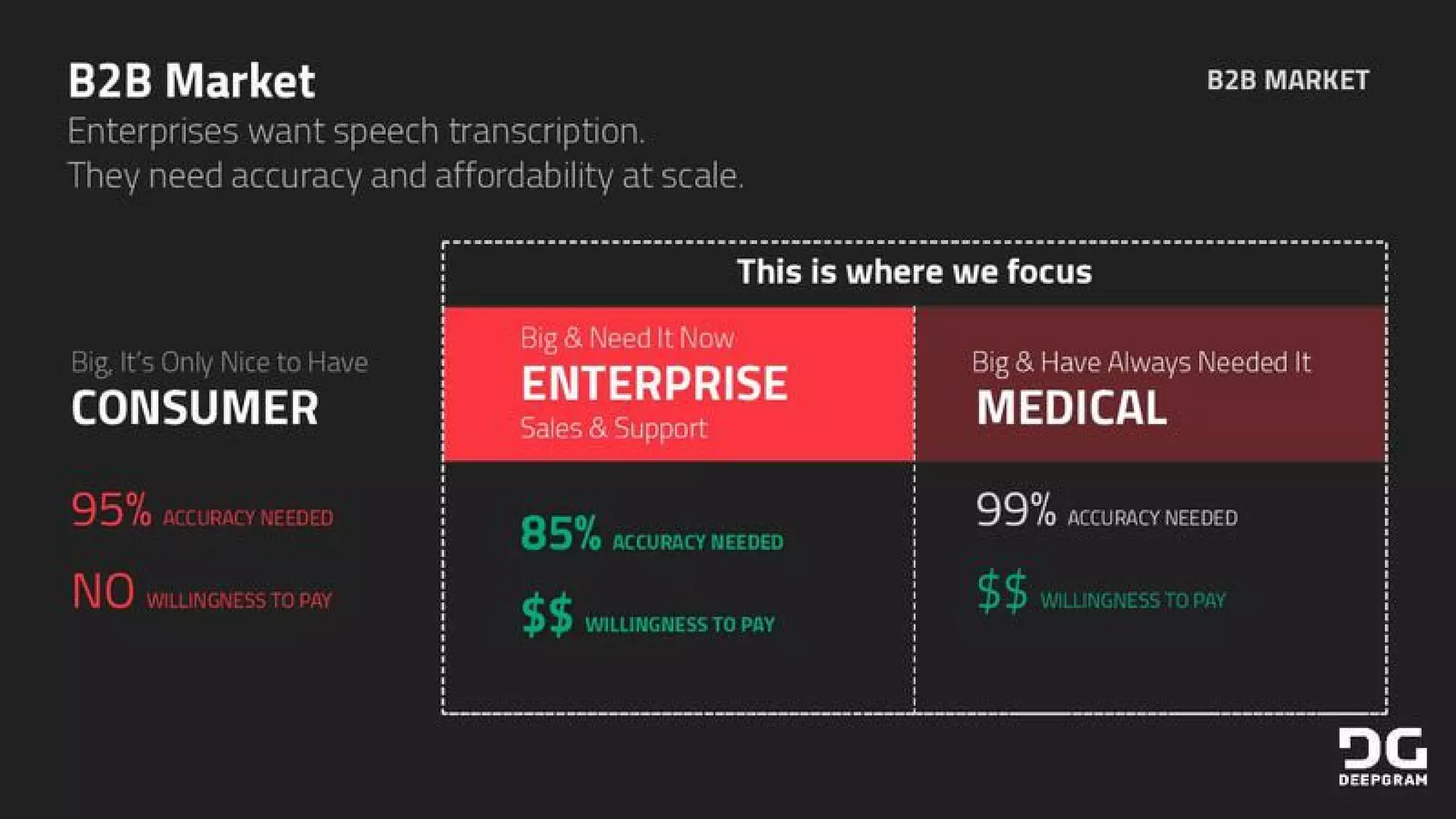
  • Target segments: Enterprise (sales & support) and Medical (high willingness to pay; slide 10 shows “This is where we focus” and accuracy needed: Enterprise 85% needed; Medical 99% needed).
  • Positioning: focus on customers who will pay for accuracy and features (Slide 10).

Business Model

  • Core revenue via API / productized speech-to-text offering, sold to enterprises and medical customers (Slides 12, 16).
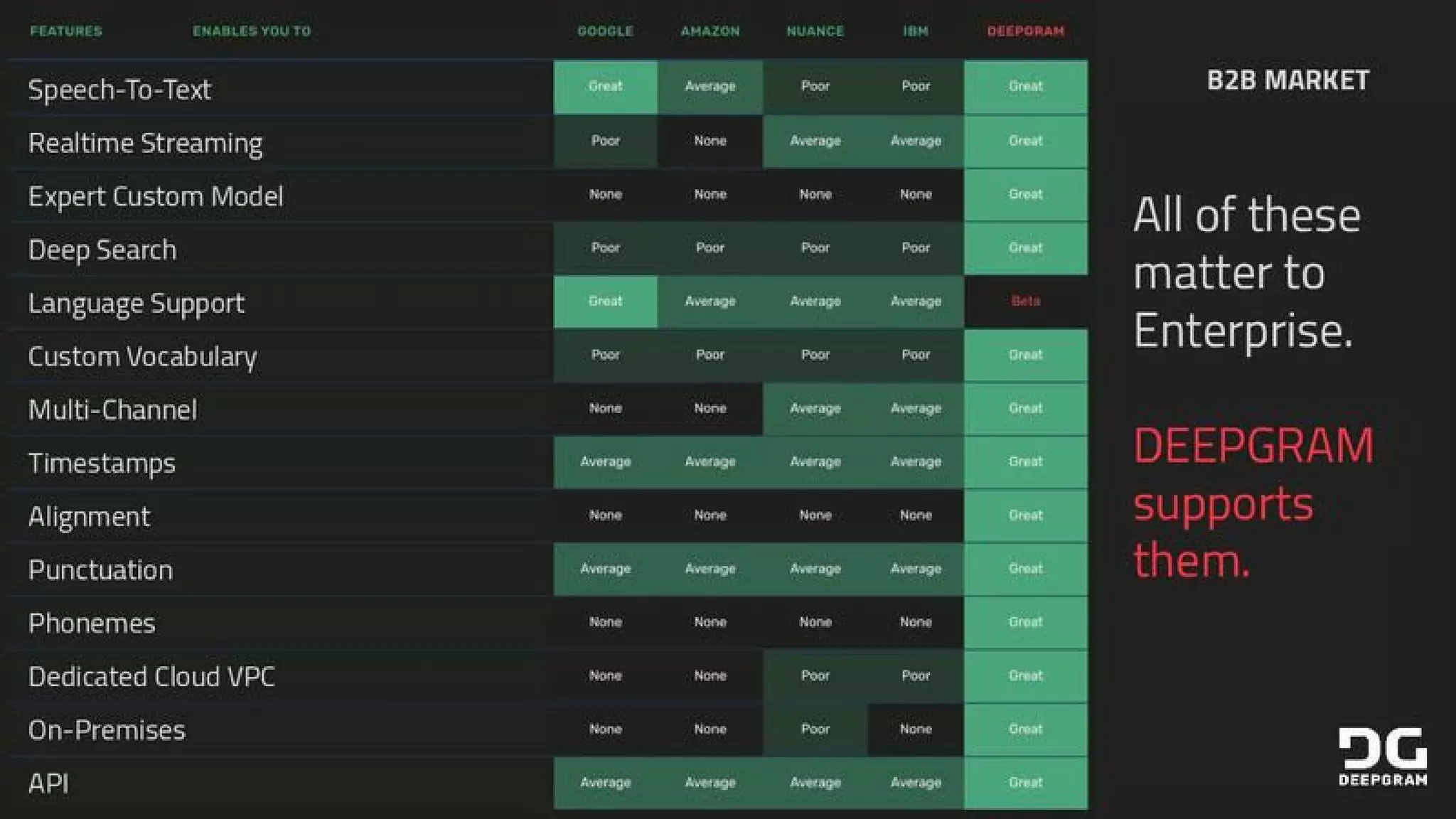
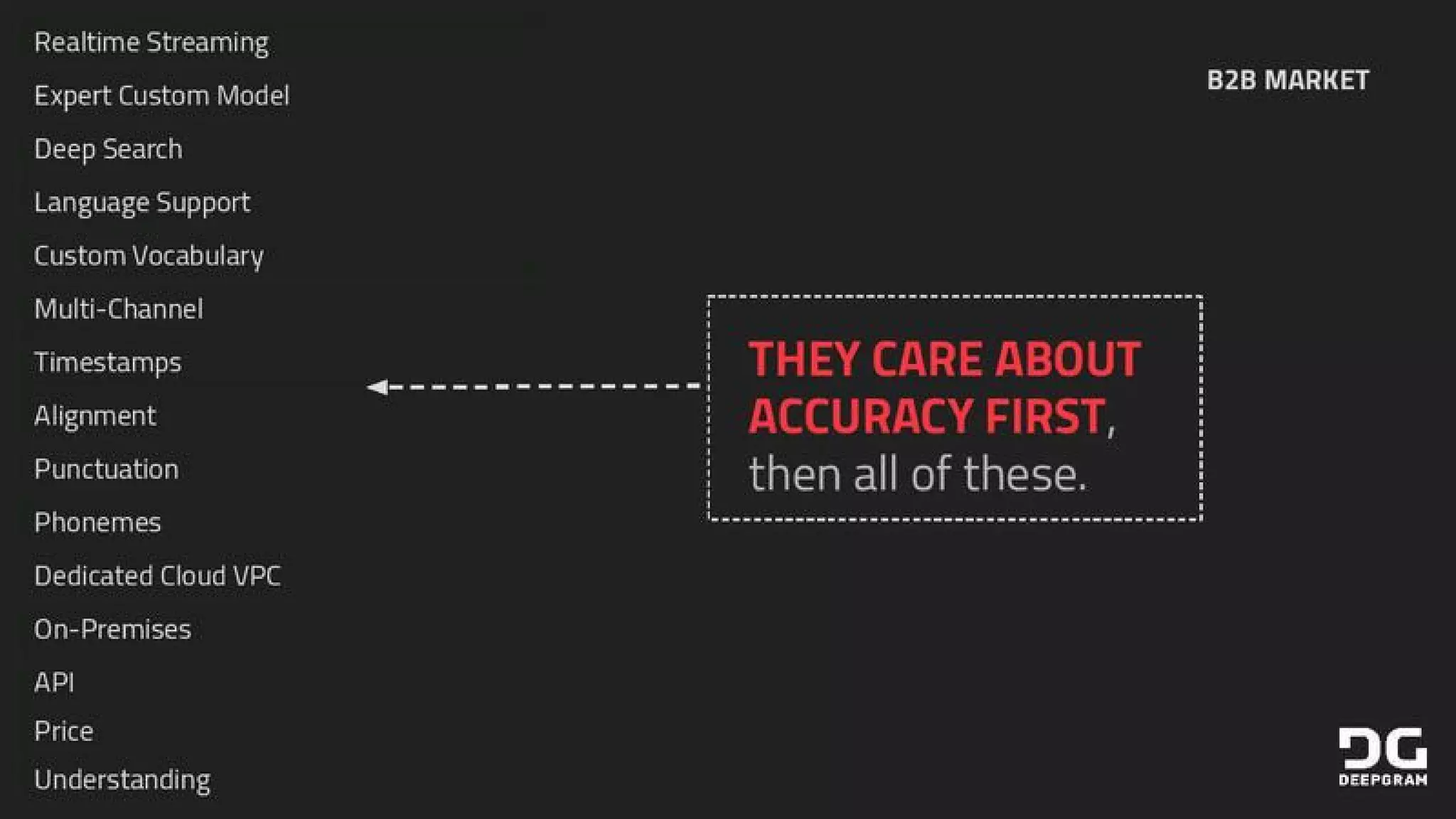
  • Enterprise-focused monetization: customers pay for higher accuracy, dedicated infrastructure (VPC / on-prem), custom models and enterprise features (custom vocabularies, multi-channel, timestamps, alignment, punctuation, phonemes — Slide 12).
  • Implied model: SaaS / usage-based (minutes transcribed) + higher-tier enterprise contracts for custom models, on-prem/dedicated hosting and SLAs. No explicit pricing or unit economics shown in the deck.

Traction & Metrics

  • Accuracy claims:
    • Legacy competitor (phone call audio): 65% (Slide 7, 11).
    • Big Tech competitor (general): 71% (Slide 7).
    • Deepgram trained: 90% (Slide 7, 11, 16).
    • Deepgram progression: General ≈70%, Initial ≈78%, Trained ≈90% (Slides 11, 16).
  • Customer proof points:
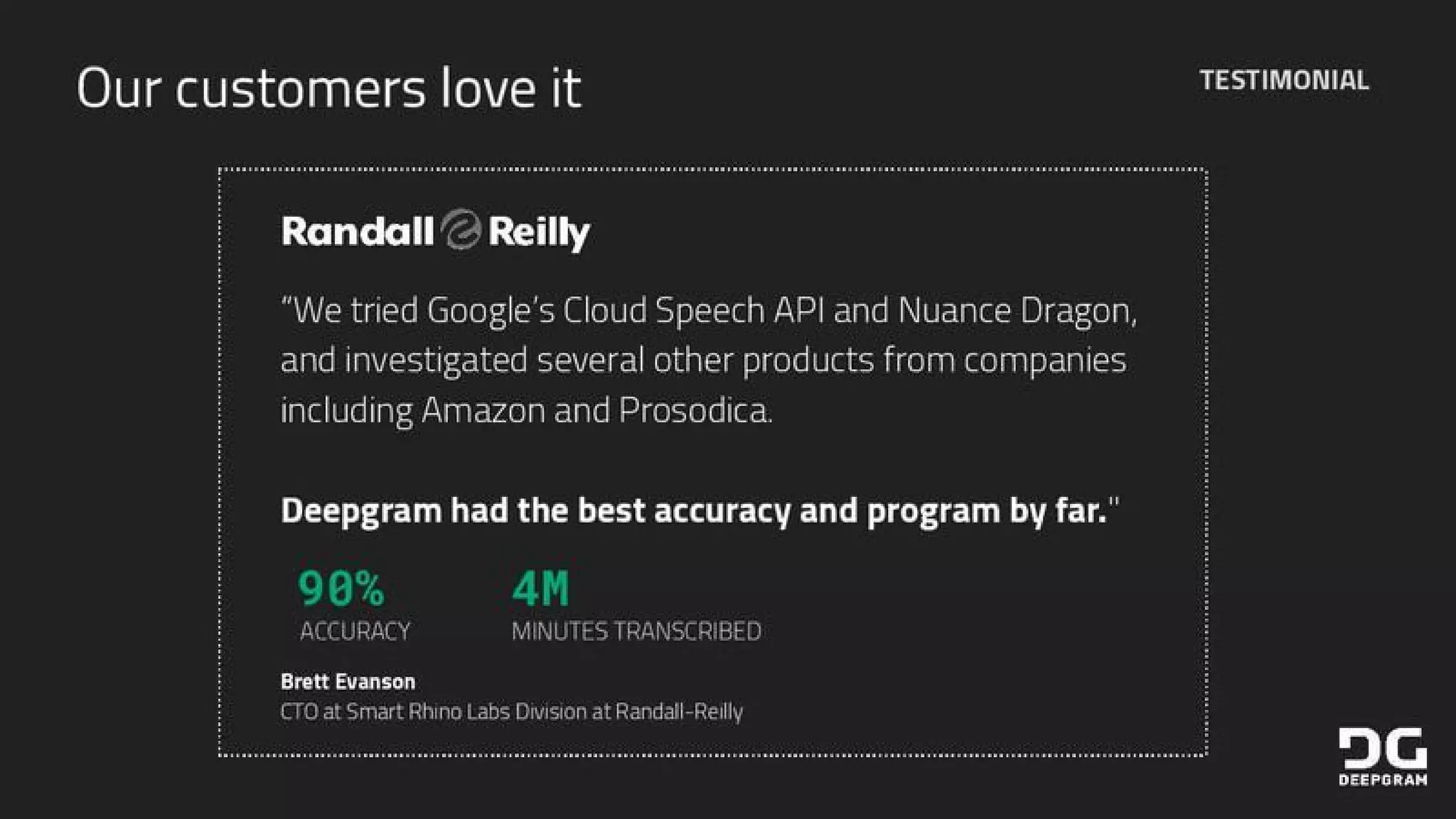
    • Randall-Reilly testimonial: “Deepgram had the best accuracy and program by far.” Reported 90% accuracy and 4M minutes transcribed (Slide 15).
  • Fundraising/financials:
    • Slide 18 lists seed raised $3.6M (YC, Compound, NVIDIA, Slack). Deck also describes plans (Raise A, grow infra/data/team) and a $10M ARR target in 18 months.
  • Performance claims:
    • Speed/scale claims: “Fastest in the world: 120x speedup,” “1 hour transcript done in 30 seconds” vs legacy “1 hour done in 1,800 seconds” (Slide 11).
    • Reliability claim: 99.9% SLA (Slide 11).

Competitive Positioning

  • Two contrasting plays (Slide 10–11):
    • “One-Size-Fits-All” (Legacy & Big Tech): catch-all models, 65–75% accuracy, poor on calls/meetings, limited enterprise features.
    • “Trained Expert” (Deepgram): per-customer trained models, 80–95% achievable accuracy, enterprise features, much faster inference and better reliability.
  • Feature matrix (Slide 12) shows Deepgram offers broad enterprise capabilities (Realtime Streaming, Expert Custom Model, Deep Search, Multi-channel, Timestamps, Alignment, On-Prem, Dedicated VPC, API) where others are average/none.
  • Differentiators: per-customer training, data flywheel (label → train → deploy), patents, GPU inference speed, enterprise deployment options.

Team

  • Leadership:
    • Scott Stephenson — CEO. Particle Physics PhD; background includes underground dark matter research and applied AI systems (Slide 17).
    • Adam Sypniewski — CTO. Dark Energy PhD; built next-gen AI for DARPA; designed AI systems for autonomous vehicles (Slide 17).
  • Team highlights: 30+ years AI experience, 3 physics PhDs, small capital-efficient engineering team (Slide 17).
  • Notable investors/affiliations shown: Y Combinator logo and other academic / corporate logos (Slide 17).

Go-to-Market Strategy

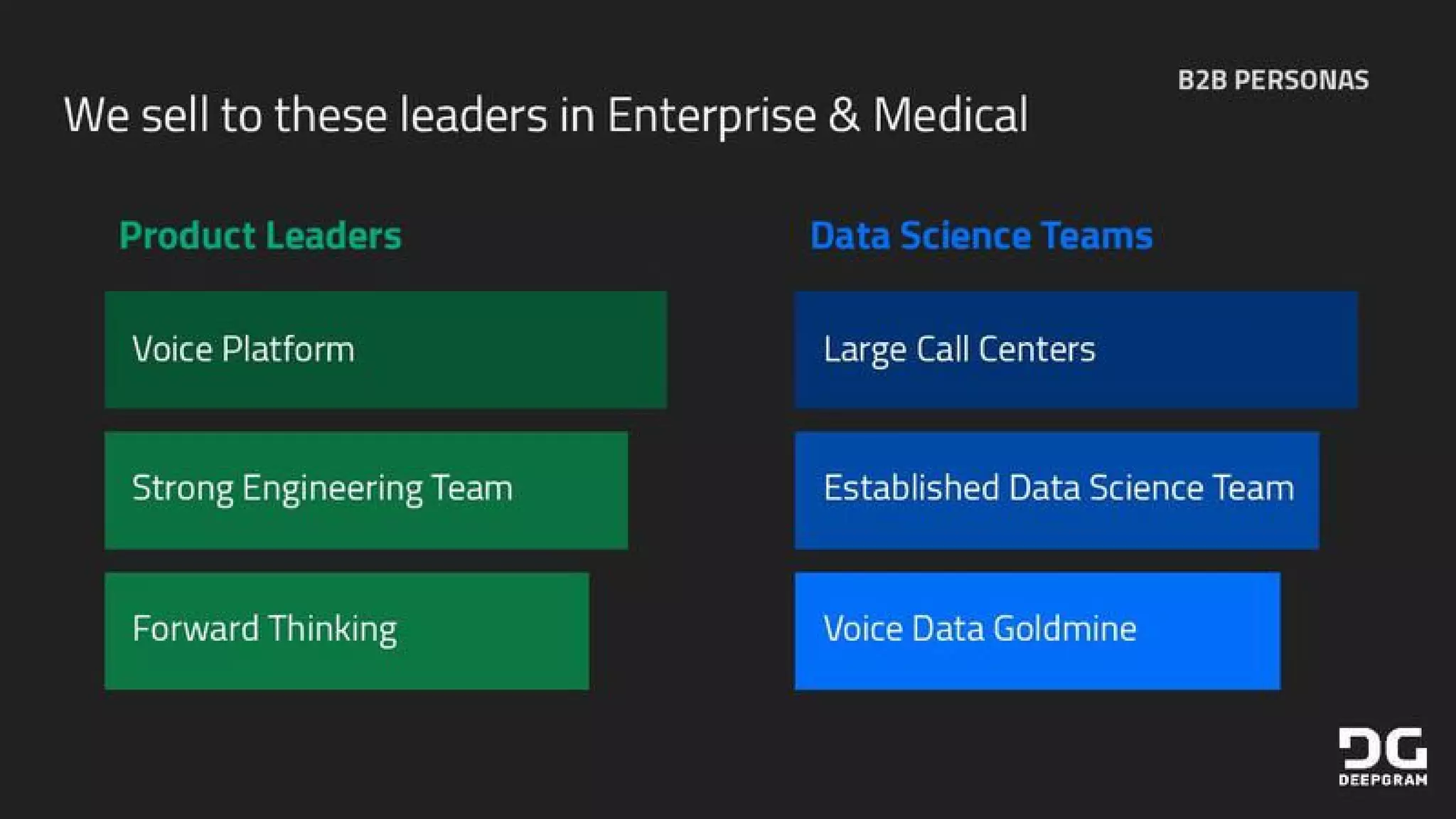
  • Target customers: Product leaders and data science teams at large call centers and enterprises (Slide 3). Also medical vertical for high willingness to pay (Slide 10).
  • GTM approach:
    • Direct sales to enterprise (Sales & Support focus shown on enterprise box, Slide 10).
    • Use early customers to attract labeled enterprise audio and feed the flywheel (Slides 15–16): customer shares raw data → label in-house → train → serve.
    • Provide enterprise features and compliance-friendly deployment (dedicated VPC/on-prem) to close enterprise deals (Slide 12).
  • Pricing rationale: enterprises willing to pay more for accuracy + features (Slide 10).

The Ask

  • At time of deck: moving from seed to “Raise A” (Slide 18). Seed previously noted as $3.6M (Slide 18), but user context references a $12M seed level; deck calls for a Series A to scale.
  • Use of funds indicated: Grow team, infrastructure, data labeling and engineering; ramp sales & marketing (Slide 18).
  • Business milestone: reach $10M ARR in 18 months (Slide 18).

Investor Deep Dive

Executive summary, strengths & red flags

Executive Summary

Deepgram’s 2018 seed deck presents a tightly focused B2B transcription/voice-understanding company built around a data-driven deep learning stack and a “trained expert” approach for enterprise audio (phone calls, meetings). The deck is notable for clear technical differentiation (per-customer trained models, GPU inference speed), concrete accuracy claims versus incumbents, and an early enterprise traction story (90% accuracy, 4M minutes transcribed).

Key Strengths

3 identified

1

Clear technical differentiation with measurable outcomes — the deck quantifies accuracy gains (65% → 90%) and speed improvements (Slide 7, 11, 16), making the technical thesis concrete.

2

Data flywheel + per-customer trained models — a defensible path to improve accuracy per customer and create lock-in through labeled datasets (Slides 7, 15–16).

3

Enterprise credibility and GTM alignment — focuses on segments that will pay (enterprise & medical), offers enterprise features and deployment options (Slide 10, 12).

Red Flags & Weaknesses

3 identified

1

Limited business and financial transparency — no ARR, MRR, pricing, LTV/CAC, churn, or margins are provided; raises questions about unit economics and capital efficiency.

2

Narrow set of visible customers / references — only one detailed testimonial (Randall-Reilly) and 4M minutes; investor diligence would want a broader pipeline and retention metrics (Slide 15).

3

Competitive & execution risk vs big tech — although accuracy claims are strong, big tech can invest heavily and may replicate per-customer customization or undercut pricing; the deck lacks defensibility details beyond “patents” and labeled data (Slides 7, 12).

More Pitch Decks To Study

Compare structure, fundraising context, and investor-facing story across similar startup decks.