Compare your deck to Writer

Compare Your Deck

Writer Pitch Deck (2021)

Ai
Stage: Series A
Raised: $21M
Year: 2021
Slides: 16
Outcome: Valued at $1.9B (Series C, 2024)

Pitch Deck

1 / 16
Writer pitch deck - The Opening: Product-first positioning
Click to expand

Deck Analysis

This deck for Writer (Series A, 2021) presents a focused, product-led pitch for an AI writing assistant aimed at teams and enterprises. It highlights a clear market thesis (writing as an unstructured, mission-critical workflow), a concrete product solution (centralized styleguides, snippets, and in-context enforcement), early traction signals (customers, DAU/MAU chart), privacy-first positioning, and a straightforward pricing strategy. The deck is notable for its clean visual design, tight narrative arc from problem → solution → go-to-market, and emphasis on features that matter to buyers (terminology control, enforceability, security).

The Opening: Product-first positioning

The Opening: Product-first positioning

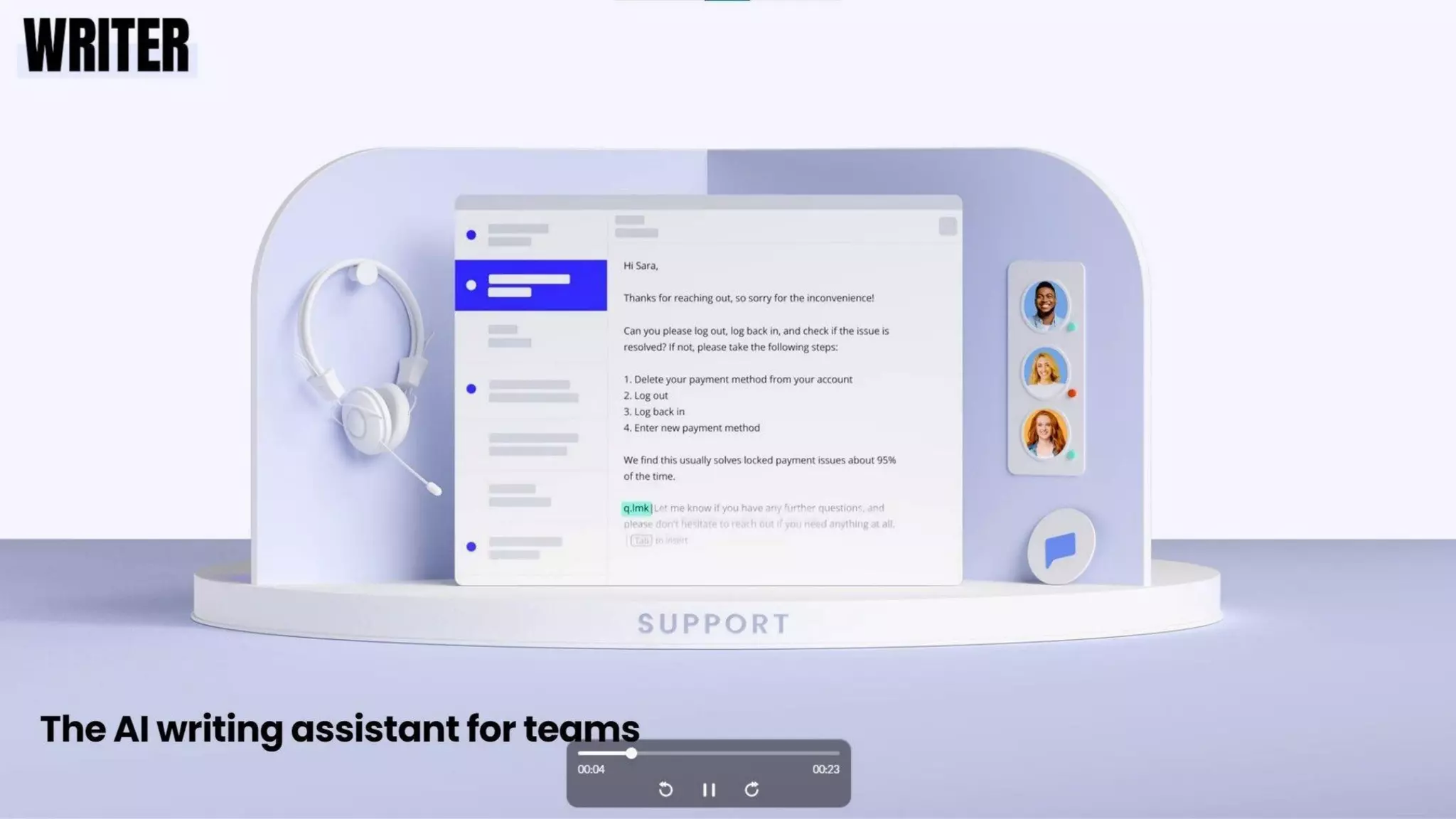
Slide 1 establishes the product and primary use case immediately: an AI writing assistant configured for teams. The visual is product-centric (in-app mockup) and paired with a short tagline that orients the viewer — it’s a tool for support teams and collaboration. That instant product-focus helps investors understand what the company builds before getting into the market or business model.

The slide uses minimal text and a high-quality mockup to convey polish and user experience. Founders can learn from this that early slides should prioritize clarity: who the product is for, what it does, and a glimpse of the interface. The visual credibility reduces friction for later claims about features and traction.

Key Takeaway: Lead with a clean, product-focused opening that shows real UI and a one-line value proposition to make the offering tangible immediately.
Market Framing: Clear, provocative thesis

Market Framing: Clear, provocative thesis

Slide 2 makes a concise market claim — “Writing is the last unstructured major business process” — which frames the opportunity in a single bold sentence. That kind of thesis both highlights the size of the problem and implies a category-defining product: if writing is still unstructured, tools that systemize it can become foundational.

This approach is effective because it gives investors a simple lens through which to evaluate the rest of the deck: every product decision, metric, and customer example should support that thesis. Founders should emulate this by distilling their market opportunity into one memorable line that sets expectations for the rest of the story.

Key Takeaway: Summarize the market opportunity in a single, memorable thesis that the rest of the deck then repeatedly reinforces.
Problem: Static styleguides aren’t enough

Problem: Static styleguides aren’t enough

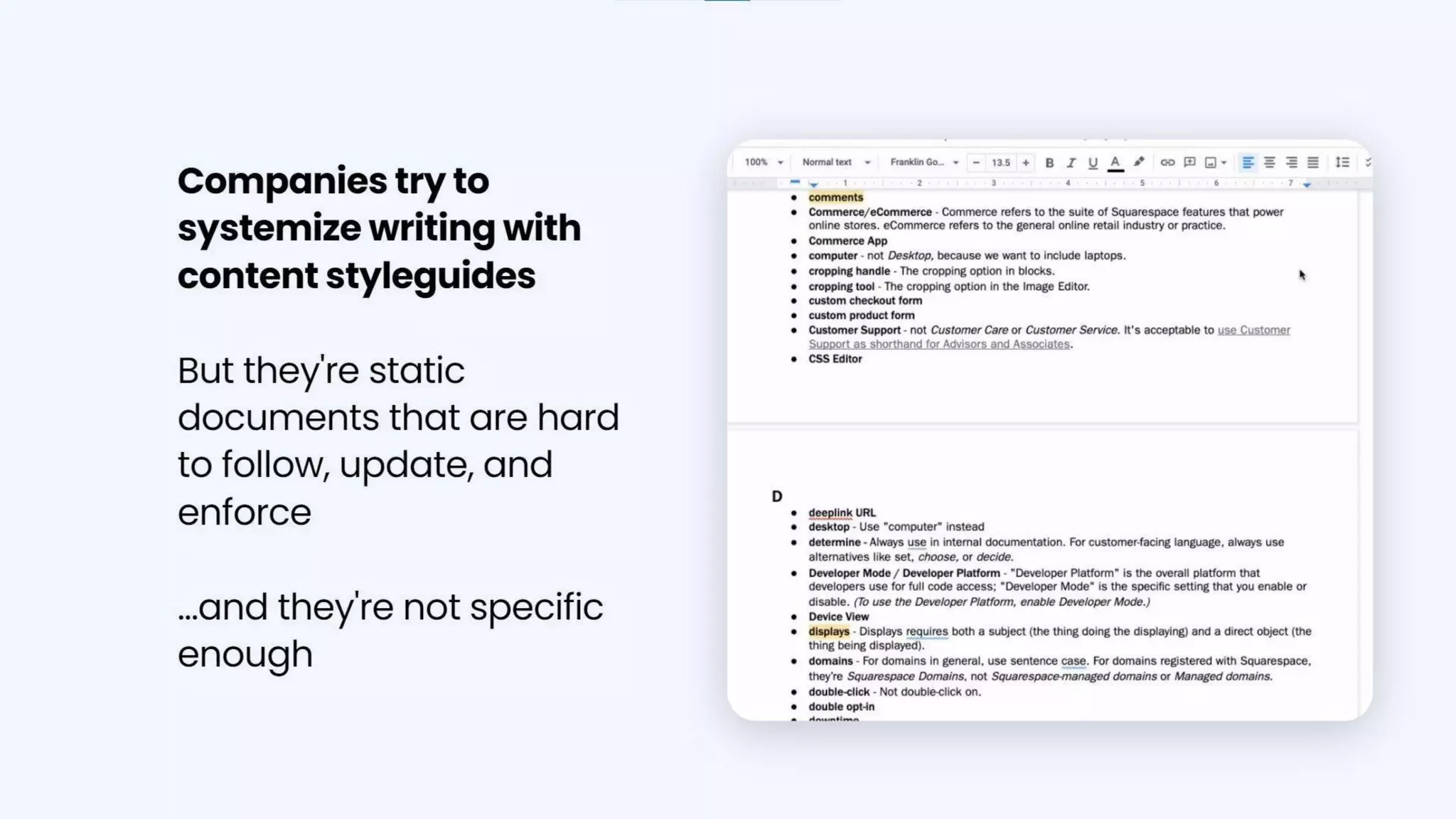
Slide 3 lays out the problem succinctly: companies attempt to standardize writing with styleguides that are static, hard to use, and not specific enough. The slide pairs short bullets with a clear screenshot of a dense styleguide document, visually reinforcing the frustration teams face when guidance exists but isn’t actionable in context.

This is an effective problem slide because it’s relatable, concrete, and demonstrates empathy for users — it doesn’t just state the problem, it shows the broken tool companies currently rely on. Founders should aim to show the existing workaround and why it fails; concrete screenshots or brief anecdotes make abstract pain tangible and motivate the solution.

Key Takeaway: Demonstrate the incumbent workaround and its failure modes with real examples so the need for your product becomes obvious.
Solution: Source of truth and configurable rules

Solution: Source of truth and configurable rules

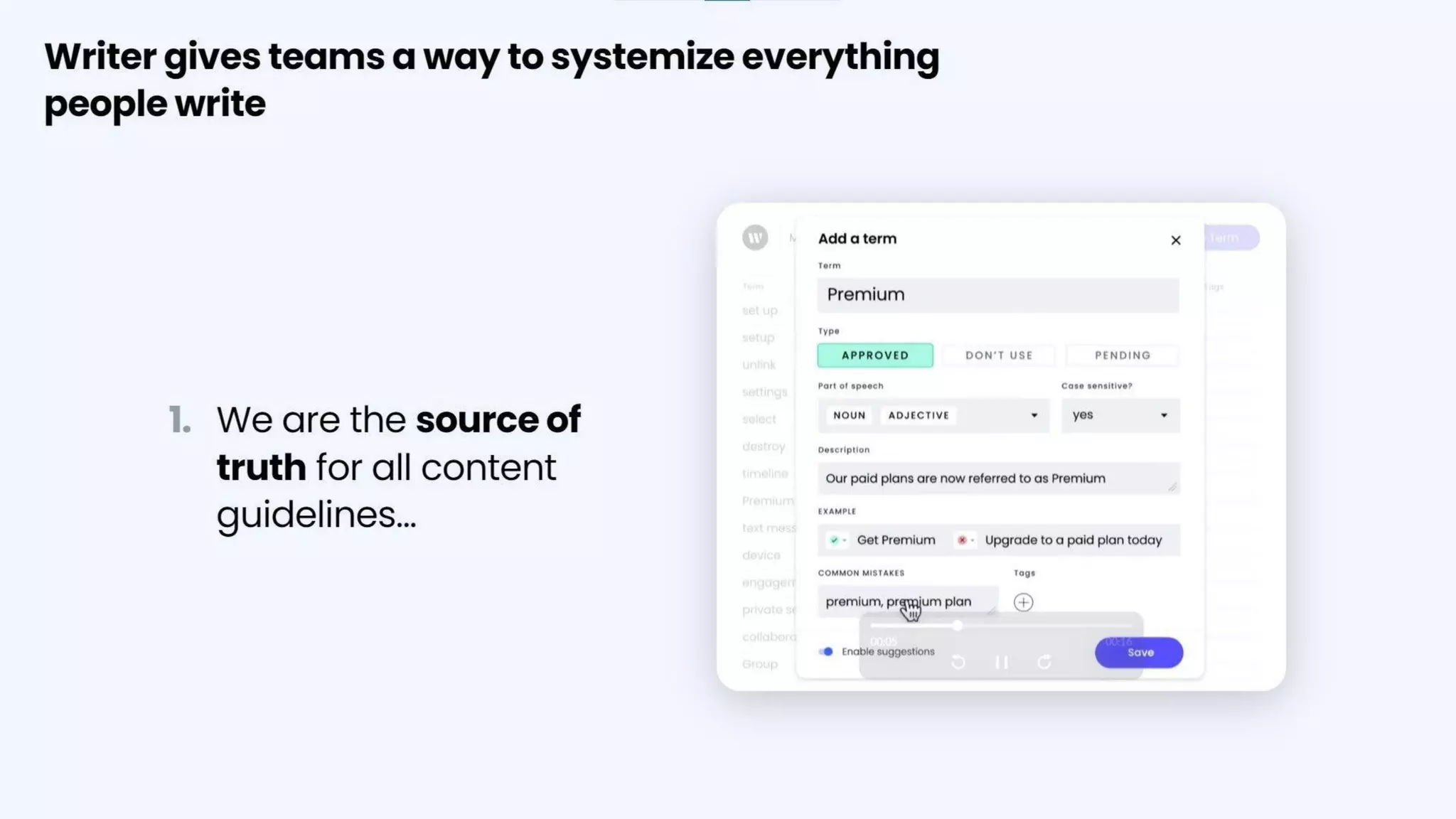
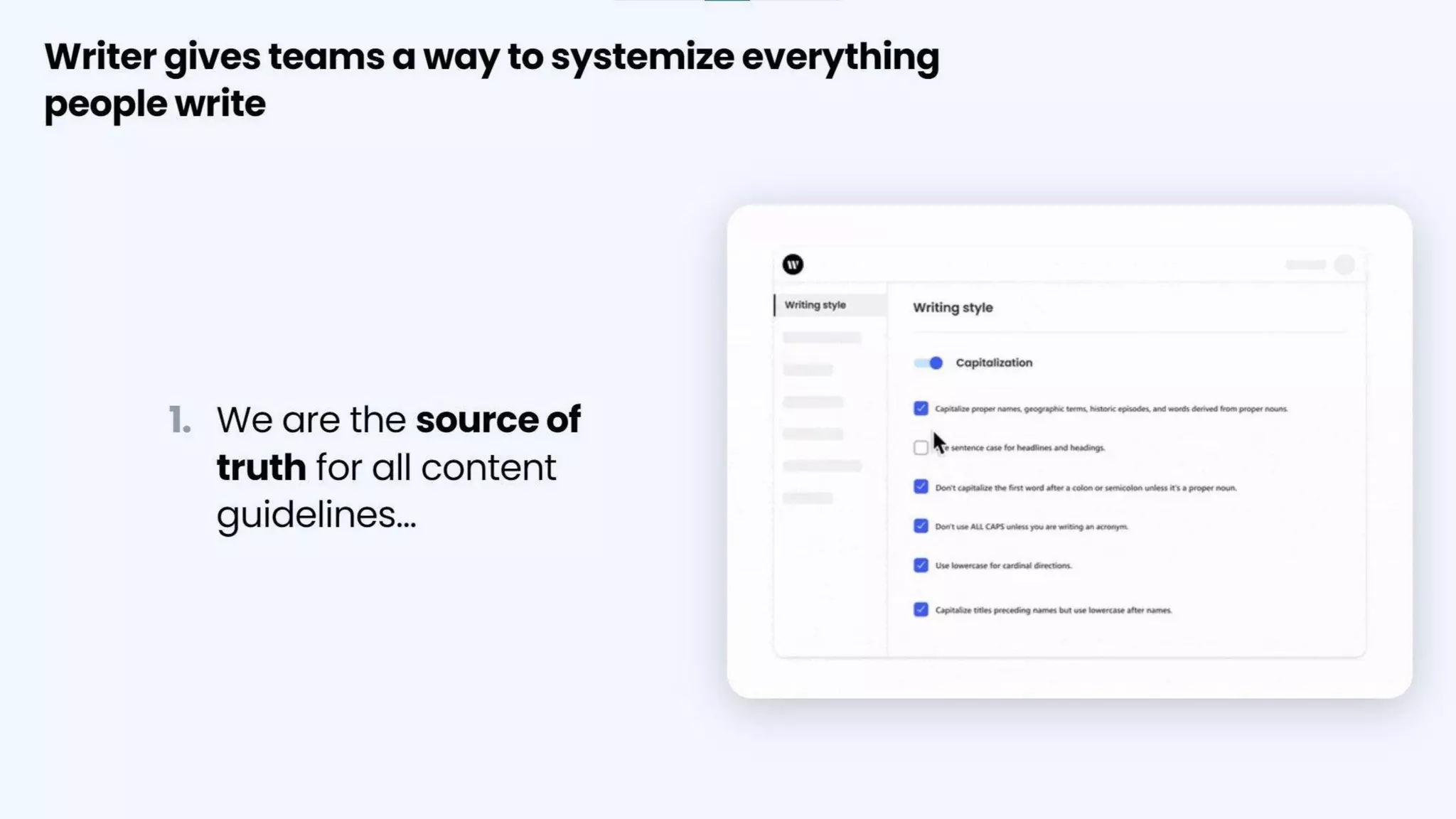
Slide 5 presents Writer’s core promise: act as the source of truth for content guidelines. It shows a UI for writing style configuration where teams can toggle rules and make authoritative decisions. Presenting the solution as a centralized, editable rules engine speaks directly to buyers tasked with governance and reduces ambiguity about how decisions propagate.

The slide is strong because it connects product capabilities to buyer priorities (consistency, governance) and signals enterprise-readiness (configurable rules, admin capabilities). Founders should show how their product maps to specific buyer pain — in this case, replace static documents with a managed, enforceable system — and provide screenshots to build credibility.

Key Takeaway: Show how your product operationalizes governance: a single, editable source of truth that maps directly to buyer responsibilities.
Features & Adoption: Snippets, enforcement, and integrations

Features & Adoption: Snippets, enforcement, and integrations

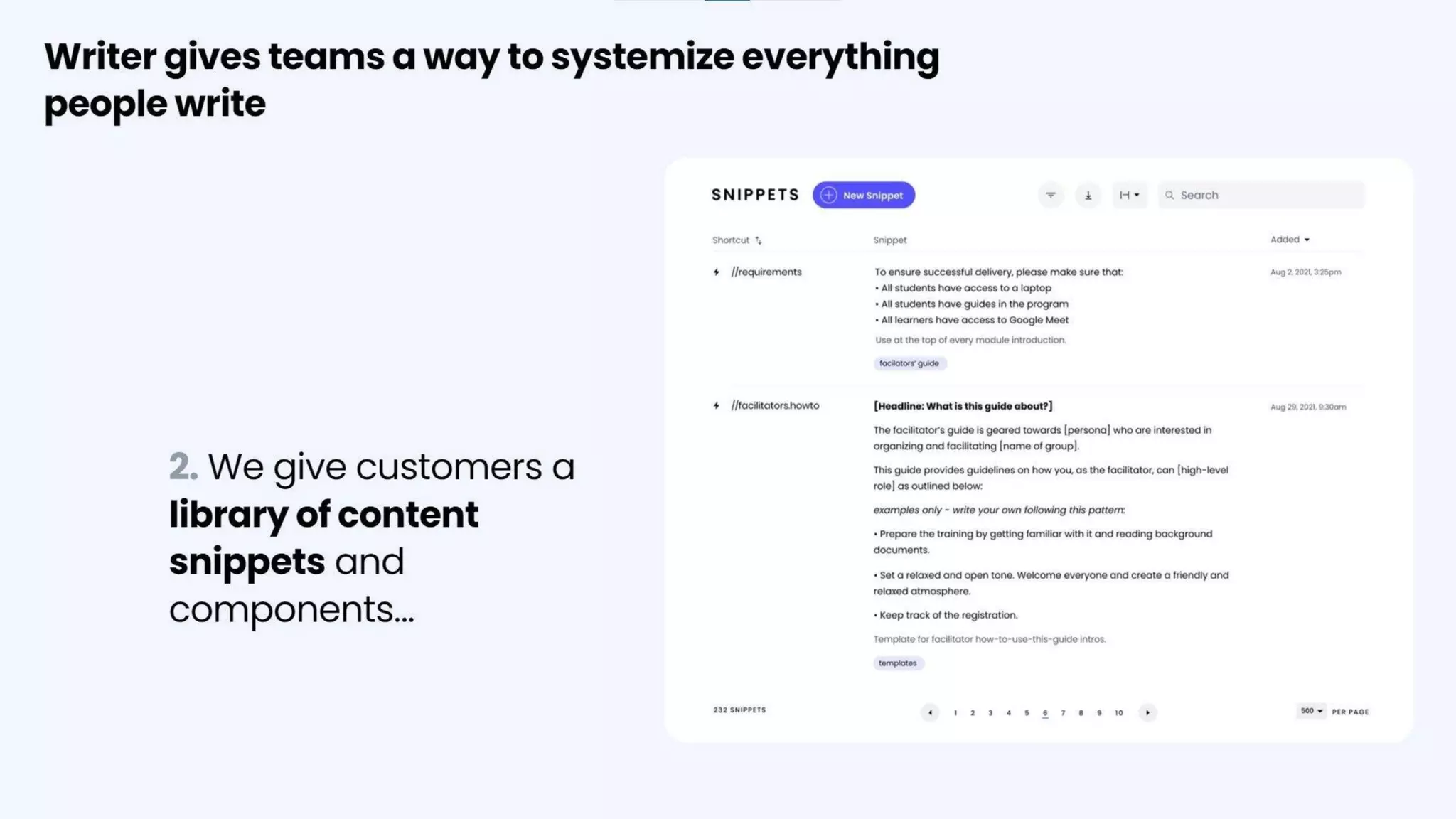
Slide 7 highlights a key product pillar — a library of reusable snippets and components — showing how teams can deploy consistent messaging at scale. The UI emphasizes discoverability (search/listing), shortcuts, and reuse, which are critical for driving adoption in support and content teams. By making content elements easy to insert, Writer reduces friction and increases the likelihood of consistent usage.

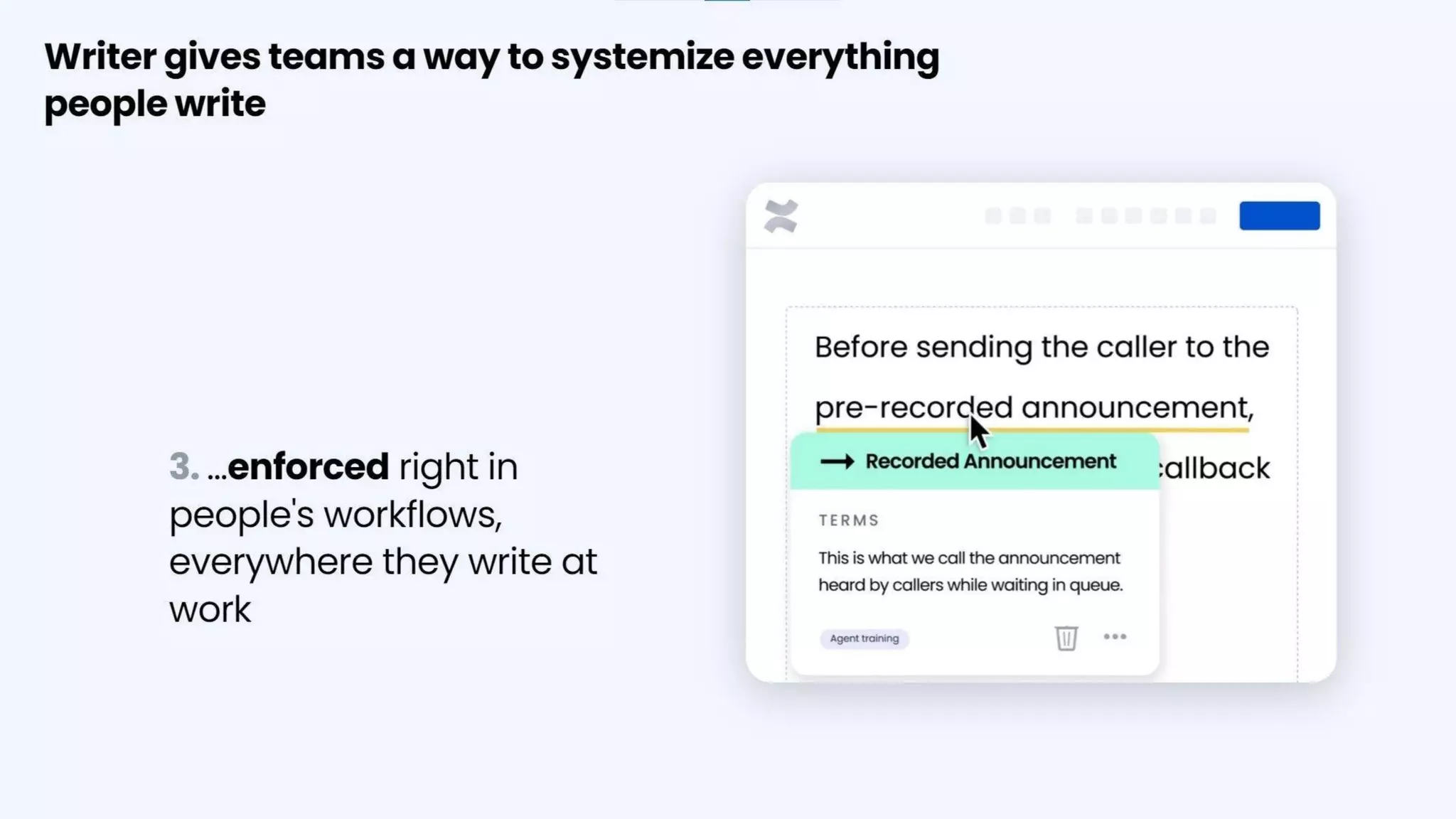
Slide 8 (related visuals in the deck) and nearby slides also show in-context enforcement (tooltips and popups) and integrations into common writing workflows. That combination (centralized content + local enforcement + integrations) creates a defensible product pattern: it’s not enough to store rules, you must ensure they’re applied where people write. Founders should design for these three pillars to move from a neat admin panel to behavior change in end users.

Key Takeaway: Build both a content library and low-friction in-context enforcement plus integrations so rules aren’t just stored — they’re actually used.
Trust & Security: Positioning data privacy as a differentiator

Trust & Security: Positioning data privacy as a differentiator

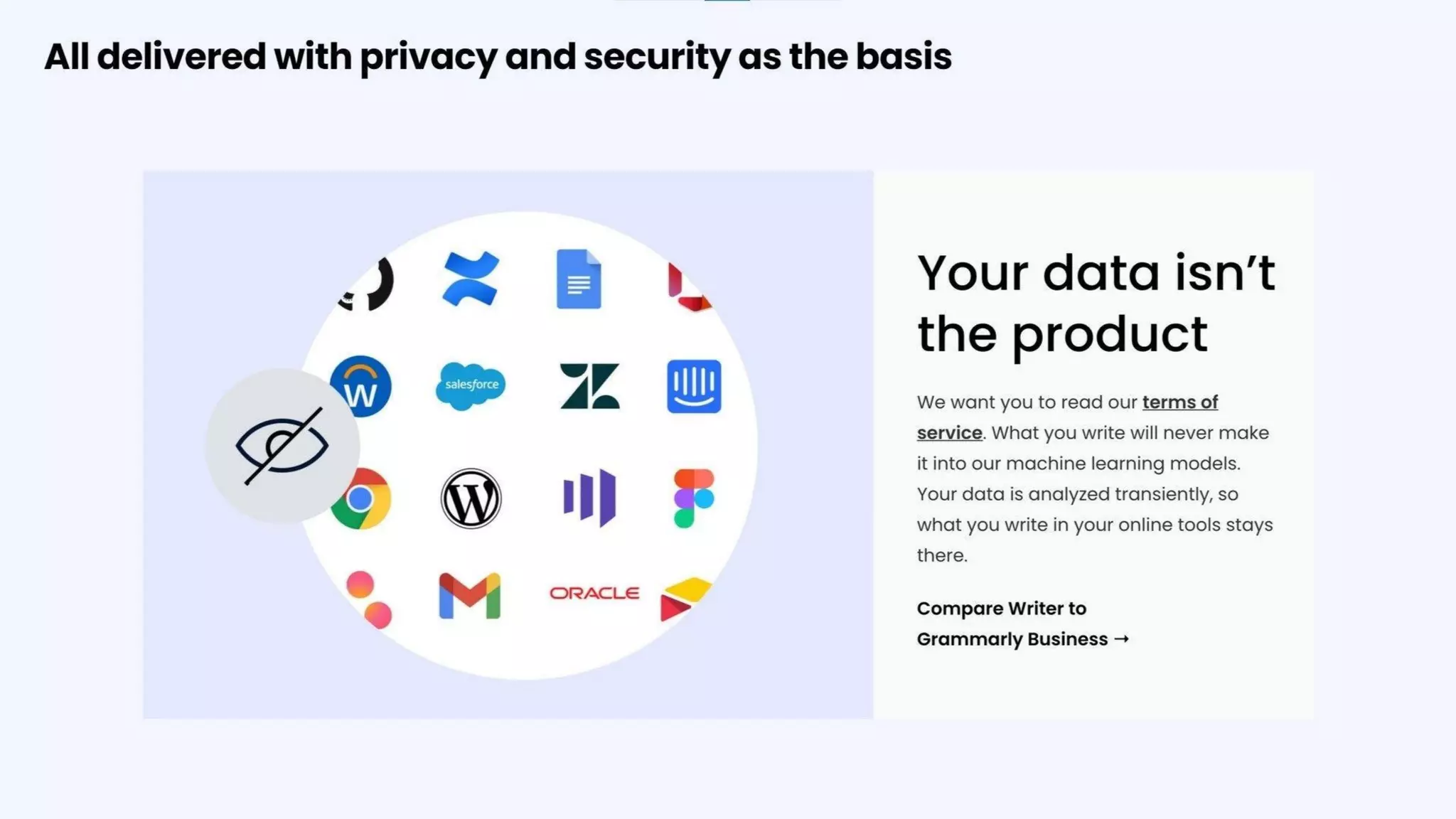
Slide 9 explicitly addresses privacy and security with a headline that ‘Your data isn’t the product’ and a short explanation that customer text isn’t used to train models. For an AI company selling into enterprises, emphasizing data-handling policies upfront reduces sales friction and differentiates from consumer-first competitors who rely on broader model training.

This slide works because it preempts a common enterprise objection and ties product architecture to a commercial advantage. Founders in AI should similarly surface data governance and processing terms early, and be explicit about what is and isn’t shared with third parties or models — that transparency speeds procurement and builds trust.

Key Takeaway: Make privacy and data usage policies a front-and-center part of your pitch if you sell AI tools to enterprises — it’s a commercial as well as ethical requirement.
Business Model & GTM: Simple pricing and enterprise hooks

Business Model & GTM: Simple pricing and enterprise hooks

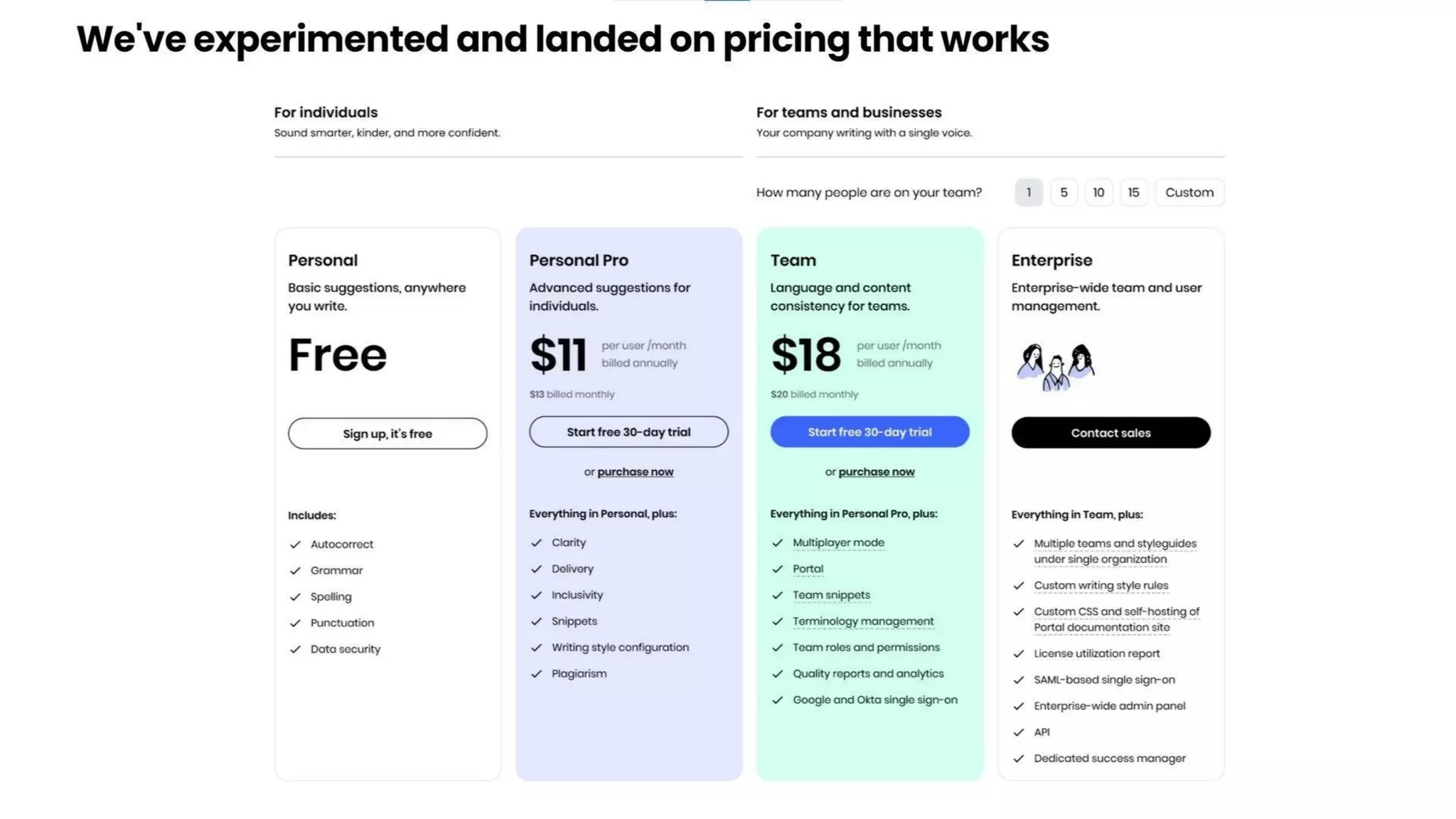
Slide 12 shows a straightforward pricing matrix with free, personal, team, and enterprise tiers. The visual differentiates individual users from teams and highlights team features (single sign-on, admin, multi-team management) that justify enterprise pricing. This model signals a clear upgrade path: free adoption at the user level, then conversion to paid teams and finally enterprise agreements.

The pricing slide is effective because it ties product features to buyer segments and shows a clear monetization funnel. Founders should present pricing that aligns with usage patterns and decision-makers: a low-friction freemium to drive top-of-funnel adoption and explicit enterprise capabilities that address procurement requirements and justify higher ARPU.

Key Takeaway: Design pricing to match adoption funnels: make it easy for individuals to try, then surface team/enterprise features that justify upgrade and procurement conversations.

Conclusion: Key Lessons

Writer’s Series A deck is a model of product-led storytelling: a crisp market thesis, a concrete problem illustrated with real examples, a solution shown through UI, and commercial signals (customers, privacy posture, pricing) that make the opportunity believable. Its strengths are clarity, tight alignment between product features and buyer pain, and proactive handling of enterprise concerns like data governance.

For founders building enterprise SaaS (especially in AI): 1) lead with product clarity and real UI to lower cognitive friction; 2) state a single market thesis and keep reinforcing it; 3) show incumbent pain concretely; 4) demonstrate not just configuration but enforcement and integrations so buyers see behavioral impact; and 5) address privacy and procurement blockers early. Following these principles will make your deck both persuasive and actionable for investors and customers alike.

Full Deck Analysis

11 sections

Overview

Company: Writer
Round: Series A ($21M)
Year: 2021
Outcome: Valued at $1.9B (Series C, 2024)

Executive Summary

Writer’s Series A deck presents an enterprise-focused AI writing assistant that systemizes company writing using centralized styleguides, terminology/snippets, and enforcement across the apps employees already use. The deck is tightly product-led in presentation (lots of UI demos and integration logos), emphasizes privacy and enterprise controls, and backs claims with customer logos and high product engagement (DAU/MAU) metrics — a compelling mix that helped the company scale toward high valuation.

Problem Statement

  • Core thesis: “Writing is the last unstructured major business process” (Slide 2).
  • Conventional solution gap: companies use static content styleguides that are hard to follow, update, and enforce (Slide 3).
  • Pain expressed: inconsistent customer-facing language, fragmented knowledge, and lack of enforcement in everyday workflows (Slides 3–4).

Solution

  • Product positioning: a single source-of-truth writing platform for teams that:
    • Centralizes writing style rules / terminology (Slides 4–6).
    • Provides a library of reusable content snippets and templates (Slide 7).
    • Enforces guidelines inline across users’ workflows via integrations (Slides 8–9).
  • Demo-first approach: multiple UI mockups show style toggles, “add a term” workflows, snippets management, and inline enforcement popovers (Slides 5–8).
  • Privacy/security emphasized: “Your data isn’t the product” and claims that customer text is not fed into their ML models (Slide 9).

Market Opportunity

  • The deck frames the opportunity qualitatively (writing as a ubiquitous enterprise process) but does not provide explicit TAM / SAM / SOM numbers or dollar-sized market estimates in the slides provided.
  • Implicit market signals:
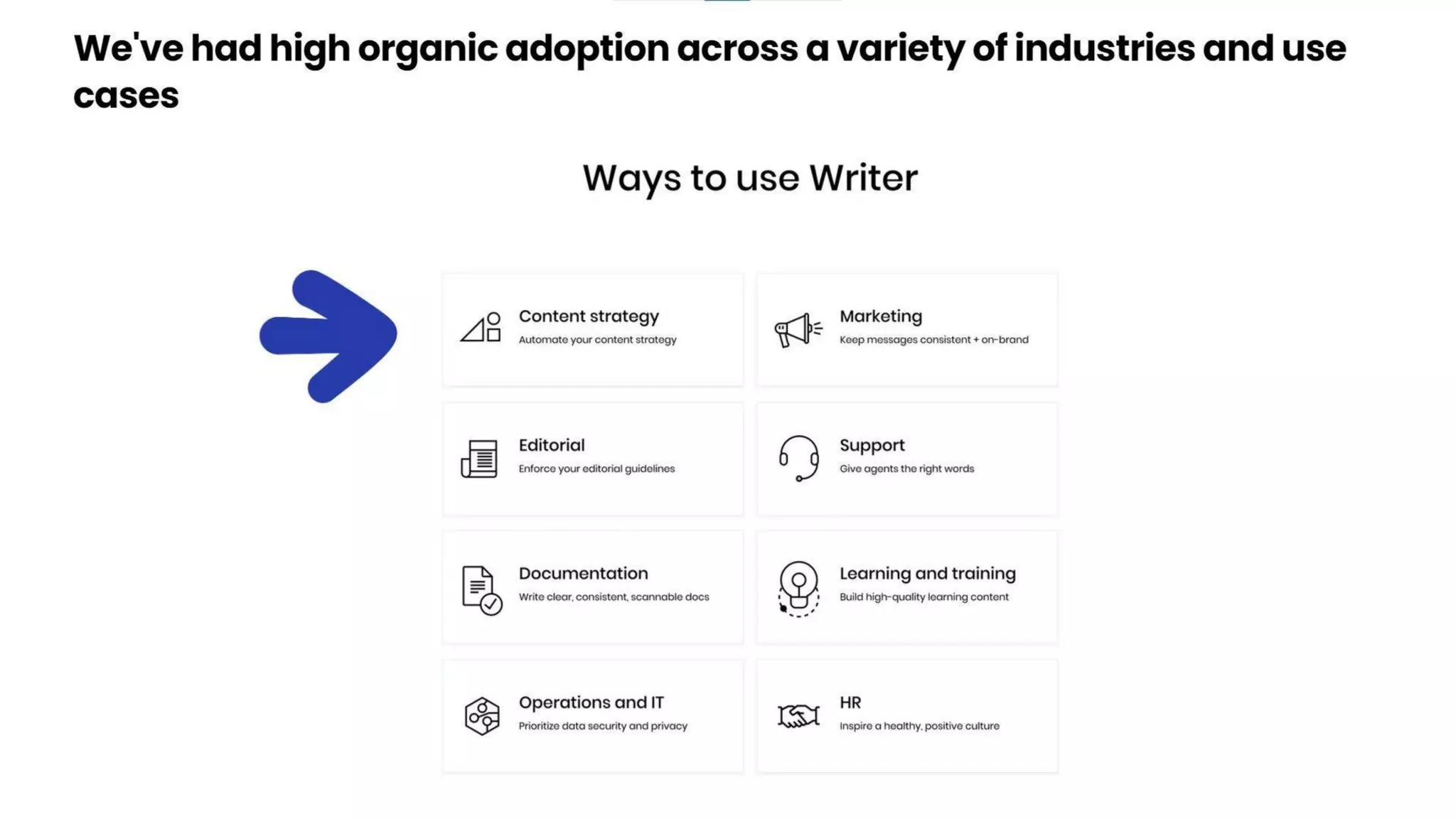
    • Target: enterprises and teams across content, support, marketing, documentation, learning/training, operations, HR (Slide 13).
    • Wide integration targets (Gmail, Google Docs, Salesforce, Zendesk, WordPress, etc.) imply a large addressable base of knowledge-worker SaaS users (Slides 8–9).

Business Model

  • Pricing tiers shown (Slide 11):
    • Free (Personal): basic suggestions.
    • Personal Pro: $11/user/month (annual billing) or $13 monthly.
    • Team: $18/user/month (annual billing) or $20 monthly.
    • Enterprise: custom pricing/contact sales.
  • Revenue model: per-seat subscription (SaaS, freemium → self-serve upgrades → enterprise sales).
  • Enterprise monetization levers: multi-team/org management, admin controls, SSO, custom rules, dedicated support (Slide 11).

Traction & Metrics

  • Customer logos and references across industries (Slide 10 & Slide 11): Intuit, Twitter, UiPath, Pinterest, Vistaprint, Bill.com, Deloitte, McKesson, Webflow, Squarespace, United Healthcare, etc. — demonstrates enterprise interest and pilot deployments.
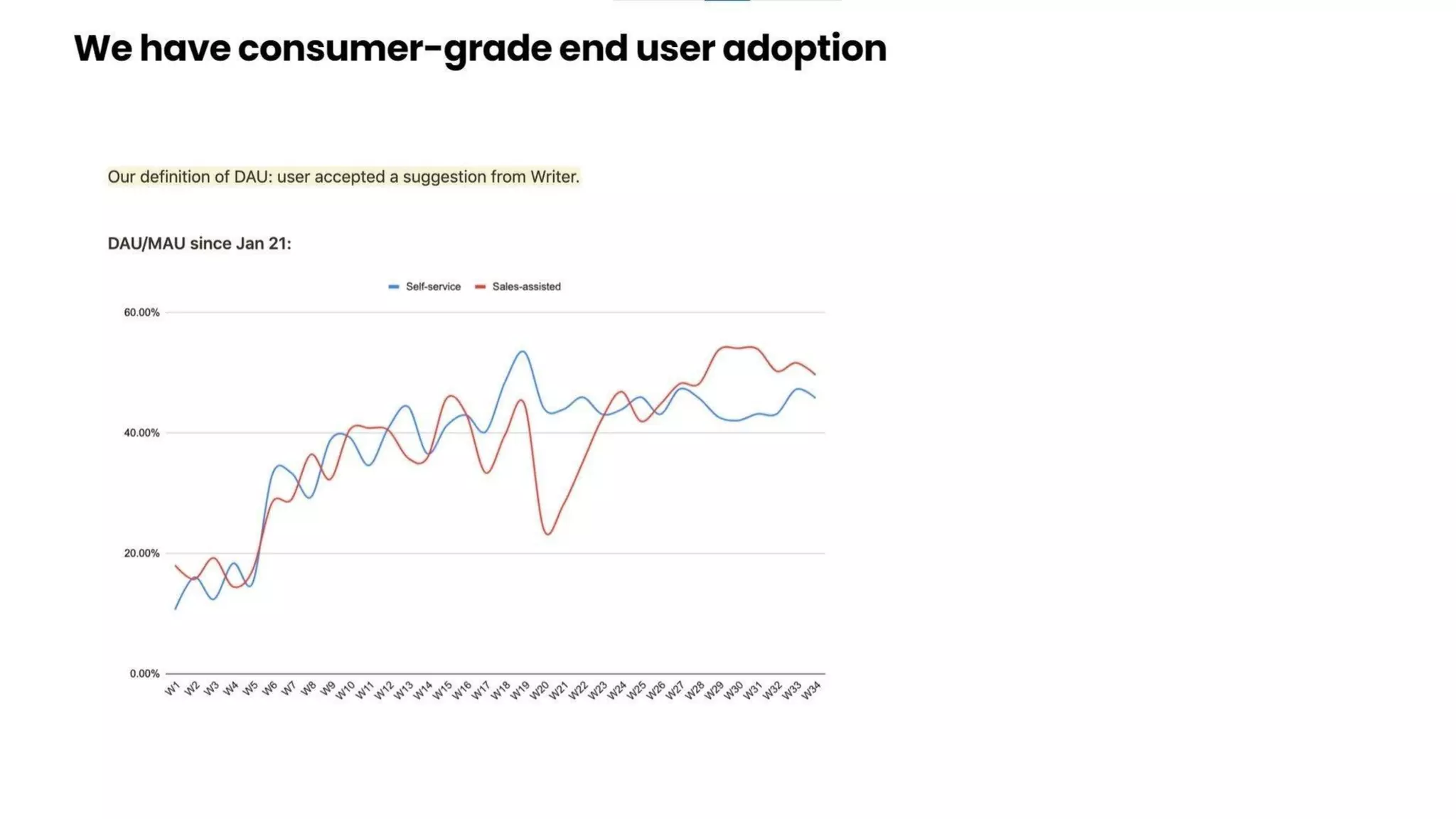
  • Engagement metric: DAU/MAU chart (Slide 14) with two cohorts:
    • Self-service cohort (blue) trending ~40–50% DAU/MAU over time.
    • Sales-assisted cohort (red) trending higher — peaks near ~55–60% DAU/MAU.
    • Interpretation: substantial suggestion adoption rates (definition: “user accepted a suggestion from Writer”); strong product engagement relative to typical productivity tools.
  • No explicit ARR, MRR, churn, LTV, CAC, or user counts disclosed in the slides shown.

Competitive Positioning

  • Primary competitor compared: Grammarly Business (Slide 15).
  • Differentiators emphasized:
    • Business-focused features: multipayer/collaboration, terminology & snippets, writing style configuration, admin controls, multi-team management, custom rule builder, documentation site (Slide 15).
    • Data & privacy policies framed as superior — positioning data not used to train models (Slide 9).
    • Integration enforcement across tools (Slides 8–9) for on-the-job compliance.
  • The deck positions Writer as the enterprise-first choice vs consumer-oriented Grammarly.

Team

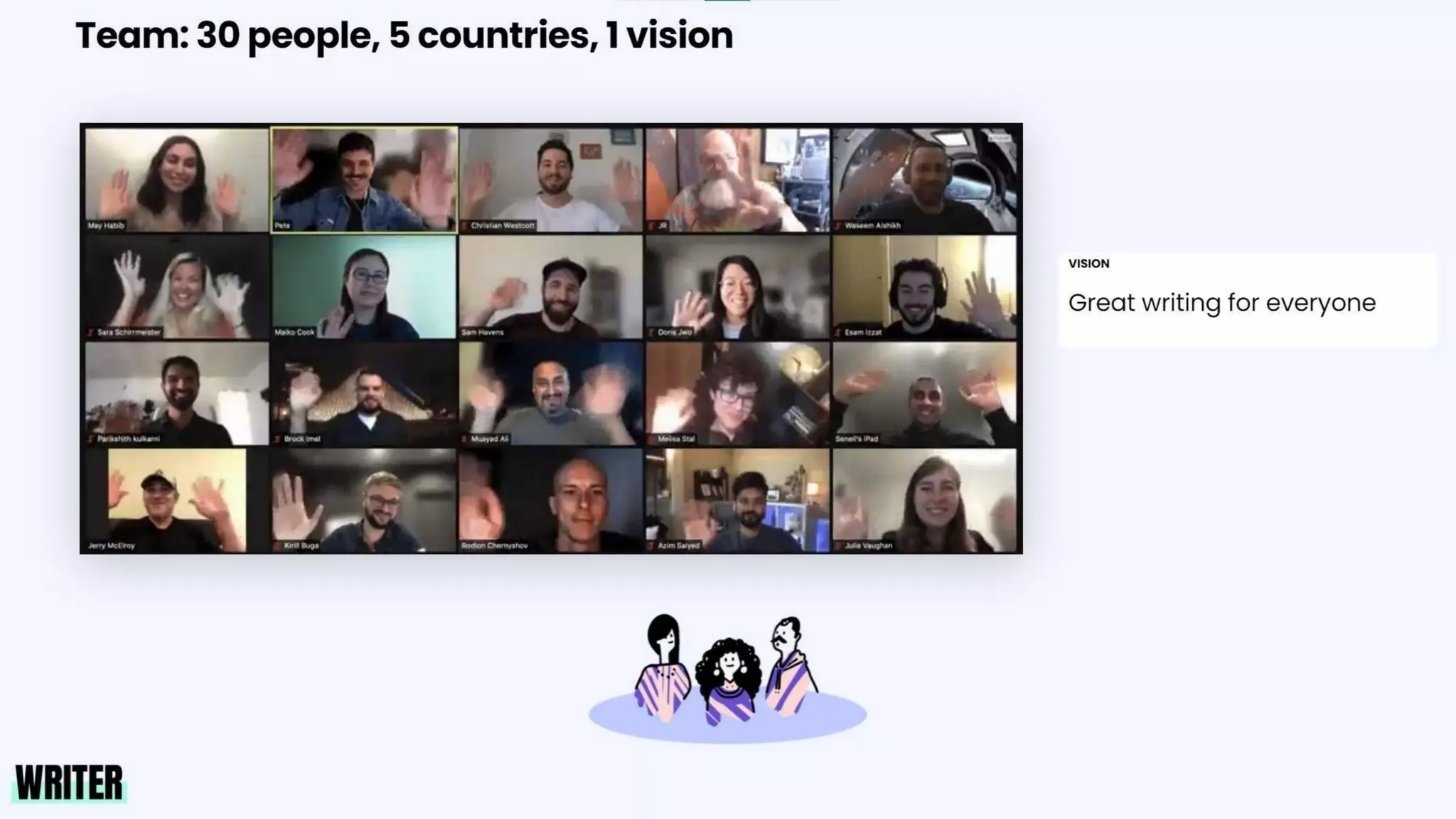
  • Team size & distribution: ~30 people across 5 countries (Slide 16).
  • The deck shows a group photo grid and a company vision statement but does not include founder bios or detailed bios on the slides provided. (Investors would expect founding team credentials elsewhere; not shown in these slides.)

Go-to-Market Strategy

  • Hybrid GTM shown implicitly:
    • Product-led / self-service funnel: freemium Personal tier and self-service upgrades (pricing Slide 11).
    • Sales-assisted / enterprise motion: sales-assisted cohort (DAU/MAU), enterprise tier, custom contracts and features (Slide 14 & Slide 11).
  • Distribution via integrations across common enterprise SaaS tools (Gmail, Docs, Salesforce, Zendesk, Intercom, WordPress, GitHub, Oracle, Office, Confluence etc.) to embed enforcement in workflows (Slides 8–9).
  • Use cases across functions (Slide 13) to expand within accounts.

The Ask

  • What they raised: Series A — $21M (known).
  • Use of proceeds: deck does not itemize a line-by-line use of funds but closing slides and narrative emphasize hiring across all teams and go-to-market expansion (Slide 16 — “We are hiring across all teams”). Likely allocation: product development, hiring, GTM/expansion, and scaling infrastructure/security.

Investor Deep Dive

Executive summary, strengths & red flags

Executive Summary

Writer’s Series A deck presents an enterprise-focused AI writing assistant that systemizes company writing using centralized styleguides, terminology/snippets, and enforcement across the apps employees already use. The deck is tightly product-led in presentation (lots of UI demos and integration logos), emphasizes privacy and enterprise controls, and backs claims with customer logos and high product engagement (DAU/MAU) metrics — a compelling mix that helped the company scale toward high valuation.

Key Strengths

3 identified

1

Clear product-led narrative with strong visual demos — multiple UI screenshots showing how the product solves the stated problem end-to-end (Slides 4–8). This builds credibility that the product is real and usable.

2

Enterprise focus and privacy positioning — explicit features for admin control, multi-team management, and an assertion that user data is not used to train models (Slides 9, 11, 15). This addresses a major enterprise adoption barrier.

3

Tangible engagement metrics and customer logos — DAU/MAU chart demonstrating high suggestion acceptance and a wide set of reputable customers across industries (Slides 10, 14). These are persuasive traction signals for investors.

Red Flags & Weaknesses

3 identified

1

No explicit revenue / financial metrics — ARR, MRR, churn, CAC, LTV, or payback period are absent from the slides shown. Investors would want these before committing at Series A.

2

No TAM numbers or unit economics — the deck argues the market qualitatively but does not quantify TAM/SAM/SOM or provide pricing elasticity/ARPU analysis beyond display pricing (Slides 2, 11).

3

Limited team/founder detail — slide shows headcount and geographic distribution but lacks founder backgrounds, prior exits, or domain expertise on the deck slides provided (Slide 16). That information is typically crucial at Series A.

More Pitch Decks To Study

Compare structure, fundraising context, and investor-facing story across similar startup decks.