Compare your deck to Cobalt

Compare Your Deck

Cobalt Pitch Deck (2016)

Cybersecurity
Stage: Seed
Raised: $1.5M
Year: 2016
Slides: 25
Outcome: Raised $38M+ total; leading PtaaS platform

Pitch Deck

1 / 25
Cobalt pitch deck slide 1
Click to expand

Deck Analysis

This deck presents Cobalt (seed 2016), a startup positioning itself as a Pentest-as-a-Service (PtaaS) platform that productizes security talent and builds a marketplace + SaaS engine for continuous, developer-friendly penetration testing. The slides combine a clear problem statement (legacy consulting models and brittle automation), a product-centric solution (on-demand credits, in-app delivery, developer integrations), and early traction / unit-economics signals. It’s notable for pairing service-market storytelling with concrete operational claims (speed, cost reduction, tester community metrics) and for emphasizing community as a defensible asset.

The Opening: Clear positioning and value prop

The Opening: Clear positioning and value prop

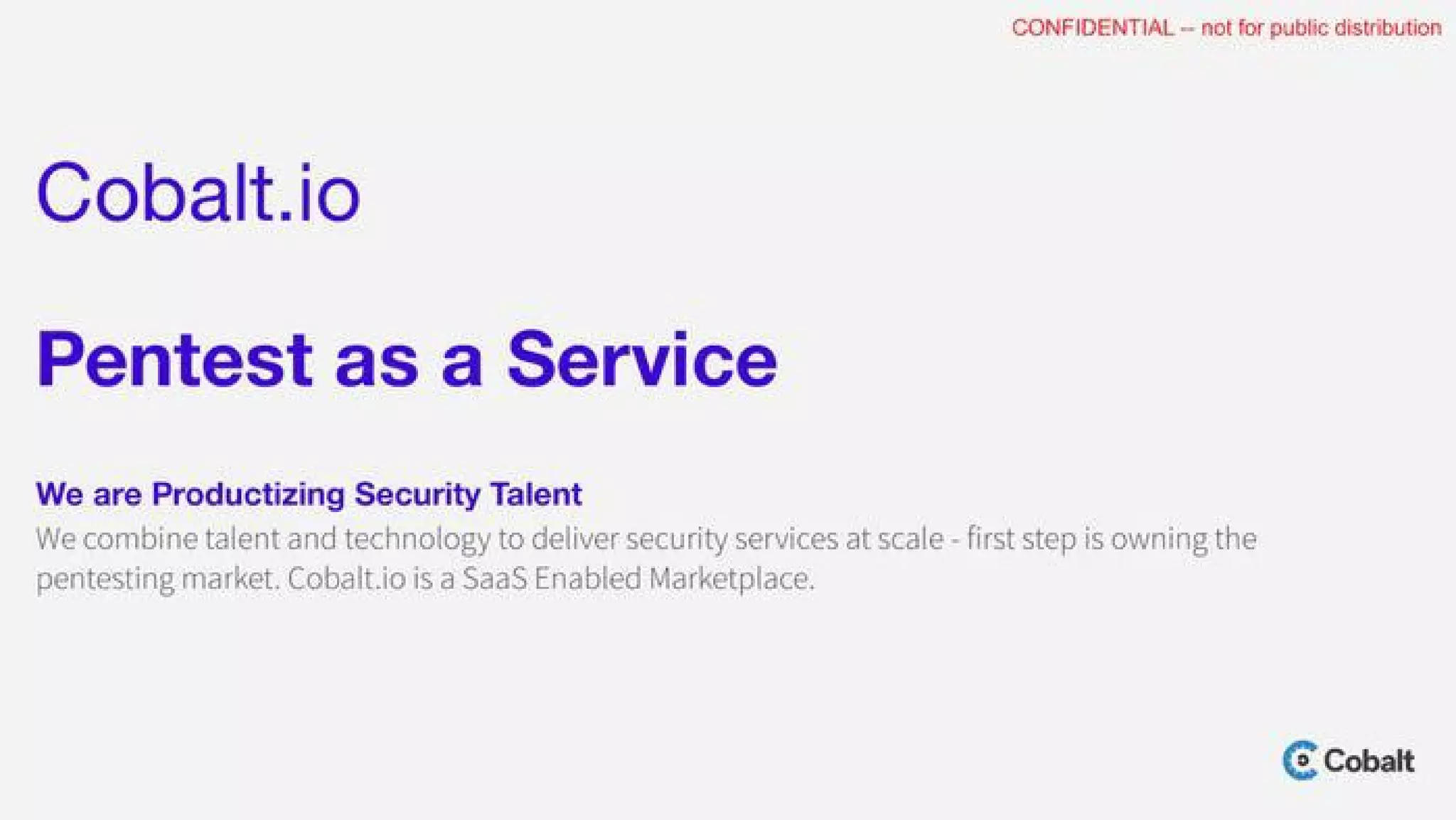
Slide 2 (the 'Pentest as a Service' slide) functions as an effective cover + one-line value prop: the company name and instantly understandable category (PtaaS). The design is simple, the message is unambiguous, and it immediately frames the rest of the deck — the founders are selling a transformation of a known security process into a productized service. Founders should note how a crisp one-line framing reduces cognitive load for investors and sets expectations for the remainder of the presentation.

The slide also introduces tone and confidence: professional branding, a short descriptive subheading (“We are Productizing Security Talent”), and a brief paragraph stating their go-to-market thesis (talent + technology at scale). The lesson is pragmatic — spend time refining a one-line value proposition and a single sentence that explains the business model (marketplace + SaaS) before diving into details.
Key Takeaway: Lead with a concise category + one-sentence business model so investors immediately understand what you sell and how you do it.
The Problem: legacy pentesting workflows

The Problem: legacy pentesting workflows

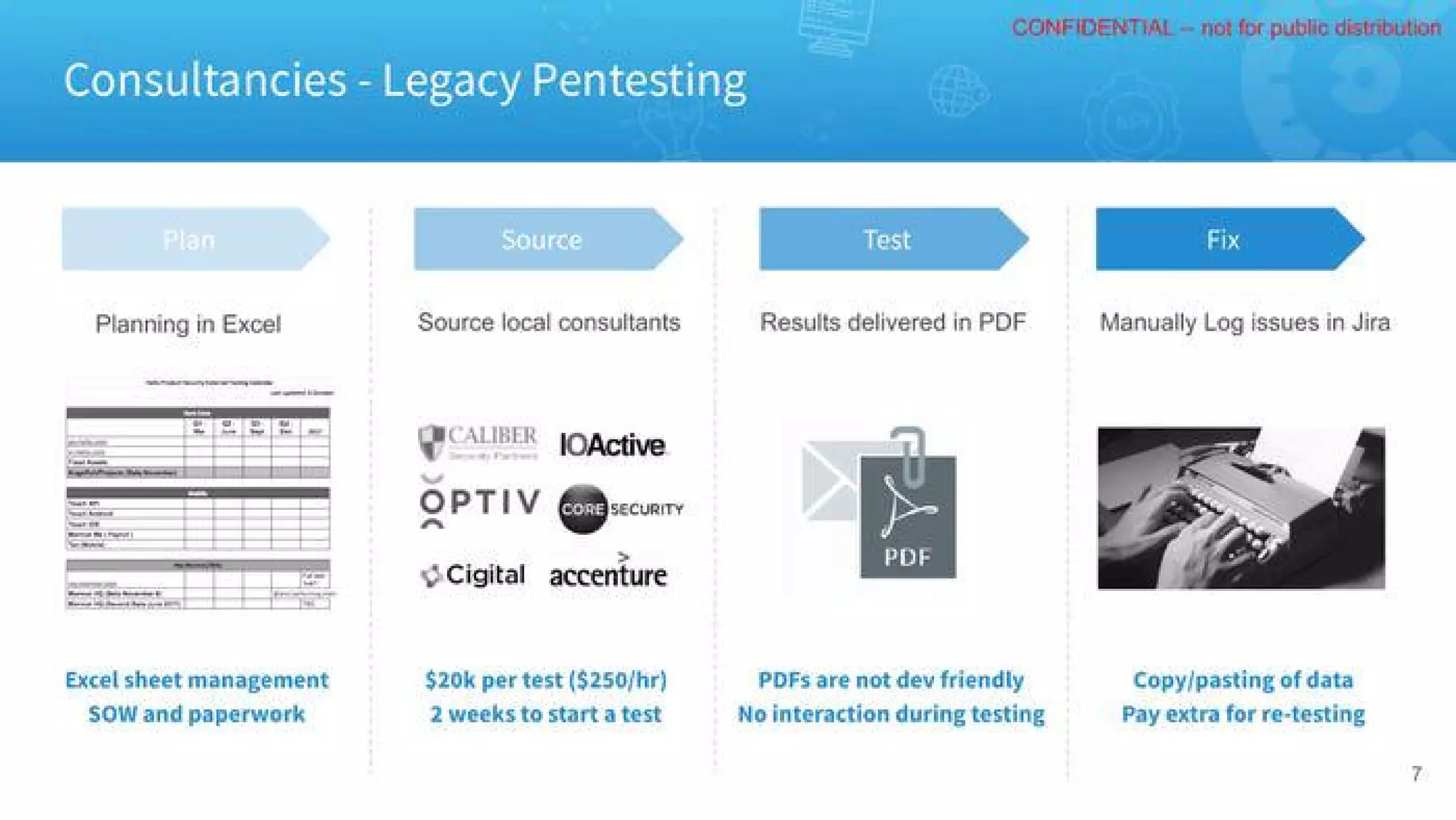
Slide 7 (Consultancies - Legacy Pentesting) lays out the painful current-state workflow: Excel planning, sourcing consultants, PDF results, manual JIRA logging and re-testing billing. The slide uses four columns (Plan, Source, Test, Fix) to walk the viewer through the experience — an effective narrative technique because it simulates a customer journey and highlights friction points at each stage.

This slide works because it makes the problem concrete and operational, not abstract: costs, slow start times, developer friction, and extra re-test fees are all called out. Founders should replicate this approach by mapping the customer journey, quantifying the pain (time/cost/quality), and using that as the baseline from which the product’s impact is measured.

Key Takeaway: Map a real customer journey with concrete pain points (time, cost, friction) so your solution’s benefits become directly comparable and measurable.
The Solution: product + marketplace packaged as a service

The Solution: product + marketplace packaged as a service

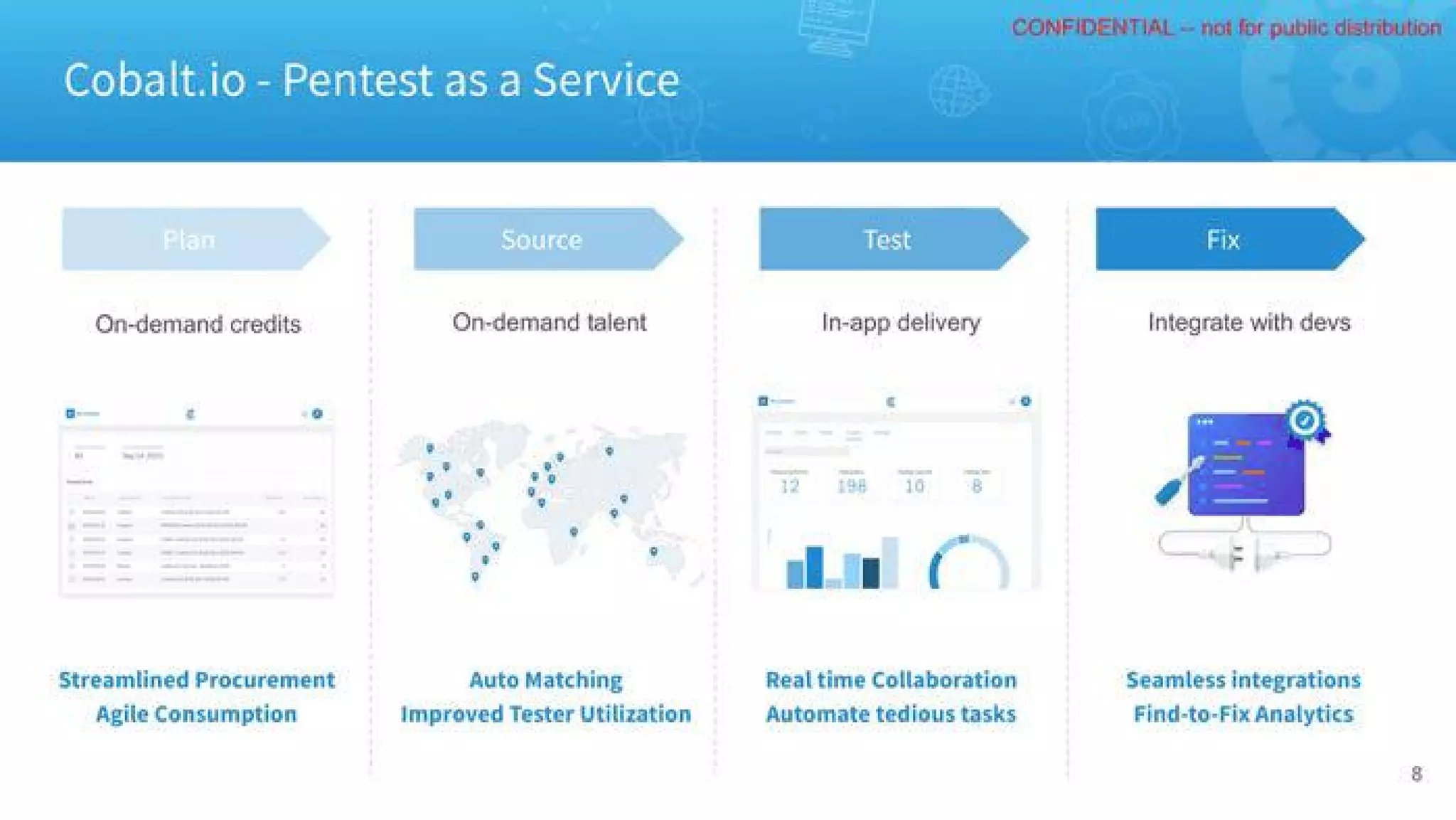
Slide 8 (Cobalt.io - Pentest as a Service) presents the company’s productized approach across the same Plan → Source → Test → Fix steps. Each column now shows productized alternatives: on-demand credits, on-demand talent, in-app delivery, and developer integrations. The slide is effective because it directly mirrors the legacy slide, making the comparison immediate and obvious.

It also highlights operational outcomes under each column (streamlined procurement, auto-matching, real-time collaboration, seamless integrations). Founders should note how mirroring the problem structure with the solution structure makes the pitch easier to follow and sharper: it clearly shows how each pain point is resolved by a feature or process change.

Key Takeaway: Mirror the problem layout when presenting your solution — show one-to-one how each pain point is solved by a concrete product or process change.
Product economics and delivery improvements

Product economics and delivery improvements

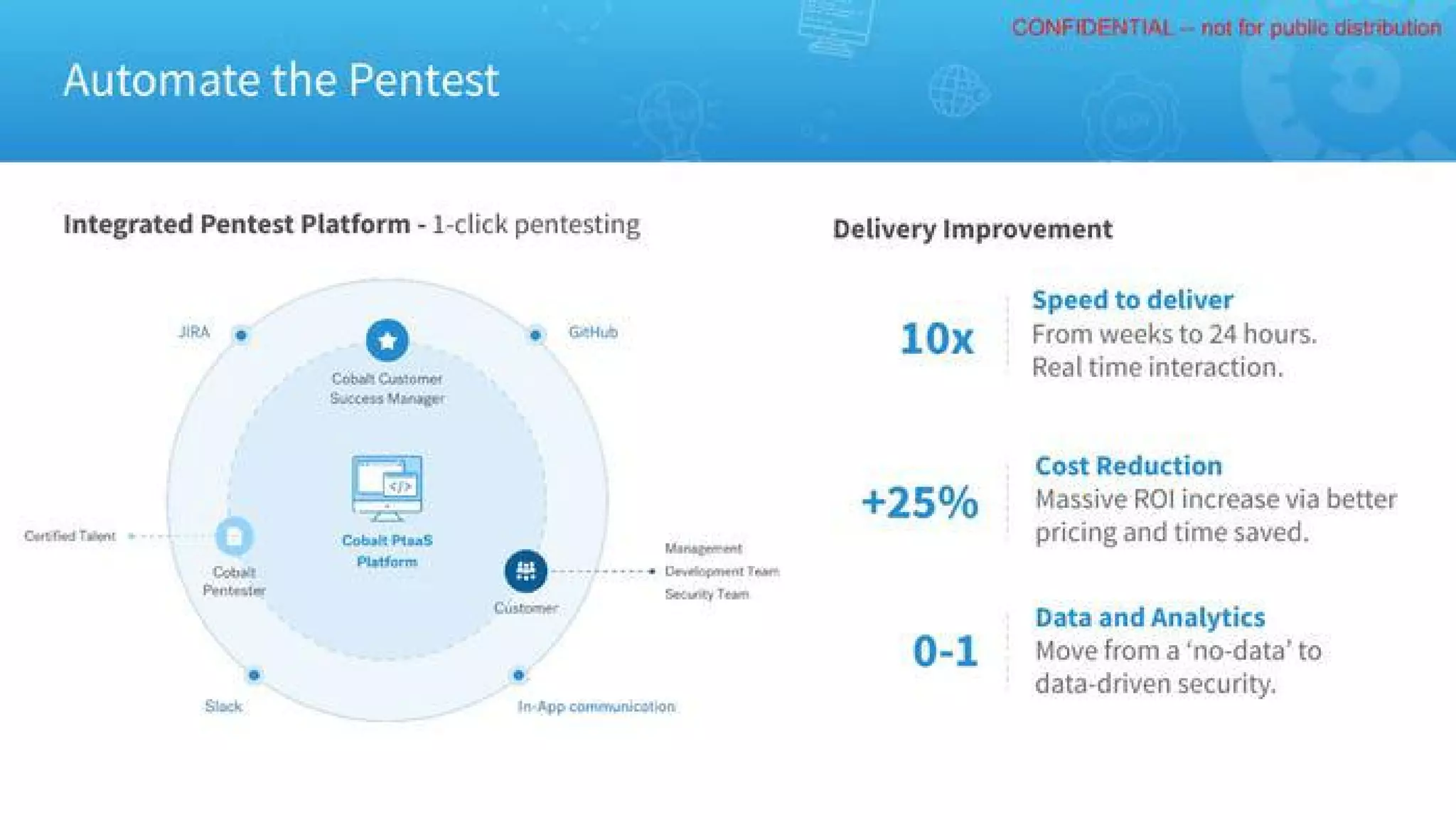
Slide 9 (Automate the Pentest) quantifies delivery gains and ties product integrations to outcome metrics: 10x speed to deliver (weeks → 24 hours), +25% cost reduction, and movement from no-data to data-driven security. The left side shows the integrated platform and partner points (GitHub, Jira, Slack), reinforcing that integrations are central to their value proposition. This combination of tooling + metrics conveys both technical approach and business impact.

The slide demonstrates a smart investor-oriented structure: explain the mechanism (platform + integrations), then the resulting delivery improvements and economics. Founders should follow this pattern — show the product architecture succinctly, then link each architectural choice to measurable improvements investors care about (speed, cost, data/retention).

Key Takeaway: Show the product architecture and immediately connect technical choices (integrations, automations) to quantifiable business outcomes investors care about.
Traction & unit economics: growth signals and redacted specifics

Traction & unit economics: growth signals and redacted specifics

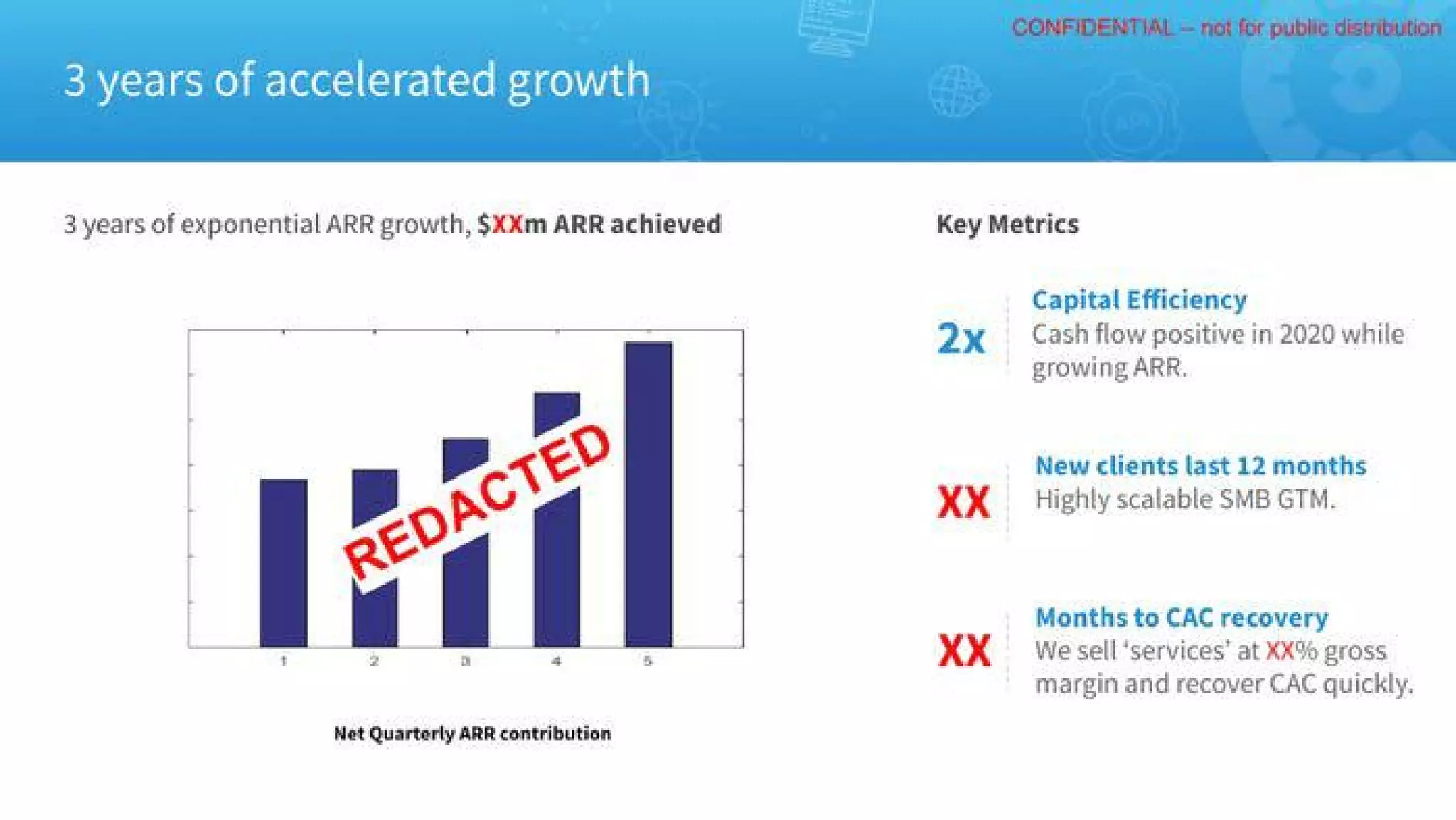
Slide 14 (3 years of accelerated growth) and adjacent slides reveal growth-oriented messaging: exponential ARR curves (redacted values) and callouts like 2x capital efficiency and CAC recovery. The chart shows net quarterly ARR contribution with a 'REDACTED' stamp — tactically signaling strong numbers while retaining confidentiality. This signals to investors there are strong results behind the deck even if the exact figures aren’t public.

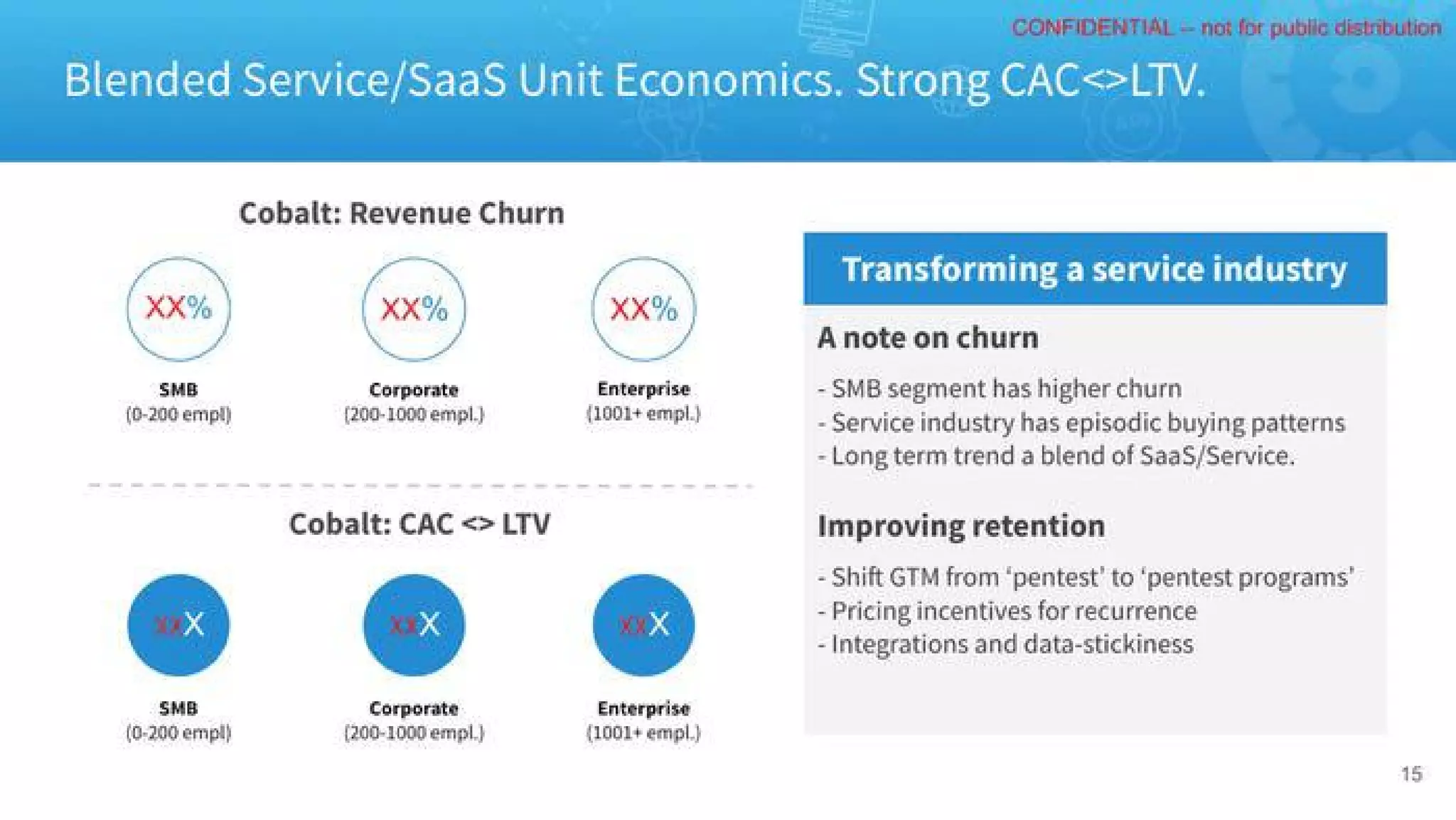
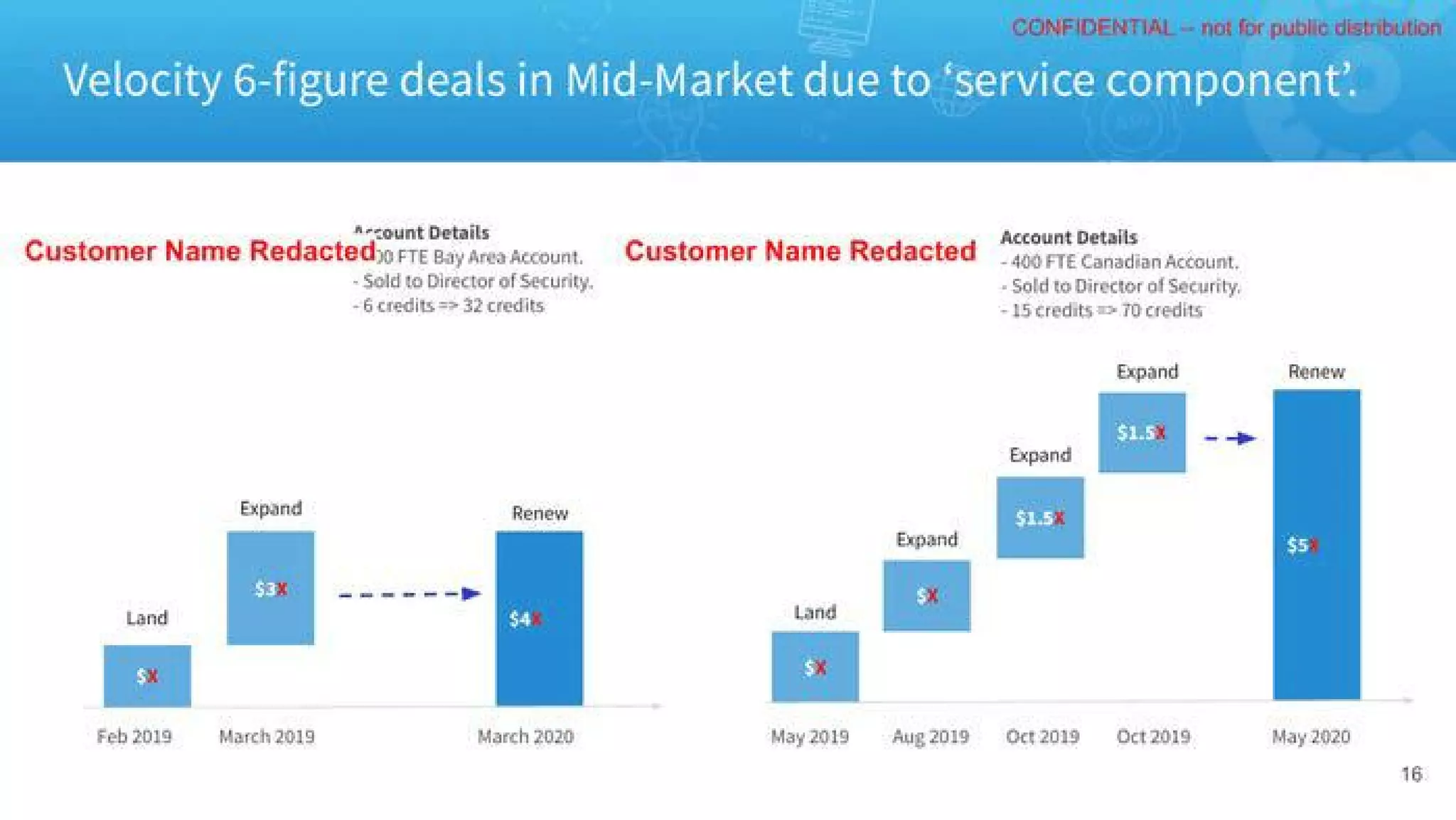
The broader deck also contains customer case growth (slide 16 showing staged expansions to six-figure deals) and unit economics discussion (slide 15 about churn and CAC <> LTV balances). Founders should present high-level growth curves and unit economics even if early; use redaction sparingly to protect sensitive data while still communicating momentum and efficiency metrics that investors expect.

Key Takeaway: Share high-level growth curves and unit-economics (CAC, LTV, churn, payback) to demonstrate scalable economics — redact specifics only when necessary but keep the narrative credible.
Team, community and operational footprint as defensibility

Team, community and operational footprint as defensibility

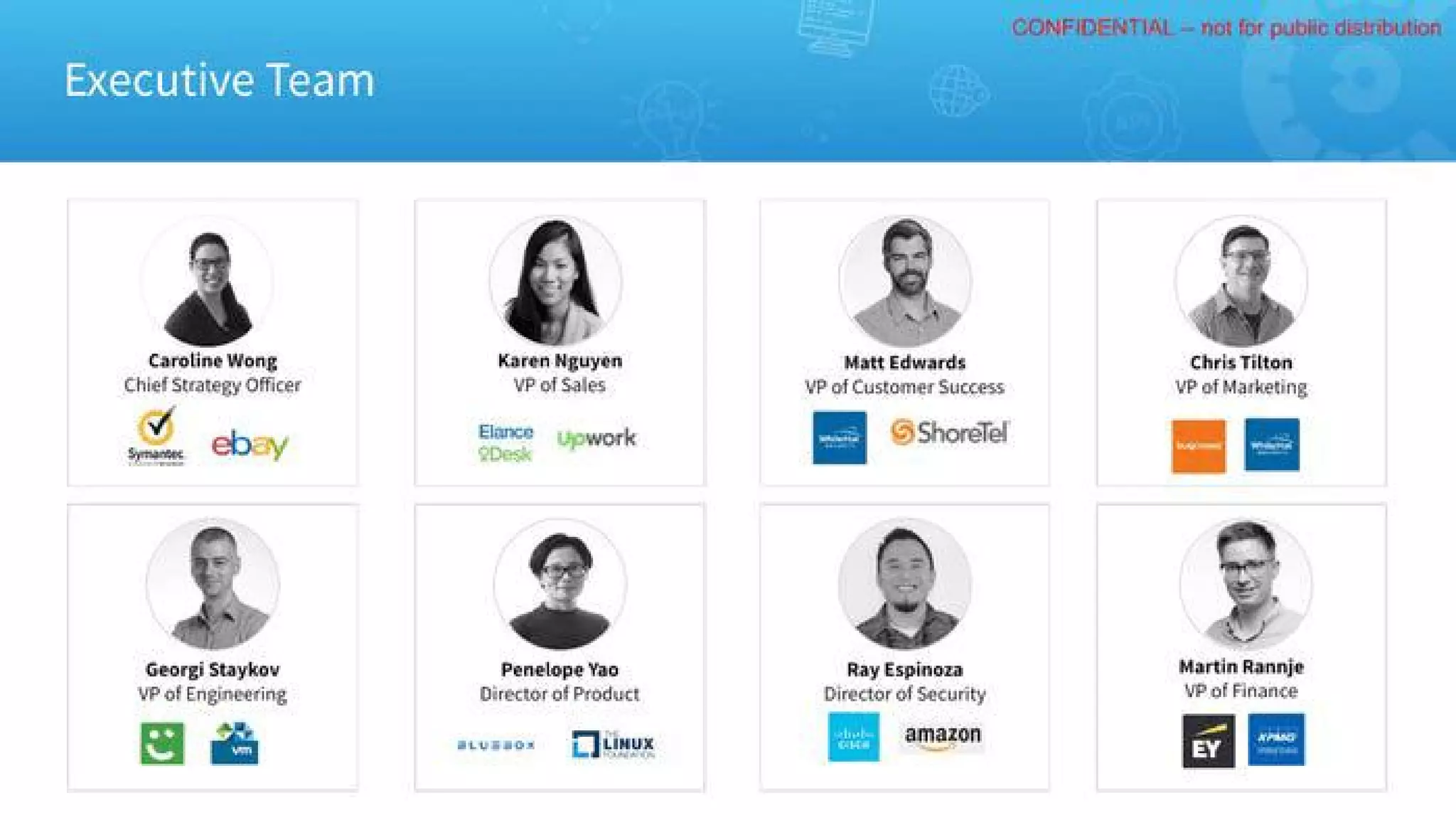
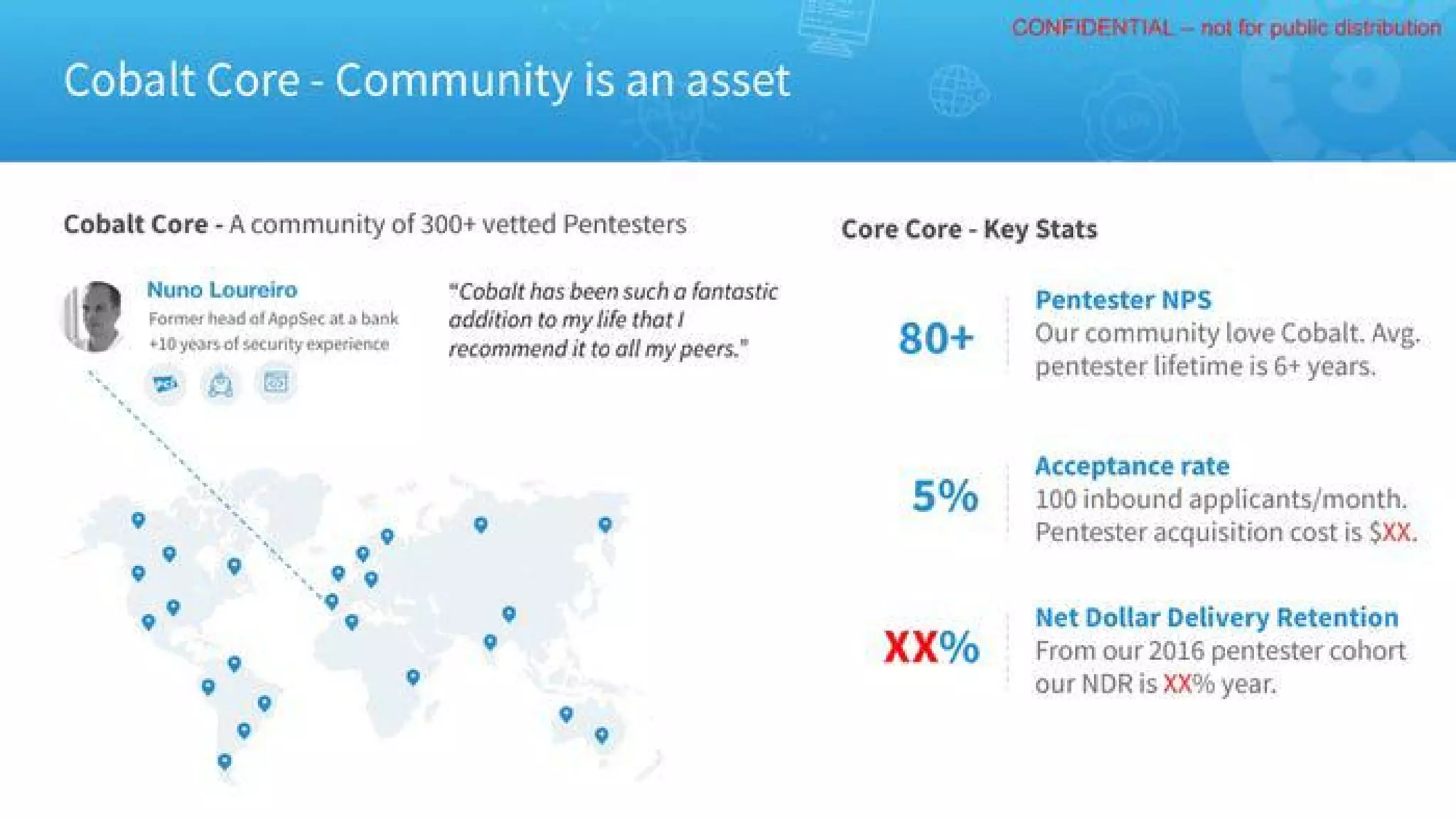
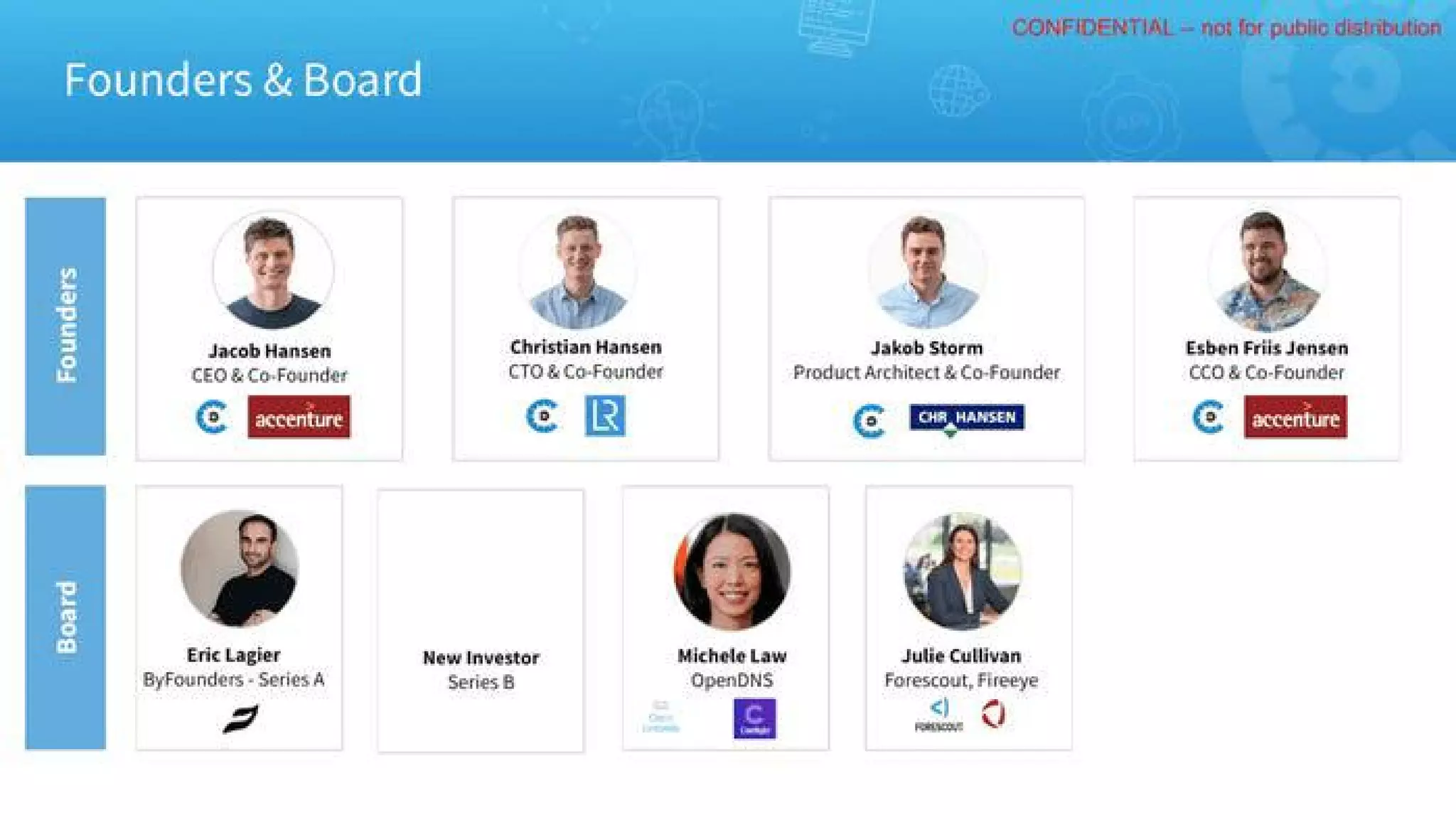
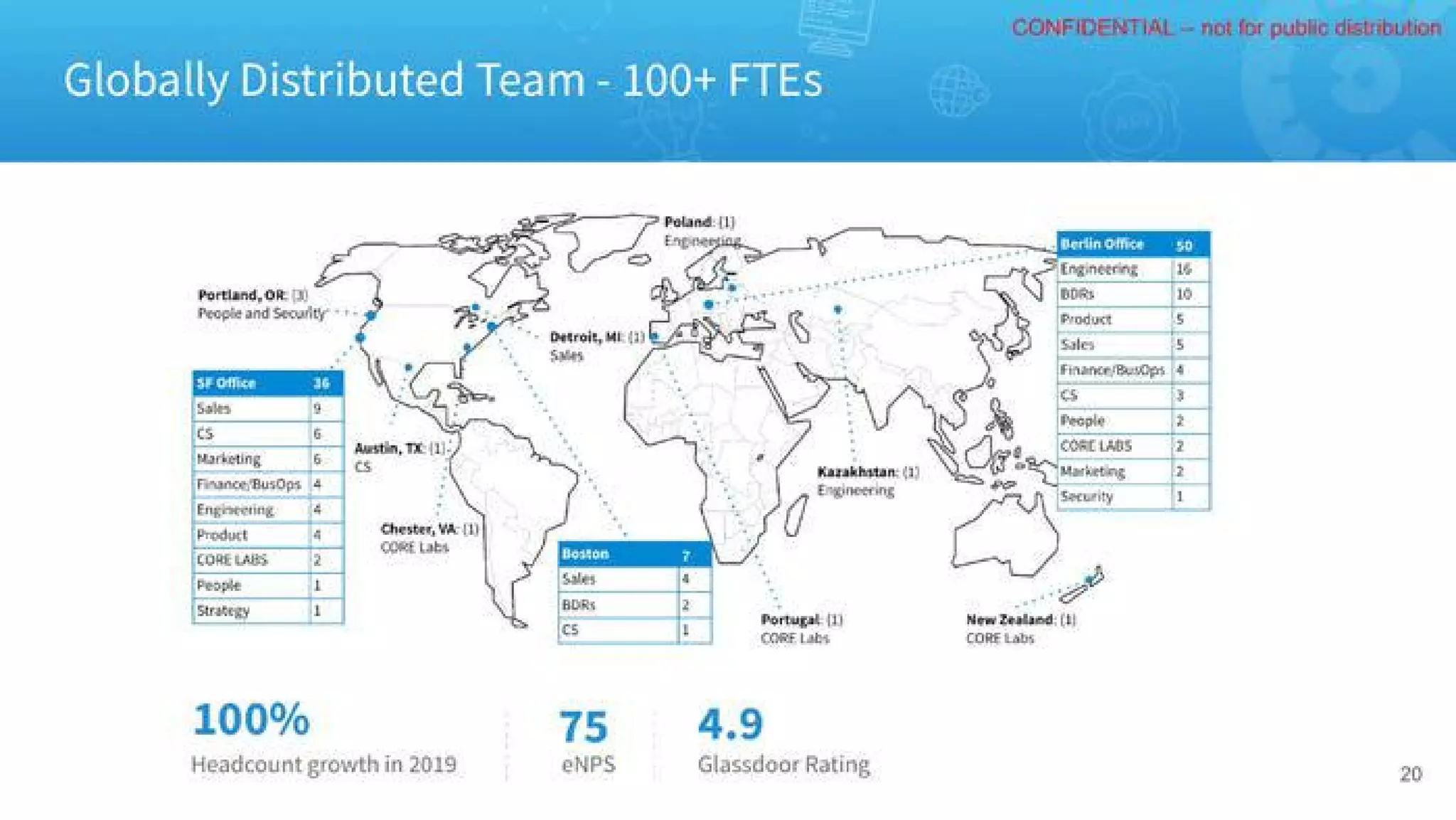
Slide 19 (Founders & Board) highlights founding team bios and board members, while other slides (10, 20, 21) document the core community of vetted pentesters and a globally distributed team. The deck leverages team credibility (ex-Accenture, OpenDNS, etc.) and community metrics (300+ vetted testers, pentester NPS, acceptance rates) to argue for a defensible network effect: quality talent + platform = harder to replicate.

This layer of defensibility is critical for marketplace/service hybrids. Founders should invest in demonstrating a strong operator team plus concrete community metrics (NPS, applicant funnel, retention) because these are the moat for talent-driven marketplaces. Also, showing global delivery capacity (map and headcount) reassures investors about ability to execute at scale.

Key Takeaway: Highlight team credibility and community metrics (NPS, applicant volume, acceptance rates) to show you control a scarce supply-side asset that powers your marketplace.

Conclusion: Key Lessons

Cobalt’s deck is a strong example of converting a services market into a product narrative: it pairs a crisp value proposition with a mapped customer problem, a mirrored product solution, measurable delivery improvements, and early traction/unit economics. The deck balances technical credibility (platform integrations, community of testers) with commercial signals (growth curves, case expansions) and practical go-to-market details.

Actionable advice for founders: 1) Lead with a single-sentence category + business model; 2) Map the customer journey and mirror it when presenting your solution; 3) Connect product design choices to specific, quantifiable business outcomes (speed, cost, retention); 4) Present unit economics and growth curves even if redacted — investors need to see scalability logic; 5) Emphasize supply-side defensibility (team, community metrics) for marketplace/service hybrids. Doing these five things will make a pitch deck far more persuasive and investor-ready.

Full Deck Analysis

11 sections

Overview

Company: Cobalt
Round: Seed ($1.5M)
Year: 2016
Outcome: Raised $38M+ total; became a leading Pentest-as-a-Service (PtaaS) platform

Executive Summary

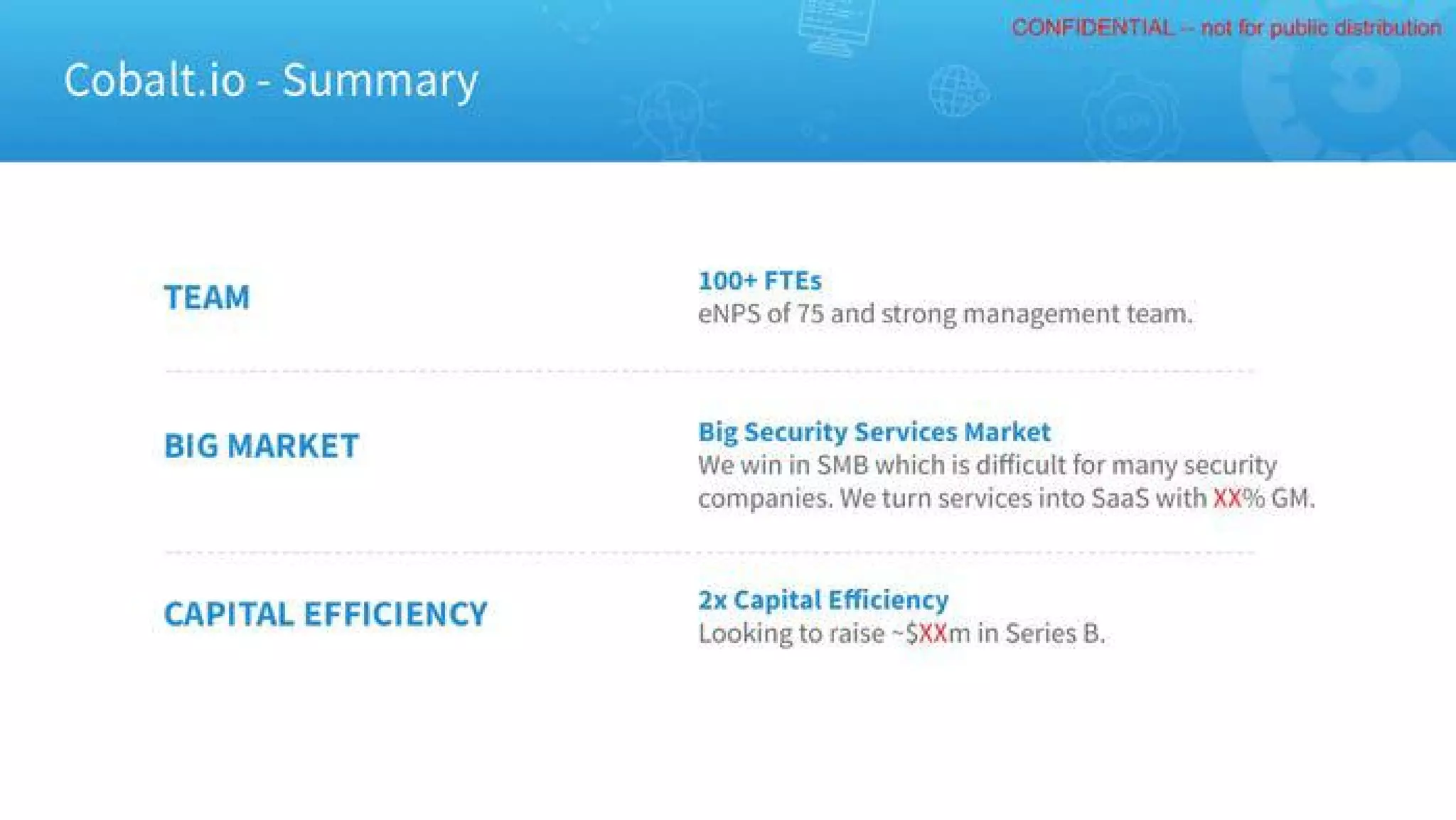
The deck presents Cobalt as a product-first reimagination of how pentesting is procured and delivered — turning a slow, expensive consultancy model into an on‑demand, software-enabled service. It pairs a marketplace of vetted pentesters with a SaaS collaboration and delivery platform, targeting a multi‑billion dollar security services market. The narrative, traction claims (500+ customers, 100+ FTEs) and clear GTM create a credible seed-stage investment case despite several redacted financials.


Problem Statement

How the deck articulates the problem:

  • Legacy pentesting is described as slow, manual and costly: planning in Excel, sourcing local consultants, PDF delivery and manual re‑logging of issues (Slide 7).
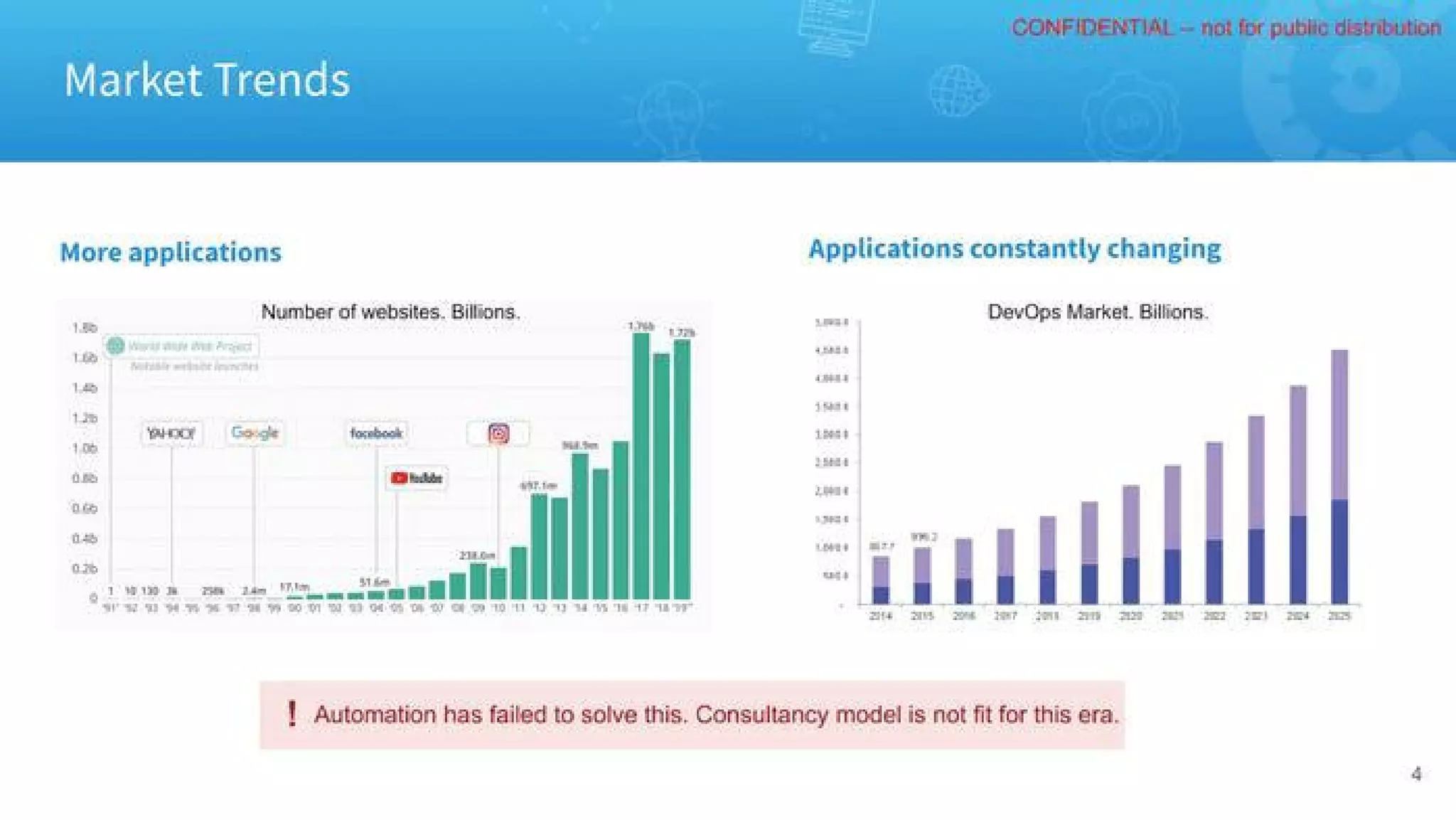
  • Market dynamics amplify the problem: more apps and constantly changing applications increase demand for frequent, developer-friendly testing (Slide 4).
  • Automation alone hasn’t solved the problem and the consultancy model “is not fit for this era” (Slide 4 bottom callout).
  • Key pain points called out: lack of developer-friendly output, slow setup (~2 weeks) and high cost (~$20k per test / $250/hr as example on Slide 7).

(Specific slides: 4, 7)


Solution

How the deck positions the solution:

  • Cobalt = Pentest as a Service (PtaaS): a blended model of on‑demand credits, an automated matching marketplace and an in‑app collaborative delivery platform (Slides 8–9).
  • Product components: streamlined procurement (credits), on‑demand vetted talent, real‑time collaboration and developer integrations (JIRA, GitHub, Slack) to speed remediation (Slides 8–10).
  • Outcomes promised: speed (weeks → 24 hours), cost reduction (+25% ROI improvement), and better data/analytics for continuous security (Slide 9).

(Specific slides: 8, 9, 10)


Market Opportunity

TAM/SAM/SOM information and signals from the deck:

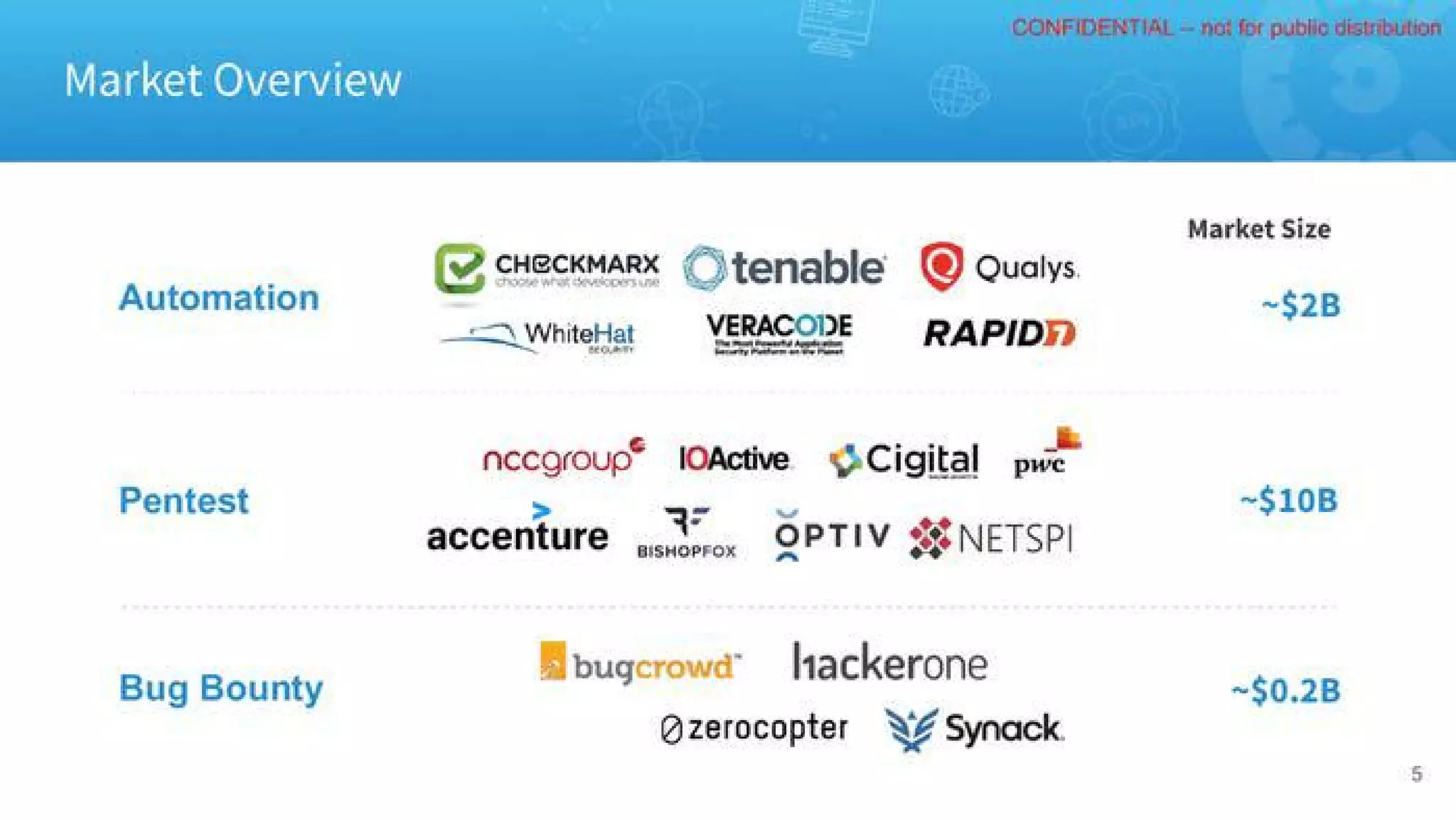
  • Market segmentation provided on Slide 5:
    • Automation/security scanning vendors market: ~ $2B (labelled “Automation ~ $2B”).
    • Pentest services market: ~ $10B (labelled “Pentest ~ $10B”).
    • Bug bounty/contests market: ~ $0.2B (labelled “Bug Bounty ~ $0.2B”).
  • Slide 4 emphasizes growth drivers: explosion in the number of web apps and DevOps adoption (charts), implying large and growing demand for continuous testing.
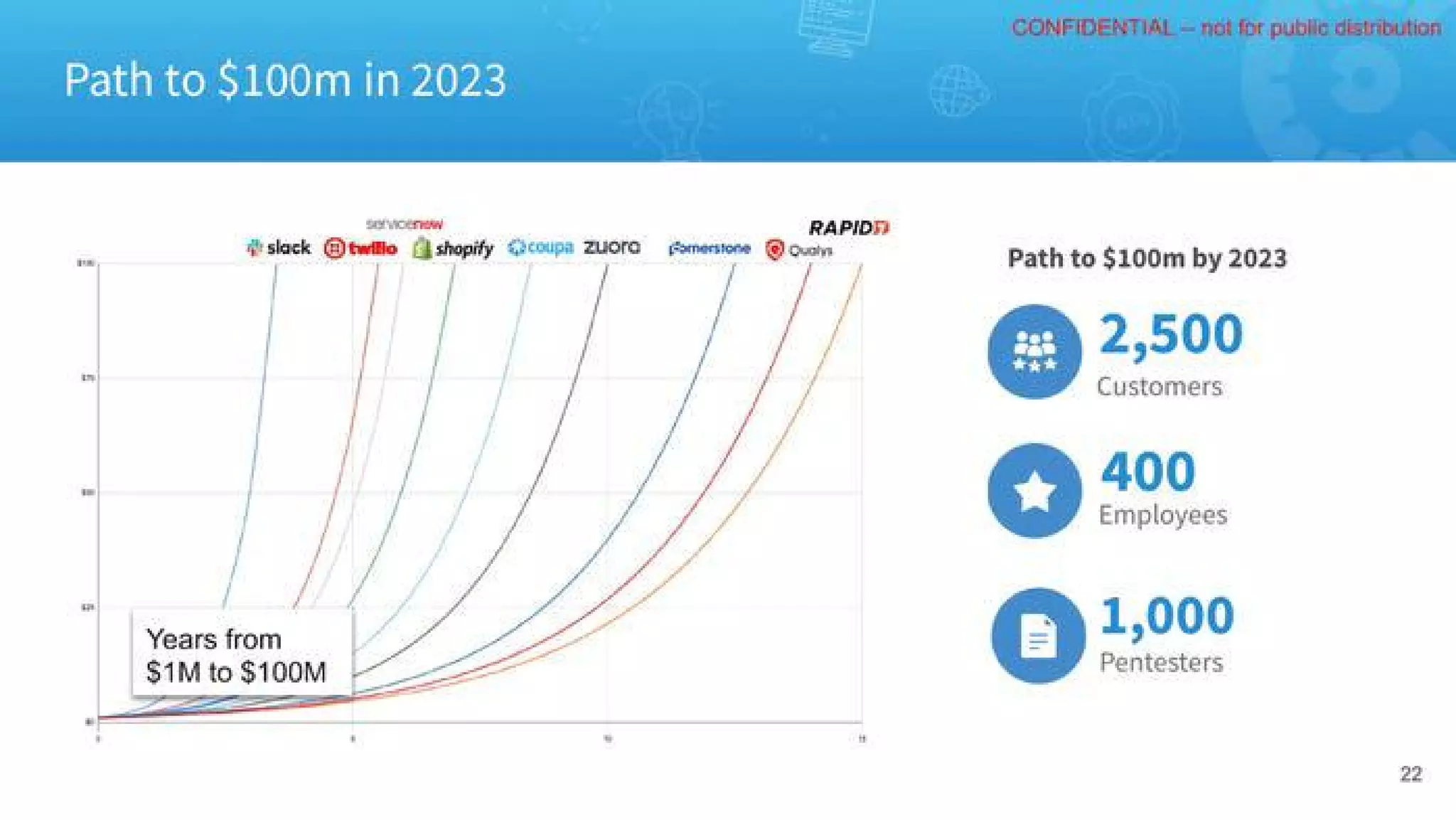
  • Path-to-scale targets: slide 22 shows a goal of 2,500 customers, 400 employees and 1,000 pentesters to reach $100M by 2023 (plan/aspiration).

(Specific slides: 4, 5, 22)


Business Model

Revenue model and unit economics:

  • Core revenue model: sell pentest “credits” and on‑demand services (Slide 8).
  • Legacy comparators: typical consultancy prices referenced (~$20k per test / $250/hr) to show room for better pricing/efficiency (Slide 7).
  • Unit economics claims:
    • Delivery improvements claim: 10x speed to deliver and +25% cost reduction (Slide 9).
    • Capital efficiency claim: “2x capital efficiency” and cash flow positive in 2020 while growing ARR (Slide 14).
    • Churn/retention slides present revenue churn buckets (SMB/Corporate/Enterprise) and Cobalt CAC <> LTV graphics but specific numbers were redacted (Slide 15).
  • Sales model: a mix of self-serve/credits for faster procurement plus an enterprise sales motion (Slides 8, 16, 17).

(Specific slides: 7–9, 14–16, 22)


Traction & Metrics

Growth metrics and proof points (explicit numbers from slides):

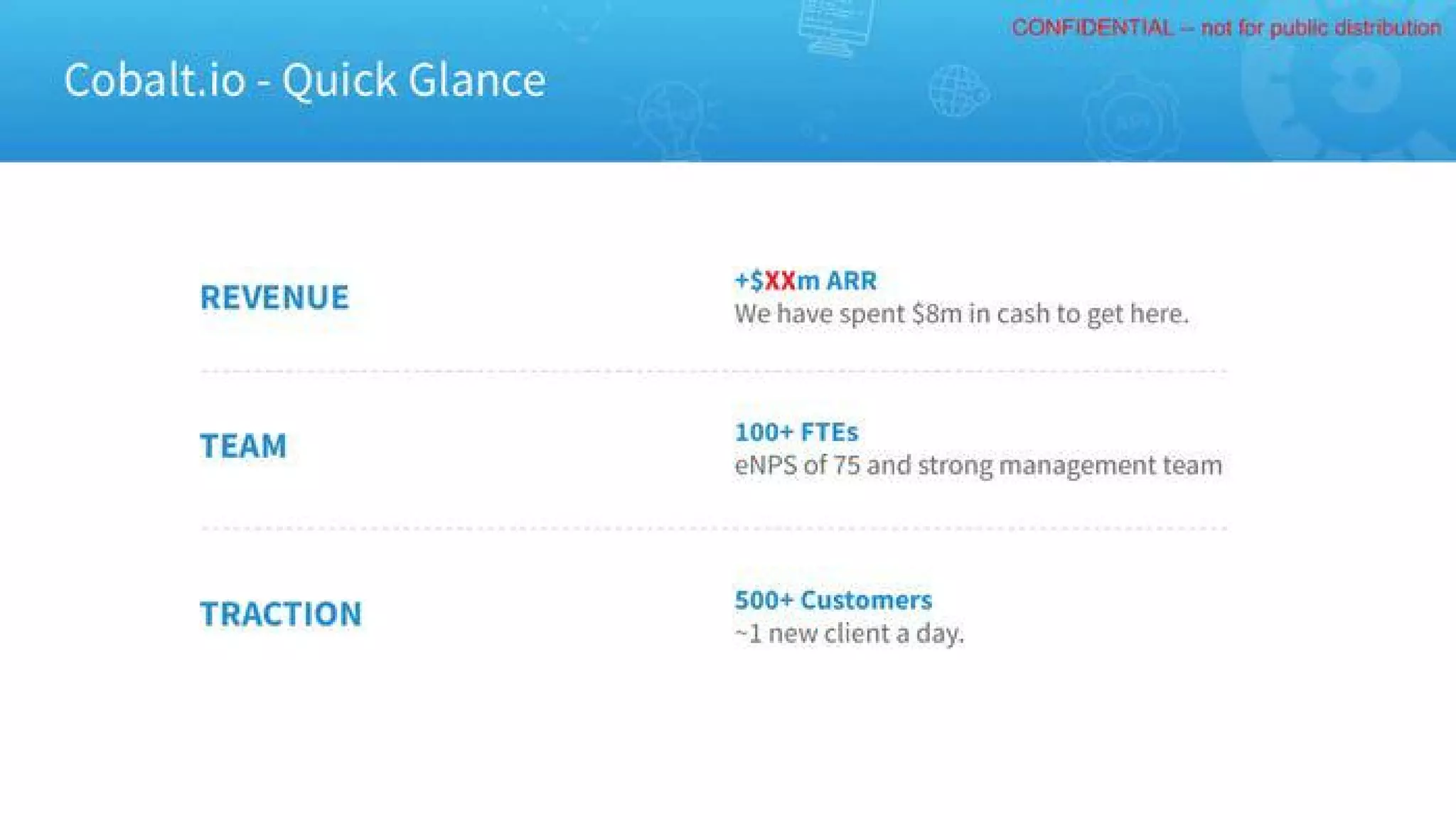
  • Customers: 500+ customers; roughly “~1 new client a day” stated (Slide 3).
  • Team: 100+ full time employees (FTEs) (Slide 3 and Slide 20).
  • Spend to date: “We have spent $8m in cash to get here” (Slide 3).
  • Community: “Cobalt Core” — 300+ vetted pentesters, pentester NPS 80+, average pentester lifetime 6+ years (Slide 11).
  • Applicant funnel: ~100 inbound pentester applicants / month, acceptance rate ~5% (Slide 11).
  • Delivery performance claims: 10x speed improvement, +25% cost reduction, move from “no-data” to data‑driven security (Slide 9).
  • Revenue/ARR: ARR numbers are redacted/obfuscated (“+$XXm ARR”) and a multi‑quarter ARR chart is presented but redacted (Slides 3, 14).
  • Growth examples: Slide 16 shows illustrative customer account expansion cases (land → expand → renew) and a staged increase in ARR for example accounts.

(Specific slides: 3, 9, 11, 14, 16)


Competitive Positioning

How they differentiate:

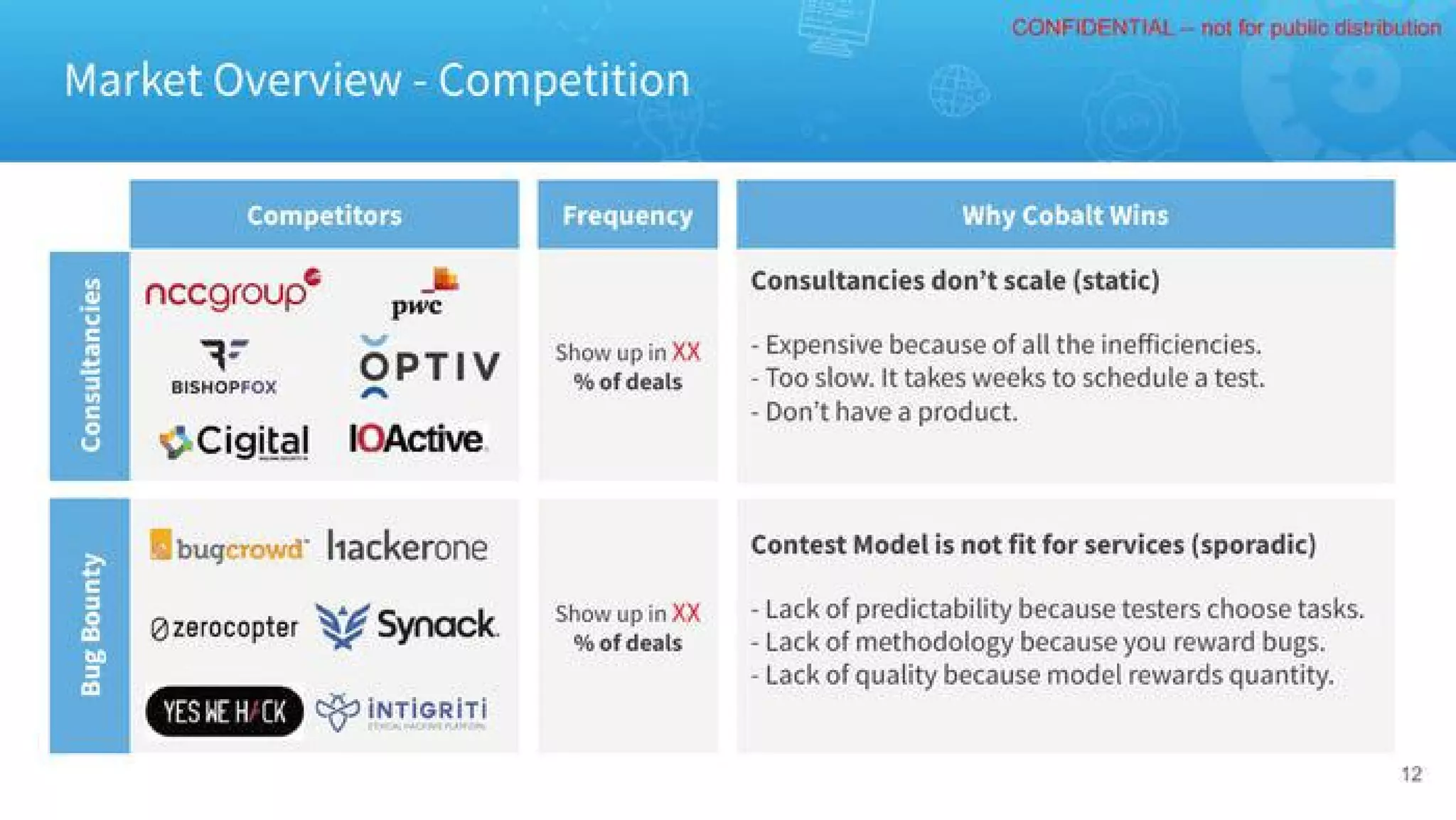
  • Positioning: product + marketplace vs. traditional consultancies and bug-bounty platforms (Slides 5, 12).
    • Consultancies: “don’t scale”, slow, expensive, lack product (Slide 12).
    • Bug-bounty: contest model not fit for predictable services, quality concerns (Slide 12).
  • Differentiators emphasized:
    • On‑demand credits and automated matching for speed and utilization (Slides 8–9).
    • In‑app collaboration (developer-friendly output, JIRA/GitHub/Slack integrations) to reduce remediation friction (Slides 8–10).
    • Vetted pentester community with high NPS and long lifetime (Slide 11).

(Specific slides: 5, 8–12)


Team

Team credentials as presented:

  • Founders and leadership have prior experience in consulting, product and security companies; slide content shows prior employers and security/consulting backgrounds (e.g., consultancy and security firm logos, enterprise security leadership backgrounds) and an experienced executive team across product, engineering, security, GTM and finance (Slides 18–20).
  • Board/advisors include experienced security and product operators (Slide 18–19).
  • The deck emphasizes operational capability with an executive team that includes experienced leaders in sales, customer success, engineering and security (Slide 20).

(Specific slides: 18–20)


Go-to-Market Strategy

Distribution approach shown:

  • Offer on‑demand credits for streamlined procurement to reduce friction (Slide 8).
  • Two-pronged GTM: SMB-scalable model for broader adoption and dedicated enterprise motions for large accounts (Slide 15, Slide 16).
  • Customer success and in‑app engagement to drive expansion (Slide 16).
  • Integrations (JIRA/GitHub/Slack) and analytics to increase stickiness and drive programmatic buys (Slides 9–10, 15).

(Specific slides: 8, 9, 15, 16)


The Ask

  • Seed round: $1.5M (stated in header/context).
  • Slide 25 (summary) and Slide 3 show cash spent to date ($8M) and ARR redacted; deck likely used the seed to scale product and marketplace, invest in GTM and build the pentester community. The explicit use‑of‑funds slide is not present/explicit (capital raise target beyond seed shown as aspirational Series B in board slide).

(Specific slides: front matter / 3 / 25 — no explicit line-item use of funds present)


Investor Deep Dive

Executive summary, strengths & red flags

Executive Summary

The deck presents Cobalt as a product-first reimagination of how pentesting is procured and delivered — turning a slow, expensive consultancy model into an on‑demand, software-enabled service. It pairs a marketplace of vetted pentesters with a SaaS collaboration and delivery platform, targeting a multi‑billion dollar security services market. The narrative, traction claims (500+ customers, 100+ FTEs) and clear GTM create a credible seed-stage investment case despite several redacted financials.

Key Strengths

3 identified

1

Clear problem/customer pain articulation with concrete examples (Slide 7)

2

Product + marketplace model with defensible community assets (Slides 8–11)

3

Credible early traction and GTM story (Slides 3, 16)

Red Flags & Weaknesses

3 identified

1

Key financials redacted or vague (Slides 3, 14, 15)

2

Reliance on labor-intensive expertise (pentester supply scaling risk) (Slides 11, 8)

3

Missing explicit use-of-funds and runway detail for the seed ask (Slides 3/25)

More Pitch Decks To Study

Compare structure, fundraising context, and investor-facing story across similar startup decks.