Compare your deck to Calm

Compare Your Deck

Calm Pitch Deck (2018)

Consumer
Stage: Series A
Raised: $27M
Year: 2018
Slides: 20
Outcome: Valued at $2B

Pitch Deck

1 / 20
Calm pitch deck - The Opening: Brand and Visual Positioning
Click to expand

Deck Analysis

This Series A pitch deck from Calm uses strong branding, clear mission framing, product depth, and hard traction metrics to tell a concise growth story for a consumer mental wellness app. The deck pairs evocative imagery and a calming visual identity with evidence of market momentum (downloads, subscribers, revenue), product breadth, and a small/high-margin team — the combination that helped Calm raise $27M at a high valuation. Notable is how the deck balances emotion (brand, mission) with data (user and financial traction), offering a blueprint for consumer apps aiming to scale via subscription monetization.

The Opening: Brand and Visual Positioning

The Opening: Brand and Visual Positioning

The first slide (logo over a serene mountain-lake photo) immediately sets the emotional tone of the business: calm, restorative, and premium. Using a single strong visual with large negative space and the app icon centered communicates the product’s purpose in one glance and establishes a cohesive brand that carries through the rest of the deck.

This approach works because Calm is selling an experience as much as a product. Founders can learn the value of an opening slide that emotionally primes the audience and mirrors the user experience rather than overwhelming with text. A consistent, well-photographed visual identity builds credibility and helps an abstract wellness product feel tangible and trustworthy.

Key Takeaway: Use an opening visual that embodies your product’s core emotional benefit — keep it simple and consistent across the deck.

Mission & Problem Framing: Why This Product Matters

Mission & Problem Framing: Why This Product Matters

Slide 6 states Calm’s mission — 'To make the world happier and healthier' — using large, legible type over the same peaceful landscape. The slide is concise and aspirational, which is appropriate for a consumer wellness brand seeking to scale: it communicates purpose without getting bogged down in operational detail. This positions Calm as mission-driven, a narrative that resonates with users, partners, and investors interested in impact.

Slide 7 (the WHO quote, 'Stress is the health epidemic of the 21st century') effectively quantifies urgency and validates market need through an authoritative third-party citation. Pairing a mission statement with an external statistic is a powerful combo: mission gives meaning, the statistic gives scale and credibility. Founders should note that problem framing should link emotional resonance (mission) to objective urgency (data or authoritative quotes) to justify product-market relevance.

Key Takeaway: Combine an aspirational mission with an authoritative data point to make your product feel both meaningful and necessary.
Product Depth: Features and Experience

Product Depth: Features and Experience

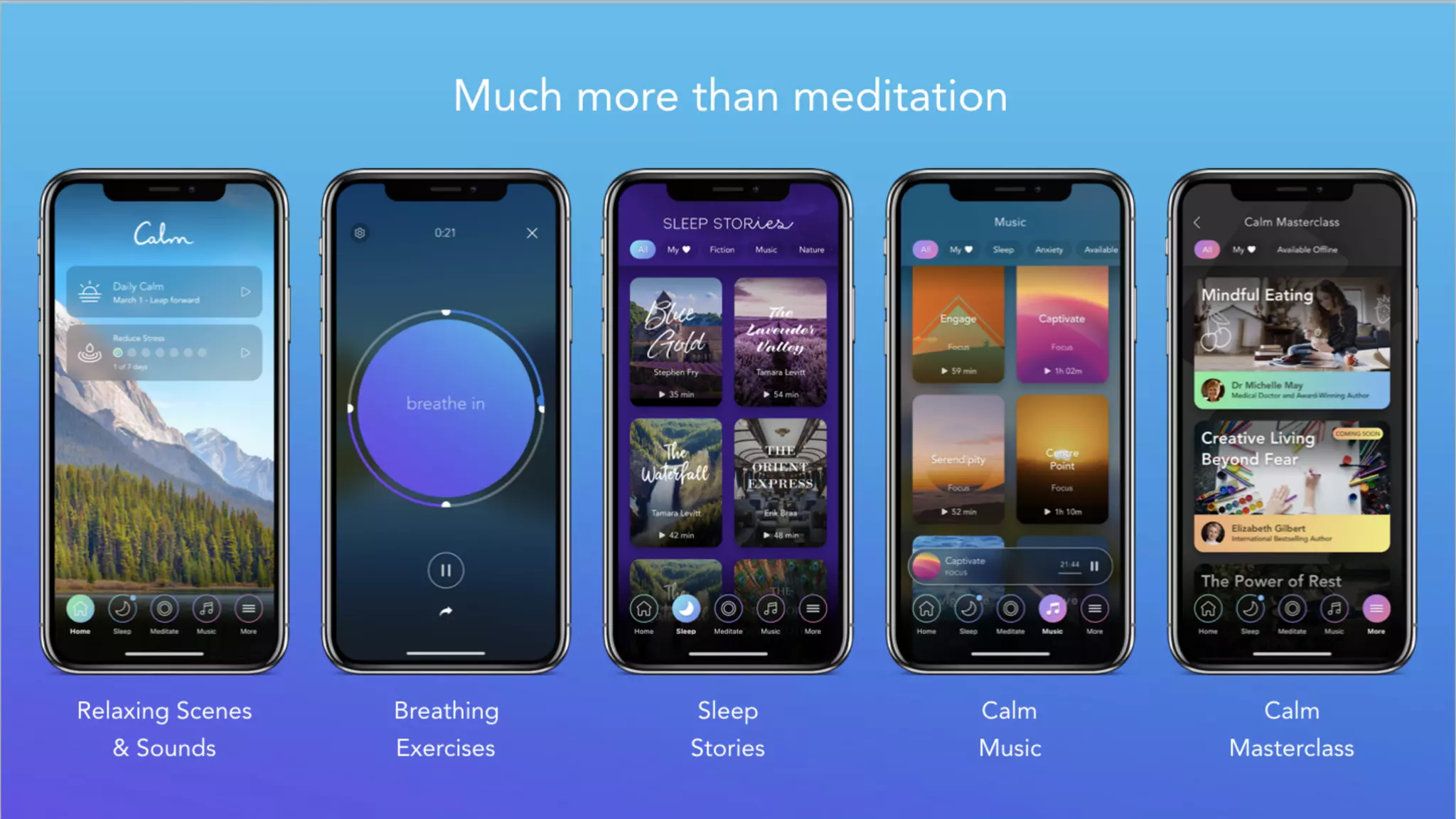
The product slides (e.g., the 'Much more than meditation' page) showcase multiple product pillars — relaxing scenes, breathing exercises, sleep stories, music, and masterclasses — using clean device mockups. This demonstrates breadth without distracting detail: investors immediately see that Calm is not a single feature app but a multi-modal wellness platform, increasing the perceived lifetime value and differentiation versus single-feature competitors.

The visual treatment is important: polished phone mockups, consistent color palette and minimal copy let the UI speak. For founders, this demonstrates how to present product variety succinctly — emphasize representative experiences, show them in situ (on-device), and avoid long feature lists. The goal is convincing the viewer that the product is delightful, repeatable, and monetizable.

Key Takeaway: Showcase representative, polished product experiences in device mockups to convey breadth and user delight without text overload.
Traction: Downloads and Momentum

Traction: Downloads and Momentum

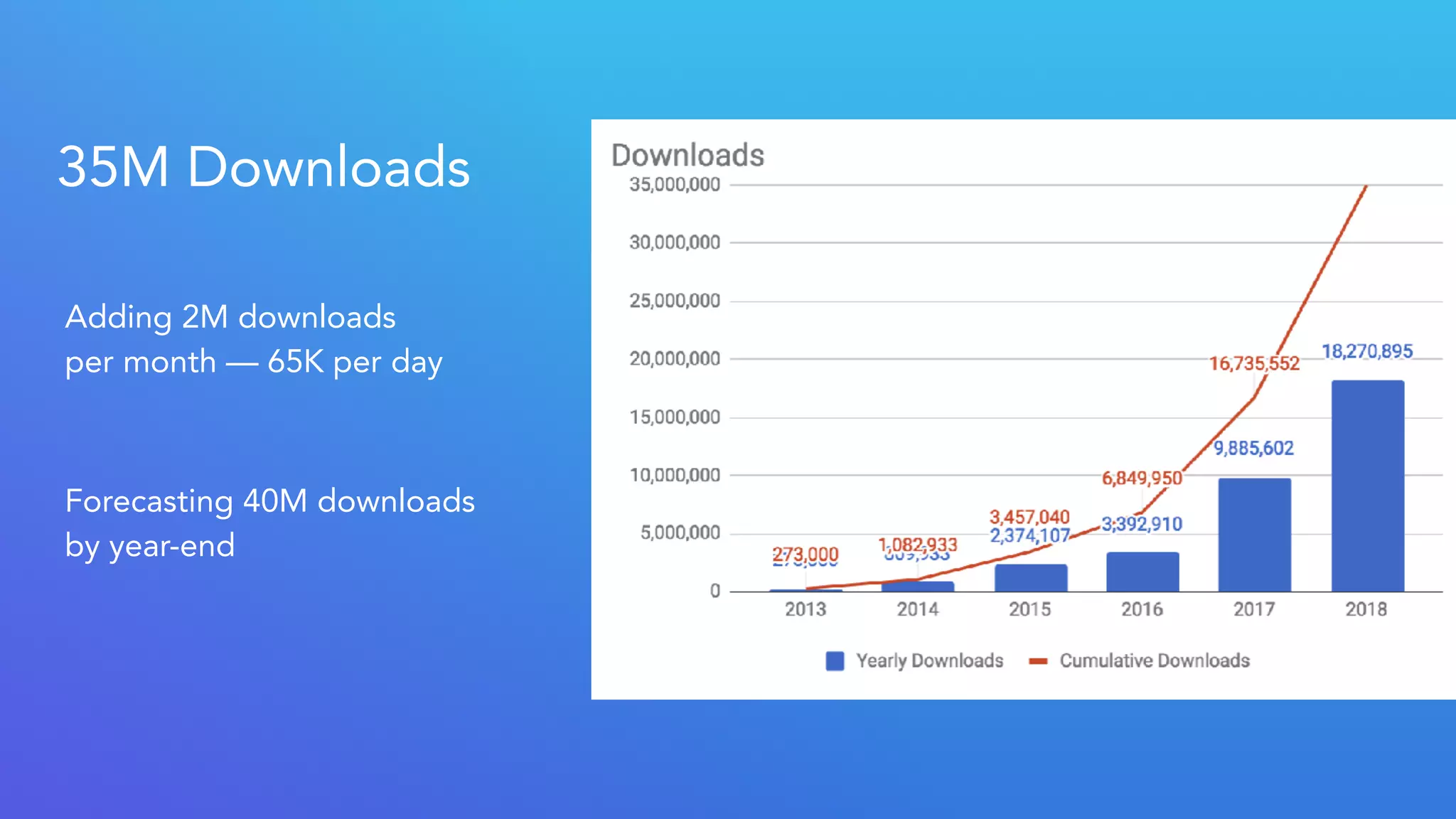
The downloads slide highlights explosive user growth (35M downloads, adding ~2M per month), using a simple chart and supporting callouts. This kind of metric is persuasive for consumer investors because it proves product-market fit at scale and indicates strong top-of-funnel acquisition — both crucial for a subscription business model. The slide communicates velocity (growth rate) as clearly as absolute scale.

Founders should note how Calm pairs a single headline metric with context (monthly additions, daily rates, forecast) so investors can assess sustainability. When showing downloads, include both cumulative and velocity metrics and keep the visual tidy: investors first scan for scale, then for growth trend and forecast credibility.

Key Takeaway: Present a headline adoption metric plus velocity/context to show both scale and current momentum in a single clear slide.
Monetization: Paying Subscribers and Conversion

Monetization: Paying Subscribers and Conversion

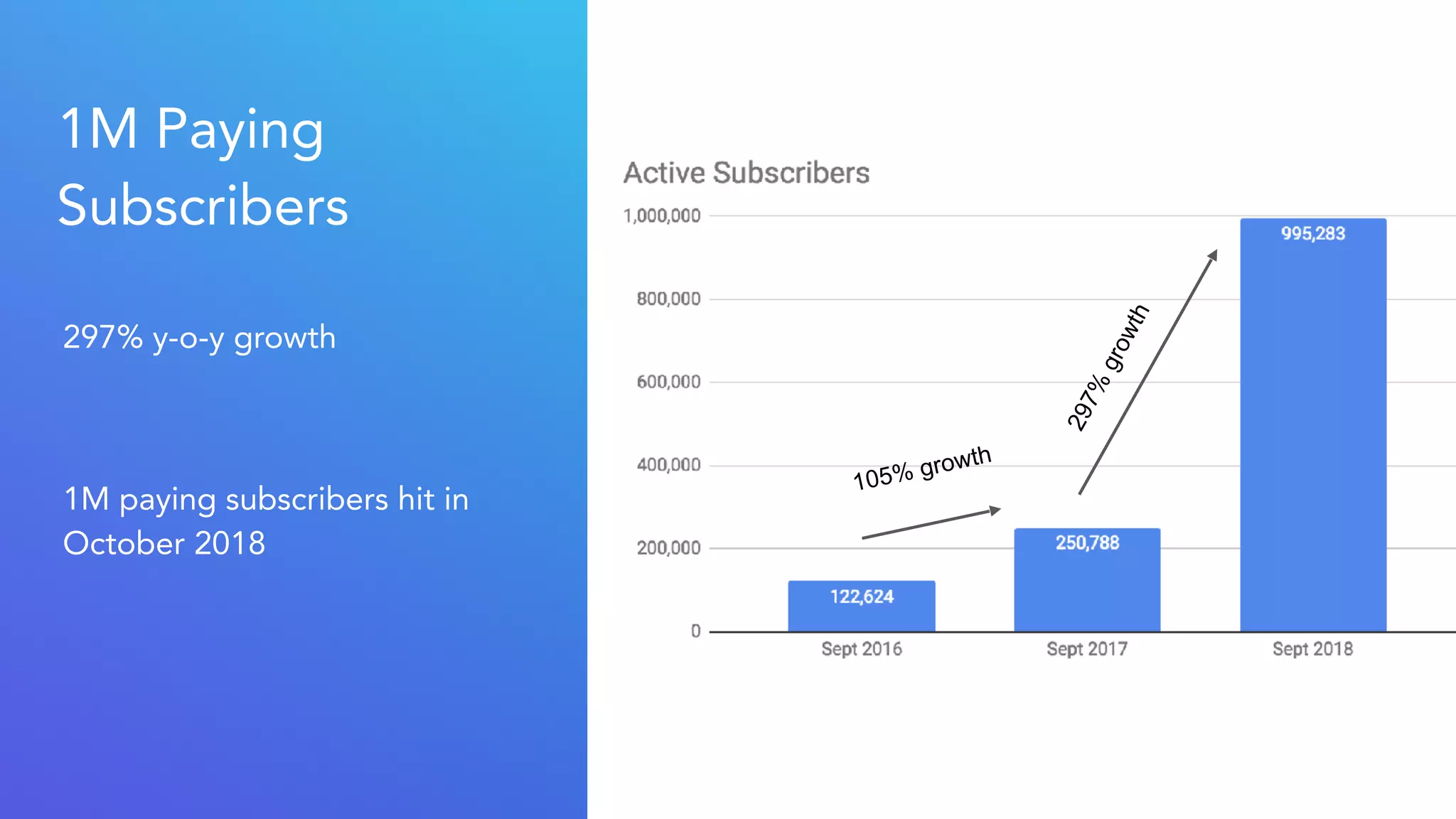
Calm dedicates a focused slide to paying subscribers (1M paying, 297% year-over-year growth). That clarity — separating free downloads from paid conversions — is critical for subscription businesses. The slide demonstrates that Calm isn’t only driving installs but also converting users into recurring revenue, a different and more valuable signal to investors.

The slide also calls out the timing (1M paid hit in October 2018), which helps investors understand cadence and inflection points. For founders, the lesson is to separate user adoption metrics from monetization metrics and to highlight conversion inflection points — these are often the most important predictors of long-term valuation.

Key Takeaway: Clearly separate and emphasize paid conversion metrics and growth inflection points — investors value recurring-revenue signals over raw installs.
Revenue & Unit Economics: Profitable Growth

Revenue & Unit Economics: Profitable Growth

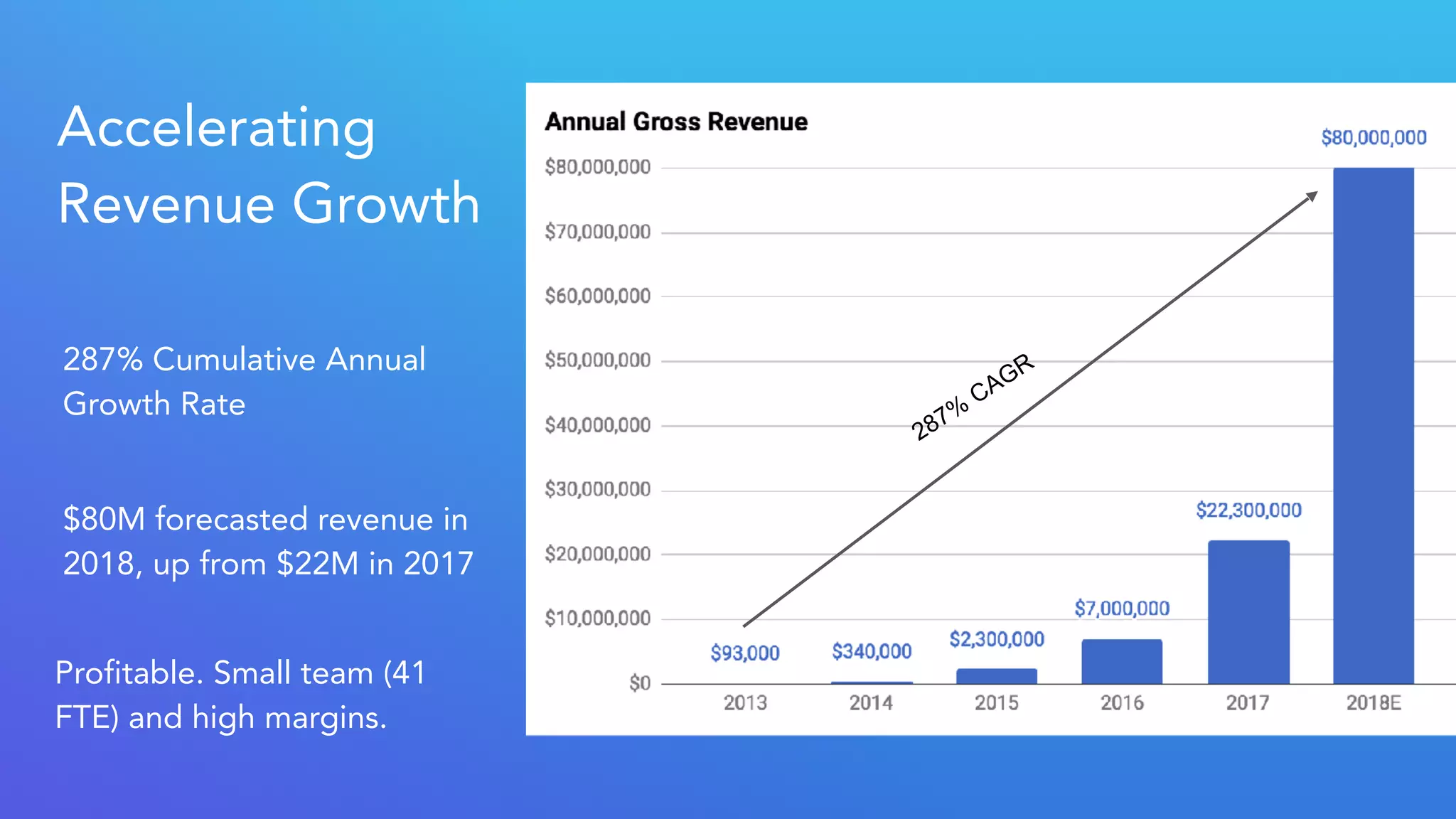
The revenue slide shows a steep trajectory ($7M in 2016 to $22.3M in 2017 and $80M forecast for 2018) and calls out a 287% CAGR. Combining revenue growth with notes on profitability and a small team (41 FTE) tells a complete financial story: rapid scale but operationally efficient. This is compelling to investors who want growth but also care about capital efficiency and margins.

This slide balances figures and qualitative context (profitable, small team), which helps investors quickly assess scalability and capital needs. Founders should emulate this structure: present historical revenue and forward-looking forecasts, show CAGR, and include qualitative signals of healthy unit economics (profitability, cohort retention, team efficiency) to reduce perceived risk.

Key Takeaway: Show historical revenue, a realistic forecast/CAGR, and contextual notes on profitability or unit economics to convince investors your growth is sustainable.
Team: Founders and Company Culture

Team: Founders and Company Culture

The deck includes a slide with the two co‑founders front-and-center and another image showing a cohesive team. This humanizes the company and signals culture fit for a consumer brand where content creation and product design matter. Presenting a small, engaged team alongside the product underscores the claim of being a tight, high-impact organization.

Founders should remember that investors invest in teams as much as ideas: include a concise team slide that communicates relevant experience, complementary skills, and culture. Visuals of the actual team (photos) can strengthen credibility, especially when paired with traction and financial evidence that shows the team executes.

Key Takeaway: Use team visuals and a short, complementary narrative to show capability and culture — investors want to see who will execute the plan.

Conclusion: Key Lessons

Calm’s deck succeeds by marrying evocative branding and mission-driven storytelling with crisp, high-impact metrics (downloads, paying subscribers, revenue growth) and polished product presentation. Its structure — open with emotion, define the problem, show product breadth, prove traction, and finish with monetization and financials — is a repeatable framework for consumer subscription startups. The deck is concise, visually consistent, and prioritizes the metrics investors care about.

Actionable advice for founders: lead with a strong, product-aligned visual identity; pair mission with authoritative market validation; show representative product experiences using device mockups; separate adoption from monetization metrics and highlight conversion inflection points; and present clear revenue history plus unit-economics context. Keep slides uncluttered and make every visual support the narrative: emotion to establish need, product to prove solution, and metrics to validate scale and economics.

Full Deck Analysis

11 sections

Overview

Company: Calm
Round: Series A ($27M)
Post-Money Valuation: $250M
Pre-Money Valuation: $223M (implied)
Year: 2018
Outcome: Valued at $2B+ (8x return on Series A valuation)


Executive Summary

Calm’s Series A pitch deck presents a masterclass in data-driven storytelling for a consumer subscription business at inflection point. The deck effectively combines emotional brand positioning with hard metrics across downloads (35M), paying subscribers (1M), revenue ($80M forecasted 2018), and profitability—a rare combination for a growth-stage startup. By positioning mental fitness as the “new physical fitness” and stress as a “health epidemic,” Calm frames a massive TAM while demonstrating clear market leadership (#1 wellness app by revenue globally) and exceptional unit economics (41 FTE generating $1.95M revenue per employee). The pitch successfully de-risks the investment through third-party validation (Apple App of the Year 2017, 4.8/5 rating, 400K reviews) and articulates a diversified growth strategy beyond consumer digital.


Problem Statement

Slide 6: “Stress is the health epidemic of the 21st century”

The deck opens with a WHO-attributed quote positioned over a crowded subway platform, establishing stress as a systemic, global health crisis rather than an individual wellness preference. This framing is critical—it elevates the addressable market from “meditation enthusiasts” to “anyone experiencing modern stress,” which is essentially the global adult population.

Supporting context (Slide 7): The deck draws an explicit parallel to the physical fitness revolution of the 1970s-80s, suggesting mental fitness is at the beginning of a multi-decade trend with massive TAM expansion potential. This analogy is powerful because it implies:

  • Early market penetration (Calm is the “Nike of meditation”)
  • Decades of growth runway ahead
  • Mainstream acceptance and normalization

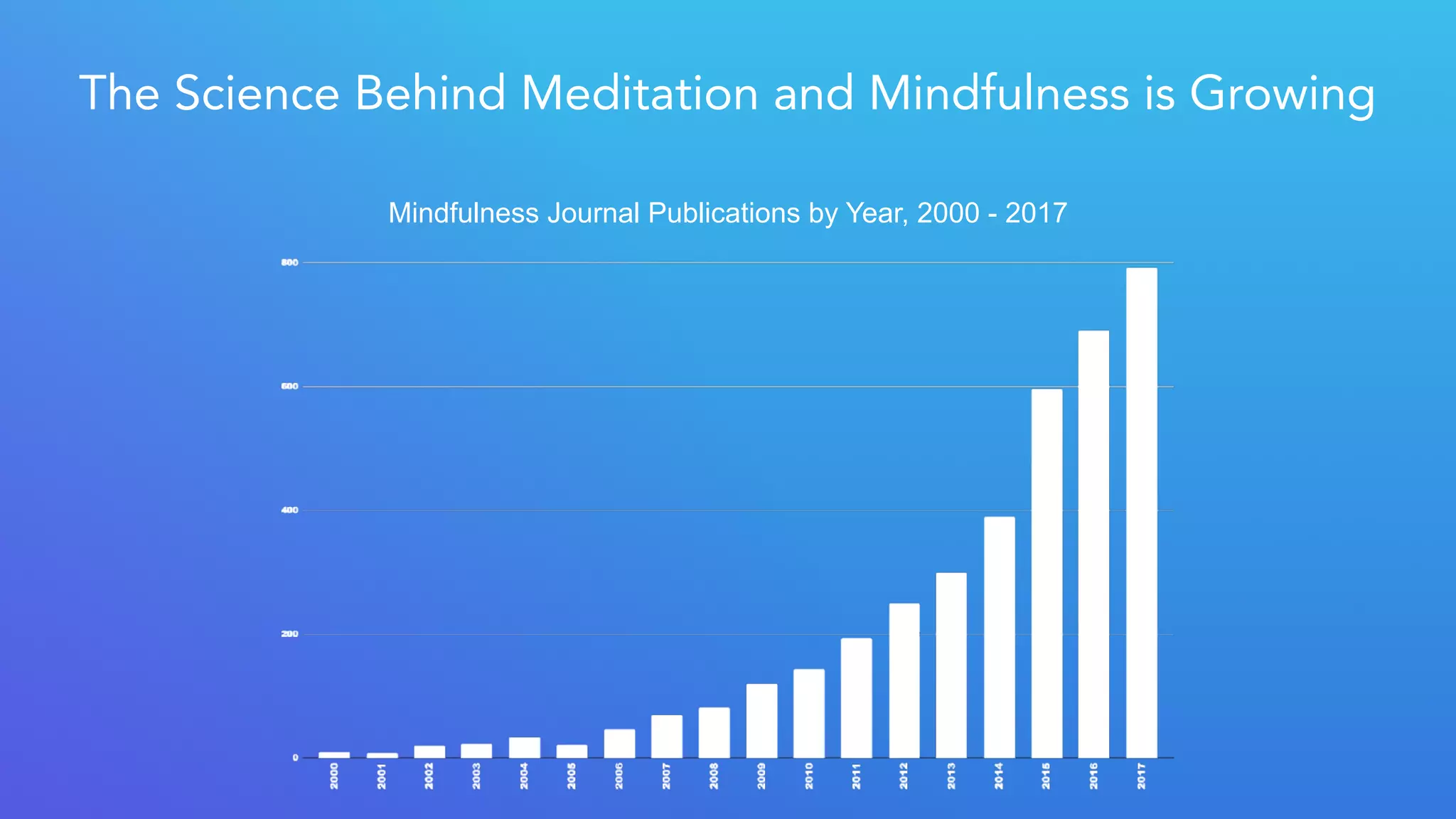
Problem validation (Slide 8): Scientific credibility is established through mindfulness journal publications growing from ~50 (2000) to ~800 (2017), demonstrating that the problem is not only real but increasingly validated by peer-reviewed research.

Limitation: The deck doesn’t quantify the problem in economic terms (e.g., cost of stress-related illness, lost productivity, healthcare spend). This is a missed opportunity to establish TAM more rigorously.


Solution

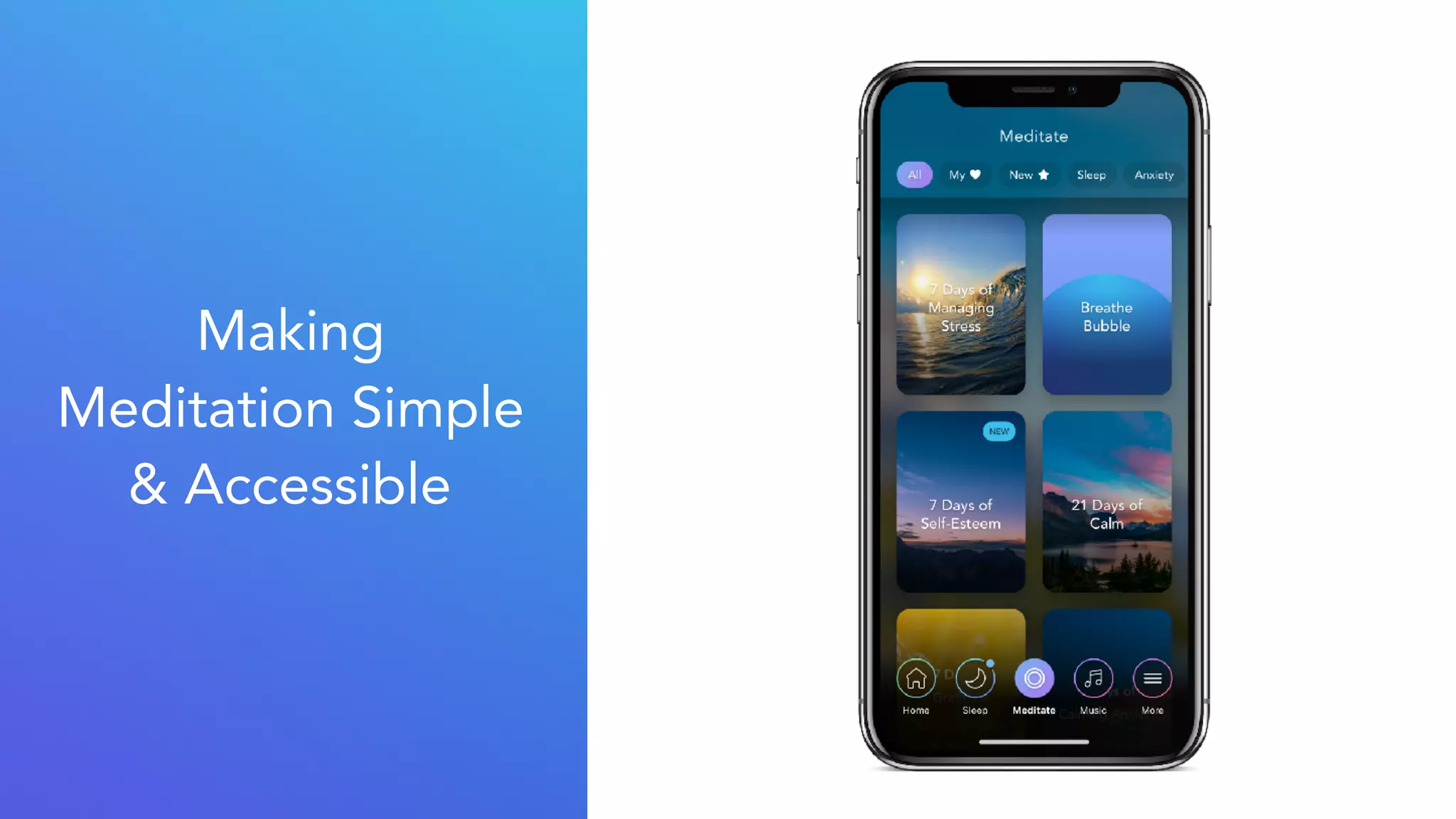
Slide 9: “Making Meditation Simple & Accessible”

Calm’s core value proposition is elegantly simple: democratizing meditation by removing barriers to entry. The deck positions meditation as something that has been “gatekept” (requiring yoga studios, gurus, or specialized knowledge) and makes it accessible via smartphone.

Product breadth (Slide 10): “Much more than meditation”

The deck demonstrates that Calm is not a single-feature app but a comprehensive wellness platform:

  • Meditate: Guided meditations (7-day programs, breathing exercises)
  • Sleep Stories: Narrated sleep content (Stephen Fry, Tamara Levitt) with 35-54 minute durations
  • Breathing Exercises: Interactive visual guides
  • Calm Music: Curated ambient music with mood-based categorization
  • Calm Masterclass: Expert-led courses (Dr. Michelle May on “Mindful Eating”)

This multi-feature approach is strategically important because it:

  1. Increases user engagement (multiple reasons to open the app)
  2. Enables multiple monetization vectors
  3. Reduces churn (users have more reasons to maintain subscription)
  4. Creates defensibility (harder to replicate than single-feature app)

Design philosophy: The UI shown across all product screens emphasizes simplicity, beauty, and accessibility—no jargon, intuitive navigation, nature-based imagery that reinforces the brand promise.


Market Opportunity

Implicit TAM Analysis:

The deck doesn’t explicitly state TAM/SAM/SOM, but provides enough data to infer:

TAM (Total Addressable Market):

  • Global adult population: ~4.5B people
  • Problem statement: “Stress is the health epidemic of the 21st century” (WHO)
  • Implied TAM: Anyone experiencing stress = essentially all adults
  • Realistic TAM: Affluent, digitally-connected adults in developed markets = ~1B+ people

SAM (Serviceable Addressable Market):

  • English-speaking, smartphone-owning adults in developed markets
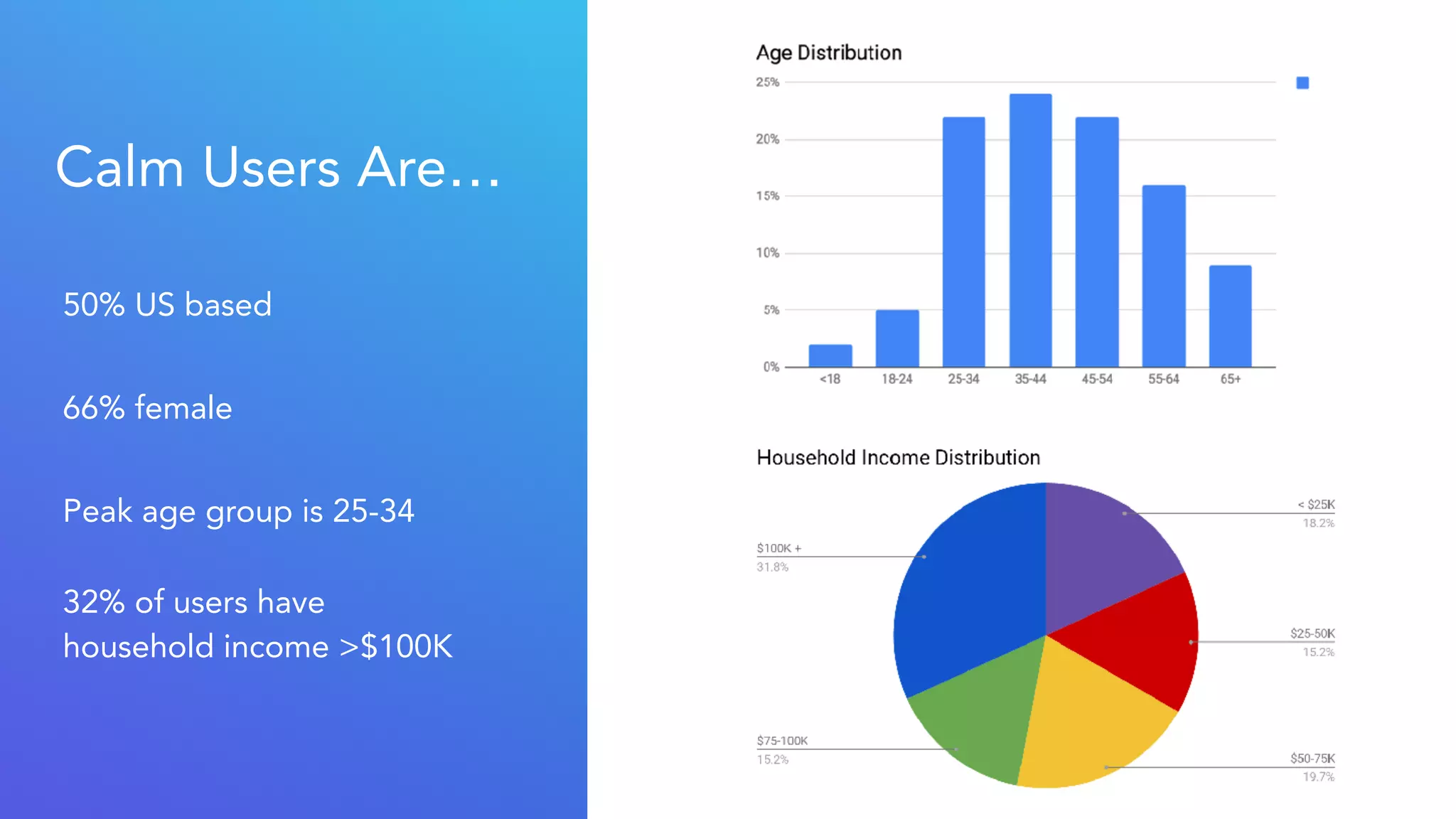
  • Current geographic focus: 50% US-based (Slide 13)
  • Implied SAM: ~300-500M people in English-speaking developed markets

SOM (Serviceable Obtainable Market):

  • Current: 35M downloads, 1M paying subscribers
  • Penetration: ~0.3% of implied SAM
  • Significant runway for growth

Market Size Benchmarks (Slide 12):

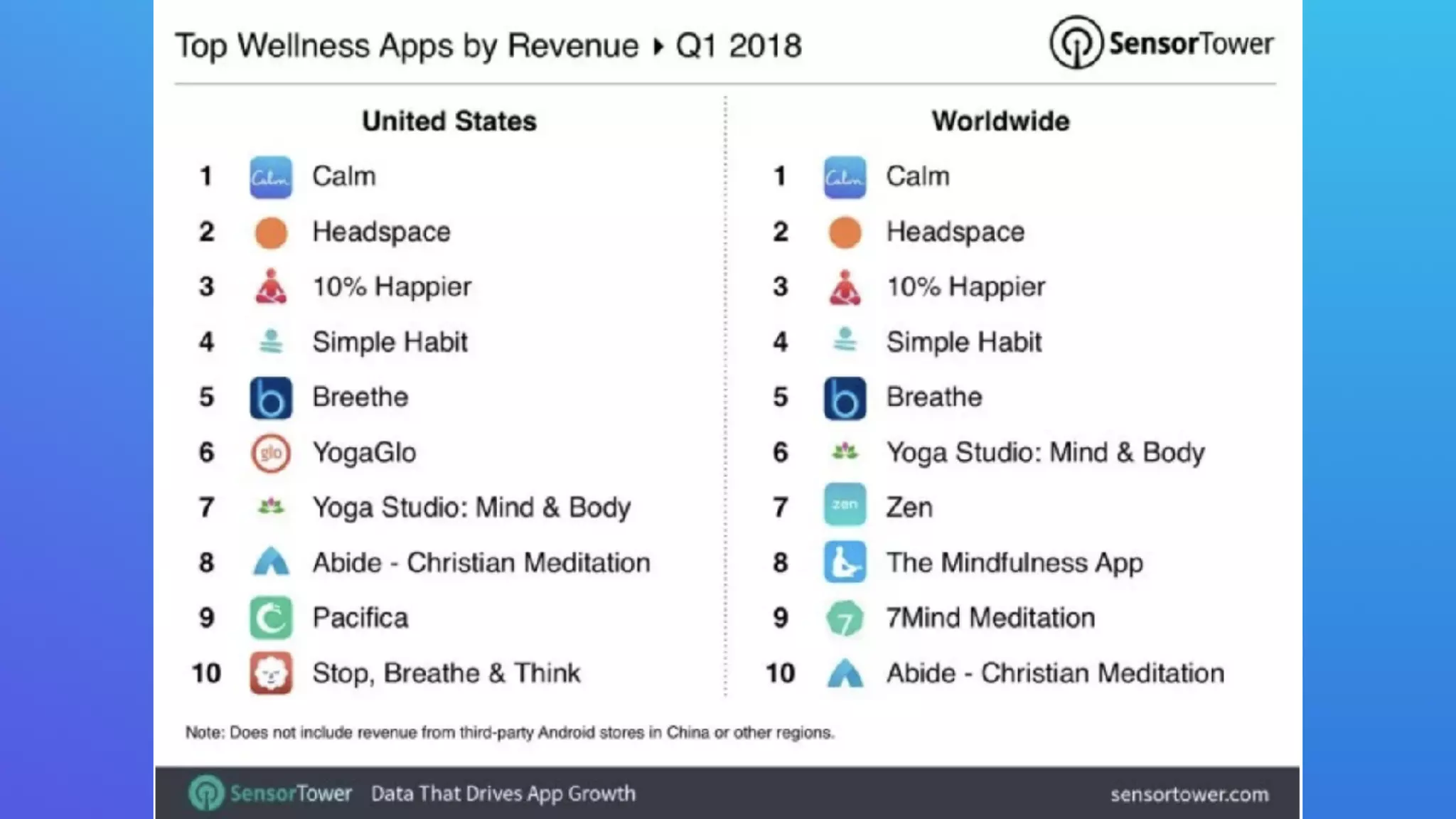
  • Calm is #1 wellness app by revenue (US and Worldwide, Q1 2018)
  • Competitive set includes: Headspace (#2), 10% Happier (#3), Simple Habit (#4), Breathe (#5)
  • Existence of 10 major wellness apps in top rankings suggests market is large enough to support multiple winners

Market Growth Signals:

  • Mindfulness journal publications: 50 (2000) → 800 (2017) = 16x growth
  • Mental fitness trend positioning as equivalent to physical fitness boom (1970s-80s)
  • Mainstream media coverage (TIME magazine “Mindful Revolution”)

Limitation: The deck provides no explicit TAM estimate, market research data, or competitive market sizing. This is a notable gap—investors typically want to see TAM/SAM/SOM analysis explicitly stated.


Business Model

Revenue Model: Freemium Subscription

Pricing Structure (Implied):

  • Free tier: Limited content access, likely with ads or feature restrictions
  • Paid subscription: Unlimited access to all content
  • Pricing tiers: Likely monthly and annual options (standard for subscription apps)

Unit Economics (Slide 15-16):

Metric Value
Downloads 35M (cumulative)
Paying Subscribers 1M (Oct 2018)
Conversion Rate ~3% (1M / 35M)
Monthly Downloads 2M (current run rate)
Daily Downloads 65K (current run rate)
YoY Subscriber Growth 297% (Sept 2017 → Sept 2018)

Revenue Metrics (Slide 16):

Year Revenue Growth
2013 $93K —
2014 $340K 265%
2015 $2.3M 576%
2016 $7M 204%
2017 $22.3M 218%
2018E $80M 259%
5-Year CAGR 287% —

Profitability:

  • Deck claims company is “profitable” with “high margins”
  • Team size: 41 FTE
  • Revenue per employee: ~$1.95M (2018E)
  • This is exceptional efficiency for a consumer app company

ARPU Calculation (Estimated):

  • 1M paying subscribers
  • $80M forecasted revenue (2018)
  • Implied ARPU: $80/subscriber/year = $6.67/month
  • This suggests either: (a) mix of monthly ($9.99) and annual ($69.99) subscriptions, or (b) lower average pricing in international markets

Churn Implications:

  • 297% YoY subscriber growth suggests either: (a) strong net new acquisition, or (b) low churn
  • Likely both: high acquisition (65K downloads/day) + strong retention (evidenced by 4.8/5 rating and “life changing” user reviews)

Monetization Diversification (Slide 17):
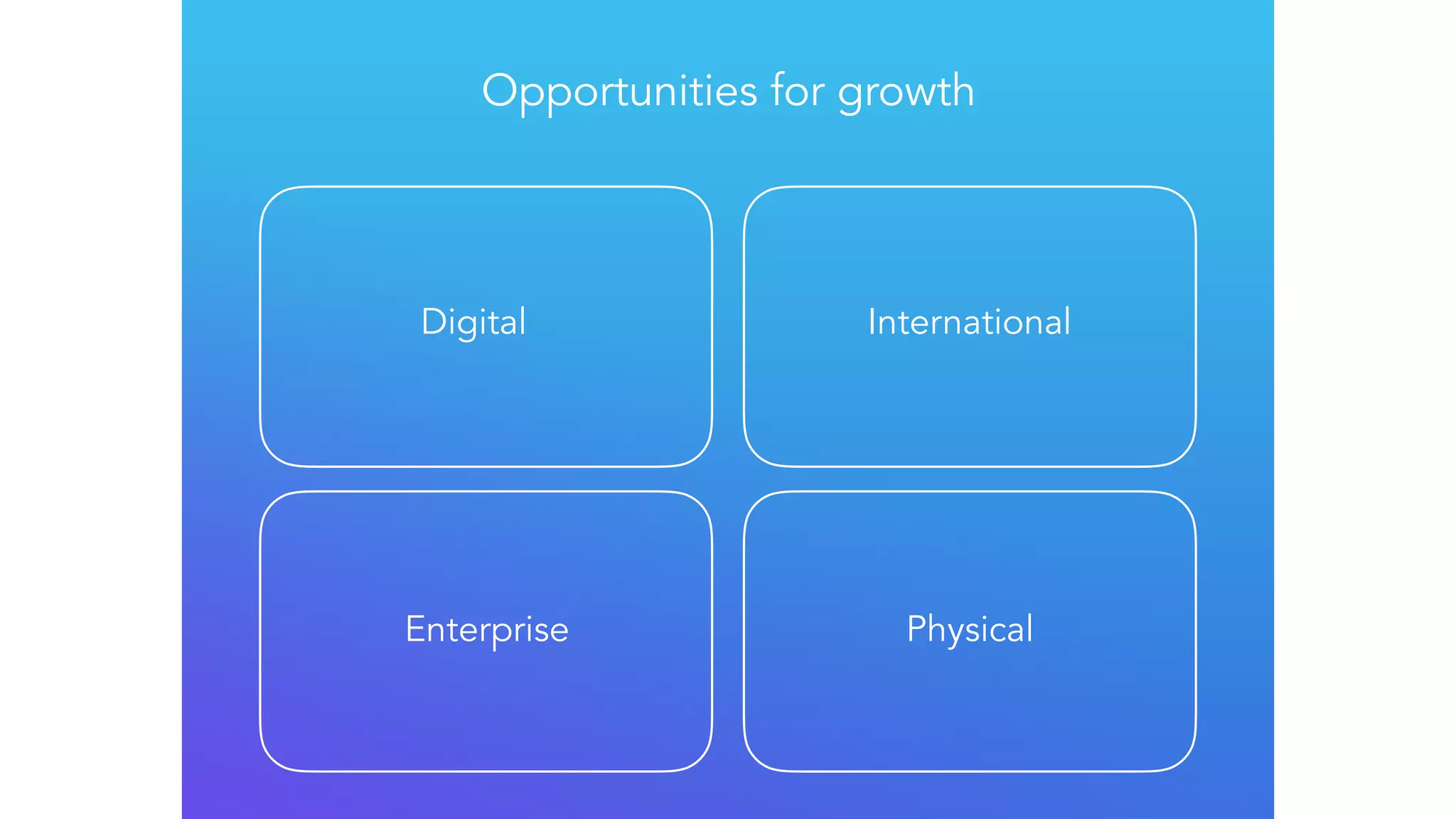
The deck identifies four growth vectors:

  1. Digital: Deepening consumer engagement (current focus)
  2. International: Geographic expansion (50% US-based currently)
  3. Enterprise: B2B corporate wellness (high-margin, recurring)
  4. Physical: Offline/retail expansion (brand extension)

This suggests management is thinking beyond consumer subscription and exploring adjacent revenue streams.


Traction & Metrics

User Acquisition (Slide 14):

Year Downloads YoY Growth
2013 273K —
2014 1.08M 297%
2015 2.37M 119%
2016 3.39M 43%
2017 9.89M 192%
2018 18.27M 85%
Cumulative 35M —

Key insight: Growth is accelerating in absolute terms (2017-2018 added 8.4M downloads vs. 6.5M in 2016-2017) despite lower YoY percentage growth. This suggests market expansion rather than saturation.

Monetization Traction (Slide 15):

Period Subscribers Growth
Sept 2016 122.6K —
Sept 2017 250.8K 105%
Sept 2018 995.3K 297%
Oct 2018 1M (milestone)

Critical insight: Subscriber growth is accelerating dramatically (105% → 297%), suggesting improving product-market fit and/or improved monetization strategy.

User Satisfaction (Slide 11):

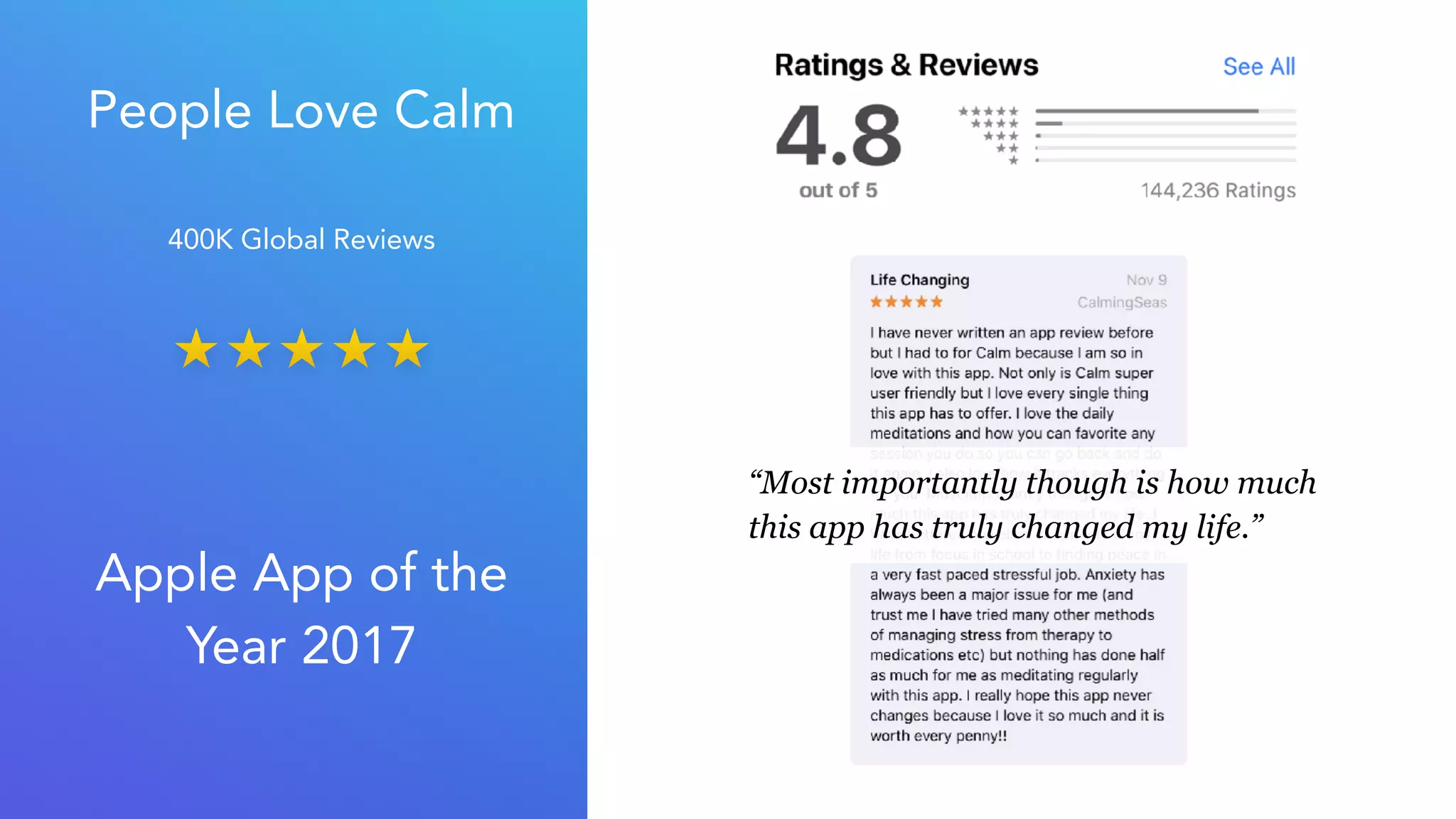
  • App Store Rating: 4.8/5
  • Total Reviews: 144,236
  • Global Reviews: 400K+
  • Apple App of the Year: 2017
  • User sentiment: “Life changing,” “anxiety relief,” “stress management”

Geographic Distribution (Slide 13):

  • US-based: 50%
  • International: 50%
  • Implication: Strong international traction; significant runway for US market deepening

Demographic Profile (Slide 13):

  • Gender: 66% female, 34% male
  • Age: Peak 25-34 (22%), strong in 35-44 (24%)
  • Income: 31.8% earn $100K+, 18.2% earn <$25K
  • Implication: Affluent, educated demographic with strong willingness to pay

Market Position (Slide 12):

  • Rank: #1 wellness app by revenue (US and Worldwide, Q1 2018)
  • Competitors: Headspace (#2), 10% Happier (#3), Simple Habit (#4)
  • Margin vs. #2: Significant gap suggests strong competitive moat

Competitive Positioning

Direct Competitors:

  1. Headspace (#2 by revenue)
    • Similar positioning (meditation app)
    • Well-funded competitor
    • Likely similar pricing and feature set
  2. 10% Happier (#3 by revenue)
    • Smaller, more niche positioning
    • Likely lower marketing spend
  3. Simple Habit (#4 by revenue)
    • Focused on short-form content
    • Different positioning (5-minute meditations)
  4. Breathe (#5 by revenue)
    • Breathing-focused app
    • Narrower feature set

Calm’s Competitive Advantages (Implied):

  1. Content Breadth: Unlike competitors focused on meditation alone, Calm offers sleep stories, music, masterclasses, and breathing exercises. This multi-feature approach increases engagement and reduces churn.

  2. Celebrity/Expert Content: Named narrators (Stephen Fry, Dr. Michelle May) and curated content suggest higher production quality and brand prestige vs. competitors.

  3. Market Leadership: #1 ranking by revenue demonstrates clear market preference. This creates a virtuous cycle: more revenue → more content investment → better product → more users.

  4. Brand Positioning: “Making meditation simple & accessible” is more consumer-friendly than competitors’ positioning. The brand identity (nature imagery, calm aesthetic) is distinctive and memorable.

  5. User Satisfaction: 4.8/5 rating with 144K+ reviews suggests superior product experience vs. competitors.

  6. Profitability: Claim of profitability at 41 FTE suggests better unit economics than competitors, enabling more aggressive growth investment.

Competitive Risks (Not Addressed in Deck):

  1. Headspace threat: Well-funded, similar positioning, could outspend Calm on marketing
  2. Big tech entry: Apple, Google, or Amazon could launch competing meditation apps
  3. Commoditization: Meditation content is not inherently defensible; competitors can replicate features
  4. Churn risk: Subscription fatigue could limit growth if users perceive meditation as commodity

Deck Limitation: The competitive analysis is minimal. Slide 12 shows market leadership but doesn’t explain why Calm is winning or what defensible advantages exist beyond current market position.


Team

Founders (Slide 3):

  1. Michael Acton-Smith (Co-Founder)
    • Background: Not detailed in deck
    • Role: Co-Founder (likely CEO or product-focused)
  2. Alex Tew (Co-Founder)
    • Background: Not detailed in deck
    • Role: Co-Founder (likely CEO or business-focused)

Team Size (Slide 4):

  • Approximately 25-30 employees visible in team photo
  • Diverse in gender, age, and background
  • Casual, friendly culture (dogs in photo, outdoor setting)
  • Wearing Calm-branded merchandise

Team Efficiency (Slide 16):

  • 41 FTE generating $80M forecasted revenue (2018)
  • Revenue per employee: $1.95M
  • This is exceptional efficiency, suggesting:
    • Strong product-market fit (minimal sales overhead)
    • Lean operations
    • High-leverage business model (software/subscription)

Team Credentials (Deck Limitation):
The deck provides minimal detail on founder backgrounds, prior experience, or key hires. This is a notable gap—investors typically want to see:

  • Founder track record (prior exits, relevant experience)
  • Key executive team (CFO, COO, VP Product, VP Marketing)
  • Board composition
  • Advisor network

The deck shows team culture and size but not team credibility/credentials.


Go-to-Market Strategy

User Acquisition Channels (Implied):

  1. Organic/Viral:
    • 65K downloads/day suggests strong organic growth
    • High app store rating (4.8/5) likely drives organic discovery
    • “Life changing” user reviews likely drive word-of-mouth
  2. App Store Optimization:
    • #1 wellness app ranking drives visibility
    • Apple App of the Year 2017 award likely boosted discoverability
  3. Media/PR:
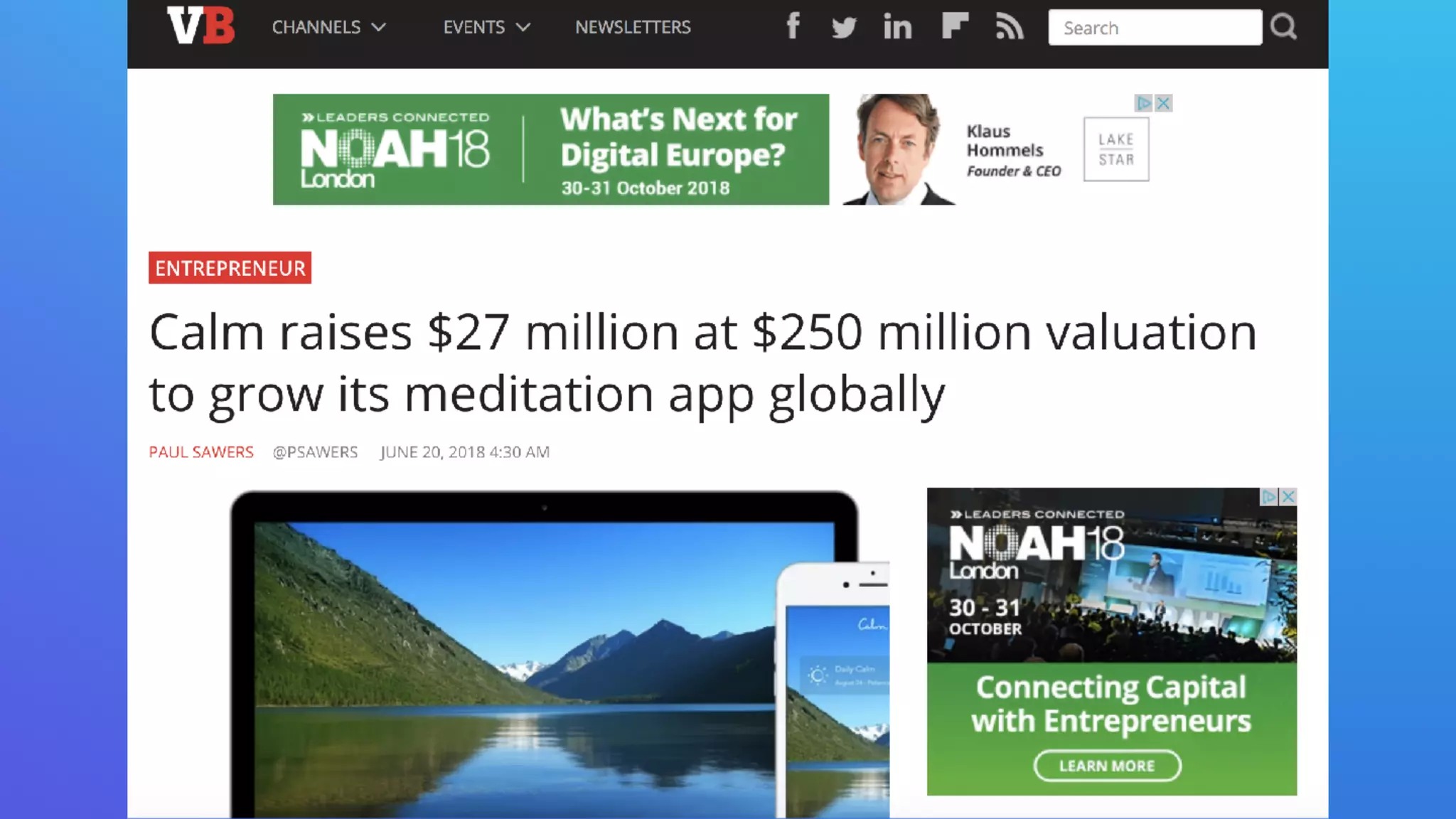
    • VentureBeat coverage (Slide 18) suggests active PR strategy
    • TIME magazine coverage (Slide 7) indicates mainstream media interest
  4. Content Marketing:
    • Celebrity narrators (Stephen Fry) likely drive media coverage and user acquisition
    • Expert masterclasses (Dr. Michelle May) suggest thought leadership positioning
  5. Paid Marketing (Implied but not detailed):
    • 2M downloads/month suggests significant marketing spend
    • Likely channels: Facebook, Instagram, YouTube (typical for consumer apps)

Monetization Strategy:

  • Freemium model: Free tier with limited content drives user acquisition
  • Paid subscription: Converts engaged users to paying subscribers (~3% conversion)
  • Retention focus: Multiple features (meditation, sleep, music, masterclass) reduce churn

Expansion Strategy (Slide 17):

  • Digital: Deepening consumer engagement (new features, content)
  • International: Geographic expansion (currently 50% US-based)
  • Enterprise: B2B corporate wellness (high-margin, recurring)
  • Physical: Offline/retail expansion (brand extension)

Deck Limitation: The GTM strategy is largely implied rather than explicitly detailed. The deck doesn’t provide:

  • Customer acquisition cost (CAC)
  • Payback period
  • Lifetime value (LTV)
  • Marketing spend allocation
  • Specific channel performance metrics

The Ask

Funding Details (Slide 18):

  • Amount: $27 million Series A
  • Post-Money Valuation: $250 million
  • Pre-Money Valuation: $223 million (implied)
  • Investor: Not specified in deck (NOAH Advisors is financial advisor, not investor)

Use of Funds (Implied):

  • Slide 18 headline: “to grow its meditation app globally”
  • Slide 17 identifies four growth vectors: Digital, International, Enterprise, Physical
  • Likely allocation:
    • Content production (sleep stories, masterclasses, music)
    • International expansion (localization, marketing)
    • Enterprise sales team (B2B corporate wellness)
    • Product development (new features)
    • Marketing/user acquisition

Deck Limitation: The deck does not provide explicit use of funds breakdown. Investors typically want to see:

  • Percentage allocation to product, marketing, sales, operations
  • Specific milestones funded by capital
  • 18-24 month roadmap

Investor Deep Dive

Executive summary, strengths & red flags

Executive Summary

Calm's Series A pitch deck presents a masterclass in data-driven storytelling for a consumer subscription business at inflection point. The deck effectively combines emotional brand positioning with hard metrics across downloads (35M), paying subscribers (1M), revenue ($80M forecasted 2018), and profitability—a rare combination for a growth-stage startup. By positioning mental fitness as the "new physical fitness" and stress as a "health epidemic," Calm frames a massive TAM while demonstrating clear market leadership (#1 wellness app by revenue globally) and exceptional unit economics (41 FTE generating $1.95M revenue per employee). The pitch successfully de-risks the investment through third-party validation (Apple App of the Year 2017, 4.8/5 rating, 400K reviews) and articulates a diversified growth strategy beyond consumer digital.

Key Strengths

7 identified

1

Exceptional Traction with Hard Metrics

The deck backs every claim with specific numbers: 35M downloads, 1M paying subscribers, $80M forecasted revenue, 287% CAGR, 4.8/5 rating with 144K+ reviews. This is rare for Series A pitches and dr...

2

Market Leadership Position with Clear Defensibility

Calm is #1 wellness app by revenue globally (Slide 12), with a significant gap to #2 (Headspace). This market leadership creates a virtuous cycle: more revenue → more content investment → better pr...

3

Profitability at Growth Stage (Rare)

The deck claims Calm is "profitable" with "high margins" and only 41 FTE. This is exceptional for a consumer app company at Series A stage. Most growth-stage startups are burning cash to acquire us...

4

Emotional Brand Positioning + Data-Driven Storytelling

The deck opens with beautiful nature imagery and a WHO quote about stress as a "health epidemic," then backs this up with hard data: 35M downloads, 1M subscribers, $80M revenue, 287% CAGR. This com...

5

Affluent, Engaged User Base with High Willingness to Pay

The demographic profile (Slide 13) shows 66% female, peak age 25-34, and 31.8% earning $100K+. This is an ideal demographic for premium subscription pricing. The 4.8/5 rating and "life changing" te...

6

Third-Party Validation Across Multiple Dimensions

- Apple App of the Year 2017

7

Diversified Growth Strategy Beyond Consumer Digital

Slide 17 identifies four growth vectors: Digital, International, Enterprise, Physical. This shows management is thinking beyond the current business model and has identified multiple paths to scale...

Red Flags & Weaknesses

8 identified

1

Missing Unit Economics and Churn Data

While the deck shows subscriber growth and revenue, it doesn't provide:

2

Minimal Competitive Analysis

The deck shows Calm is #1 by revenue (Slide 12) but doesn't explain *why* or what defensible advantages exist. It doesn't address:

3

Vague Use of Funds

The deck doesn't provide explicit use of funds breakdown. Slide 18 says "to grow its meditation app globally" but doesn't specify:

4

Limited Founder/Team Credentials

The deck shows team culture (Slide 4) and team size (41 FTE) but provides minimal detail on:

5

No Explicit TAM/SAM/SOM Analysis

The deck positions stress as a "health epidemic" and mental fitness as the "new physical fitness," but doesn't quantify:

6

Profitability Claim Lacks Detail

The deck claims Calm is "profitable" with "high margins" but doesn't provide:

7

Growth Deceleration in Downloads (Potential Red Flag)

While subscriber growth is accelerating (105% → 297%), download growth is decelerating:

8

Slide 20 (Financial Advisor) Wastes Valuable Real Estate

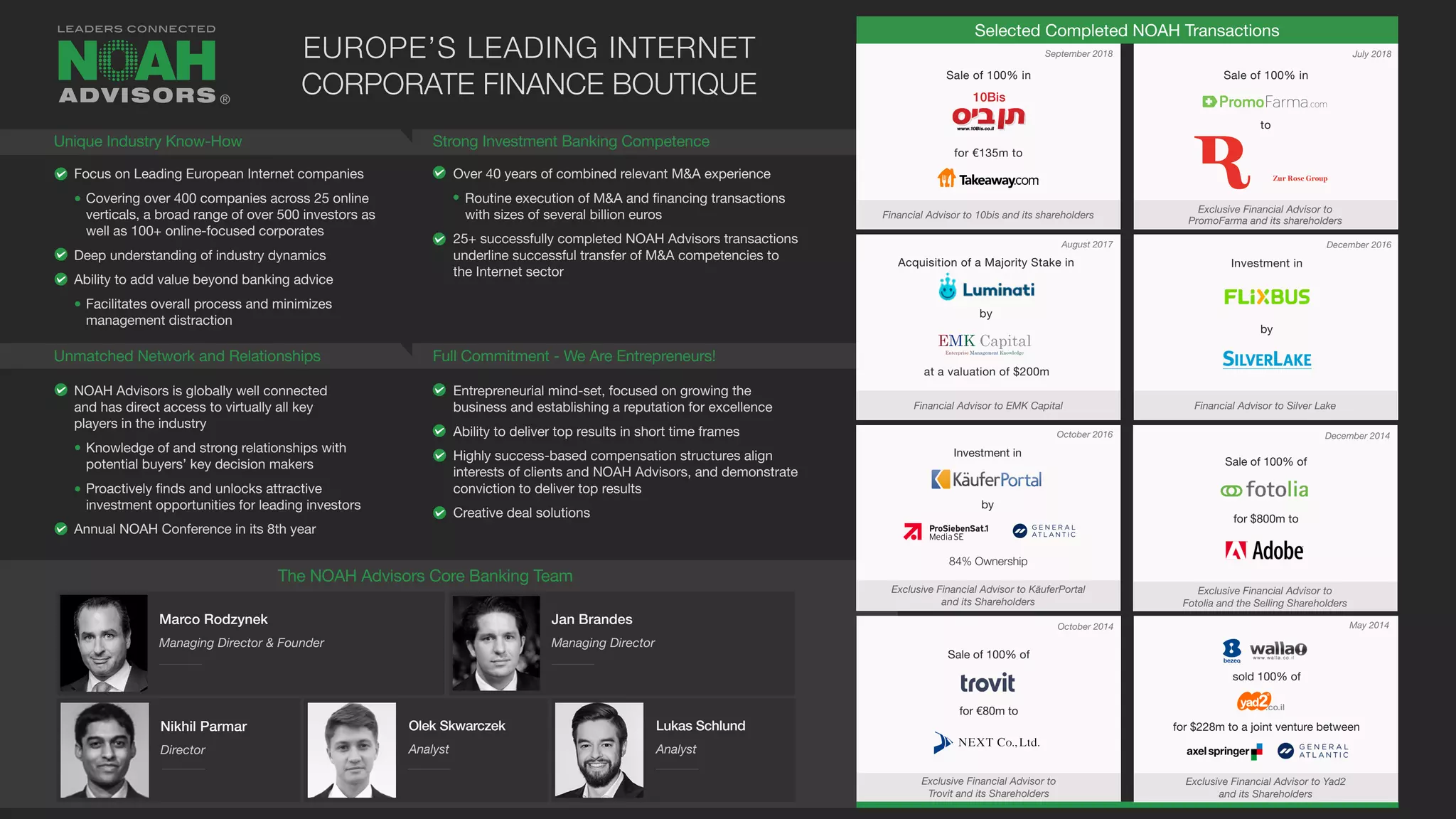
The final slide is about NOAH Advisors (financial advisor) rather than a compelling closing statement or call to action. This is a missed opportunity to reinforce the investment thesis or create ur...

More Pitch Decks To Study

Compare structure, fundraising context, and investor-facing story across similar startup decks.