Compare your deck to BuzzFeed

Compare Your Deck

BuzzFeed Pitch Deck (2008)

Media
Stage: Seed
Raised: $3.5M
Year: 2008
Slides: 21
Outcome: SPAC at $1.5B, later declined

Pitch Deck

1 / 21
BuzzFeed pitch deck - Cover & Positioning: Clear brand promise
Click to expand

Deck Analysis

This 2008 BuzzFeed seed deck presents a crisp product-driven pitch from a team that combined editorial taste with data and distribution technology. Notable for its early articulation of "buzz" detection, distributed widgets, and "ads as content," the deck balances traction, product roadmap, monetization, and a lightweight team slide. It foreshadows how BuzzFeed would grow by blending editorial curation, algorithmic signals, and a platform approach — a combination that later scaled to a large media-technology business and public exit.

Cover & Positioning: Clear brand promise

Cover & Positioning: Clear brand promise

The opening slide (clean red cover with the BuzzFeed name and tagline "What's Buzzing on the Web?") is minimalist and memorable. It establishes an immediate brand identity and a simple thesis: the company is about surfacing what's trending. This kind of clarity helps the audience instantly understand category and purpose without cognitive overload.

Founders can learn from this restraint: a one-sentence positioning on the first slide sets expectations and creates a through-line for the rest of the deck. The slide also projects design confidence — an important signal for consumer-facing products — and prepares investors for a narrative that will connect audience, product, and monetization.

Key Takeaway: Open with a single clear line that states your product's promise and category — simplicity and design confidence set the tone.
Traction & Unit Economics: Quantify early momentum

Traction & Unit Economics: Quantify early momentum

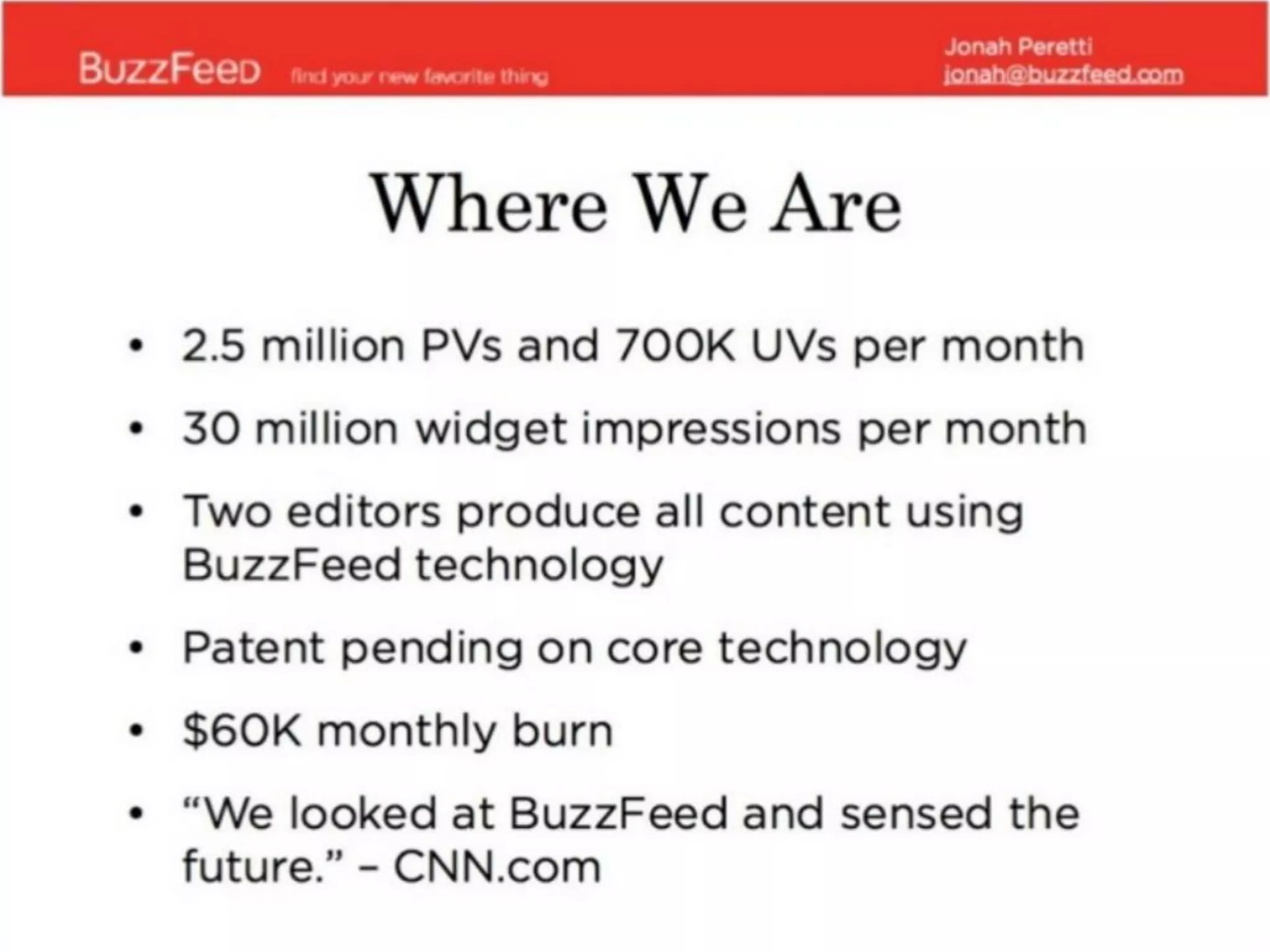
Slide 2 lists concrete metrics: pageviews, unique visitors, 30m widget impressions, two editors producing content, patent pending, and a $60K monthly burn. These specifics give investors fast, actionable signals about traction, operational efficiency, and runway. The mix of audience metrics and operational detail (staffing, burn) shows that the founders understand both growth and unit economics.

The slide also includes a short external quote (CNN) which adds third-party validation — a strong move for early-stage consumer media. For founders, presenting a few high-signal metrics (traffic, engagement/distribution metrics, burn) is more persuasive than overwhelming with vanity stats. This slide balances credibility and realism by showing both upside and costs.

Key Takeaway: Present a concise set of high-signal metrics (audience, distribution, burn) and include third-party validation where possible to build credibility.
Vision & Roadmap: Roadmap tied to scaling leverage

Vision & Roadmap: Roadmap tied to scaling leverage

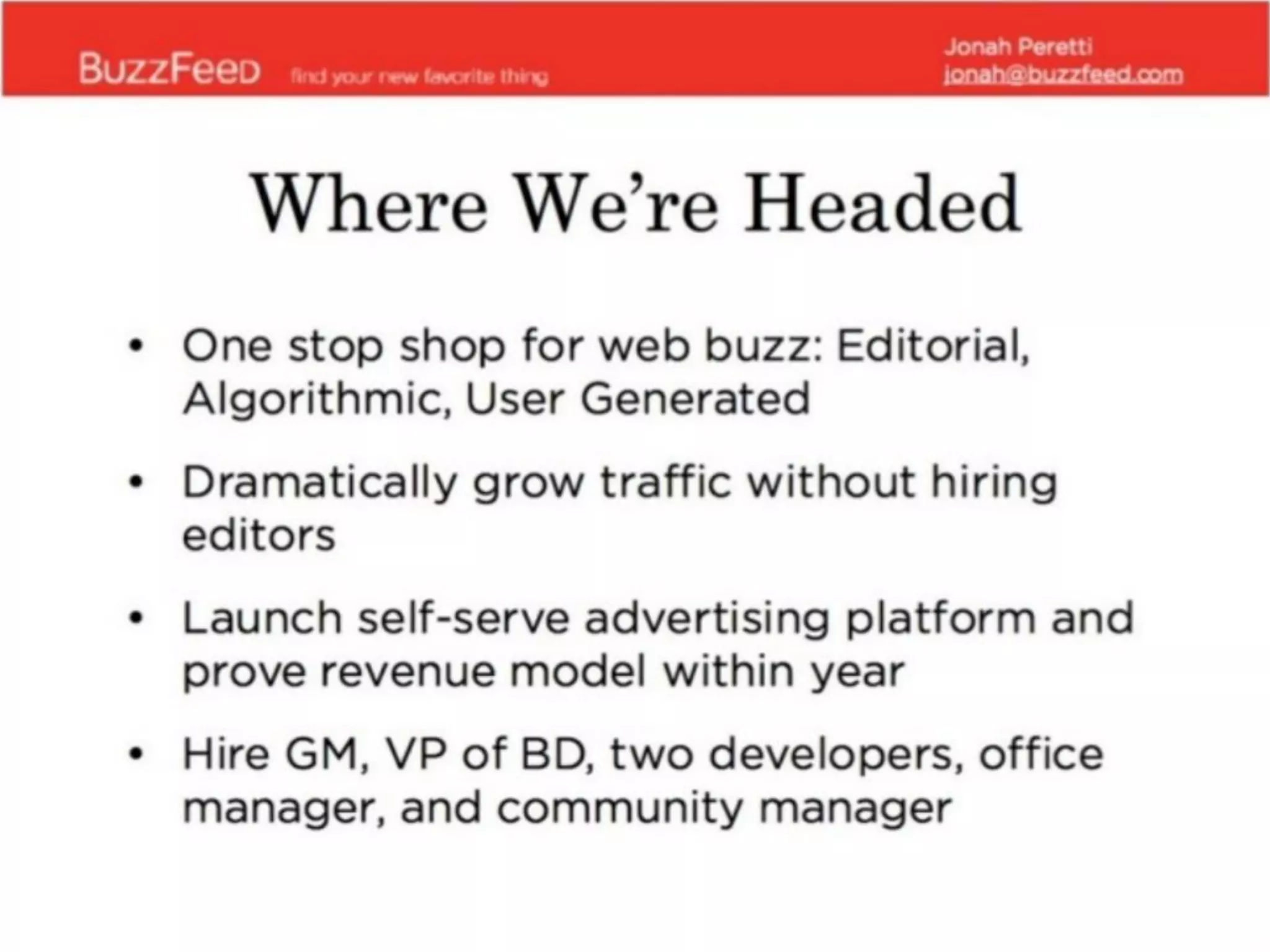
Slide 3 outlines where BuzzFeed is headed — combining editorial, algorithmic detection, and user-generated content; growing traffic without hiring editors; launching a self-serve ad platform; and specific hires. This roadmap communicates a clear lever for fast scaling: shift from editorially intensive content to algorithmic and user-generated models that multiply output without linear editorial headcount growth.

Founders should note how the deck ties product evolution to capital needs and organizational hires. By describing both product features (self-serve ad platform) and immediate personnel needs (GM, BD, developers), the team makes a practical connection between the raise and expected milestones. Investors like to see how funding will be deployed to de-risk scaling plans.

Key Takeaway: Show a product roadmap that explains how growth will become more capital-efficient (e.g., automation, self-serve tools) and link hires to milestones.
Product & Front Page Strategy: Multi-source content funnel

Product & Front Page Strategy: Multi-source content funnel

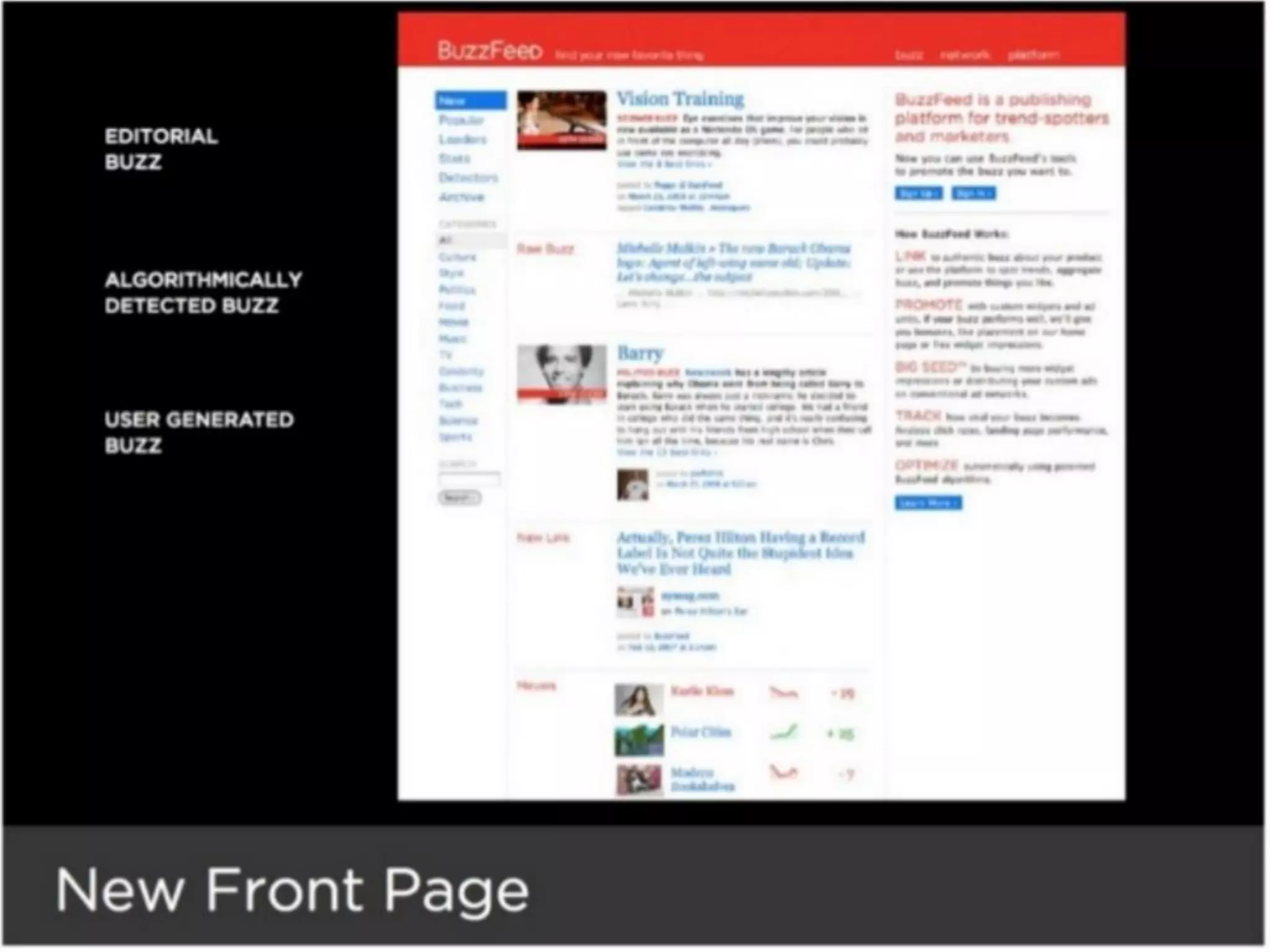
The "New Front Page" slide (slide 8) visualizes how editorial buzz, algorithmically detected buzz, and user-generated buzz coexist on the homepage. This is an important product insight: a mixed feed that leverages multiple content sources reduces single-channel risk and increases content velocity. The interface-level depiction helps investors visualize user experience rather than just abstract concepts.

From a founder perspective, this slide demonstrates the power of a layered content strategy: editorial for quality, algorithms for scale, and users for density. It also implicitly highlights retention and discovery mechanics (fresh, trending, leaderboard-style signals) that make the site sticky. Showing an actual front-page mockup instead of a text-only plan helps translate strategy into tangible product execution.

Key Takeaway: Use mockups to show how different content sources integrate in the product; a layered content feed communicates a scalable editorial strategy.
Monetization: Ads-as-content and premium services

Monetization: Ads-as-content and premium services

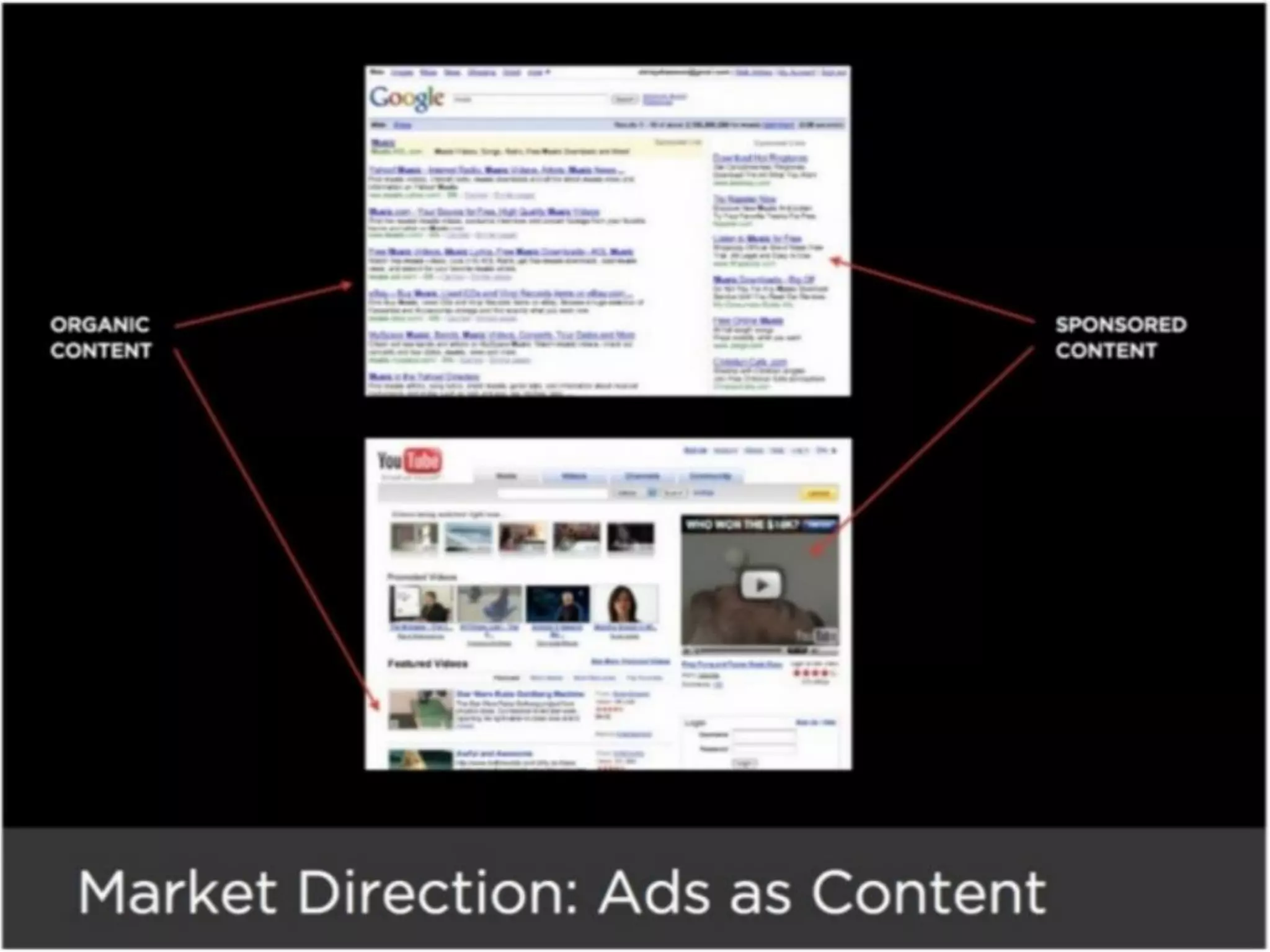
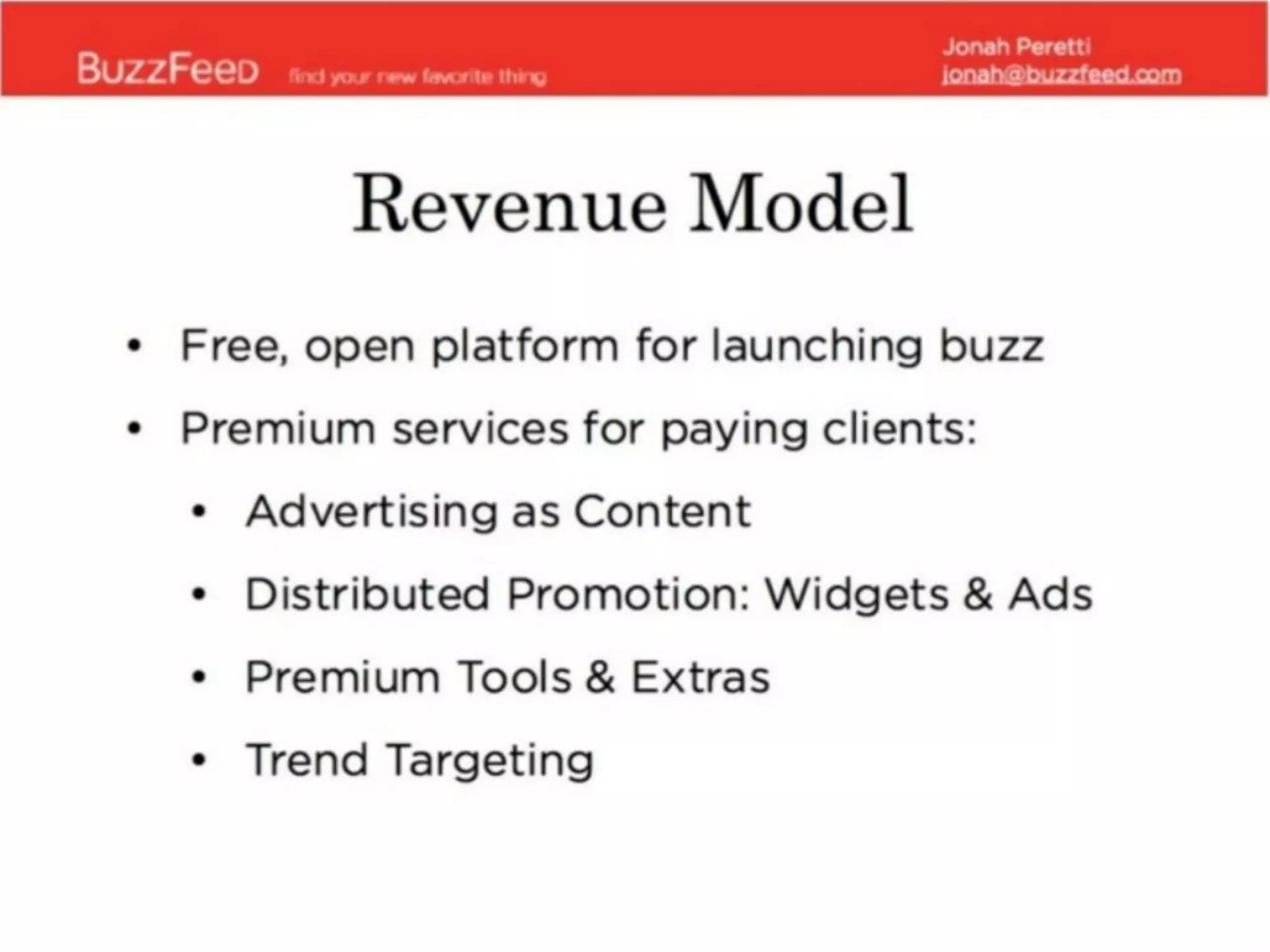
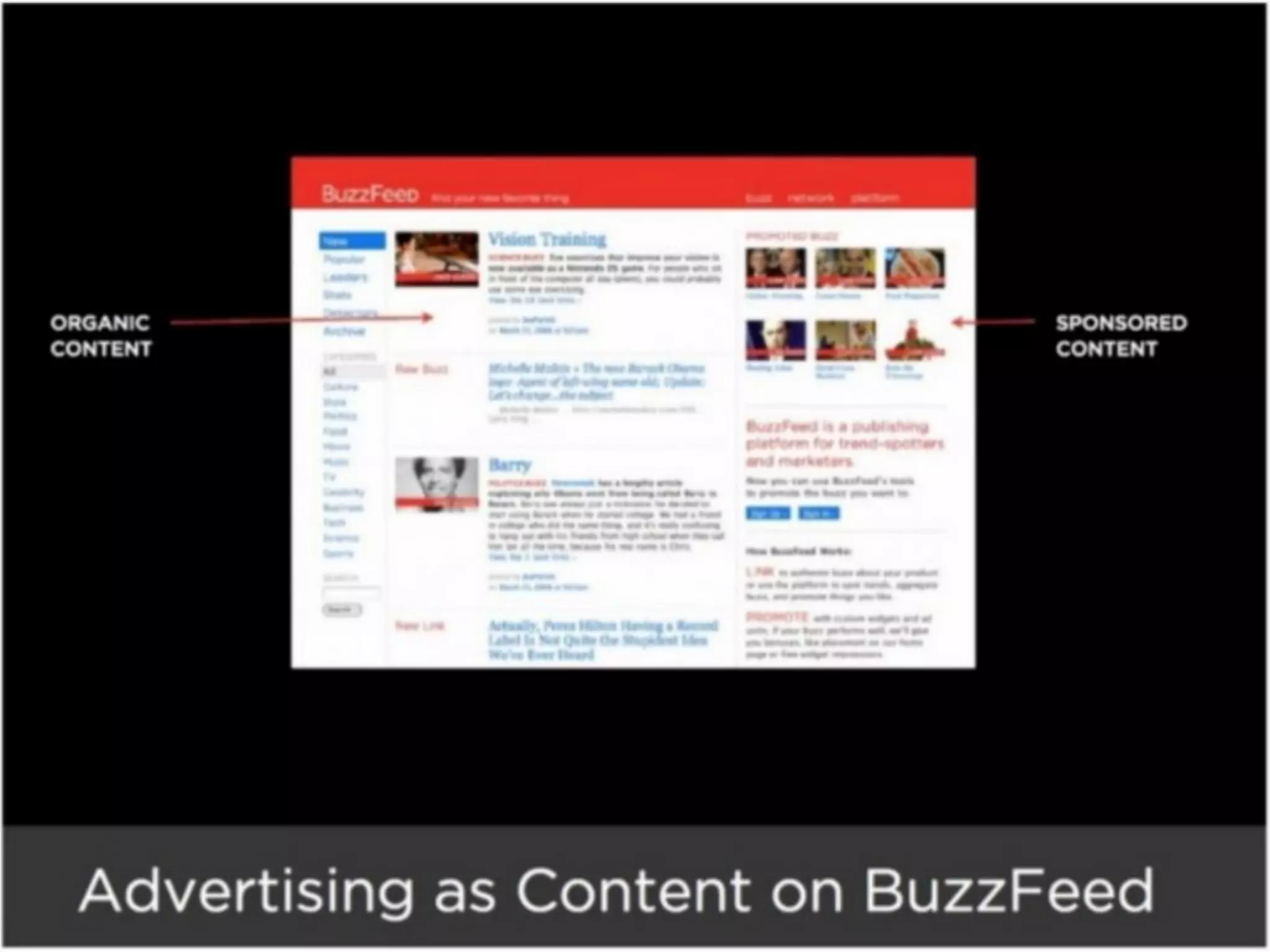
Slide 13 (Revenue Model) lists a free platform plus premium services: advertising as content, distributed promotion (widgets & ads), premium tools/extras, and trend targeting. This demonstrates a multi-pronged revenue approach that fits the product — selling both attention (ad units/widgets) and platform features (tools/trends). The inclusion of both organic and sponsored pathways shows a realistic monetization funnel.

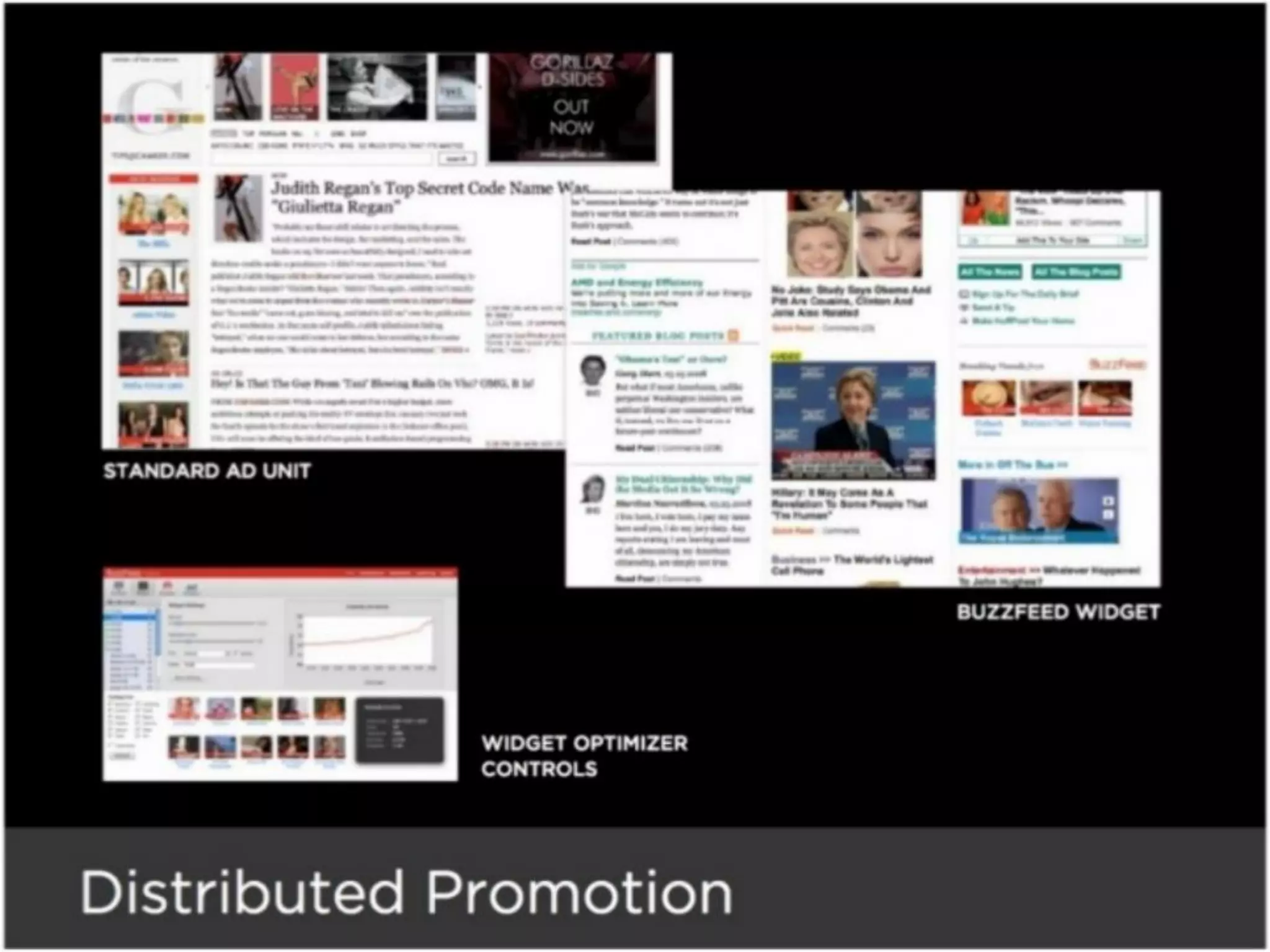
The deck smartly positions monetization as a complement to product features (widgets, trend targeting), not as an afterthought. Founders should emulate this: tie revenue ideas to product hooks and metrics (what drives value for advertisers, how you measure impact). Also, offering both standard ad units and bespoke promotional products (custom widgets/microsites shown later) helps capture both short-term inventory revenue and higher-margin partner work.

Key Takeaway: Tie revenue streams directly to product capabilities — sell both scalable ad inventory and higher-margin platform services that demonstrate measurable impact.
Product Infrastructure: Web app, analytics, and optimization

Product Infrastructure: Web app, analytics, and optimization

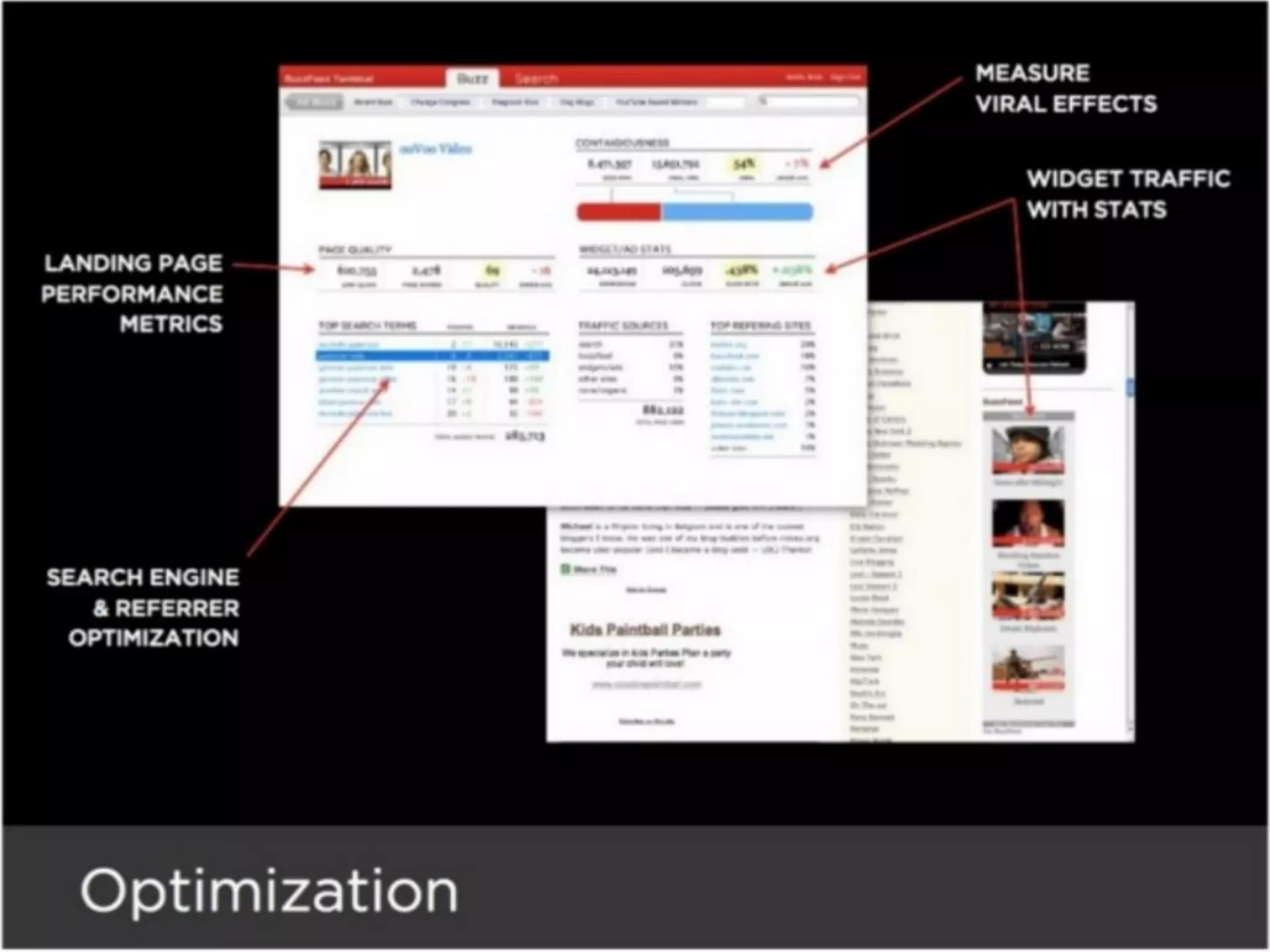
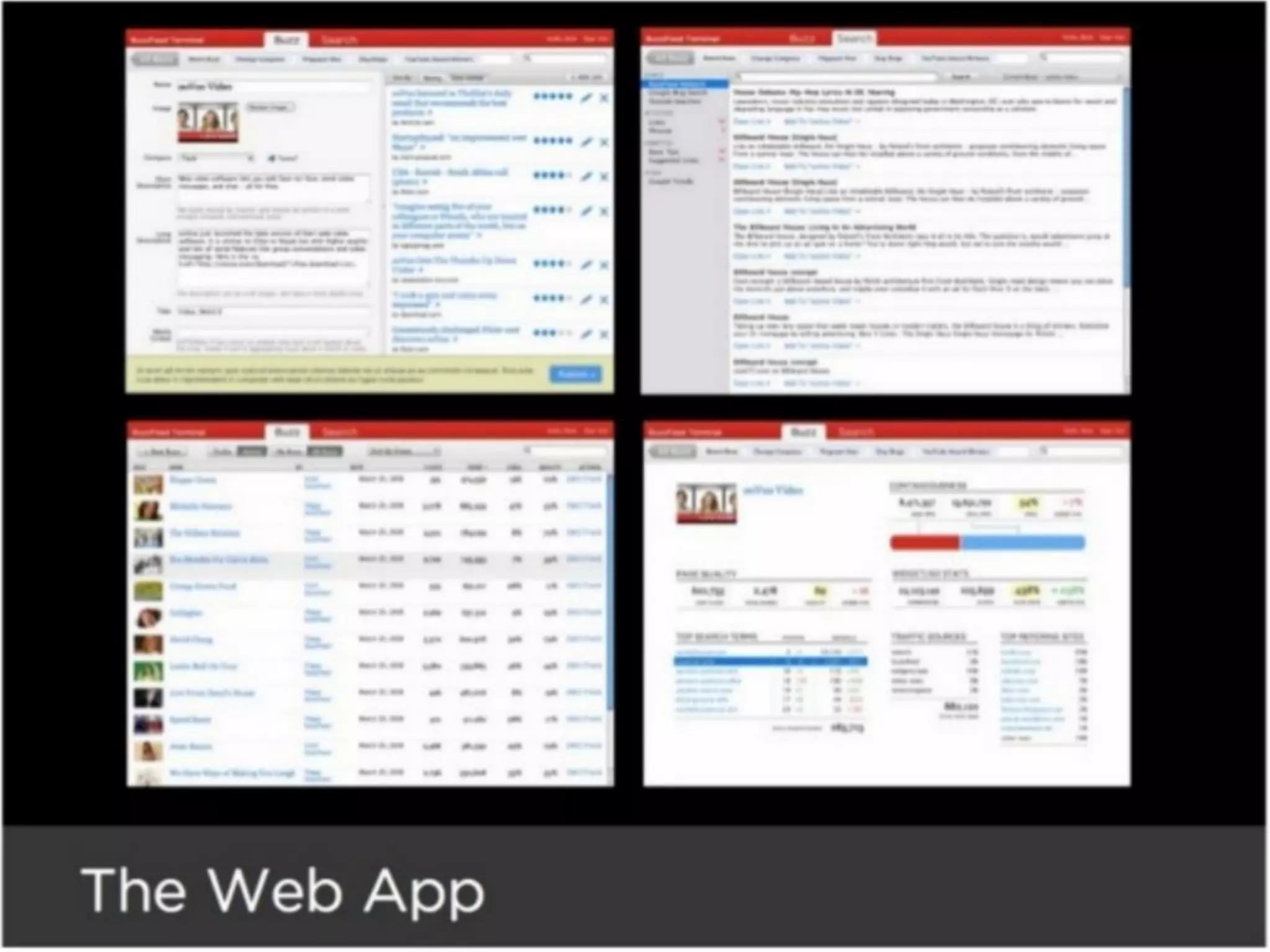
Slide 10 (The Web App) and adjacent optimization slides demonstrate the backend tooling BuzzFeed planned: content management, search/detection, leaderboards, and detailed landing-page metrics. By emphasizing analytics (landing page performance, widget traffic stats, search/referrer optimization), the deck shows how product, editorial, and sales teams can iterate using real performance data.

This is a critical lesson: platforms that succeed at distribution invest early in measurement and tools that turn signals into actions. Founders should prioritize building dashboards and simple optimization tools to prove value to advertisers and to refine content algorithms quickly. Showing internal tooling reassures investors that growth can be scaled and measured rather than left to guesswork.

Key Takeaway: Invest in measurable product infrastructure and dashboards early — metrics-oriented tooling turns experiments into repeatable growth.
Team & Credibility: Complementary skills and advisors

Team & Credibility: Complementary skills and advisors

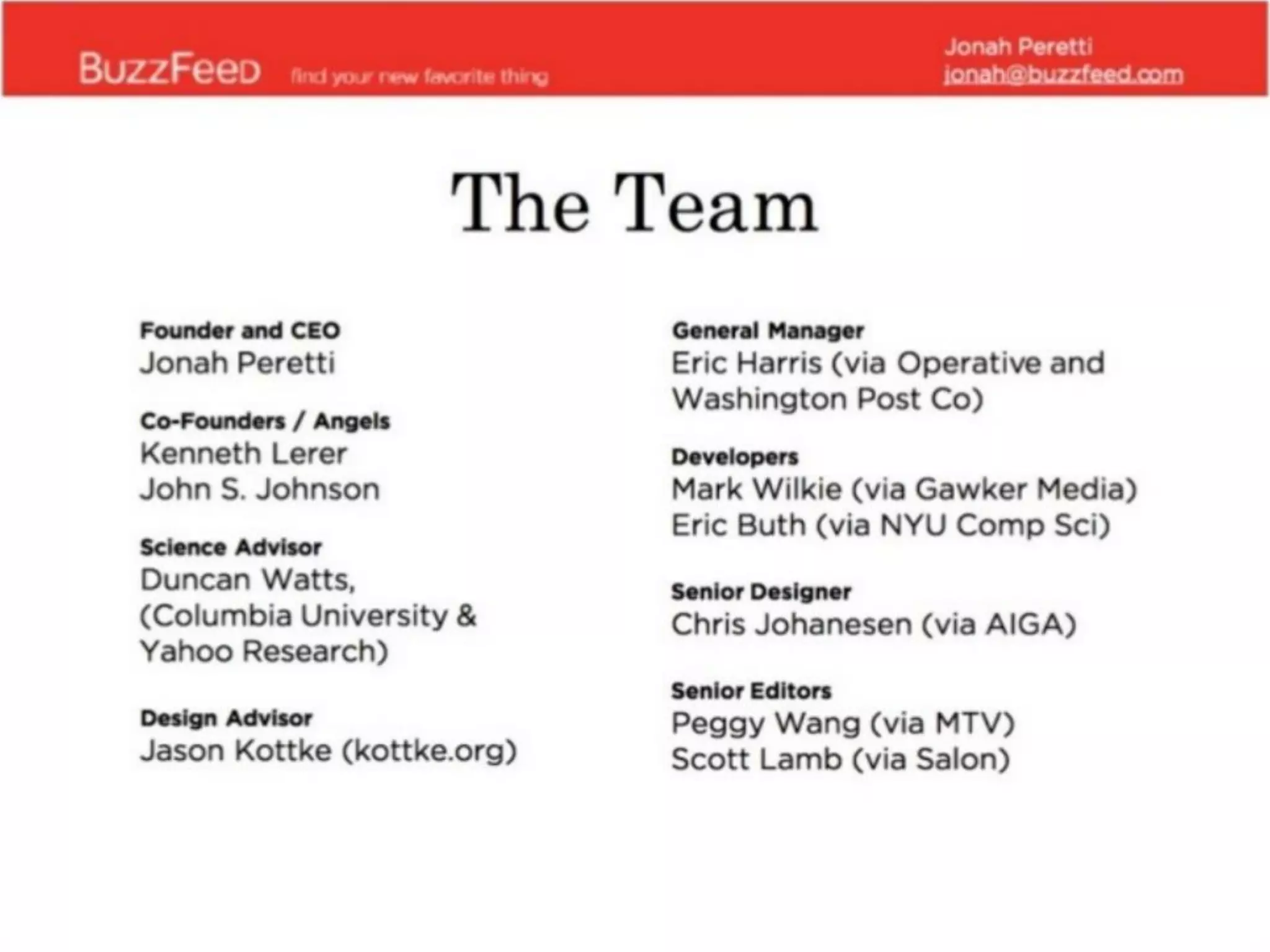
Slide 21 lists the founding team, advisors, and initial hires, mixing editorial backgrounds (senior editors from MTV/Salon), technology talent (NYU comp sci, Gawker), and a science advisor (Duncan Watts). This blend provided credibility across the product, editorial, and data sides — crucial for a media-tech hybrid. The slide is lean but highlights connections to established media and research institutions.

For founders, this demonstrates the importance of assembling a team that covers the core risk areas for your business: content quality, technology, and go-to-market. Inclusion of recognizable advisors (academia and media) can compensate for a small early headcount and reassure investors about execution capability and domain expertise.

Key Takeaway: Build a founding team that covers your core risks (product, content, engineering) and add advisors who bring credibility in research or industry relationships.

Conclusion: Key Lessons

This deck is an instructive early example of a successful product-led pitch: it pairs a simple brand promise with concrete traction, a clear roadmap to scale, product mockups, measurable monetization strategies, and operational tooling. Strengths include crisp positioning, prioritized metrics, product visuals that show execution, and a realistic hiring/use-of-funds roadmap. Actionable advice for founders: lead with one clear thesis, present a small set of high-signal metrics (audience, distribution, burn), tie your roadmap to capital needs and efficiency levers, show product UX or mocks rather than abstract words, and demonstrate how you'll measure and monetize value. Finally, assemble a team that covers the critical execution domains and use advisors to fill credibility gaps.

Full Deck Analysis

11 sections

Overview

Company: BuzzFeed
Round: Seed ($3.5M)
Year: 2008
Founder/CEO: Jonah Peretti
Outcome: SPAC at $1.5B (2021), later declined significantly
Key Tagline: “Find your new favorite thing”


Executive Summary

BuzzFeed’s 2008 seed pitch presents a technology platform positioned at the intersection of media and advertising, designed to detect, curate, and monetize viral trends. The deck articulates a compelling vision for trend-centric content discovery and native advertising, backed by real traction (2.5M monthly page views, 30M widget impressions) and a strong founder with Huffington Post credibility. However, the pitch relies heavily on aspirational monetization models with no revenue proof, an undersized team (9 people) for ambitious global platform goals, and underestimated competitive threats from Google and Facebook—making this a high-risk, high-reward seed investment that ultimately succeeded in market opportunity but required significant strategic pivots away from the platform thesis toward original content creation.


Problem Statement

The Problem (Implicit):
The deck doesn’t explicitly state a problem but implies several interconnected challenges:

  1. Content Discovery Fragmentation (Slide 1-3): Users struggle to find trending content across the fragmented web; content discovery is manual and inefficient
  2. Publisher Monetization Gap (Slide 12-17): Publishers and advertisers lack efficient platforms to reach audiences around trending topics
  3. Trend Detection Inefficiency (Slide 5): Identifying viral trends requires manual monitoring; no automated system exists

How the Deck Articulates It:

  • Slide 2 (“Where We Are”) establishes that BuzzFeed has already solved this with 2.5M PVs and 30M widget impressions
  • Slide 4-6 show the product working (editorial, algorithmic, UGC content)
  • Slides 12-17 position the monetization opportunity as underserved

Notable Absence: The deck never explicitly states “the problem” in a traditional problem statement slide. Instead, it jumps to solution/traction, assuming investors understand the market opportunity.


Solution

Core Solution Architecture:

BuzzFeed positions itself as a three-part content platform:

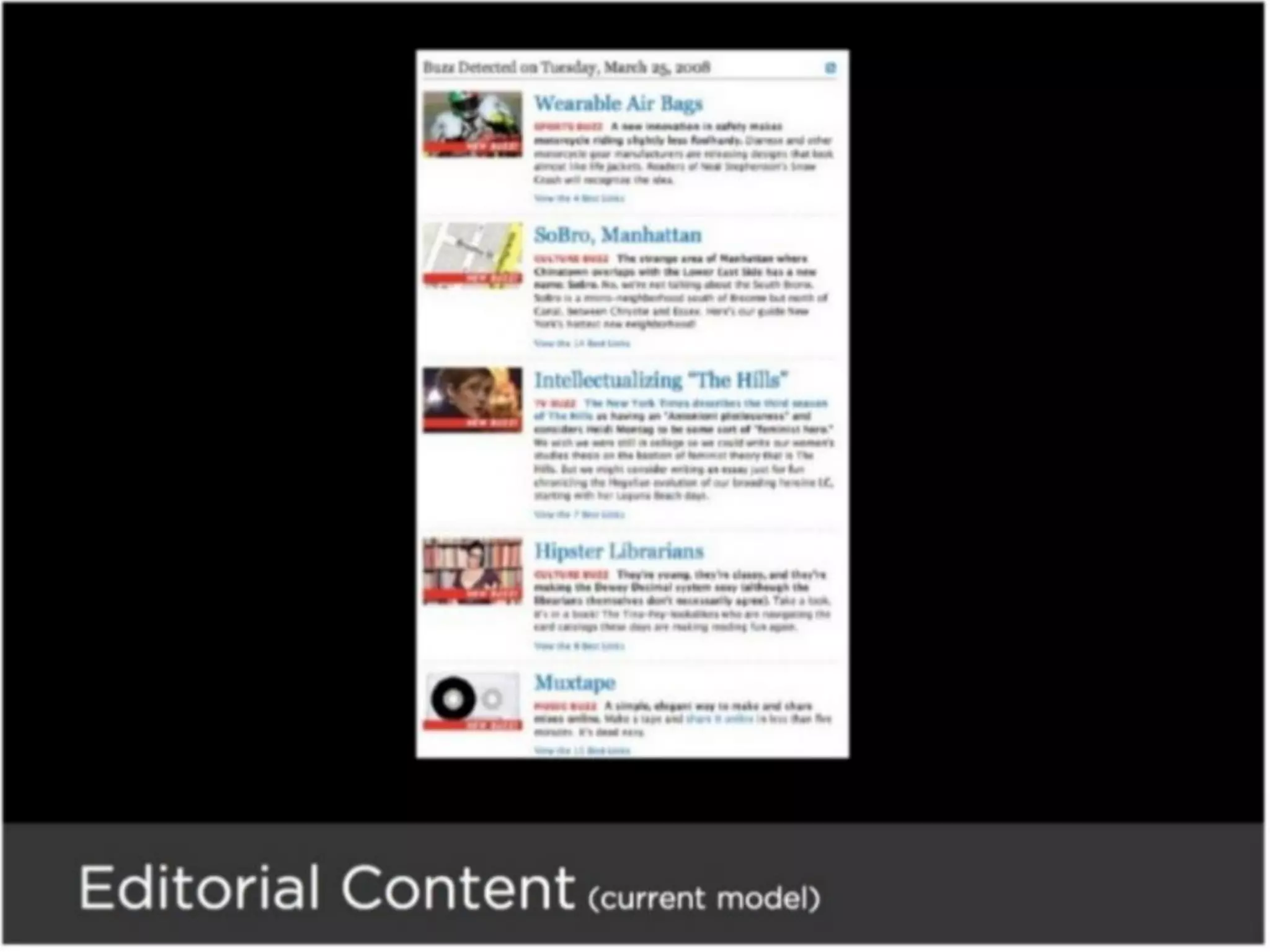
  1. Editorial Content (Slide 4)
    • Curated trend-spotting by 2 editors
    • Topics: culture, lifestyle, entertainment, news
    • Example: “Intellectualizing ‘The Hills’”, “Hipster Librarians”
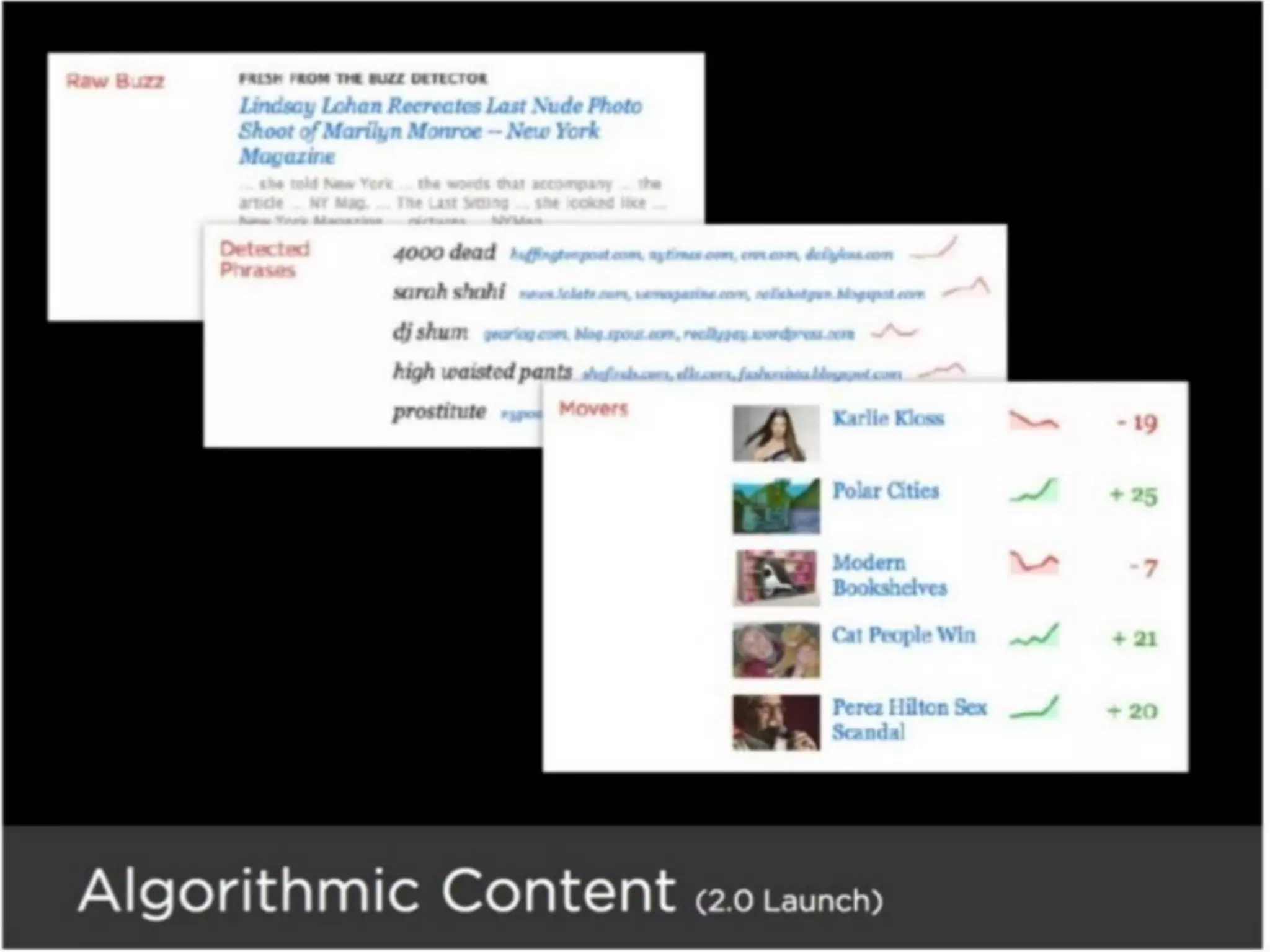
  2. Algorithmic Content (Slide 5)
    • Real-time trend detection from web
    • Automated phrase detection and ranking
    • Example: “4000 dead”, “sarah palin”, “high waisted pants”
    • Enables scaling without editorial hiring
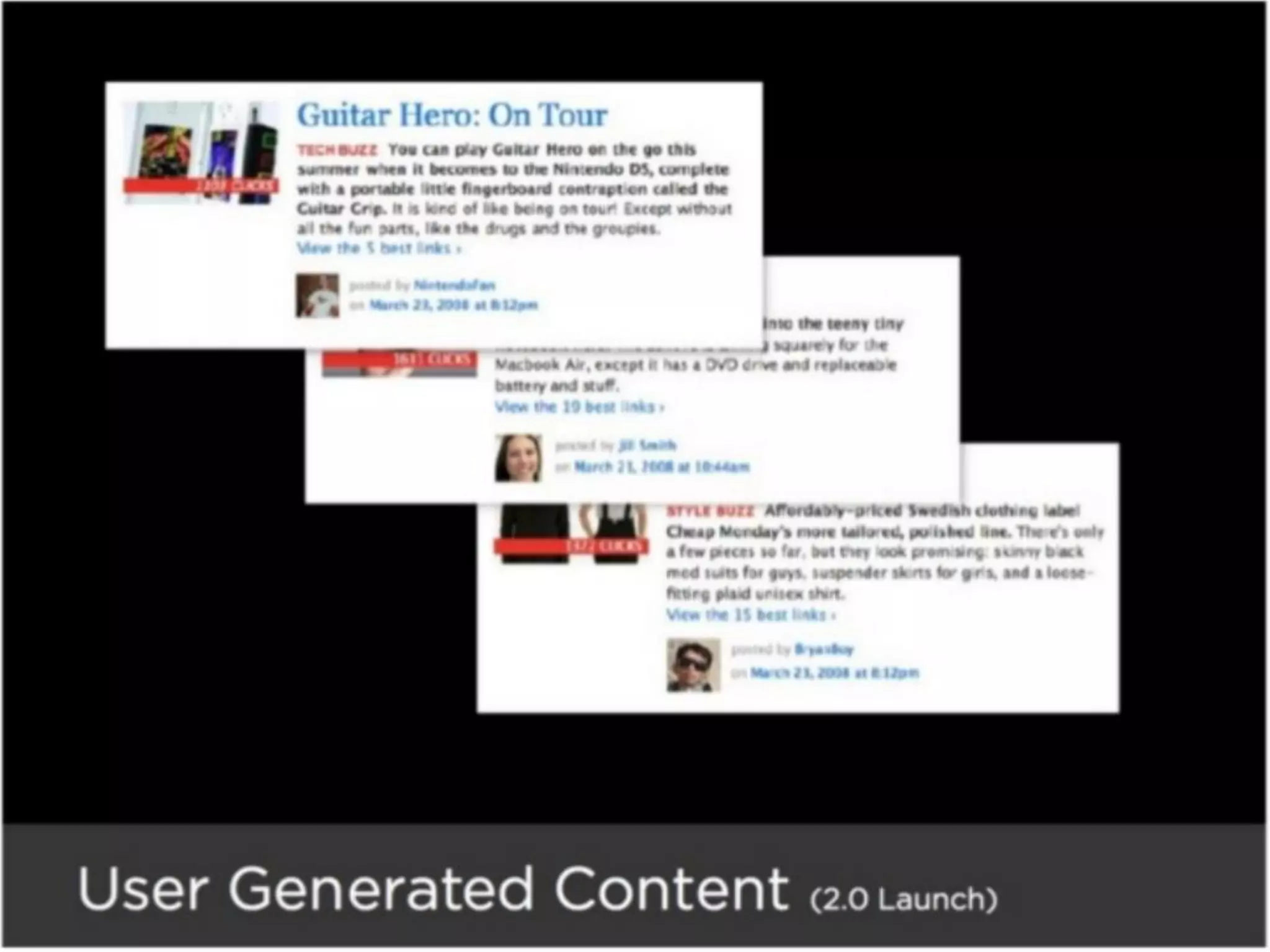
  3. User Generated Content (Slide 6)
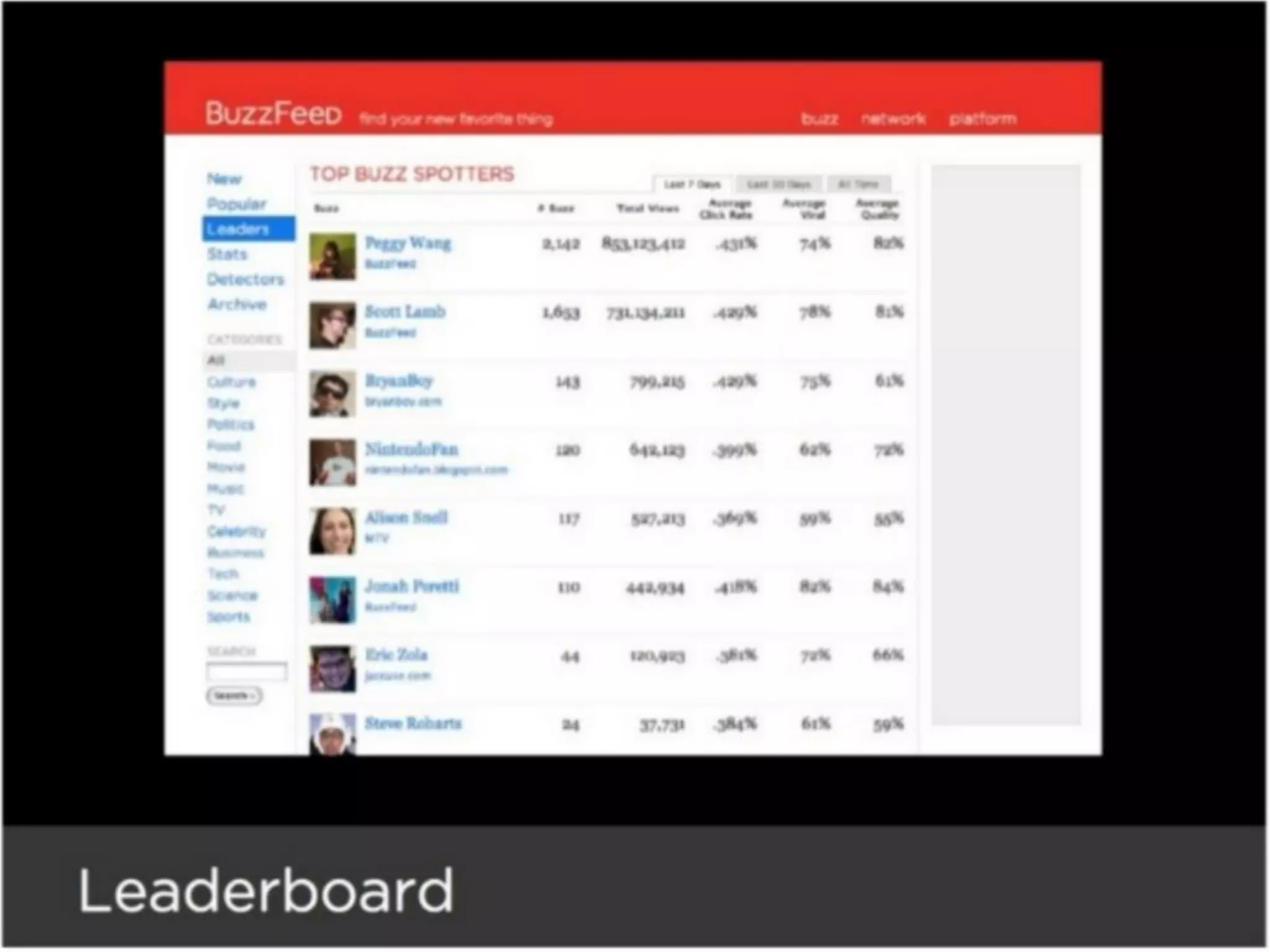
    • Community submissions with gamification (leaderboard)
    • Crowdsourced trend discovery
    • Example: Guitar Hero reviews, fashion finds

Product Features (Slide 7-10):

  • Integrated homepage mixing all three content types
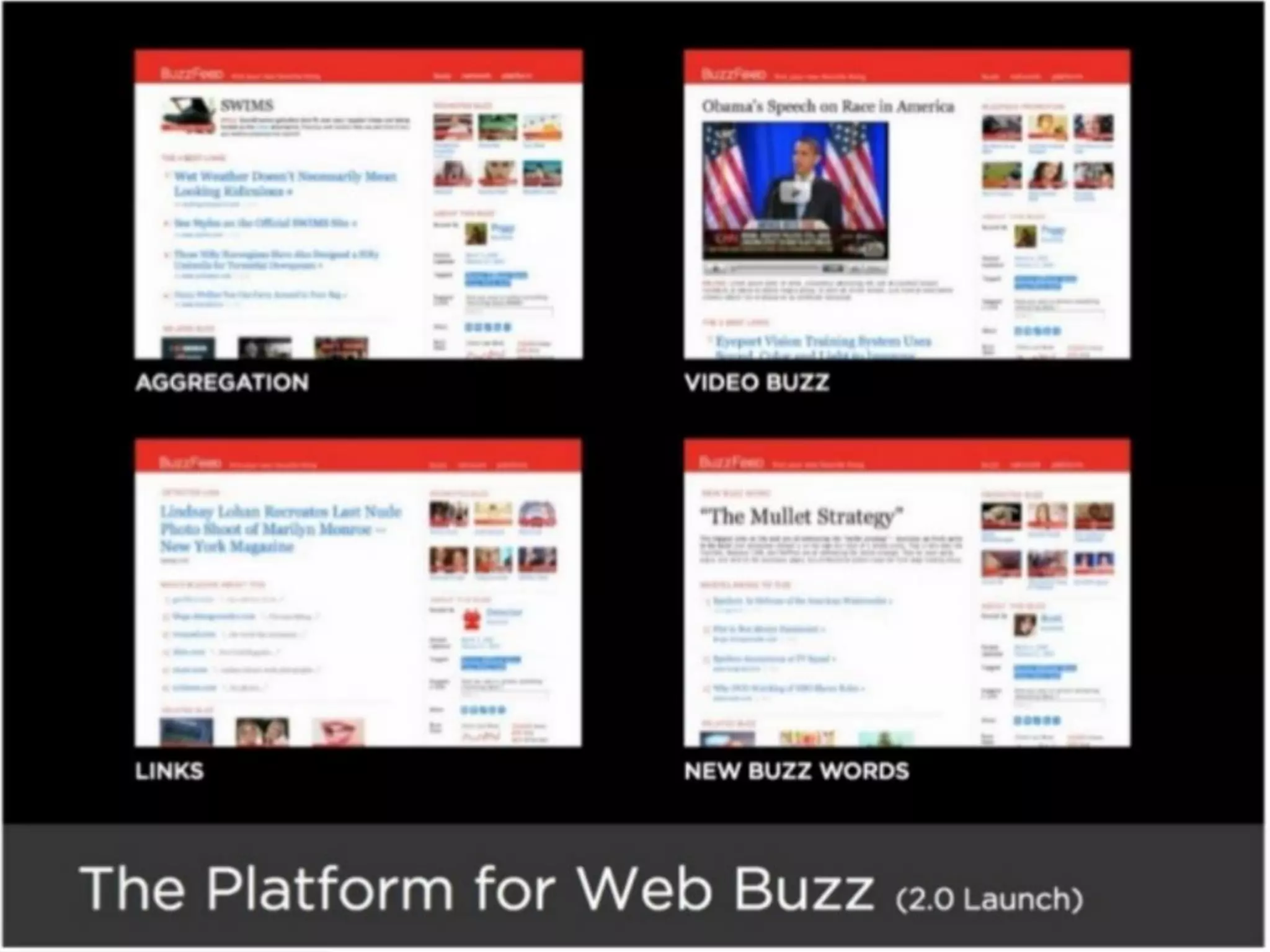
  • Multiple content formats: aggregation, video, links, essays
  • Backend tools for publishers: analytics, optimization, performance tracking
  • Widget distribution system (30M impressions/month)

Monetization Layer (Slide 12-17):

  • Freemium platform (free for users, premium for advertisers)
  • Native advertising (“Advertising as Content”)
  • Distributed widgets with advertiser integration
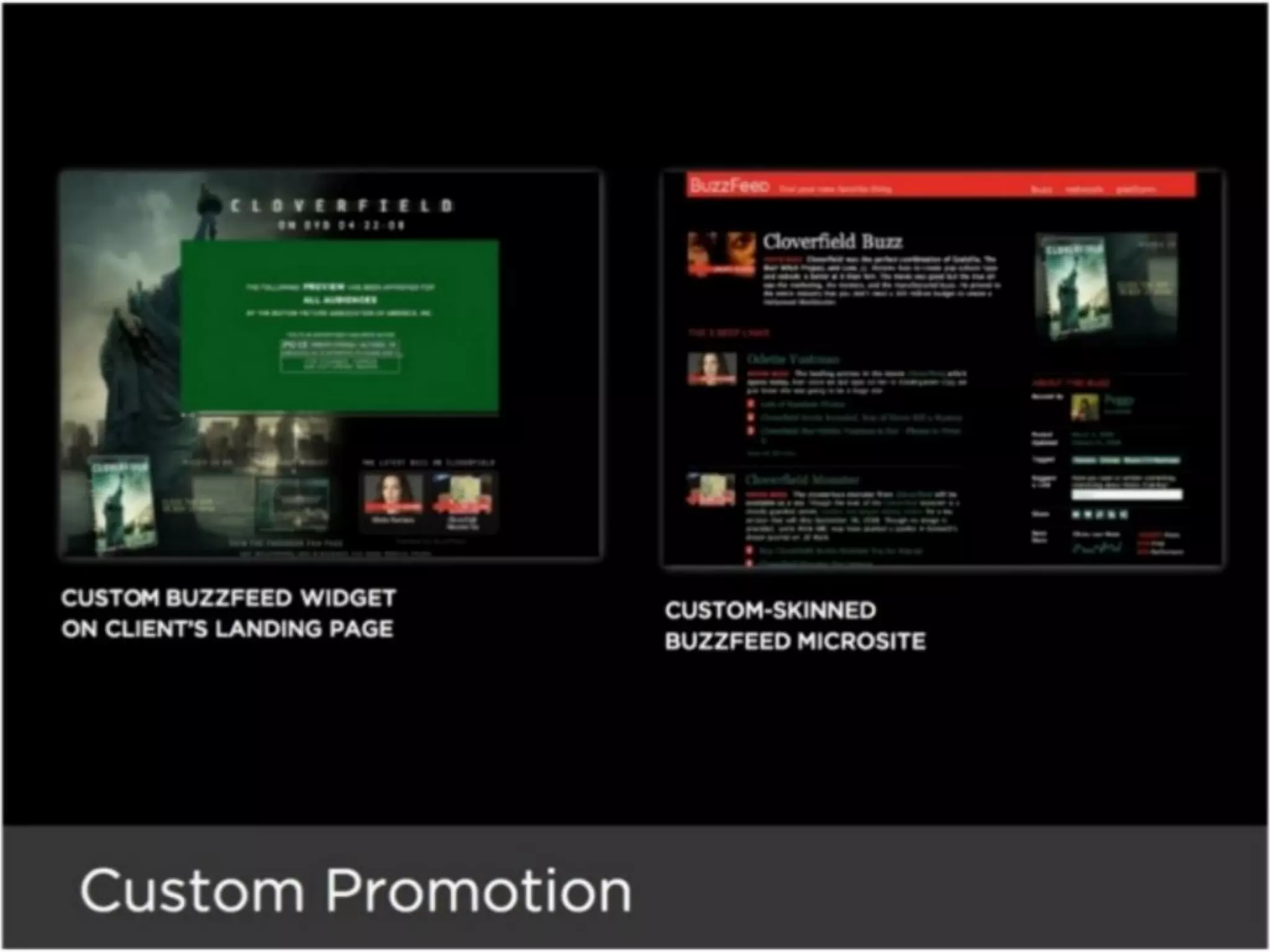
  • Custom branded experiences (Cloverfield example)
  • Performance-based trend targeting

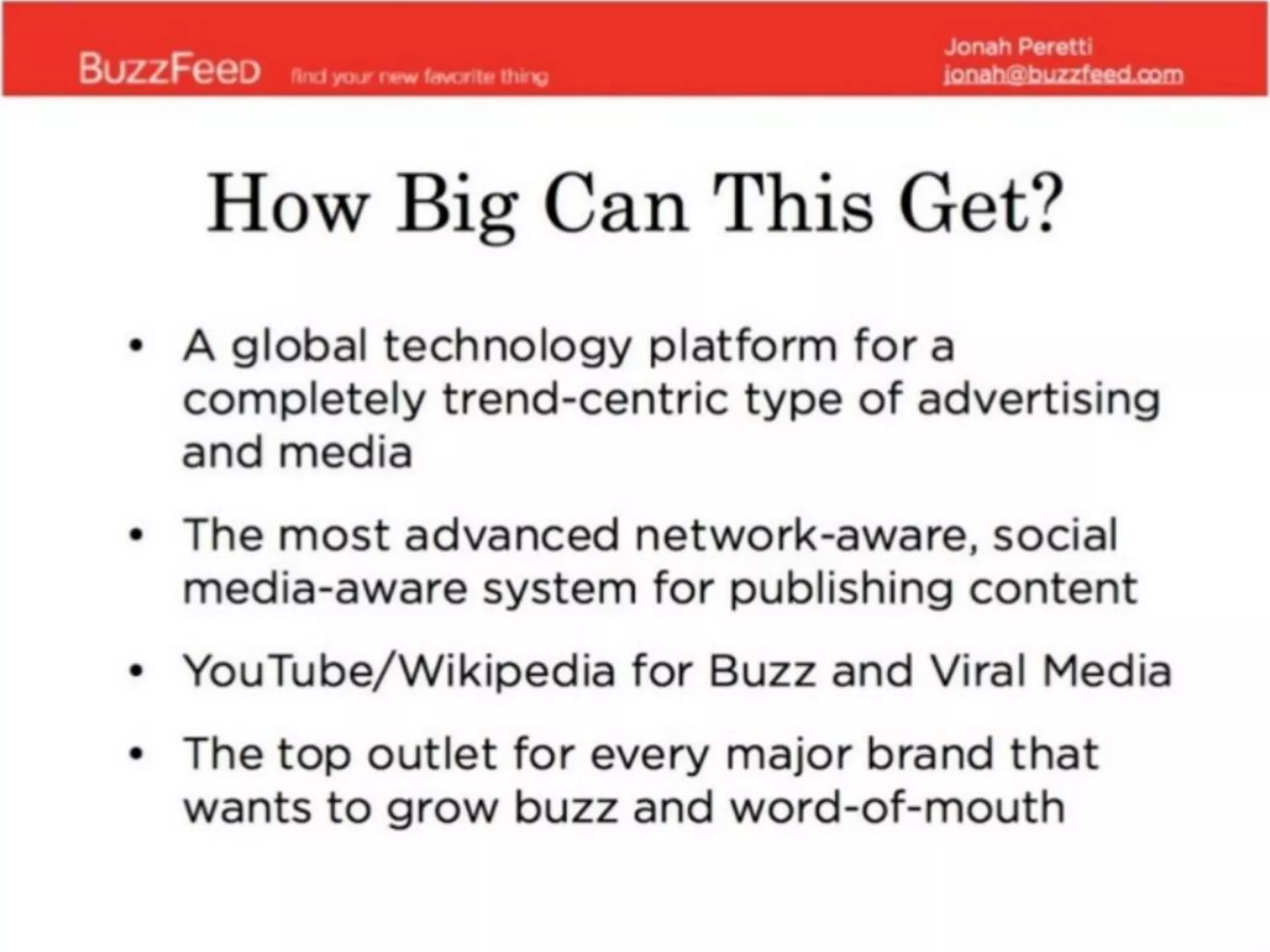
Positioning: “YouTube/Wikipedia for Buzz and Viral Media” (Slide 19)


Market Opportunity

Market Size Analysis:

The deck does not provide explicit TAM/SAM/SOM analysis. Instead, it implies market opportunity through:

Addressable Markets (Inferred):

  1. Content Discovery Market
    • Competitive set: Digg, Reddit, StumbleUpon
    • Implied TAM: Billions in annual media consumption
    • No specific sizing provided
  2. Digital Advertising Market
    • Competitive set: Google AdWords, Facebook Ads, Viral Agencies
    • Implied TAM: Billions in annual ad spend
    • No specific sizing provided
  3. Publisher Tools Market
    • Competitive set: Typepad, WordPress, Blogger
    • Implied TAM: Millions of publishers needing distribution
    • No specific sizing provided

Market Validation (Slide 13):

  • References Google (search ads) and YouTube (video ads) as proof that “ads as content” model works at scale
  • Implies market is moving toward native advertising

Notable Gaps:

  • No total addressable market (TAM) calculation
  • No serviceable addressable market (SAM) estimate
  • No serviceable obtainable market (SOM) projection
  • No market growth rate or CAGR
  • No customer acquisition cost (CAC) or lifetime value (LTV) analysis

Implicit Market Assumptions:

  • Every major brand wants to “grow buzz and word-of-mouth” (Slide 19)
  • Trend-centric advertising is a “completely new type of advertising” (Slide 19)
  • Global market opportunity (“global technology platform”)

Business Model

Revenue Model (Slide 12):

Freemium Platform with Four Premium Services:

  1. Advertising as Content
    • Native ads blended with organic content
    • Brands pay to have content featured
    • Example: Cloverfield microsite (Slide 16)
  2. Distributed Promotion: Widgets & Ads
    • Embedded widgets on publisher sites (30M impressions/month)
    • Standard display ad units
    • Widget optimizer controls for publishers
    • Revenue likely: CPM or revenue share
  3. Premium Tools & Extras
    • Advanced analytics dashboards (Slide 9-10)
    • Optimization tools
    • Custom implementations
    • Likely: SaaS subscription model
  4. Trend Targeting
    • Performance-based CPC/CPA model
    • Advertisers pay per click/action on trend-related content
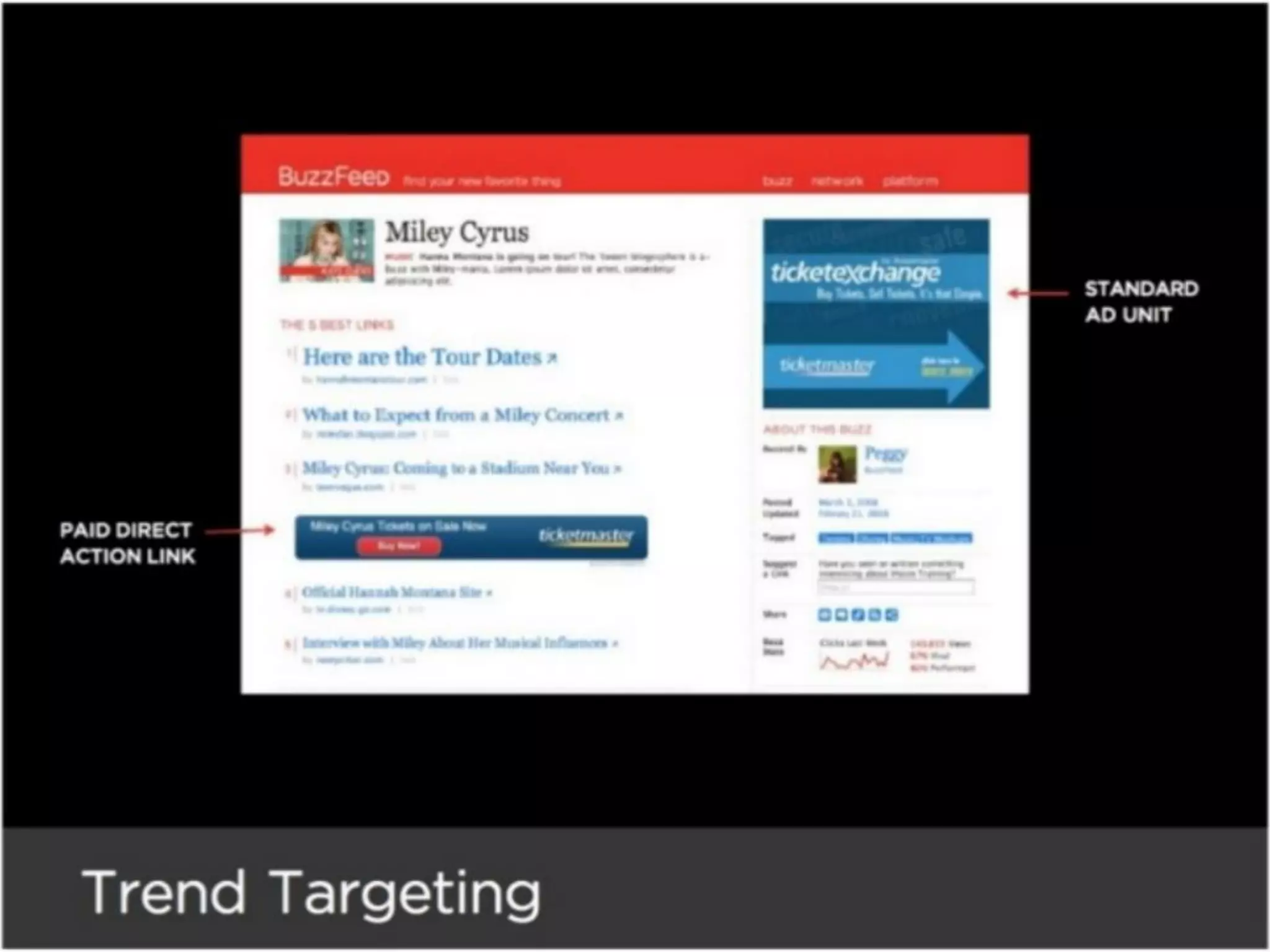
    • Example: TicketExchange “Buy Now” button on Miley Cyrus trend page (Slide 17)

Unit Economics:

  • Burn Rate: $60K/month (Slide 2)
  • Runway: ~58 months on $3.5M seed ($3.5M ÷ $60K = 58 months)
  • Revenue: $0 shown; all monetization aspirational
  • Gross Margin: Not provided
  • CAC/LTV: Not provided

Monetization Timeline:

  • “Self-serve advertising platform within 12 months” (Slide 3)
  • Implies no revenue currently; all revenue expected in future

Business Model Risks:

  • No proven willingness-to-pay from advertisers
  • No pricing tiers or rate cards shown
  • No customer acquisition strategy for B2B
  • Depends on scaling both users AND advertisers simultaneously

Traction & Metrics

User Metrics (Slide 2):

  • 2.5M page views/month
  • 700K unique visitors/month
  • 30M widget impressions/month (distributed reach)
  • Timeframe: March 2008 (current at time of pitch)

Content Metrics (Slide 11 - Leaderboard):

  • Top contributor (Peggy Wang): 3,142 buzz submissions, 65.1M total views
  • Second (Boon Lamb): 1,633 buzz submissions, 734.1M total views
  • Founder (Jonah Peretti): 330 buzz submissions, 443.9K views

Engagement Metrics (Slide 11):

  • Average Click Rate: -34% to -49% (negative trend across all top users)
  • Average CTR: 6% to 99% (high variance)
  • Average WTF: 50% to 82% (metric definition unclear)

Operational Metrics (Slide 2):

  • Team Size: 2 editors producing all content
  • Monthly Burn: $60K
  • Runway: ~58 months

Third-Party Validation (Slide 2):

  • CNN.com Quote: “We looked at BuzzFeed and sensed the future”

Notable Gaps:

  • No revenue metrics
  • No customer metrics (advertisers, publishers)
  • No retention/churn data
  • No growth rate (month-over-month or year-over-year)
  • Negative click rate trends suggest declining engagement

Trend Data (Slide 5):

  • Real-time detection of trending phrases
  • Example trending topics: “4000 dead”, “sarah palin”, “dj shum”, “high waisted pants”
  • Momentum indicators showing +/- movement

Competitive Positioning

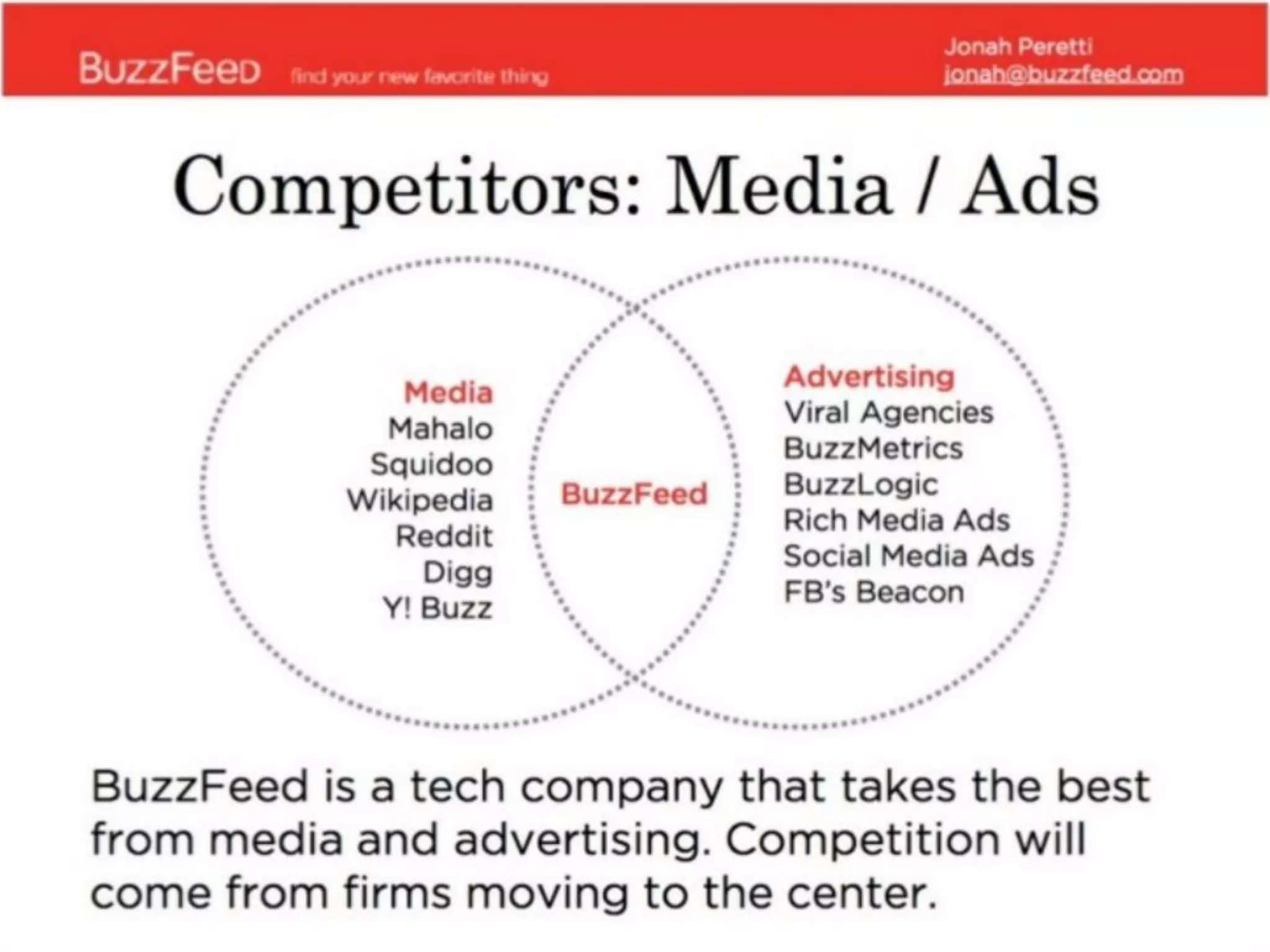
Competitive Landscape (Slide 18):

Venn Diagram Positioning:

Left Circle - Media Competitors:

  • Mahalo
  • Squidoo
  • Wikipedia
  • Reddit
  • Digg
  • Y! Buzz

Right Circle - Advertising Competitors:

  • Viral Agencies
  • BuzzMetrics
  • BuzzLogic
  • Rich Media Ads
  • Social Media Ads
  • Facebook Beacon

BuzzFeed’s Position: Center (intersection of both)

Competitive Thesis (Slide 18):

“BuzzFeed is a tech company that takes the best from media and advertising. Competition will come from firms moving to the center.”

Differentiation Claims:

  1. Hybrid Content Model
    • Editorial + Algorithmic + User Generated (unique mix)
    • Competitors focus on one or two
  2. Trend-Centric Focus
    • Real-time trend detection and monetization
    • Competitors don’t combine discovery + monetization
  3. Network-Aware, Social Media-Aware
    • Advanced distribution (widgets, social)
    • Competitors lack distribution infrastructure
  4. Patent-Pending Technology
    • Core trend detection algorithm
    • Claimed defensibility (Slide 2)
  5. Lean Operations
    • 2 editors producing content at scale
    • Competitors require larger editorial teams

Competitive Vulnerabilities (Not Addressed):

  • Google has superior search/trend data
  • Facebook has superior social graph and targeting
  • YouTube dominates video content
  • Digg/Reddit have larger communities
  • Traditional media (CNN, NYT) have brand authority
  • No explanation of why competitors can’t replicate model

Notable Omissions:

  • No direct comparison of features/pricing vs. competitors
  • No market share analysis
  • No competitive win/loss data
  • No customer testimonials vs. alternatives

Team

Team Composition (Slide 20):

Leadership:

  • Founder & CEO: Jonah Peretti
    • Background: Co-founder of The Huffington Post
    • Credibility: Proven ability to build viral media platform
    • Role: Overall vision and strategy

Co-Founders / Angels:

  • Kenneth Lerer
    • Background: Huffington Post investor/advisor
    • Credibility: Media/tech investor
    • Role: Strategic advisor and investor
  • John S. Johnson
    • Background: Not specified in deck
    • Credibility: Unknown
    • Role: Co-founder/investor

Advisors:

  • Duncan Watts (Science Advisor)
    • Background: Columbia University & Yahoo Research
    • Expertise: Network science, viral dynamics
    • Credibility: Academic + industry research
  • Jason Kottke (Design Advisor)
    • Background: Kottke.org (design/web culture blog)
    • Expertise: Web design, internet culture
    • Credibility: Respected in web community

Current Team:

  • Eric Harris (General Manager)
    • Background: Operative and Washington Post Co
    • Expertise: Operations, media
    • Credibility: Traditional media operations
  • Mark Wilkie (Developer)
    • Background: Gawker Media
    • Expertise: Web development, media tech
    • Credibility: Proven media tech experience
  • Eric Buth (Developer)
    • Background: NYU Computer Science
    • Expertise: Software engineering
    • Credibility: Academic training
  • Chris Johannesen (Senior Designer)
    • Background: AIGA (American Institute of Graphic Arts)
    • Expertise: Design, UX
    • Credibility: Professional design credentials
  • Peggy Wang (Senior Editor)
    • Background: MTV
    • Expertise: Entertainment/culture editorial
    • Credibility: Major media brand experience
    • Note: Also #1 on leaderboard (3,142 buzz submissions)
  • Scott Lamb (Senior Editor)
    • Background: Salon
    • Expertise: Editorial, journalism
    • Credibility: Respected online publication

Team Strengths:

  • Founder has proven track record (Huffington Post)
  • Strong advisors in network science and design
  • Media industry experience (MTV, Salon, Washington Post, Gawker)
  • Mix of tech (developers) and editorial (editors)
  • Small, lean team suggests capital efficiency

Team Weaknesses:

  • Only 9 people total (including advisors) for “global technology platform” ambitions
  • Missing critical roles:
    • VP of Sales/Business Development (critical for B2B monetization)
    • CFO/Finance (managing $3.5M and $60K/month burn)
    • VP of Marketing (go-to-market strategy)
    • VP of Product (product strategy)
  • Limited diversity (all names appear male)
  • Part-time team members (“via” other companies suggests not full-time)
  • No business/marketing expertise visible
  • Execution risk for ambitious vision with small team

Notable Absence:

  • No mention of hiring plan beyond Slide 3 (GM, VP BD, 2 developers, office manager, community manager)
  • No indication of when these hires would occur
  • No budget allocation for hiring

Go-to-Market Strategy

The deck provides LIMITED explicit go-to-market strategy. Inferred GTM:

User Acquisition (B2C):

  • Organic/Viral: Content designed to be shareable
  • Widget Distribution: 30M impressions/month on publisher sites
  • Leaderboard Gamification: Incentivizes user submissions (Slide 11)
  • No paid acquisition mentioned

Publisher Acquisition (B2B2C):

  • Widget Embedding: Self-serve widget optimizer (Slide 15)
  • Analytics Tools: Performance dashboards to attract publishers (Slide 9-10)
  • Revenue Sharing: Implied but not detailed
  • No sales team mentioned (planned hire in Slide 3)

Advertiser Acquisition (B2B):

  • Custom Implementations: Cloverfield case study (Slide 16)
  • Self-Serve Platform: “Self-serve advertising platform within 12 months” (Slide 3)
  • Trend Targeting: Performance-based pricing (Slide 17)
  • No sales/BD team mentioned (planned hire: “VP of BD” in Slide 3)

Distribution Channels:

  1. Direct Site (BuzzFeed.com)
    • Editorial content
    • Algorithmic content
    • User-generated content
  2. Widget Network
    • 30M impressions/month
    • Embedded on publisher sites
    • Drives traffic back to BuzzFeed
  3. Sponsored Content
    • Native ads on BuzzFeed
    • Custom microsites
    • Branded widgets

Monetization Channels:

  1. Advertising as Content (native ads)
  2. Distributed Promotion (widgets + ads)
  3. Premium Tools (analytics, optimization)
  4. Trend Targeting (performance-based CPC/CPA)

Notable Gaps:

  • No customer acquisition cost (CAC) targets
  • No sales process described
  • No pricing strategy
  • No partnership strategy (beyond widget distribution)
  • No international expansion plan
  • No mobile strategy (2008 context: pre-smartphone era)

The Ask

Funding Round:

  • Amount: $3.5M seed round
  • Valuation: Not disclosed in deck
  • Use of Funds: Not explicitly detailed

Implied Use of Funds (from Slide 3):

  1. Hiring (largest expense):
    • General Manager
    • VP of Business Development
    • 2 Developers
    • Office Manager
    • Community Manager
  2. Operations:
    • Office space
    • Infrastructure/servers
    • Tools and software
  3. Product Development:
    • Engineering for self-serve ads platform
    • Analytics tools
    • Widget optimization

Burn Rate Context:

  • Current: $60K/month (Slide 2)
  • Runway: ~58 months on $3.5M
  • Implies hiring will increase burn rate significantly

What’s NOT Asked:

  • No specific milestones tied to funding
  • No revenue targets
  • No user growth targets
  • No hiring timeline
  • No product roadmap with dates
  • No exit strategy mentioned

Investor Deep Dive

Executive summary, strengths & red flags

Executive Summary

BuzzFeed's 2008 seed pitch presents a technology platform positioned at the intersection of media and advertising, designed to detect, curate, and monetize viral trends. The deck articulates a compelling vision for trend-centric content discovery and native advertising, backed by real traction (2.5M monthly page views, 30M widget impressions) and a strong founder with Huffington Post credibility. However, the pitch relies heavily on aspirational monetization models with no revenue proof, an undersized team (9 people) for ambitious global platform goals, and underestimated competitive threats from Google and Facebook—making this a high-risk, high-reward seed investment that ultimately succeeded in market opportunity but required significant strategic pivots away from the platform thesis toward original content creation.

Key Strengths

10 identified

1

Strong Founder with Proven Track Record

- Jonah Peretti co-founded The Huffington Post

2

Real Traction with Lean Team

- 2.5M PVs, 700K UVs, 30M widget impressions with only 2 editors

3

Ahead of Curve on Native Advertising

- Slides 13-14 position "advertising as content" as market direction

4

Multiple Revenue Streams

- Four distinct monetization models (Slide 12)

5

Hybrid Content Model (Editorial + Algorithmic + UGC)

- Slides 4-6 show three distinct content sources

6

Distributed Reach via Widget Network

- 30M widget impressions/month (Slide 2)

7

Gamification & Community Engagement

- Leaderboard (Slide 11) with top contributors and metrics

8

Patent-Pending Technology

- "Patent pending on core technology" (Slide 2)

9

Third-Party Validation

- CNN.com quote: "We looked at BuzzFeed and sensed the future"

10

Concrete Product Examples

- Screenshots of actual product (Slides 4-7, 9-10, 14-17)

More Pitch Decks To Study

Compare structure, fundraising context, and investor-facing story across similar startup decks.