Compare your deck to Algolia

Compare Your Deck

Algolia Pitch Deck (2013)

SaaS
Stage: Seed
Raised: $1.2M
Year: 2013
Slides: 20
Outcome: Valued at $2.25B after Series D (2021)

Pitch Deck

1 / 20
Algolia pitch deck - The Opening: Clear, Bold Positioning
Click to expand

Deck Analysis

This seed-era Algolia deck (2013) positions the company as an API-first search platform solving a broad, under-served problem: fast, developer-friendly search across web and e-commerce experiences. Notable for clear market sizing, product vision, customer proof points and a succinct GTM model, the deck combines bold positioning with concrete examples (Mercari, The Trade Desk, ManoMano) and measurable outcomes. It’s effective because it balances developer-focused credibility with business metrics, showing how a technical product translates into revenue and growth.

The Opening: Clear, Bold Positioning

The Opening: Clear, Bold Positioning

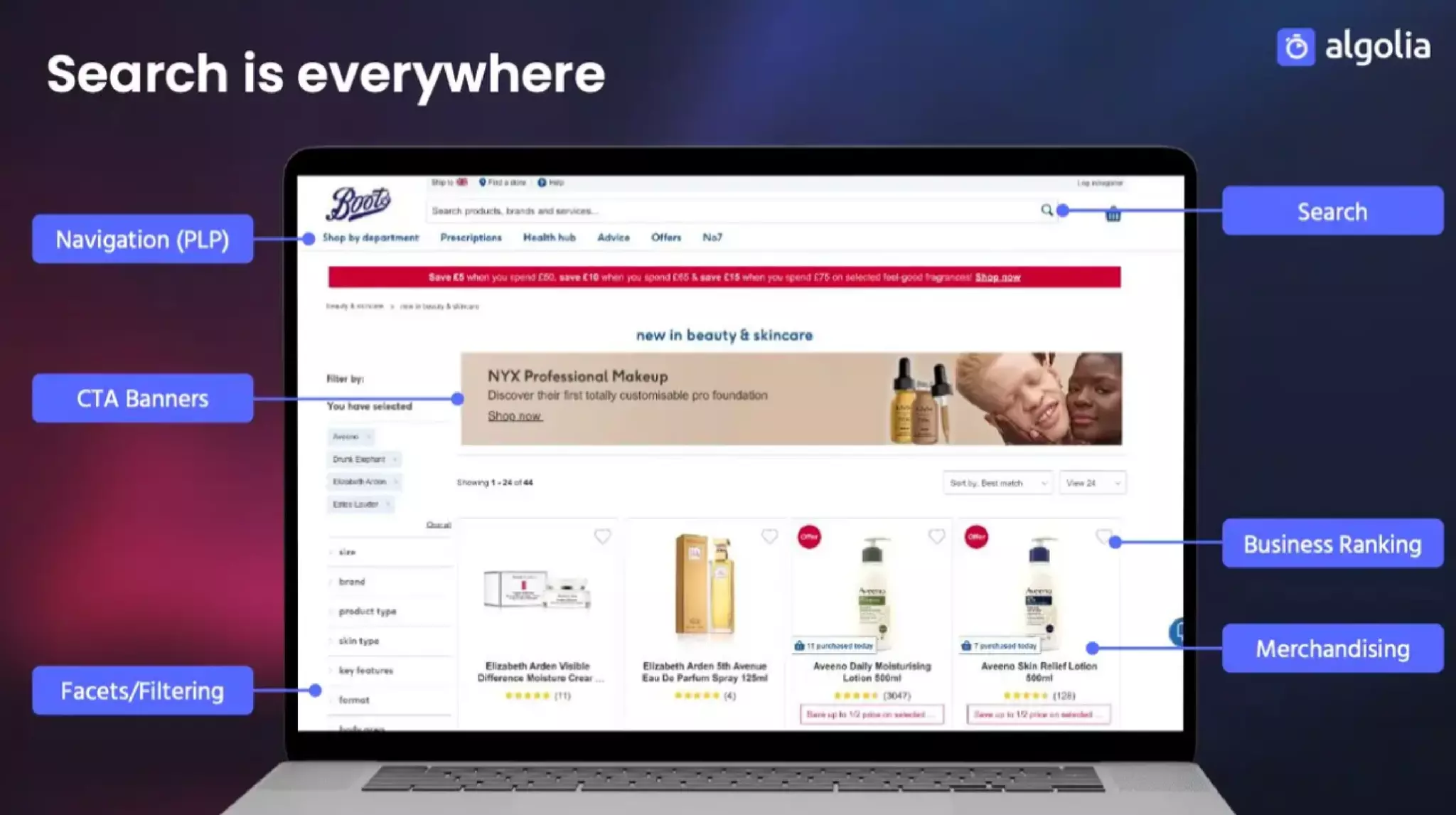
Slide 1 immediately declares the market insight: "Search is everywhere." This is a strong, concise mission statement that frames everything that follows — it tells investors the company is addressing a ubiquitous problem with broad applicability. The simplicity of the claim makes it easy to remember while setting an expectation that subsequent slides will justify why search matters now and why Algolia is uniquely positioned.

The slide’s strength is in setting tone rather than drowning the audience in detail. Founders can learn from this: open with a crisp, memorable thesis that stakes out the problem space and gives the audience a single, repeatable message to anchor the rest of the deck.

Key Takeaway: Start with a one-line mission that frames the problem at scale and makes the rest of your story cohesive.
Traction & Outcomes: Customer Impact Metrics

Traction & Outcomes: Customer Impact Metrics

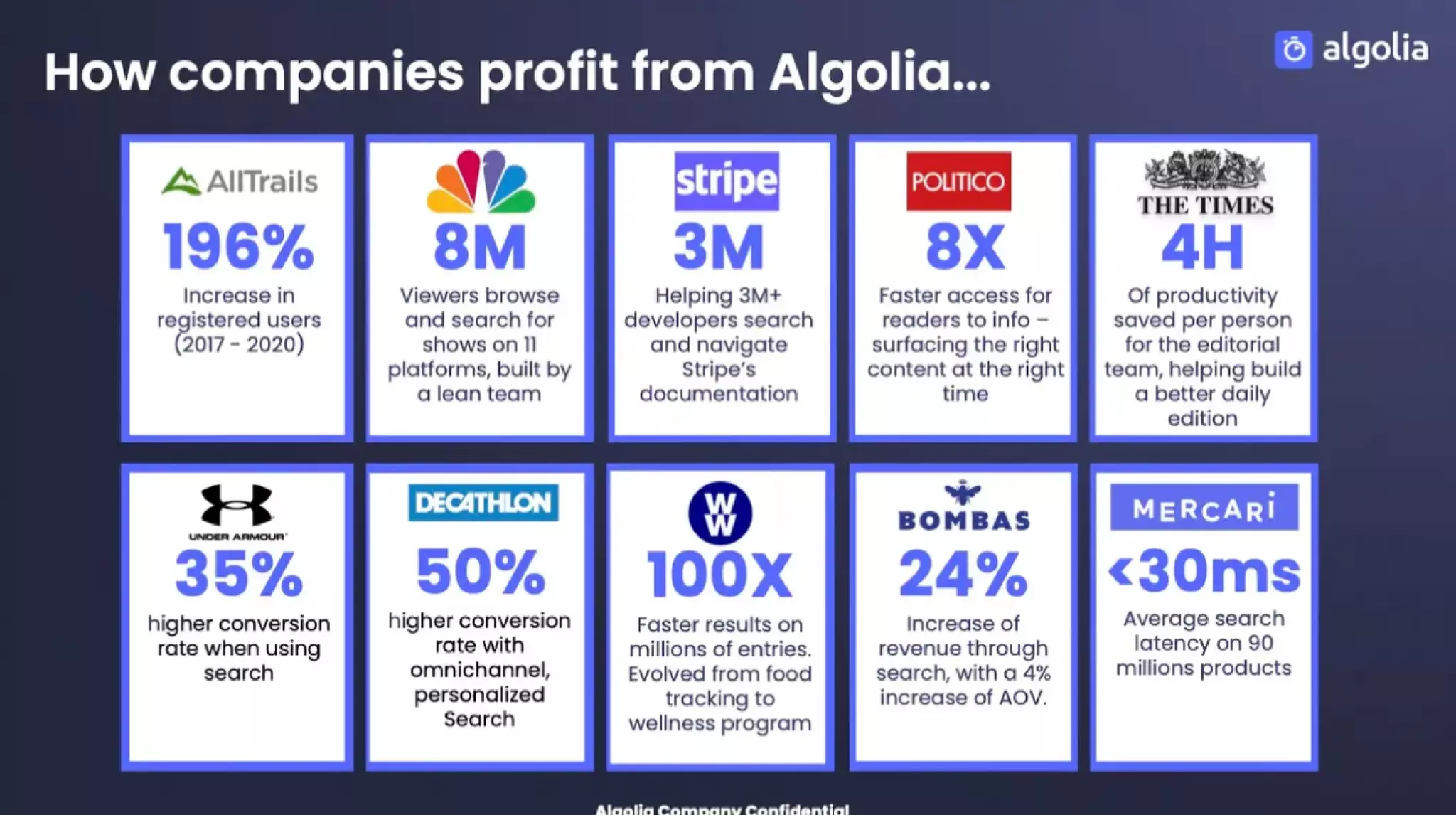
Slide 16 aggregates customer outcomes (conversion uplifts, latency improvements, usage metrics) across several brand logos — AllTrails, Stripe, Mercari, Bombas, Under Armour, Decathlon, etc. The format (big percentage or numeric benefit tied to a recognizable customer) communicates impact quickly and credibly: results speak louder than promises. Including a mix of e-commerce and enterprise outcomes demonstrates cross-segment value and revenue-relevant benefits like higher conversions and time saved.

This slide shows the power of outcome-focused storytelling: metrics translate product value into commercial outcomes investors care about. Founders should collect early, concrete metrics and present them in a unified visual language (percent uplift, ms latency, user counts) to make impact tangible and comparable.

Key Takeaway: Highlight 3–6 customer outcomes with clear metrics and recognizable logos to turn product features into business value.
Product Vision: API Platform and Roadmap

Product Vision: API Platform and Roadmap

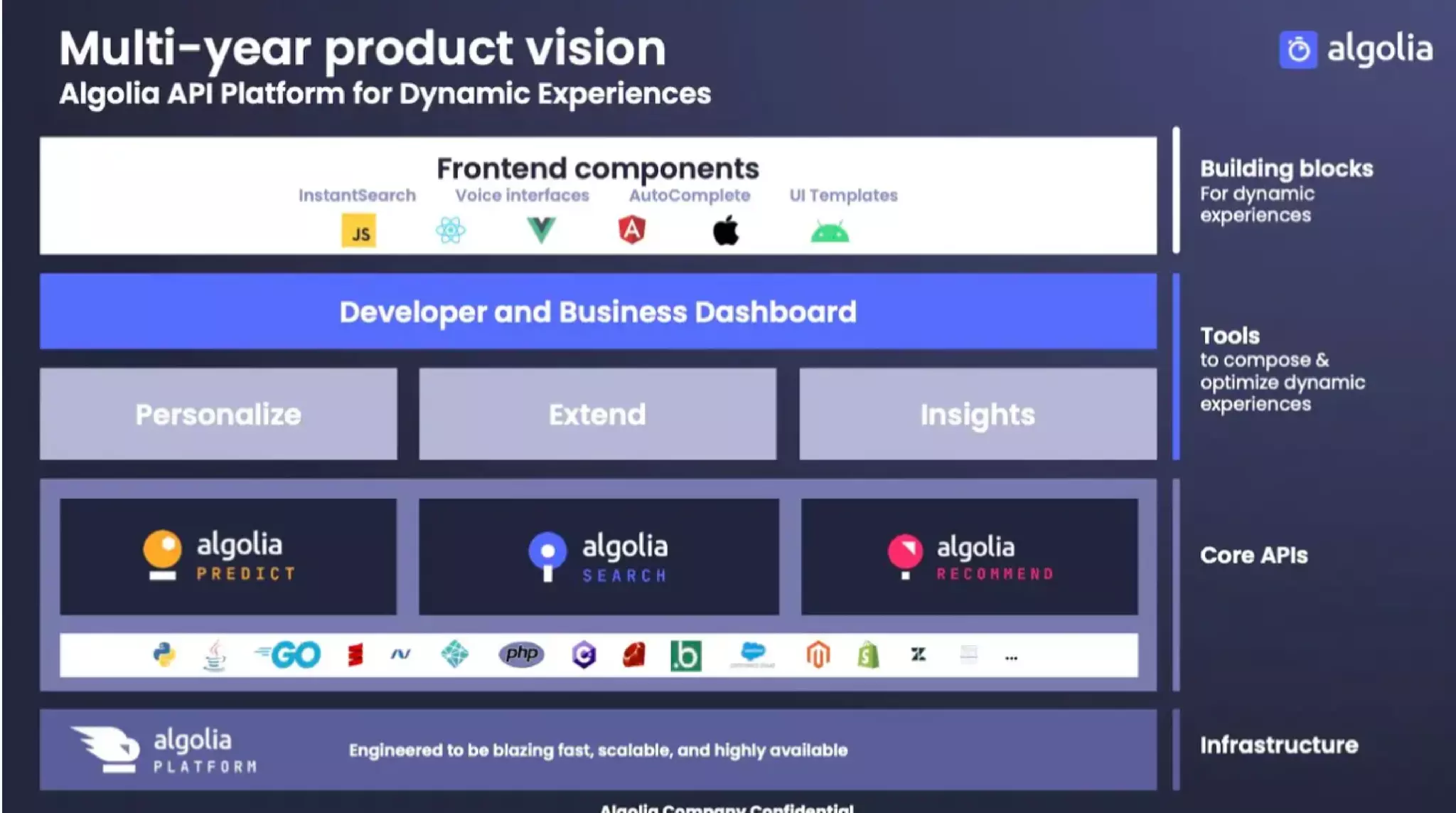
Slide 17 lays out a multi-year product vision: frontend components, a developer/business dashboard, tools to personalize/extend/insight, and core APIs (Predict, Search, Recommend) sitting on a robust platform. The layered diagram signals maturity in thinking — it’s not just a search box but a platform strategy with extensibility and commercial tooling. This also reinforces the API-first positioning: the product is designed for developers but with business-facing layers to drive monetization and adoption.

The slide is instructive because it ties near-term product features to a longer-term platform play, showing how incremental product launches can build defensible value. Founders should demonstrate a clear product architecture that maps to commercial levers and future expansion opportunities, rather than a loose wishlist.

Key Takeaway: Show a layered product architecture that links developer primitives to business-facing tools and future expansion paths.
GTM & Business Model: Land, Expand, and Usage Pricing

GTM & Business Model: Land, Expand, and Usage Pricing

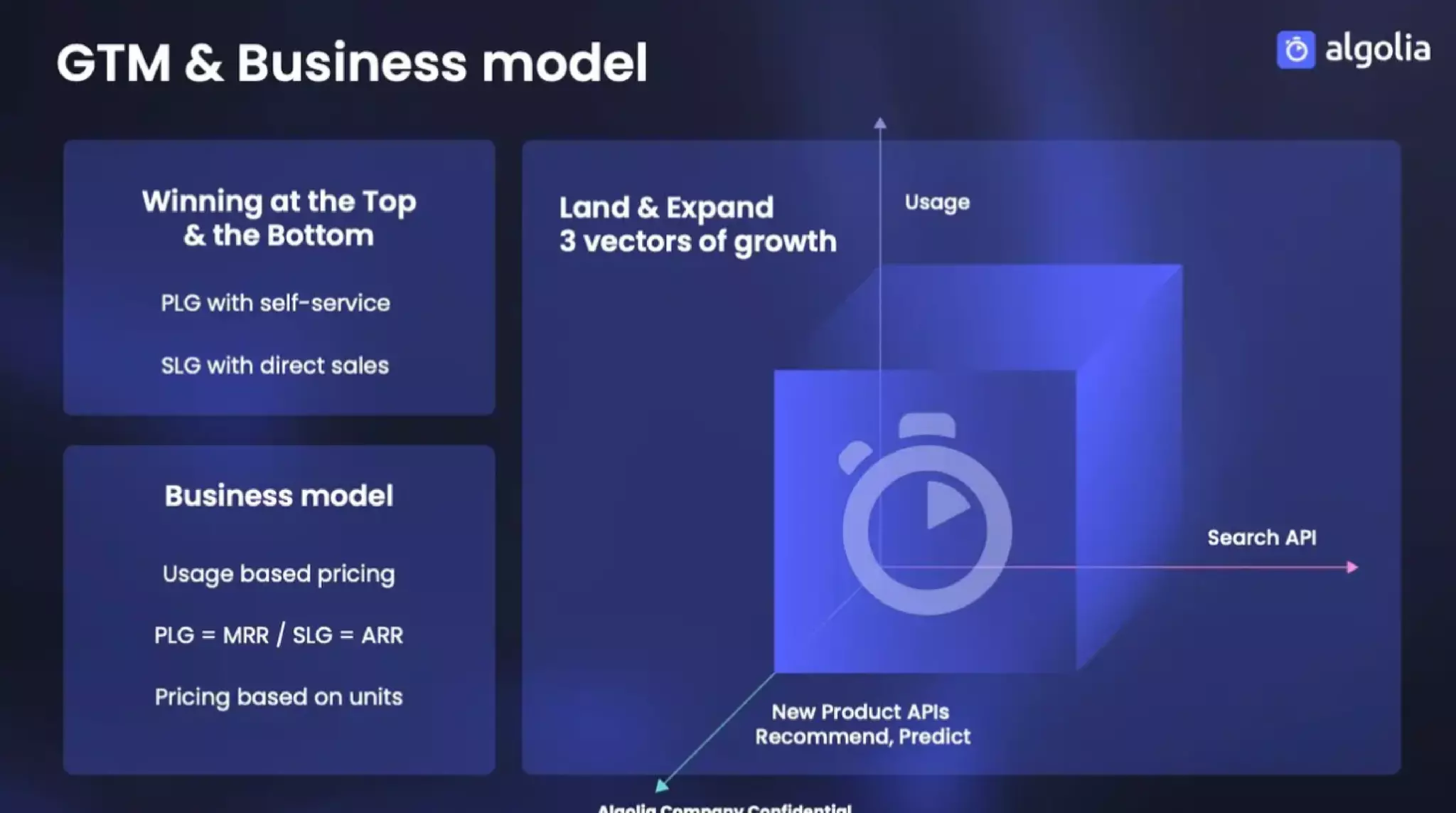
Slide 19 describes a dual GTM: product-led growth (PLG) for self-service and sales-led growth (SLG) for enterprise, paired with usage-based pricing. The visual cube showing axes (Search API usage, new product APIs, and overall usage) communicates a land-and-expand motion where initial low-friction adoption can scale to larger enterprise spend. Pricing based on units/usage aligns revenue with customer value and makes expansion natural as customers increase search volume or add features like recommendations.

This approach is effective because it maps product behavior to predictable revenue expansion and addresses both developer acquisition and enterprise monetization. Founders should articulate how their pricing and GTM create a natural expansion flywheel: make it easy to start, valuable to grow, and structured so revenue scales with customer value.

Key Takeaway: Design GTM and pricing so initial low-friction adoption naturally expands into higher-value, usage-based revenue.
Customer Proof: Mercari Case Study

Customer Proof: Mercari Case Study

Slide 10 spotlights Mercari and a crisp outcome: 350,000+ new listings/day indexed instantly and sub-30ms product discovery across 90M products. This single-case highlight gives a concrete, attention-grabbing example of scale and performance that only a hardened technical product could deliver. The visual (phone + large headline) is clean and keeps the focus on the headline metrics that matter to e-commerce buyers and investors alike.

Case studies work here because they convert abstract claims into a tangible deployment and operational scale. Founders should include 1–2 short, high-impact case studies that show real-world scale/constraints solved and link those directly to business outcomes (conversion, latency, frequency, listings).

Key Takeaway: Use one high-impact customer story with crisp metrics to demonstrate real-world scale and credibility.
Team: Experienced Leadership to Scale

Team: Experienced Leadership to Scale

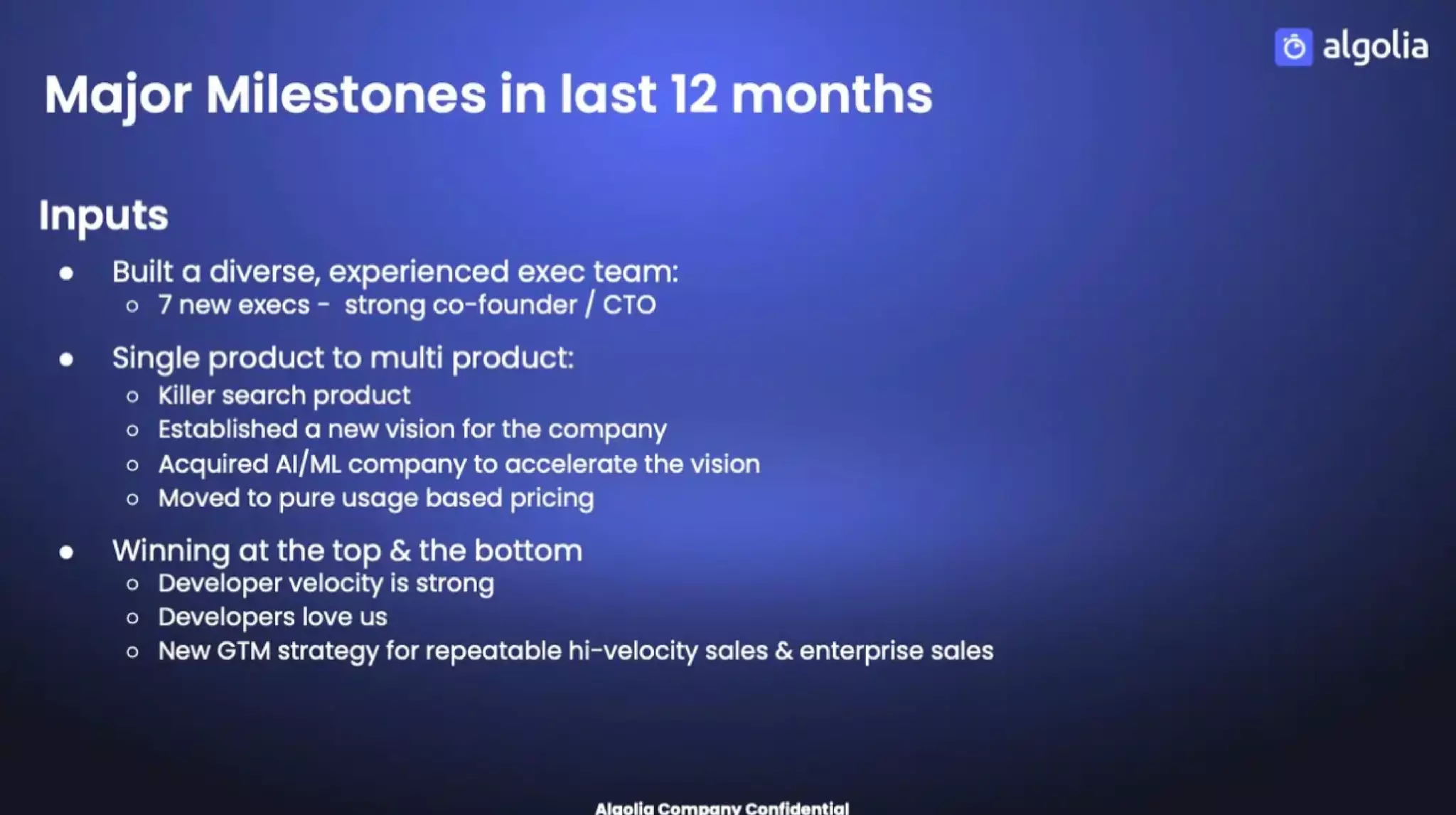
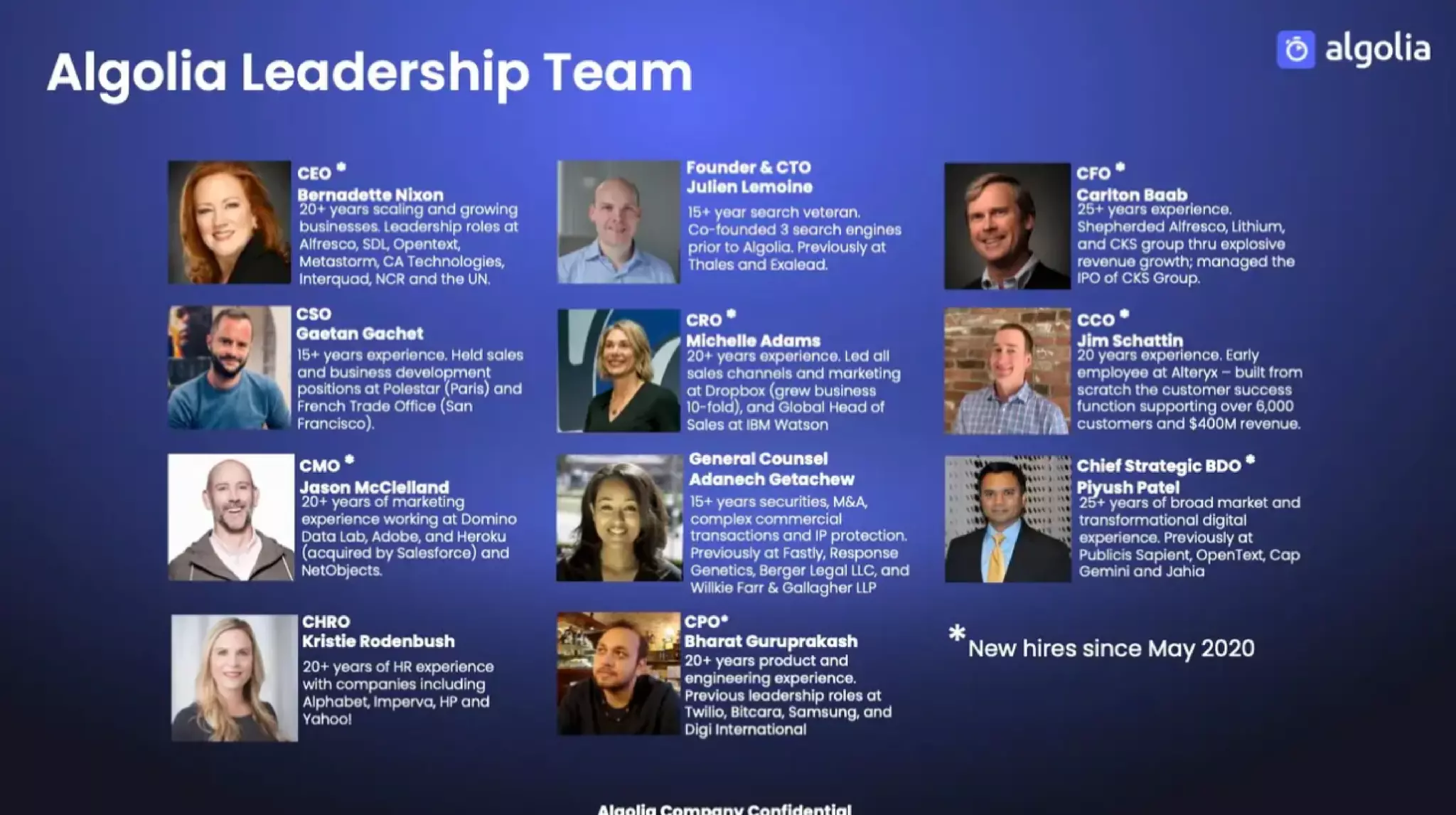
Slide 14 presents a broad leadership roster with depth across product, engineering, GTM, finance and legal — many hires noted as recent, signaling a deliberate build-out. Emphasizing experienced operators (CTO co-founder, seasoned CFO, CRO/CMO with enterprise and growth backgrounds) tells investors Algolia planned to scale beyond an engineering prototype into a market-facing company. The slide balances founder/technical credibility with commercial and operational hires needed for growth.

For investors, team slides are a risk-mitigation tool; showing complementary skill sets and relevant industry experience reduces execution risk. Founders should highlight key hires and the gaps they fill (e.g., CTO + enterprise sales + finance), and call out recent strategic hires that indicate the company is ready to scale.

Key Takeaway: Show a balanced leadership team with clear functional coverage and recent hires that indicate readiness to scale.

Conclusion: Key Lessons

Algolia’s seed-era deck is a strong example of combining a crisp market thesis, measurable customer outcomes, a layered product vision, and a coherent GTM/pricing strategy. Its strengths are clarity (one-line mission), credibility (performance metrics and recognizable customers), and a forward-looking platform roadmap that maps technical components to commercial levers. Actionable advice for founders: lead with a concise mission, quantify the market and timing with trends, convert product capabilities into business outcomes using data-driven case studies, present a product architecture that supports expansion, and explain how your GTM and pricing capture that value. Finally, show a team with complementary skills to execute the plan — that alignment between vision, metrics, model and people is what turns a pitch into investor conviction.

Full Deck Analysis

11 sections

Overview

Company: Algolia
Round: Seed ($1.2M)
Year: 2013
Outcome: Valued at $2.25B after Series D (2021)


Executive Summary

Algolia’s seed deck is a focused, product- and developer-first pitch that frames a clear problem (search is everywhere / search is broken) and shows a fast, API-first solution with measurable customer outcomes. The deck couples product vision and GTM (PLG + direct sales) with early traction & high-impact case studies to make a compelling foundation for a small seed raise.


Problem Statement

  • Core thesis: “Search is everywhere” — end-user search is critical across e-commerce and apps but is often slow, poorly tuned, and hard for developers to implement (slide 1, slide 9).
  • The deck positions market forces driving the problem: demand for APIs, growth in e-commerce, and digital transformation (slide 5).
  • Concrete product pain points are implied in the e‑commerce screenshot: navigation, facets/filtering, merchandising, business ranking and search input UX all need improvement (slide 9).

Solution

  • API-first, developer-focused search platform that delivers low-latency, relevance-tuned search (slides 4 & 8).
  • Product vision: modular API platform (Search core) plus Predict/Recommend, front-end components (InstantSearch, autocomplete, voice, UI templates), and a Developer & Business Dashboard for composition and optimization (slide 18).
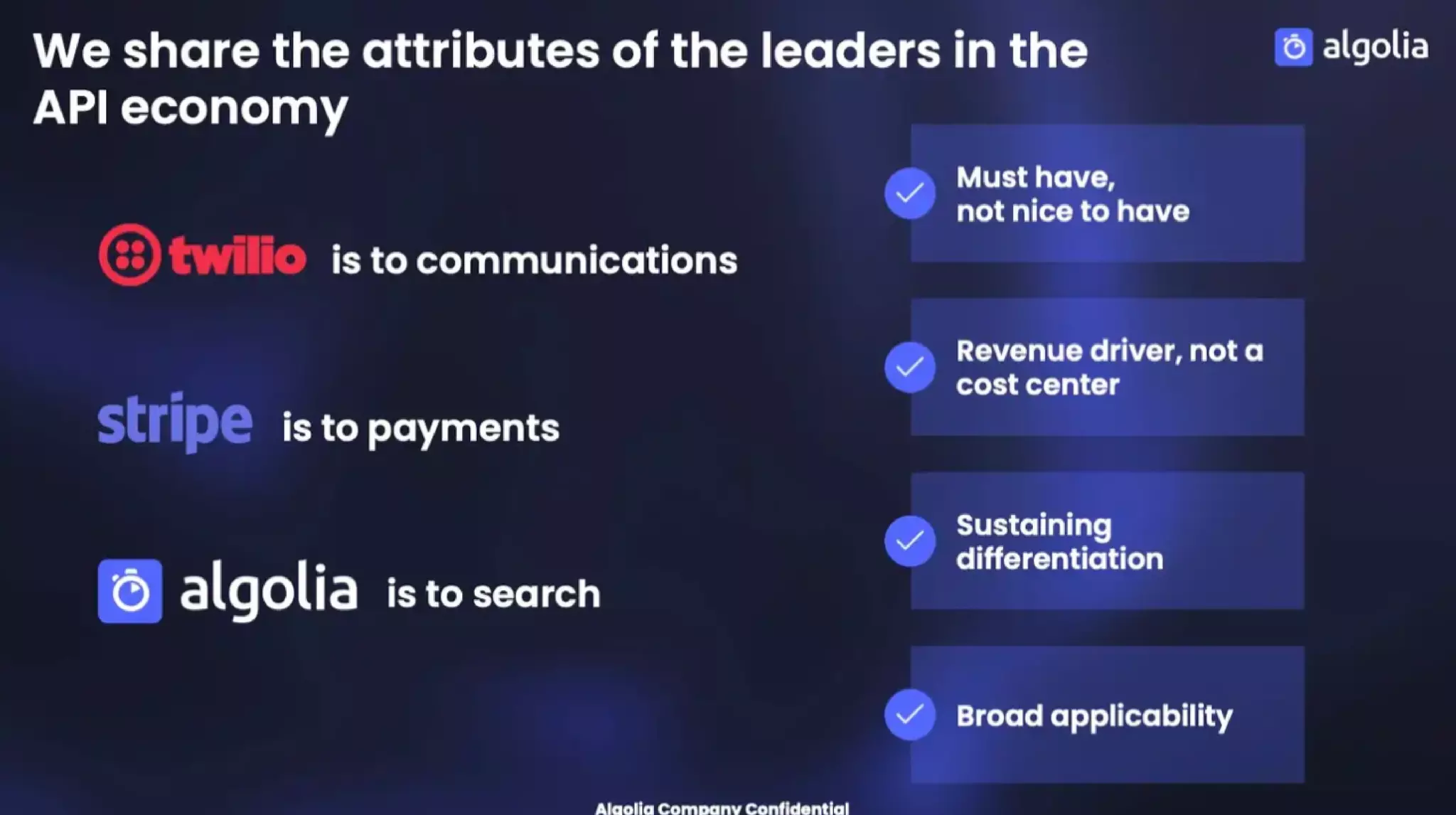
  • Positioning vs. incumbents: marketed as “a better way to build search” and compared to the role Twilio plays for communications / Stripe for payments — Algolia for search (slide 7).

Market Opportunity

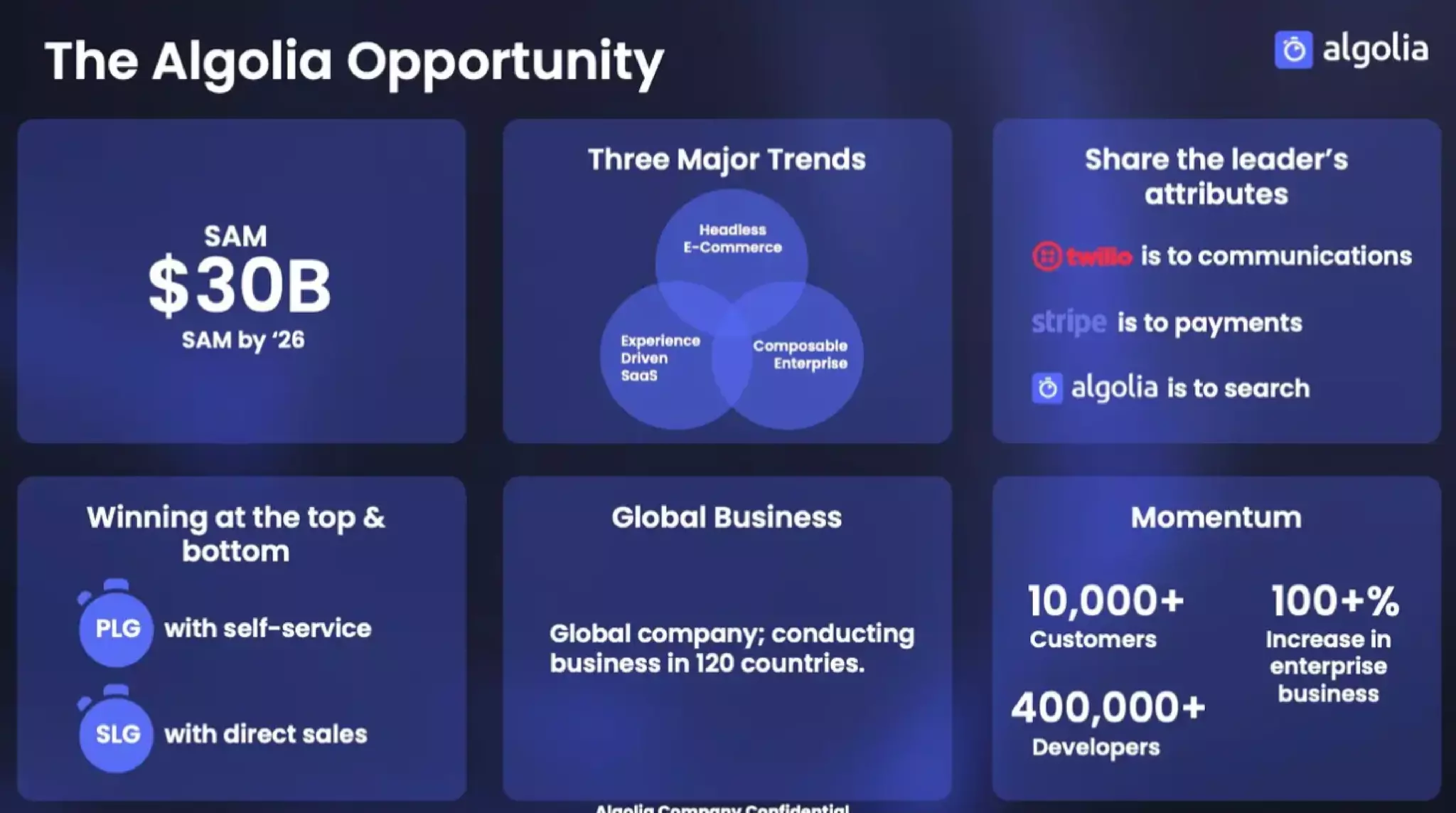
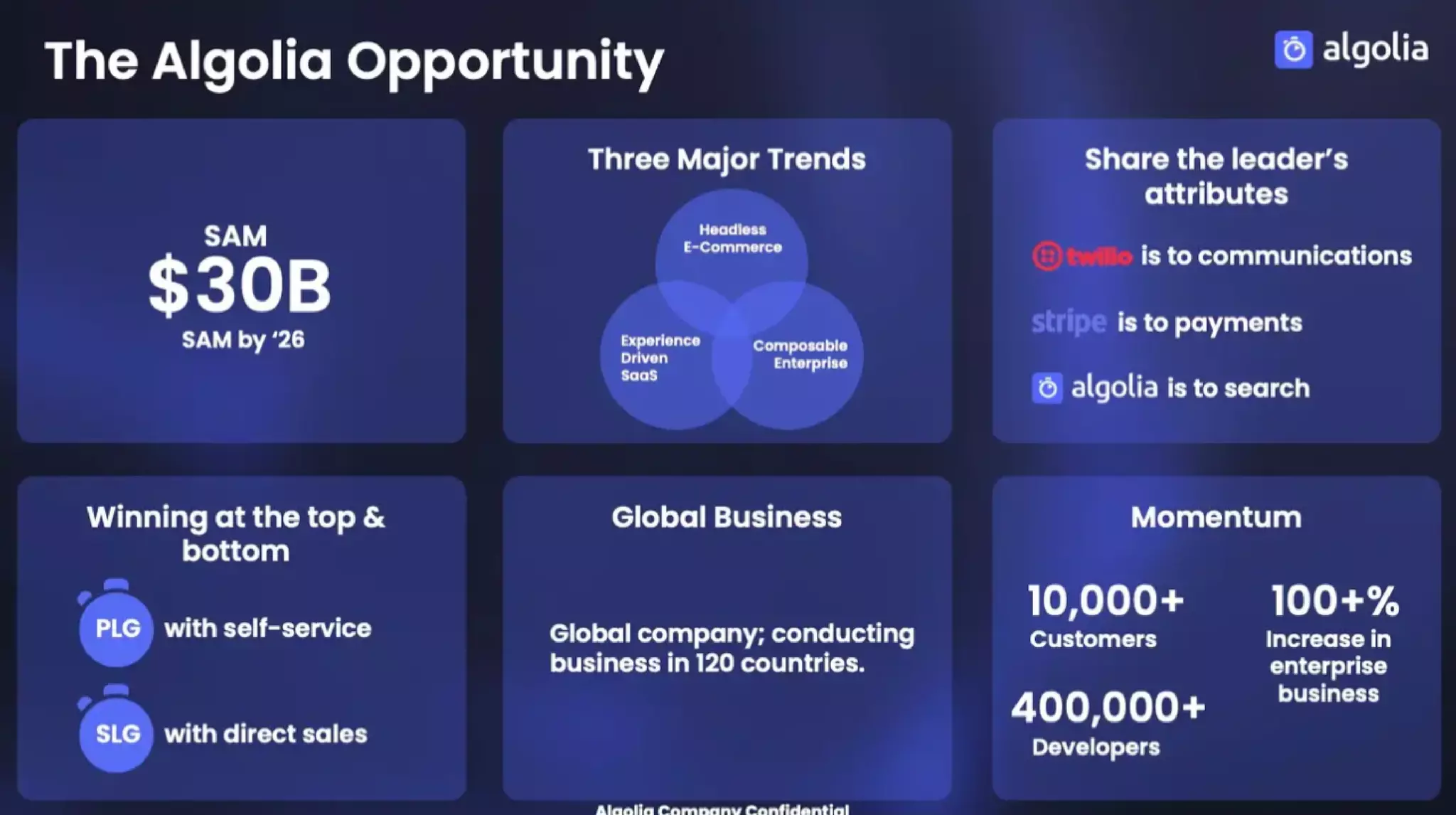
  • Explicit SAM cited: $30B (SAM by ’26) (slides 3 & 20).
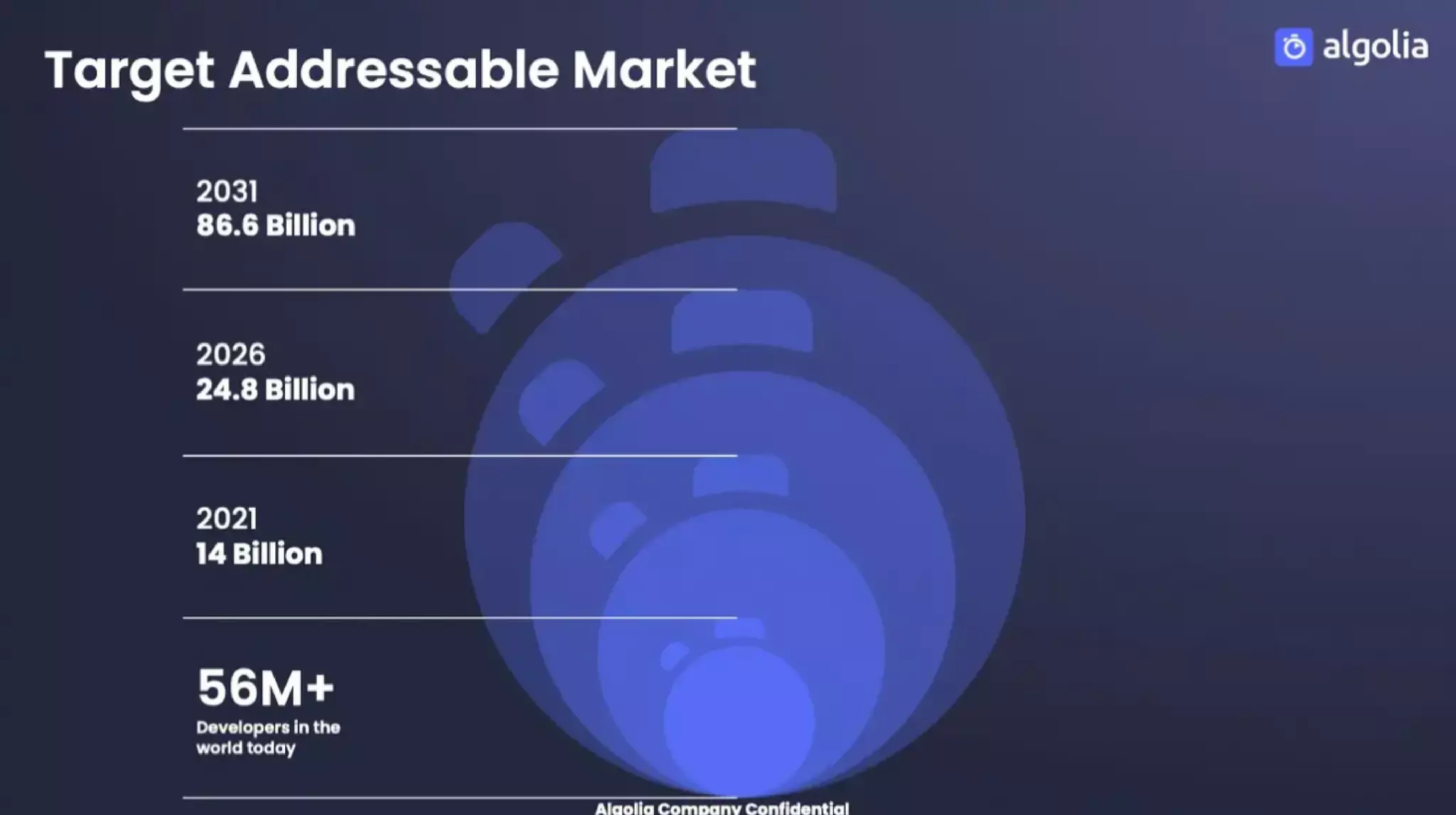
  • Broader addressable numbers on slide set:
    • 2021: $14B (slide 17)
    • 2026: $24.8B (slide 17)
    • 2031: $86.6B (slide 17)
    • Developer population stat: 56M+ developers in the world (slide 17)
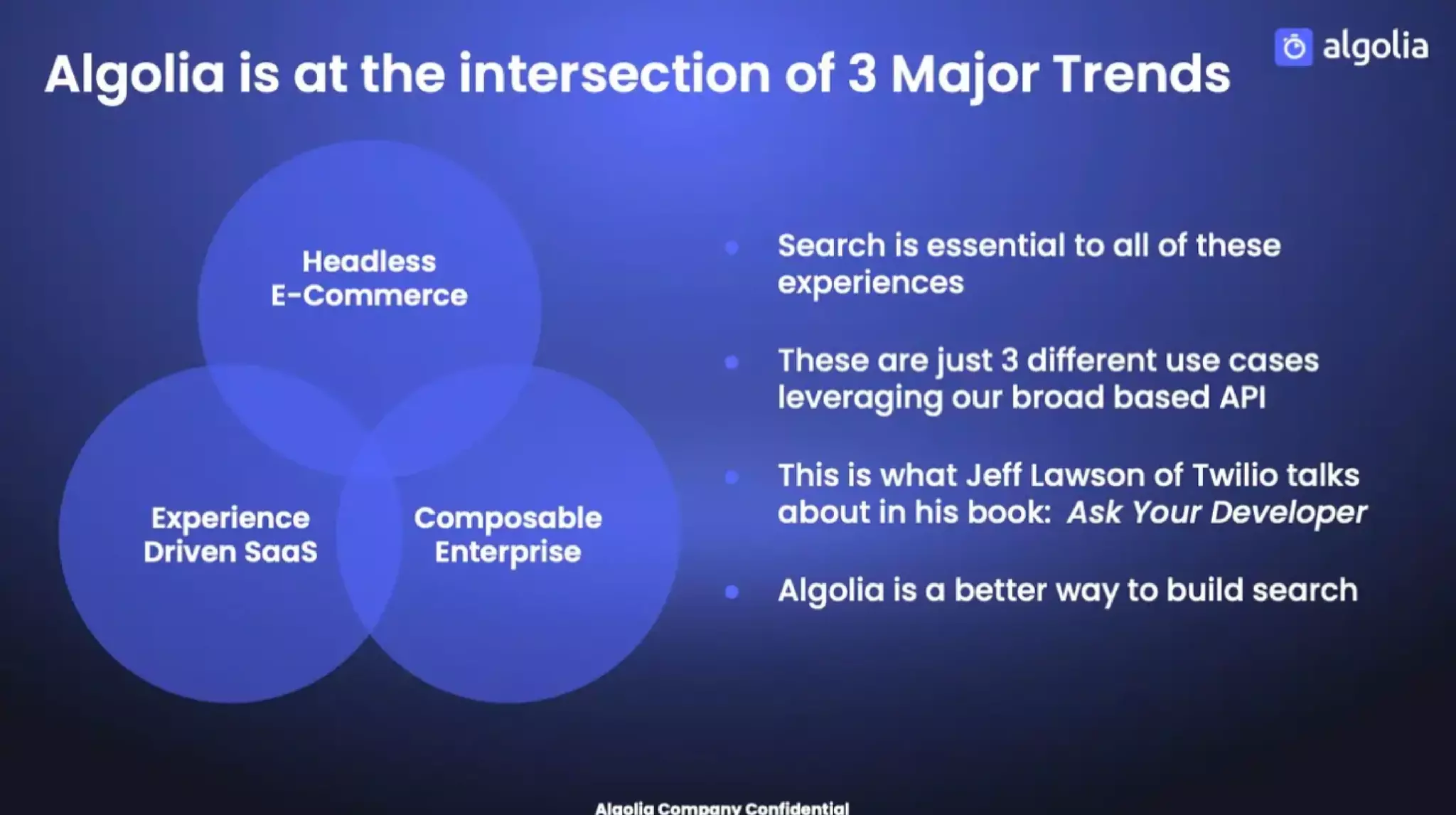
  • The deck frames search as applicable across headless e-commerce, experience-driven SaaS, and composable enterprises (3 major trends, slide 8) — enabling broad applicability to multiple verticals.

Business Model

  • Usage-based pricing is the primary model (slide 19).
  • Dual GTM monetization:
    • PLG / self-service for bottom-of-funnel adoption (PLG → MRR)
    • SLG / direct sales for enterprise customers (SLG → ARR) (slide 3 & slide 19)
  • Pricing basis: “pricing based on units” (slide 19).
  • Land & expand vector: core Search API usage with new product APIs (Recommend, Predict) driving expansion (slide 19).

Traction & Metrics

  • Customers & developers:
    • 10,000+ customers (slide 3 / 20)
    • 400,000+ developers on platform (slide 3 / 20)
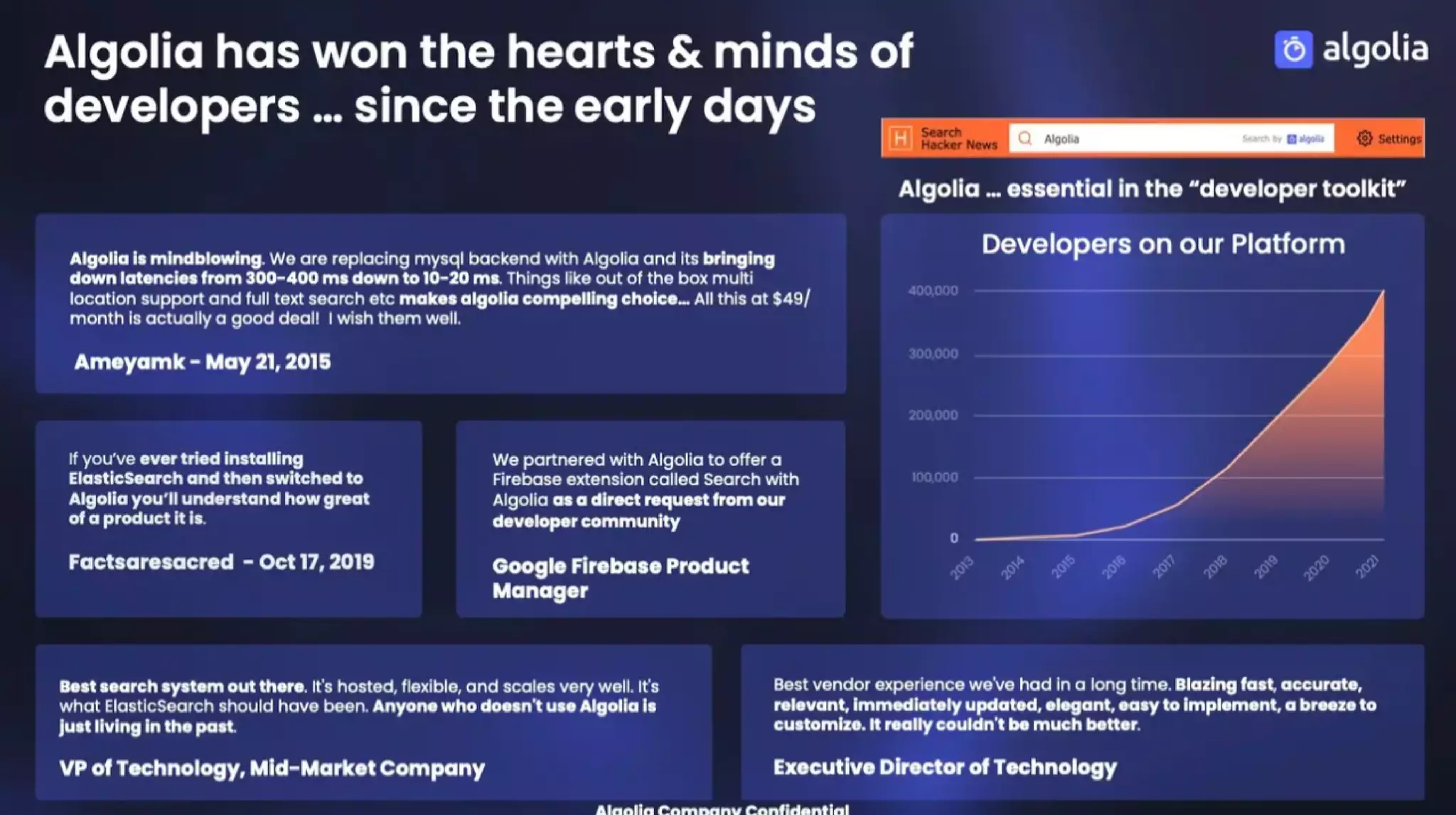
    • Developer growth curve visual (up to ~400k by 2021 shown on slide 6)
  • Momentum metric: “100+% increase in enterprise business” cited (slide 3 / 20).
  • Case studies / outcomes (slide 15, individual case slides):
    • Mercari: 350,000+ new listings/day; <30ms product discovery across 90+M products (slide 10)
    • ManoMano: +20% conversion in multiple markets within 2 weeks (slide 12)
    • AllTrails: 196% increase in registered users (2017–2020) (slide 15)
    • Under Armour: 35% higher conversion rate when using search (slide 15)
    • Decathlon: 50% higher conversion with omnichannel/personalized search (slide 15)
    • Bombas: 24% increase in revenue through search (slide 15)
    • The Times: 4 hours productivity saved per editorial person (slide 15)
    • Stripe: helping 3M+ developers search and navigate Stripe’s docs (slide 15)
    • Politico: 8x faster access to info (slide 15)
  • Performance KPI: average search latency <30ms showcased for large product sets (Mercari / slide 10 & slide 15).

Competitive Positioning

  • Positioning highlights:
    • Developer-first, API-first approach as a primary differentiator (slides 4 & 18).
    • Market analogy: “Twilio is to communications, Stripe is to payments, Algolia is to search” — emphasizes platform-leader ambition and network effects among developers (slide 7).
    • Product breadth (Search core + Predict + Recommend + front-end components) aims to create stickiness and prevent commoditization (slide 18).
    • Emphasis on “must-have” (revenue driver) vs. “nice-to-have” (slide 7) and sustaining differentiation / broad applicability.

Team

  • Founding & leadership:
    • Founder & CTO — Julien Lemoine: search veteran, co-founded prior search engines (slide 13).
    • CEO — Bernadette Nixon: 20+ years scaling and growing businesses; prior leadership roles at Alfresco, SDL, OpenText, etc. (slide 13).
  • Broad executive bench shown (marketing, sales, finance, product, legal, HR), signaling experienced hires and operational depth (slide 13).
  • Team credibility supports enterprise GTM and product scaling.

Go-to-Market Strategy

  • Dual approach:
    • PLG / self-service (bottom of the funnel) to attract developers and small teams (slide 3 & slide 19).
    • SLG / direct sales for enterprise accounts to capture large ARR deals (slide 3 & slide 19).
  • Land & expand: start with search API usage, then upsell to Recommend/Predict and dashboard/insights products (slide 19).
  • Developer evangelism emphasized (testimonials, growth in developers, “developer toolkit” pitch on slide 6).

The Ask

  • Raised (seed): $1.2M (provided externally).
  • Deck itself does not show a detailed use-of-funds or line-item cap table / runway slide (no explicit breakdown visible). This was a small seed raise; specific allocation not present in the slides shown.

Investor Deep Dive

Executive summary, strengths & red flags

Executive Summary

Algolia's seed deck is a focused, product- and developer-first pitch that frames a clear problem (search is everywhere / search is broken) and shows a fast, API-first solution with measurable customer outcomes. The deck couples product vision and GTM (PLG + direct sales) with early traction & high-impact case studies to make a compelling foundation for a small seed raise.

Key Strengths

3 identified

1

Clear product-market fit demonstrated by measurable customer outcomes — concrete case studies with percentages and latency metrics (Mercari <30ms, ManoMano +20% conversion, Bombas +24% revenue) (slides 10–12 & 15).

2

Developer-first positioning and traction — large developer base (400k+), strong testimonials and growth chart lend credibility for organic adoption (slide 6 & slide 3/20).

3

Cohesive product architecture and roadmap — Search core + Predict + Recommend + front-end components + dashboard gives a plausible multi-year expansion path and multiple monetization levers (slide 18).

Red Flags & Weaknesses

3 identified

1

Limited financial detail and unit economics — no ARR/MRR numbers, LTV:CAC, gross margin assumptions, or explicit revenue run-rate are shown (gap for investor diligence).

2

Pricing and customer onboarding specifics thin — "usage-based pricing" and "pricing based on units" are stated, but no price points, tiers, or examples of customer spend are shown (slide 19).

3

Competitive analysis is high-level and analogical — the deck leans on Twilio/Stripe analogies and product differentiation claims but lacks a clear matrix against search incumbents (Elasticsearch, Solr) or cloud vendor alternatives, which an investor would expect to see.

More Pitch Decks To Study

Compare structure, fundraising context, and investor-facing story across similar startup decks.