Compare your deck to YouTube

Compare Your Deck

YouTube Pitch Deck (2005)

Social
Stage: Series A
Raised: $11.5M
Year: 2005
Slides: 10
Outcome: Acquired by Google for $1.65B

Pitch Deck

1 / 10
YouTube pitch deck - Brand & Positioning — Clear, memorable opening
Click to expand

Deck Analysis

This Series A pitch deck from YouTube (2005) is a concise, product-first presentation that clearly frames a painful consumer problem (sharing large video files), articulates a simple mission (“Broadcast Yourself.”), and pairs a technical solution with multiple potential monetization channels. Notable for its clarity and focus, the deck emphasizes timing (cheap digital video + broadband), product mechanics (encoding to Flash), community effects, and a strong founding team with prior PayPal connections. The company raised $11.5M in this round and was later acquired by Google for $1.65B, so the deck is a useful study in how a minimalist, focused narrative can support massive growth.

Brand & Positioning — Clear, memorable opening

Brand & Positioning — Clear, memorable opening

Slide 1 is essentially the brand promise: the YouTube logo and the tagline “Broadcast Yourself.” It’s a bold opening because it communicates both the product’s function (video distribution) and emotional appeal (empowerment, self-expression) in a single, memorable line. For investors, that clarity signals the team has a crisp view of the product’s identity and target behavior.

The slide’s simplicity is also an execution choice: it doesn’t overload with metrics or technical detail up front, which helps set the tone. Founders can learn that a tight, memorable positioning at the top of a deck primes the audience to understand subsequent slides through that lens — everything that follows should reinforce the promise made here.

Key Takeaway: Lead with a concise brand promise that frames the problem and the product emotionally and functionally.
Mission — Company Purpose

Mission — Company Purpose

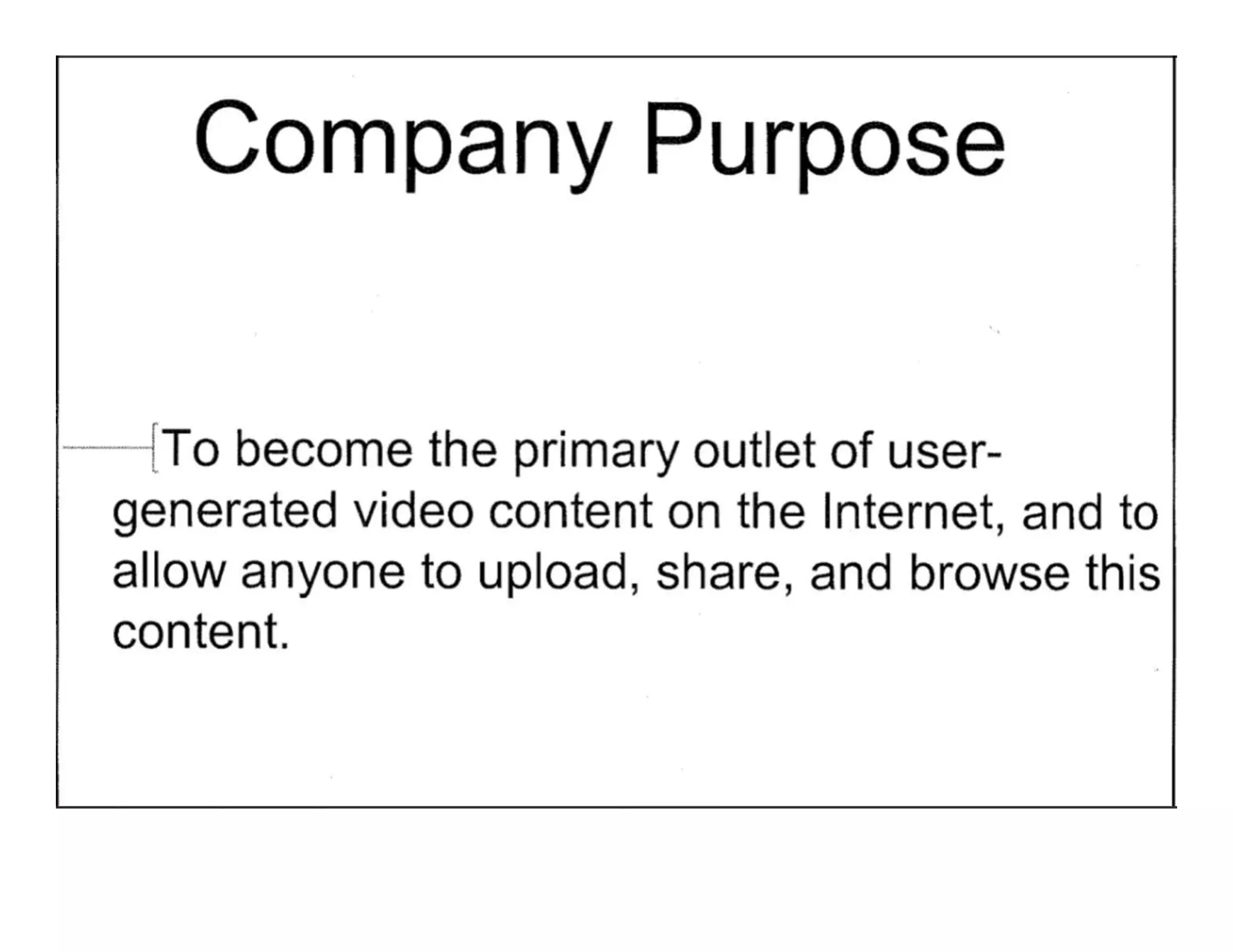
Slide 2 states the company purpose plainly: to become the primary outlet for user-generated video and to allow anyone to upload, share and browse. That mission links product features (upload/share/browse) to a strategic ambition (primary outlet). It works because it’s both operational (what you build) and aspirational (market leadership). Investors read mission statements as a proxy for team clarity and ambition; this one is measurable and actionable.

The slide also helps align internal priorities: if your purpose is primary outlet for UGV (user-generated video), decisions about product features, community rules, partnerships, and encoding are easier to evaluate. Founders should emulate the balance of specificity (what users can do) and scale ambition (be the primary outlet) when writing mission slides.

Key Takeaway: Make your mission simultaneously descriptive and aspirational — it should guide product choices and signal ambition to investors.
Problem — Crisp statement of user pain

Problem — Crisp statement of user pain

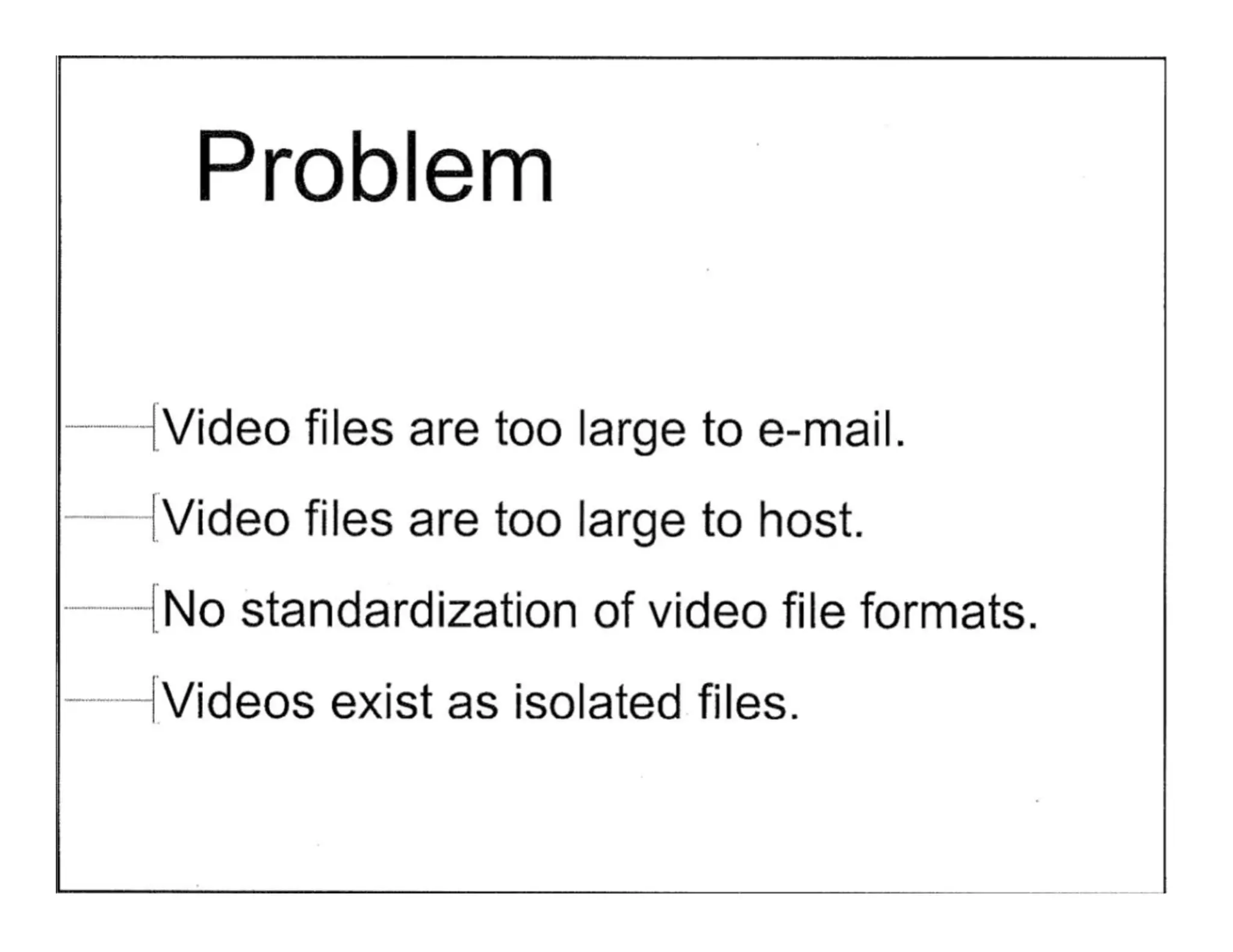
Slide 3 enumerates four crisp, practical problems: video files are too large to email, too large to host, lack of standard formats, and videos exist as isolated files. This is effective because it translates a broad opportunity (video on the internet) into concrete, solvable friction points that justify a platform solution. It makes the case that the problem is technical, social, and infrastructural simultaneously.

By framing the problem as multiple related pains, the deck primes the audience to appreciate a platform-level solution rather than a point tool. Founders should similarly break down a market opportunity into discrete user frictions, showing why an integrated product is necessary instead of a one-off fix.

Key Takeaway: List specific, concrete user frictions that together require a platform solution, not just a point product.
Solution — Product + technical approach tied to community

Solution — Product + technical approach tied to community

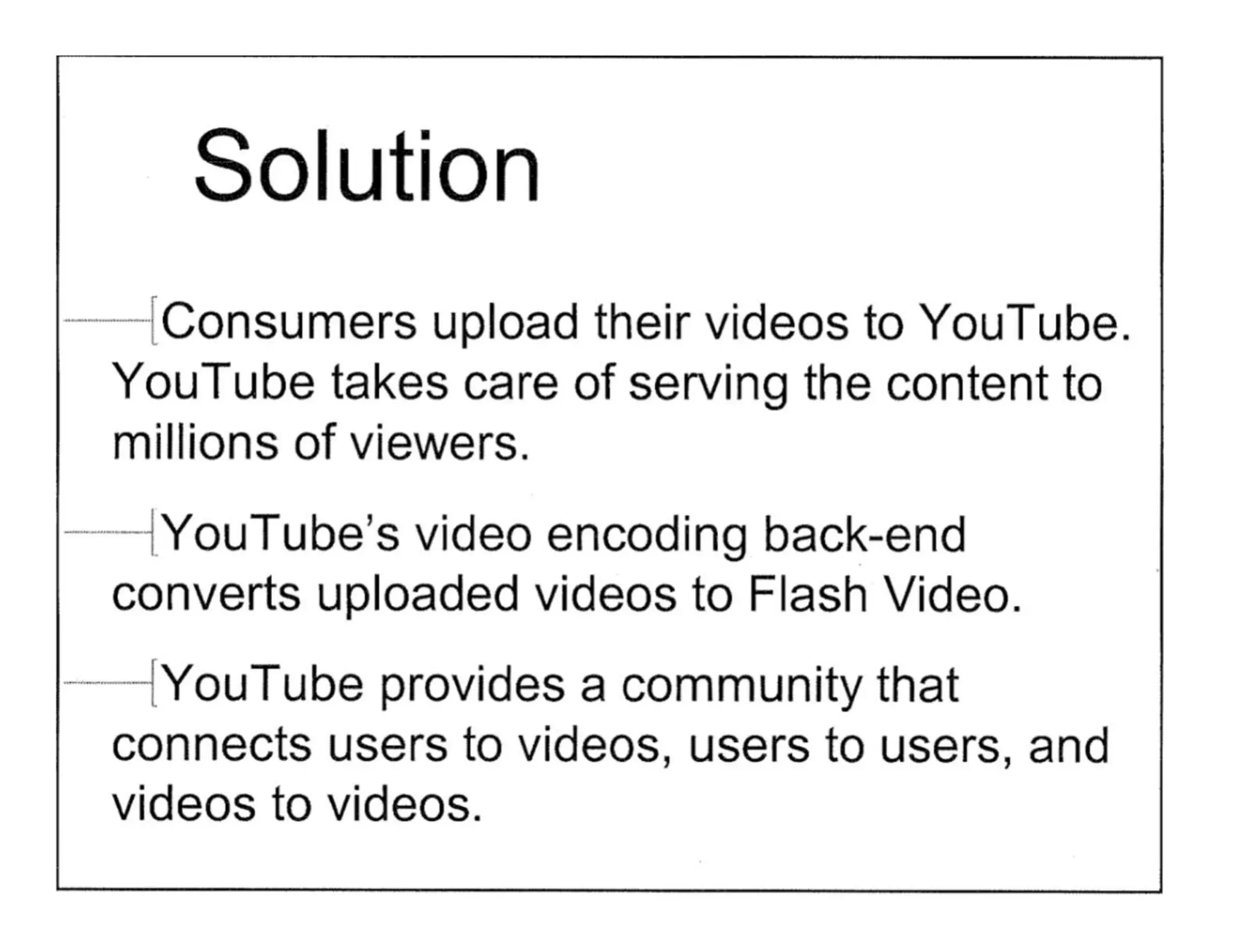
Slide 4 answers the previously stated problems with a straightforward product flow: consumers upload, YouTube serves millions, the back-end transcodes to Flash Video, and the platform creates community connections. This is strong because it ties technical implementation (encoding to a web-friendly format) to user outcomes (easy sharing and discovery) and network effects (users connected to users and videos). It shows the team thought through both the stack and the distribution dynamics.

For founders, this is a model for linking engineering choices to strategic leverage. Don’t present a feature list in isolation — show how a technical decision enables scale and community, and therefore competitive defensibility. Also note they describe conversion to Flash, which signals practical engineering tradeoffs to enable immediate reach.

Key Takeaway: Tie technical decisions to user outcomes and network effects so investors see how engineering enables scale and defensibility.
Market Size & Timing — Why now?

Market Size & Timing — Why now?

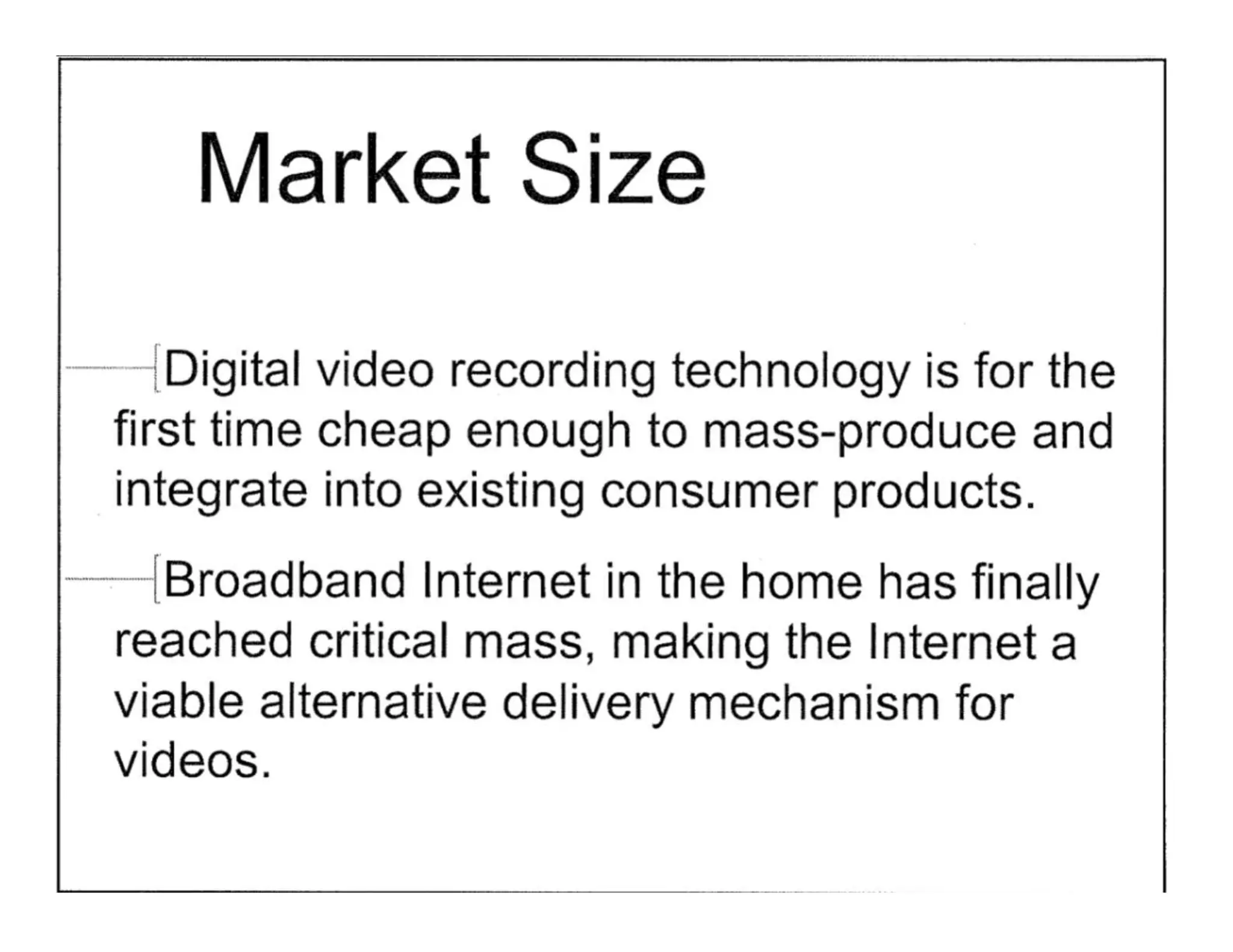
Slide 5 focuses on timing: digital video recording is cheap enough to mass-produce and broadband has reached critical mass in homes. This is an effective market slide because it pairs technological enablers with adoption readiness, making a compelling argument that the market is emerging and ripe for a platform play. The slide avoids over-precision in TAM math and instead emphasizes secular trends that justify rapid user growth.

Founders should emulate the combination of technology maturity and distribution readiness: show that cost curves and infrastructure shifts remove previous constraints. Investors want evidence the timing window is open and that the company can ride exponential adoption rather than fight legacy bottlenecks.

Key Takeaway: Make the case that macro technology and distribution trends have changed the economics, creating a time-limited window to build category leadership.
Go-to-Market & Monetization — Multiple paths to revenue

Go-to-Market & Monetization — Multiple paths to revenue

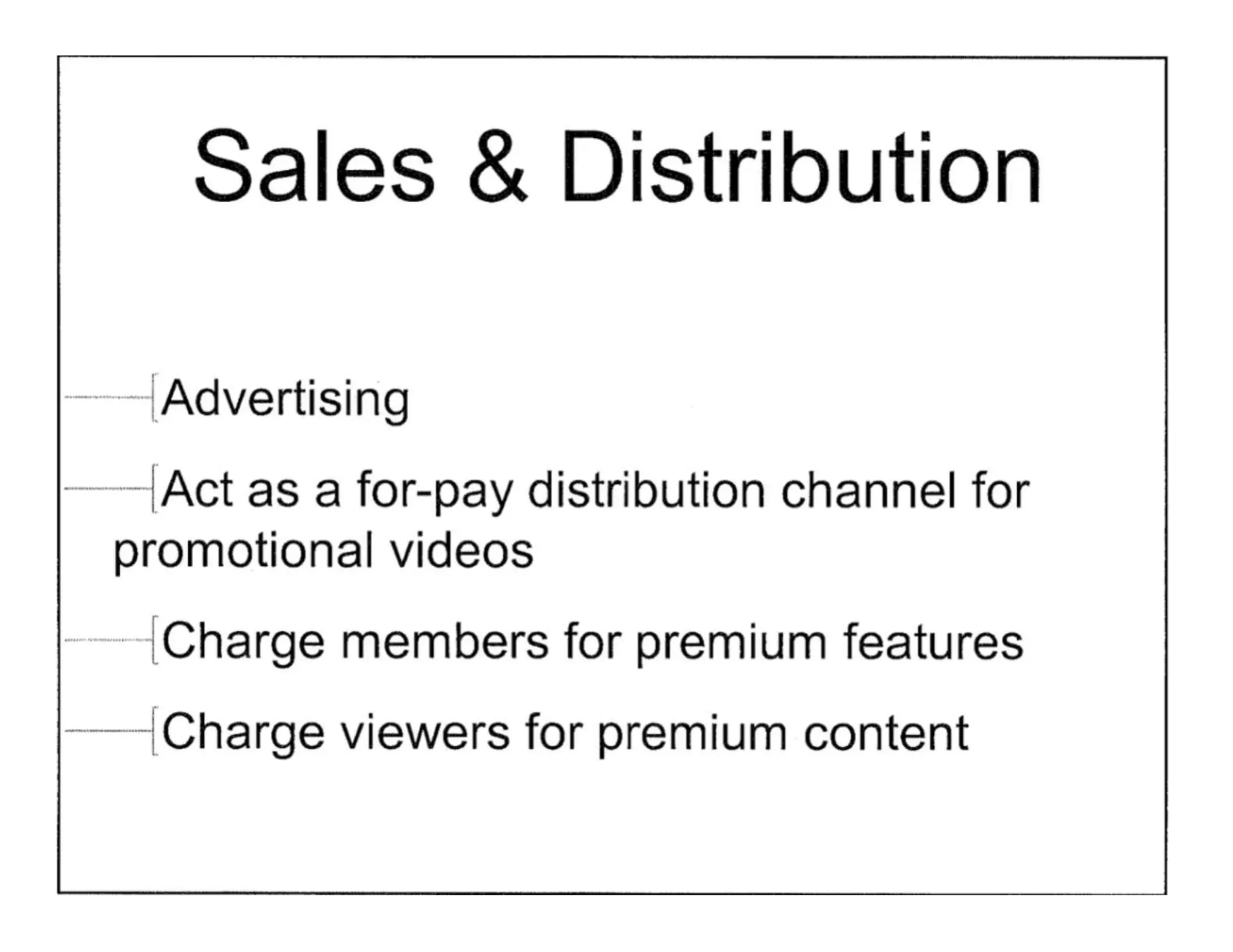
Slide 8 lays out several monetization strategies: advertising, paid distribution for promotional videos, charging members for premium features, and charging viewers for premium content. This is effective because it shows the team has thought about diversified revenue streams rather than relying on a single uncertain channel. It also maps monetization to different user segments (advertisers, creators, viewers), which is important for platform economics.

The slide balances a primary, scalable option (advertising) with optional, incremental revenue levers (premium features and pay content), signaling adaptability. Founders should present a layered monetization plan with a clear primary engine and optional experiments that can be tested later as the platform matures.

Key Takeaway: Propose a tiered monetization strategy with one clear primary revenue engine and additional levers to test as the product scales.
Team & Traction — Credibility and early momentum

Team & Traction — Credibility and early momentum

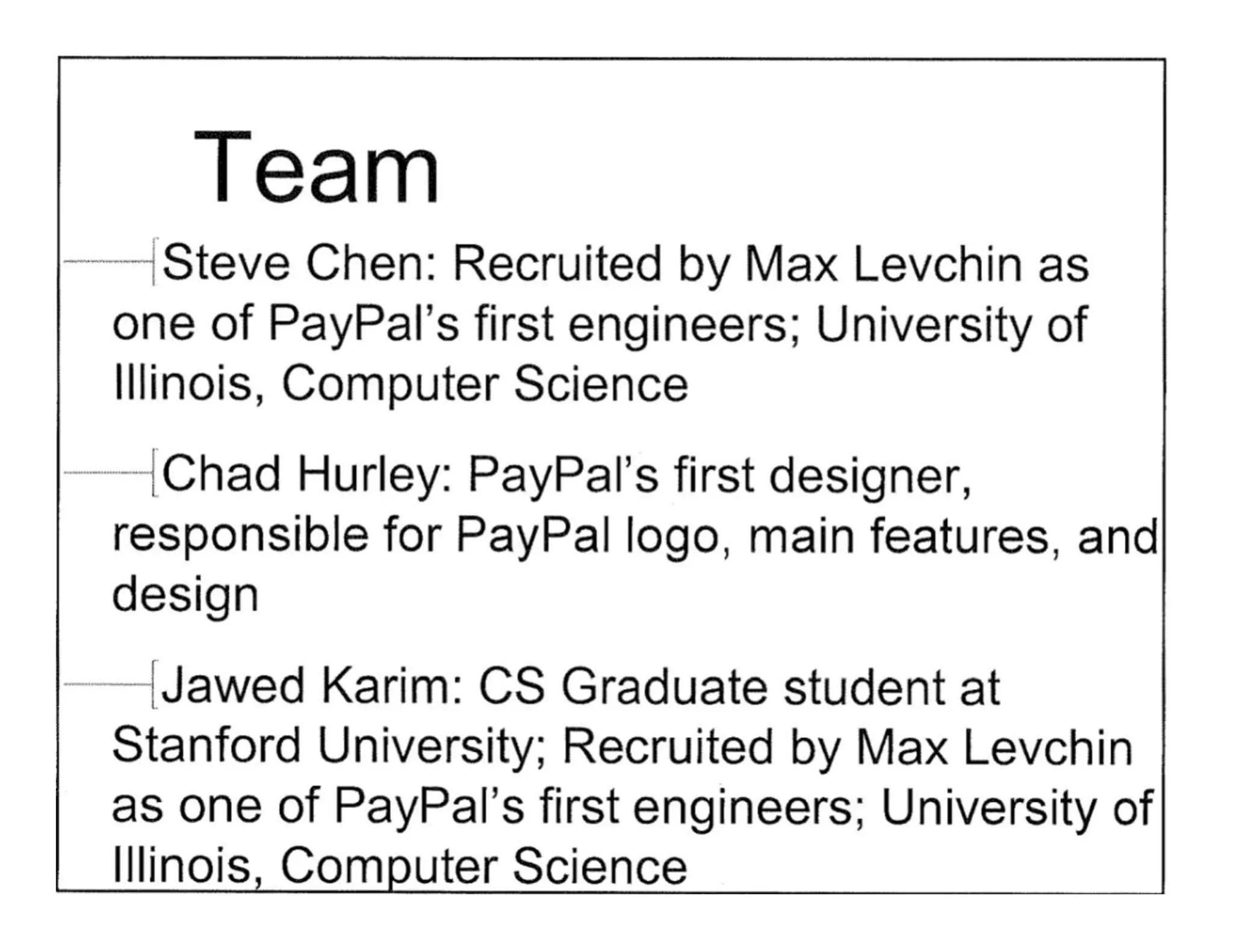
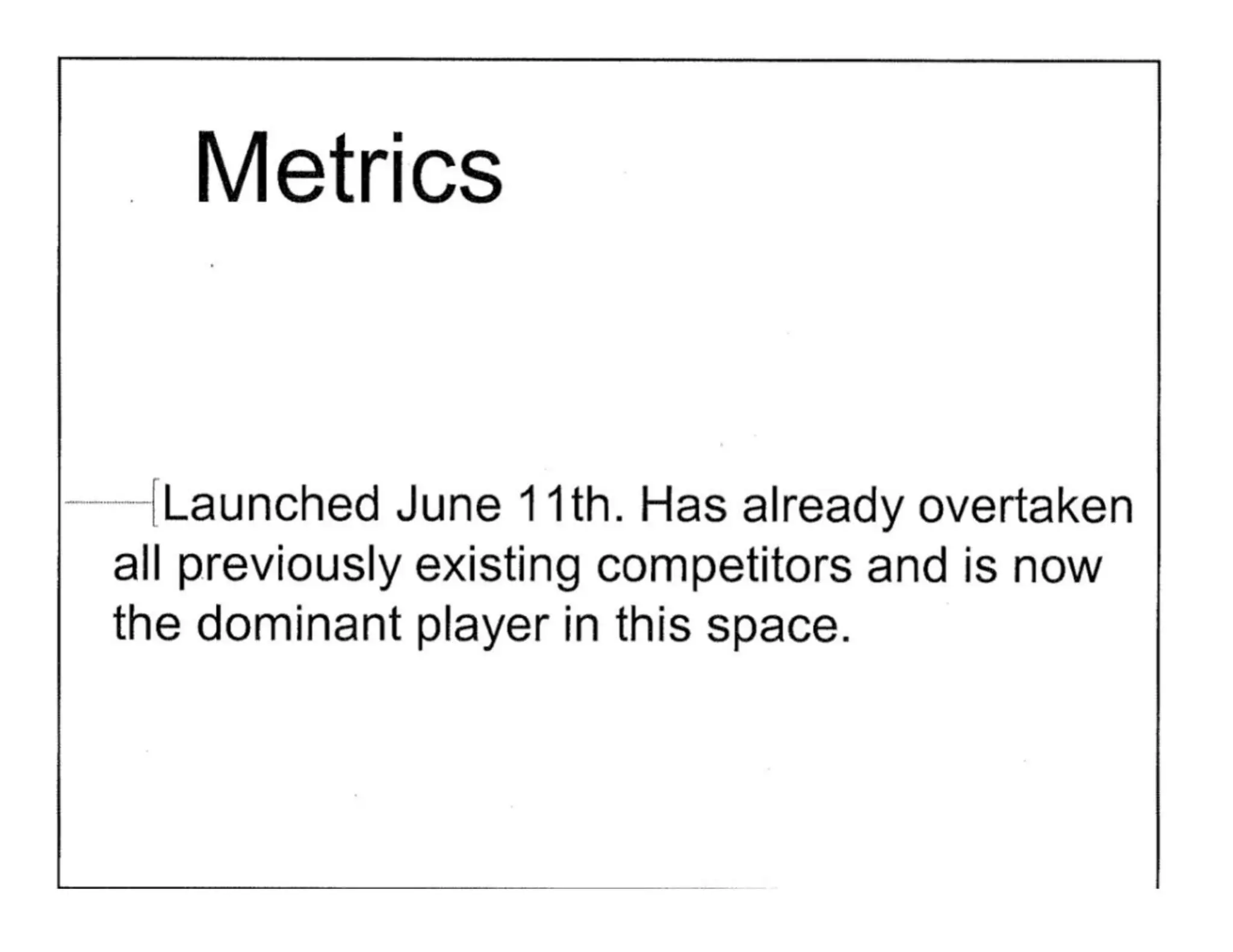
Slide 9 highlights the founding team (Steve Chen, Chad Hurley, Jawed Karim) and their PayPal connections and design/engineering backgrounds. Slide 10 (metrics) notes the launch date and rapid competitive outperformance. Together these communicate both competence (prior experience at a successful startup) and early traction (quickly overtook competitors). That combination is highly persuasive to investors: skill plus evidence of product-market fit.

For founders, this underscores two rules: hire founders with relevant prior experience or complementary skills, and present early traction as soon as possible. Even simple metrics (launch date + relative market position) can make the opportunity feel real — especially when paired with a team that can execute the next roadmap.

Key Takeaway: Show founders’ relevant track records and immediate, measurable traction to convert product potential into investor confidence.

Conclusion: Key Lessons

This deck’s strengths are its clarity, economy, and alignment between product, engineering decisions, and business model. It defines a real user pain, presents a practical technical solution, and connects that solution to both community-driven network effects and realistic monetization options. The deck also leans into timing and team credibility, which together make the opportunity feel immediate and executable.

Actionable advice for founders: lead with a crisp positioning, break down the user problem into concrete frictions, show how specific technical choices enable scale, present a layered monetization plan, and highlight team experience plus early traction. Keep the narrative simple and focused — investors judge coherence across mission, product, market, and team more than dense slide decks with excessive detail.

Full Deck Analysis

11 sections

Overview

Company: YouTube
Round: Series A ($11.5M)
Year: 2005
Outcome: Acquired by Google for $1.65B (October 2006)
Time to Exit: ~16 months post-Series A

Executive Summary

YouTube’s Series A pitch deck is a masterclass in problem-solution clarity paired with minimal quantitative validation. The deck elegantly articulates why user-generated video distribution was broken (technical barriers, format fragmentation, isolation) and how YouTube’s Flash Video encoding + community platform solved it. Despite lacking specific user metrics, revenue projections, or detailed competitive differentiation, the pitch succeeded because the product’s explosive growth was already undeniable by late 2005—just 5 months post-launch. The combination of a proven PayPal-alumni founding team, perfect market timing (broadband adoption + cheap video capture), and obvious product-market fit made this one of the most successful Series A investments in tech history (143x return for investors).

Problem Statement

Slides 3-4 articulate four specific, technical barriers to video sharing:

  1. File size limitations (email) - Videos too large to email
  2. File size limitations (hosting) - Videos too large for individuals to host
  3. Format fragmentation - No standardization of video file formats
  4. Content isolation - Videos exist as isolated files with no discovery mechanism

Problem framing approach:

  • Focuses on technical friction rather than user pain points
  • Assumes investors understand infrastructure constraints
  • Doesn’t quantify how many people are affected or severity
  • Positions the problem as a distribution infrastructure gap rather than a consumer demand gap

Effectiveness: Strong for a technical audience; would benefit from user research or market validation showing people actually want to share videos.

Solution

Slide 4 presents a three-layer value proposition:

  1. Infrastructure layer - “Consumers upload their videos to YouTube. YouTube takes care of serving the content to millions of viewers.”
    • Solves file size and hosting problems
    • Implies CDN/scalable infrastructure
  2. Technology layer - “YouTube’s video encoding back-end converts uploaded videos to Flash Video.”
    • Solves format standardization problem
    • Flash Video was the key technical innovation (ubiquitous plugin in 2005)
  3. Community layer - “YouTube provides a community that connects users to videos, users to users, and videos to videos.”
    • Solves content isolation problem
    • Implies network effects and viral growth loops

Solution positioning:

  • Elegant simplicity: upload → encode → distribute → discover
  • Technically credible (Flash Video was the right choice for 2005)
  • Hints at network effects without over-explaining
  • Doesn’t explain why YouTube’s UX is better than competitors

Effectiveness: Clear and technically sound, but lacks competitive differentiation or proof that the solution actually works.

Market Opportunity

Slide 5: Market Size (Macro Tailwinds)

The deck identifies two enabling factors rather than quantifying TAM:

  1. Supply-side enabler: “Digital video recording technology is for the first time cheap enough to mass-produce and integrate into existing consumer products.”
    • Implies proliferation of cameras, camcorders, phones with video capability
    • No specific numbers on device shipments or adoption rates
  2. Demand-side enabler: “Broadband Internet in the home has finally reached critical mass, making the Internet a viable alternative delivery mechanism for videos.”
    • Implies sufficient bandwidth for video streaming
    • No specific numbers on broadband penetration, speeds, or household adoption

Market sizing approach:

  • Focuses on conditions rather than size
  • Identifies inflection points (“for the first time,” “finally reached critical mass”)
  • Assumes investors will extrapolate the opportunity themselves
  • Zero quantification of TAM, SAM, or SOM

Critical gap: No mention of:

  • Total addressable market size
  • Serviceable addressable market
  • Market growth rate
  • Competitive market share estimates
  • Revenue opportunity

Effectiveness: Identifies real macro trends but provides zero quantitative market analysis. For a Series A, this is weak—investors typically want TAM estimates, growth projections, and addressable market analysis.

Business Model

Slide 8: Sales & Distribution (Four Revenue Streams)

  1. Advertising - Listed first, implying primary focus
    • No details on ad format, pricing (CPM), or revenue potential
    • No mention of advertiser targeting or brand safety
  2. For-pay distribution channel - “Act as a for-pay distribution channel for promotional videos”
    • B2B model targeting brands/marketers
    • Suggests YouTube would charge brands to distribute content
    • No pricing model or go-to-market strategy
  3. Premium member features - “Charge members for premium features”
    • Freemium model
    • No specifics on which features or pricing
    • Conflicts with “Broadcast Yourself” democratization message
  4. Premium content - “Charge viewers for premium content”
    • Pay-per-view model
    • Contradicts free UGC positioning
    • No details on content strategy or pricing

Business model assessment:

  • Multiple revenue streams suggest uncertainty about which model would work
  • No financial projections on revenue, margins, or path to profitability
  • No unit economics (CAC, LTV, ARPU)
  • No pricing strategy for any revenue stream
  • Conflicting models - Premium content/features may alienate free users

Historical note: YouTube’s actual business model became advertising-focused (pre-roll and in-stream video ads), not premium content or member fees. The deck’s multiple revenue streams suggest the founders hadn’t yet validated which model would drive the majority of revenue.

Effectiveness: Weak. Investors would want to see financial projections, unit economics, and evidence that at least one revenue stream is working.

Traction & Metrics

Slide 10: Metrics (The Critical Weakness)

What the deck claims:

  • “Launched June 11th”
  • “Has already overtaken all previously existing competitors”
  • “Is now the dominant player in this space”

What the deck does NOT provide:

  • Monthly Active Users (MAU)
  • Daily Active Users (DAU)
  • Daily video uploads
  • Total videos on platform
  • Watch time / total views
  • User growth rate (week-over-week, month-over-month)
  • Engagement metrics (comments, shares, subscriptions)
  • Revenue or ARR
  • Cost structure or burn rate

Traction timeline:

  • Launch: June 11, 2005
  • Series A pitch: Late 2005 (estimated ~5 months post-launch)
  • Implication: YouTube achieved “dominant player” status in ~5 months

Assessment:

  • Bold claims without evidence - “Overtaken all competitors” and “dominant player” are unsubstantiated
  • No baseline metrics - Doesn’t specify what “overtaken” means (users? traffic? engagement?)
  • Incomplete slide - Feels rushed; lots of white space suggests more content was planned
  • Red flag for Series A - Investors typically demand specific metrics (MAU, DAU, growth rate, engagement)

Why this weakness didn’t kill the deal:
The explosive growth was likely obvious to anyone who used YouTube in mid-2005. The product’s viral adoption was undeniable—no metrics needed. Investors were probably more interested in discussing traction verbally or in a separate data room than reading it in the deck.

Effectiveness: This is the deck’s most glaring weakness. However, YouTube’s actual traction was so strong that the lack of metrics in the deck didn’t matter.

Competitive Positioning

Slide 6: Competition (Superficial Analysis)

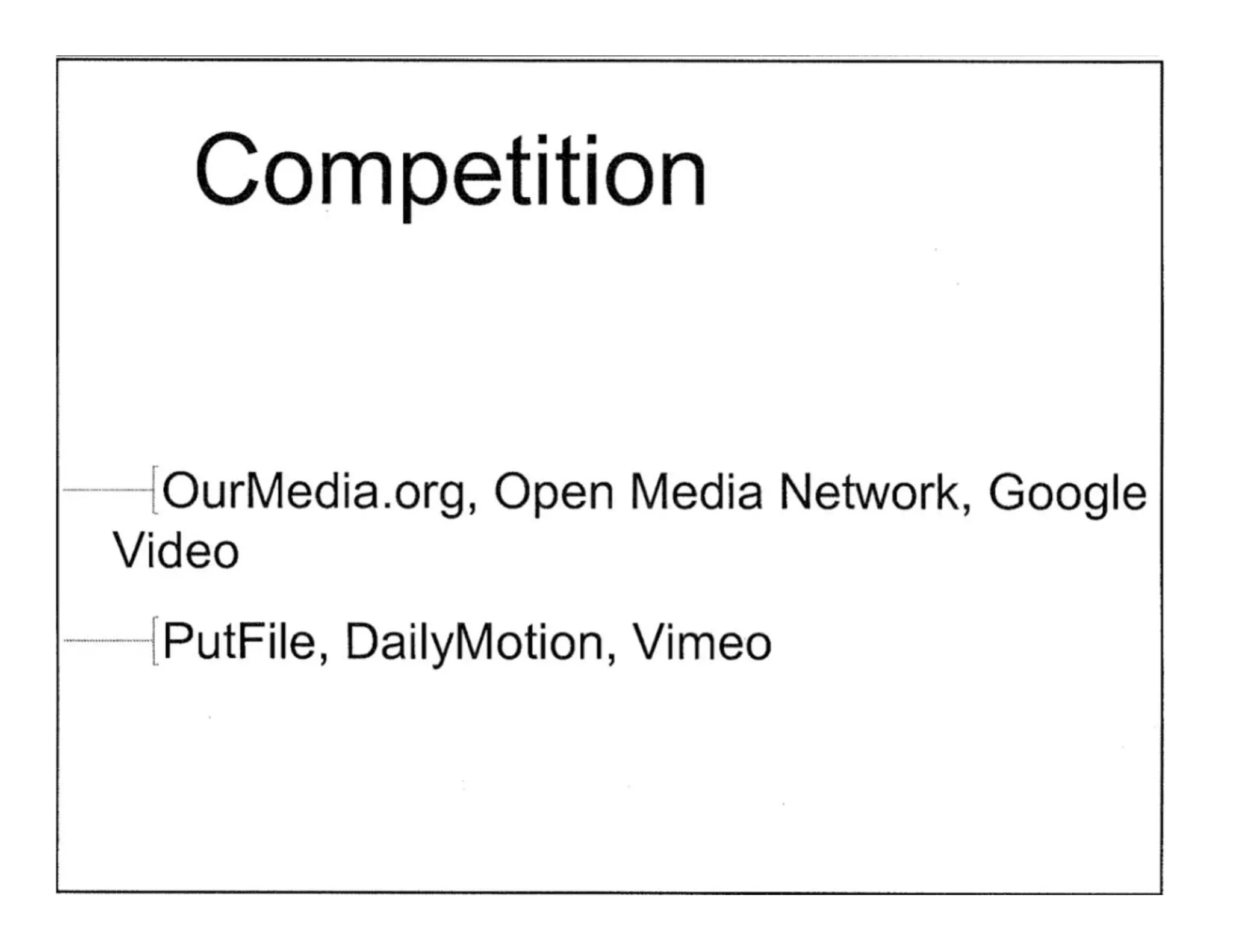
Competitors listed:

  1. OurMedia.org
  2. Open Media Network
  3. Google Video
  4. PutFile
  5. DailyMotion
  6. Vimeo

What the deck provides:

  • A simple list of competitor names
  • No analysis of features, positioning, or capabilities
  • No comparison of user experience, technology, or business models
  • No assessment of competitive advantages or disadvantages

What the deck does NOT provide:

  • Competitive differentiation strategy
  • Barriers to entry or defensibility
  • Why YouTube wins vs. each competitor
  • Competitive moat or sustainable advantage
  • Market share estimates
  • Competitive threat assessment

Critical concern: Google Video

  • Google is a major threat (massive resources, existing user base, distribution)
  • Deserves deeper analysis than just being listed
  • No explanation of how YouTube competes against Google’s resources
  • No discussion of acquisition risk (which became reality)

Assessment:

  • Weakest section of the deck - Simply listing competitor names without analysis
  • Misses opportunity to articulate differentiation - No explanation of why YouTube’s UX, community, or technology is superior
  • Ignores Google threat - Google Video could have crushed YouTube with resources; no strategy discussed
  • Red flag for Series A - Investors need to understand competitive moat and defensibility

Why this weakness didn’t kill the deal:
YouTube’s product experience was dramatically superior to competitors. The UX was so much better that differentiation was obvious to anyone who tried it. The deck didn’t need to explain why YouTube won—the product spoke for itself.

Effectiveness: Poor. However, YouTube’s actual competitive advantage (superior UX, viral growth loops, community features) was so strong that the lack of articulation in the deck didn’t matter.

Team

Slide 9: Team (Three Founders)

Steve Chen

  • Background: Recruited by Max Levchin as one of PayPal’s first engineers
  • Education: University of Illinois, Computer Science
  • Role: (Not specified in deck)
  • Credibility: PayPal engineering experience; strong technical foundation

Chad Hurley

  • Background: PayPal’s first designer
  • Responsibilities: Responsible for PayPal logo, main features, and design
  • Role: (Not specified in deck, but clearly design/product)
  • Credibility: Proven design leadership at PayPal; created iconic logo

Jawed Karim

  • Background: CS Graduate student at Stanford; recruited by Max Levchin as one of PayPal’s first engineers
  • Education: University of Illinois, Computer Science
  • Role: (Not specified in deck)
  • Credibility: Stanford + PayPal experience; strong technical background

Team assessment:

Strengths:

  • PayPal pedigree - All three have direct experience at a successful, high-growth company
  • Max Levchin endorsement - Two founders recruited by PayPal co-founder (powerful signal)
  • Technical depth - Multiple CS graduates; engineering-focused team
  • Design expertise - Chad Hurley’s design leadership at PayPal is valuable
  • Top schools - Stanford and University of Illinois represent strong technical education
  • Proven execution - PayPal experience demonstrates ability to build and scale

Weaknesses:

  • All technical founders - No business development, sales, or marketing expertise visible
  • No CEO/leadership clarity - Doesn’t specify who is CEO or organizational structure
  • No photos - Makes it harder for investors to remember/connect with founders
  • Incomplete team - Only 3 people listed; suggests very early stage
  • Missing business roles - No CFO, COO, VP Sales, or VP Marketing mentioned
  • Jawed Karim bio is confusing - Timeline unclear (Stanford grad student + PayPal engineer simultaneously?)

Why this team worked:

  • Product-focused founders - YouTube’s success was driven by superior product/UX, not sales/marketing
  • PayPal credibility - Investors trusted founders who had already built and scaled a successful company
  • Technical execution - The team’s engineering capability was sufficient to build the platform

Effectiveness: Strong team credentials with PayPal pedigree, but lacks business/go-to-market expertise. For a product-driven company in a viral market, this was acceptable.

Go-to-Market Strategy

Explicit GTM strategy: Not provided in the deck

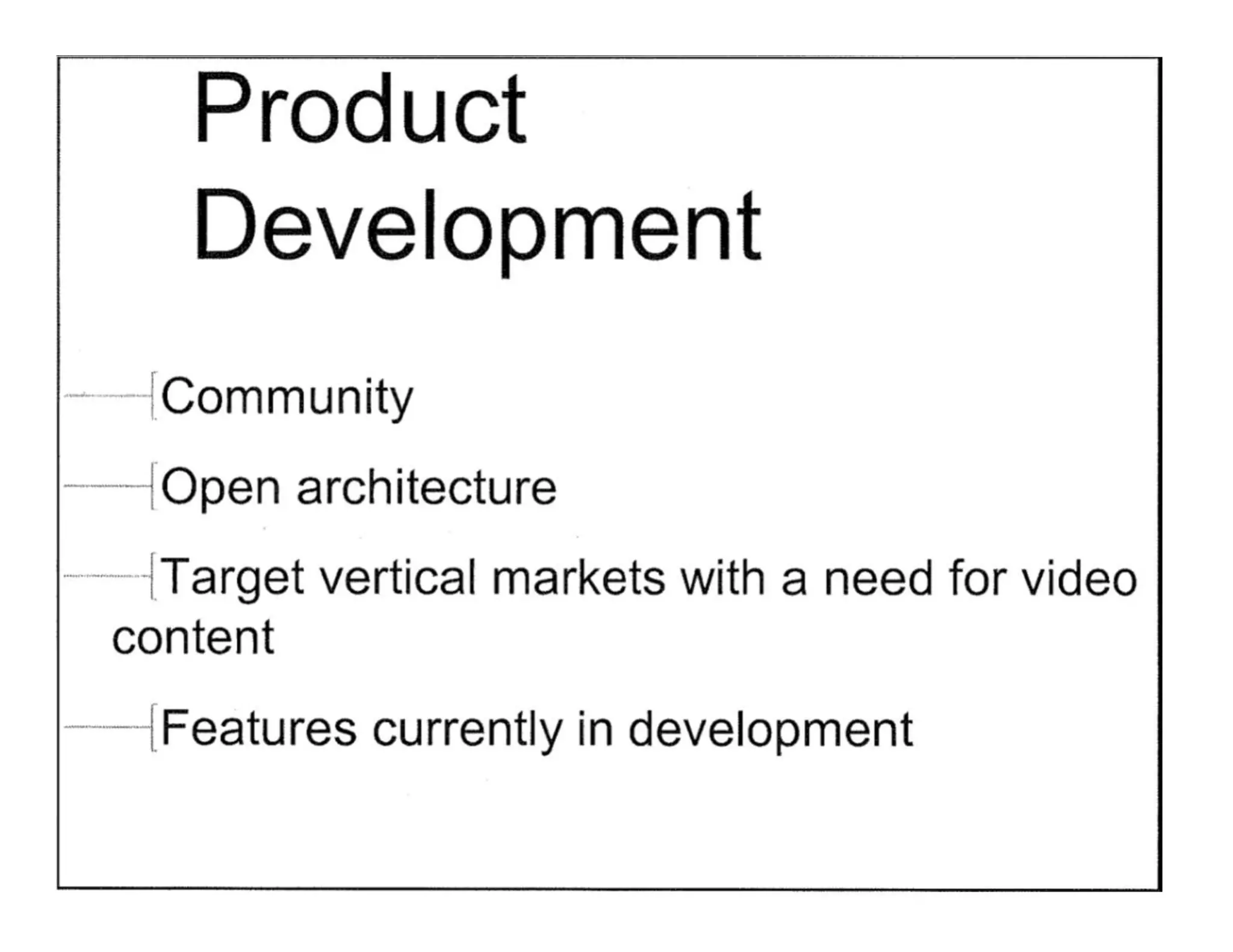
Implied GTM approach (from Slide 7: Product Development):

  • “Target vertical markets with a need for video content”
  • Suggests segmentation strategy beyond consumer
  • No specifics on which verticals, how to reach them, or sales strategy

What’s missing:

  • No discussion of user acquisition strategy
  • No mention of marketing channels (viral, paid, organic, partnerships)
  • No sales strategy for B2B (for-pay distribution channel)
  • No partnership strategy
  • No distribution partnerships mentioned
  • No PR/media strategy

Why this wasn’t a problem:
YouTube’s growth was organically viral. The product was so compelling that users naturally shared it. GTM strategy was less important than product quality and network effects. The deck’s focus on product development over go-to-market reflects this reality.

Effectiveness: Weak on explicit GTM, but YouTube’s viral nature made traditional go-to-market less critical.

The Ask

Explicit ask: Not shown in the 10 slides provided

Known facts:

  • Series A amount: $11.5M
  • Investors: Sequoia Capital (lead), Artis Capital Management
  • Valuation: Not disclosed in deck (estimated ~$20-30M post-money based on typical Series A multiples)

Likely use of funds (inferred from Slide 7: Product Development):

  • Engineering team expansion (product development)
  • Infrastructure/CDN costs (serving millions of viewers)
  • Sales/marketing (targeting vertical markets)
  • Operations and overhead

What’s missing:

  • No explicit breakdown of use of funds
  • No hiring plan or team expansion roadmap
  • No infrastructure investment plan
  • No marketing budget allocation
  • No runway/burn rate discussion

Effectiveness: The ask itself is not shown, but the $11.5M raise was clearly sufficient to fund YouTube’s growth through acquisition.

Investor Deep Dive

Executive summary, strengths & red flags

Executive Summary

YouTube's Series A pitch deck is a masterclass in **problem-solution clarity** paired with **minimal quantitative validation**. The deck elegantly articulates why user-generated video distribution was broken (technical barriers, format fragmentation, isolation) and how YouTube's Flash Video encoding + community platform solved it. Despite lacking specific user metrics, revenue projections, or detailed competitive differentiation, the pitch succeeded because the product's explosive growth was already undeniable by late 2005—just 5 months post-launch. The combination of a proven PayPal-alumni founding team, perfect market timing (broadband adoption + cheap video capture), and obvious product-market fit made this one of the most successful Series A investments in tech history (143x return for investors).

Key Strengths

5 identified

1

Problem-Solution Clarity (Slides 3-4)

The deck identifies four specific, technical barriers to video sharing and proposes an elegant solution that directly addresses each one. The mapping is clear: file size → infrastructure, format fr...

2

Founding Team Credibility (Slide 9)

All three founders have direct PayPal experience, recruited by Max Levchin (PayPal co-founder). This is a massive credibility signal in 2005—PayPal was the gold standard for startup execution.

3

Macro Tailwinds Identification (Slide 5)

The deck correctly identifies two critical enabling factors: (1) affordable digital video capture, and (2) broadband adoption at critical mass. These are real, verifiable trends that create the mar...

4

Rapid Product-Market Fit (Slide 10)

YouTube achieved "dominant player" status in ~5 months post-launch. This is extraordinary velocity and suggests undeniable product-market fit.

5

Memorable Brand & Positioning (Slide 1)

"Broadcast Yourself" is a simple, aspirational, ownable tagline that captures the core value proposition in two words. It's democratizing, empowering, and easy to remember.

More Pitch Decks To Study

Compare structure, fundraising context, and investor-facing story across similar startup decks.