Compare your deck to Sorare

Compare Your Deck

Sorare Pitch Deck (2020)

Gaming
Stage: Series A
Raised: $4M
Year: 2020
Slides: 22
Outcome: Valued at $4.3B after Series B (2021)

Pitch Deck

1 / 22
Sorare pitch deck - Opening: Strong brand positioning and hero image
Click to expand

Deck Analysis

This deck for Sorare (Series A, 2020) presents a concise, visually-driven pitch for a blockchain-based fantasy-soccer game built around digital collectible player cards. It frames a clear consumer problem (lack of true ownership/tradability for digital goods), shows product mechanics and early traction (licenses, club partnerships, and sales), and uses strong visual branding and reputable investor logos to signal credibility. Notable: the deck balances technical novelty (blockchain/NFTs) with mainstream game UX, and it helped Sorare scale to major valuations after subsequent rounds.

Opening: Strong brand positioning and hero image

Opening: Strong brand positioning and hero image

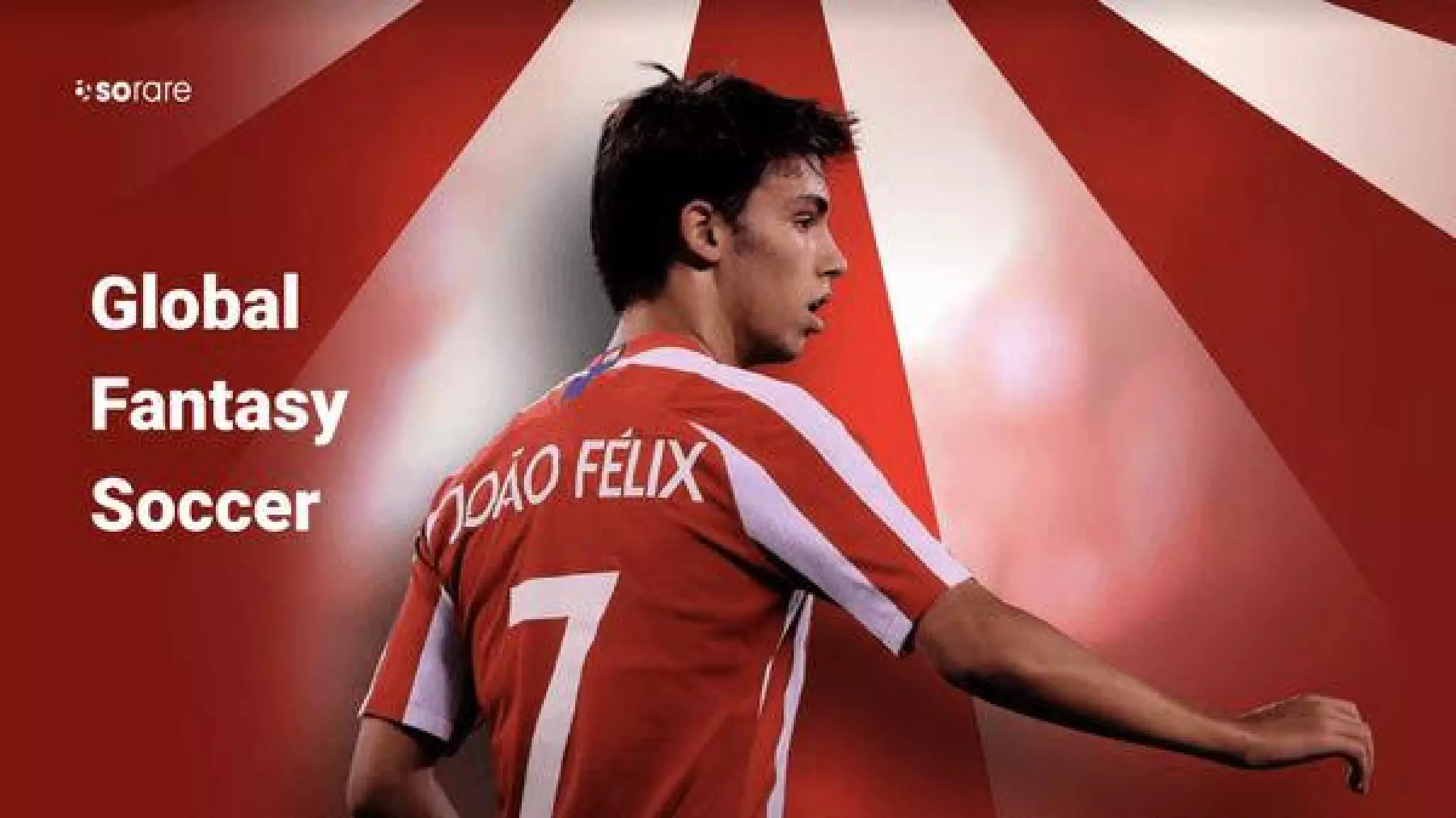
The very first slide (cover) uses a striking hero photo of a well-known player and a bold, simple headline — “Global Fantasy Soccer.” This instantly tells the audience who the product is for (soccer fans) and positions the company as global and mainstream, not niche blockchain jargon. The aesthetic is professional and sports-centric, which helps the deck appeal to both investors and potential licensing partners.

The slide’s simplicity is effective: no clutter, clear logo placement, and emotional imagery that connects to the target user. Founders can learn how an opening visual can set tone and audience expectations — use one clear message and an evocative image rather than trying to say everything up front.

Key Takeaway: Lead with a single, emotionally resonant visual and a concise tagline that immediately communicates your target market and product identity.
Problem framing: showing why digital goods fail users

Problem framing: showing why digital goods fail users

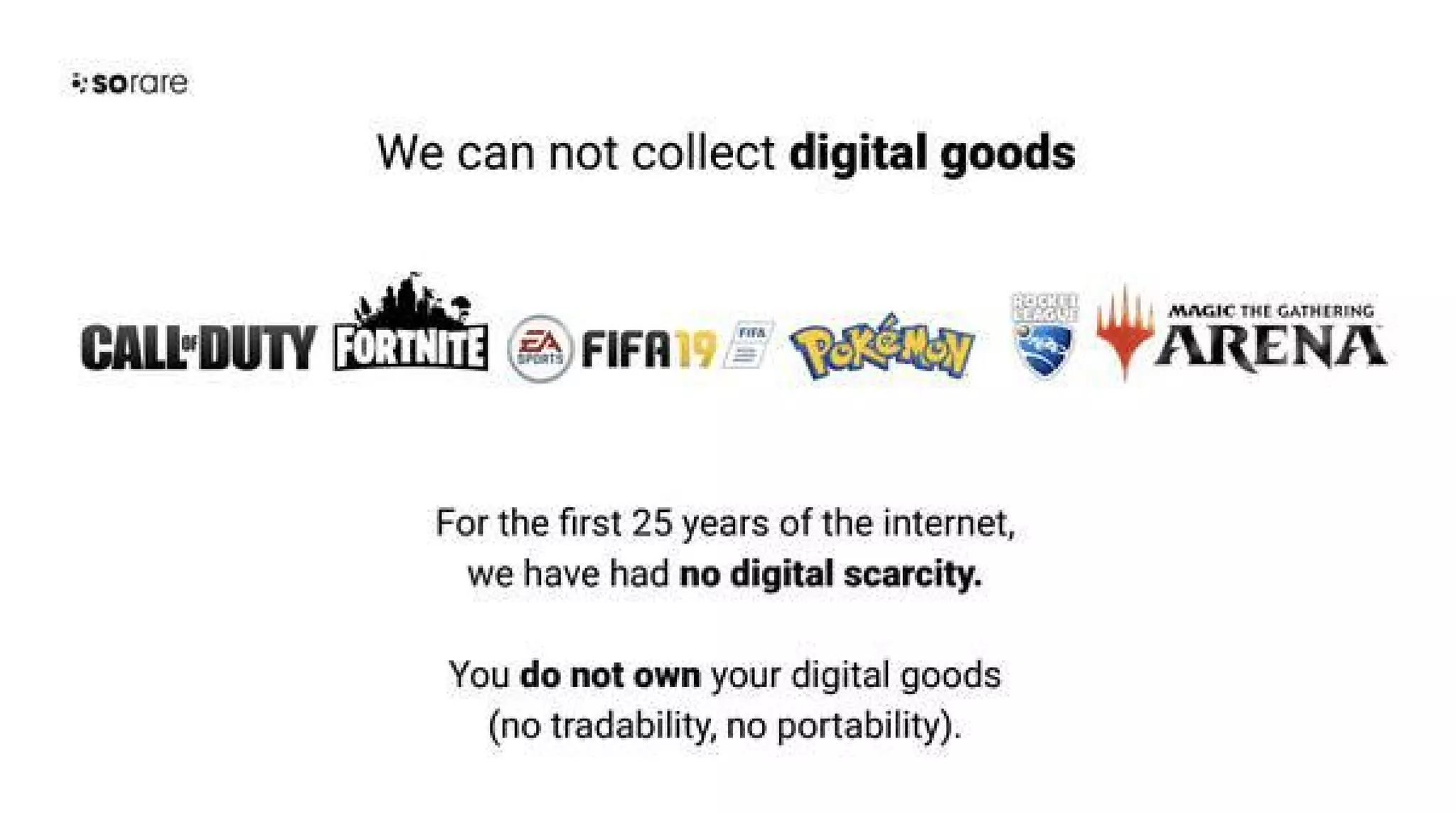
Slide 3 frames the problem clearly: mainstream digital goods (games like FIFA, Fortnite, etc.) offer no real ownership — no tradability or portability. The slide uses familiar logos to anchor the problem in recognizable examples and then states the core pain point: "You do not own your digital goods." The approach makes an abstract blockchain benefit concrete for a broad audience by contrasting expectations (collectibles) with reality (vendor-locked assets).

This is an instructive example of problem-first storytelling: start with user pain and industry context before jumping into technology. Founders should model this slide: use well-known comparators, state the pain in plain language, and avoid technical jargon when describing why existing solutions fall short.

Key Takeaway: Frame the opportunity by linking an emotional consumer pain to widely known examples — make the problem obvious before presenting your technical solution.
Market sizing: quantify the upside with simple buckets

Market sizing: quantify the upside with simple buckets

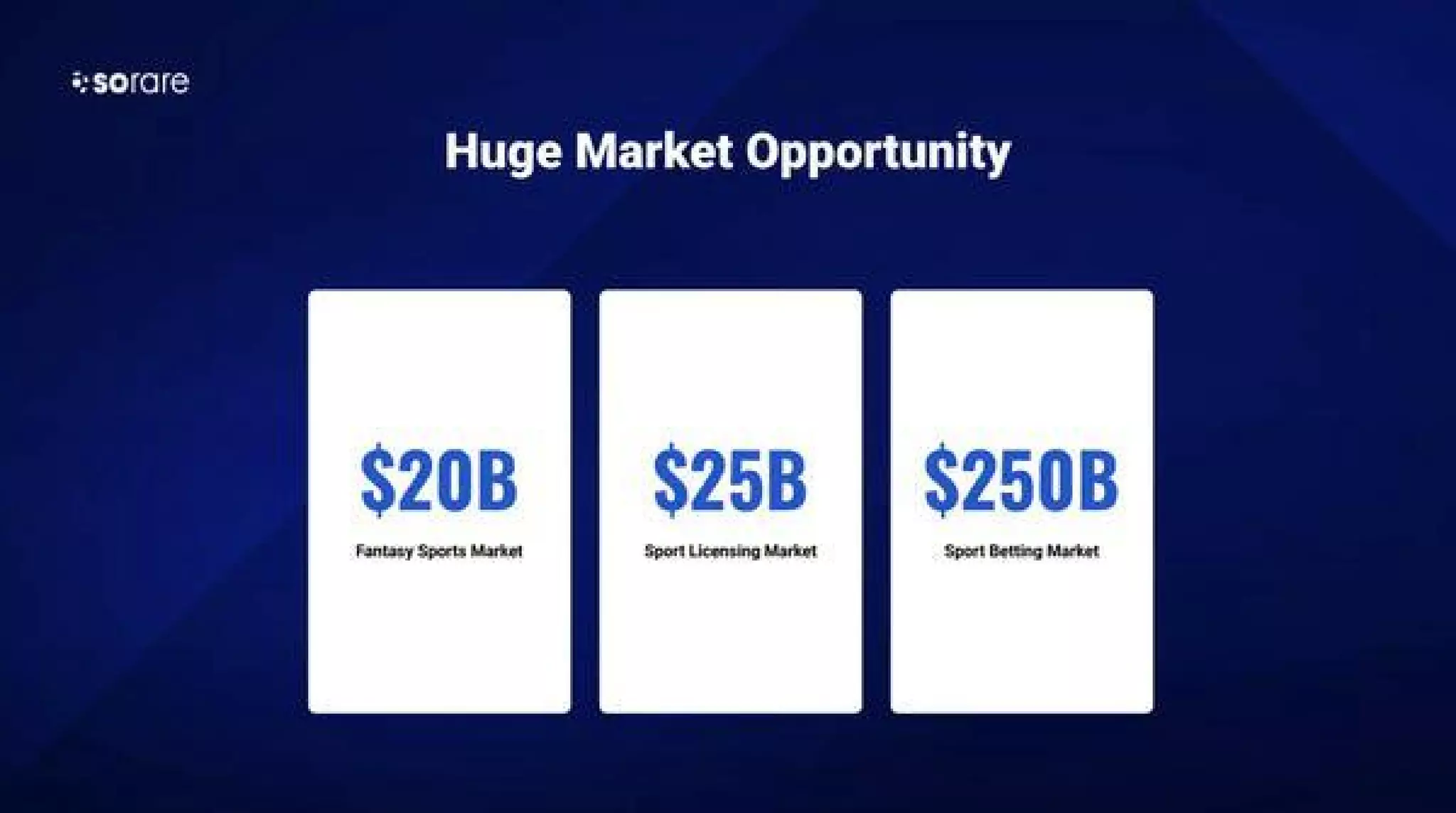
The "Huge Market Opportunity" slide (slide 7) lists clear market buckets ($20B fantasy sports, $25B sport licensing, $250B sports betting) to communicate large TAM and relevant adjacent markets. Using three large, round numbers helps investors quickly understand why the category can support a substantial business. The dark background with high-contrast numbers makes the figures the visual focal point.

This slide avoids overstating precision and instead chooses plausible, segmented markets that map to the product’s use cases (fantasy mechanics, licensing partnerships, and betting adjacencies). Founders should emulate the clarity: present segmented TAMs tied to your business model instead of a single, overreaching number that’s hard to justify.

Key Takeaway: Present TAM as clear, segmented opportunity buckets tied directly to how your product monetizes and scales.
Product: simple, repeatable weekly game loop

Product: simple, repeatable weekly game loop

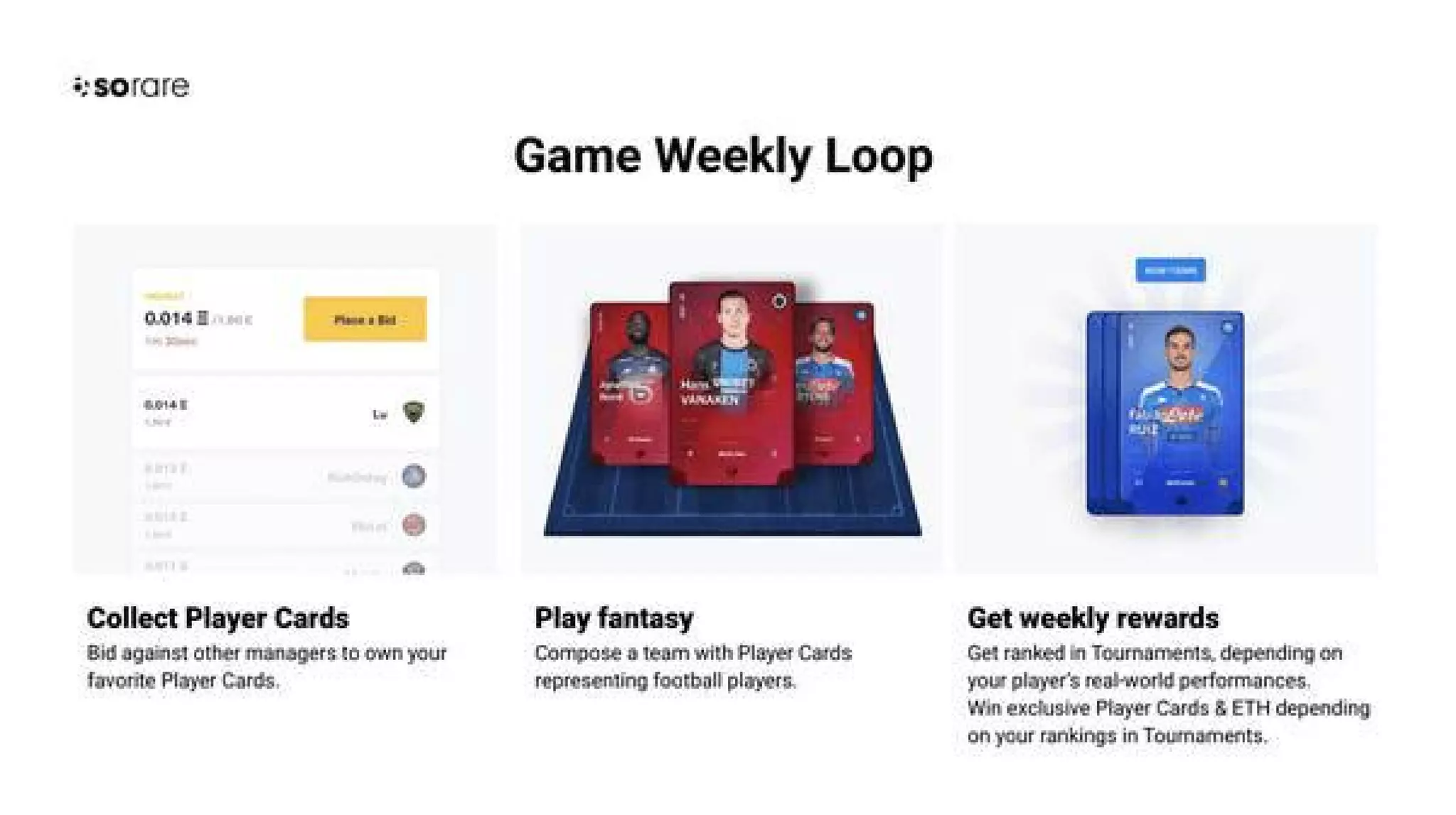
Slide 6 lays out the product mechanics in three steps: collect player cards, play fantasy matches, and earn weekly rewards. This describes a tight, repeatable user loop that drives engagement and secondary-market activity (collecting + competition + rewards). The visual cards and minimal copy make the mechanics easy to grasp for both gamers and non-gamers, which is critical when introducing blockchain-enabled features to mainstream users.

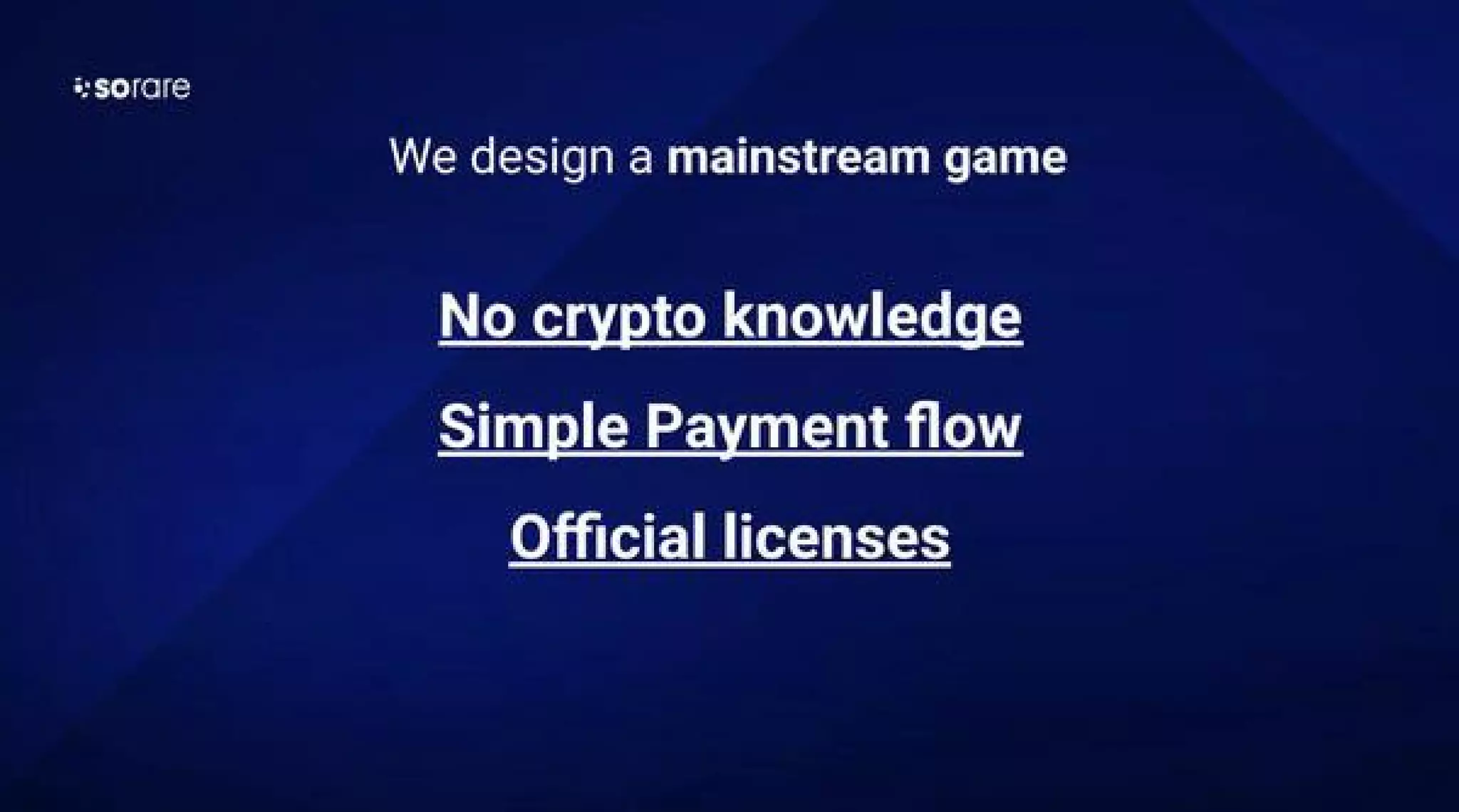
The emphasis on a straightforward user flow — no crypto knowledge required, intuitive payments, official licenses — is a deliberate product-to-market fit decision. Founders should ensure their product slides show the end-to-end user journey and highlight how retention is driven (weekly cadence, rewards), not just the underlying tech.

Key Takeaway: Demonstrate a clear, repeatable user loop with visuals and focus on frictionless onboarding so non-technical users can engage immediately.
Trust & moat: licenses and club partnerships

Trust & moat: licenses and club partnerships

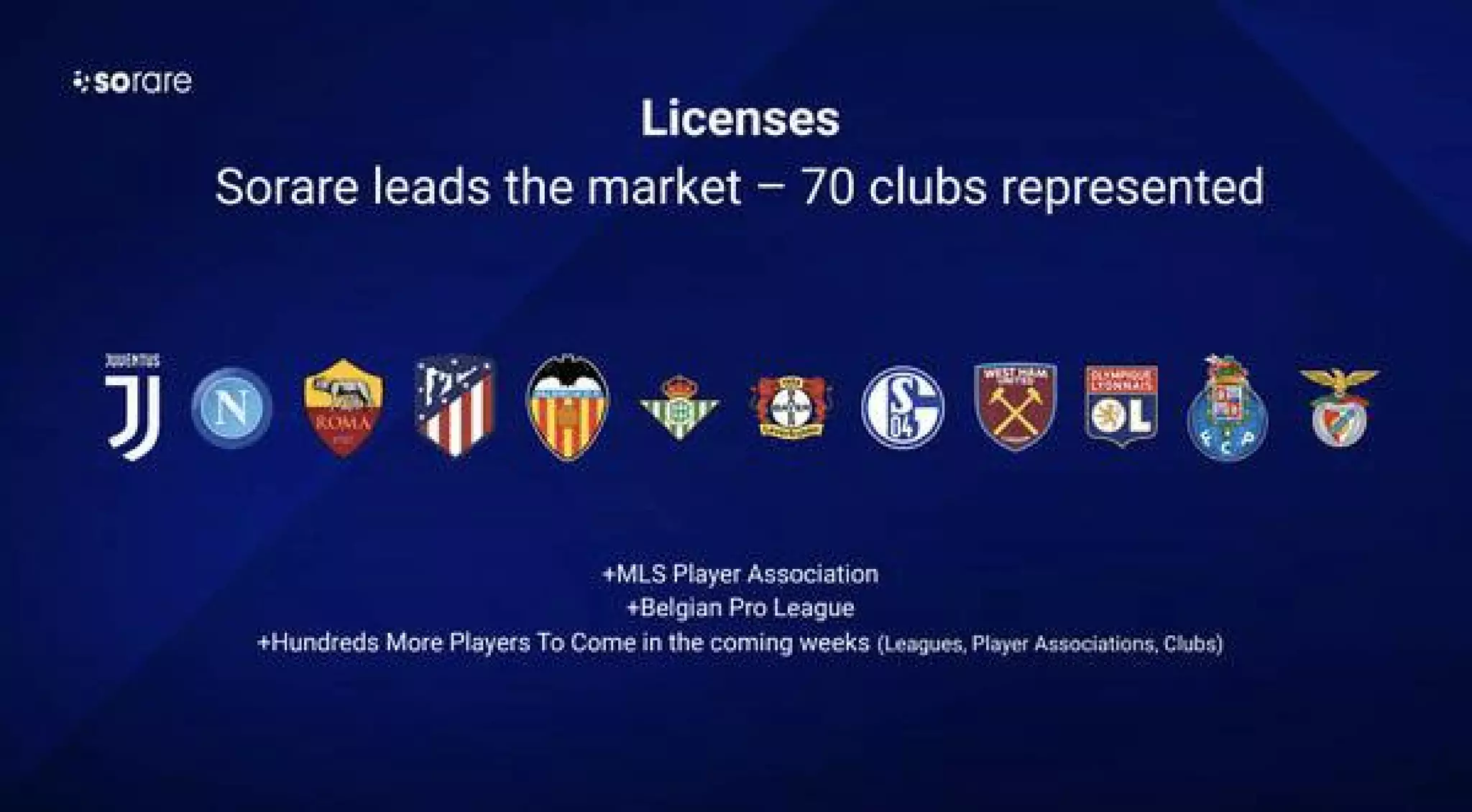
Slide 11 showcases Sorare’s licensing traction — branded club logos and the claim of 70 clubs represented. For a platform dependent on real-world players and teams, these partnerships function as both product differentiation and distribution channels. Featuring recognizable club badges and calling out leagues/associations signals legitimacy to investors and helps reduce partnership risk in the eyes of licensors.

This slide is a good lesson in social proof: when your product relies on partnerships, make them prominent. It also implies a defensible moat — exclusive or early licensing relationships that competitors face high barriers to replicate — and reinforces the narrative that Sorare is building an industry-standard product.

Key Takeaway: Showcase real-world partnerships and logos early — they provide credibility, customer acquisition channels, and a defensible moat.
Traction: visualizing rapid revenue and adoption

Traction: visualizing rapid revenue and adoption

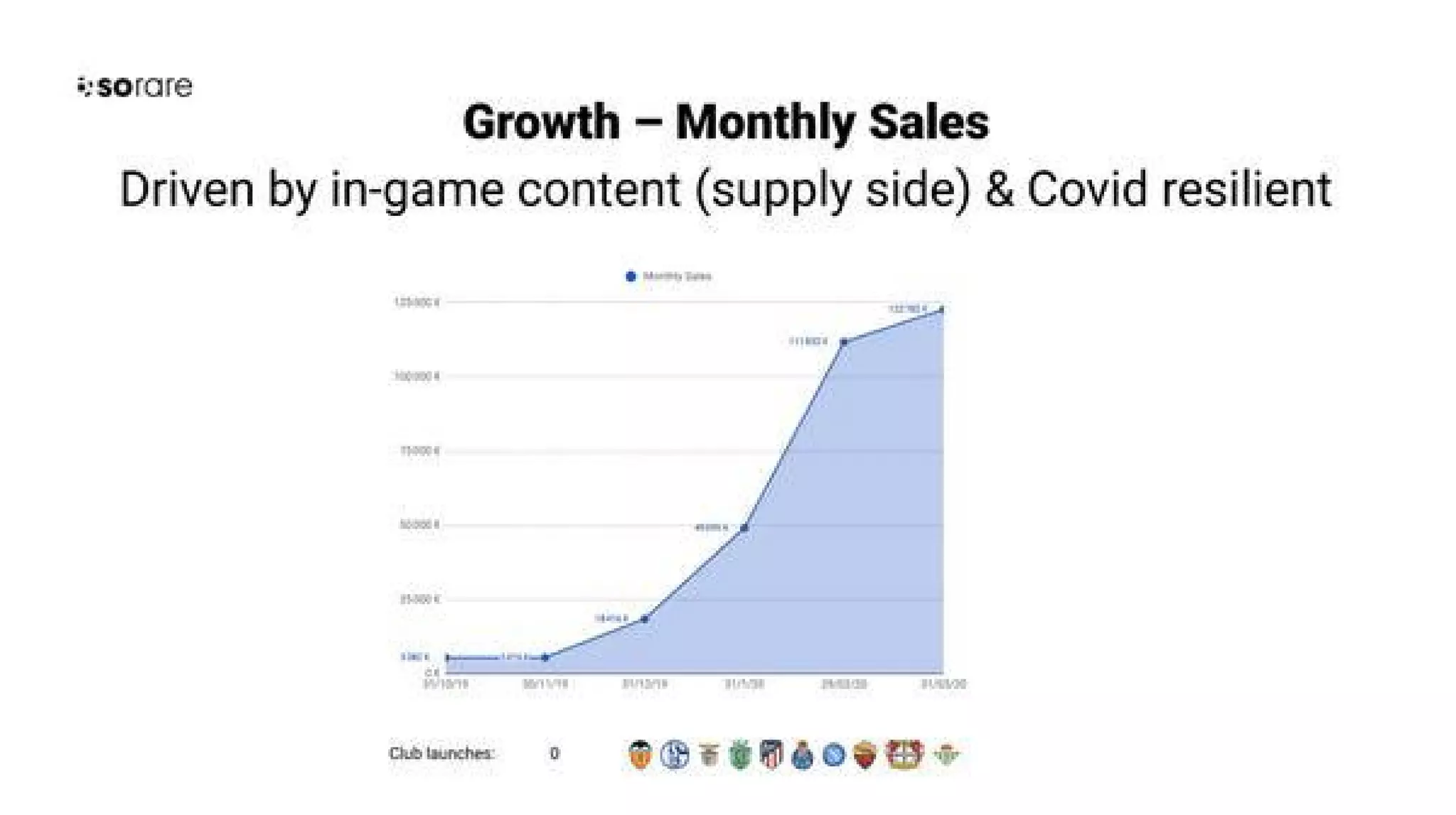
Slide 10 contains a monthly sales growth chart that communicates steep, recent revenue acceleration and club launches over time. The area chart and the annotated club icons give viewers a sense of momentum and correlation between partnership rollouts and sales spikes. The slide also supports claims elsewhere in the deck (e.g., €1M sales) with a visual trend rather than raw bullet points.

For investors the visual trajectory matters more than a single month’s number — it suggests product-market fit and scalable demand. Founders should use simple charts to show growth inflection points, annotate key drivers (partnerships, launches), and avoid clutter so the trend is unmistakable.

Key Takeaway: Use an annotated growth chart to make momentum tangible — highlight catalysts that explain step-changes in traction.
Team: relevant experience and credibility

Team: relevant experience and credibility

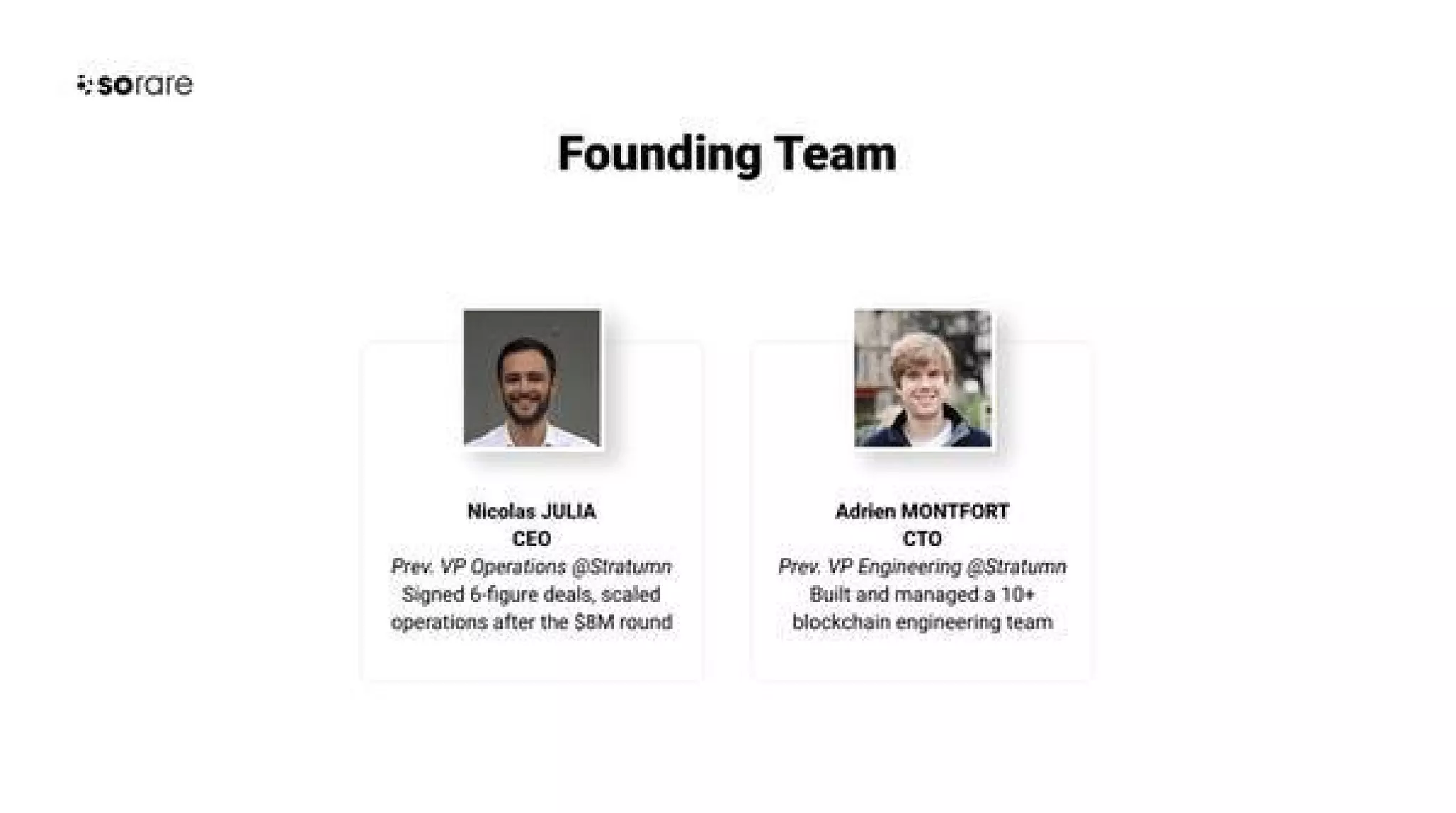
Slide 2 profiles the founding team with photos and concise bios: CEO and CTO with prior VP roles, blockchain engineering experience, and operational credibility. The slide balances technical and business strengths, which is essential for a product that sits at the intersection of gaming, licensing, and blockchain. The brief bios emphasize outcomes (deals signed, scaled ops, managed engineering teams) rather than long resumes.

Investors bet on teams — and this slide signals the right mix of executional experience and domain knowledge. Founders putting together team slides should prioritize short, outcome-focused blurbs, clear roles (CEO/CTO), and evidence of prior, relevant success that maps to the current opportunity.

Key Takeaway: Prioritize concise bios that highlight past outcomes relevant to your current business — show why this team can execute.
Funding & investor signal: credible backers accelerate trust

Funding & investor signal: credible backers accelerate trust

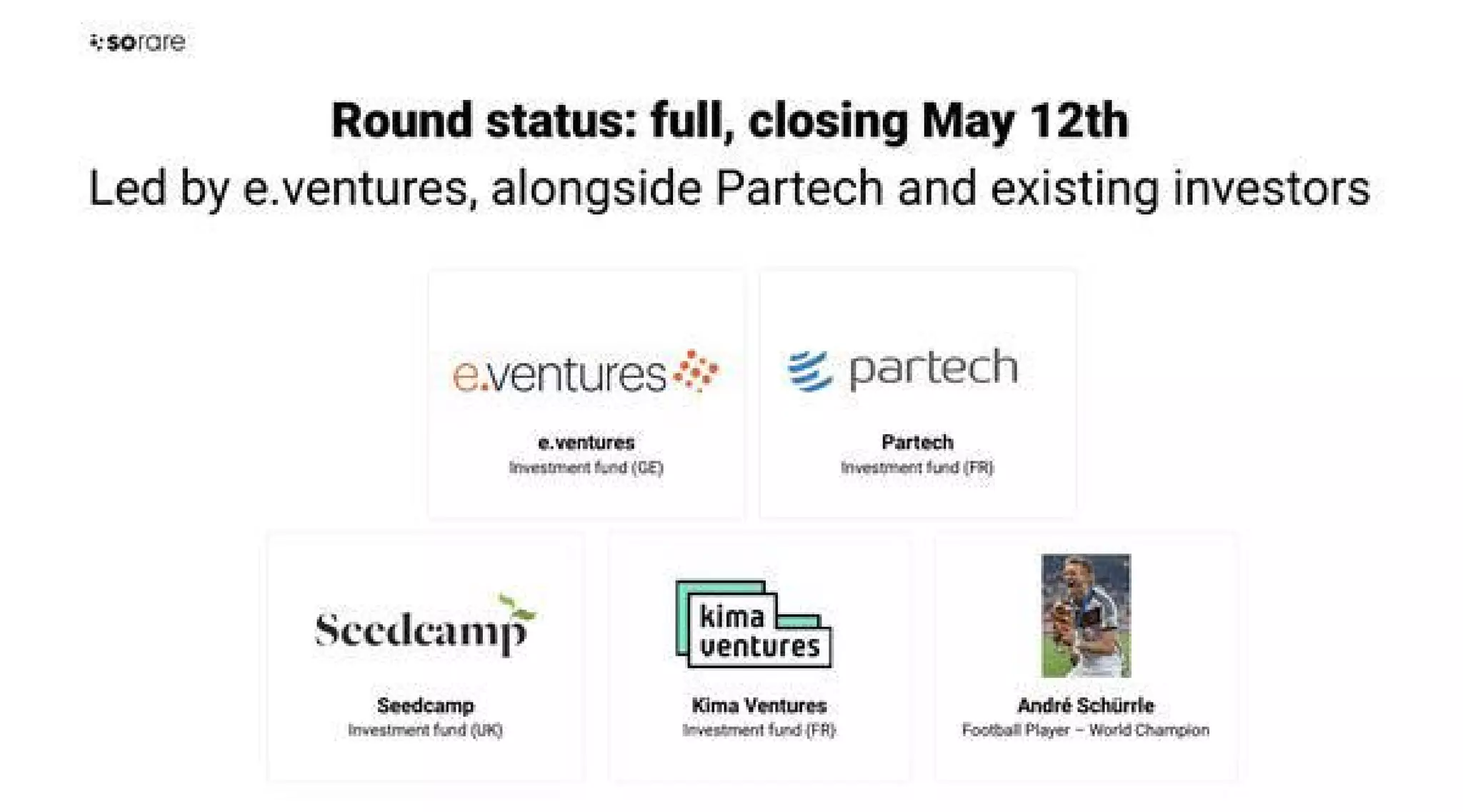
Slide 18 lists lead and participating investors (e.ventures, Partech, Seedcamp, Kima Ventures) and frames the round as 'full' and closing on a date. The inclusion of well-known VC logos provides immediate validation and helps with future recruiting, business development, and licensing conversations. For startups, showcasing investor quality is often as persuasive as top-line traction because it signals due diligence by sophisticated firms.

This slide also communicates fundraising readiness and scarcity (closing date), which creates urgency among prospective investors reading the deck. Founders should include clear investor logos and the round status to translate back-channel credibility into front-page validation, but avoid making fundraising the primary narrative — it should support product and traction claims.

Key Takeaway: Display reputable investor logos and round status to convey validation and momentum — use timing to create a sense of urgency if appropriate.

Conclusion: Key Lessons

Sorare’s deck is a strong example of clear problem framing, simple product storytelling, and credibility-building through partnerships and investors. Strengths include a bold opening, an easily understood user loop, concrete traction visuals, and prominent licensing/social proof — all laid out with minimal text and high-impact visuals. The deck carefully balances technical novelty (blockchain ownership) with mainstream UX and business fundamentals, making the opportunity accessible to both gaming and generalist investors.

Actionable advice for founders: (1) lead with an emotional hook and one-line positioning; (2) frame the problem with widely understood comparators before describing technology; (3) show the repeatable user loop and retention mechanics; (4) use logos/partnerships as social proof; (5) present traction with simple, annotated charts that highlight inflection points. Keep slides visual, claims backed by one or two metrics, and bios outcome-focused — this combination communicates vision, execution, and credibility effectively.

Full Deck Analysis

11 sections

Overview

Company: Sorare
Round: Series A ($4M)
Year: 2020
Outcome: Valued at $4.3B after Series B (2021)

Executive Summary

Sorare pitched a mainstream, blockchain-native fantasy soccer game where licensed player “cards” are ERC‑721 NFTs that users buy, trade and use in weekly fantasy tournaments. The deck pairs clear product mechanics (collect → play → rewards), strong early traction (€1M sales, ~70–76 clubs signed), and meaningful league/club licensing to argue for rapid adoption and a large sports/gaming market opportunity.

Problem Statement

  • Digital goods today lack true ownership, tradability and scarcity (Slide 3). The deck frames the historic internet era as one of “no digital scarcity” and says gamers/fans do not truly own in‑game items (no portability, no tradability).
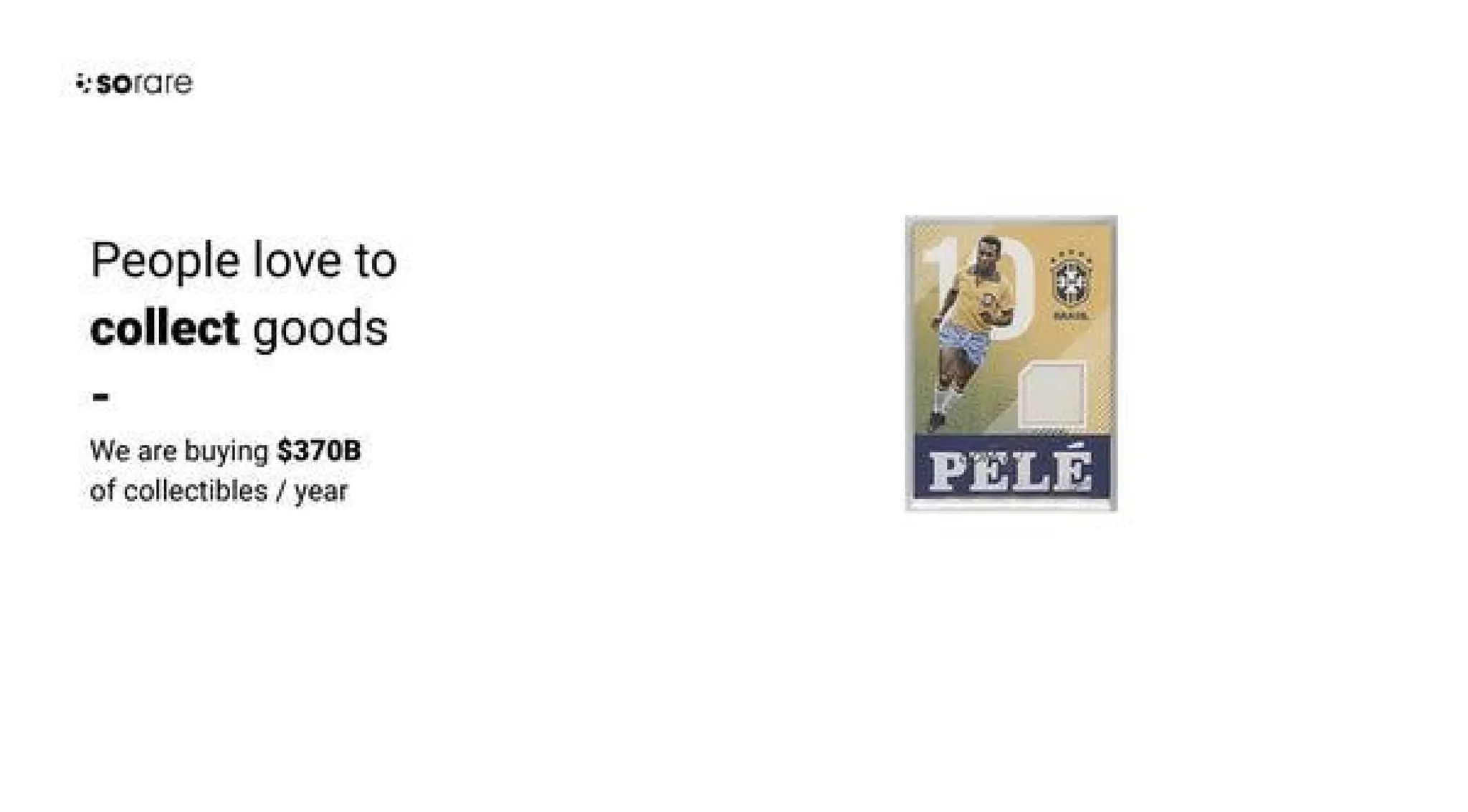
  • Traditional collectibles markets (physical trading cards, memorabilia) are large but fragmented and not digitally native (Slide 5: “People love to collect goods — We are buying $370B of collectibles / year”).

Solution

  • Sorare mints scarce, tradable digital player cards as NFTs usable in a fantasy game (Slides 6 & 22).
  • Core product loop: Collect player cards (auction/marketplace), compose a fantasy team, play weekly tournaments and win rewards (Slide 6).
  • UX focus: designed for mainstream players with “No crypto knowledge”, “Simple payment flow” and “Official licenses” (Slide 9).
  • Underlying tech: ERC‑721 / Ethereum NFTs to create digital scarcity, ownership and secondary market royalties (Slides 4 & 22).

Market Opportunity

  • Explicit market figures shown in the deck (Slide 7):
    • Fantasy Sports Market: $20B
    • Sport Licensing Market: $25B
    • Sports Betting Market: $250B
  • Collectibles market cited: $370B per year in purchases (Slide 5).
  • These numbers position a large TAM (sports + collectibles + betting overlap) though the deck does not explicitly break TAM→SAM→SOM.

Business Model

  • Primary revenue from sales of digital player cards (auctions / fixed sales) and in‑game purchases (Slide 6: “Collect Player Cards — Bid against other managers”).
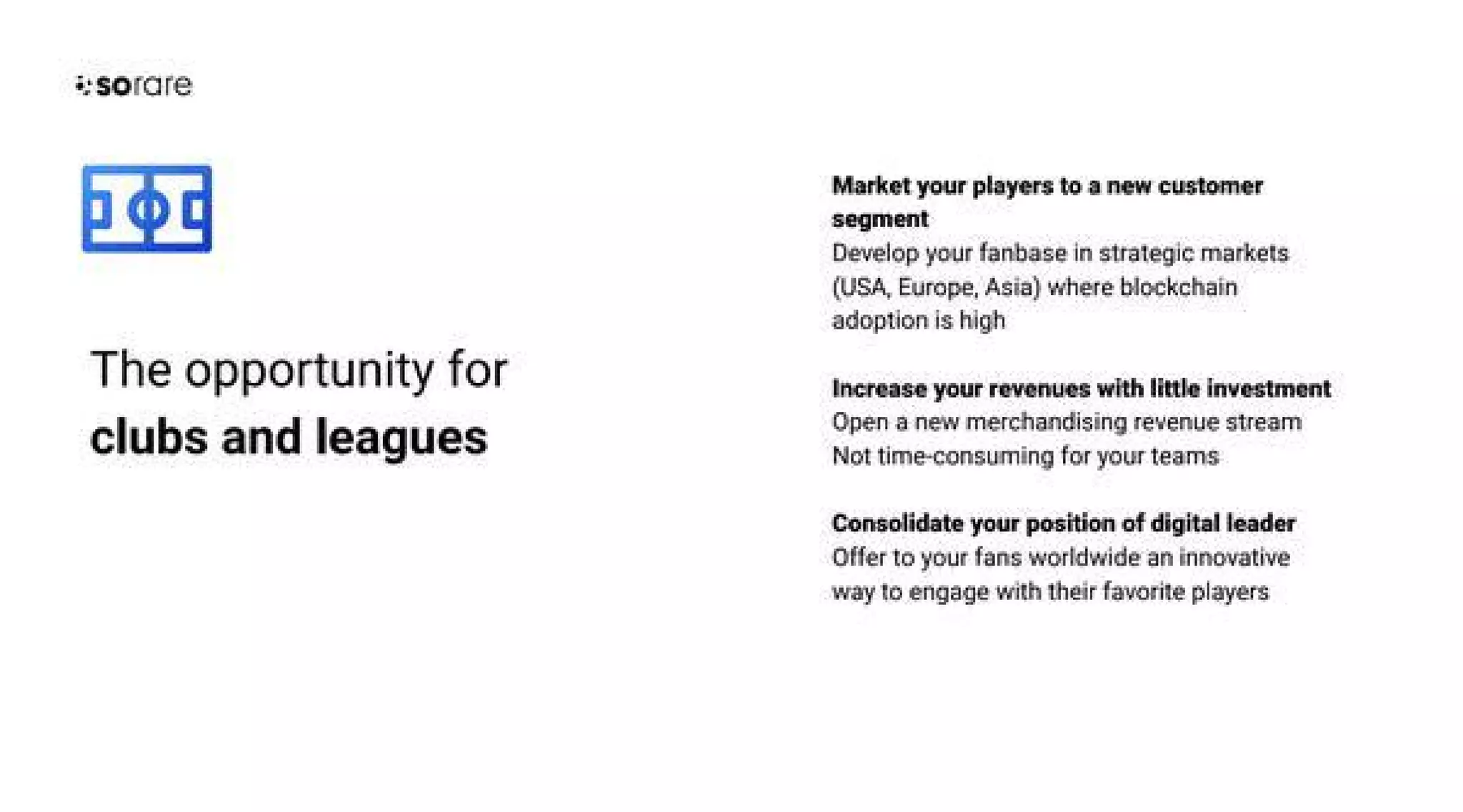
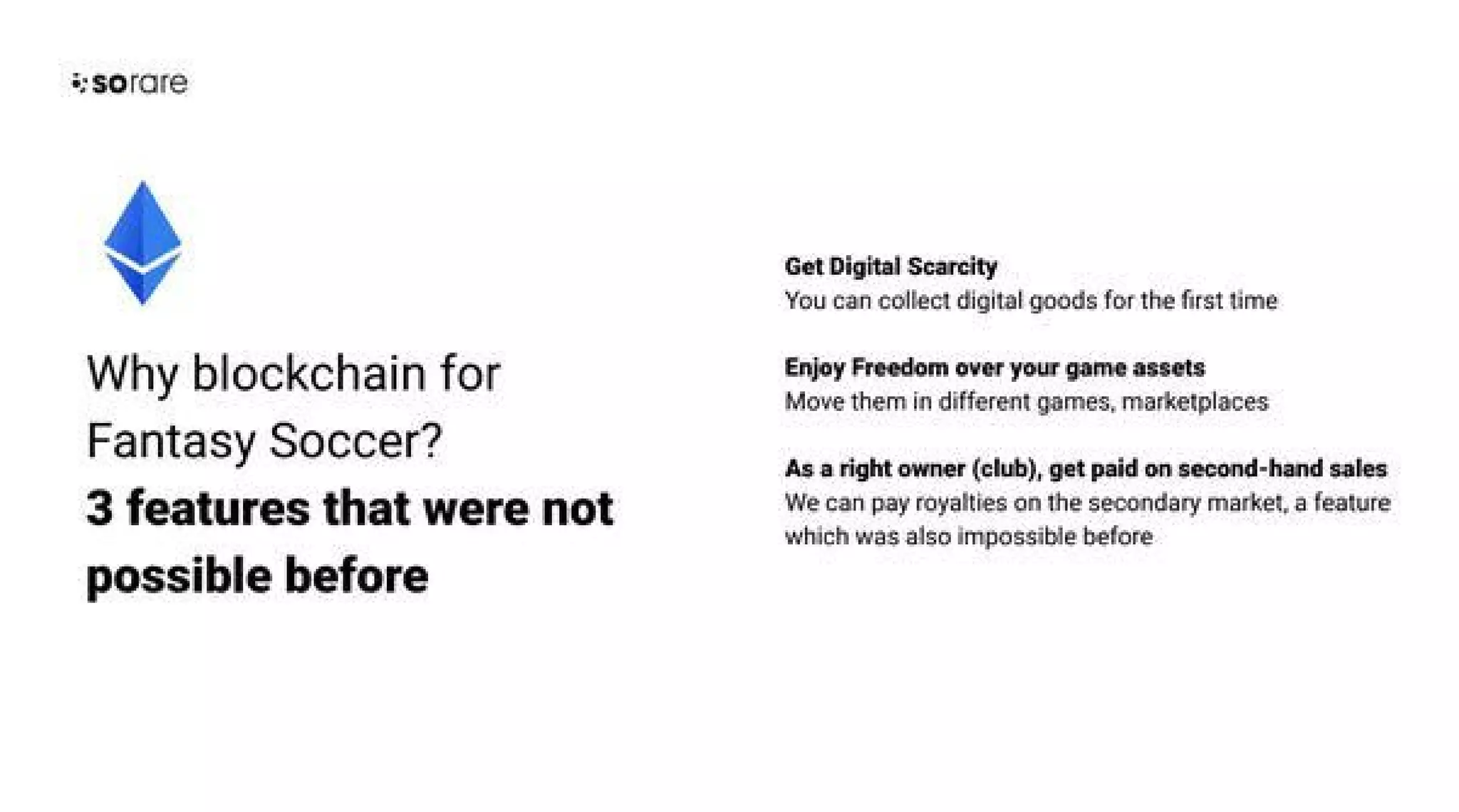
  • Secondary revenue via marketplace transaction fees and possible club royalties on secondary sales (appendix Slide 22 notes clubs can be paid on second‑hand sales).
  • They also monetize engagement through tournaments with ETH / exclusive cards as rewards that drive secondary market activity (Slide 6).
  • No explicit unit economics, CAC/LTV or margin breakdown is provided in the deck.

Traction & Metrics

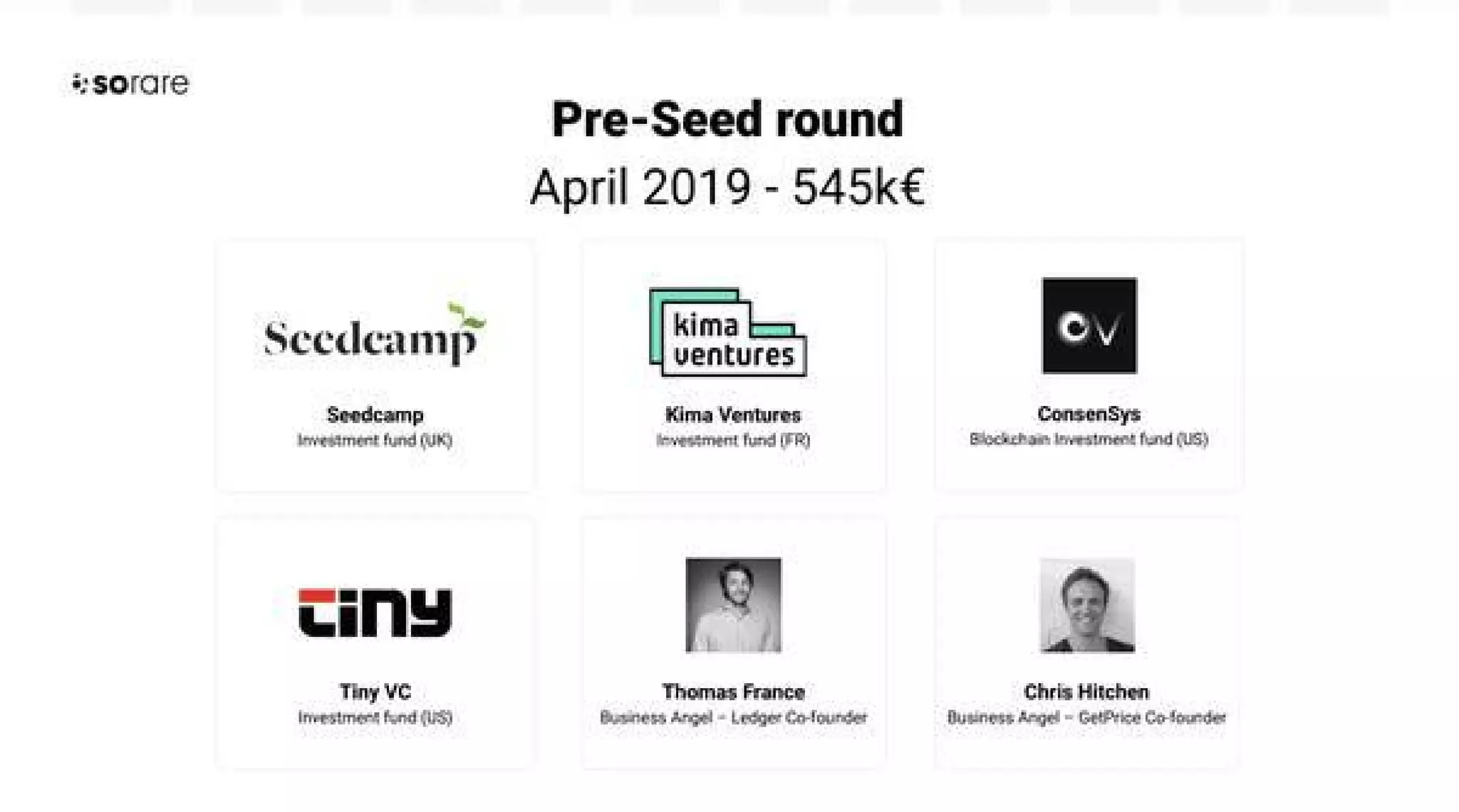
  • Pre‑seed April 2019: €545k raised (Slide 14).
  • Early traction claims:
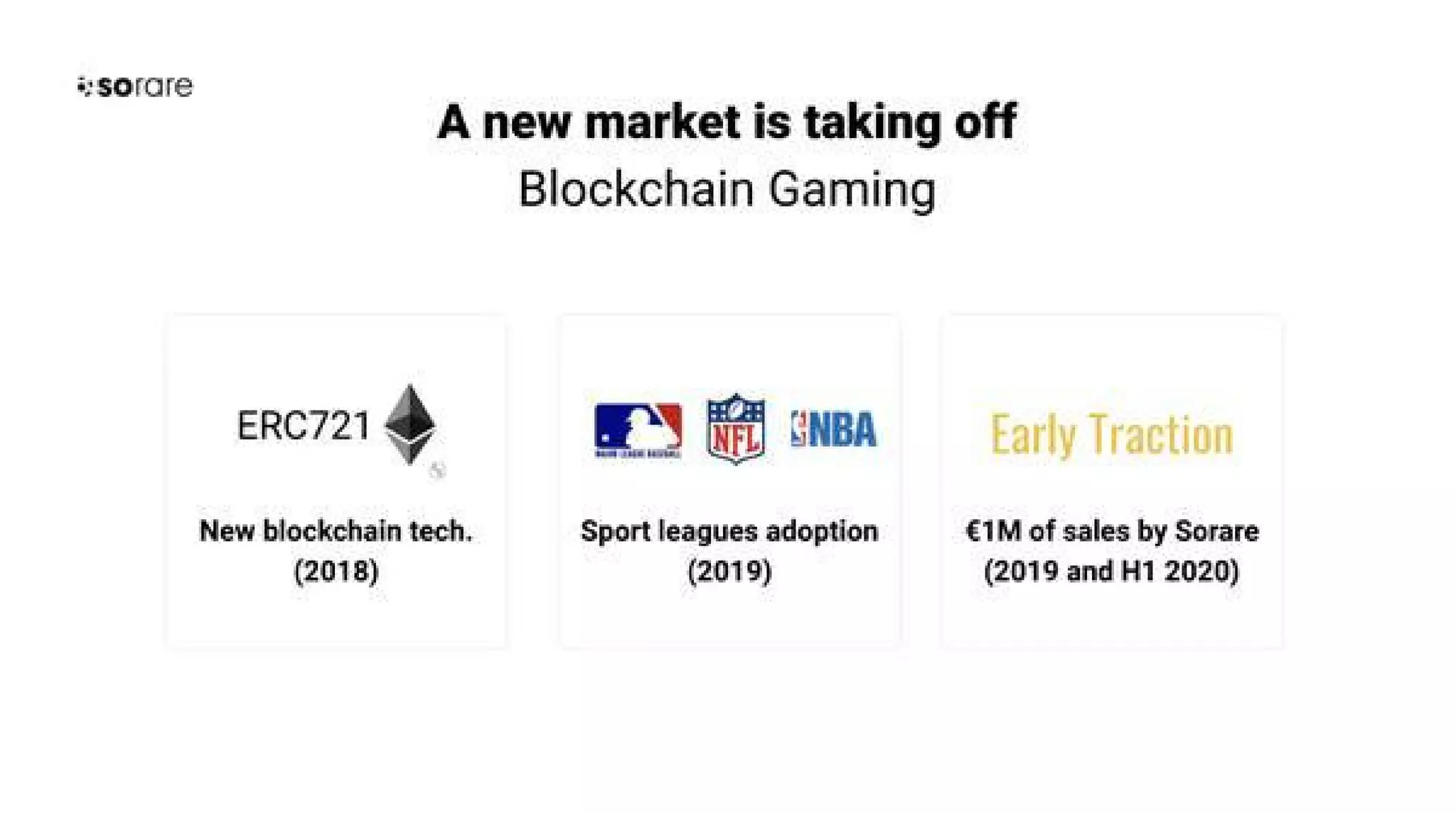
    • €1M total sales by Sorare (2019 and H1 2020) (Slide 4 & Slide 16).
    • 76 football clubs signed / ~70 clubs represented (Slides 12 & 16).
    • Monthly sales growth chart showing a sharp revenue ramp over 2019–H1 2020 (Slide 11) — visual demonstrates steep adoption but exact monthly numbers are not tabulated on the slide.
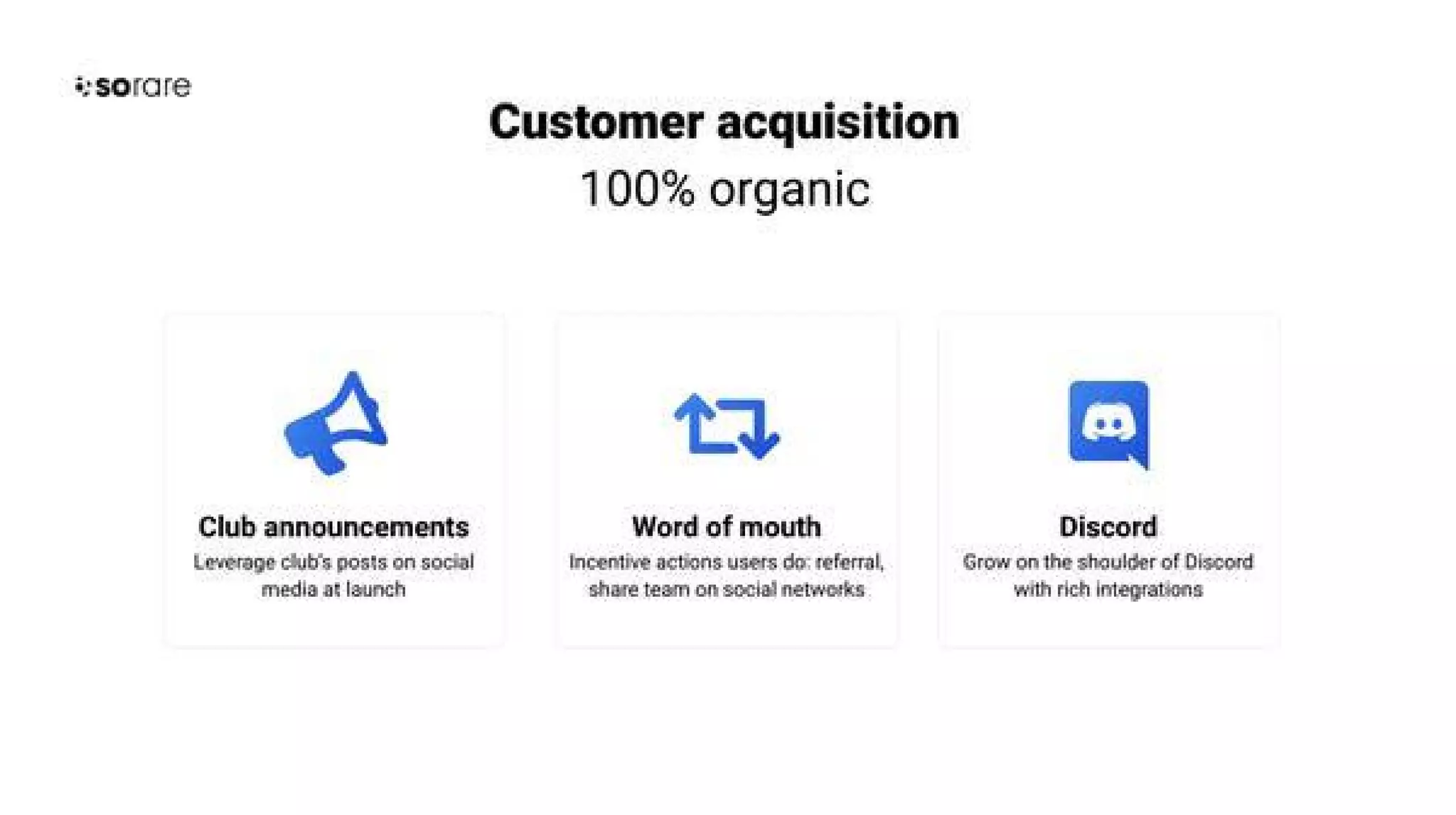
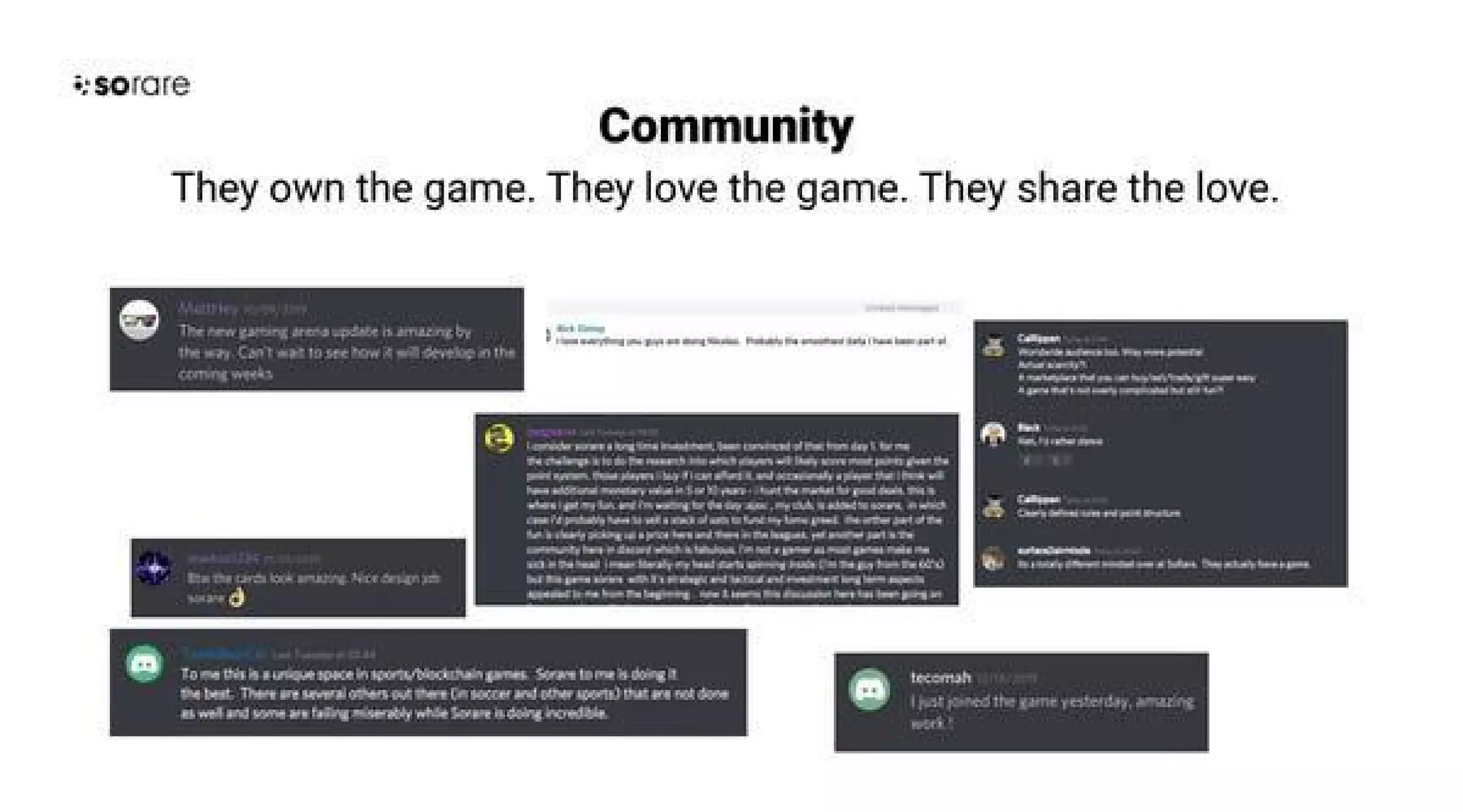
    • Community-driven activity: Discord and organic acquisition channels with club announcements and word of mouth (Slides 13 & 17).
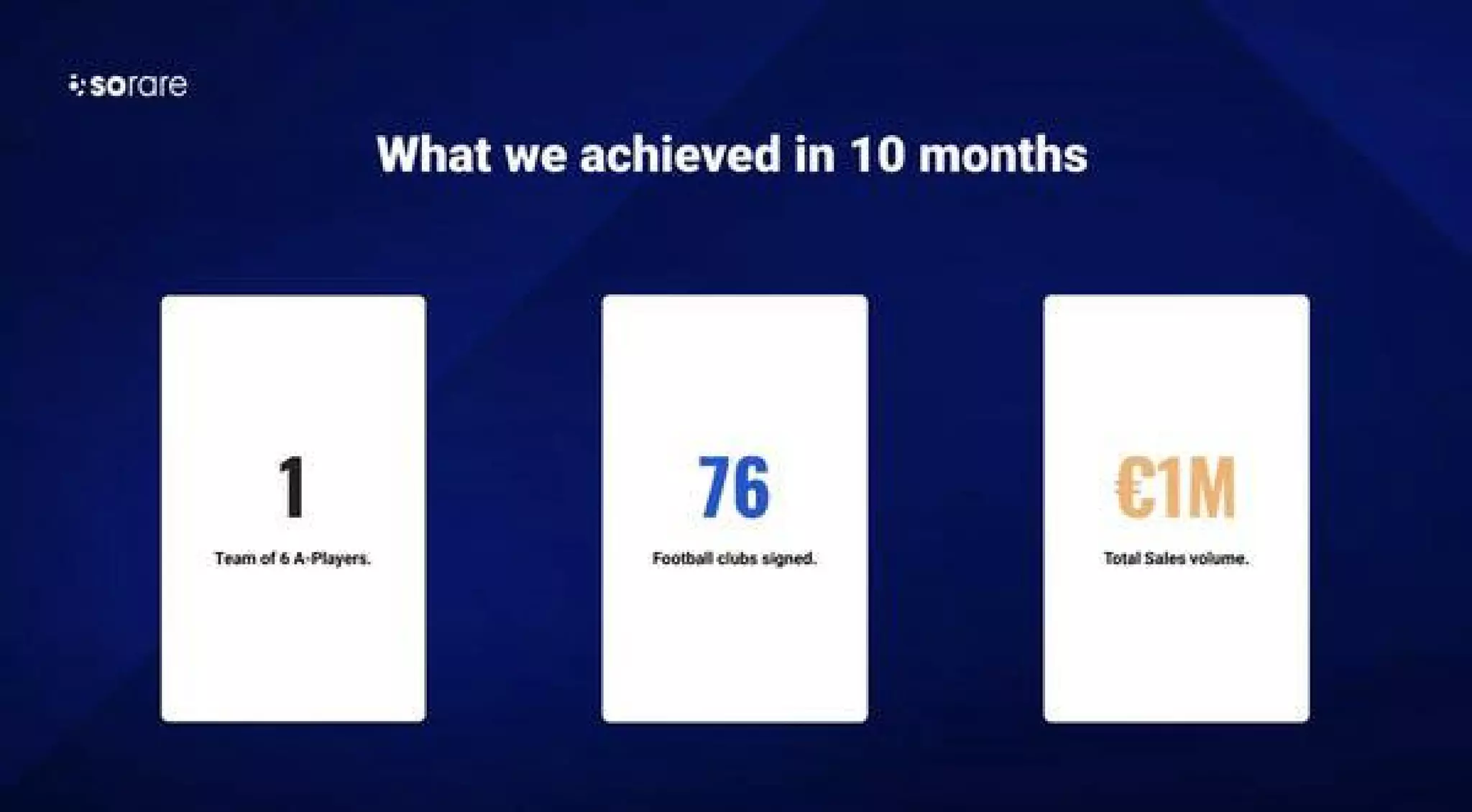
  • What they achieved in 10 months (Slide 16): 1 team of 6 A‑players, 76 clubs signed, €1M total sales.

Competitive Positioning

  • Differentiation emphasized:
    • Official licenses with many clubs (Slide 12) — creates exclusive content supply.
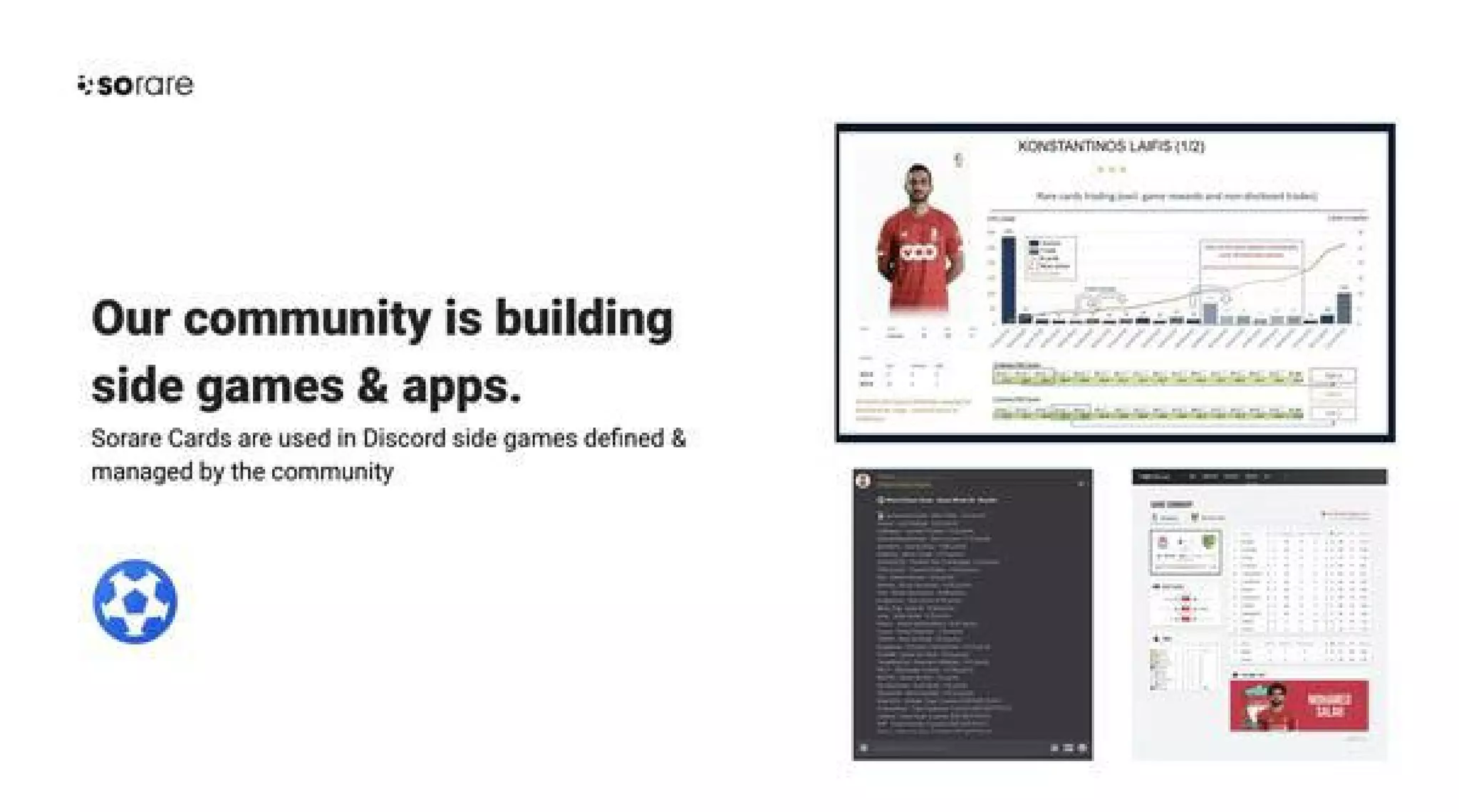
    • Community: strong organic growth and Discord ecosystem that builds side games/apps (Slides 13 & 17).
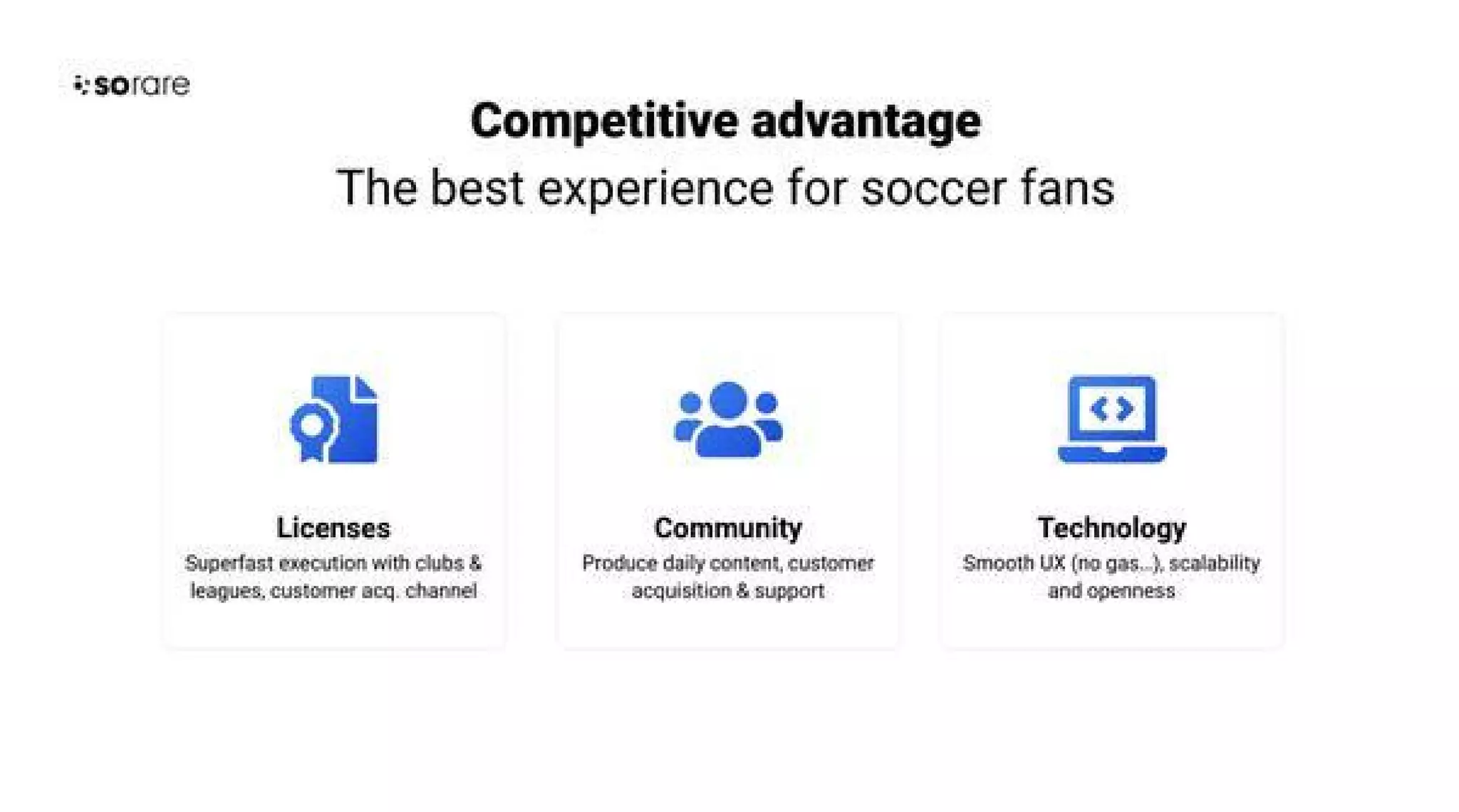
    • Technology & UX: claims of smooth UX (‘no gas’), scalability and openness (Slide 9 & Slide 10).
  • Competitive advantages summary also presented as three pillars: Licenses, Community, Technology (Slide 10).

Team

  • Founders highlighted (Slide 2):
    • Nicolas Julia — CEO (previous VP Operations @ Stratumn; experience scaling operations and signing deals).
    • Adrien Montfort — CTO (previous VP Engineering @ Stratumn; built and managed blockchain engineering teams).
  • Investors / advisors shown (Slides 14 & 18): Seedcamp, Kima Ventures, ConsenSys, Tiny VC, Thomas France, Chris Hitchen; later Series A lead investors e.ventures and Partech (Slide 18). André Schürrle appears as an investor/partner in Slide 18.

Go-to-Market Strategy

  • 100% organic acquisition emphasized (Slide 13):
    • Club announcements at launch (leveraging club social channels).
    • Word of mouth (referrals, social sharing).
    • Discord integrations and community growth (Slide 13 & 17).
  • Channel strategy heavily reliant on licensed clubs as distribution partners and on community virality/Discord for retention and engagement.

The Ask

  • Series A raise: $4M (round noted in the brief context).
  • Slide 18 indicates round was “full, closing May 12th — Led by e.ventures, alongside Partech and existing investors.”
  • The deck does not provide a clear line‑item use of funds (no explicit allocation of the $4M in the slide set).

Investor Deep Dive

Executive summary, strengths & red flags

Executive Summary

Sorare pitched a mainstream, blockchain-native fantasy soccer game where licensed player "cards" are ERC‑721 NFTs that users buy, trade and use in weekly fantasy tournaments. The deck pairs clear product mechanics (collect → play → rewards), strong early traction (€1M sales, ~70–76 clubs signed), and meaningful league/club licensing to argue for rapid adoption and a large sports/gaming market opportunity.

Key Strengths

3 identified

1

Licenses & supply advantage — Signed ~70–76 clubs early, which creates exclusive supply of player cards and strong go‑to‑market marketing via club channels (Slides 12 & 16).

2

Early product-market fit + revenue — €1M in sales in first ~10 months demonstrates real monetization of NFT player cards and validates the collect/play/reward model (Slides 4 & 16).

3

Community-driven growth and retention — 100% organic acquisition, strong Discord ecosystem, and community building of side-games increases stickiness and lowers paid CAC (Slides 13 & 17).

Red Flags & Weaknesses

3 identified

1

Lack of detailed unit economics / financial projections — No CAC, LTV, gross margin, burn rate, or three-year projections are shown; investors cannot evaluate capital efficiency from the deck.

2

Vague monetization and marketplace economics — No clear fee schedule, royalty splits, or revenue share model with clubs is detailed (Slide 22 suggests royalties but no structure is presented).

3

Regulatory & platform risk not addressed — reliance on licensed player likenesses and use of blockchain/NFTs carry IP/regulatory concerns and potential volatility (e.g., Ethereum gas/UX issues were lightly mentioned as “no gas” UX but not explained technically).

More Pitch Decks To Study

Compare structure, fundraising context, and investor-facing story across similar startup decks.