Compare your deck to Quora

Compare Your Deck

Quora Pitch Deck (2010)

Social
Stage: Various
Raised: $225M+ total
Year: 2010
Slides: 16
Outcome: Valued at $2B

Pitch Deck

1 / 16
Quora pitch deck - The Opening: Clear, memorable positioning
Click to expand

Deck Analysis

This deck is an early-stage investor pitch for Quora (2010) that crisply positions the product as the intersection of knowledge Q&A and social search. It uses strong visual branding, a clear problem→solution narrative, founder credibility, early traction metrics, and a straightforward financing ask. Notable for its focus on product-led differentiation (real-time, verified social profiles, topic streams) and for communicating adoption signals that matter to investors (user growth, search traffic mix, and content quality).

The Opening: Clear, memorable positioning

The Opening: Clear, memorable positioning

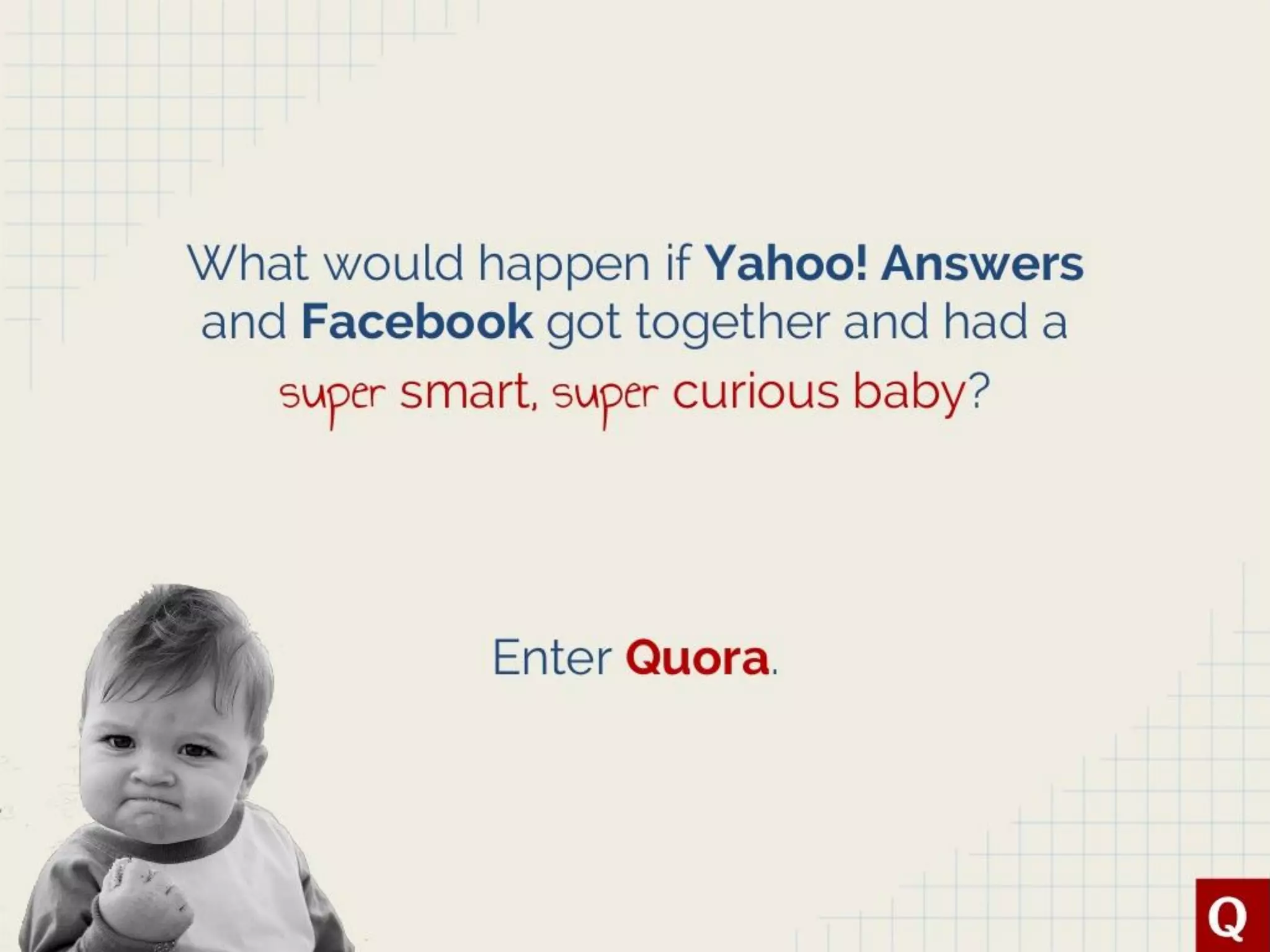
Slide 1 opens with a simple, memorable hook: “What would happen if Yahoo! Answers and Facebook got together and had a super smart, super curious baby? Enter Quora.” The line quickly conveys what Quora is by referencing two well-known comparisons rather than relying on abstract product language. Paired with a striking, viral-friendly baby image, it creates an easy-to-repeat narrative investors and press can use to describe the company.

This is effective because it reduces cognitive load for the audience and provides an emotional hook. Founders can learn to use analogies that map to familiar products to position new ideas quickly, and to pair that positioning with a simple visual that reinforces the message.

Key Takeaway: Lead with a concise, memorable analogy plus a supporting visual to make your product instantly understandable.

Brand and value proposition: concise and differentiated

Brand and value proposition: concise and differentiated

Slide 2 presents the Quora mark and the one-line value proposition: “Where Knowledge Queries meets Social Search.” The slide is visually clean and uses typographic emphasis to highlight the two axes of differentiation: knowledge (quality content) and social (people-centric discovery). It reframes Q&A as a new category rather than a direct clone of existing players.

This clarity helps investors quickly grasp the unique positioning and perceived defensibility. Founders should emulate this economy of language: combine an attractive visual identity with a tightly worded value prop that highlights how you differ from incumbents.

Key Takeaway: Use a single, tightly worded value proposition paired with a recognizable visual identity to stake out your category.
Team credibility: show relevant experience

Team credibility: show relevant experience

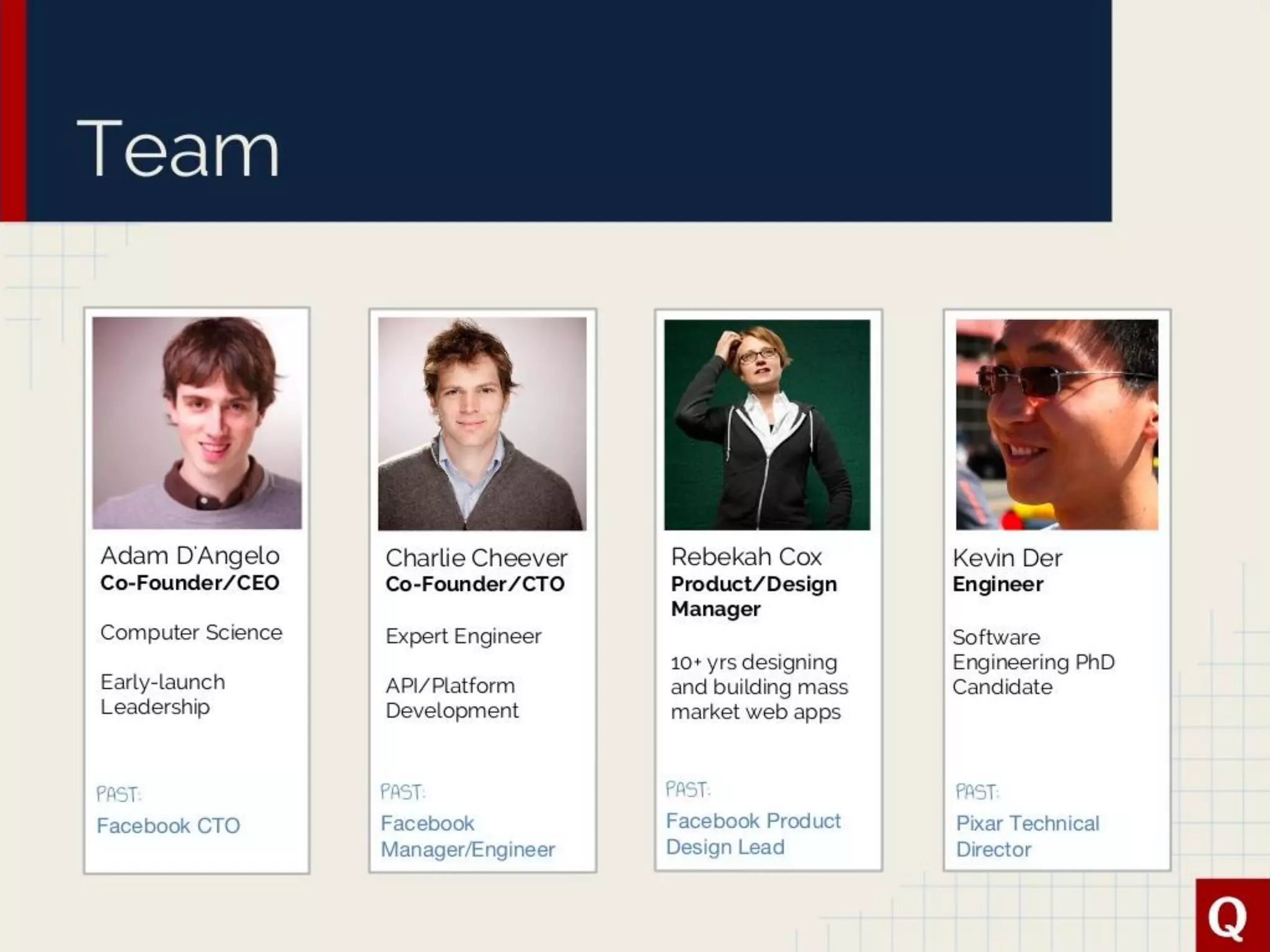
Slide 3 profiles the founding team (Adam D’Angelo, Charlie Cheever, Rebekah Cox, Kevin Der) and emphasizes relevant backgrounds (Facebook CTO, engineering leads, product/design). Photos plus short blurbs convey capability and role fit—technical founders with product and design strength. The slide includes past affiliations which serve as social proof that the team can build and scale social products.

Investors often bet on teams as much as ideas. This slide is effective because it balances brevity and relevance—highlighting the core hires and why they matter for execution. Founders should present a focused team slide that ties each founder’s background to the company’s critical early priorities (e.g., product, platform, growth).

Key Takeaway: Showcase a compact team slide connecting each founder’s prior experience directly to the startup’s execution risks.
Problem articulation: precise pain points and competitive context

Problem articulation: precise pain points and competitive context

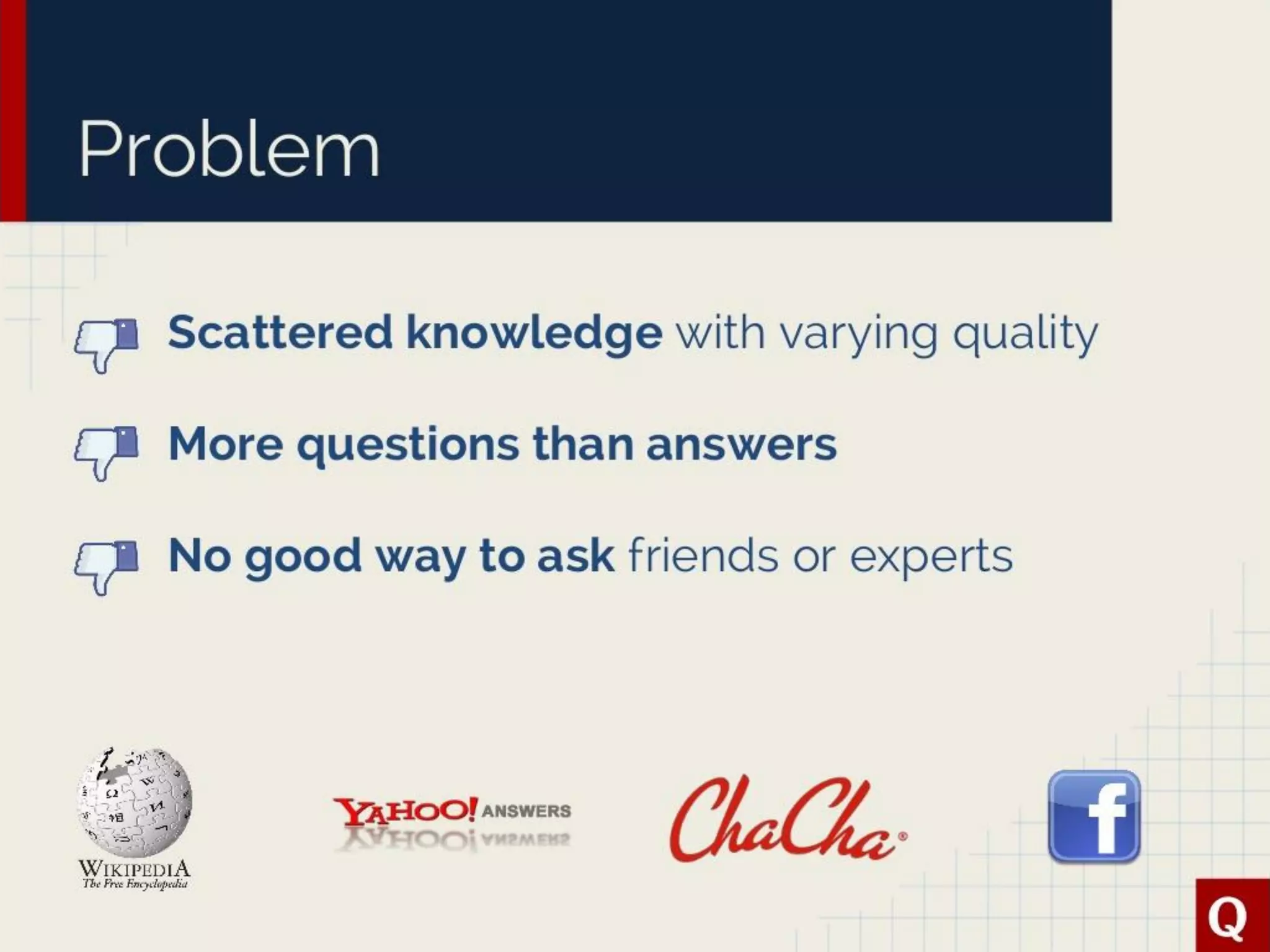
Slide 4 states three concise problems: scattered knowledge with varying quality, more questions than answers, and no good way to ask friends or experts. The slide pairs these bullets with icons and competitive logos (Wikipedia, Yahoo Answers, ChaCha, Facebook) to quickly contextualize the market. By naming both user pain and weak incumbents, it sets up the need for a new solution.

This approach is effective because it focuses on user-centric problems rather than feature lists, and it foreshadows how Quora’s social + quality approach addresses those gaps. Founders should use a similar structure—small set of clear, user-focused problems supported by competitive mapping—to justify their product direction.

Key Takeaway: Frame a short list of real user pain points and show where incumbents fail to create urgency for your solution.
Why now: market timing and attention economics

Why now: market timing and attention economics

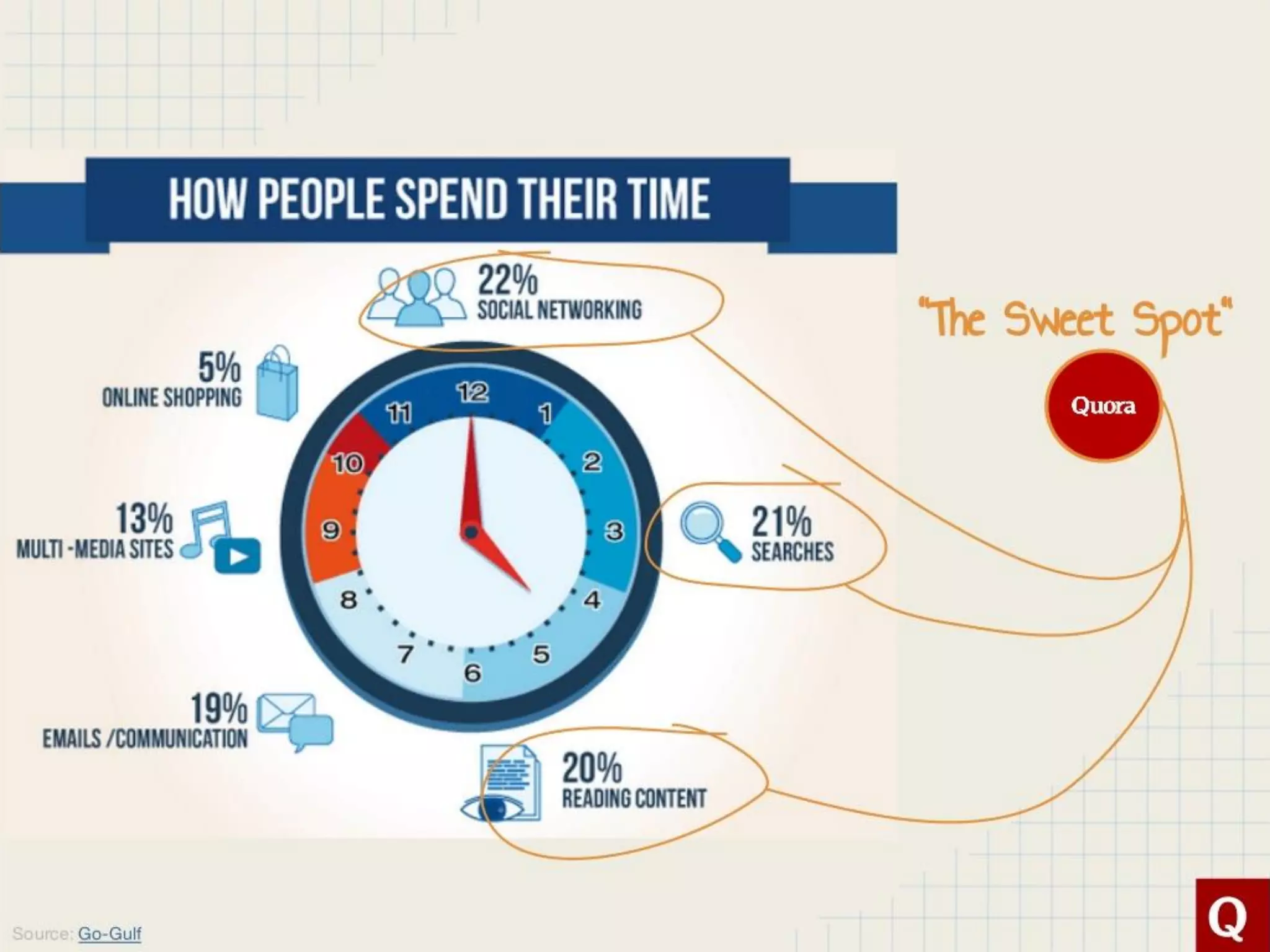
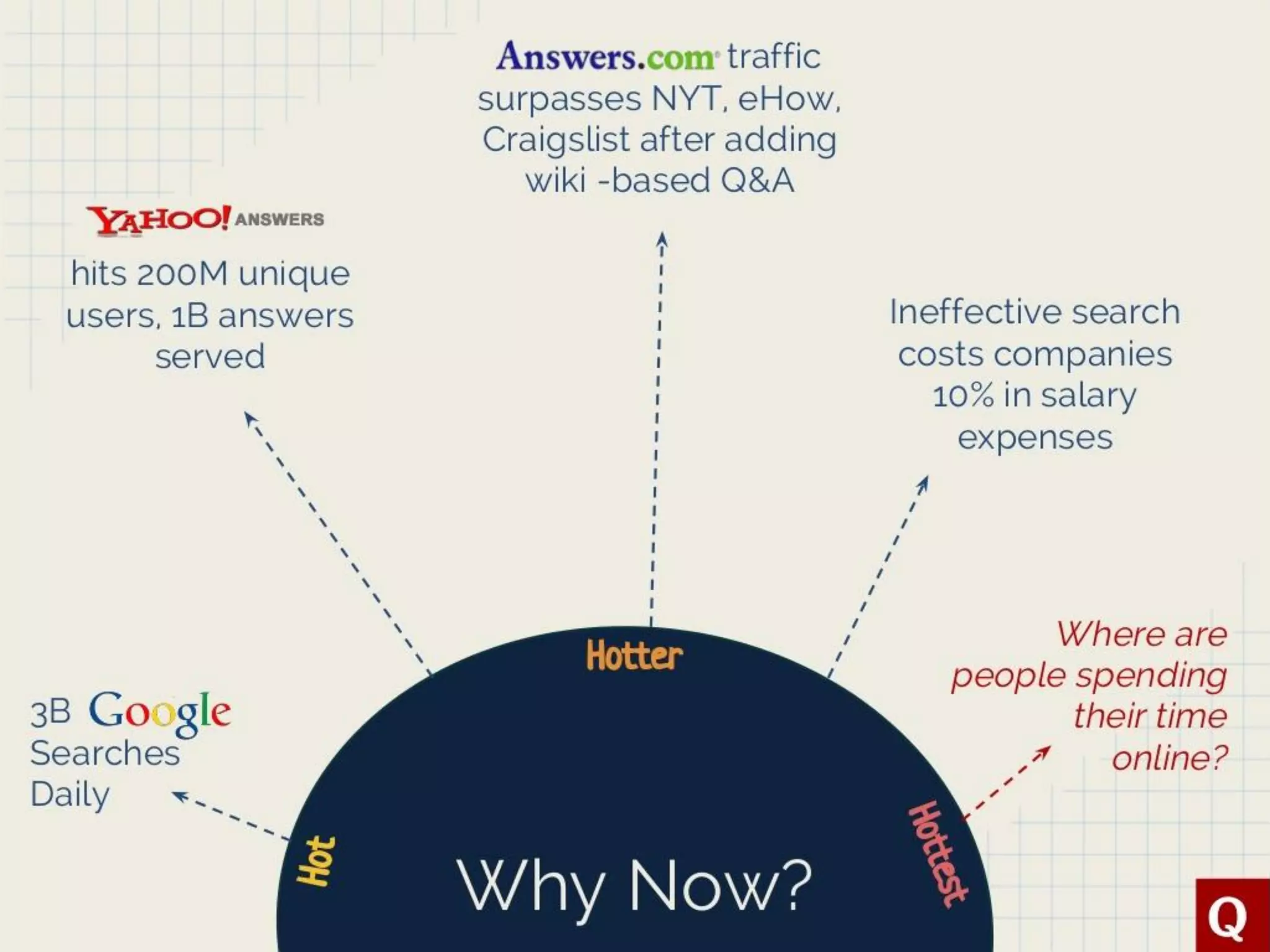
Slide 6 (Why Now?) mixes macro signals—3B daily Google searches, Yahoo Answers scale, search-driven revenue pain inside companies—with a key insight about where people spend time online. The deck uses this to argue that user attention and search behavior are aligning to make a social, high-quality Q&A product feasible and valuable. The slide conveys both demand-side (search volume, wasted corporate time) and supply-side (existing Q&A momentum) evidence.

This combination is persuasive because it shows the founders are thinking beyond product to timing and distribution. Founders should back their product thesis with quantifiable trends and show how timing improves the odds of building a durable business.

Key Takeaway: Support your product narrative with measurable market trends that amplify demand and distribution opportunities.
Solution & product design: social features that create quality

Solution & product design: social features that create quality

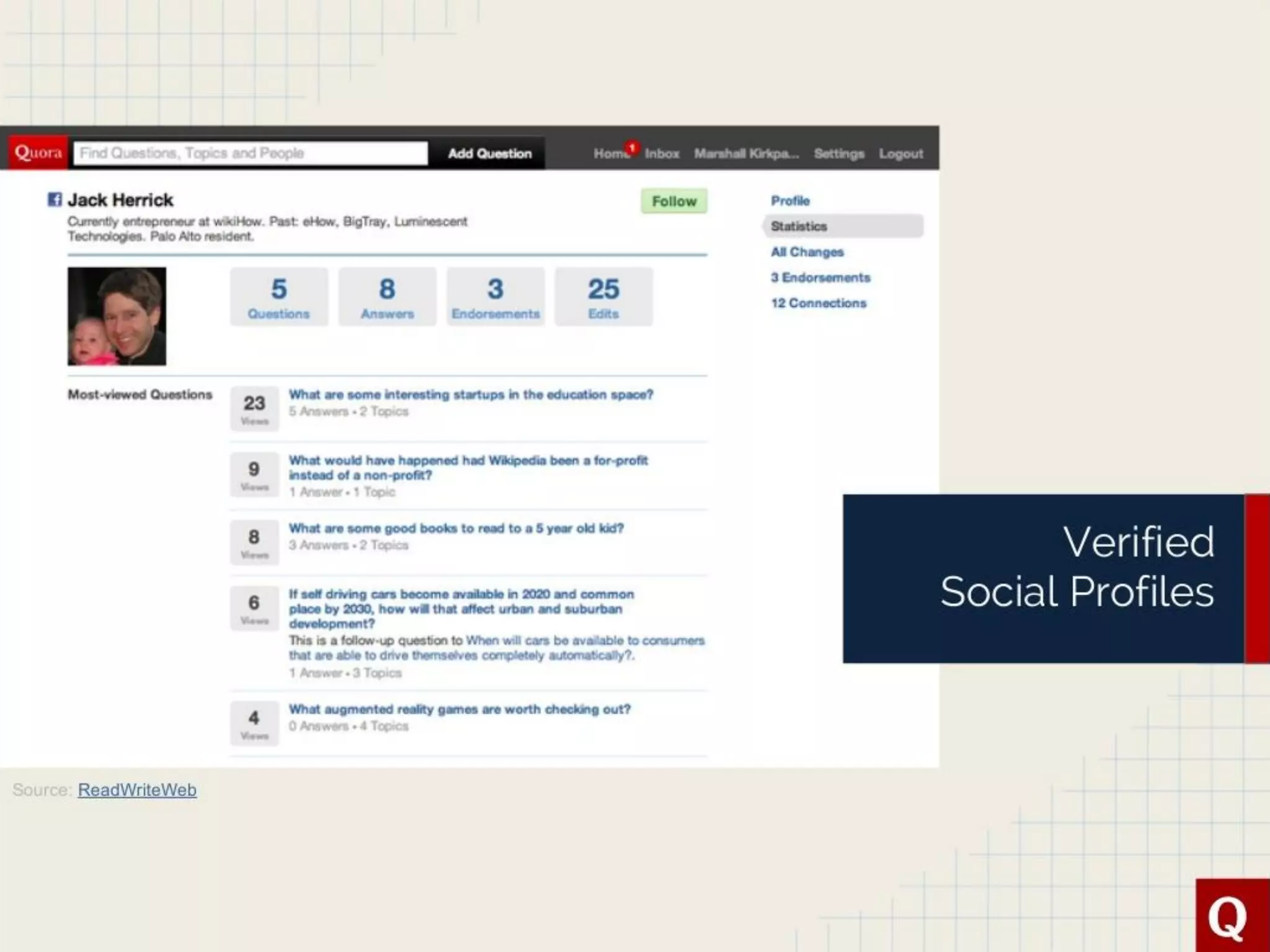
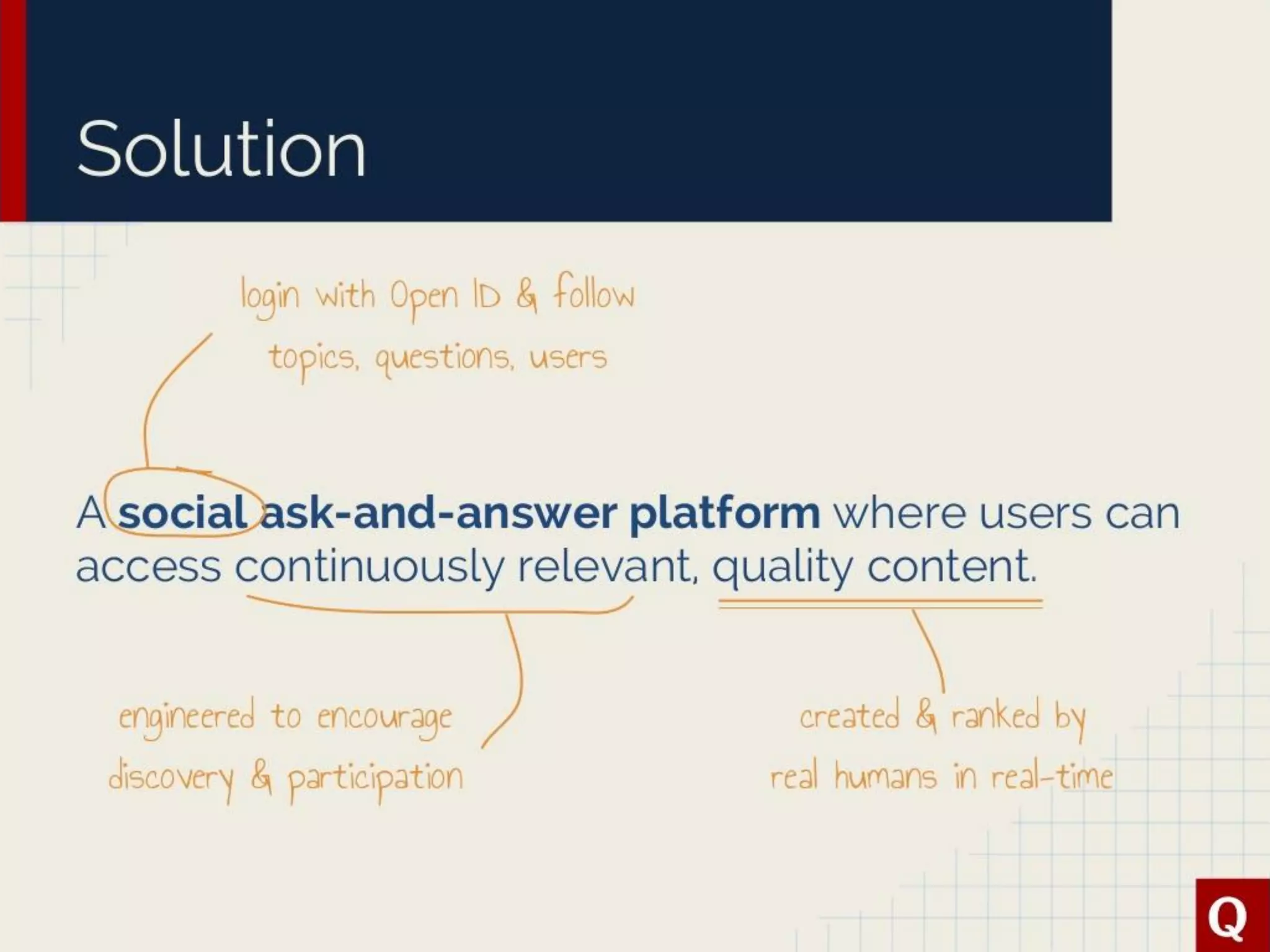
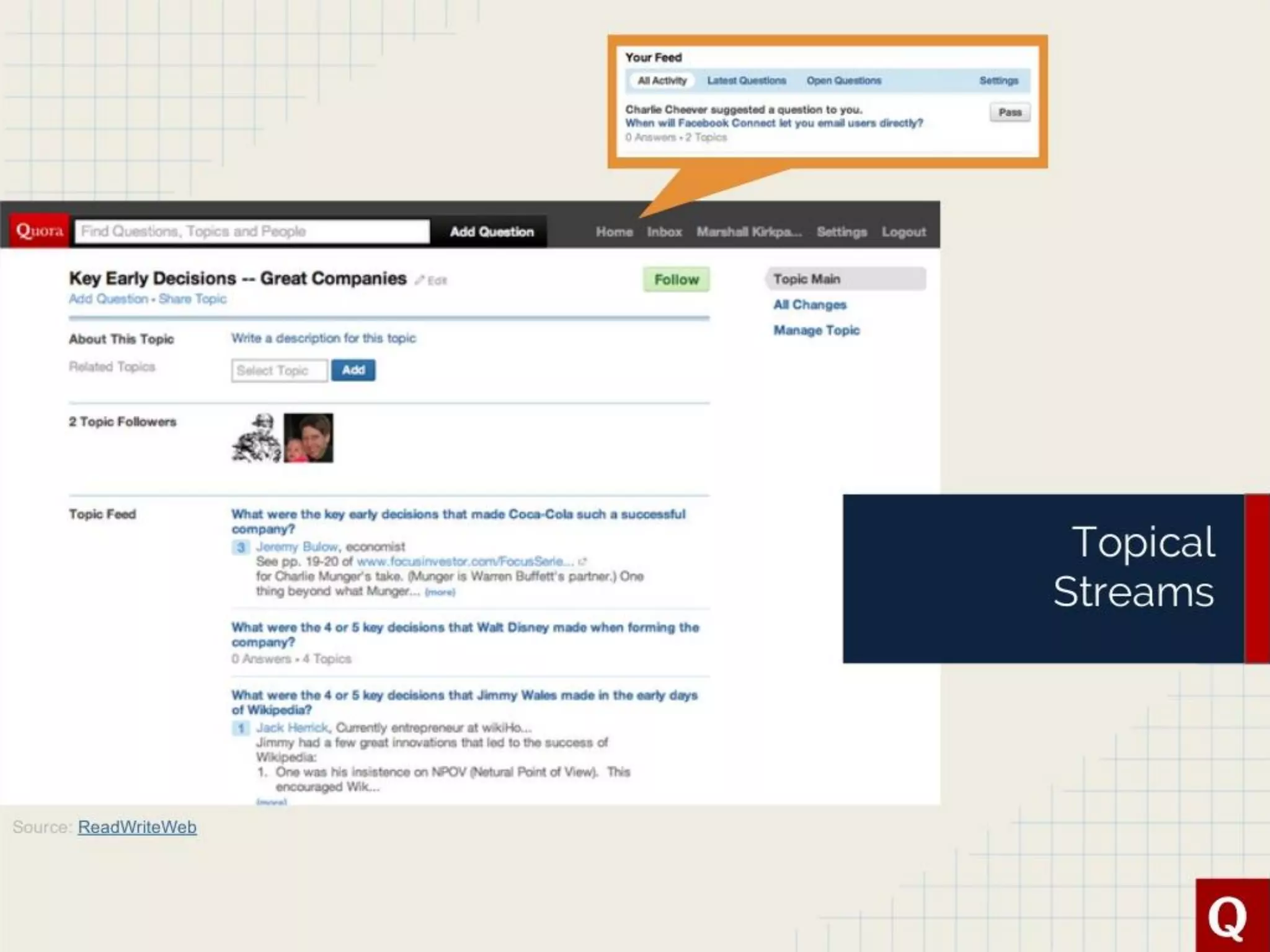
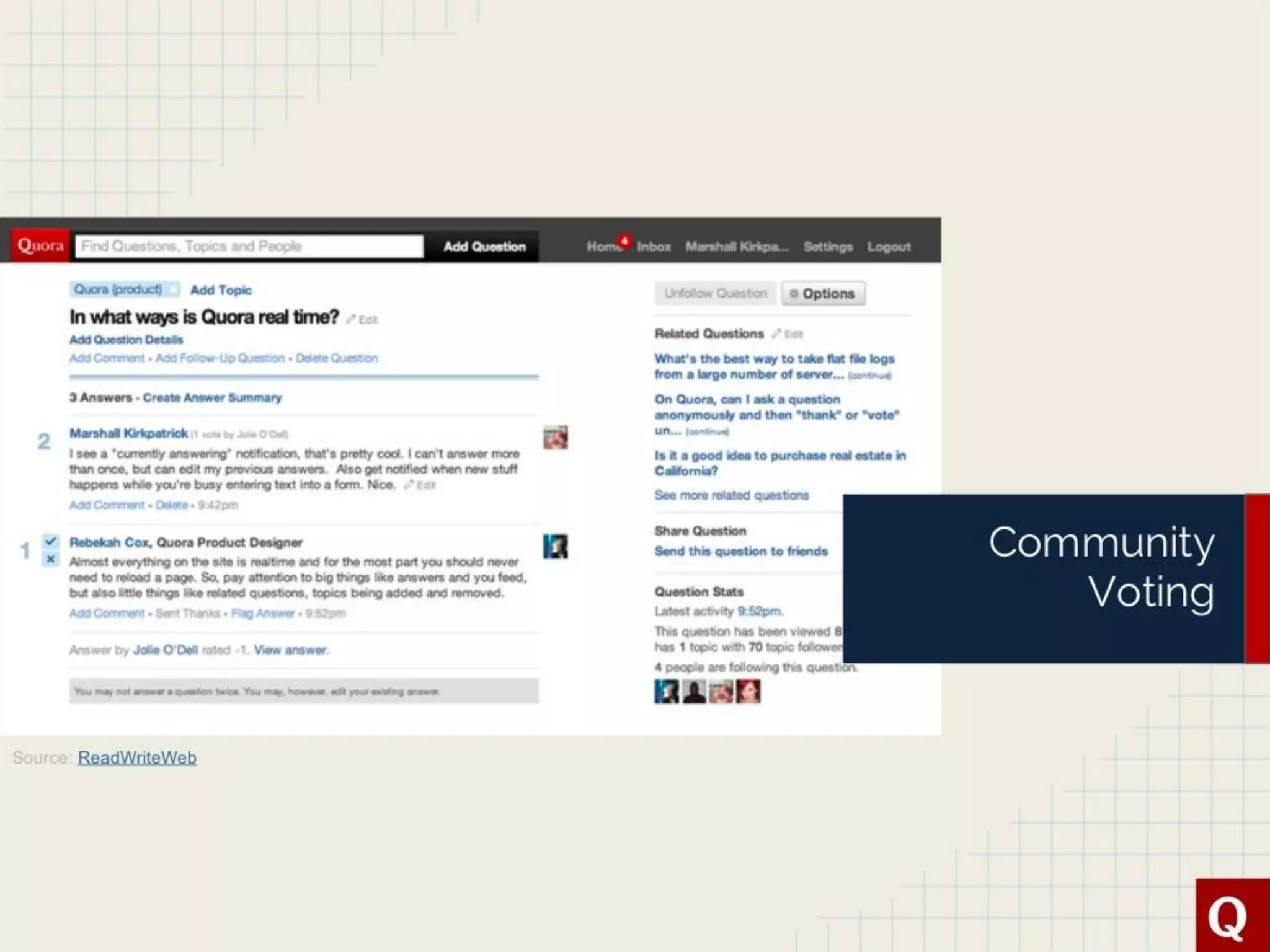
Slide 8 lays out the core solution: a social ask-and-answer platform with OpenID login, followable topics/questions/users, engineered discovery and participation, and human-created rankings. Adjacent slides (9 and 10 in the deck sequence) show concrete product elements—verified social profiles, topical streams, community voting—that translate the abstract value prop into user flows and moderation mechanics.

This is effective because it ties product mechanics to the earlier problems (quality, discoverability, social reach). Founders can learn to map specific features to each pain point and to show how product design creates the desired content quality and engagement loops.

Key Takeaway: Map product features directly to stated problems and show how design choices produce quality, discovery, and engagement.
Traction & Vitals: early metrics to prove momentum

Traction & Vitals: early metrics to prove momentum

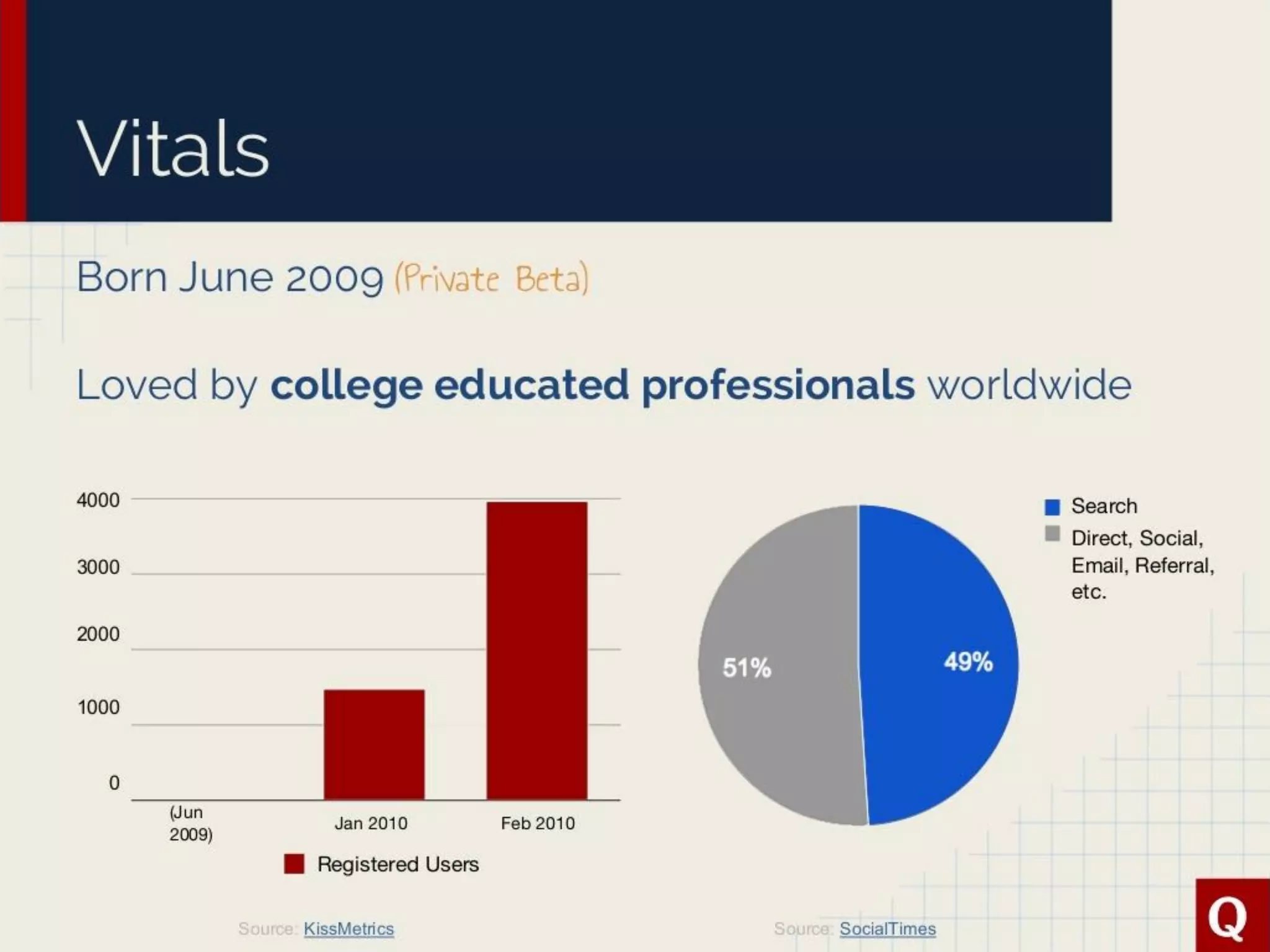
Slide 11 presents key early metrics: born June 2009 (private beta), adoption by college-educated professionals, registered user growth from Jan to Feb 2010, and traffic source split (search ~49%). The deck highlights the kind of traction investors care about—cohort signals, organic growth channels, and search discoverability that implies long-term growth potential via SEO and referral.

This slide works because it provides concrete numbers without overwhelming detail, focusing on the signals that validate product-market fit and growth engine. Founders should include a compact metrics slide that emphasizes adoption velocity, quality of users, and scalable traffic channels.

Key Takeaway: Present a short set of high-signal metrics (growth, user quality, acquisition channels) to prove early traction and drive investor confidence.

Conclusion: Key Lessons

Quora’s 2010 deck combines clarity of positioning, founder credibility, product mechanics tied to user pain, market timing, and compact traction evidence into a persuasive investor narrative. Strengths include a memorable opening analogy, disciplined value proposition, a team slide that reduces execution risk, problem→solution pairing that maps features to pains, and a small set of meaningful metrics that signal momentum. The visuals are clean and support quick comprehension rather than distracting with data overload.

Actionable advice for founders: lead with a one-line category-defining proposition, show why now with measurable trends, connect each product feature to a specific user problem, present a tight team slide that demonstrates execution capability, and include 3–5 high-signal traction metrics. Keep slides visually simple—use brand, single-sentence positioning, and clear numeric evidence to tell a coherent story investors can repeat.

Full Deck Analysis

12 sections

Overview

Company: Quora
Round: Various ($225M+ total)
Year: 2010
Outcome: Valued at $2B
Stage: Pre-revenue, private beta (launched June 2009)


Executive Summary

Quora’s 2010 pitch deck presents a compelling vision of combining Q&A functionality with social networking to create a high-quality knowledge platform. The deck effectively positions Quora at the intersection of three major user behaviors (social networking 22%, searches 21%, reading content 20%) while directly addressing the quality and fragmentation problems plaguing existing platforms like Yahoo! Answers. With a founding team boasting Facebook and Pixar pedigree, early traction showing 3x user growth in one month (1,200 to 3,900 users Jan-Feb 2010), and a clear roadmap to monetization, the deck makes a compelling case for why this team can build the “Wikipedia meets Facebook” platform for the social era.


Problem Statement

The deck articulates three core, interconnected problems (Slide 4):

  1. Scattered knowledge with varying quality - Existing platforms like Yahoo! Answers, Wikipedia, and ChaCha suffer from fragmented, inconsistent content quality
  2. More questions than answers - Supply/demand imbalance creates frustration for users seeking information
  3. No good way to ask friends or experts - While social networks exist (Facebook) and Q&A platforms exist (Yahoo! Answers), no platform elegantly combines the ability to ask your trusted network of experts

Supporting context (Slide 5):

  • Yahoo! Answers: 200M unique users, 1B answers served (but low quality)
  • Answers.com: Traffic surpasses NYT, eHow, Craigslist after adding wiki-based Q&A (proving Q&A demand)
  • Business impact: Ineffective search costs companies 10% in salary expenses
  • Google: 3B searches daily (massive information-seeking behavior)

The problem is validated through market data showing that 21% of online time is spent on searches and 22% on social networking—two behaviors that should be unified but aren’t.


Solution

Quora positions itself as “A social ask-and-answer platform where users can access continuously relevant, quality content” (Slide 7).

Three core differentiators:

  1. Open ID login with follow mechanism - Users can follow topics, questions, and other users, creating a personalized feed (vs. Yahoo! Answers’ anonymous, non-social model)

  2. Engineered for discovery & participation - Product design explicitly encourages users to ask questions and engage (vs. passive consumption on Wikipedia)

  3. Real humans creating and ranking content in real-time - Community voting and human curation ensure quality (vs. algorithmic or anonymous systems)

Key features demonstrated (Slides 8-10):

  • Verified social profiles (Facebook integration for identity verification)
  • Topical streams (organized by topic, not chronological)
  • Real-time notifications (“currently answering” signals)
  • Community voting and answer ranking
  • Expert credibility signals (checkmarks for verified experts like Rebekah Cox, Quora Product Designer)
  • Related questions (content interconnection)
  • Send Thanks and Flag Answer (community moderation)

Market Opportunity

The deck establishes a large, underserved market through multiple angles:

Market Size Indicators (Slide 5-6):

  • Google: 3B searches daily (massive information-seeking behavior)
  • Yahoo! Answers: 200M unique users, 1B answers served (proven Q&A demand)
  • Answers.com: Traffic surpasses NYT, eHow, Craigslist (Q&A drives significant traffic)
  • User behavior: 21% of online time spent on searches + 22% on social networking = 43% addressable to Quora’s “sweet spot”

Business Impact:

  • Ineffective search costs companies 10% in salary expenses (enterprise value proposition)

Target Market:

  • College-educated professionals worldwide (premium, high-value user segment vs. Yahoo! Answers’ mass market)

Competitive Validation:

  • The existence of Wikipedia, Yahoo! Answers, Stack Exchange, Reddit, and others proves the market exists
  • Quora’s positioning suggests TAM is at least in the billions (combining search market + social networking market)

Notable gap: The deck does not provide explicit TAM/SAM/SOM calculations, instead relying on comparative market indicators and user behavior data.


Business Model

Current Status: Pre-revenue (Slide 13)

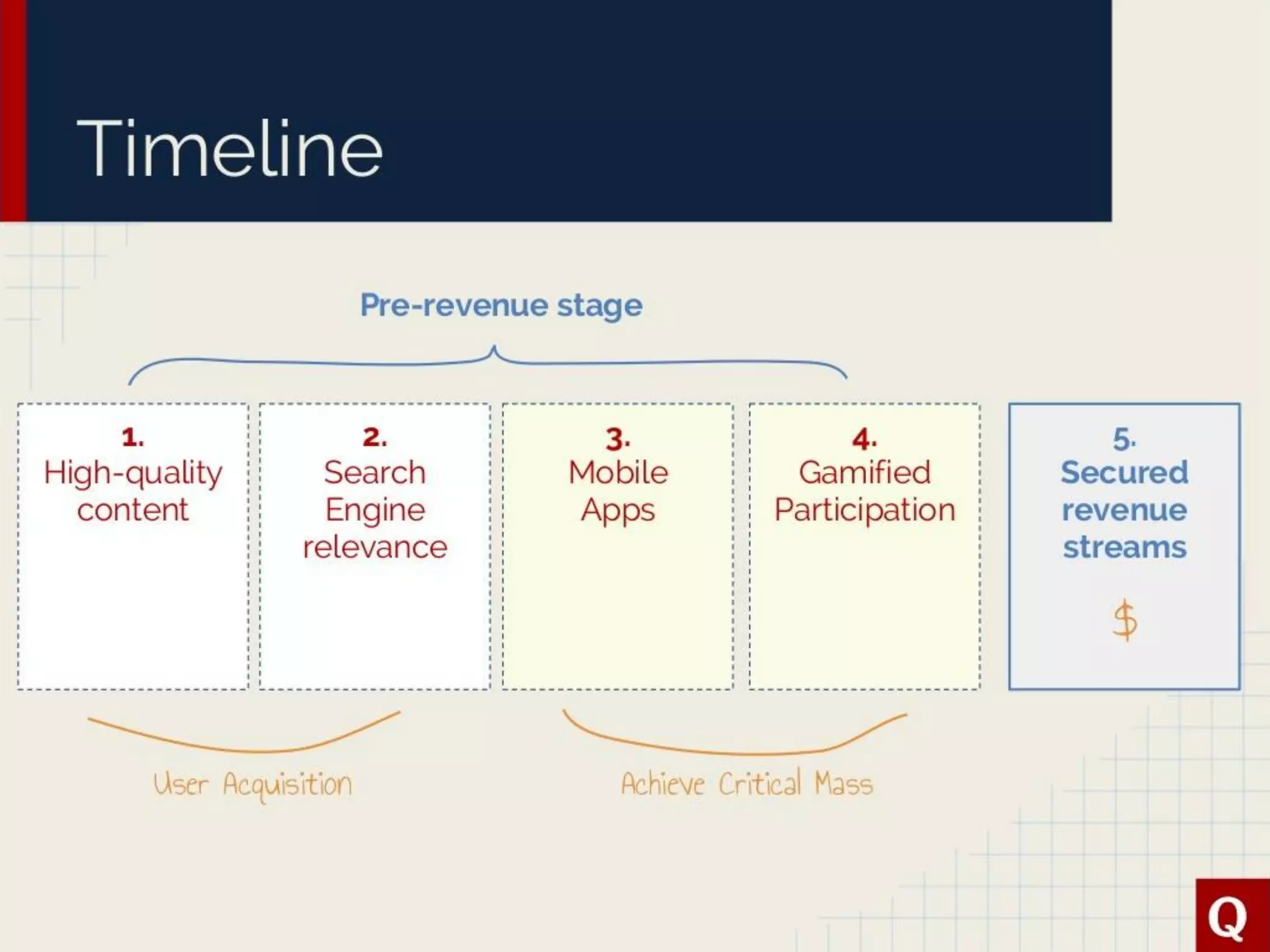
Monetization Strategy (Slide 13 - Timeline Phase 5):

  • Deferred until “critical mass” achieved
  • Phase 5 labeled “Secured revenue streams” but specific model not detailed

Implied revenue opportunities (not explicitly stated):

  • Advertising (likely, given search/content focus)
  • Premium features (possible, given social platform precedent)
  • Enterprise licensing (possible, given business value proposition)
  • Sponsored content (possible, given expert/professional audience)

Unit Economics: Not provided in deck

Burn Rate/Runway: Not provided in deck

Key insight: The deck prioritizes growth over monetization, deferring revenue until phases 1-4 establish critical mass. This is appropriate for 2010 venture context (pre-2008 financial crisis mentality still prevalent) but represents a risk if capital runs out before profitability.


Traction & Metrics

Launch & Growth (Slide 11):

  • Launched: June 2009 (private beta)
  • Jan 2010: ~1,200 registered users
  • Feb 2010: ~3,900 registered users
  • Growth rate: 3x in one month (Jan-Feb 2010)

User Characteristics:

  • “Loved by college educated professionals worldwide”
  • Organic growth: 49% from search, 51% from direct/social/email/referral

Engagement Signals (Slides 8-10):

  • Sample user (Jack Herrick, co-founder): 5 questions, 8 answers, 3 endorsements, 25 edits
  • Sample question views: 4-23 views per question (modest but real engagement)
  • Topic followers: 2-70 followers per topic
  • Answer counts: 0-3 answers per question shown

Notable gaps:

  • No DAU/MAU metrics
  • No retention/churn data
  • No time-on-site or engagement depth metrics
  • No answer quality metrics or satisfaction scores
  • No viral coefficient or NPS data

Assessment: Traction is real but modest. 3,900 users by Feb 2010 is small, but 3x monthly growth is impressive for an 8-month-old private beta. The organic acquisition split (49% search, 51% direct/social) suggests both SEO and word-of-mouth are working.


Competitive Positioning

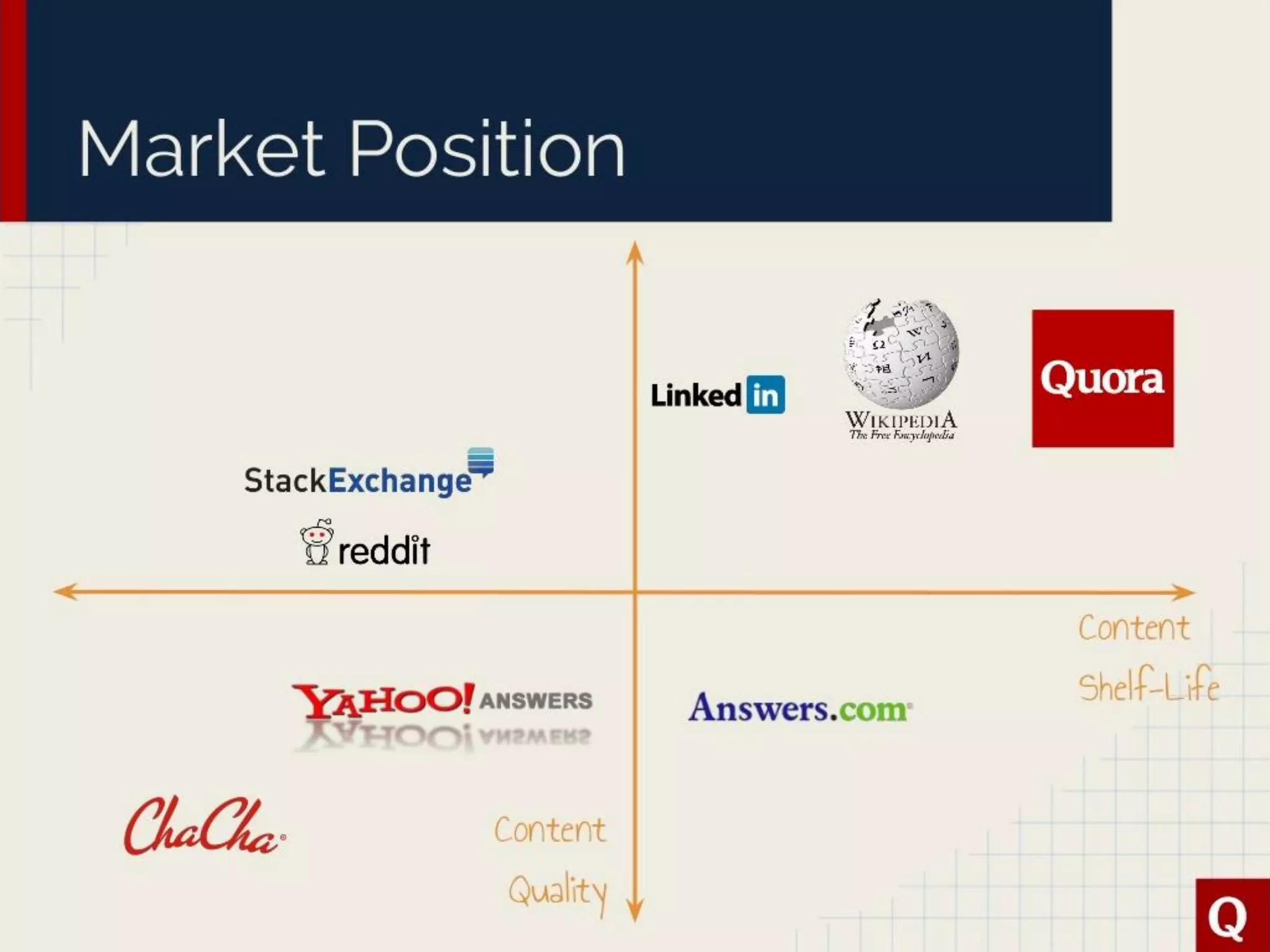
Positioning Matrix (Slide 12):

Quora positions itself in the “High Quality + Permanent Content” quadrant, alongside Wikipedia:

Dimension Ephemeral Content Permanent Content
High Quality LinkedIn, Stack Exchange, Reddit Wikipedia, Quora
Low Quality ChaCha, Yahoo! Answers Answers.com, Shelf-Life

Competitive Differentiation:

  1. vs. Yahoo! Answers:
    • Quora: High quality, permanent, social
    • Yahoo! Answers: Low quality, ephemeral, anonymous
    • Advantage: Quora’s verified profiles and community voting address quality concerns
  2. vs. Wikipedia:
    • Quora: High quality, permanent, social, real-time
    • Wikipedia: High quality, permanent, but not social or real-time
    • Advantage: Quora adds social discovery and real-time engagement
  3. vs. Stack Exchange:
    • Quora: Broad topics, social, general audience
    • Stack Exchange: Narrow (programming), technical, expert audience
    • Advantage: Quora’s broader scope and social features
  4. vs. Reddit:
    • Quora: High quality, permanent, expert-driven
    • Reddit: Community-driven, ephemeral, variable quality
    • Advantage: Quora’s quality focus and permanent content
  5. vs. Facebook:
    • Quora: Knowledge-focused, Q&A format
    • Facebook: Social, but not knowledge-focused
    • Advantage: Quora’s specialized focus on knowledge discovery

Key positioning insight: Quora occupies a unique space—combining Wikipedia’s quality and permanence with Facebook’s social features and real-time engagement. This is the “sweet spot” the deck emphasizes.


Team

Founders (Slide 3):

  1. Adam D’Angelo - Co-Founder/CEO
    • Background: Computer Science
    • Experience: Early-launch leadership
    • Past: Facebook CTO
    • Credibility: Led Facebook’s technical strategy; understands platform scaling
  2. Charlie Cheever - Co-Founder/CTO
    • Background: Expert Engineer
    • Expertise: API/Platform Development
    • Past: Facebook Manager/Engineer
    • Credibility: Built Facebook’s platform infrastructure; understands API design

Early Hires (Slide 3):

  1. Rebekah Cox - Product/Design Manager
    • Background: 10+ years designing and building mass market web apps
    • Past: Facebook Product Design Lead
    • Credibility: Led Facebook’s product design; understands user experience at scale
  2. Kevin Der - Engineer
    • Background: Software Engineering PhD Candidate
    • Past: Pixar Technical Director
    • Credibility: Deep technical expertise; experience with complex systems at Pixar

Team Assessment:

  • Strengths: All four have prestigious backgrounds (Facebook, Pixar); complementary skills (CEO/leadership, CTO/engineering, product/design, engineering depth); proven ability to build at scale
  • Weaknesses: Limited diversity (3 male, 1 female); no business/finance expertise visible; no marketing/growth expertise visible; all from tech backgrounds (no domain experts in specific verticals)

Investor signal: The Facebook pedigree is the strongest credential. Adam D’Angelo as Facebook CTO signals he understands platform scaling and network effects. The team’s ability to recruit from Facebook and Pixar suggests strong networks and credibility in Silicon Valley.


Go-to-Market Strategy

Explicit GTM strategy: Not detailed in deck

Inferred GTM approach (from traction data and roadmap):

Phase 1-2 (User Acquisition):

  • Build high-quality content (organic, founder-seeded)
  • Optimize for search engine relevance (49% of traffic from search in Feb 2010)
  • Leverage social/referral channels (51% of traffic from direct/social/email/referral)
  • Target college-educated professionals (premium segment, not mass market)

Phase 3-4 (Scale & Engagement):

  • Launch mobile apps (expand platform reach)
  • Implement gamified participation (badges, points, endorsements to drive engagement)
  • Achieve critical mass (undefined, but implied to be 100K-1M+ users)

Phase 5 (Monetization):

  • Secure revenue streams (advertising, premium features, or enterprise licensing)

Distribution channels identified:

  • Organic search (49% of traffic)
  • Direct/social/email/referral (51% of traffic)
  • No paid acquisition mentioned
  • No partnership strategy mentioned
  • No enterprise sales strategy mentioned

Notable gaps:

  • No viral coefficient or growth loop described
  • No content marketing strategy
  • No influencer or expert recruitment strategy
  • No international expansion strategy (despite “worldwide” positioning)
  • No B2B or enterprise go-to-market strategy

The Ask

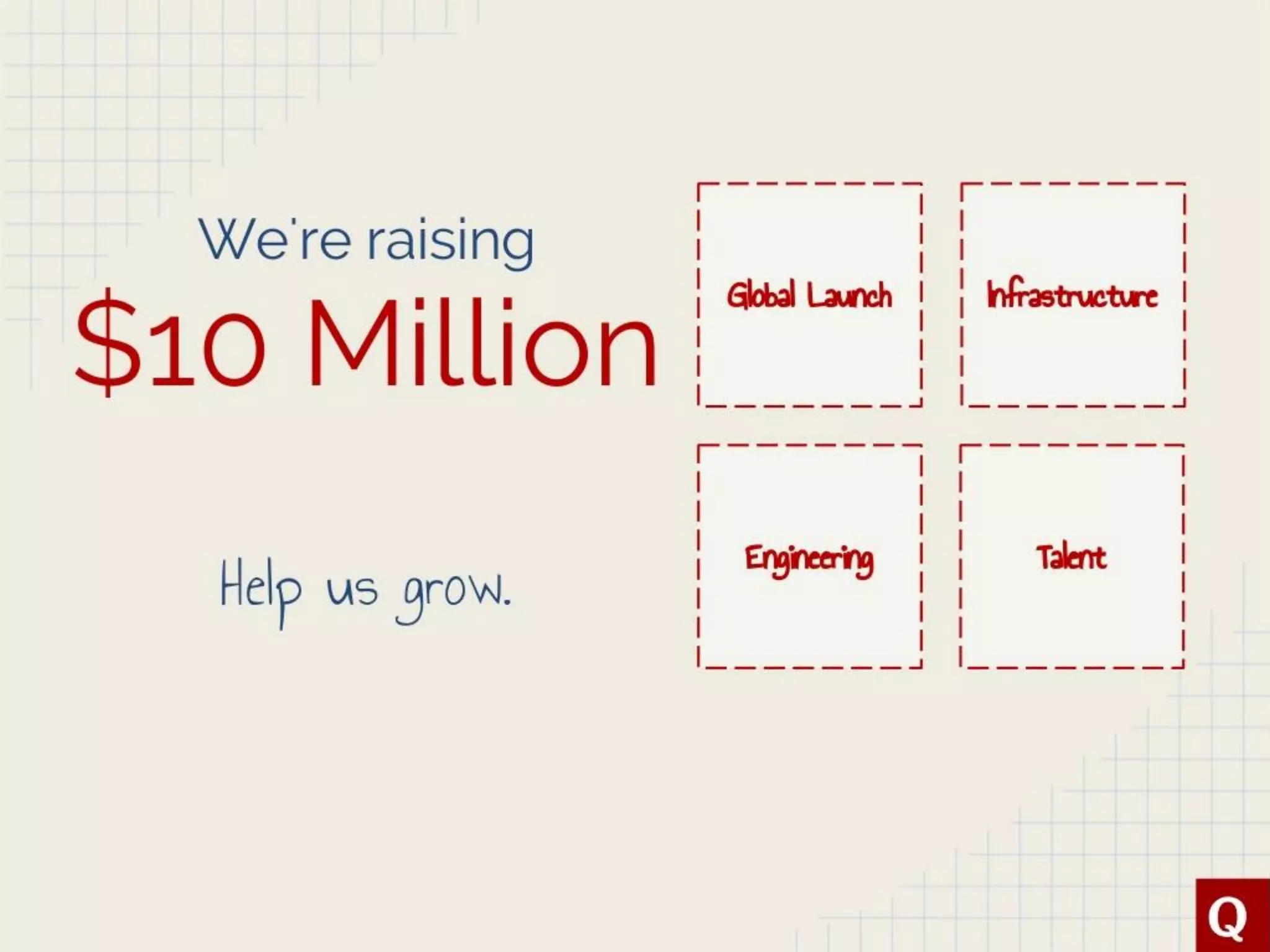
Funding Amount (Slide 14): $10 Million

Use of Proceeds (Slide 14 - 2x2 grid, no percentages specified):

  1. Global Launch - Expand internationally; likely includes marketing and localization
  2. Infrastructure - Build servers, CDN, and systems to support growth
  3. Engineering - Hire engineers to build new features and improve platform
  4. Talent - Hire across functions (product, design, operations, etc.)

Allocation: Appears roughly equal (25% each), but not explicitly stated

Implied runway: $10M at typical 2010 burn rates (~$500K-$1M/month for a 4-person team scaling) suggests 10-20 months of runway

Notable gaps:

  • No post-money valuation mentioned
  • No dilution percentage mentioned
  • No investor preferences or terms mentioned
  • No burn rate or runway explicitly stated
  • No contingency plan if capital runs out before profitability

Key Takeaways

What Quora Did Right

  1. Start with a memorable metaphor - “Yahoo! Answers + Facebook” is instantly understandable and sets the tone for the entire pitch

  2. Lead with team pedigree - When traction is modest, founder credibility becomes the primary risk mitigation

  3. Use data to validate problems - 3B Google searches daily and 200M Yahoo! Answers users prove the market exists

  4. Show real product, not mockups - Screenshots of actual user-generated questions and answers are more compelling than wireframes

  5. Position at the intersection of proven markets - Combining search (21% of online time) + social (22% of online time) = 43% addressable market

  6. Defer monetization until critical mass - Focus on growth and product-market fit first; worry about revenue later

  7. Provide a clear roadmap - Five phases from user acquisition to revenue shows long-term thinking

  8. Cite sources - 12 references make the deck fact-checkable and credible

What Quora Could Have Improved

  1. Show engagement metrics, not just user count - DAU, MAU, retention, and time-on-site would validate product-market fit

  2. Specify monetization strategy - “Secured revenue streams” is vague; specify advertising, premium features, or enterprise licensing

  3. Calculate explicit TAM/SAM/SOM - Inferred market size is good, but explicit calculations are better

  4. Show burn rate and runway - $10M is meaningless without knowing how long it lasts

  5. Provide international expansion strategy - “Global Launch” is mentioned but not detailed

  6. Include business/finance expertise on team - All four founders are technical; no CFO or business development visible

  7. Show paid acquisition strategy - 100% organic growth is impressive but harder to scale

  8. Validate quality claims with data - “High quality content” is claimed but not measured


Investor Deep Dive

Executive summary, strengths & red flags

Executive Summary

Quora's 2010 pitch deck presents a compelling vision of combining Q&A functionality with social networking to create a high-quality knowledge platform. The deck effectively positions Quora at the intersection of three major user behaviors (social networking 22%, searches 21%, reading content 20%) while directly addressing the quality and fragmentation problems plaguing existing platforms like Yahoo! Answers. With a founding team boasting Facebook and Pixar pedigree, early traction showing 3x user growth in one month (1,200 to 3,900 users Jan-Feb 2010), and a clear roadmap to monetization, the deck makes a compelling case for why this team can build the "Wikipedia meets Facebook" platform for the social era.

Key Strengths

10 identified

1

Brilliant Positioning & Metaphor (Slides 1-2)

- The "Yahoo! Answers + Facebook = super smart, super curious baby" metaphor is instantly memorable and communicates the value prop in seconds

2

Strong Founder Pedigree (Slide 3)

- All four team members have prestigious backgrounds (Facebook CTO, Facebook engineers, Pixar technical director)

3

Clear Problem Articulation (Slide 4)

- Three specific, relatable problems (scattered knowledge, more questions than answers, no good way to ask experts)

4

Data-Driven Market Validation (Slides 5-6)

- Uses concrete numbers (3B Google searches daily, 200M Yahoo! Answers users, 43% of online time in target behaviors)

5

Competitive Positioning Matrix (Slide 12)

- Simple 2x2 matrix clearly shows Quora's unique positioning (high quality + permanent content)

6

Real Product Demos (Slides 8-10)

- Shows actual UI screenshots with real questions, answers, and engagement metrics

7

Explosive Growth Traction (Slide 11)

- 3x user growth in one month (1,200 to 3,900 users Jan-Feb 2010) despite being pre-revenue

8

Clear Roadmap to Monetization (Slide 13)

- Five-phase roadmap shows path from user acquisition → critical mass → revenue

9

Transparent Sourcing (Slide 16)

- 12 references support key claims throughout the deck

10

Visual Design Consistency

- Clean, minimalist design with consistent color scheme (red + navy) throughout

More Pitch Decks To Study

Compare structure, fundraising context, and investor-facing story across similar startup decks.