
Compare your deck to Paddle

Compare Your Deck

Paddle Pitch Deck (2012)

Fintech
Stage: Series A
Raised: $150K
Year: 2012
Slides: 14
Outcome: Valued at $1.4B after Series D (2022)

Pitch Deck

1 / 14
Paddle pitch deck - Establishing the Metric: Why NDR Matters
Click to expand

Deck Analysis

This deck from Paddle (Series A, 2012) positions the company as a fintech-focused “Revenue Delivery Platform” built to drive Net Dollar Retention (NDR) for SaaS businesses. It’s notable because the pitch tightly links a business metric investors care about (NDR) with a clear product category (revenue delivery) and shows how Paddle’s platform removes the operational complexity that prevents scale — a story that appeared prescient given Paddle’s later $1.4B valuation. The slides use a problem→solution→proof structure, bold visuals, and concrete customer examples to make the case.

The Opening: Brand & Positioning

The Opening: Brand & Positioning

Slide 14 (the cover) uses a minimalist, brand-forward visual: the Paddle logo on a dark background with the tagline “The Revenue Delivery Platform for a growth-ready future.” This style communicates confidence and a premium, platform-level ambition immediately. The simple, bold positioning primes the audience for a product that sits at a strategic intersection (finance, compliance, billing) rather than a narrow point-solution.

For founders: starting with a crisp, descriptive one-line value statement helps anchor the entire pitch. The design choice — dark, uncluttered, logo-first — signals that you’re selling a foundational piece of infrastructure, not a feature, which aligns visual tone with strategic messaging.

Key Takeaway: Lead with a clear, high-level positioning statement that defines category and aspiration in one line.
Establishing the Metric: Why NDR Matters

Establishing the Metric: Why NDR Matters

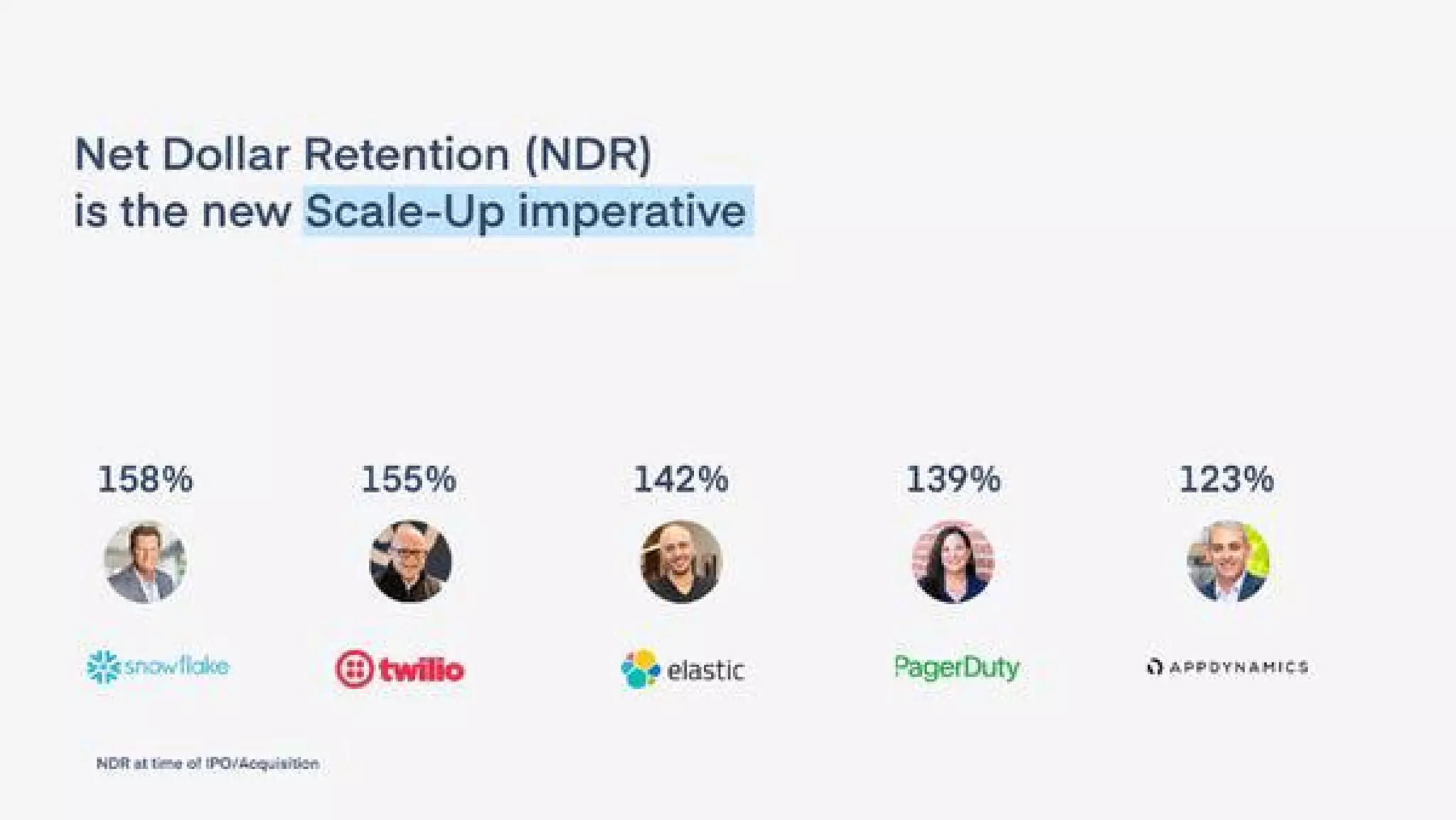
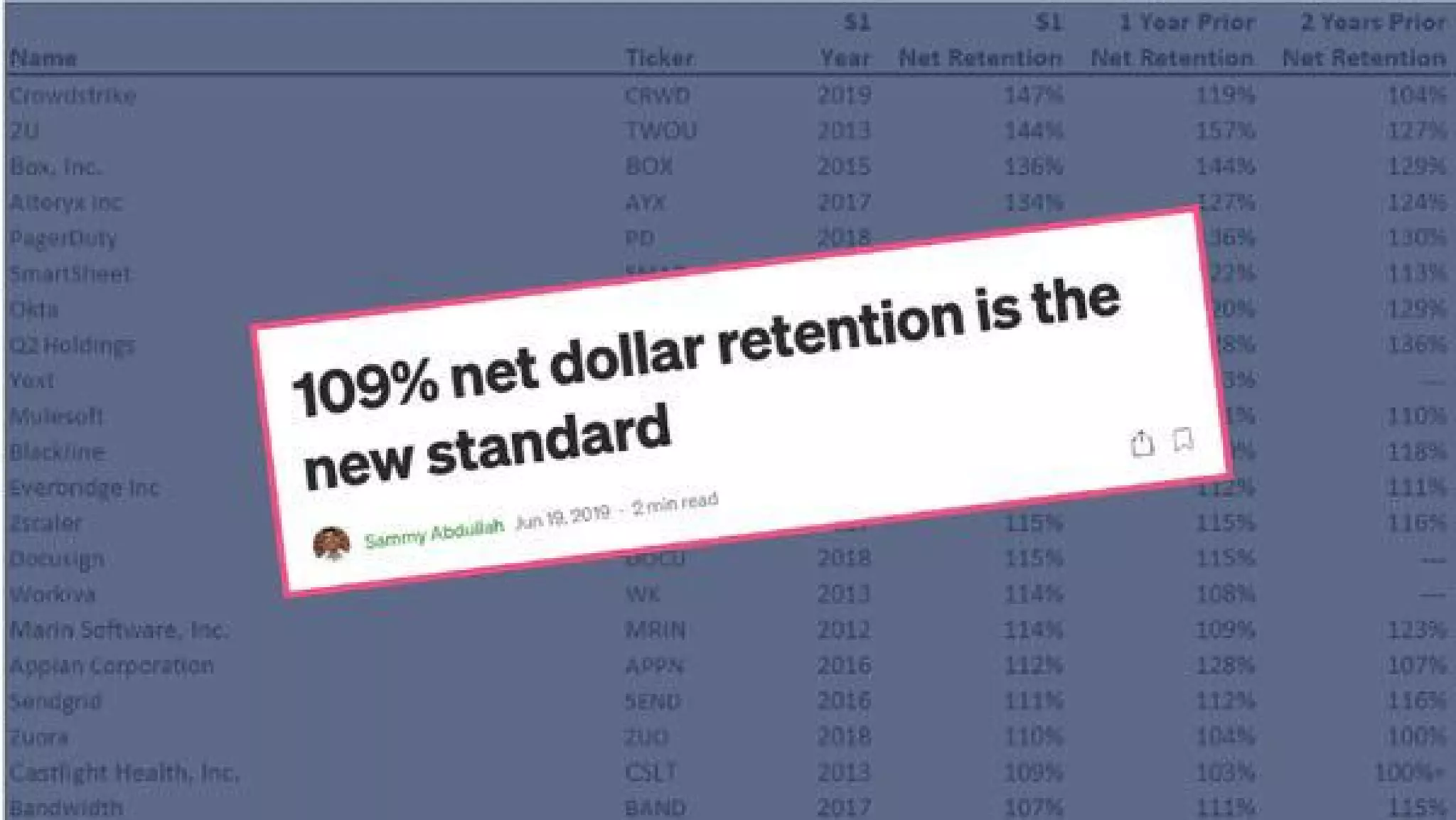
Slide 1 (the NDR headline) immediately foregrounds Net Dollar Retention (NDR) as the new standard and shows market proof that top SaaS IPOs achieved very high NDRs. This is effective because it converts a financial KPI into a strategic goal for founders and investors — not just a number to report. By opening with NDR, the deck reframes the conversation from top-line growth to the quality and sustainability of revenue.

Founders should note how anchoring a deck around one compelling metric focuses the rest of the narrative: problem definition, product features, and case studies all become naturally tied to helping customers move that metric. Showing representative high-NDR companies also gives social proof and positions Paddle as part of a defensible playbook for scaling SaaS.

Key Takeaway: Pick one investor-relevant metric and structure your entire pitch around how your product moves that metric.
Define the Concept: What is NDR and How to Calculate It

Define the Concept: What is NDR and How to Calculate It

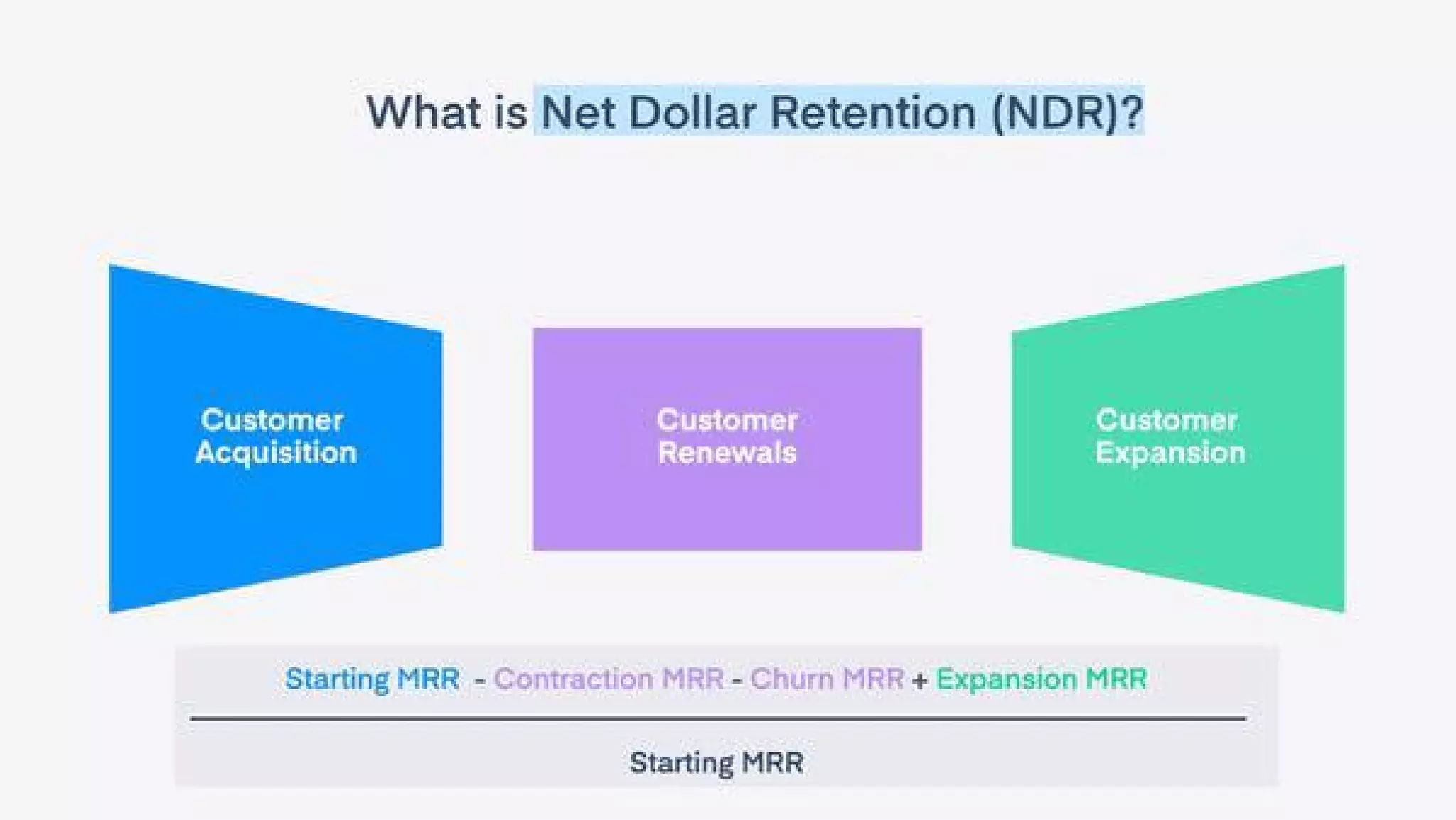
Slide 2 defines Net Dollar Retention, breaking it into customer acquisition, renewals, and expansion components with a simple formula (Starting MRR - Contraction MRR - Churn MRR + Expansion MRR) / Starting MRR. This educational slide is valuable because it converts an abstract KPI into actionable levers the audience can understand and measure. The visual separation into three business functions (acquisition, renewals, expansion) connects product and go-to-market implications directly to the math.

This teaches founders the power of decomposing a KPI into levers: investors like to see not just a target number but the mechanisms that will produce it. The slide’s clarity also signals that the team understands both the technical and commercial sides of SaaS monetization — important credibility early in a deck.

Key Takeaway: Explain the core metric mathematically and map it to the operational levers your product affects.
Problem Framing: Revenue Delivery Infrastructure is Broken

Problem Framing: Revenue Delivery Infrastructure is Broken

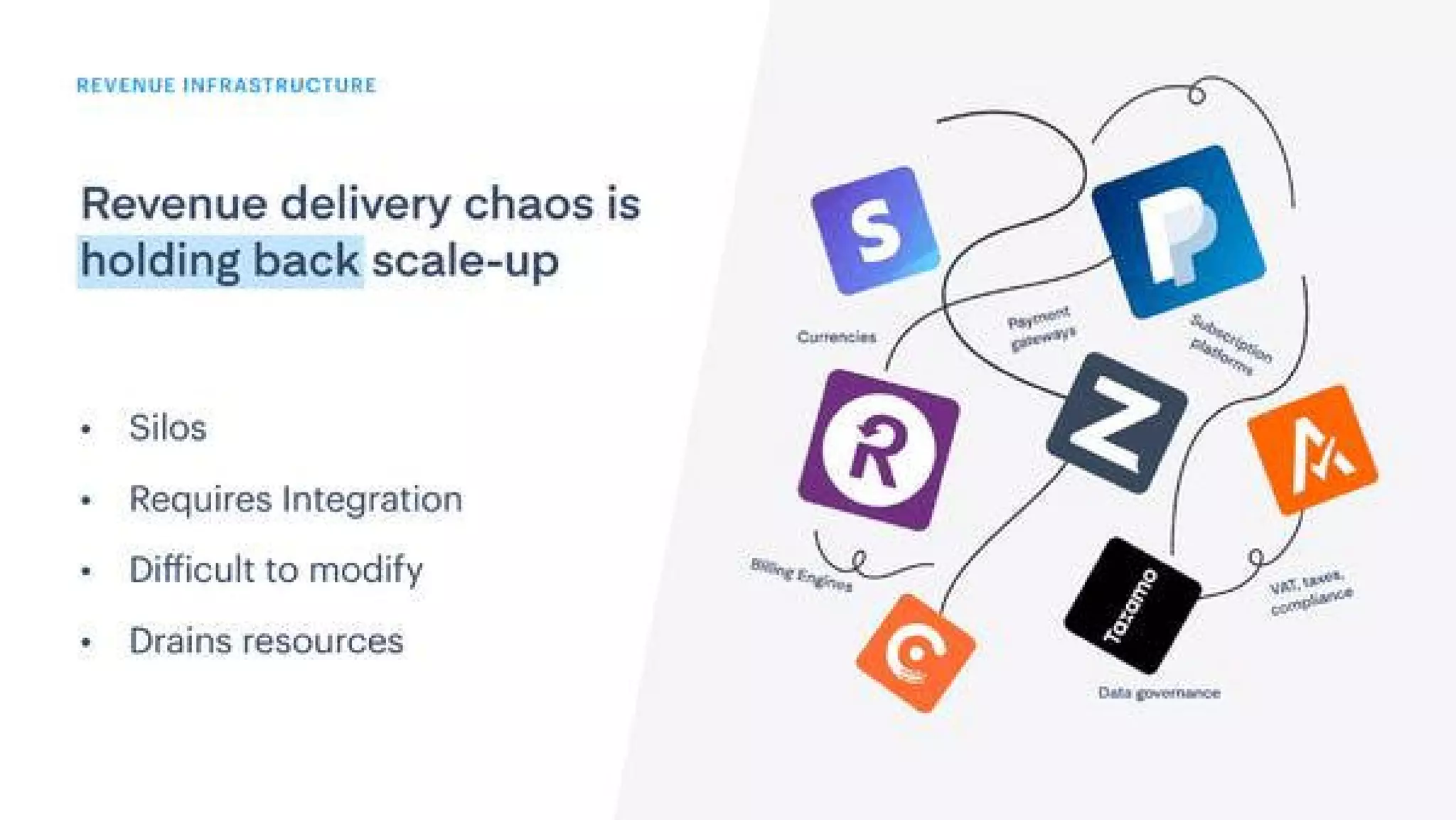
Slide 7 and surrounding slides articulate the problem: modern revenue infrastructure is fragmented, siloed, hard to modify, and drains resources. The imagery of tangled integrations (payment gateways, billing engines, compliance tools) plus explicit bullets (silos, requires integration, difficult to modify, drains resources) makes the pain concrete. Rather than burying the problem in jargon, the deck shows operational consequences that executives and engineers both recognize.

Founders should learn how Paddle ties a technical operations problem to a strategic business outcome (NDR). Effective problem framing connects everyday developer pain to executive KPIs — that dual-level framing increases urgency and expands the set of decision-makers who will care.

Key Takeaway: Make the problem tangible for both technical and business audiences by linking operational pain to financial impact.
Solution Overview: Why a Revenue Delivery Platform

Solution Overview: Why a Revenue Delivery Platform

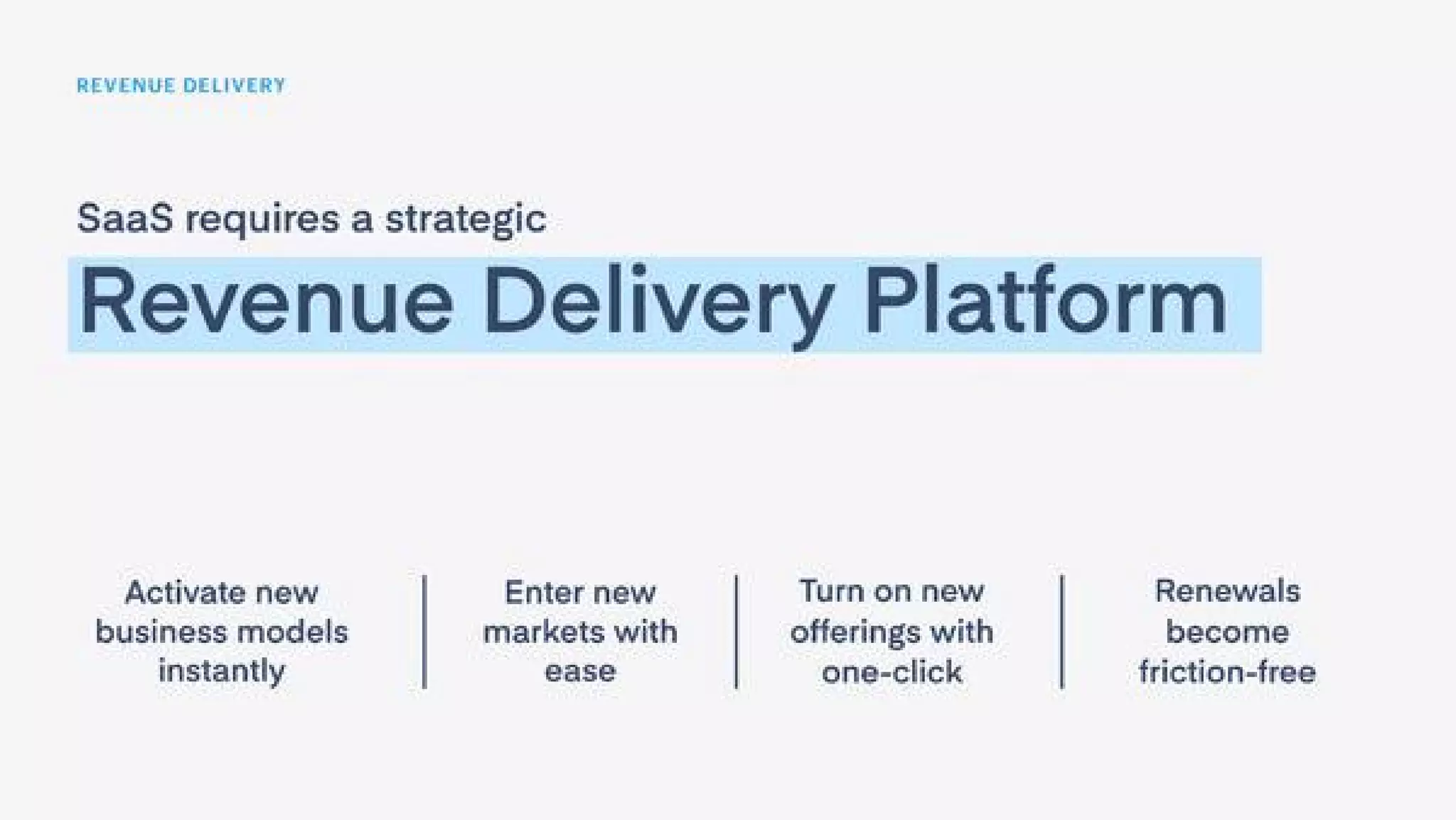
Slide 8 (SaaS requires a strategic Revenue Delivery Platform) outlines the benefits founders and product teams get from a platform solution: activate new business models quickly, enter new markets, turn on offerings with one click, and frictionless renewals. These benefit-led bullets are short, outcome-focused, and directly address the levers in the NDR formula (expansion, renewals). The slide reframes the product as strategic infrastructure rather than a piecemeal integration.

The lesson for founders is to translate technical capabilities into business outcomes. Product features should be framed as enablers of metrics and growth motions (e.g., faster go-to-market, easier upsell) so investors see the path from product to scale.

Key Takeaway: Frame features as strategic enablers of business outcomes — not just technical improvements.
Product Architecture: Clear, Modular, Platform-Centric Diagram

Product Architecture: Clear, Modular, Platform-Centric Diagram

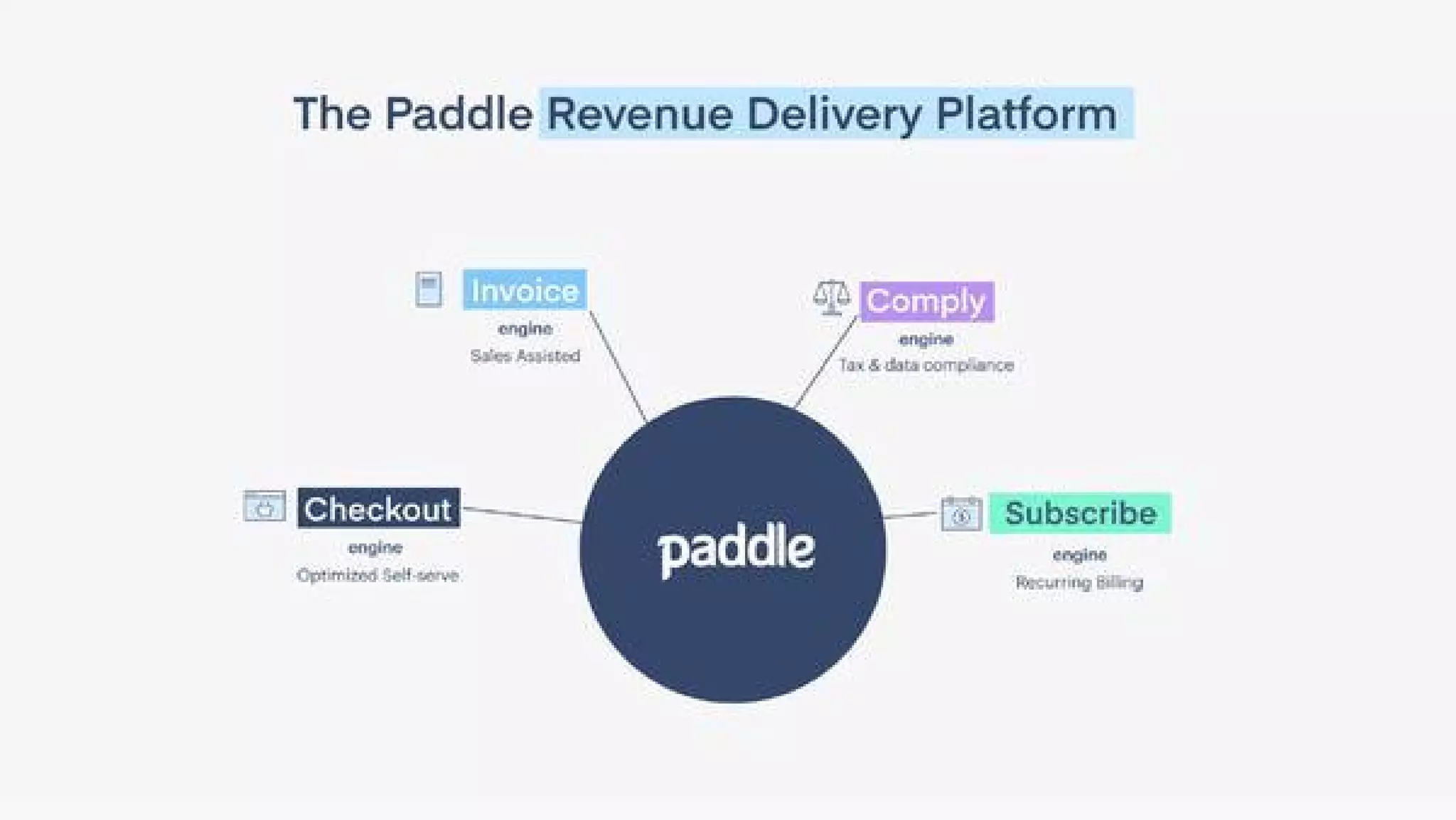
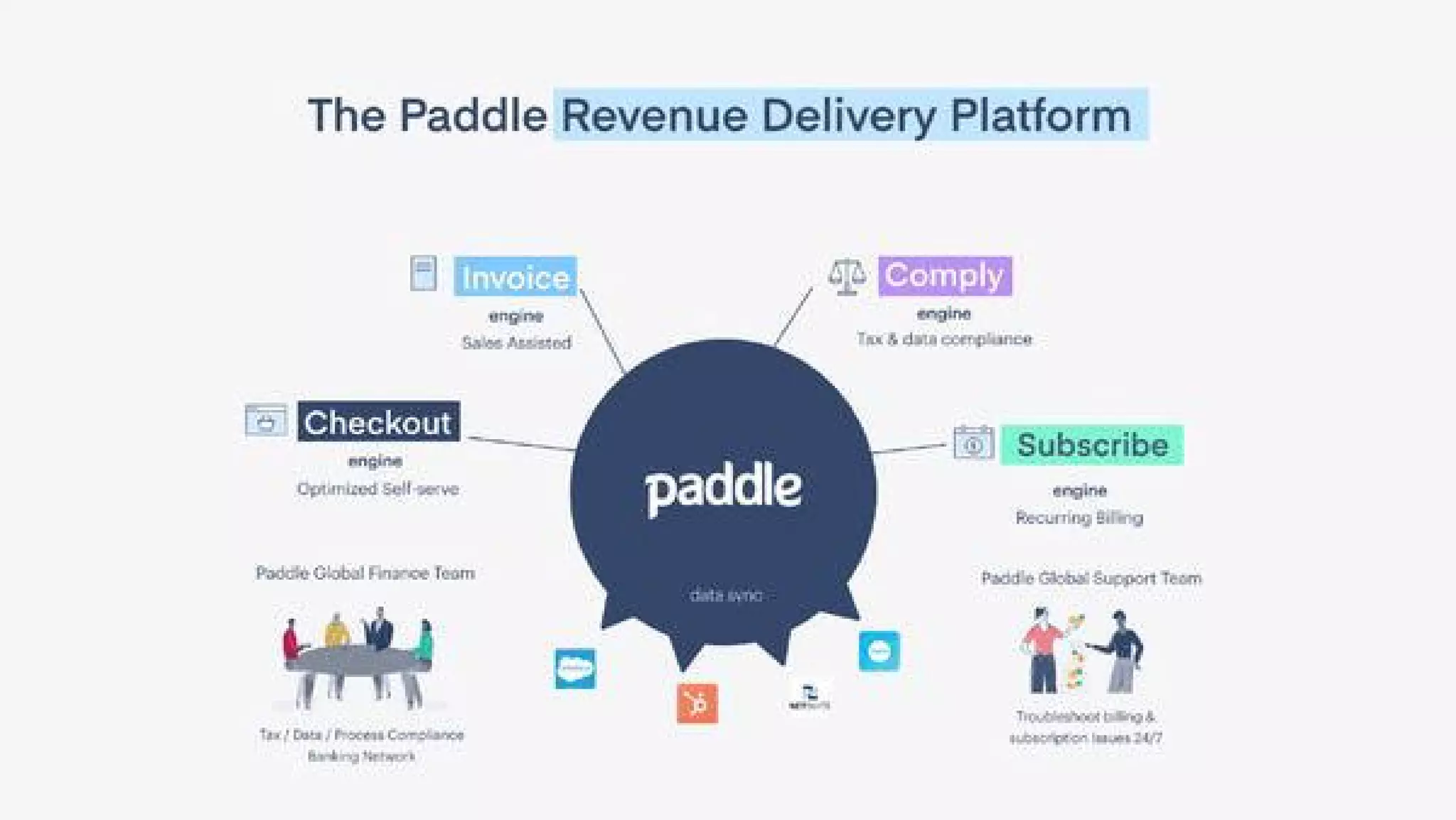
Slide 12 presents Paddle’s product map: a central Paddle platform with engines for Checkout, Invoice, Subscribe, and Comply. The spoke-and-hub diagram visually communicates modularity and that Paddle centralizes data and processes while exposing discrete capabilities. This helps buyers and investors quickly grasp scope and extensibility: you can adopt one engine or the whole platform.

For founders, this demonstrates the value of a visual product architecture: show how components fit, where value consolidates (data and compliance), and how incremental adoption is possible. A clear diagram reduces technical skepticism and supports sales conversations by mapping product capabilities to buyer needs.

Key Takeaway: Use a simple hub-and-spoke diagram to convey modular architecture and incremental adoption paths.
Proof: Early Customer Outcomes & Use Cases

Proof: Early Customer Outcomes & Use Cases

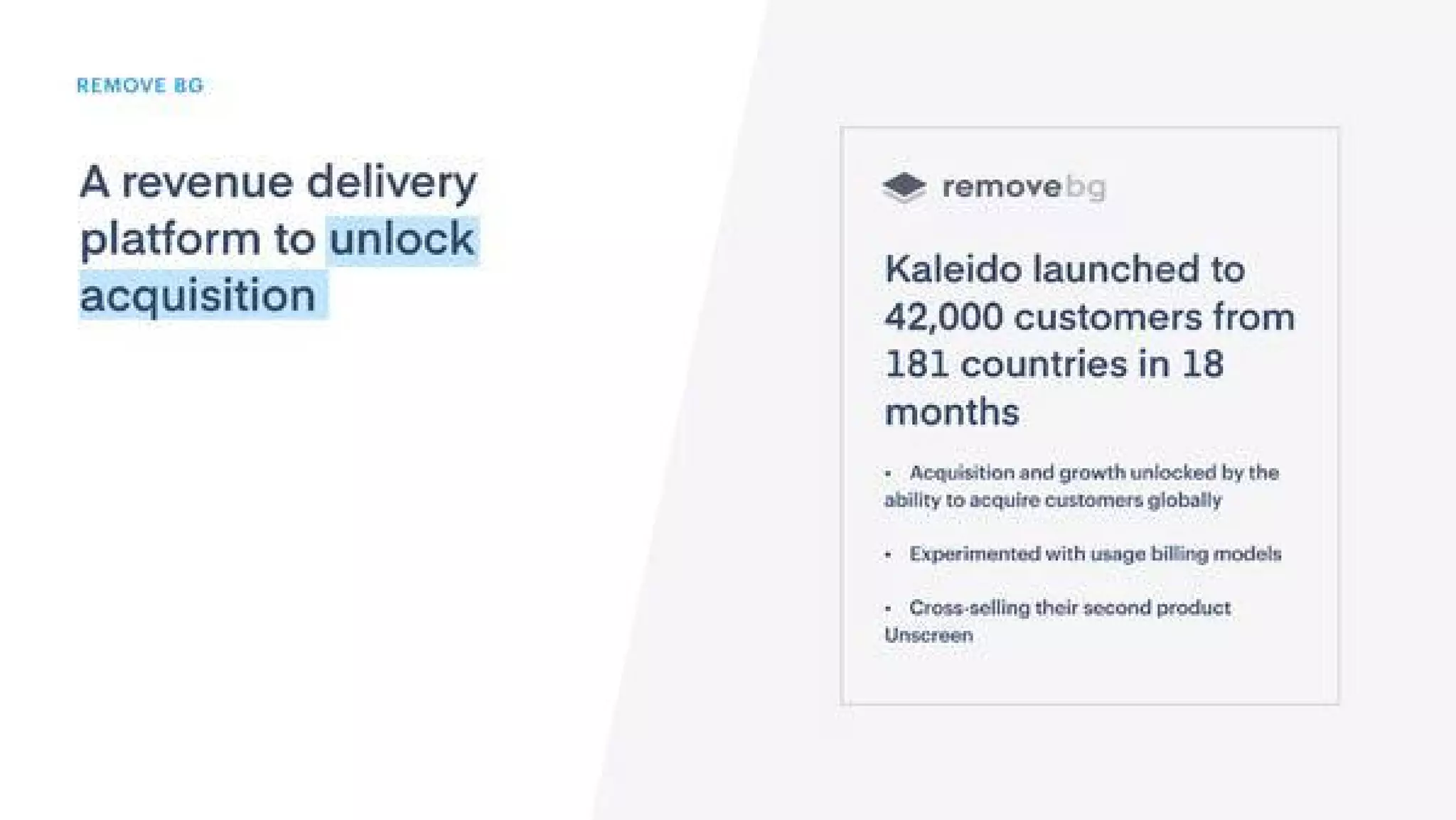
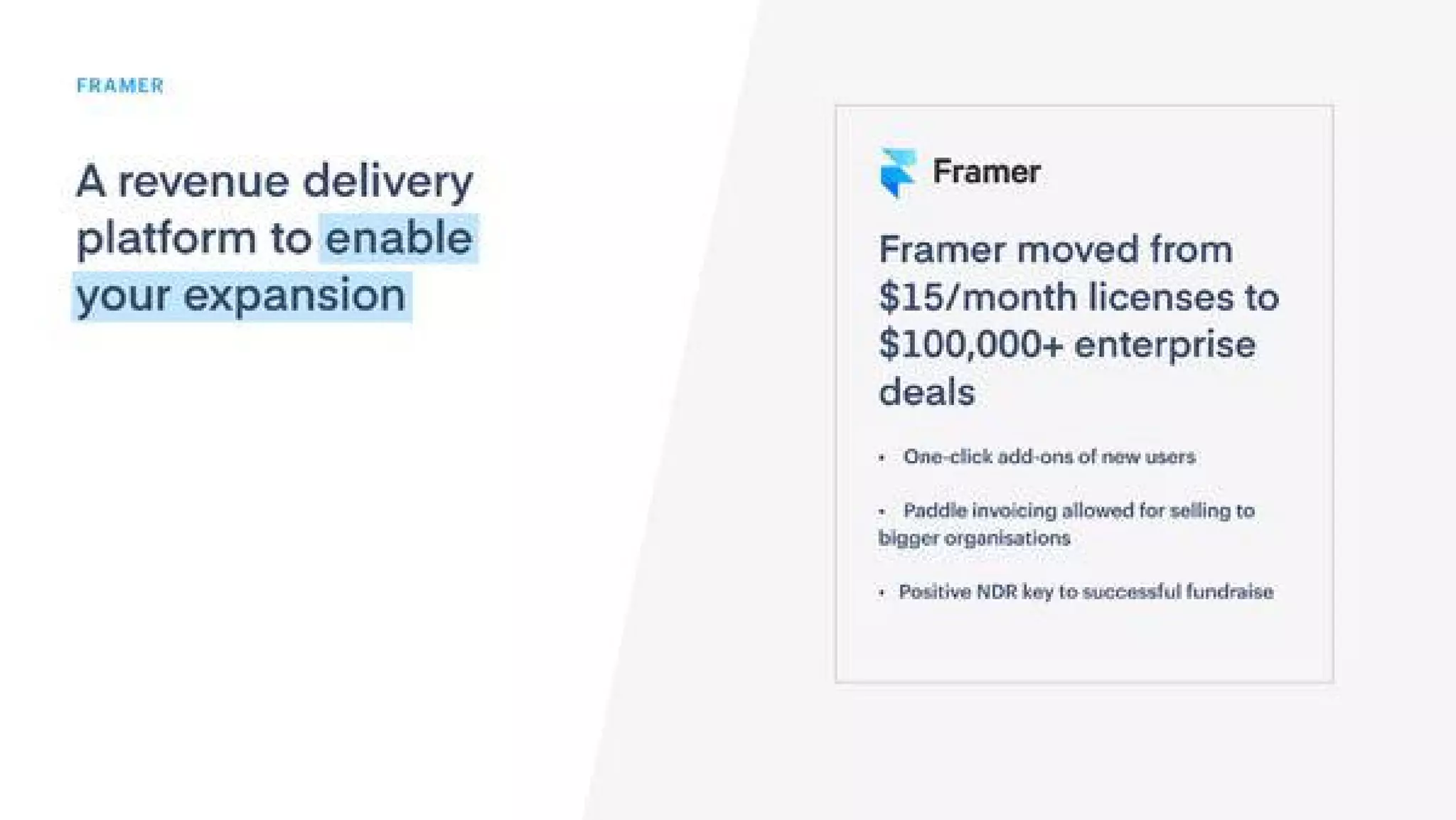
Slide 10 (case study examples such as Remove.bg and Framer on slides 10/11 in the deck sequence) highlights concrete customer outcomes — rapid global customer acquisition and moving from low-touch pricing to enterprise deals. These short anecdotes validate the product claims with real-world metrics (e.g., customers and time-to-scale) and show different ways the platform unlocked growth: acquisition, new pricing models, and enterprise expansion.

Founders should use concise, quantifiable customer stories to prove traction. Pick examples that map to the key levers you promise to move (e.g., expansion revenue, enterprise ARR) and present the before/after impact with simple numbers or milestones.

Key Takeaway: Include short, numeric customer stories that map directly to the core metric your product improves.

Conclusion: Key Lessons

Paddle’s Series A deck is effective because it centers a single investor-relevant metric (NDR), demonstrates a credible problem that spans technical and business stakeholders, and shows a modular product that directly links to the metric’s levers. The visual language is consistent — bold positioning, simple formulas, clear architecture diagrams, and bite-sized case studies — which makes the narrative easy to follow and persuasive. For founders: pick one powerful metric, teach the audience how it’s calculated, show the operational friction that prevents progress, and then explain precisely how your product removes that friction and produces measurable outcomes. Use diagrams to convey product architecture and short customer stories with numbers to validate claims. Finally, make your positioning explicit early so every subsequent slide reinforces the same high-level thesis.

Full Deck Analysis

11 sections

Overview

Company: Paddle
Round: Series A ($150K)
Year: 2012
Outcome: Valued at $1.4B after Series D (2022)

Executive Summary

Paddle’s Series A deck frames a clear, high-impact problem: modern SaaS companies can’t scale revenue predictably because revenue infrastructure is fragmented and fragile. The pitch proposes a unified “Revenue Delivery Platform” (checkout, subscriptions, invoicing, compliance) and backs the concept with concrete customer case studies (remove.bg, Framer) and industry benchmarks (Net Dollar Retention numbers). The deck is notable for focusing on a specific, repeatable pain point for SaaS and for tying product capabilities directly to measurable SaaS outcomes (improved NDR and enterprise expansion).


Problem Statement

How the deck articulates the problem:

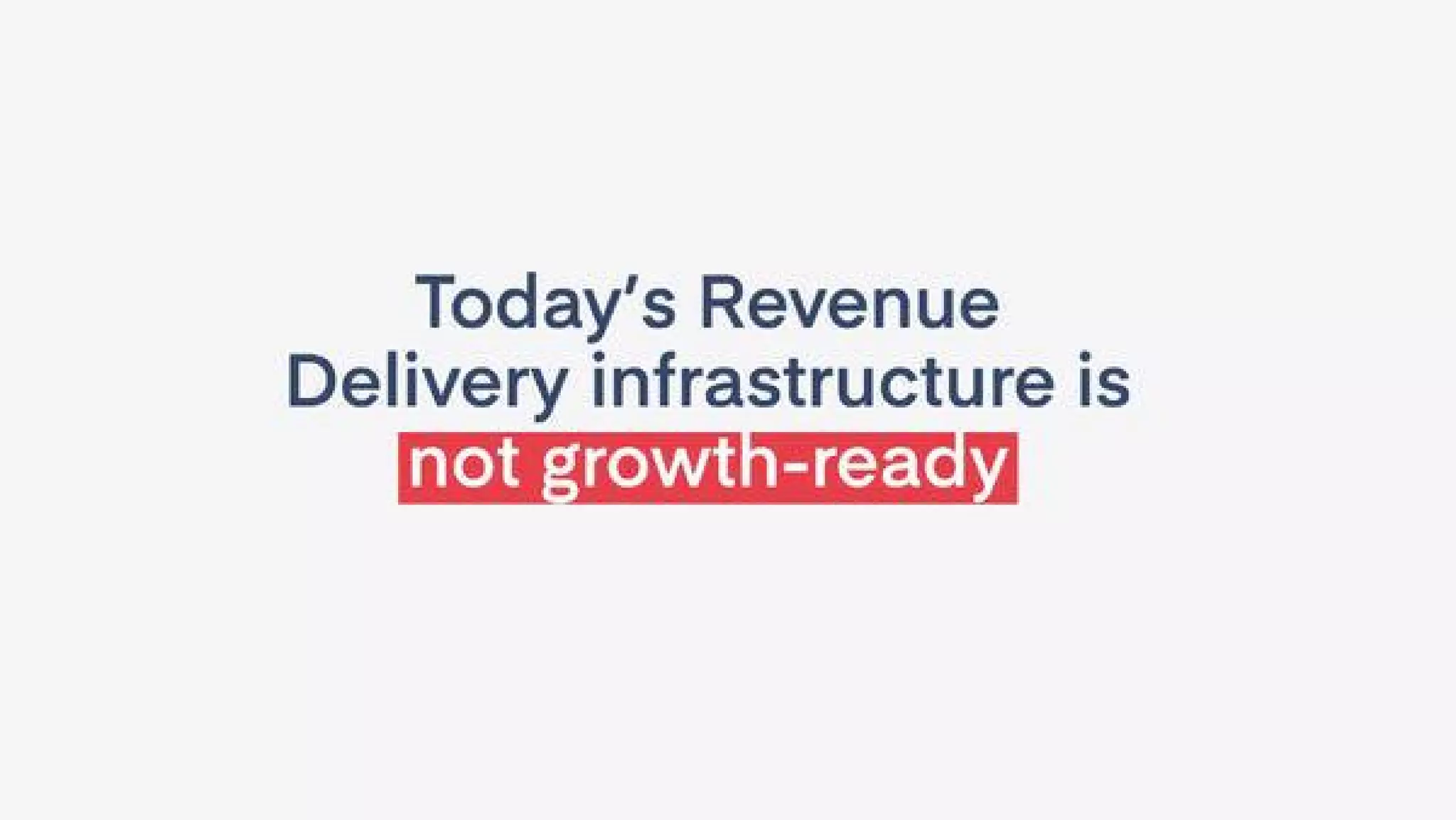
  • Slides 5–8: Clear headline — “Today’s Revenue Delivery infrastructure is not growth-ready” (slide 6). The deck describes the root causes of the problem as:
    • Siloed systems (multiple point solutions) (slide 8)
    • Need for heavy integration work (slide 8)
    • Difficulty modifying existing setups and high resource drain (slide 8)
    • Chaotic revenue stacks (visual on slide 7/8 showing many disconnected services)
  • Slides 2–4 set the strategic context: Net Dollar Retention (NDR) is critical for scale-up success and top SaaS IPOs had very high NDR (slides 2–4). The implied problem: disconnected revenue tooling prevents companies from achieving high NDR and scale.

Solution

How the deck positions the solution:

  • Introduces the concept of a single, strategic “Revenue Delivery Platform” (slides 9 and 12–14).
  • Core platform capabilities highlighted:
    • Checkout engine (optimized self-serve) (slides 13–14)
    • Subscribe engine (recurring billing) (slides 13–14)
    • Invoice engine (sales-assisted invoicing) (slide 13)
    • Comply engine (tax and data compliance) (slides 13–14)
    • Operational support: Paddle Global Finance Team and Global Support Team (slide 14)
  • Benefits promised: instant activation of new business models, easy market expansion, one-click enablement of offerings, friction-free renewals (slide 9).
  • Product positioning connects directly to NDR optimization and enterprise expansion (slides 3, 10, 12).

Market Opportunity

TAM / SAM / SOM analysis (what is shown and what is missing):

  • The deck does not present explicit TAM / SAM / SOM numbers. No dollar-sized market slides were included in the provided images.
  • The market narrative is implicit: target customers are SaaS businesses seeking global scale, improved NDR and enterprise expansion (slides 3, 9, 11–12).
  • The use of NDR benchmarks and case studies suggests the addressable market is broad across SaaS vendors (from small self-serve to enterprise).

(Conclusion: market sizing is not quantified in the slides provided. Investors would have to infer large TAM from the breadth of SaaS companies referenced.)


Business Model

Revenue model and unit economics (based on what’s shown / implied):

  • The deck does not show explicit pricing, ARPU, margin, CAC, LTV, or other unit-economics tables.
  • Implied commercial sources:
    • Transaction / checkout fees for self-serve sales (Checkout engine)
    • Subscription billing/recurring-fee services (Subscribe engine)
    • Invoicing/sales-assisted revenue capture (Invoice engine)
    • Value-added compliance & support services (Comply engine, Global Finance/Support teams)
  • Positioning implies a platform/transactional + service model (platform fees + support/invoice services), but no concrete pricing or economics figures are in the slides.

Traction & Metrics

Growth metrics and proof points shown:

  • Industry NDR benchmarks used as evidence of importance:
    • Snowflake: 158% NDR (slide 4)
    • Twilio: 155% NDR
    • Elastic: 142% NDR
    • PagerDuty: 139% NDR
    • AppDynamics: 123% NDR
      (These are shown on slides 3–4 to demonstrate NDR as a scale metric.)
  • Customer case studies (slides 11–12):
    • remove.bg / Kaleido: “Launched to 42,000 customers from 181 countries in 18 months” (slide 11) — concrete adoption metric.
    • Framer: “Moved from $15/month licenses to $100,000+ enterprise deals” (slide 12) — evidence of enabling enterprise expansion / higher ACV.
  • Funding traction:
    • Raised $150K in Series A (from the context you provided).
  • No explicit MRR/ARR, churn, CAC, LTV or growth curves are presented in the slides.

Competitive Positioning

How they differentiate:

  • Single platform vs. point-solution ecosystem: Paddle’s main differentiation is being an integrated Revenue Delivery Platform covering checkout, subscriptions, invoicing and compliance (slides 12–14).
  • Operational services: Paddle emphasizes not just software but a global finance and support team to handle compliance, billing issues and enterprise needs (slide 14).
  • Outcome focus: they tie product to high-value SaaS outcomes — improved NDR, faster enterprise expansion, global Day One capability (slides 3, 9, 10).
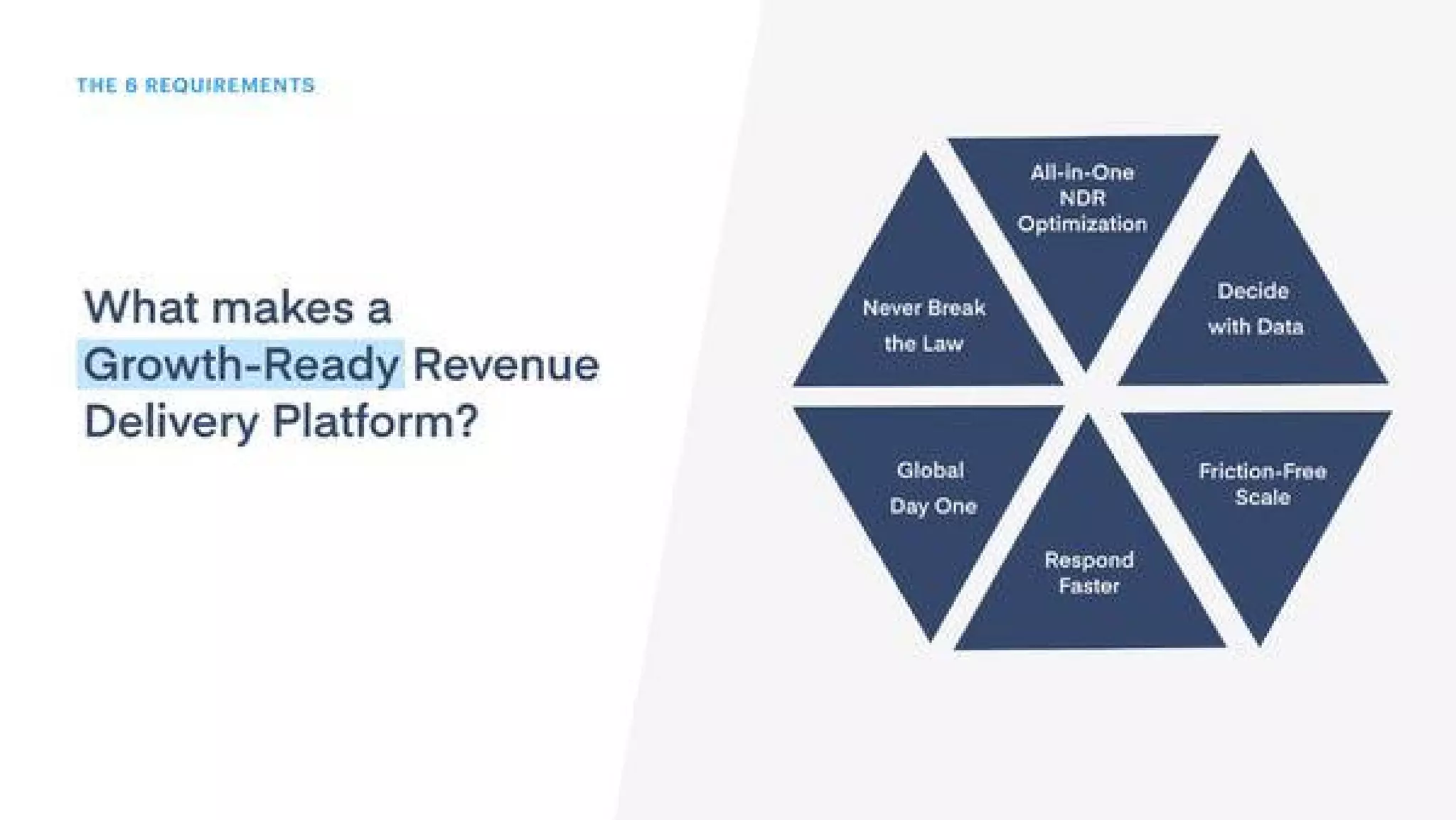
  • Messaging centers on removing integration friction and legal/compliance risk (“Never Break the Law”, “Global Day One”, slide 10).

Team

Team credentials (slide evidence):

  • The provided slide images do not include a visible team slide or founder bios. The deck emphasizes product and customer outcomes but does not show founder backgrounds or team credentials in the slides we saw.
  • (Investor view: team detail is missing from the shown images and would be a critical addendum in a live pitch.)

Go-to-Market Strategy

Distribution approach if shown:

  • GTM is implied rather than detailed:
    • Self-serve acquisition via Checkout engine for smaller customers (slide 13).
    • Sales-assisted invoicing and enterprise enablement for larger deals (Invoice engine; Framer case study shows enterprise upsell, slide 12).
    • Positioning for global customer acquisition (remove.bg example; “Global Day One” requirement on slide 10).
    • No explicit channel partnerships, sales motion details, or CAC figures are shown.
  • Messaging suggests a product-led + sales-assisted hybrid GTM: self-serve checkout for viral acquisition + sales/invoicing for enterprise.

The Ask

What they were raising and use of funds:

  • The deck was for a Series A and the company raised $150K (you provided). The slides shown do not contain a specific “ask” slide or use-of-funds breakdown in the images provided.
  • (Investor view: the deck lacks explicit breakdown of how the raise would be used — product development, hiring, GTM, etc. — at least in the slides shown.)

Investor Deep Dive

Executive summary, strengths & red flags

Executive Summary

Paddle’s Series A deck frames a clear, high-impact problem: modern SaaS companies can’t scale revenue predictably because revenue infrastructure is fragmented and fragile. The pitch proposes a unified "Revenue Delivery Platform" (checkout, subscriptions, invoicing, compliance) and backs the concept with concrete customer case studies (remove.bg, Framer) and industry benchmarks (Net Dollar Retention numbers). The deck is notable for focusing on a specific, repeatable pain point for SaaS and for tying product capabilities directly to measurable SaaS outcomes (improved NDR and enterprise expansion).

Key Strengths

3 identified

1

Strong problem-to-solution narrative tied to a measurable SaaS KPI (NDR)

2

Compelling, concrete case studies that show tangible outcomes

3

Product clarity and modular platform design

Red Flags & Weaknesses

3 identified

1

Lack of quantified market sizing (TAM/SAM/SOM)

2

Missing unit economics and financial metrics

3

Team & ask details absent from slides shown

More Pitch Decks To Study

Compare structure, fundraising context, and investor-facing story across similar startup decks.