Compare your deck to Instacart

Compare Your Deck

Instacart Pitch Deck (2013)

Marketplace
Stage: Various
Raised: Multiple
Year: 2013
Slides: 20
Outcome: IPO at $10B valuation

Pitch Deck

1 / 20
Instacart pitch deck - Opening: Brand and Signal
Click to expand

Deck Analysis

This deck summarizes Instacart's early story: a focused consumer marketplace that connected urban customers, freelance shoppers, and local stores to deliver groceries quickly. It combines crisp positioning, visual fundraising milestones, a clear articulation of users and operations, and candid discussion of operational crises and strategic partnerships. Notable is how the deck balances product messaging with investor-facing signals (funding timeline, lead backers) and operational detail that demonstrates the unit economics and feasibility of the marketplace model.

Opening: Brand and Signal

Opening: Brand and Signal

The first slide is a stripped-down title slide that combines the Instacart logo with the subtitle 'Lessons From The Past'. Its minimalism underscores brand recognition and sets a retrospective, learning-focused tone. For investors and partners who already know the company, this approach signals confidence and avoids wasting real estate on obvious background.

Key Takeaway: Open with a strong, recognizable brand mark and a concise framing line to set tone and credibility immediately.
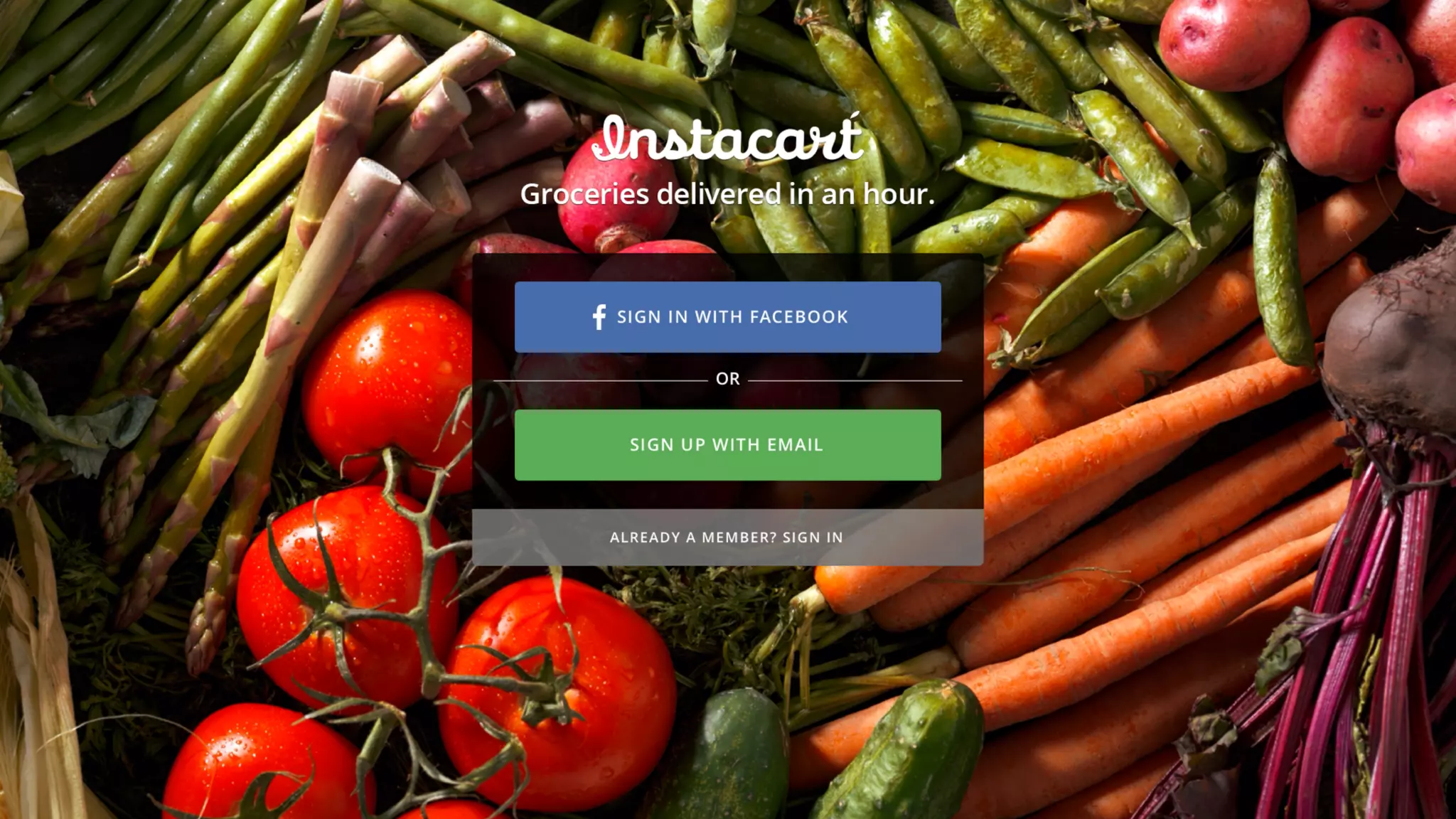
Product: Clear Value Proposition and Low-friction Signup

Product: Clear Value Proposition and Low-friction Signup

The product screenshot (home/landing) doubles as a one-line value prop: 'Groceries delivered in an hour.' That single sentence instantaneously communicates the core customer benefit and the service's differentiator. The page also centers very simple CTAs (social sign-in and email sign-up) and places them above the fold on a visually rich background, making the conversion path obvious and friction-minimized.
The use of social login as a primary CTA shows consumer-focused product thinking: remove signup friction and increase acquisition velocity. Founders can learn the importance of front-loading the core promise, making the action obvious, and using strong visuals that reinforce product category and quality (fresh produce in this case).

Key Takeaway: Lead with a single, benefit-driven sentence and make the signup path extremely low-friction to convert first-time visitors.
Fundraising Timeline: Milestones and Momentum

Fundraising Timeline: Milestones and Momentum

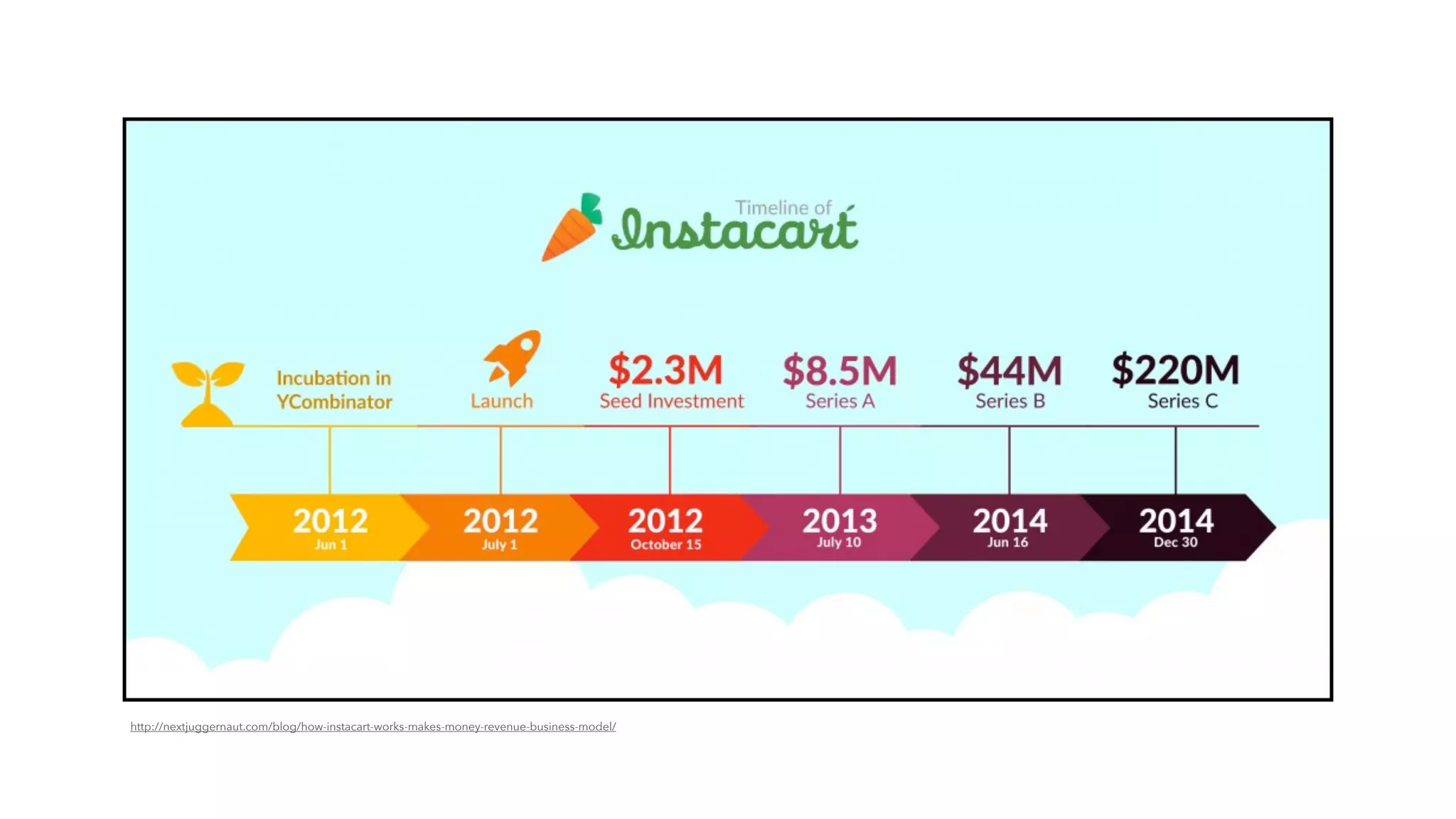
The timeline slide visualizes early milestones and the cadence of funding rounds. It compresses complex fundraising history into an easily digestible graphic showing incubator involvement, launch, seed, and successive series raises. Visual timelines do double duty: they tell a narrative of momentum and make it easy for later-stage investors to understand how capital was deployed over time.
Founders should note how the slide frames credibility through both dates and amounts; the visual reinforces rapid progress and helps justify valuation and future capital asks. For presentation decks, a clear timeline replaces verbose spreadsheets and gives context for growth claims.

Key Takeaway: Use a compact timeline to show fundraising and operational milestones so investors can quickly grasp your tempo and credibility.
Investor and Round Details: Transparency About Backers

Investor and Round Details: Transparency About Backers

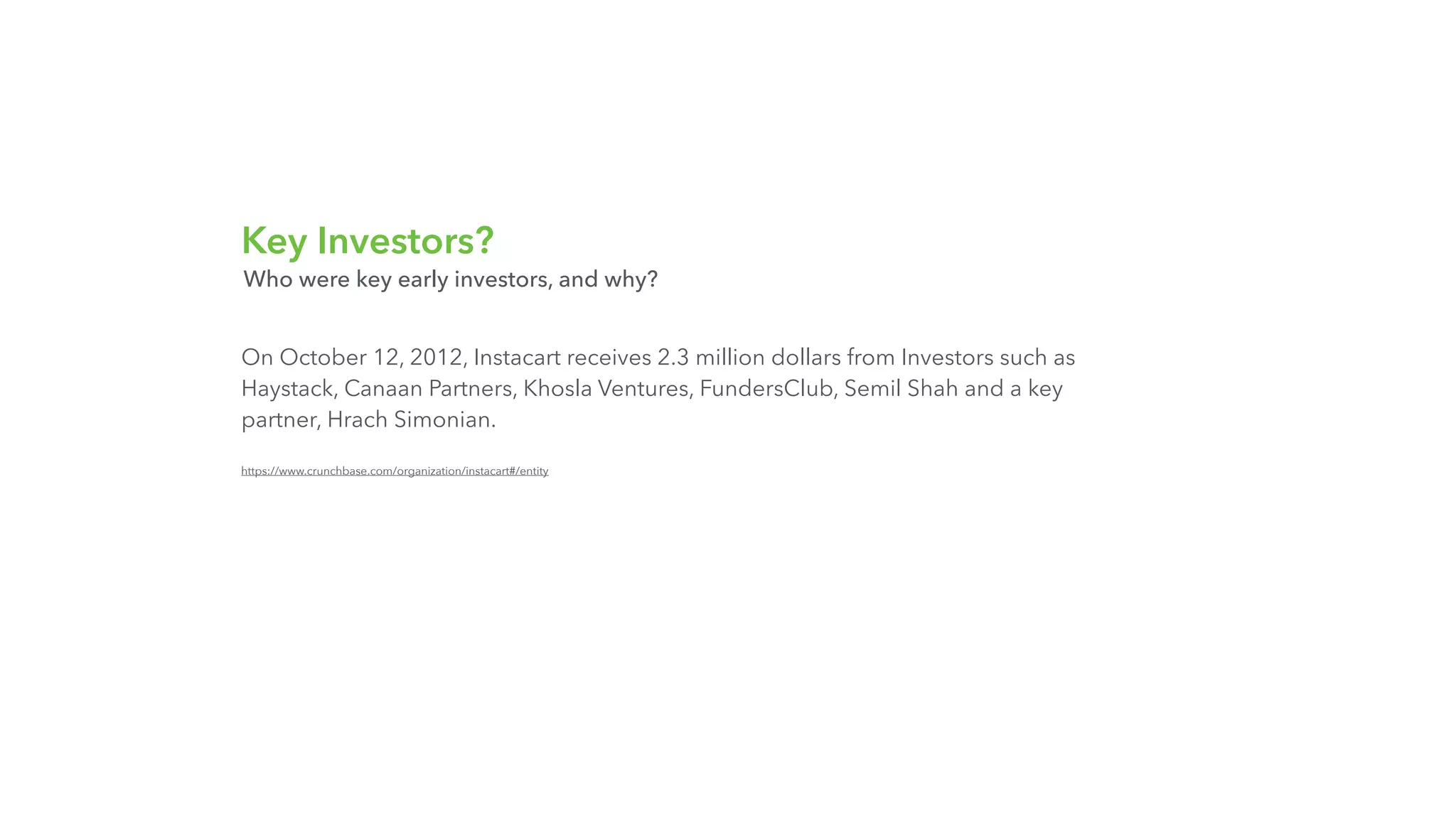
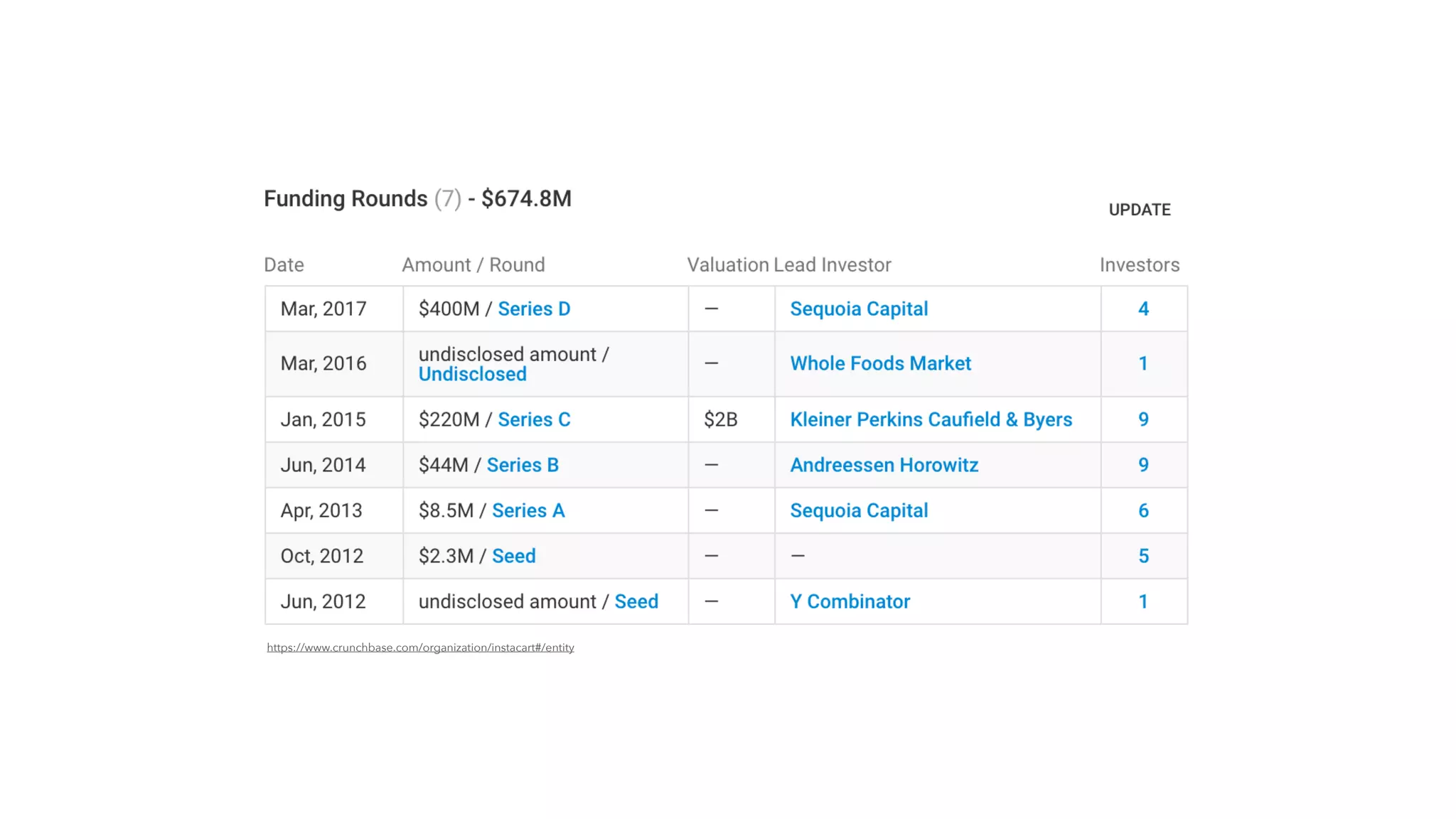
The funding rounds table lists dates, amounts, lead investors, and round types, which communicates institutional validation and the escalation of outside belief. Showing recognizable lead investors and large round sizes signals to readers that the company achieved repeatable conviction from top-tier firms. This is especially important for marketplace businesses that require substantial capital to scale supply-side liquidity and geographic expansion.
The lesson for founders is to clearly document investor pedigree and round details in investor-facing materials; it helps new potential partners understand cap table dynamics, leverage, and the quality of due diligence already performed. Transparency about rounds also reduces questions and builds trust, particularly when there are complex or undisclosed amounts involved.

Key Takeaway: List round dates, amounts, and lead investors to communicate institutional validation and make fundraising history easy to verify.
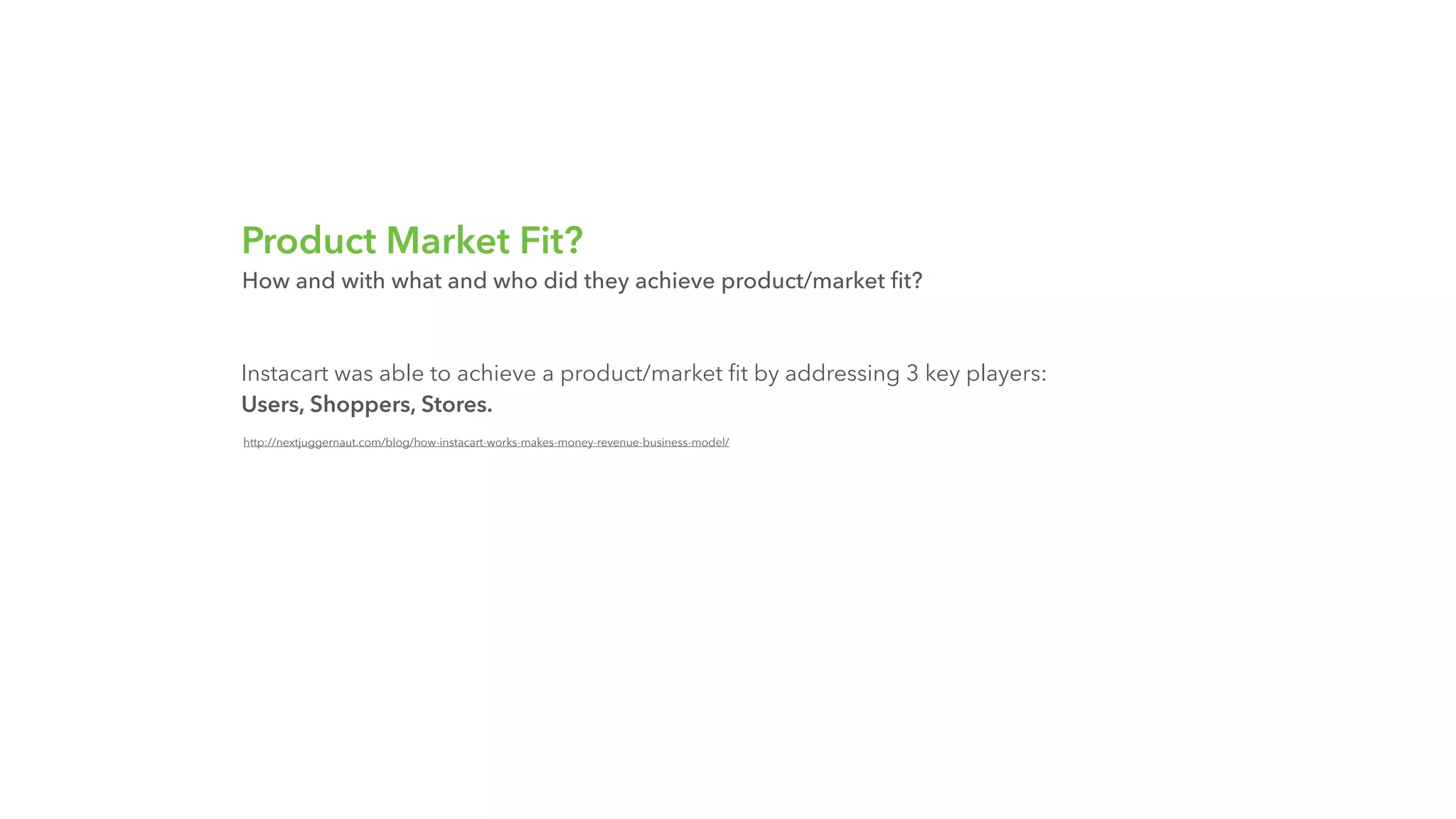
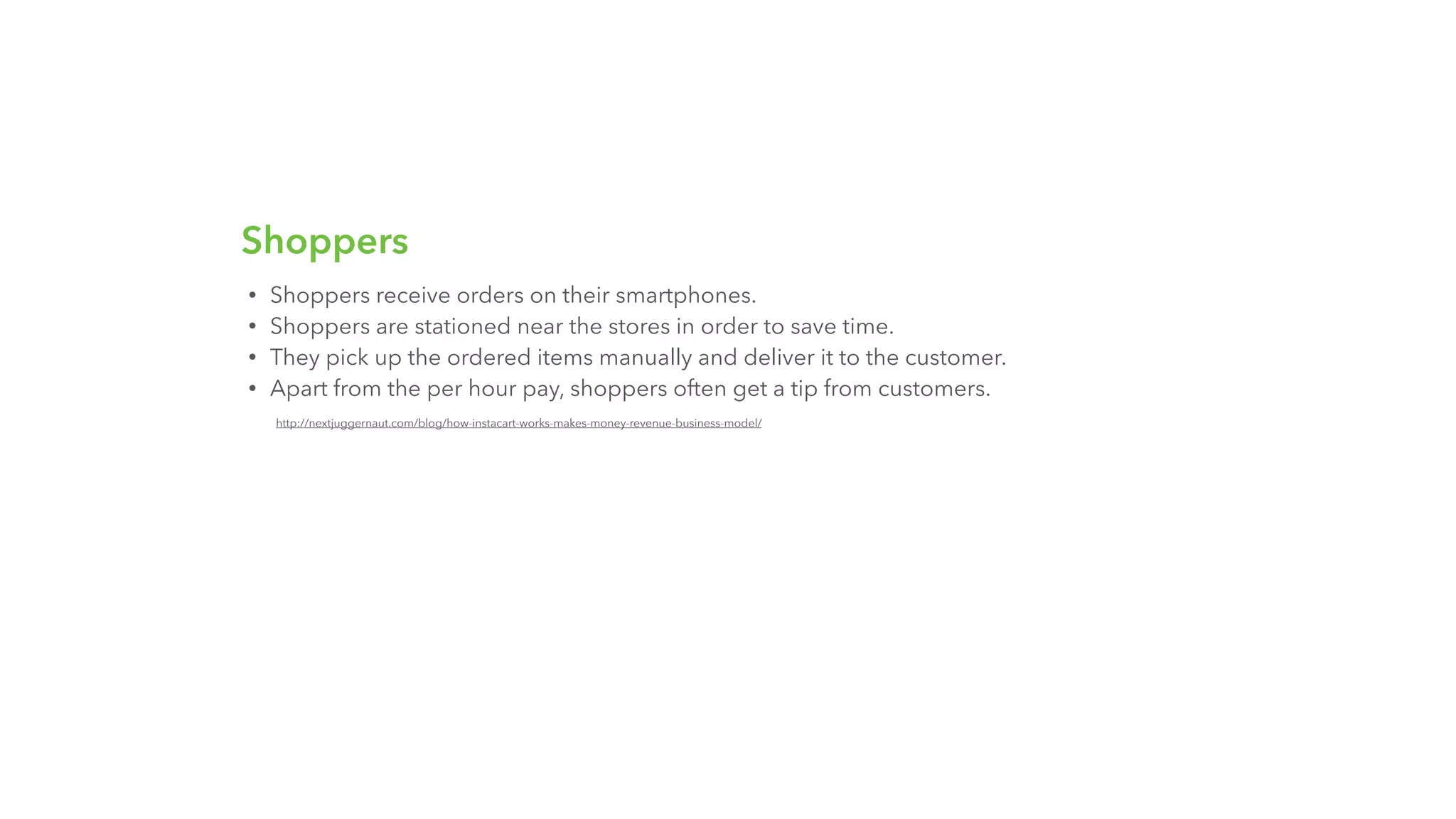
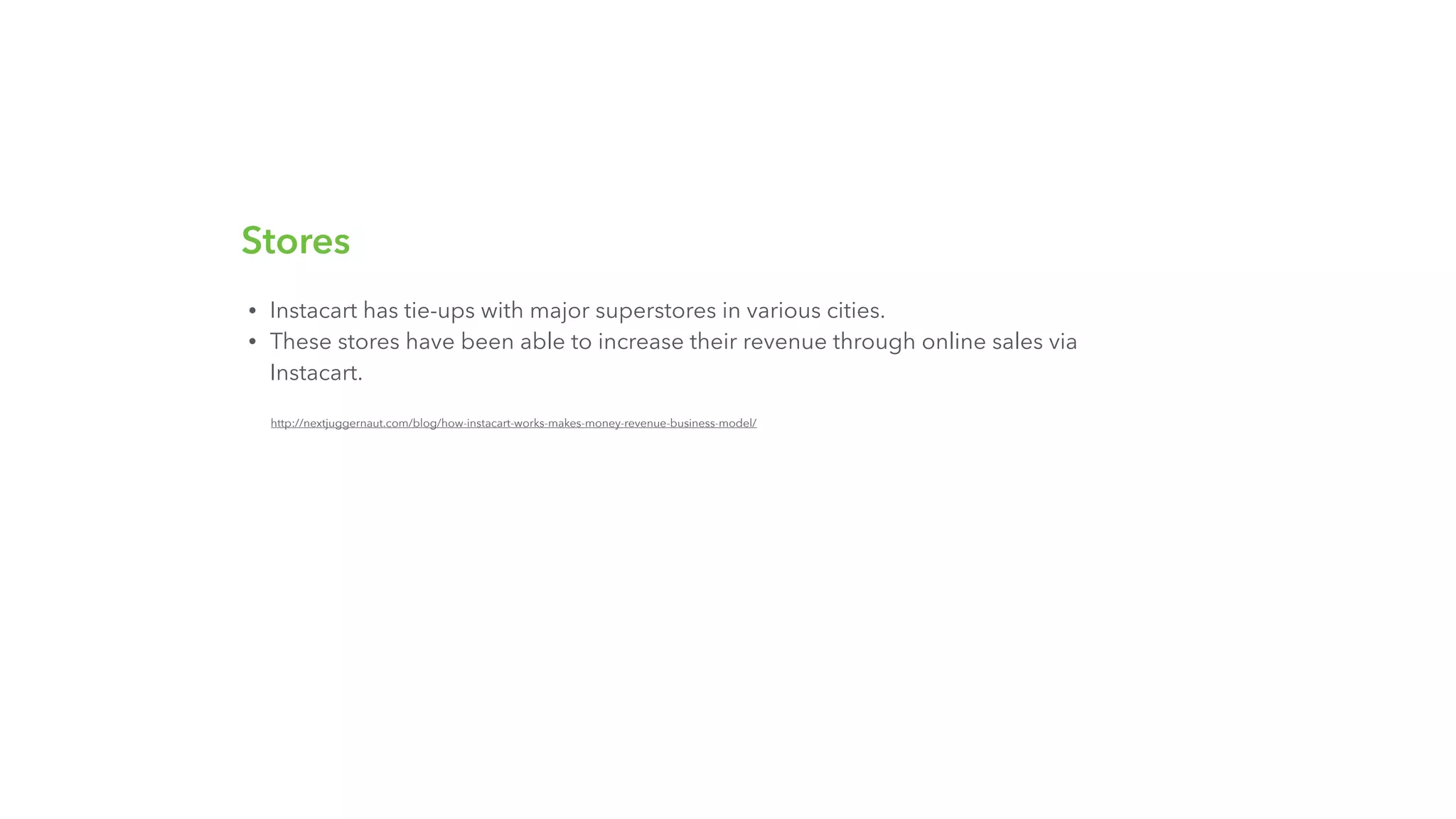
Product-Market Fit: Three-sided Marketplace Focus

Product-Market Fit: Three-sided Marketplace Focus

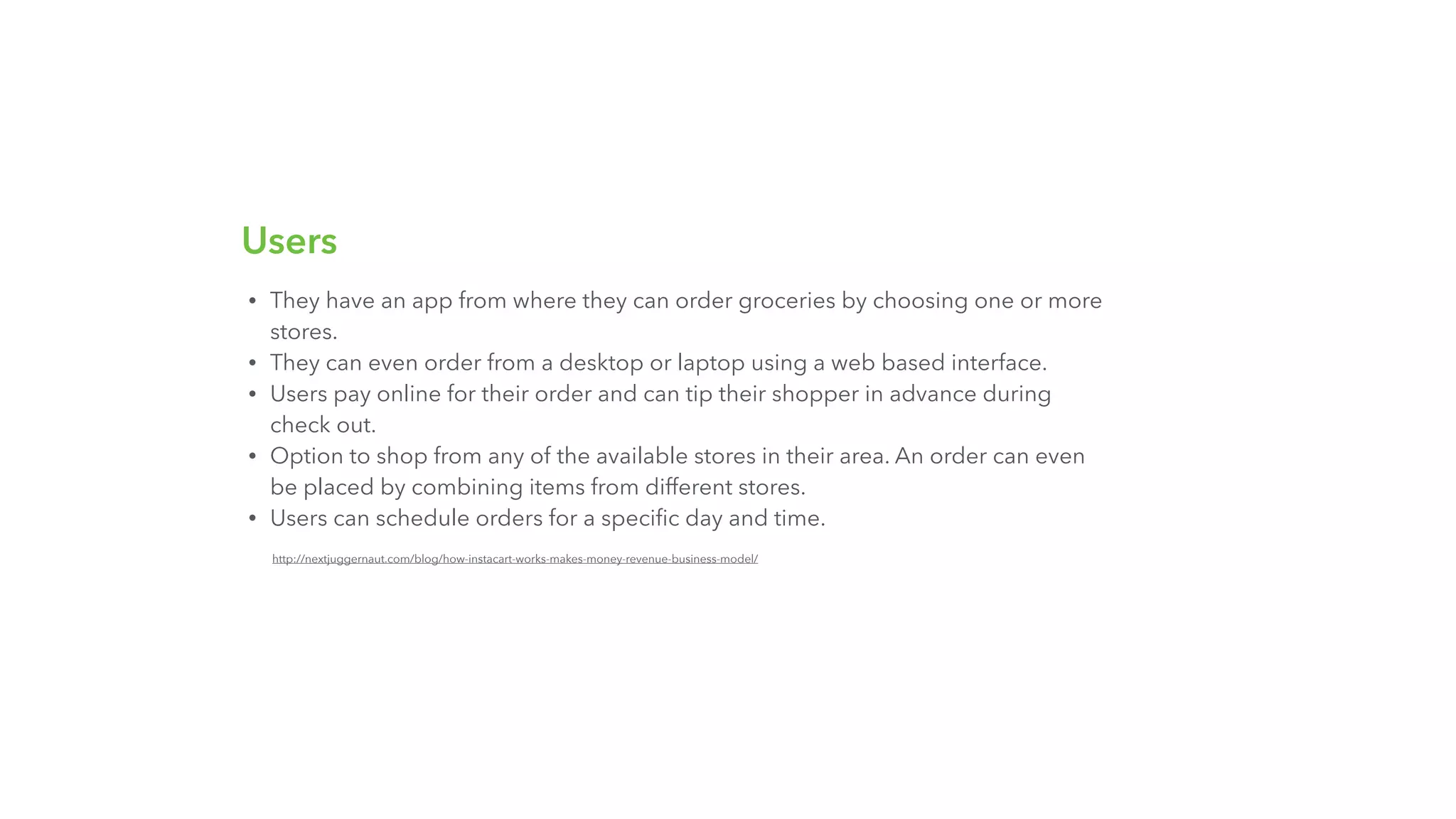
A set of slides explains how Instacart achieved product-market fit by explicitly addressing three players: users, shoppers, and stores. The deck breaks each group's experience down into practical features and operational design choices (mobile ordering, scheduling, shopper payment and tips, in-store partnerships). This three-sided clarity shows the founders understood the interdependent incentives that make a marketplace sticky and operationally possible.
For founders building two- or three-sided marketplaces, the takeaway is to articulate each stakeholder's value proposition and the mechanisms that balance supply and demand. Practical details (e.g., shoppers stationed near stores, tip options) show how product design solves real friction points and should be highlighted to demonstrate operational maturity.

Key Takeaway: Explicitly map each marketplace participant and show concrete product features or operational decisions that solve their core problems.
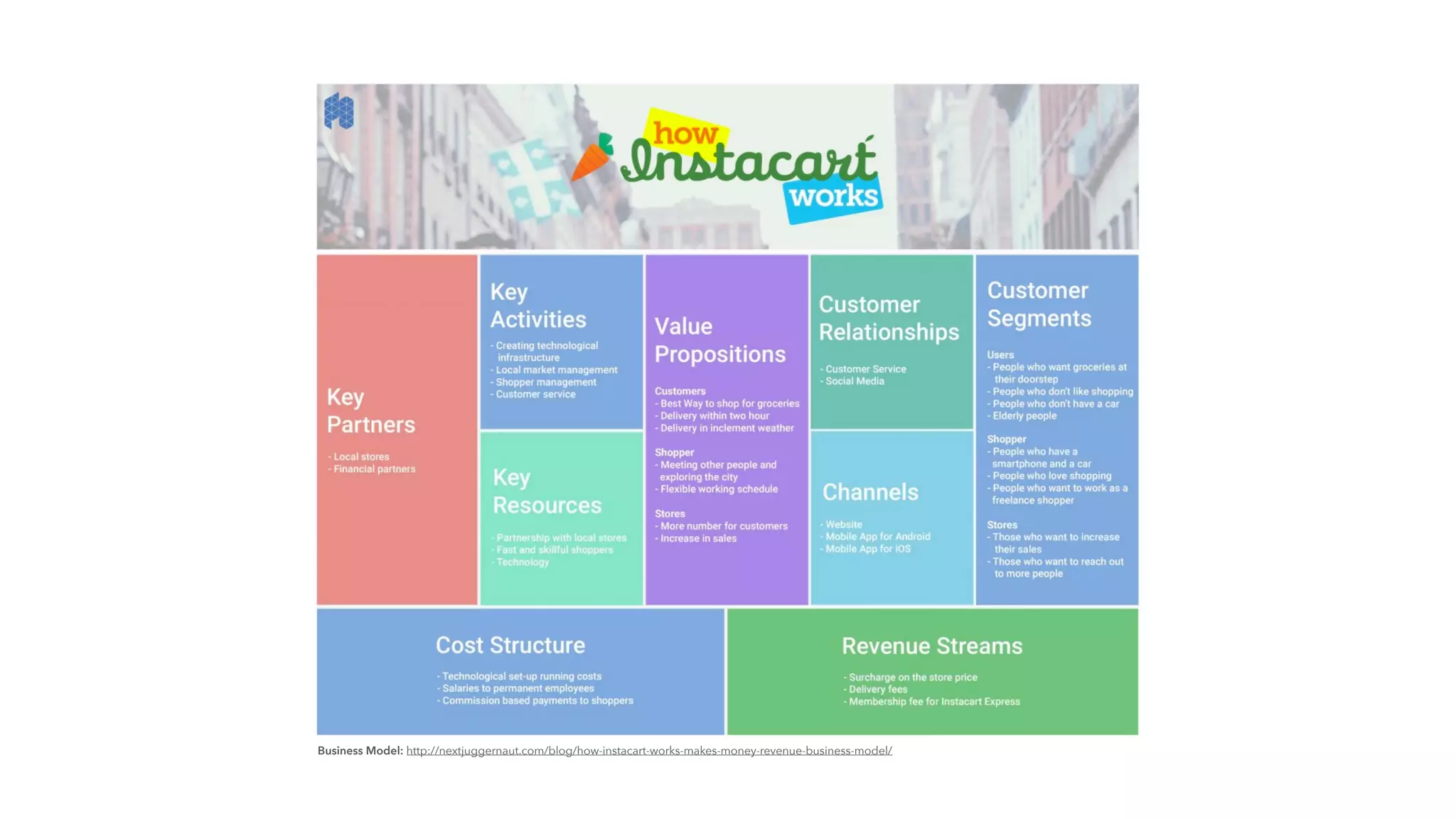
Business Model: Visualizing Revenue and Costs

Business Model: Visualizing Revenue and Costs

The business model canvas slide succinctly lays out key partners, activities, resources, channels, cost structure, and revenue streams. Presenting this information visually makes the unit economics and monetization levers easier to follow: surcharges, delivery fees, membership, and partnerships. The canvas also points to where costs concentrate (technology and worker pay) and where leverage can be gained (partnerships with stores).
Founders should emulate the use of a one-page visual to show how the business actually makes money and where scale effects will appear. Investors want to see clear revenue streams and the levers you will pull to improve margins—this canvas format communicates that efficiently.

Key Takeaway: Use a single visual to tie together partners, cost structure, and specific revenue streams so investors see how scale translates to economics.
Operational Crises and Strategic Responses

Operational Crises and Strategic Responses

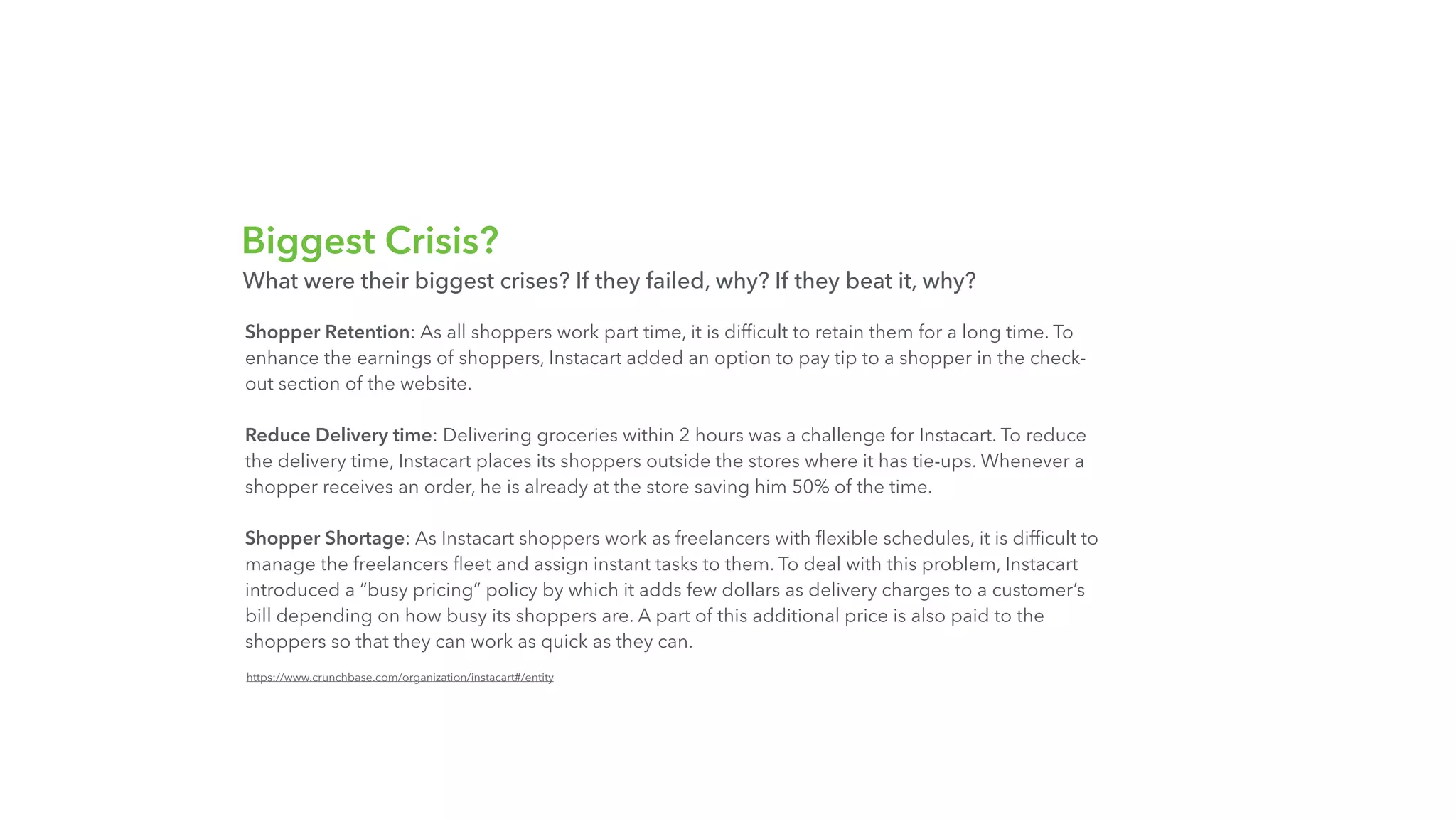
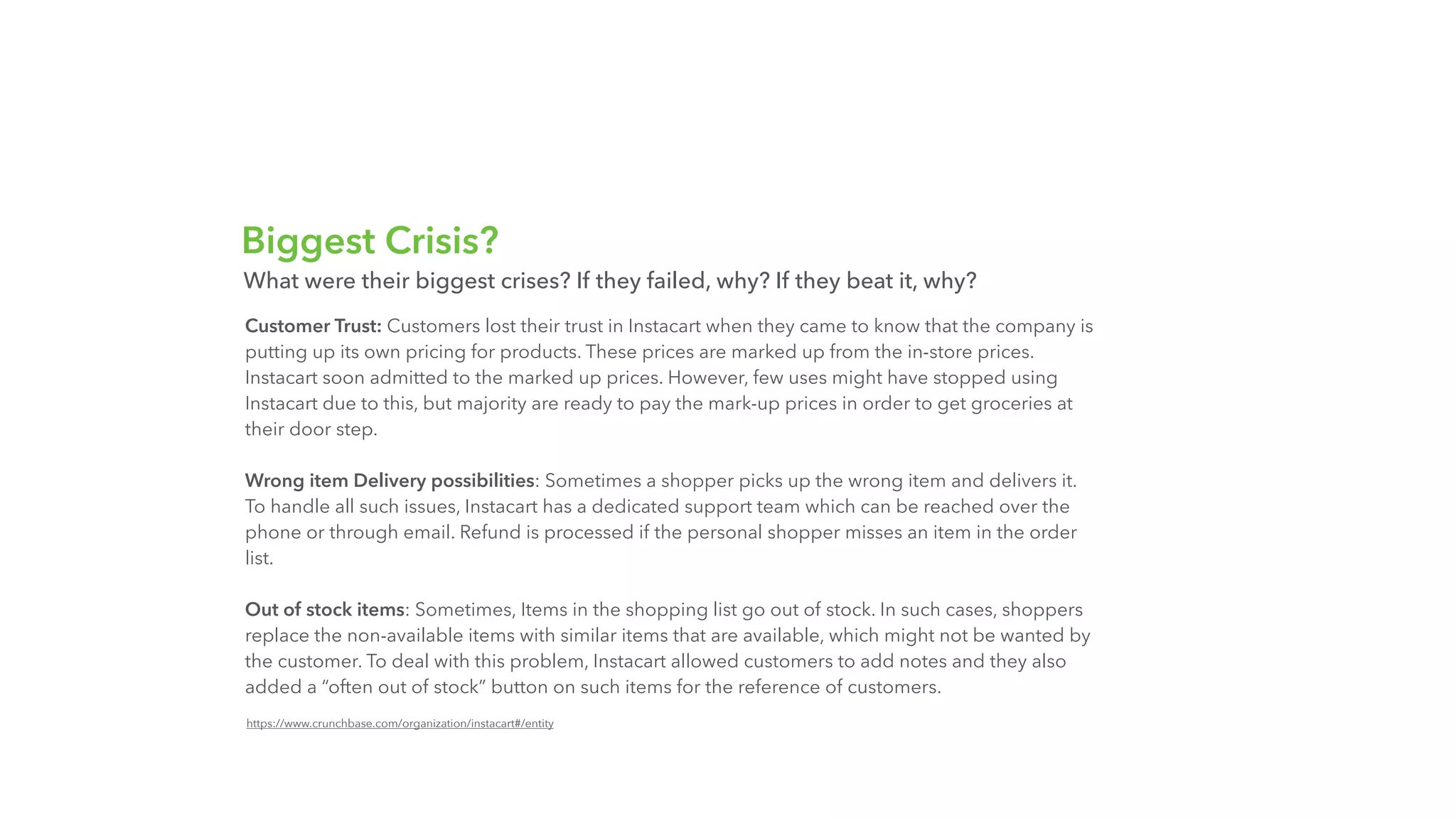
The deck candidly lists major operational challenges—shopper retention, delivery times, pricing during busy periods, customer trust with pricing/markups, wrong item deliveries, and out-of-stock handling—and the tactical responses used to mitigate them. This candor is powerful because it demonstrates that the team not only recognizes risk but has tested and implemented mitigations, such as tips and busy-pricing to incentivize shoppers, stationing shoppers near stores to cut delivery time, and adding customer support and refund policies for errors.
Including problems and their fixes in a pitch signals maturity and reduces investor anxiety about execution risk. Founders should call out the top 3–5 operational risks and present specific, tested fixes rather than vague assurances, which turns potential weaknesses into evidence of learning and resilience.

Key Takeaway: Highlight your top operational risks and the concrete, tested responses you implemented to reduce investor concern and show executional competence.

Conclusion: Key Lessons

This deck balances brand, product clarity, investor evidence, operational detail, and honesty about crises. Its strengths are a one-line value proposition, simple conversion-focused product presentation, a clear fundraising timeline with reputable backers, a concise business model canvas, and explicit documentation of operational challenges plus fixes. These elements together demonstrate product-market fit and execution capability—critical signals for investors in capital-intensive marketplaces.
For founders preparing their own decks: lead with a crystal-clear single-sentence value proposition, show momentum with an easy-to-scan timeline, document investor validation and economics, map each marketplace participant with concrete features that solve their pain, and openly list top risks alongside concrete mitigations. Doing so turns a pitch from a marketing brochure into a credible plan for scaling and managing real-world complexity.

Full Deck Analysis

11 sections

Overview

Company: Instacart
Round: Various (Multiple rounds: Seed through Series D)
Year: 2013 (with updates through 2017)
Outcome: IPO at $10B valuation
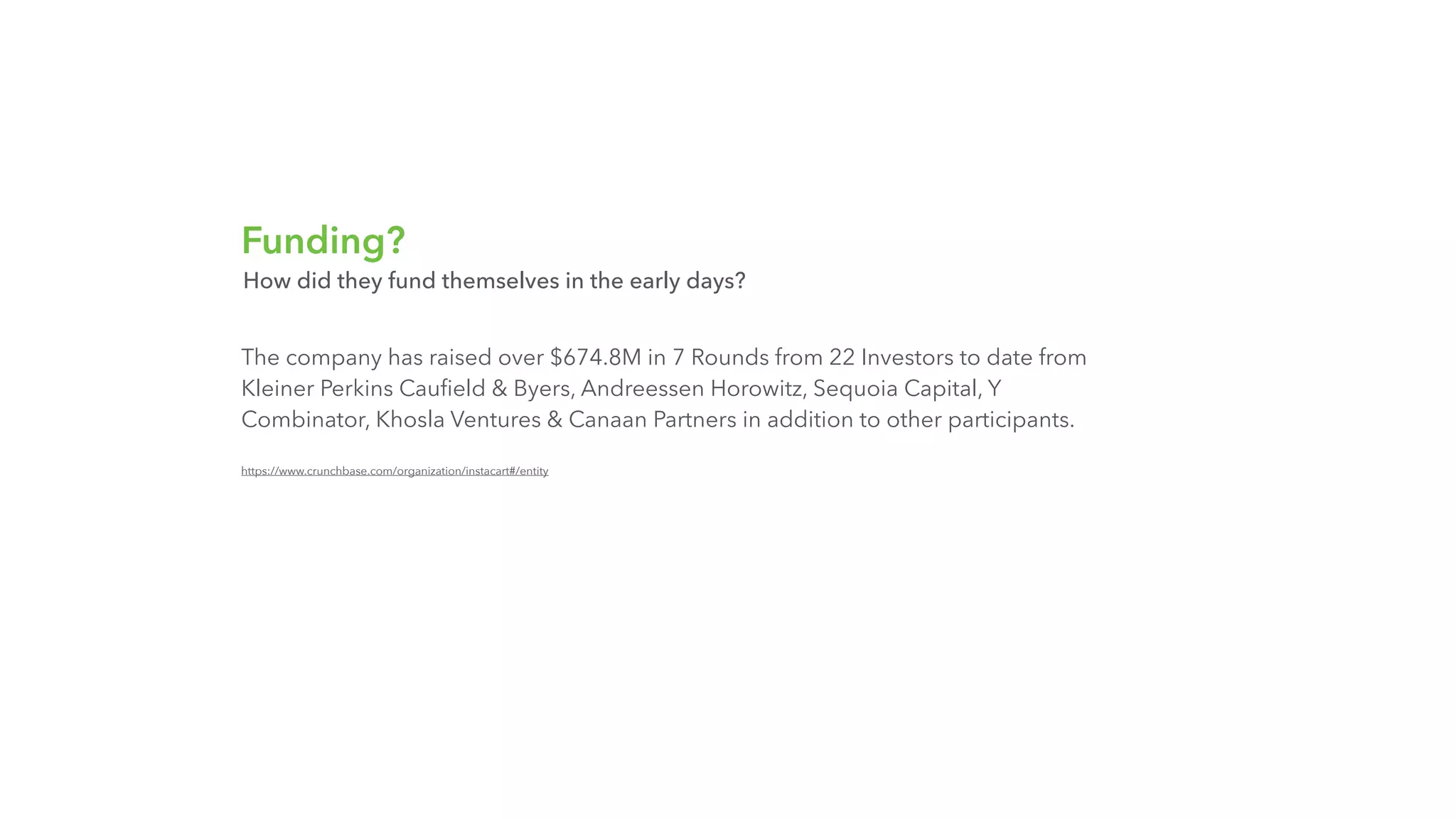
Total Raised (by deck date): $674.8M across 7 rounds

Executive Summary

This deck is a retrospective “Lessons From The Past” analysis of Instacart’s journey from YCombinator incubation (Jun 2012) to Series D funding ($400M, Mar 2017). Rather than a traditional forward-looking pitch, it uses a seven-point framework to examine how Instacart achieved product-market fit through a three-sided marketplace (Users, Shoppers, Stores), overcame operational crises through innovative solutions (dynamic pricing, stationed shoppers, tipping), and secured strategic partnerships (notably Whole Foods/Amazon exclusivity). The deck demonstrates how a well-capitalized startup can scale rapidly by solving for all stakeholders simultaneously while maintaining investor confidence through transparent problem-solving narratives.

Problem Statement

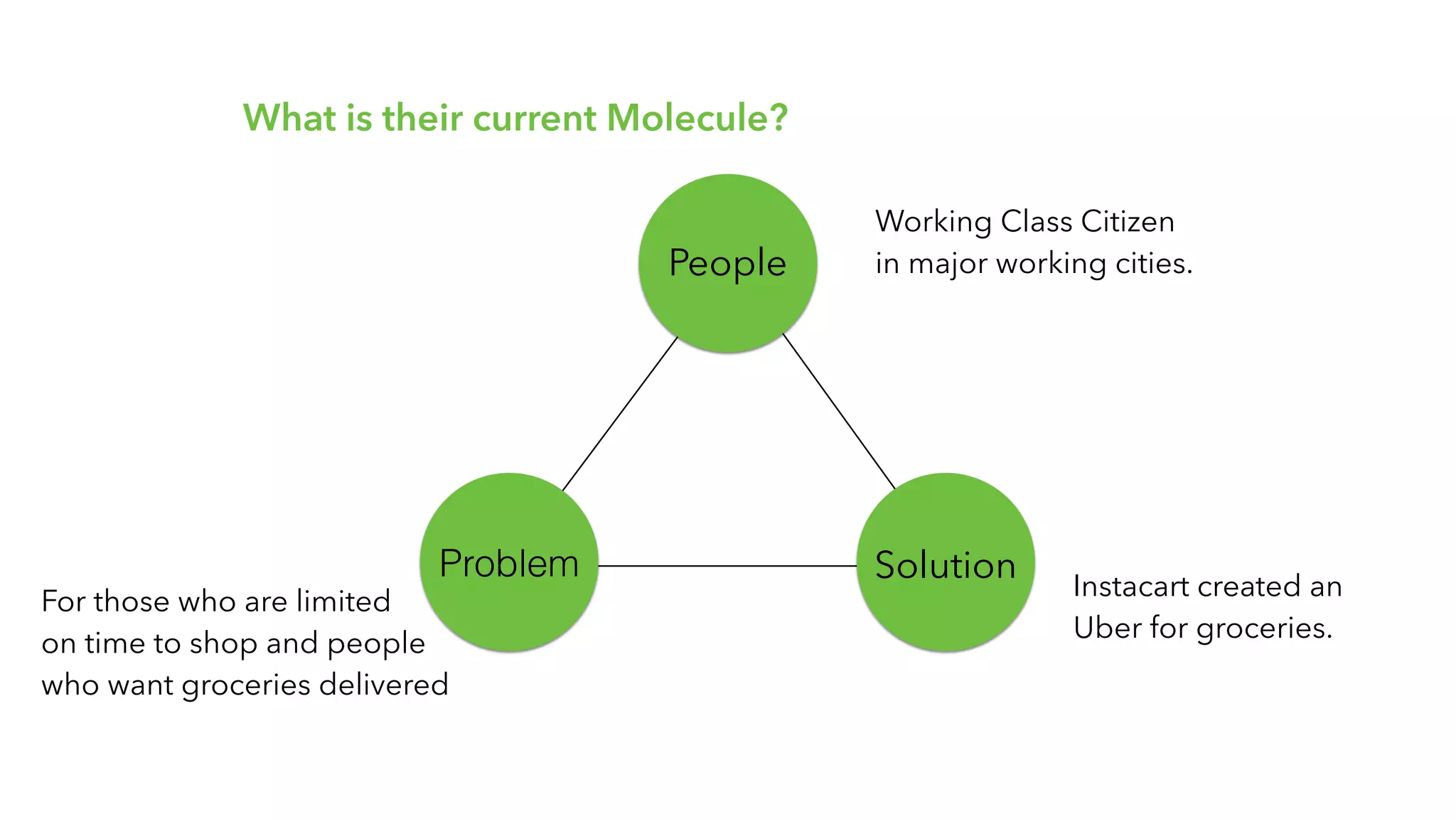
Primary Problem (Slide 20 - “The Molecule”):

  • Target User: Working class citizens in major working cities
  • Core Pain Point: Limited time to shop for groceries; desire for convenient home delivery
  • Market Context: Grocery shopping is time-consuming and inconvenient for busy professionals

Secondary Problems (Slides 15-16 - Operational Crises):

  1. Shopper Retention: Part-time gig workers difficult to retain long-term
  2. Delivery Speed: Meeting 2-hour (later 1-hour) delivery windows operationally challenging
  3. Shopper Availability: Managing flexible freelance workforce and matching supply to demand
  4. Customer Trust: Transparency around pricing markups and product substitutions
  5. Fulfillment Accuracy: Wrong item delivery and out-of-stock inventory management

Retail Partner Problem (Slide 13):

  • Grocery stores seeking new revenue channels and customer reach through online sales

Solution

Core Value Proposition (Slide 3):
“Groceries delivered in an hour”

Three-Sided Marketplace Solution (Slides 10-13):

For Users (Slide 11):

  • Mobile app + web interface for ordering
  • Multi-store selection with cross-store item combining
  • Online payment with advance tipping
  • Flexible scheduling for specific dates/times
  • 1-hour delivery window

For Shoppers (Slide 12):

  • Smartphone-based order management
  • Stationed near stores to enable rapid fulfillment
  • Dual compensation: hourly pay + customer tips
  • Flexible work schedule
  • Dynamic pricing incentives during peak demand (“busy pricing”)

For Stores (Slide 13):

  • New online sales channel
  • Revenue increase through Instacart orders
  • Non-exclusive partnerships with major supermarket chains

Operational Solutions to Crises (Slides 15-16):

  1. Shopper Retention: Added tipping option in checkout to increase earnings
  2. Delivery Speed: Station shoppers outside stores (saves 50% of delivery time)
  3. Shopper Shortage: Implement “busy pricing”—dynamic delivery charges based on shopper availability; portion of surge pricing paid to shoppers
  4. Customer Trust: Admitted to price markups; majority of customers accept premium for convenience
  5. Fulfillment Quality: Dedicated customer support team (phone/email); refunds for errors; customer notes on substitution preferences; “often out of stock” button for transparency

Market Opportunity

Geographic Scope (Slide 4):

  • Major cities of USA (specific cities not enumerated in deck)

Target Market Definition (Slide 20):

  • Working class citizens in major working cities
  • People who want groceries at doorstep
  • People who don’t like shopping
  • People who don’t have a car
  • Busy people

Market Size Analysis:

  • TAM/SAM/SOM: Not explicitly stated in deck
  • Implied Market: US grocery market with focus on urban, time-constrained professionals
  • Addressable Segment: Busy professionals in major metropolitan areas willing to pay premium for convenience

Market Validation (Slide 19):

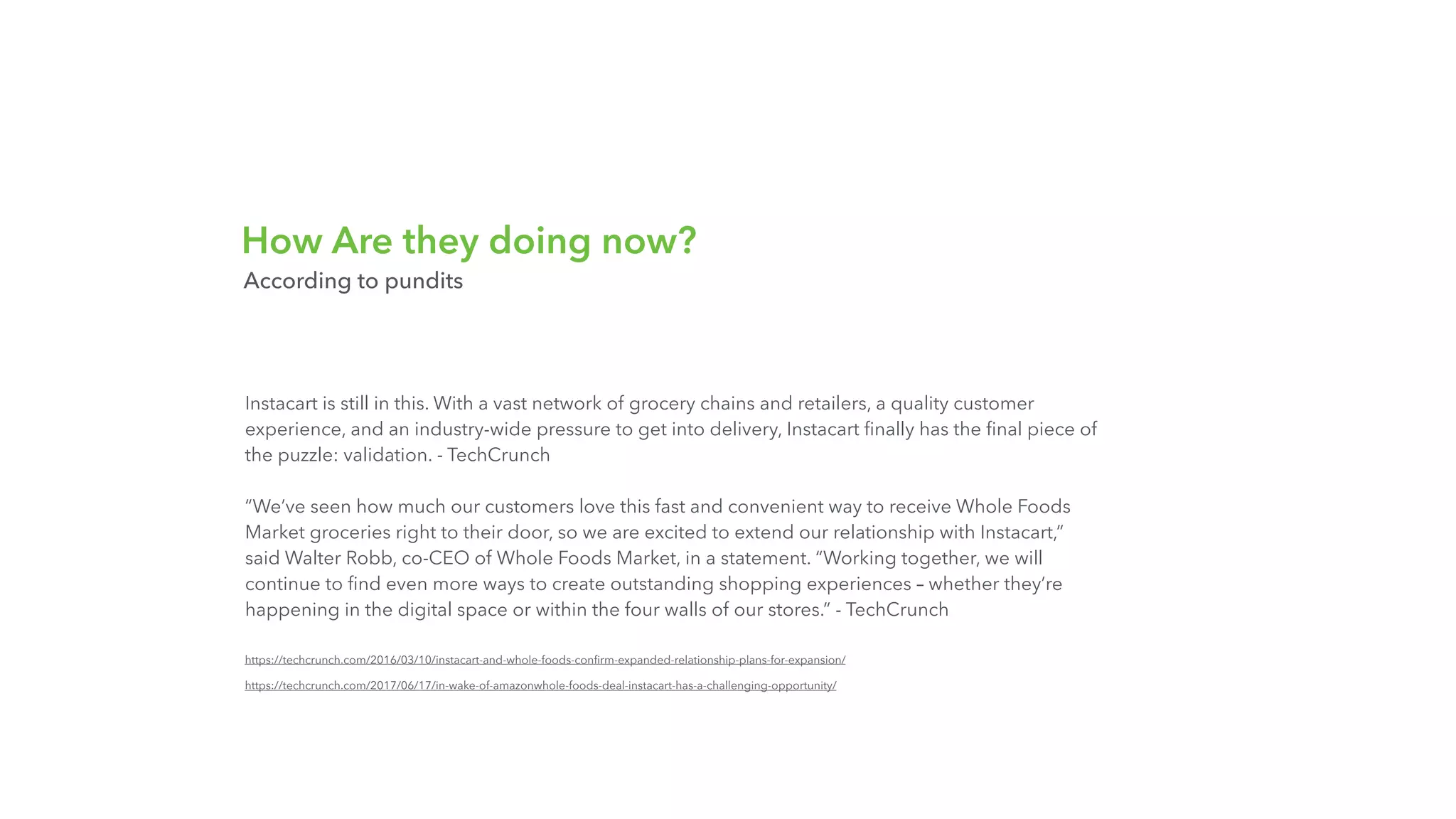
  • TechCrunch analyst quote: Instacart has “final piece of the puzzle” for grocery delivery
  • Industry-wide pressure for retailers to enter delivery space
  • Whole Foods partnership expansion signals market acceptance

Business Model

Revenue Streams (Slide 14 - Business Model Canvas):

  1. Surcharge on store price - Markup on products above in-store prices
  2. Delivery fees - Per-order delivery charge (dynamic via “busy pricing”)
  3. Membership fee - “Instacart Express” subscription model (mentioned but not detailed)

Cost Structure (Slide 14):

  1. Technological set-up and running costs - Platform infrastructure
  2. Salaries to permanent employees - Core team and support staff
  3. Commission-based payments to shoppers - Variable cost per order

Unit Economics:

  • Not disclosed in deck - No specific CAC, LTV, order value, or margin data provided
  • Pricing Model: Customers pay surcharge + delivery fee; portion of delivery fee goes to shoppers
  • Shopper Economics: Hourly pay + tips + surge pricing incentives during peak demand

Channels (Slide 14):

  • Website
  • Mobile App (Android)
  • Mobile App (iOS)

Traction & Metrics

Funding Traction (Slides 5, 7, 8):
| Round | Date | Amount | Lead Investor | Investors |
|——-|——|——–|—————|———–|
| Seed | Jun 2012 | Undisclosed | Y Combinator | 1 |
| Seed | Oct 2012 | $2.3M | Multiple | 5 |
| Series A | Apr 2013 | $8.5M | Sequoia Capital | 6 |
| Series B | Jun 2014 | $44M | Andreessen Horowitz | 9 |
| Series C | Jan 2015 | $220M | Kleiner Perkins | 9 |
| Series D | Mar 2017 | $400M | Sequoia Capital | 4 |
| Whole Foods | Mar 2016 | Undisclosed | Strategic | 1 |

Total Raised: $674.8M+ across 7 rounds

Valuation Milestone:

  • Series C Valuation (Jan 2015): $2B

Investor Quality:

  • 22 total investors across rounds
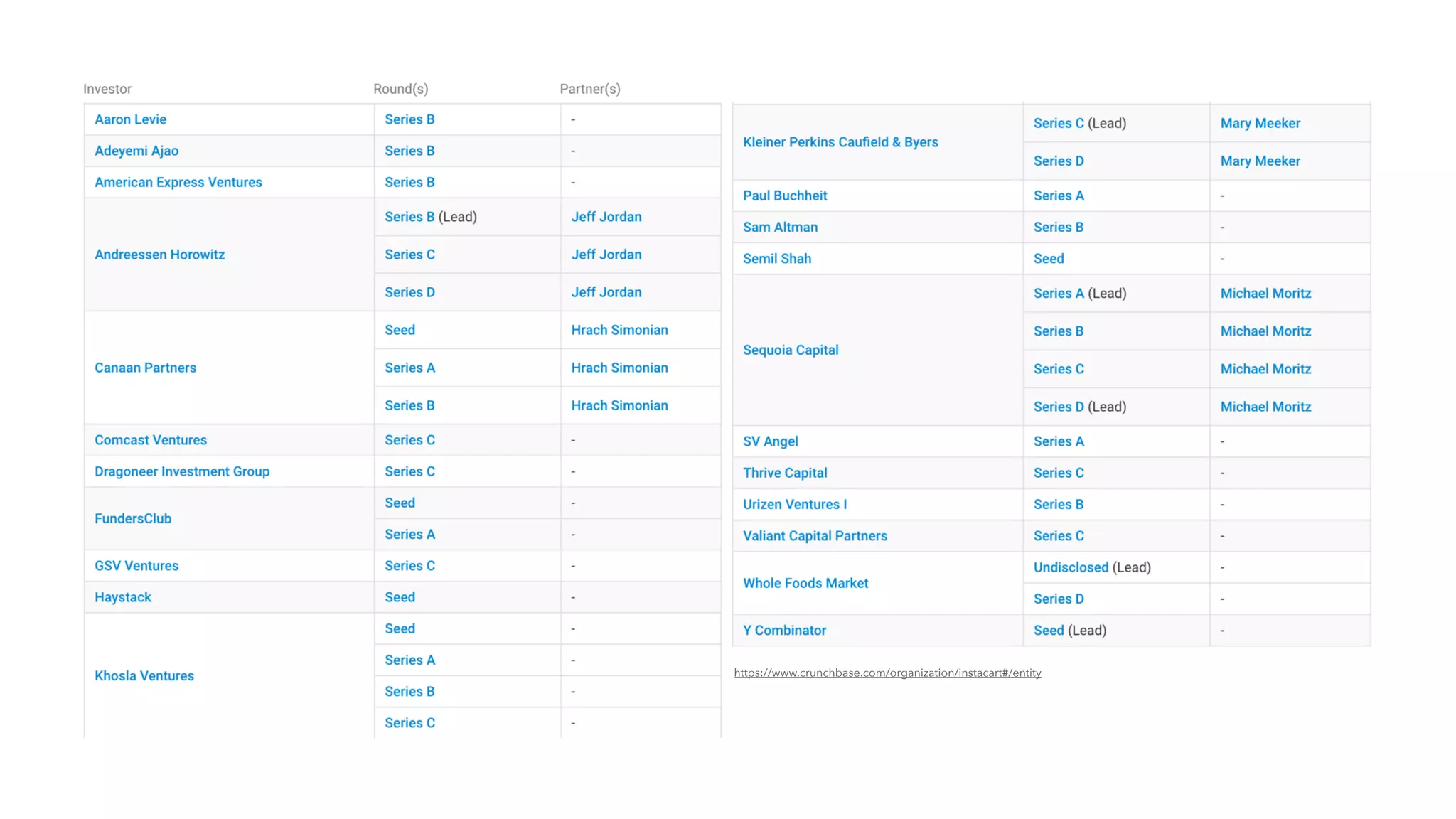
  • Tier-1 VCs: Kleiner Perkins, Andreessen Horowitz, Sequoia Capital, Khosla Ventures, Canaan Partners
  • Strategic Investor: Whole Foods Market (Series D)
  • Repeat Investors: Andreessen Horowitz, Sequoia, Canaan Partners, Khosla across multiple rounds

Growth Indicators (Implicit):

  • Rapid funding acceleration: $2.3M → $8.5M → $44M → $220M → $400M (110x growth over 5 years)
  • Repeat investor participation signals strong performance between rounds
  • Strategic partnership with Whole Foods (5-year exclusive deal for perishables)

User/Market Metrics:

  • Not disclosed in deck - No specific user numbers, order volume, GMV, retention rates, or geographic expansion data provided

Competitive Positioning

Competitive Differentiation (Slide 20):

  • Positioning: “Uber for groceries”
  • Unique Angle: On-demand, 1-hour delivery model vs. traditional grocery delivery

Competitive Advantages (Implicit from Business Model Canvas, Slide 14):

  1. Technology Infrastructure - Proprietary platform for matching orders to shoppers
  2. Shopper Network - Stationed shoppers near stores enabling rapid fulfillment
  3. Retail Partnerships - “Vast network of grocery chains and retailers”
  4. Customer Experience - Multi-store ordering, flexible scheduling, transparent pricing
  5. Strategic Partnerships - Exclusive Whole Foods deal blocks Amazon from using competitors

Competitive Threats (Not Addressed):

  • Amazon Fresh (implied but not mentioned)
  • Google Shopping Express
  • Traditional grocery delivery services
  • Retailers’ own delivery capabilities

Market Position (Slide 19):

  • “Final piece of the puzzle” for grocery delivery (per TechCrunch)
  • Industry-wide recognition of Instacart’s leadership

Team

Team Credentials:

  • Not disclosed in deck - No founder names, backgrounds, or team composition provided
  • Key Partner Identified: Hrach Simonian (Canaan Partners) - identified as “key partner” in seed round, suggesting ongoing advisory/board role

Investor Confidence Signal:

  • Repeat participation from top-tier VCs suggests strong founder/team credibility
  • Whole Foods partnership expansion suggests operational excellence and relationship management

Go-to-Market Strategy

Market Entry Approach (Slides 11-13):

  1. User Acquisition: Mobile app + web platform with social login (Facebook integration shown on Slide 3)
  2. Shopper Recruitment: Flexible gig work model with competitive compensation (hourly pay + tips + surge incentives)
  3. Retail Partnerships: Non-exclusive partnerships with major supermarket chains
  4. Geographic Expansion: “Major cities of USA” (specific expansion strategy not detailed)

Channel Strategy (Slide 14):

  • Website
  • Mobile apps (iOS and Android)
  • Social media (customer service channel)

Partnership-Driven Growth:

  • Whole Foods exclusive partnership (5-year deal, 2016) - strategic anchor tenant
  • Local store partnerships for inventory and fulfillment

Customer Retention Mechanisms:

  • Tipping option to build shopper quality
  • Membership model (Instacart Express) for repeat customers
  • Customer notes and preferences for personalized experience

The Ask

Funding Rounds Shown (Slides 5, 8):

  • Series A: $8.5M (Apr 2013)
  • Series B: $44M (Jun 2014)
  • Series C: $220M (Jan 2015)
  • Series D: $400M (Mar 2017)

Use of Funds (Not Explicitly Stated):

  • Implied from Business Model Canvas (Slide 14):
    • Technology infrastructure development
    • Shopper network expansion and management
    • Customer acquisition and marketing
    • Retail partnership development
    • Geographic expansion to new cities

Capital Efficiency:

  • $2.3M seed → $2B valuation (Series C) = 870x return in 2.5 years
  • Suggests strong unit economics and market validation

Investor Deep Dive

Executive summary, strengths & red flags

Executive Summary

This deck is a retrospective "Lessons From The Past" analysis of Instacart's journey from YCombinator incubation (Jun 2012) to Series D funding ($400M, Mar 2017). Rather than a traditional forward-looking pitch, it uses a seven-point framework to examine how Instacart achieved product-market fit through a three-sided marketplace (Users, Shoppers, Stores), overcame operational crises through innovative solutions (dynamic pricing, stationed shoppers, tipping), and secured strategic partnerships (notably Whole Foods/Amazon exclusivity). The deck demonstrates how a well-capitalized startup can scale rapidly by solving for all stakeholders simultaneously while maintaining investor confidence through transparent problem-solving narratives.

Key Strengths

6 identified

1

Three-Sided Marketplace Design with Clear Value Props

- The deck clearly articulates distinct value propositions for Users (convenience), Shoppers (flexible income), and Stores (new revenue channel). This demonstrates sophisticated business model thin...

2

Transparent Problem-Solving Narrative

- Rather than hiding operational challenges, the deck showcases how Instacart identified and solved real crises (shopper retention, delivery speed, supply-demand matching). This builds investor con...

3

Exceptional Investor Pedigree and Momentum

- $674.8M raised from tier-1 VCs (Kleiner Perkins, Andreessen Horowitz, Sequoia) with repeat participation signals strong validation. Strategic investor (Whole Foods) adds credibility.

4

Strategic Partnership with Whole Foods/Amazon

- 5-year exclusive deal for Whole Foods perishables (2016) creates competitive moat and blocks Amazon from using competitors. Demonstrates Instacart's negotiating power and market position.

5

Rapid Funding Acceleration

- 110x funding growth over 5 years ($2.3M → $400M) demonstrates exceptional market validation and investor confidence.

6

Business Model Canvas Clarity

- Slide 14 provides comprehensive business model overview covering all nine elements (partners, activities, resources, value props, relationships, channels, segments, costs, revenue). Professional,...

Red Flags & Weaknesses

10 identified

1

Missing Critical Traction Metrics

- Deck provides no user numbers, order volume, GMV, retention rates, or geographic coverage specifics. For a company claiming $2B valuation, this is a significant omission.

2

Over-Reliance on Third-Party Citations

- Nearly every slide cites external sources (Crunchbase, NextJuggernaut, TechCrunch, Axios) rather than company data. This undermines credibility and suggests the deck may be compiled from public s...

3

Weak Exit Strategy

- Slide 18 simply states "N/A" for exit strategy. For a Series C/D company, this is concerning and suggests either lack of strategic planning or poor deck construction.

4

Inconsistent Timeline and Data

- Slide 8 shows Series D as "Mar 2017" but earlier slides (Slide 5) showed Series C as "Dec 2014" with Series D as "Dec 30, 2014"—major discrepancy. Additionally, Slide 17 describes 2016 partnershi...

5

Vague on Unit Economics and Profitability

- No mention of CAC, LTV, order economics, or path to profitability. "Busy pricing" explanation suggests dynamic pricing to manage supply, but no data on impact.

6

Limited Competitive Analysis

- Deck positions Instacart as "Uber for groceries" but doesn't address actual competitors (Amazon Fresh, Google Shopping Express, traditional grocery delivery). No competitive positioning or differ...

7

Customer Trust Crisis Poorly Resolved

- Slide 16 describes customer backlash to price markups, then states "few uses might have stopped using Instacart due to this, but majority are ready to pay the mark-up prices." This is wishful thi...

8

No Team Information

- Deck provides zero information on founders, CEO, or team credentials. For a $2B company, this is a major omission.

9

Inconsistent Delivery Time Claims

- Slide 3 promises "1-hour delivery" but Slide 15 discusses "2-hour delivery window" as the challenge being solved. Inconsistency raises questions about actual performance.

10

Whole Foods Partnership Vagueness

- Slide 17 describes 5-year exclusive deal but doesn't explain terms, revenue impact, or strategic importance. Doesn't mention that Amazon later acquired Whole Foods (2017), which would fundamental...

More Pitch Decks To Study

Compare structure, fundraising context, and investor-facing story across similar startup decks.