Compare your deck to DoorDash

Compare Your Deck

DoorDash Pitch Deck (2013)

Marketplace
Stage: YC
Raised: $120K
Year: 2013
Slides: 7
Outcome: IPO at $39B valuation

Pitch Deck

1 / 7
DoorDash pitch deck - The Opening: Clear value proposition and brand
Click to expand

Deck Analysis

This YC pitch deck from DoorDash (2013) succinctly presents a local food logistics marketplace that pairs on-demand couriers with integrated restaurant ordering. It highlights a clear problem/solution fit (enable every restaurant to deliver), positions the company against competitors, and backs claims with early traction metrics — faster delivery times, strong week-over-week growth, and meaningful annualized restaurant sales. The deck is notable for combining simple, design-forward storytelling with metrics that demonstrate product-market fit and a defensible operational advantage.

The Opening: Clear value proposition and brand

The Opening: Clear value proposition and brand

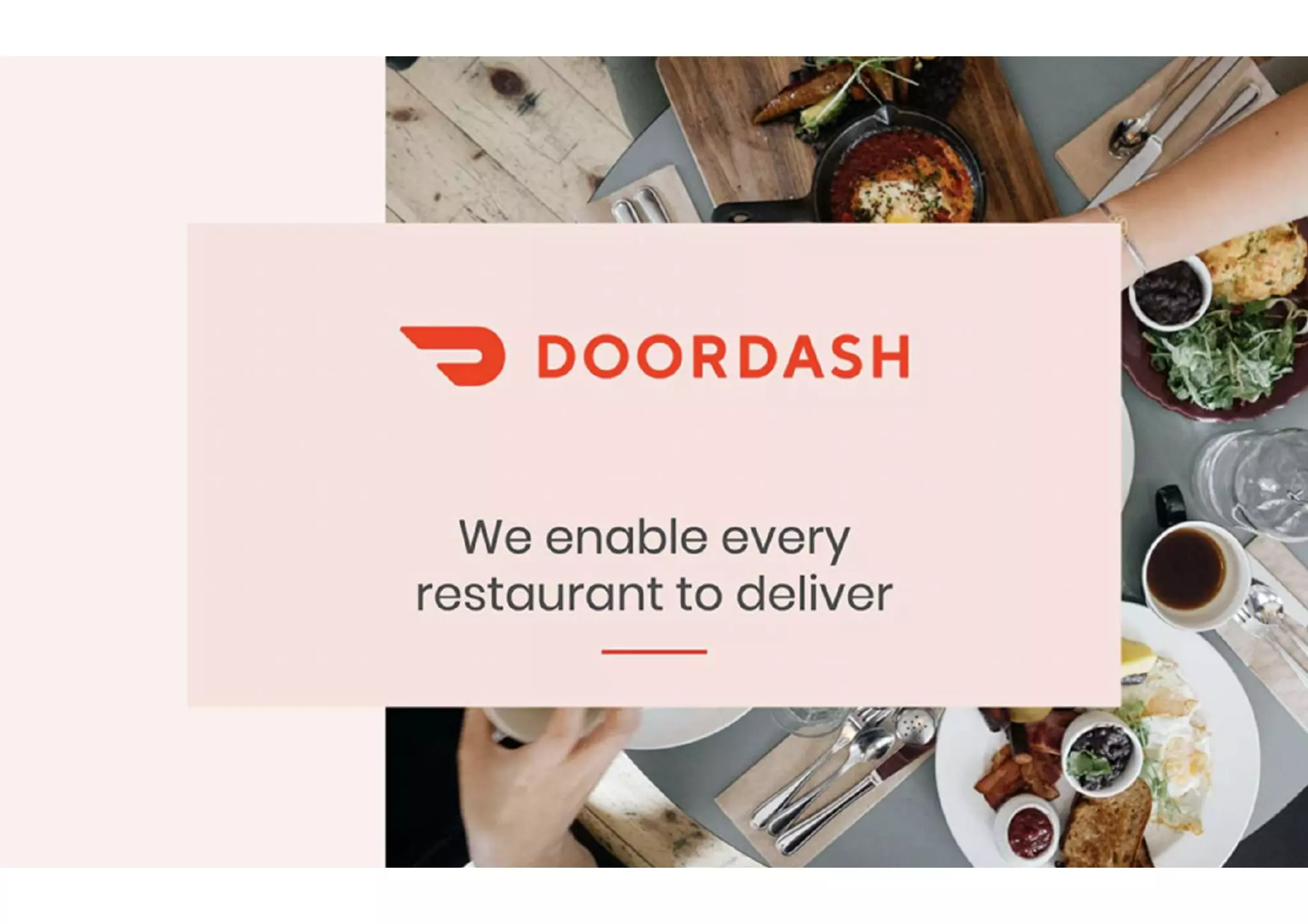
The first slide immediately states the company name and a one-line mission: "We enable every restaurant to deliver." It uses large type, minimal copy, and lifestyle photography to establish context (food, restaurants) while making the promise explicit and easy to remember. This is effective because investors instantly understand the target customer (restaurants) and the service outcome (deliveries) without having to parse jargon.

For founders, the lesson is to lead with a crisp value proposition that names who you serve and what you do. The visual treatment here supports the message — clean typography, strong logo placement, and relevant imagery help create an emotional as well as rational hook. There's no filler; the slide does the job of orienting the audience in seconds.
Key Takeaway: Start your deck with a single, unambiguous sentence that names the customer and the core outcome — reinforced by clean visuals that set context.
Competitive positioning: map the landscape simply

Competitive positioning: map the landscape simply

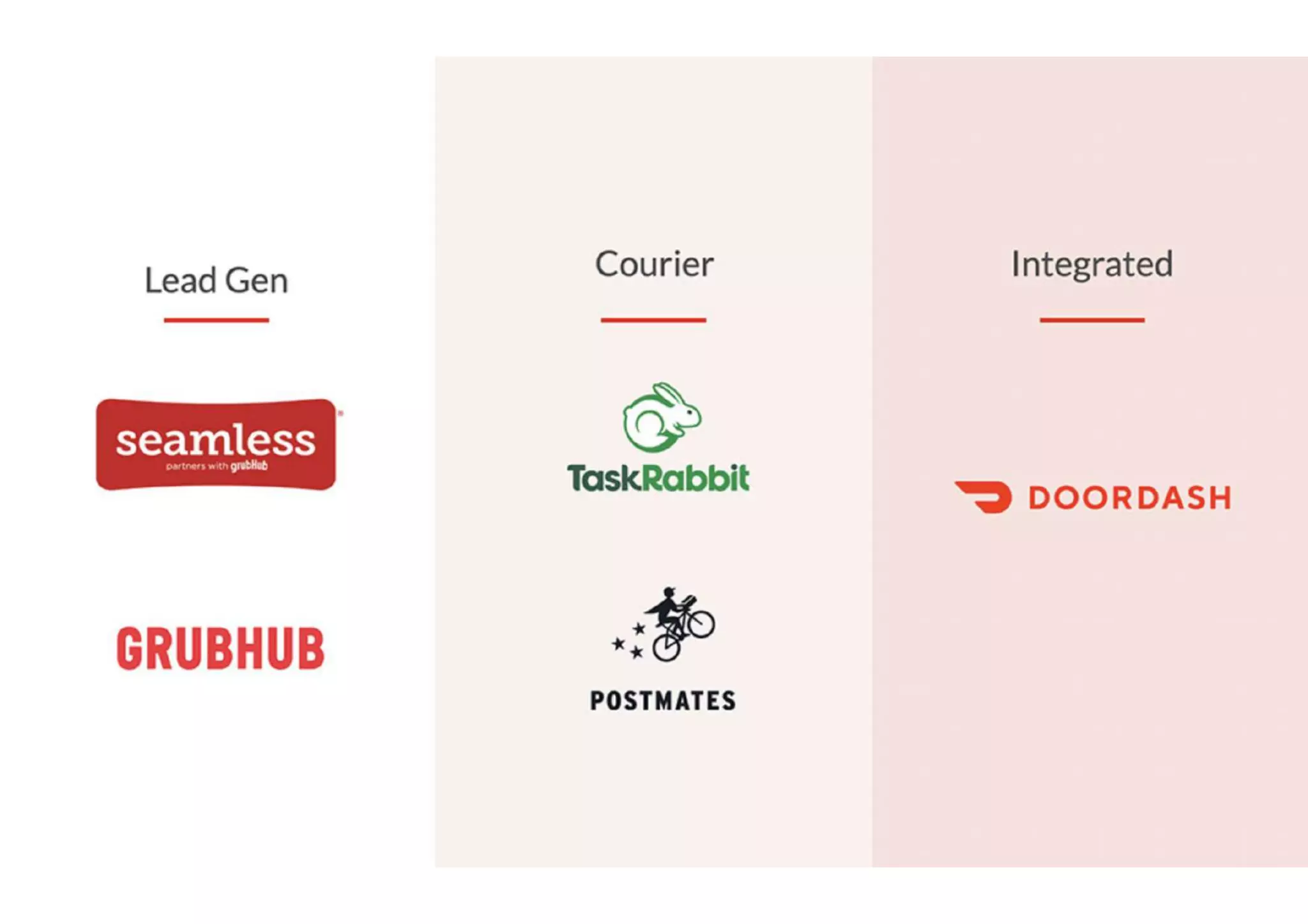
Slide 2 lays out competitors across three categories: lead generation (Seamless, Grubhub), courier marketplaces (TaskRabbit, Postmates), and an "Integrated" approach (DoorDash). This three-column framing clarifies how DoorDash differentiates: not just a listing or a courier network, but an integrated merchant-facing logistics solution. The simple logos and minimal labels make it easy for investors to grasp the landscape at a glance.

Founders should emulate this by mapping competitors in a way that highlights their unique axis of differentiation. Rather than a long list, group competitors by the specific role they play and show where your offering sits. This helps investors understand defensibility and why customers would choose you over incumbents.

Key Takeaway: Present competitors in a concise matrix or categories that directly contrast your unique approach — make the differentiation visually obvious.
Operational advantage: faster delivery times

Operational advantage: faster delivery times

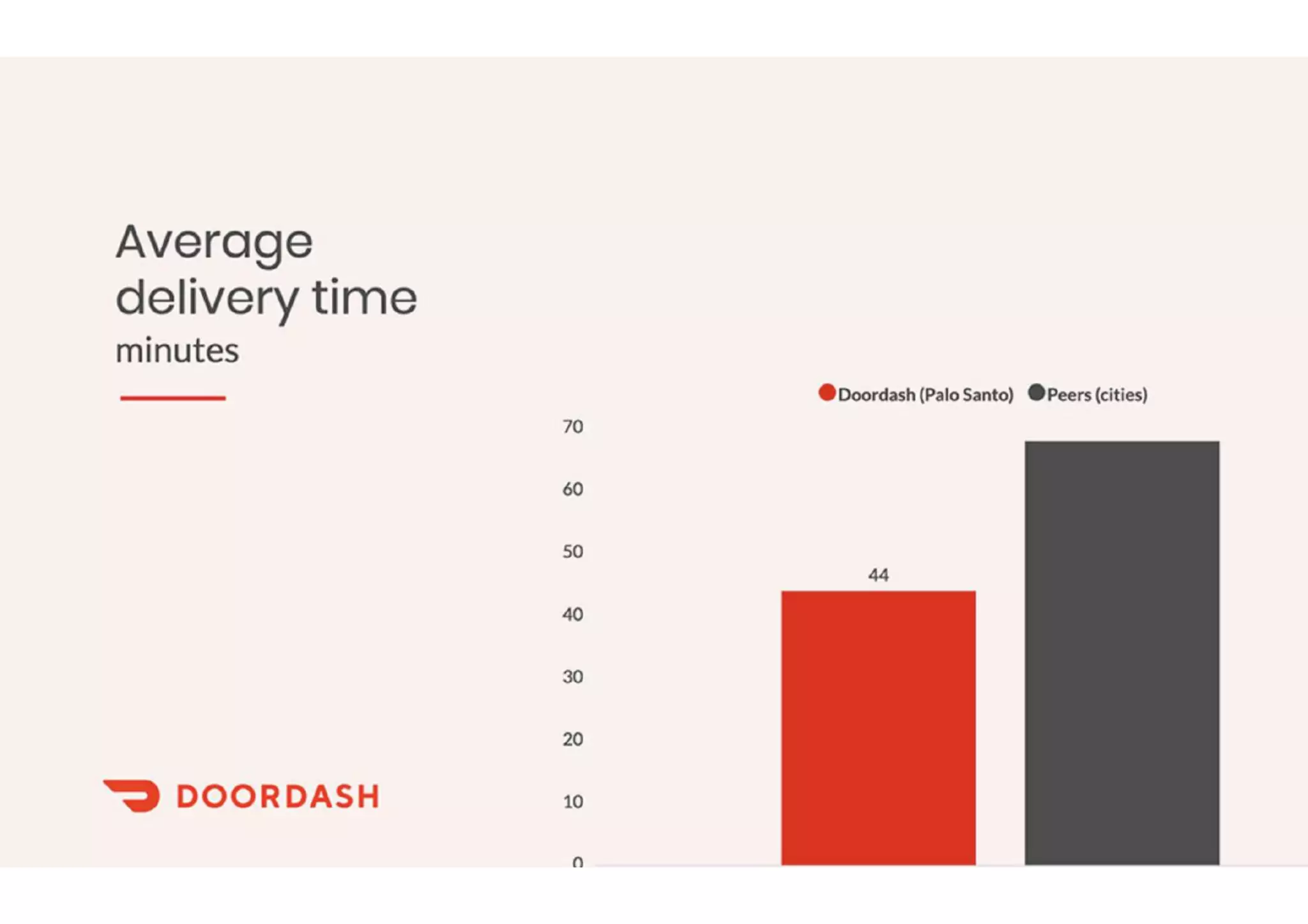
Slide 3 presents a concrete operational metric: average delivery time. DoorDash (Palo Alto) shows 44 minutes versus ~70 minutes for peers (cities). This is a strong, tangible claim of superior service that ties directly to user experience and retention. Presenting a simple bar chart with numeric labels makes the advantage obvious and credible.

For founders building marketplaces or logistics businesses, operational KPIs that affect customer satisfaction (speed, reliability, cost) are powerful evidence of early product-market fit. Use clear, comparable metrics and be prepared to explain methodology — investors will probe how you achieve the advantage and whether it scales.

Key Takeaway: Use a single, hard-to-argue metric that demonstrates your operational edge — make it visual and directly tied to customer value.
Traction: growth curve and momentum

Traction: growth curve and momentum

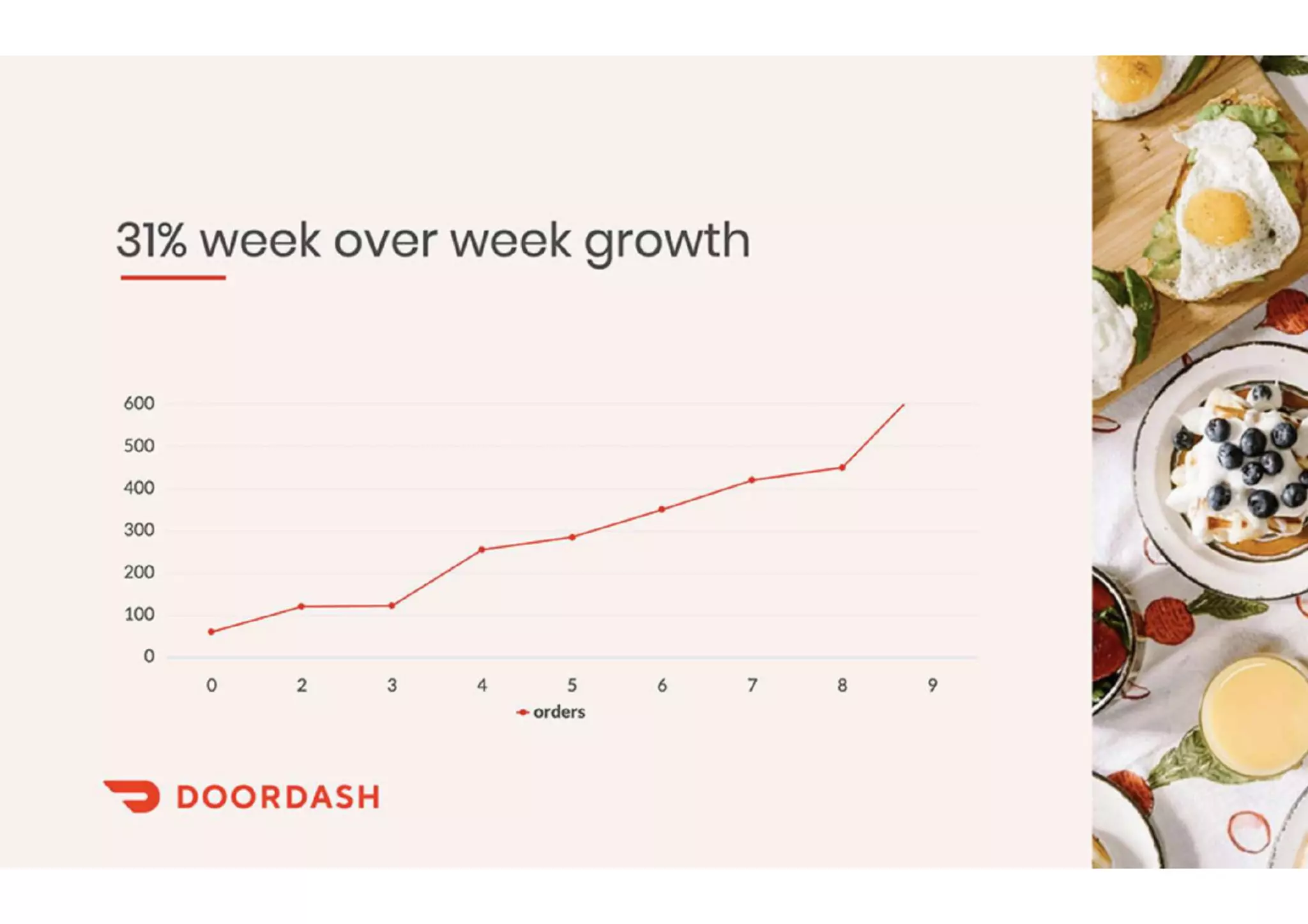
Slide 4 shows a line chart with "31% week over week growth" and a rising orders curve that accelerates late in the series. The explicit growth rate headline plus the visual trajectory communicates momentum — one of the most persuasive signals to early investors. The graph lacks complex labeling, which keeps attention on the trend rather than granular data points.

Founders should highlight compound growth and present trends that tell a clear story of adoption. Call out the growth rate prominently, and use a simple visual that avoids clutter. If growth is uneven, annotate reasons (product changes, partnerships) so investors can connect cause and effect.

Key Takeaway: Lead with a clear growth statistic and a simple visual trend that demonstrates momentum — narrative and numbers should reinforce each other.
Monetization signal: early revenue per restaurant

Monetization signal: early revenue per restaurant

Slide 5 communicates "$1.5 Million Annualized restaurant sales," which signals meaningful economic impact for merchants using the platform. By translating orders and growth into dollar figures, the deck shows that the product creates real revenue for restaurants (and potential take rate for DoorDash). This helps investors estimate marketplace GMV and revenue potential even from sparse early data.

For founders, convert user or order metrics into monetary impact as soon as possible. Investors care about the size of the economic opportunity and the platform's ability to capture value; early annualized GMV or merchant sales figures help ground projections and validate the business model.

Key Takeaway: Translate usage into economic terms (GMV, annualized merchant sales) early in the deck to show the real-world financial impact of your product.
Moat: combine logistics with merchant integration

Moat: combine logistics with merchant integration

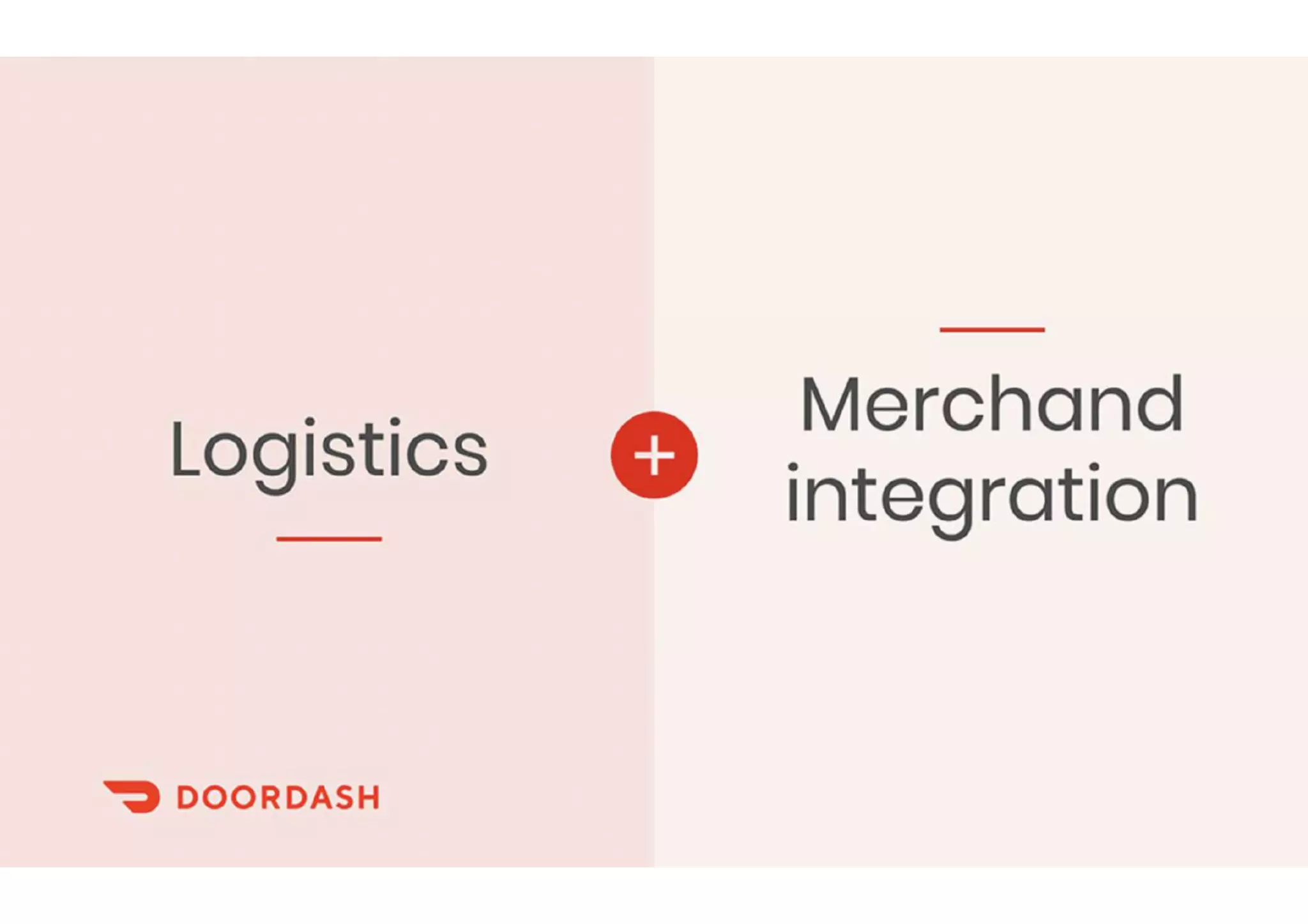
Slide 6 emphasizes the two-part thesis: "Logistics + Merchant integration." This succinctly states why DoorDash's model is defensible — logistics alone is replicable, but pairing it with deep merchant integration (ordering systems, workflows) creates stickiness. The slide uses minimal text and a split layout to make the combination feel like a strategic formula rather than an afterthought.

Founders building platform businesses should articulate the components of their moat and how they reinforce one another. Don’t just claim a competitive advantage — break it down into complementary pieces (technology, operations, partnerships) and show how they compound to raise barriers to entry.

Key Takeaway: Define your moat as a set of complementary advantages and explain how they interlock to create defensibility.
Vision: expand beyond food to local logistics

Vision: expand beyond food to local logistics

The final slide frames the long-term vision: "The Future: FedEx of Local." That analogy expands the company's scope from restaurant delivery to a broader local logistics platform. It’s aspirational but grounded — it ties the immediate restaurant-focused product to a larger, scalable market opportunity. The imagery and concise phrasing make the ambition memorable without overloading on speculative detail.

For founders, close with a bold but credible vision that connects current traction to a sizable future opportunity. Use a simple metaphor or comparison to help investors quickly grasp the endgame, but avoid overpromising — ensure the path between today's product and that vision is defensible and logical.

Key Takeaway: End with a clear, credible big-picture vision that links present traction to a larger, well-defined market opportunity.

Conclusion: Key Lessons

DoorDash’s YC deck is a model of clarity: a sharp value proposition, a compact competitor map, operational KPIs that demonstrate a real service advantage, clear growth metrics, early monetization signals, and a concise articulation of moat and vision. The deck balances design and substance — visuals that set context and numbers that prove momentum and economic potential. Founders should prioritize: (1) leading with a single sentence that explains who you serve and what you deliver, (2) using one or two hard metrics to prove operational advantage, (3) converting usage into dollar-based impact, and (4) explaining how complementary assets create a durable moat. Keep slides minimal, visual, and narrative-driven so each one advances the story investors need to believe in both traction and scale.

Full Deck Analysis

12 sections

Overview

Company: DoorDash
Round: YC ($120K)
Year: 2013
Outcome: IPO at $39B valuation (2020)
Implied Return: 325,000x+ on YC investment


Executive Summary

DoorDash’s 2013 YC pitch presents a food delivery startup with a differentiated “integrated” business model combining logistics and merchant integration. The deck demonstrates strong product-market fit through explosive growth (31% week-over-week), operational superiority (44-minute delivery vs. 70-minute competitors), and early revenue traction ($1.5M annualized GMV). Despite minimal market analysis and missing unit economics, the pitch successfully communicates a clear vision (“FedEx of Local”) and proves execution capability through real delivery photos and concrete metrics.


Problem Statement

How the deck articulates the problem:

The deck doesn’t explicitly state a problem statement, but implies it through the mission statement (Slide 1) and competitive positioning (Slide 2):

  • Implicit Problem: Most restaurants lack delivery capability and are forced to partner with third-party platforms (lead-gen models like Seamless/GrubHub) or rely on courier-only services (TaskRabbit, Postmates) that don’t integrate with their operations
  • Market Gap: Existing solutions are fragmented—either marketplace platforms without logistics, or logistics services without merchant integration
  • Opportunity: Restaurants need an integrated solution that handles both customer acquisition AND reliable delivery

Reference: Slide 2 (competitive positioning) shows the fragmentation; Slide 1 (mission) implies restaurants are underserved.


Solution

How the deck positions the solution:

DoorDash positions itself as the only integrated platform combining two core capabilities:

  1. Logistics (Slide 6)
    • In-house courier network
    • Route optimization and delivery execution
    • Proof: 44-minute average delivery time (Slide 3)
  2. Merchant Integration (Slide 6)
    • Direct restaurant partnerships
    • Operational integration (implied through branded packaging in Slide 7)
    • Enables restaurants to offer delivery without operational burden

Key Insight: Unlike competitors who are either marketplace-only or logistics-only, DoorDash controls both sides, enabling faster delivery (44 min vs. 70 min) and better restaurant experience.

Reference: Slide 6 explicitly breaks down the two capabilities; Slide 3 proves the delivery speed advantage; Slide 7 shows operational maturity through branded packaging.


Market Opportunity

TAM/SAM/SOM Analysis:

The deck does not provide explicit market sizing, which is a notable weakness for a YC pitch. However, we can infer opportunity from:

Implicit Market Signals:

  • Total Addressable Market (TAM): “Every restaurant” (Slide 1) suggests massive scope—potentially hundreds of thousands of restaurants in the US alone
  • Serviceable Addressable Market (SAM): Not specified, but Slide 2’s competitive landscape (Seamless, GrubHub, TaskRabbit, Postmates) suggests a multi-billion dollar opportunity
  • Serviceable Obtainable Market (SOM): Not addressed; no geographic expansion strategy shown

Missing Context:

  • No US restaurant count or delivery market size
  • No TAM/SAM/SOM breakdown
  • No geographic expansion roadmap
  • No addressable market by city or region

Vision Scope: Slide 7’s “FedEx of Local” suggests ambition to expand beyond food delivery to all local commerce, implying a much larger TAM than food alone.


Business Model

Revenue Model:

The deck does not explicitly state the revenue model, but implies a commission-based marketplace model:

  • Likely Structure: Commission on restaurant sales (typical for food delivery platforms)
  • Evidence: Slide 5 uses “Annualized restaurant sales” ($1.5M) as the key metric, suggesting revenue is tied to GMV flowing through the platform

Assumed Commission Rate: Not disclosed (typical range for food delivery: 15-30%)

Unit Economics:

Critical Gap: The deck provides zero information on unit economics:

  • ❌ Commission rate not disclosed
  • ❌ Customer acquisition cost (CAC) not shown
  • ❌ Customer lifetime value (LTV) not shown
  • ❌ Delivery cost per order not disclosed
  • ❌ Path to profitability not addressed
  • ❌ Gross margin not mentioned

This is a significant weakness for a YC pitch, though early-stage startups often prioritize growth over profitability.


Traction & Metrics

Growth Metrics with Specific Numbers:

Metric Value Reference
Week-over-Week Growth 31% Slide 4
Order Growth (9 weeks) ~60 → ~600 orders Slide 4
Total Growth Multiple 10x in 9 weeks Slide 4
Average Delivery Time 44 minutes Slide 3
Competitor Delivery Time ~70 minutes Slide 3
Speed Advantage 26 minutes faster (37% improvement) Slide 3
Annualized Restaurant Sales $1.5 Million Slide 5

Proof Points:

  1. Product-Market Fit Signal: 31% WoW growth is exceptional and suggests strong product-market fit
  2. Operational Excellence: 44-minute delivery vs. 70-minute competitors validates the integrated model
  3. Revenue Traction: $1.5M annualized GMV shows business viability at early stage
  4. Execution Proof: Real delivery photos (Slide 7) with branded packaging demonstrate operational maturity

Missing Metrics:

  • ❌ Number of restaurants on platform
  • ❌ Number of customers/orders per day
  • ❌ Customer retention/repeat rate
  • ❌ Average order value
  • ❌ Geographic coverage (only Palo Santo mentioned)
  • ❌ Time period for metrics (which 9 weeks? when measured?)

Competitive Positioning

Three-Category Market Structure (Slide 2):

Category Model Competitors Weakness
Lead Gen Marketplace only Seamless, GrubHub No logistics; slow delivery
Courier Logistics only TaskRabbit, Postmates No merchant integration; fragmented
Integrated Both logistics + merchant DoorDash None identified

DoorDash’s Differentiation:

  1. Integrated Model Advantage:
    • Controls both customer acquisition AND delivery
    • Faster delivery (44 min vs. 70 min) proves integration works
    • Better restaurant experience through operational integration
  2. Competitive Moat:
    • Logistics network is capital-intensive and hard to replicate
    • Merchant relationships create switching costs
    • Speed advantage creates customer preference
  3. Positioning Weakness:
    • Deck doesn’t explain why integration is superior beyond delivery speed
    • No discussion of defensibility or competitive response
    • Doesn’t address how well-funded competitors (GrubHub, Seamless) could copy the model

Note: TaskRabbit comparison is somewhat misleading—it’s a general task platform, not a direct food delivery competitor.


Team

Team Credentials:

Critical Gap: The deck does not mention the founding team at all.

  • ❌ No founder names
  • ❌ No founder backgrounds or experience
  • ❌ No team size or composition
  • ❌ No relevant expertise highlighted

This is a notable omission for a YC pitch, where founder credibility is typically a key evaluation criterion. However, YC’s model emphasizes the idea and traction over founder pedigree, so this may have been intentional.

Historical Context: DoorDash was founded by Tony Xu, Stanley Tang, Evan Moore, and Kristof Toth in 2013. The deck’s omission of team suggests the focus was entirely on product-market fit and traction rather than founder credentials.


Go-to-Market Strategy

Distribution Approach:

The deck does not explicitly address go-to-market strategy, but implies a direct restaurant partnership model:

Inferred GTM:

  1. Restaurant Acquisition: Direct outreach to restaurants to sign them up for delivery
  2. Customer Acquisition: Implied through the platform (likely organic + word-of-mouth given 31% WoW growth)
  3. Geographic Expansion: Not addressed; only Palo Santo mentioned as proof point

Missing GTM Details:

  • ❌ Restaurant acquisition strategy (sales team size? cost per restaurant?)
  • ❌ Customer acquisition strategy (paid marketing? organic?)
  • ❌ Geographic expansion roadmap
  • ❌ Competitive response plan
  • ❌ Scaling strategy from single city to national

Implied Approach: The 31% WoW growth and $1.5M annualized GMV suggest organic/viral growth in a single market, but no scaling strategy is presented.


The Ask

Funding Request:

Explicit Ask:

  • Amount: $120K (YC standard batch funding)
  • Round: YC S13 (Summer 2013)

Use of Proceeds:

Critical Gap: The deck does not specify use of proceeds.

Typical YC allocation (inferred):

  • Engineering/product development
  • Initial team expansion
  • Operational costs (courier network, customer support)
  • Geographic expansion to new cities

No explicit breakdown provided in the deck.


Key Takeaways

What DoorDash Did Right:

  1. ✅ Clear, differentiated value proposition
  2. ✅ Exceptional growth metrics (31% WoW)
  3. ✅ Operational proof (44-min delivery)
  4. ✅ Professional design and visuals
  5. ✅ Ambitious, memorable vision
  6. ✅ Early revenue traction

What DoorDash Missed:

  1. ❌ Market sizing (TAM/SAM/SOM)
  2. ❌ Unit economics and profitability path
  3. ❌ Team credentials and composition
  4. ❌ Explicit go-to-market strategy
  5. ❌ Competitive defensibility discussion
  6. ❌ Geographic expansion roadmap

Why It Worked Despite Gaps:

  • YC’s Model: YC prioritizes traction and product-market fit over traditional business plan elements
  • Growth Signal: 31% WoW growth is so exceptional that it overcomes missing analysis
  • Proof of Concept: Real delivery photo and operational metrics prove execution capability
  • Timing: 2013 was early in on-demand economy; market was nascent and underexplored
  • Founder Credibility (Implied): Being accepted to YC S13 signals founder quality to investors

Investor Deep Dive

Executive summary, strengths & red flags

Executive Summary

DoorDash's 2013 YC pitch presents a food delivery startup with a differentiated "integrated" business model combining logistics and merchant integration. The deck demonstrates strong product-market fit through explosive growth (31% week-over-week), operational superiority (44-minute delivery vs. 70-minute competitors), and early revenue traction ($1.5M annualized GMV). Despite minimal market analysis and missing unit economics, the pitch successfully communicates a clear vision ("FedEx of Local") and proves execution capability through real delivery photos and concrete metrics.

Key Strengths

6 identified

1

Clear, Differentiated Value Proposition

- "Enable every restaurant to deliver" + "Integrated" model is immediately understandable and differentiated

2

Exceptional Growth Metrics

- 31% week-over-week growth is extraordinary and signals product-market fit

3

Operational Superiority Proven

- 44-minute delivery vs. 70-minute competitors validates the integrated model works

4

Professional Execution & Design

- Consistent visual design, high-quality food photography, branded packaging in real delivery photo

5

Ambitious, Memorable Vision

- "FedEx of Local" is a powerful, scalable vision that's easy to remember and communicate

6

Early Revenue Traction

- $1.5M annualized GMV at early stage proves business model viability

More Pitch Decks To Study

Compare structure, fundraising context, and investor-facing story across similar startup decks.