Compare your deck to Airbnb

Compare Your Deck

Airbnb Pitch Deck (2009)

Marketplace
Stage: Seed
Raised: $600K
Year: 2009
Slides: 14
Outcome: IPO at $47B valuation

Pitch Deck

1 / 14
Airbnb pitch deck slide 1
Click to expand

Deck Analysis

This seed-stage pitch deck from Airbnb (2009) concisely introduced a marketplace that connects travelers with local hosts. It pairs simple market validation and size estimates with clear problem/solution framing, product screenshots and a crisp business model. Notable for its combination of emotional imagery, data-backed opportunity and a founder-forward team slide, the deck demonstrates how to present a novel two-sided marketplace to early investors with clarity and conviction.

The Opening: Simple, human cover that sets the brand tone

The Opening: Simple, human cover that sets the brand tone

The opening slide (cover) pairs a warm, lived-in interior photo with a bold brand lockup and the one-line value proposition “Book rooms with locals rather than hotels.” The visual immediately signals that this is a hospitality product rooted in local experiences rather than commodity lodging. The aesthetic choice (homey photography, generous white space and a friendly red accent) establishes an emotional connection and orients the audience to the problem space before any numbers are shown.

For founders, this demonstrates the power of a single, memorable positioning line backed by evocative imagery. You don’t need to cram the cover with metrics or a long description — use it to convey tone, audience, and the core promise in a way that primes the rest of the presentation.
Key Takeaway: Open with a concise value proposition and imagery that communicates your product’s emotional benefit — not a laundry list of features.
Problem framing: Highlight pain points that create urgency

Problem framing: Highlight pain points that create urgency

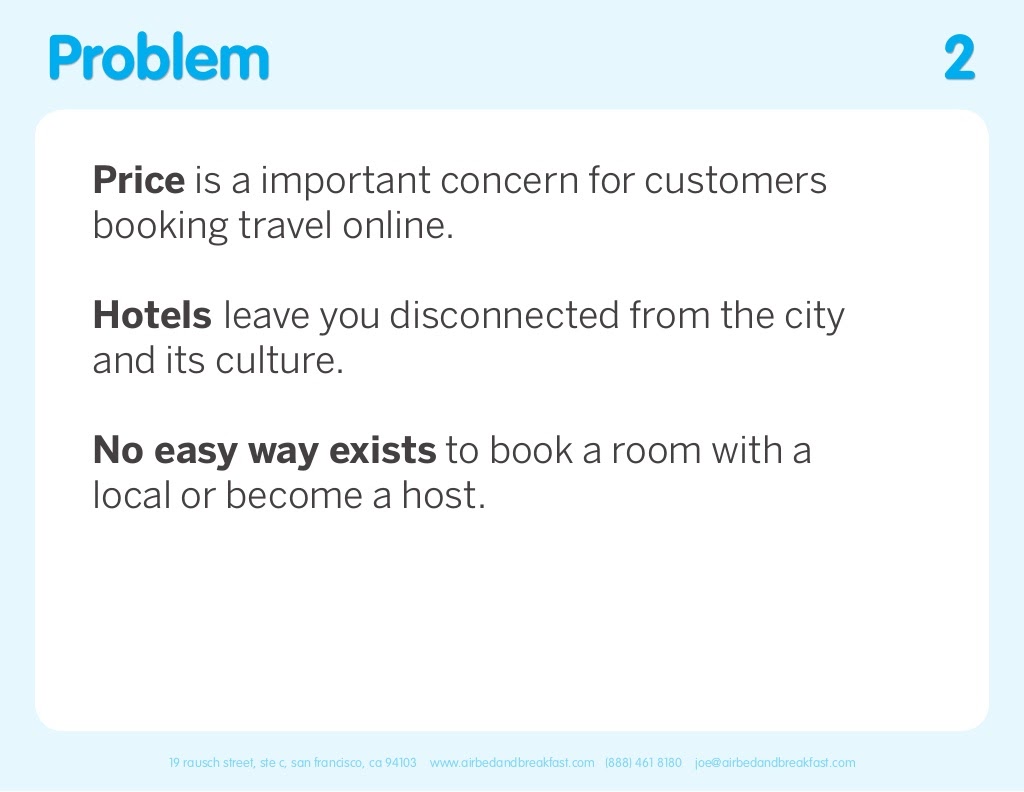
Slide 9 (Problem) lists three crisp user pains: price sensitivity, hotels’ disconnect from local culture, and the lack of an easy way to book rooms with locals or become a host. The language is short, bold and prioritized — each line is a clear pain that maps directly to the later solution. The background photograph of a real living room subtly reinforces the contrast versus sterile hotel rooms.

This approach is effective because it ties the product to specific, investor-relevant customer problems that are large and relatable. Founders can learn to keep problem statements direct and prioritized, and to pick imagery that reinforces the user experience rather than distracting from the message.

Key Takeaway: State 2–4 specific, high-impact customer pain points in plain language so investors immediately understand the need you’re solving.
Solution & Product: Show how the product addresses the pains

Solution & Product: Show how the product addresses the pains

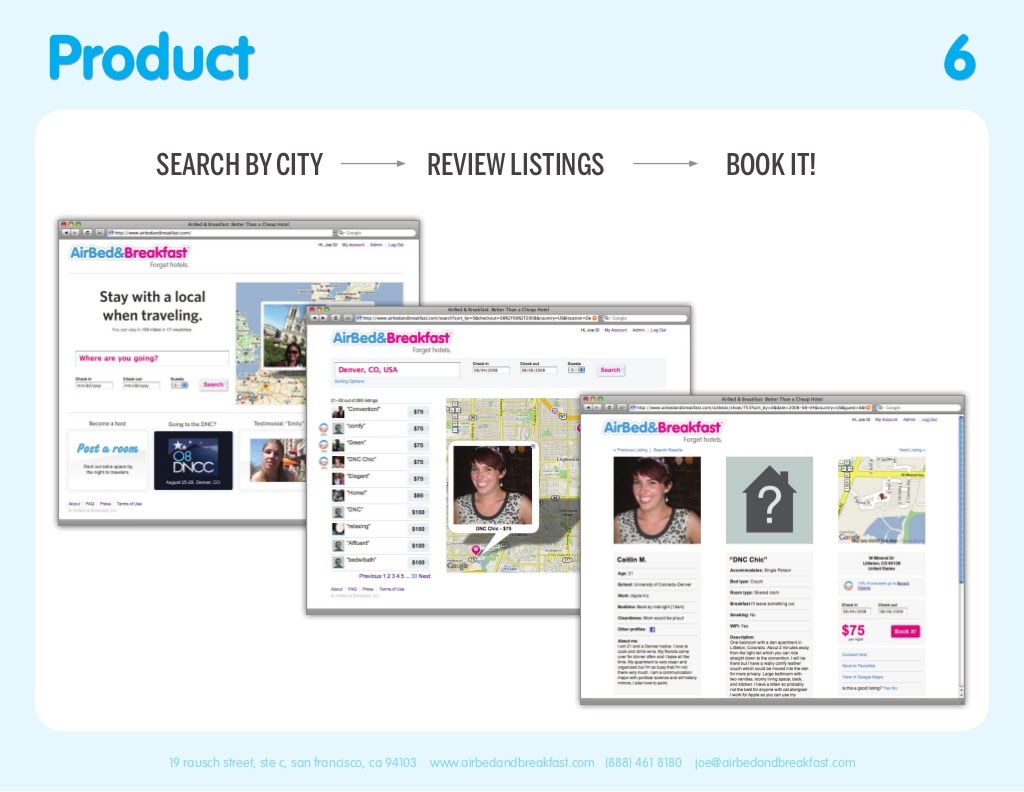
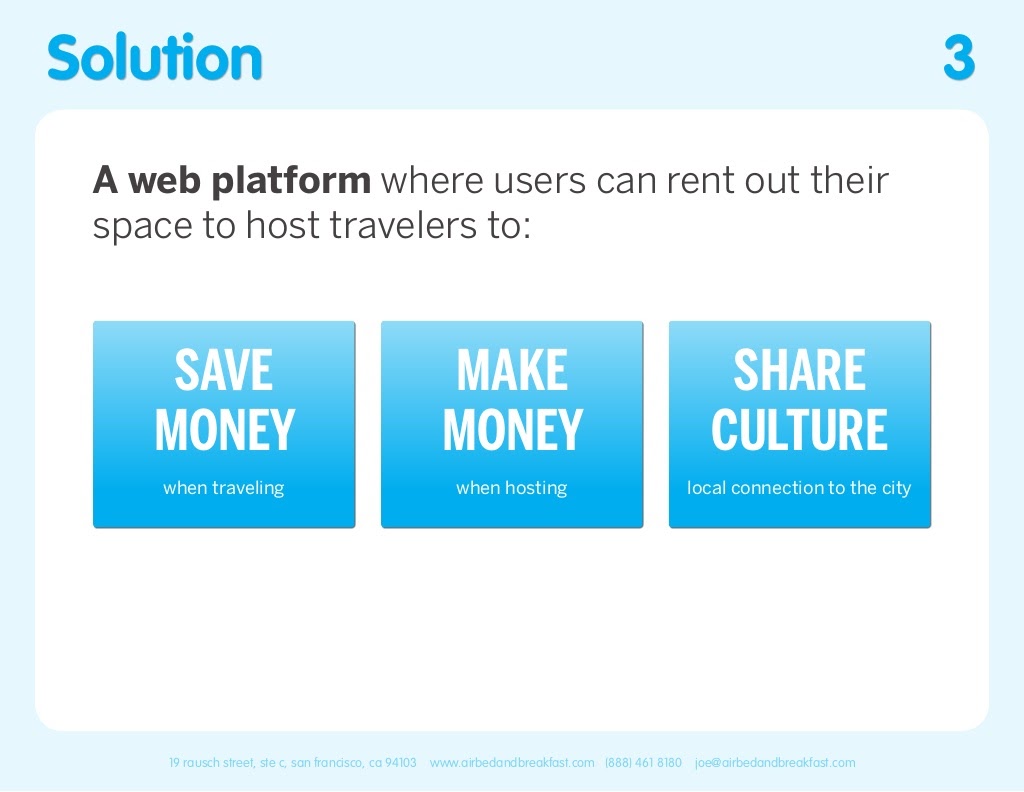
The deck uses two complementary slides to present the solution: a stylized solution slide (SLIDE 23) with icons and a bold headline, and a product/UX slide (SLIDE 24) showing the booking experience. The solution slide distills value into three clear benefits — save money, make money, share culture — tying directly back to the problem bullets. The product slide then demonstrates the actual flow (search, review, book) using a real interface screenshot, grounding the promise in a tangible product.

This combination is powerful because investors need both the conceptual value proposition and proof that the team can build a usable interface. Founders should mirror this pattern: first articulate benefits in plain terms, then show actual product screens or flows to prove feasibility and user experience.

Key Takeaway: Pair a short benefit-driven solution statement with product screenshots that demonstrate the user flow — concept + proof sells confidence.
Market validation & size: Use credible comparators and simple metrics

Market validation & size: Use credible comparators and simple metrics

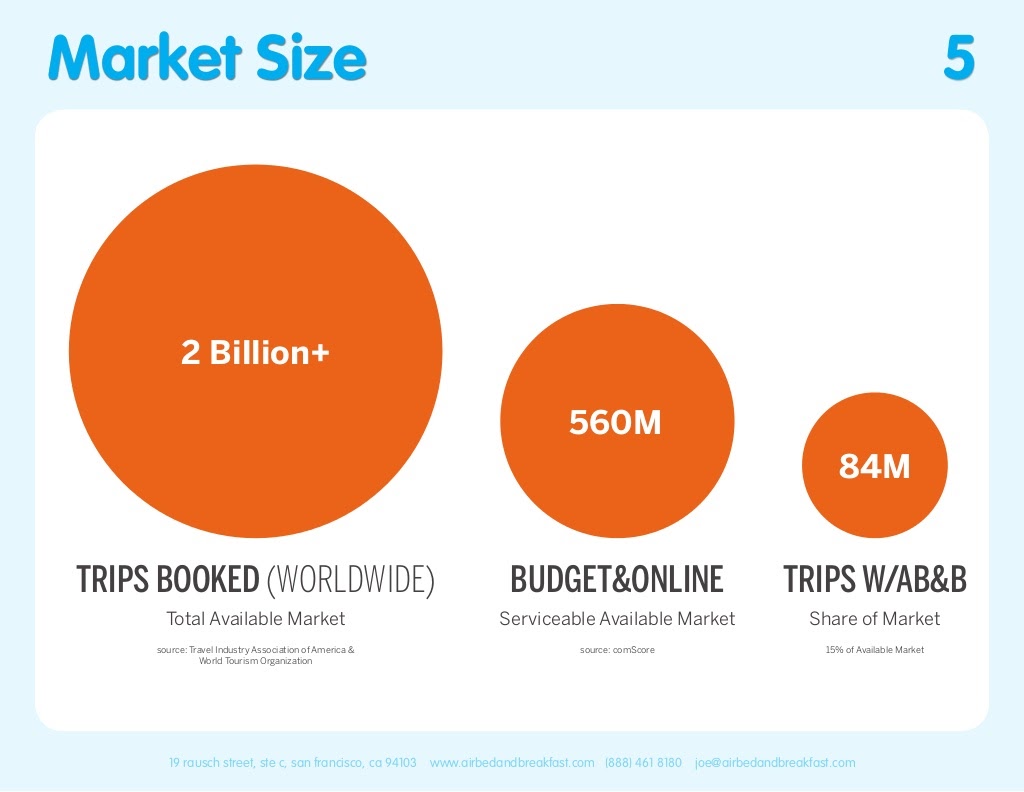
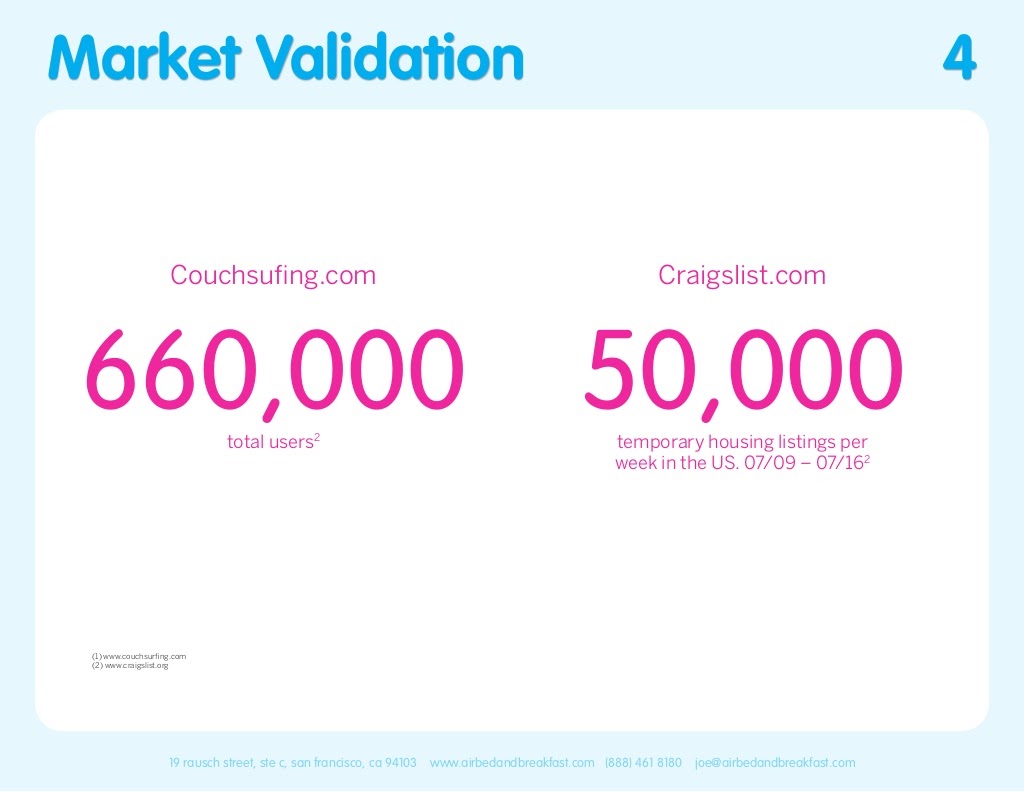
Slide 30 (Market Validation) and Slide 27 (Market Size) work together to show both validation and scale. The validation slide cites Craigslist and Couchsurfing metrics to prove existing demand and analogous user behavior, while the market size slide uses bold bubble graphics to quantify the total addressable and serviceable available market. These choices show there is both immediate behavioral evidence and a large long-term opportunity.

The lesson for founders is to present both types of market evidence: early signals (users, listings, analogous services) that justify traction, and clear TAM/SAM/SOM framing that demonstrates upside. Use simple, sourced numbers and visual metaphors (bubbles, bars) to make the scale intuitive at a glance.

Key Takeaway: Combine quick validation from similar platforms with a simple, sourced market sizing graphic to show both demand and scale.
Business model & financial ask: Clear unit economics and the raise

Business model & financial ask: Clear unit economics and the raise

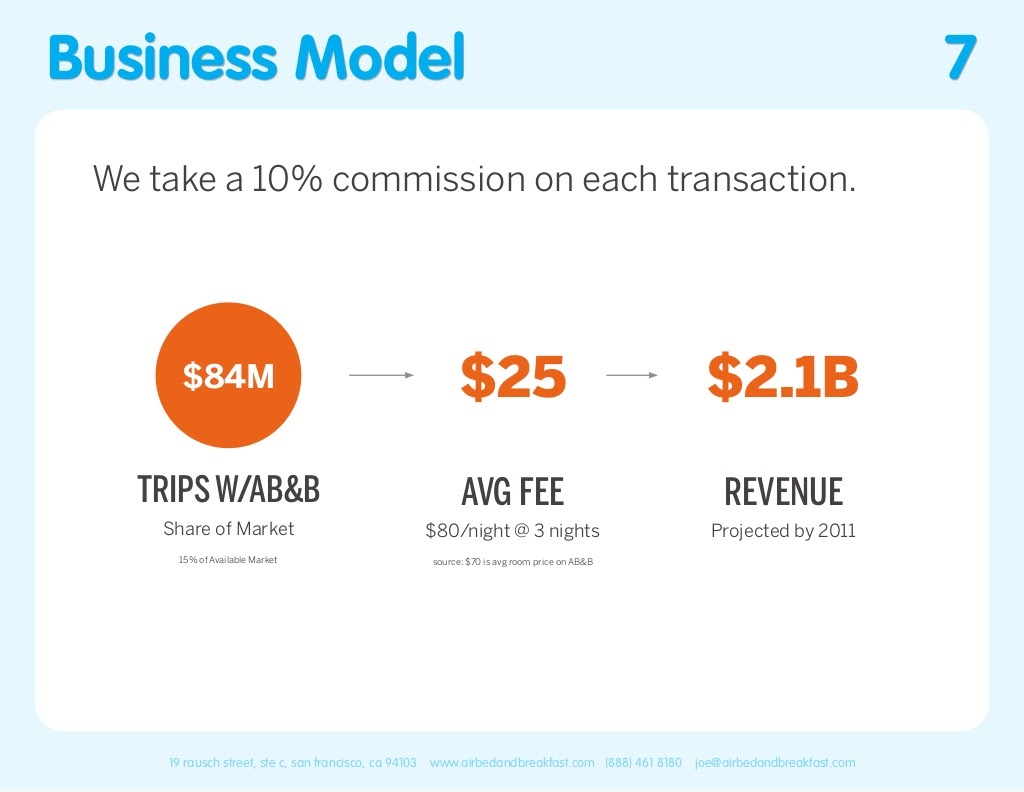
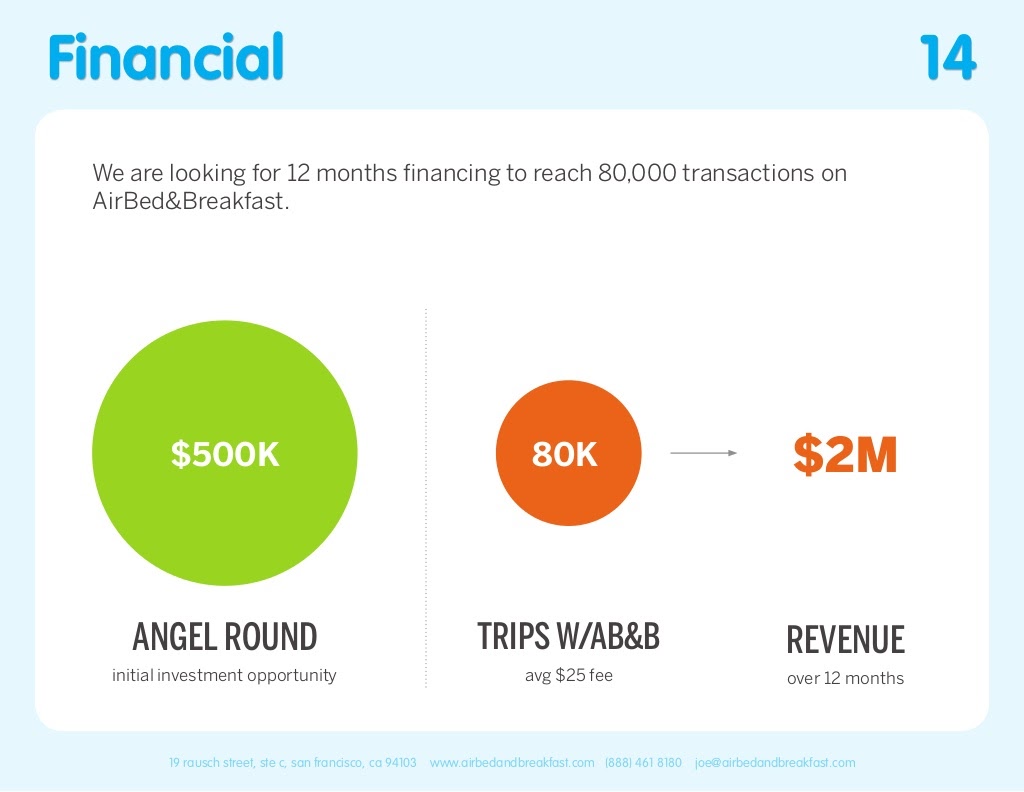
The deck lays out a straightforward revenue model — a percentage commission per transaction — and couples it with conservative projections and a specific ask. Slide 22 shows the ‘we take a 10% commission’ business model with simple big-number projections ($84M, $25 average fee, $200M projected revenue). Slide 10/11 present the specific seed ask ($500K) and how it maps to expected transactions and revenue. The clarity and arithmetic make it easy for investors to evaluate the economics and the capital efficiency of the proposed plan.

Founders should adopt this directness: state the monetization mechanism plainly, show the math for how users convert to revenue, and tie the fundraising ask to measurable milestones (users, transactions, revenue). Avoid vague statements — investors want to see how their capital will move metrics over a defined time window.

Key Takeaway: Explain your monetization with simple unit economics and link the fundraising ask to concrete milestone-driven outcomes.
Team slide: Highlight relevant backgrounds and credibility

Team slide: Highlight relevant backgrounds and credibility

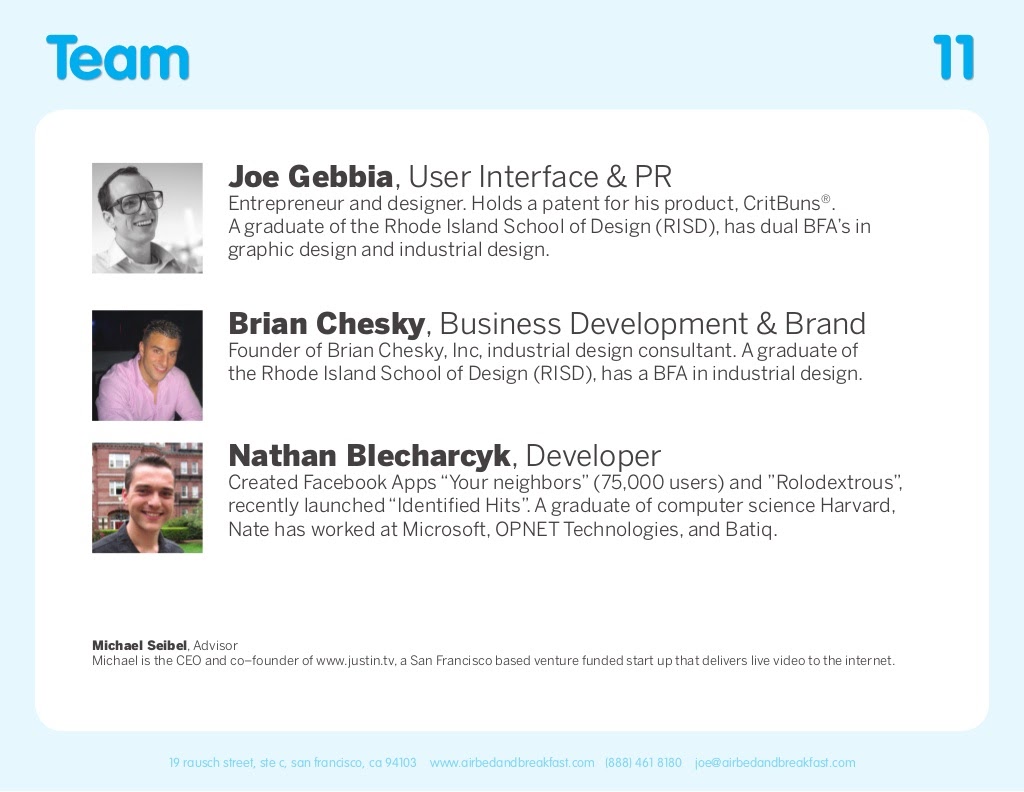
Slide 16 (Team) presents the founders with short blurbs tying their skills to the product needs — design/UI, brand/business, and technical capabilities. It also mentions a known advisor (Michael Seibel) which signals early access to network and mentorship. The layout is clean, focused on roles and relevant experience rather than CV-length bios, which keeps the investor’s attention on why this team can execute.

For founders, the takeaway is to emphasize complementary skills, prior relevant accomplishments and advisors that bring credibility. Keep bios punchy and role-focused — investors want to quickly see fit between team capabilities and product requirements.

Key Takeaway: Show complementary founder roles and a few concrete achievements or advisors that demonstrate the team can deliver.
Traction & social proof: Use testimonials and press to build trust

Traction & social proof: Use testimonials and press to build trust

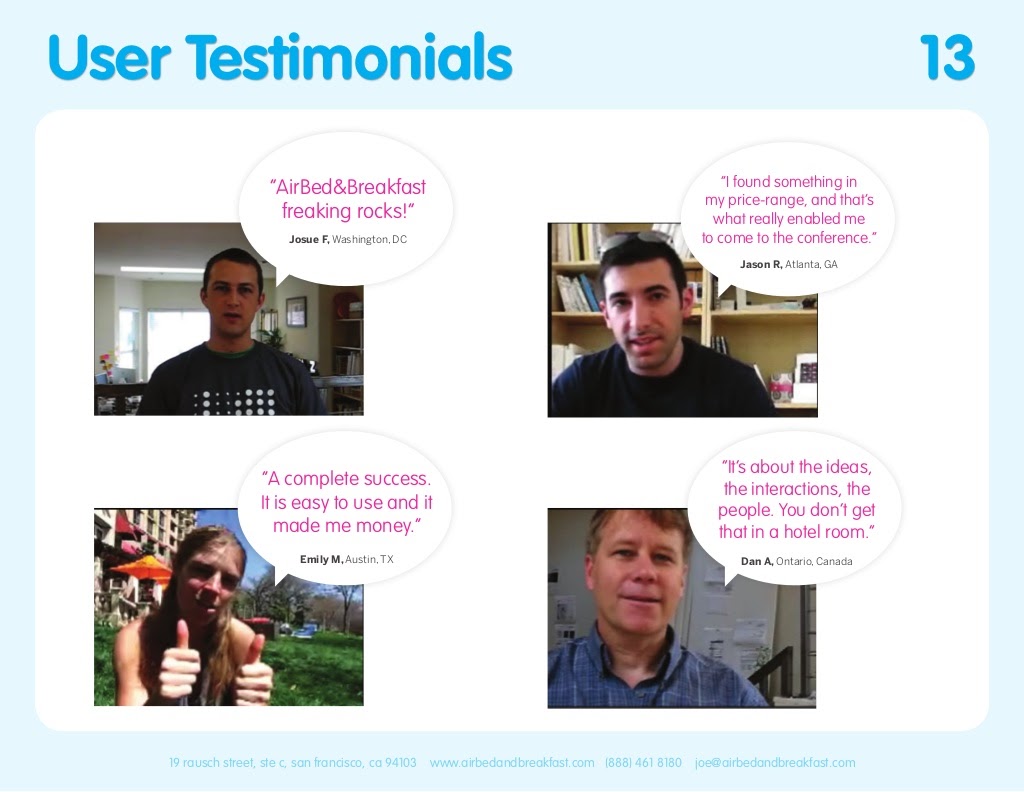
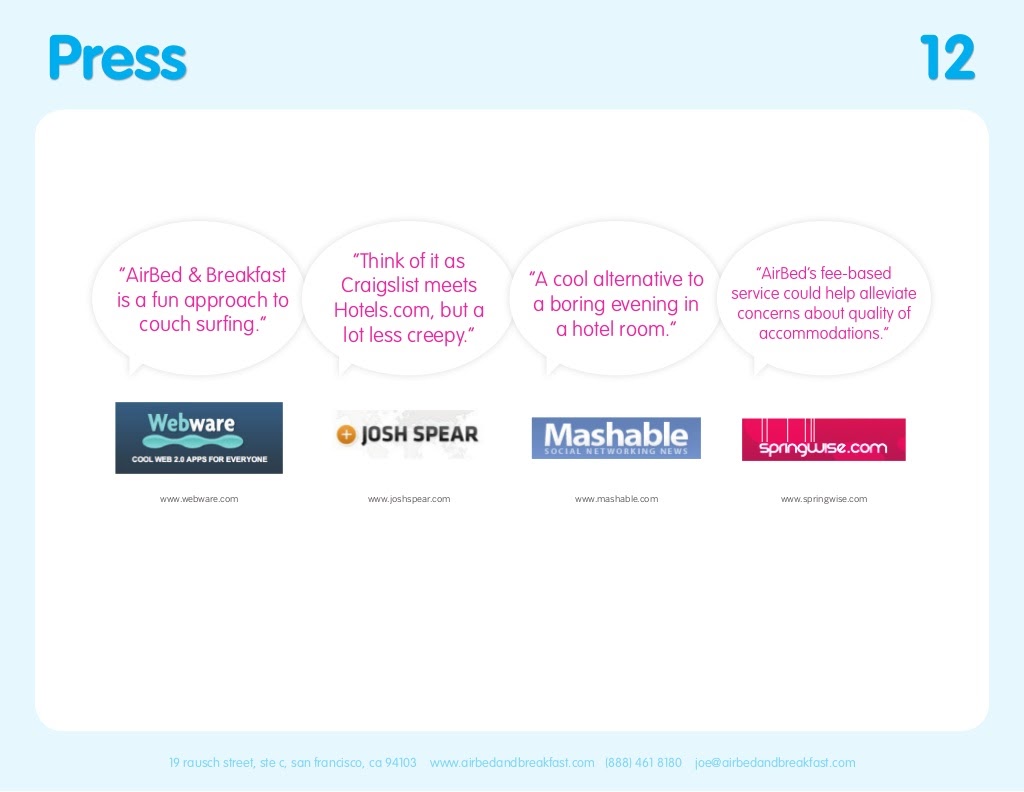
The deck uses user testimonials (Slide 11/12 equivalents) and press quotes (Slide 14) to provide social proof that the service resonates with users and the media. The testimonials are short, credible and paired with faces, while press snippets position the product in relation to known services (Craigslist, CouchSurfing) — framing Airbnb as a safer, more commercial alternative. This multi-channel social proof helps reduce perceived risk for users and investors alike.

Founders should gather and present early qualitative proof (user quotes, screenshots of bookings, press mentions) to humanize traction. Concrete anecdotes backed by numbers (when available) can be more persuasive than polished projections alone.

Key Takeaway: Augment early metrics with user quotes and press highlights to lower perceived risk and show genuine demand.

Conclusion: Key Lessons

Airbnb’s seed deck is effective because it blends emotional storytelling, succinct problem/solution framing, clear product proof, credible market validation, simple unit economics and a confident team pitch. The deck is visually coherent, prioritizes a few high-impact points per slide, and ties the fundraising ask to explicit milestones. Actionable advice for founders: lead with a single, memorable value proposition and evocative imagery; state concrete customer pains; pair benefits with real product screenshots; present credible market evidence and straightforward unit economics; and spotlight a complementary team with relevant credibility. Keep it simple, visual and milestone-driven — clarity and focus are the most persuasive tools at the seed stage.

Full Deck Analysis

13 sections

Overview

Company: Airbnb (AirBed&Breakfast)
Round: Seed ($600K raised; $500K requested)
Year: 2009
Outcome: IPO at $47B valuation (2023)

Executive Summary

Airbnb’s 2009 seed pitch deck presents a compelling two-sided marketplace for peer-to-peer accommodation, positioning itself as the affordable, authentic alternative to hotels and the monetized, trustworthy alternative to free platforms like Couchsurfing. The deck combines strong product design (working prototype with real screenshots), credible team credentials (RISD designers + Harvard engineer), and ambitious market sizing ($2.1B revenue projection by 2011) to justify a $500K seed investment. While the deck excels at emotional positioning (“Share Culture”) and clear value propositions, it lacks operational rigor in unit economics, customer acquisition strategy, and contingency planning—typical weaknesses in early-stage pitches that investors overlook when product-market fit signals are strong.

Problem Statement

The deck articulates three interconnected problems (Slide 10):

  1. Price Sensitivity — “Price is an important concern for customers booking travel online”
    • Implicit: Hotels are expensive; budget travelers need alternatives
  2. Disconnection from Culture — “Hotels leave you disconnected from the city and its culture”
    • Emotional/experiential problem; positions against transactional hotel stays
  3. Supply-Side Friction — “No easy way exists to book a room with a local or become a host”
    • Structural gap: Couchsurfing is free (no host incentive); Craigslist requires daily reposting

Weakness: The problem statement comes after the solution in deck order (Slide 10 vs. Slide 9), and lacks quantitative support. No data on hotel price sensitivity, customer dissatisfaction rates, or market size of budget travelers. The “disconnection from culture” claim is subjective and unvalidated.

Solution

The solution is presented as a three-pillar value proposition (Slide 9):

“A web platform where users can rent out their space to host travelers to:”

  1. SAVE MONEY (Guest side) — when traveling
  2. MAKE MONEY (Host side) — when hosting
  3. SHARE CULTURE — local connection to the city

Product Proof: Slide 2 shows working product screenshots with:

  • City search functionality
  • Host profiles with photos and reviews
  • Pricing ($75–$100/night visible)
  • Maps integration
  • 3-click booking flow

Strengths:

  • Two-sided value prop shows marketplace thinking
  • “Share Culture” differentiates from pure-play budget travel
  • Working product reduces execution risk
  • Clean, modern UI for 2009 standards

Weaknesses:

  • Solution presented before problem (deck flow issue)
  • Doesn’t explain why this solves the problem better than alternatives
  • No mention of trust/safety mechanisms (critical for peer-to-peer)
  • “Share Culture” is vague and hard to measure

Market Opportunity

TAM/SAM/SOM Analysis (Slide 4):

Metric Value Calculation
Total Available Market (TAM) 2 Billion+ trips Worldwide trips booked annually (Travel Industry Association)
Serviceable Available Market (SAM) 560 Million trips Budget & online travelers (comScore data)
Serviceable Obtainable Market (SOM) 84 Million trips 15% of SAM (AB&B’s addressable share)

Revenue Projection (Slide 12):

  • 84M trips × $25 average fee (10% commission on $80/night × 3 nights) = $2.1B projected revenue by 2011

Assessment:

  • Strength: Sophisticated TAM/SAM/SOM framework shows analytical rigor
  • Strength: Credible sources (Travel Industry Association, comScore)
  • Weakness: The 15% SOM assumption is unexplained and highly optimistic
  • Weakness: Assumes 100% capture of the “budget & online” segment; ignores competitive response from Craigslist, VRBO, etc.
  • Weakness: 2011 timeline is only 2 years away; assumes exponential growth with minimal traction

Business Model

Revenue Model (Slide 12):

  • Commission structure: 10% per transaction
  • Average transaction value: $80/night × 3-night stay = $240 total booking
  • Average fee per booking: $25 (10% of $240)
  • Path to revenue: 80K transactions in 12 months = $2M revenue

Strengths:

  • Simple, transparent commission model
  • Scalable with transaction volume
  • Specific assumptions stated ($80/night, 3-night stays, 10% take rate)

Critical Weaknesses:

  • No unit economics shown: No CAC (Customer Acquisition Cost), LTV (Lifetime Value), or payback period
  • No profitability path: $2M revenue ≠ $2M profit; operating costs not addressed
  • Payment processing costs ignored: Stripe/PayPal fees (~3%) would reduce net revenue to ~7% effective take rate
  • No burn rate: Doesn’t show how $500K seed capital will be spent or runway
  • Aggressive growth assumption: 80K transactions in 12 months is ambitious for a marketplace with minimal traction at seed stage

Traction & Metrics

User Testimonials (Slide 8):

  • 4 named users from different geographies (DC, GA, TX, Canada)
  • Quotes emphasize affordability, ease of use, monetization, and authentic experience
  • Video stills suggest real users (not stock imagery)

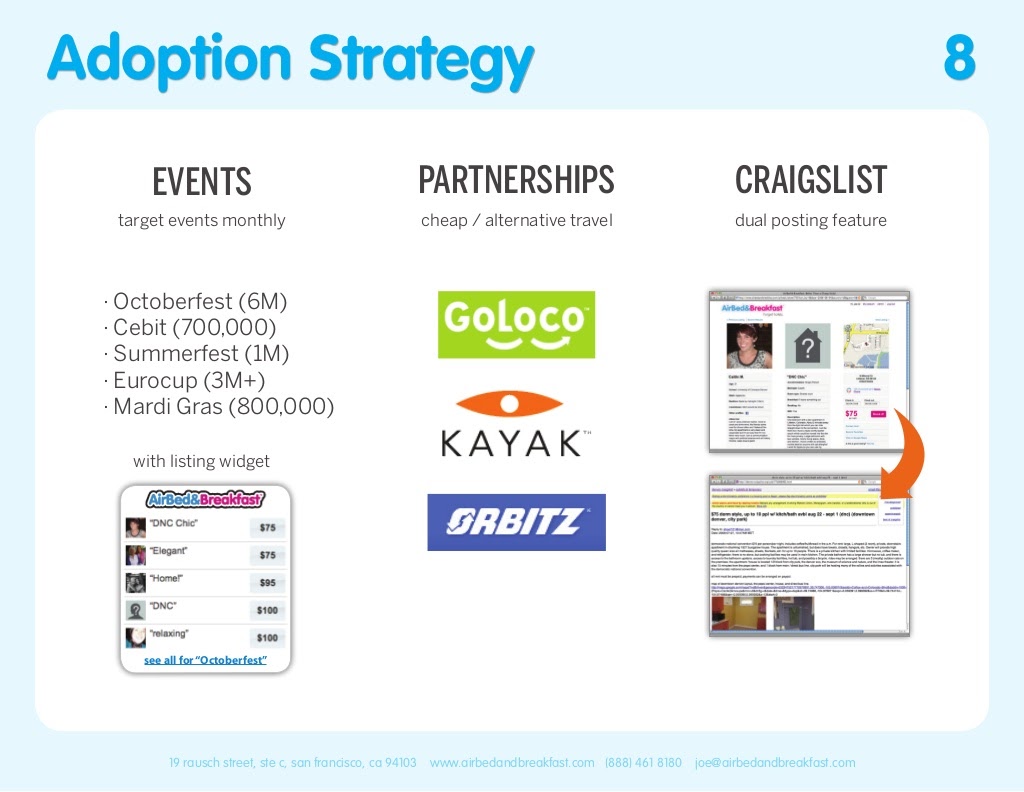
Adoption Strategy Evidence (Slide 7):

  • Event targeting: Octoberfest (6M attendees), Cebit (700K), Summerfest (1M), Eurocup (3M+), Mardi Gras (800K)
  • Partnership targets: Goloco, Kayak, Orbitz
  • Craigslist integration: Dual-posting feature to leverage existing user base

Press Coverage (Slide 14):

  • 4 publications: Webware, Josh Spear, Mashable, Springwise
  • Key quote: “Craigslist meets Hotels.com, but a lot less creepy” (Josh Spear)

Critical Gap: The deck provides no quantitative traction metrics:

  • No number of users (hosts or guests)
  • No number of listings
  • No booking volume or GMV (Gross Merchandise Value)
  • No growth rate or month-over-month metrics
  • No retention or repeat booking rates

This is a major red flag for a seed pitch. The testimonials and press coverage suggest some product-market fit, but without numbers, investors can’t assess the actual scale of traction.

Competitive Positioning

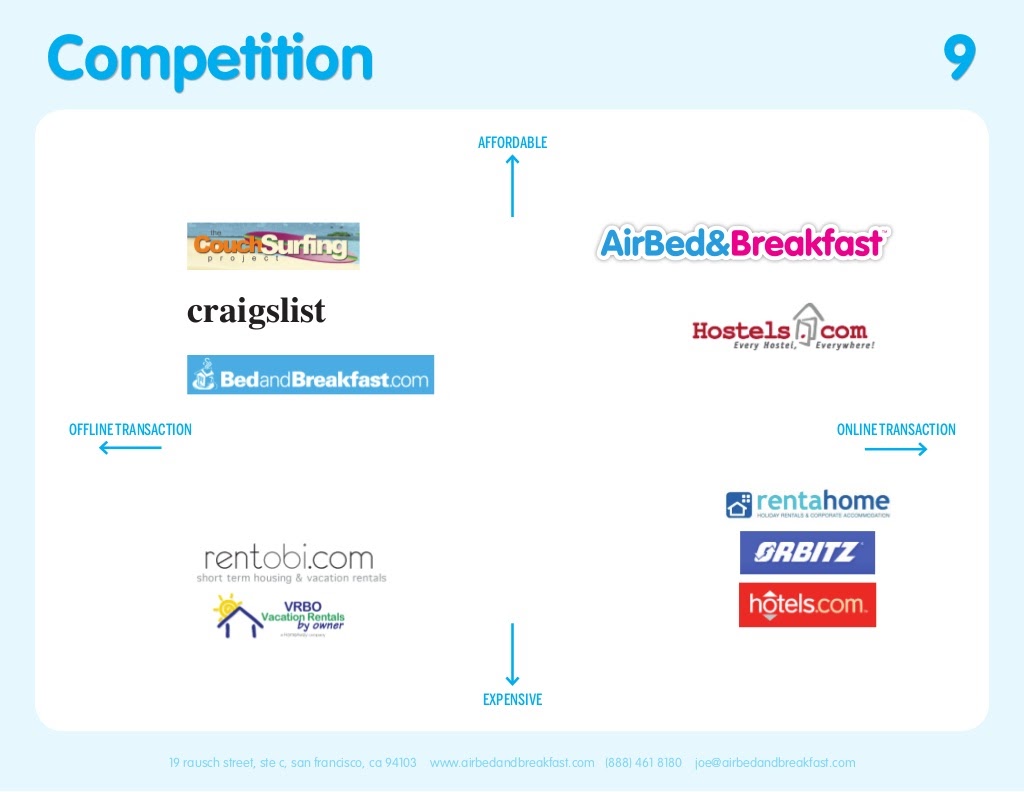
Competitive Matrix (Slide 6):

Airbnb positions itself in a unique quadrant: Affordable + Online Transaction

Competitor Position Weakness
Couchsurfing Affordable + Offline Free (no host incentive); no monetization
Craigslist Affordable + Offline Chaotic; hosts must repost daily; no trust/safety
BedandBreakfast.com Affordable + Offline Offline transaction friction
Hotels.com, Orbitz Expensive + Online High prices; no local experience
Hostels.com, RentaHome Expensive + Online Expensive; institutional

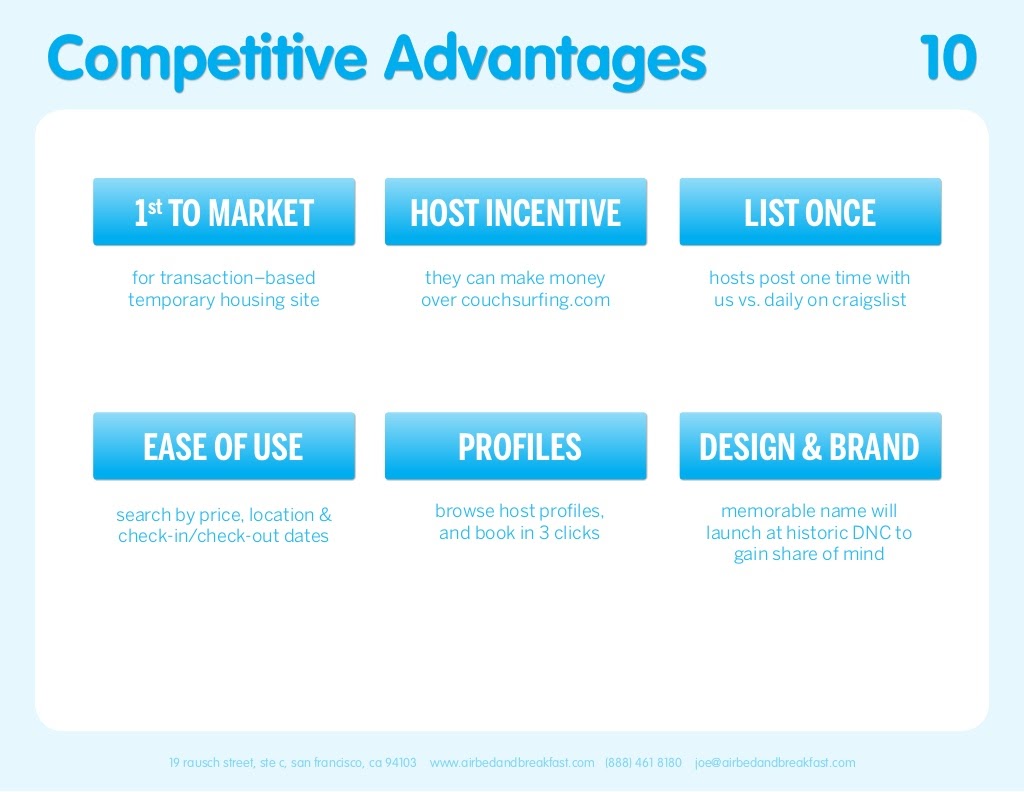
Competitive Advantages (Slide 3):

  1. 1st to Market — “for transaction-based temporary housing site”
  2. Host Incentive — “they can make money over couchsurfing.com”
  3. List Once — “hosts post one time with us vs. daily on craigslist”
  4. Ease of Use — “search by price, location & check-in/check-out dates”
  5. Profiles — “browse host profiles, and book in 3 clicks”
  6. Design & Brand — “memorable name will launch at historic DNC to gain share of mind”

Strengths:

  • Clear differentiation from free (Couchsurfing) and chaotic (Craigslist) alternatives
  • Host-centric thinking (recognizes supply-side friction)
  • Specific, measurable claims (3 clicks, one-time listing)

Weaknesses:

  • “1st to Market” claim is overstated; Couchsurfing existed; this is more “first paid model”
  • Doesn’t address why Craigslist can’t copy the model (no defensibility argument)
  • Missing network effects discussion (critical for marketplace sustainability)
  • Assumes Craigslist won’t improve or compete directly

Team

Founders:

Name Role Background Credentials
Joe Gebbia User Interface & PR Designer; holds patent for CritBuns® Dual BFA (graphic design, industrial design) from RISD
Brian Chesky Business Development & Brand Industrial design consultant BFA in industrial design from RISD
Nathan Blecharcyk Developer Built Facebook apps with 75K+ users Harvard CS graduate; worked at Microsoft, OPNET, Batiq

Advisor:

  • Michael Seibel — CEO/co-founder of justin.tv (live video streaming); provides mentorship and credibility

Assessment:

Strengths:

  • Complementary skill set: design (Gebbia, Chesky) + engineering (Blecharcyk)
  • Top-tier educational pedigree: RISD (design), Harvard (CS)
  • Relevant product experience: Blecharcyk shipped products with user traction (75K Facebook app users)
  • Advisor credibility: Michael Seibel is a recognizable name in tech; justin.tv was a successful venture

Critical Weaknesses:

  • No business/operations experience: No one has run a company, raised capital, or scaled operations
  • Design-heavy team: 2 of 3 founders are designers; limited business acumen
  • No marketplace expertise: No one has built a two-sided marketplace or managed supply/demand dynamics
  • Missing operational skills: No finance, legal, or operations background
  • Advisor is light: Michael Seibel’s level of involvement unclear; no indication of equity or commitment

This is a team that can build a beautiful product but may struggle with the operational complexity of scaling a marketplace. The lack of business experience is a notable gap, though the design pedigree and engineering chops are strong.

Go-to-Market Strategy

Three-Channel Approach (Slide 7):

1. Events (Monthly Targeting)

  • Octoberfest (6M attendees)
  • Cebit (700,000)
  • Summerfest (1M)
  • Eurocup (3M+)
  • Mardi Gras (800,000)
  • Tactic: Listing widget embedded at events; cross-promotion with event organizers

2. Partnerships (Strategic Distribution)

  • Goloco (ride-sharing platform)
  • Kayak (travel search)
  • Orbitz (travel booking)
  • Tactic: Integration with complementary travel platforms; “cheap/alternative travel” positioning

3. Craigslist Integration (Dual-Posting)

  • Tactic: Enable hosts to post once on AB&B and automatically cross-post to Craigslist
  • Benefit: Leverage Craigslist’s massive user base without requiring partnership deal

Assessment:

Strengths:

  • Multi-channel approach shows strategic thinking
  • Craigslist integration is a clever distribution hack; reduces host friction
  • Event targeting is specific and quantified (attendee numbers)
  • Partnerships with Kayak/Orbitz are logical complements

Weaknesses:

  • Event strategy doesn’t scale: Manual, labor-intensive; unclear how 5 events/year drives sustainable growth
  • Partnership details missing: No specifics on terms, revenue share, or likelihood of deals
  • Craigslist risk: Relying on Craigslist integration is risky; Craigslist could block or compete
  • No organic/viral strategy: Doesn’t address word-of-mouth, referrals, or network effects
  • No user acquisition metrics: Doesn’t project how many users/bookings these channels will drive
  • Partnerships may not materialize: Kayak, Orbitz logos shown, but no evidence of signed deals

The Ask

Funding Request (Slide 13):

  • Amount: $500K seed round (actual raise: $600K)
  • Timeline: 12 months of financing
  • Target Milestone: 80,000 transactions on AirBed&Breakfast
  • Projected Revenue: $2M over 12 months

Use of Funds:

  • Not specified. The deck does not break down how the $500K will be allocated (salaries, marketing, infrastructure, etc.)

Assessment:

Strengths:

  • Specific, measurable milestone (80K transactions)
  • Clear connection to revenue projection ($2M)
  • 12-month horizon is reasonable for seed funding

Critical Weaknesses:

  • No budget breakdown: Investors don’t know how capital will be spent
  • No burn rate: Doesn’t show monthly burn or runway
  • No contingency: Only shows upside scenario; no downside case
  • Missing key metrics: No CAC, LTV, payback period, or unit economics
  • Aggressive growth target: 80K transactions in 12 months is ambitious for a marketplace with minimal traction
  • No mention of Series A: Doesn’t address capital requirements beyond 12 months

Key Takeaways

What Airbnb Did Well:

  1. Led with a working product (not mockups)
  2. Articulated a clear two-sided value prop
  3. Identified a white-space competitive position
  4. Assembled a credible, complementary team
  5. Used specific, quantified assumptions in business model
  6. Showed early traction signals (testimonials, press)

What Airbnb Could Have Improved:

  1. Included quantitative traction metrics (users, bookings, growth rate)
  2. Showed unit economics and path to profitability
  3. Addressed trust/safety mechanisms (critical for peer-to-peer)
  4. Provided a detailed use-of-funds breakdown
  5. Discussed defensibility and network effects
  6. Ordered slides logically (problem before solution)
  7. Showed a scalable, repeatable acquisition model (not just events)

Why It Worked:
Despite these gaps, Airbnb raised $600K because:

  • The product was real and worked
  • The team was credible and complementary
  • The market opportunity was massive
  • The positioning was clear and defensible
  • Early traction signals (testimonials, press) suggested product-market fit
  • The problem was emotionally resonant (“share culture”) and rationally justified (price)

In 2009, the bar for seed funding was lower than today. Investors were willing to overlook missing unit economics and quantitative traction if the product, team, and market opportunity were compelling. Today, seed investors expect more rigor on metrics, unit economics, and go-to-market strategy.


Historical Context

Why This Deck Worked in 2009:

  • Post-financial crisis: Budget travel was a growing trend; hotels were expensive
  • Mobile/trust emerging: Smartphones and social networks were enabling peer-to-peer transactions
  • Craigslist dominance: No clear alternative for short-term rentals; market was fragmented
  • Design-driven startups: RISD/design pedigree was a strong signal in 2009
  • Lower seed bar: Seed investors were more willing to bet on team + market + product without full unit economics

How the Market Evolved:

  • Airbnb scaled from 80K transactions (12-month target) to billions of bookings
  • Network effects became the primary defensibility mechanism (not just UX)
  • Trust/safety became table stakes (insurance, verification, reviews)
  • Regulatory challenges emerged (licensing, taxes, zoning)
  • Competition intensified (Vrbo, Booking.com, HomeAway)

The fact that Airbnb achieved a $47B IPO valuation suggests the market opportunity was even larger than the $2.1B revenue projection, and the team’s ability to execute on operations and scaling far exceeded what the seed pitch suggested.

Investor Deep Dive

Executive summary, strengths & red flags

Executive Summary

Airbnb's 2009 seed pitch deck presents a compelling two-sided marketplace for peer-to-peer accommodation, positioning itself as the affordable, authentic alternative to hotels and the monetized, trustworthy alternative to free platforms like Couchsurfing. The deck combines strong product design (working prototype with real screenshots), credible team credentials (RISD designers + Harvard engineer), and ambitious market sizing ($2.1B revenue projection by 2011) to justify a $500K seed investment. While the deck excels at emotional positioning ("Share Culture") and clear value propositions, it lacks operational rigor in unit economics, customer acquisition strategy, and contingency planning—typical weaknesses in early-stage pitches that investors overlook when product-market fit signals are strong.

Key Strengths

7 identified

1

Working Product with Real Screenshots

The deck leads with a functioning product (Slide 2) showing actual UI, host profiles, pricing, maps, and booking flow. This dramatically reduces execution risk compared to pitches based on mockups ...

2

Two-Sided Marketplace Value Prop

The "Save Money / Make Money / Share Culture" framework (Slide 9) elegantly articulates value for both guests and hosts. This shows the founders understand that sustainable marketplaces require bal...

3

Clear Competitive Positioning

The positioning matrix (Slide 6) clearly identifies a white space: "Affordable + Online Transaction." By comparing to Couchsurfing (free, offline friction), Craigslist (chaotic, no monetization), a...

4

Credible Team with Relevant Experience

The team combines design excellence (RISD graduates) with engineering chops (Harvard CS, Microsoft experience) and advisor credibility (Michael Seibel from justin.tv). For a consumer product, this ...

5

Specific, Quantified Assumptions

The business model (Slide 12) is transparent: 10% commission, $80/night average, 3-night stays, $25 average fee. This makes the math easy to verify and shows the founders have thought through unit ...

6

Pragmatic Go-to-Market Strategy

The three-channel approach (events, partnerships, Craigslist integration) is boots-on-the-ground and executable. The Craigslist dual-posting feature is particularly clever—it's a distribution hack ...

7

Early Traction Signals

User testimonials (Slide 8) and press coverage (Slide 14) suggest the product resonates with early adopters. The fact that Mashable, Josh Spear, and other tech media covered the product at seed sta...

Red Flags & Weaknesses

10 identified

1

No Quantitative Traction Metrics

The deck provides testimonials and press coverage but *no numbers* on users, listings, bookings, or growth rate. This is a critical gap. Investors need to know:

2

Aggressive Market Sizing with Weak Assumptions

The $2.1B revenue projection (Slide 4 → Slide 12) is based on capturing 15% of the "budget & online" travel market by 2011. This assumes:

3

Missing Unit Economics & Profitability Path

The deck shows revenue projections but not:

4

No Burn Rate or Budget Breakdown

The $500K ask (Slide 13) doesn't specify how the capital will be spent. Investors don't know:

5

Weak Competitive Defensibility

The competitive advantages (Slide 3) don't address *why* competitors can't copy the model:

6

Team Lacks Marketplace & Operations Experience

The team is strong on design and engineering but weak on business operations. No one has:

7

Go-to-Market Strategy Doesn't Scale

The event strategy (5 events/year) is manual and labor-intensive. The partnership strategy is speculative (no signed deals). The Craigslist integration is clever but risky (Craigslist could block i...

8

Trust & Safety Not Addressed

For a peer-to-peer marketplace, trust and safety are existential. The deck doesn't mention:

9

Deck Flow & Ordering Issues

The deck presents the solution (Slide 9) before the problem (Slide 10), and the slide numbering is inconsistent (Slide 1 is labeled "Welcome" but numbered as Slide 1, while other slides are numbere...

10

Overly Optimistic Timeline

The 80K transaction target for 12 months is ambitious. For context:

More Pitch Decks To Study

Compare structure, fundraising context, and investor-facing story across similar startup decks.