Compare your deck to Monzo

Compare Your Deck

Monzo Pitch Deck (2016)

Fintech
Stage: Crowdfunding
Raised: $2.4M
Year: 2016
Slides: 16
Outcome: Valued at $4.5B

Pitch Deck

1 / 16
Monzo pitch deck - The Opening: Brand and Mission
Click to expand

Deck Analysis

This deck presents Monzo’s 2016 crowdfunding pitch: a consumer-focused challenger bank positioning itself as a mobile-first financial control centre. It combines storytelling (community, product delight) with quantified traction (users, card spend, viral mechanics), technology claims (95% built in-house, ML for fraud), and regulatory milestones (UK banking licence). Notable for its clean visual design, clear metrics, and emphasis on community-driven growth, the deck shows how a fintech can use product experience, transparency and data to win both users and investors.

The Opening: Brand and Mission

The Opening: Brand and Mission

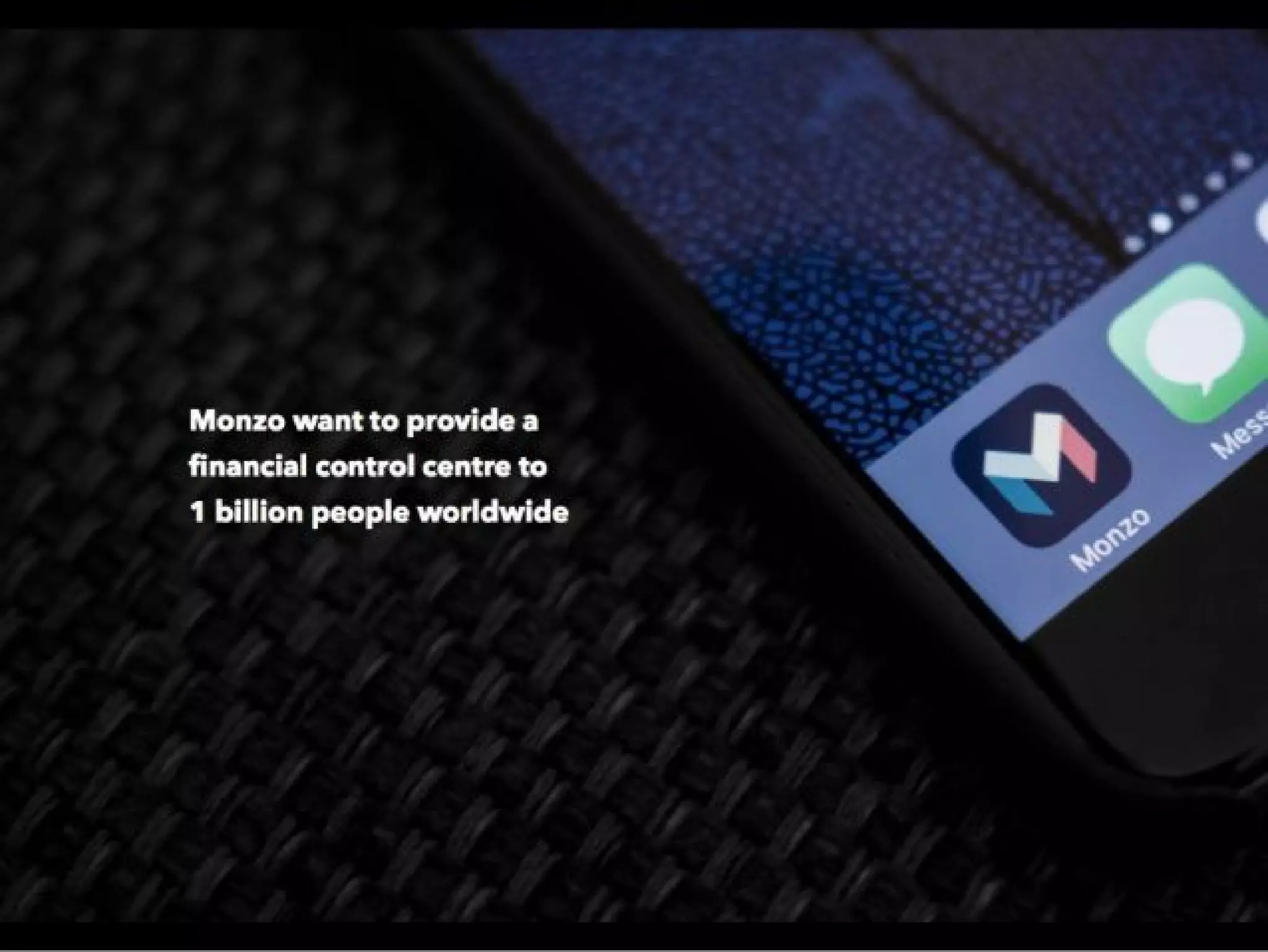
Slide 1 (cover) and slide 2 set a strong emotional and mission-driven tone: they open with the Monzo brand and a bold ambition — to provide a financial control centre to 1 billion people worldwide. The visuals (celebratory crowd, app icon) and short declarative copy establish identity and aspiration immediately, making it easy for investors to understand what Monzo aims to become beyond a single product. This is effective because it leads with vision rather than detail, which helps frame the rest of the deck as steps toward that outcome.

Founders can learn the value of starting with a concise mission and strong branding. It orients the audience and primes investors to interpret traction and technical claims as progress toward a large, relatable goal. Use a simple, high-level ambition early to give later metrics context and to make the story cohesive.

Key Takeaway: Start decks with a crisp mission and visual identity to frame all subsequent traction and technical detail as progress toward a bold, investable outcome.
Product: Mobile-first, delightful user experience

Product: Mobile-first, delightful user experience

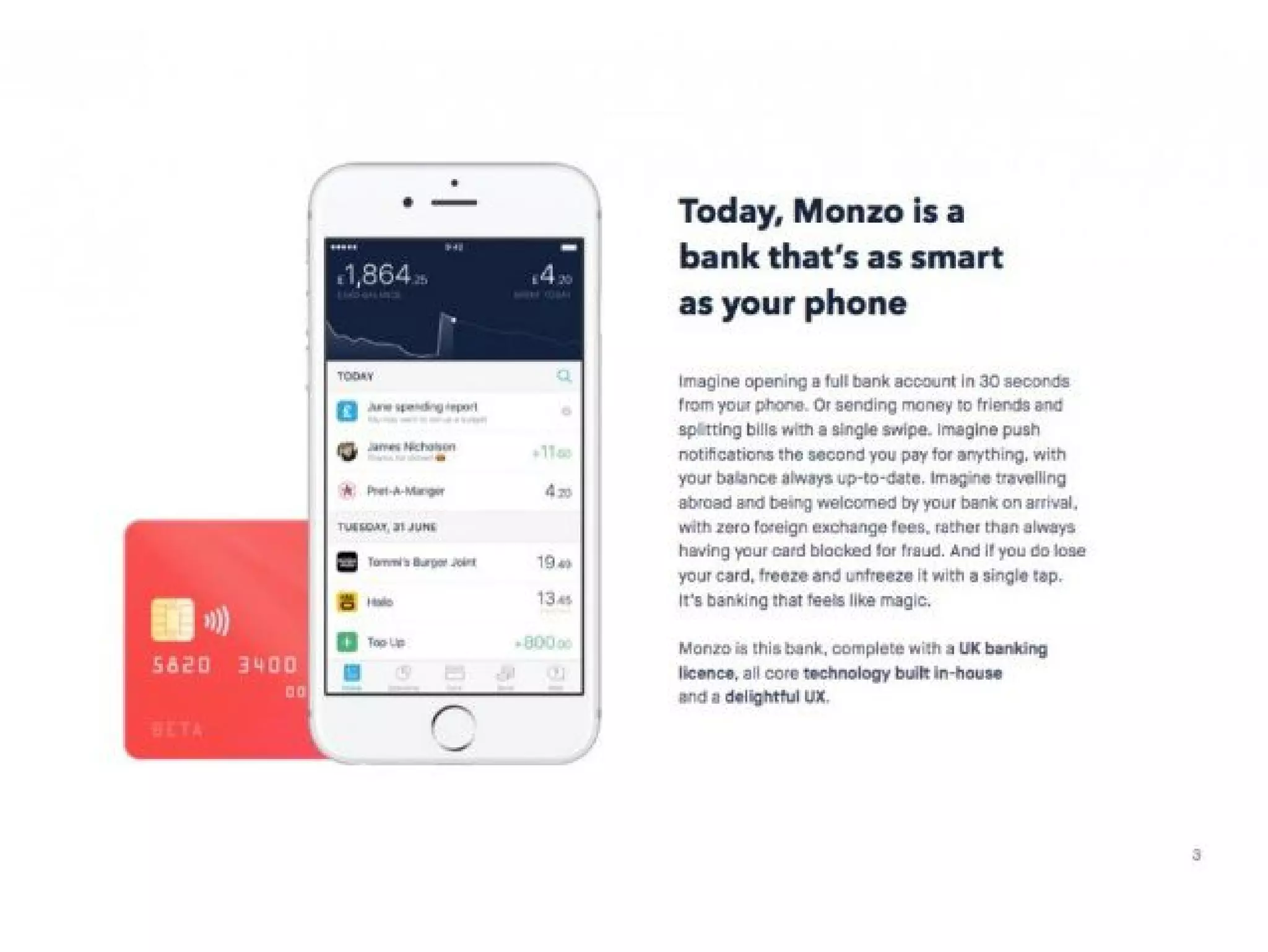
Slide 3 presents the product: an elegant mobile app and card with a short paragraph explaining fast onboarding, instant notifications, and user controls like freezing a lost card. The copy focuses on tangible user benefits rather than tech jargon — opening an account in 30 seconds, push notifications, zero FX fees — which helps investors quickly grasp product-market fit. The pairing of app UI imagery and concise bullets demonstrates a product that is both usable and differentiated on experience.

This approach is effective because consumer fintech is a trust-and-experience business; showing exactly what users see and feel reduces abstraction. For founders, include real screenshots and direct user benefits rather than long lists of features, and highlight the onboarding and retention mechanics that make the product sticky.

Key Takeaway: Use real product visuals and short benefit-driven copy to show how the product delivers a superior user experience that drives retention and referrals.
Traction: Clear, simple growth charts

Traction: Clear, simple growth charts

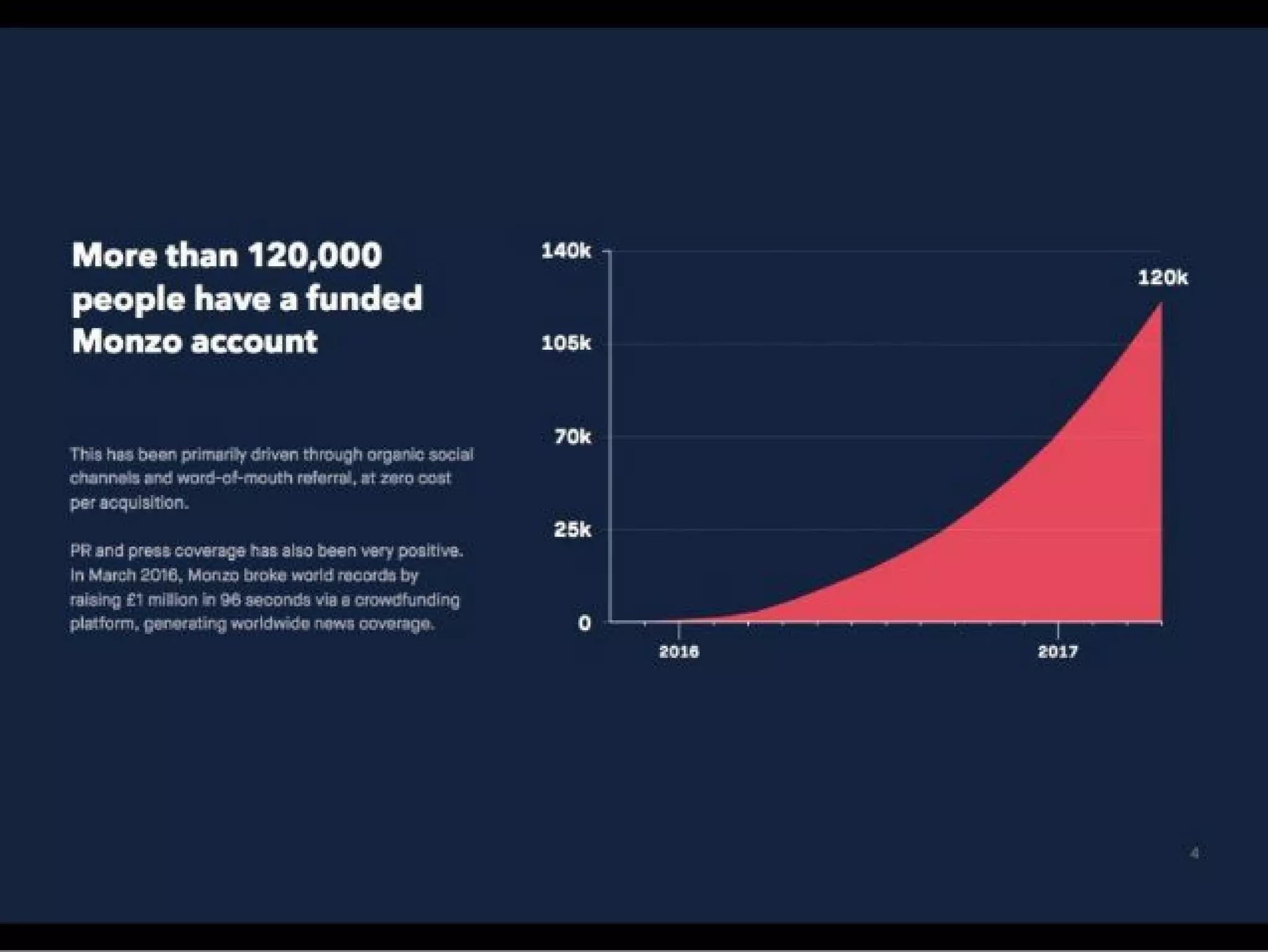
Slide 4 uses a single large chart and one headline: more than 120,000 people have a funded Monzo account. The graph shows rapid exponential growth, and the supporting copy attributes it to organic social channels and word-of-mouth, with a PR milestone (raising £1m in 96 seconds) that proves viral momentum. The visual emphasis on one compelling number keeps the message focused: traction is strong and accelerating.

Investors respond to clean, credible evidence of demand; Monzo’s slide avoids clutter and ties the chart to acquisition channels and viral events. Founders should highlight one or two headline traction metrics visually and explain the mechanism behind growth (organic channels, product virality, PR moments), so investors understand sustainability, not just raw numbers.

Key Takeaway: Display one dominant traction metric with a clear growth curve and explain the acquisition channels that produced it to prove both momentum and repeatability.
Customer Metrics: Depth over vanity numbers

Customer Metrics: Depth over vanity numbers

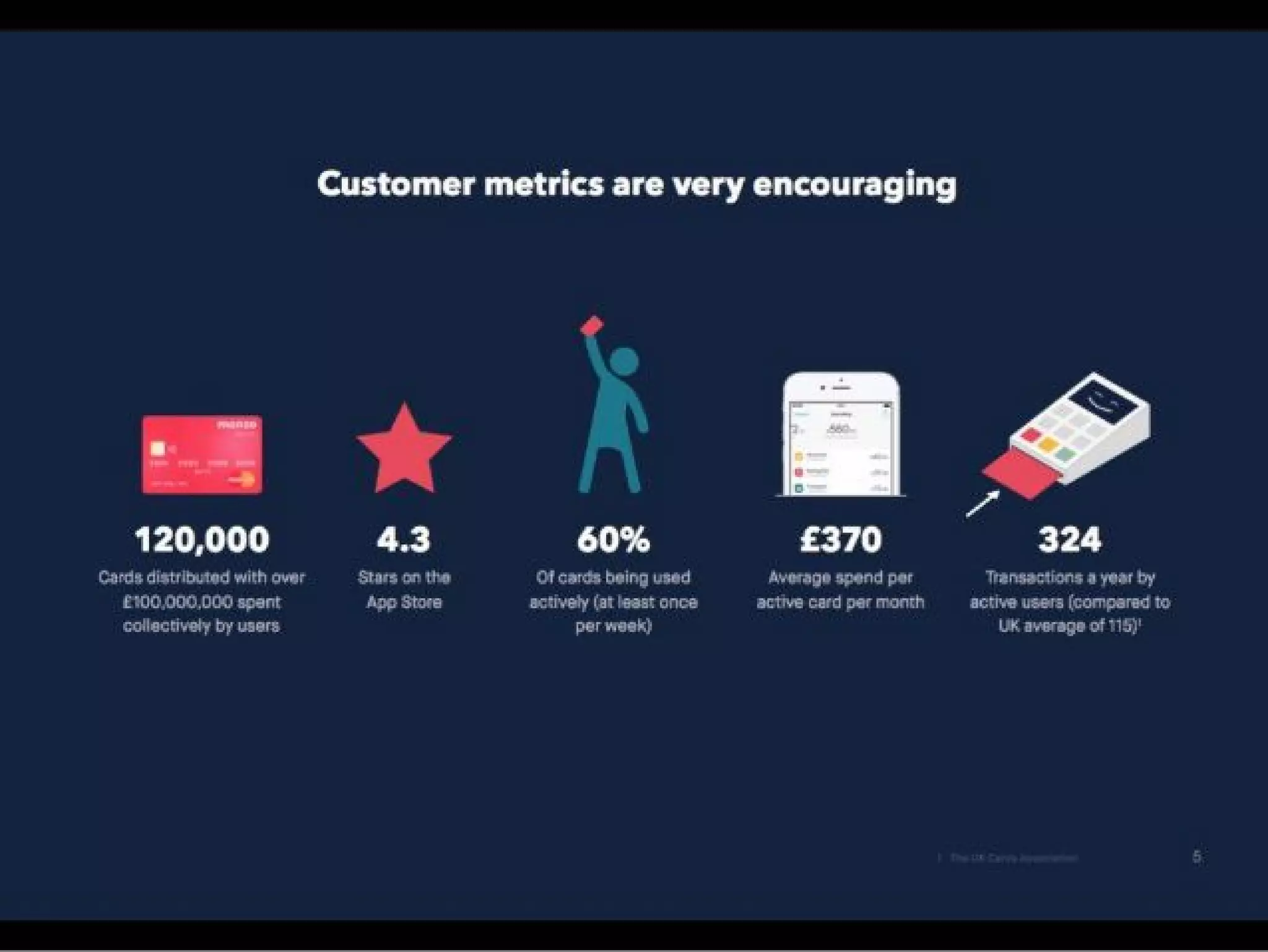
Slide 6 lists granular customer metrics — 120,000 cards distributed, 4.3 App Store rating, 60% active card usage weekly, average spend £370 per active card per month, and 324 transactions per year per active user. These are meaningful product-health indicators that speak to engagement and revenue potential rather than just user signups. The combination of NPS-like signals (app rating), usage frequency, and monetizable behavior (spend per card) gives investors a rounded view of unit economics and long-term value.

This is effective because it shows Monzo understands which metrics matter for a consumer banking business. Founders should choose KPIs that connect directly to monetization and retention and present them together so investors can quickly infer LTV, engagement and adoption quality rather than being distracted by raw download counts.

Key Takeaway: Show engagement and monetization-focused KPIs that directly connect product usage to future revenue, not just user acquisition statistics.
Viral Growth Mechanics and Community

Viral Growth Mechanics and Community

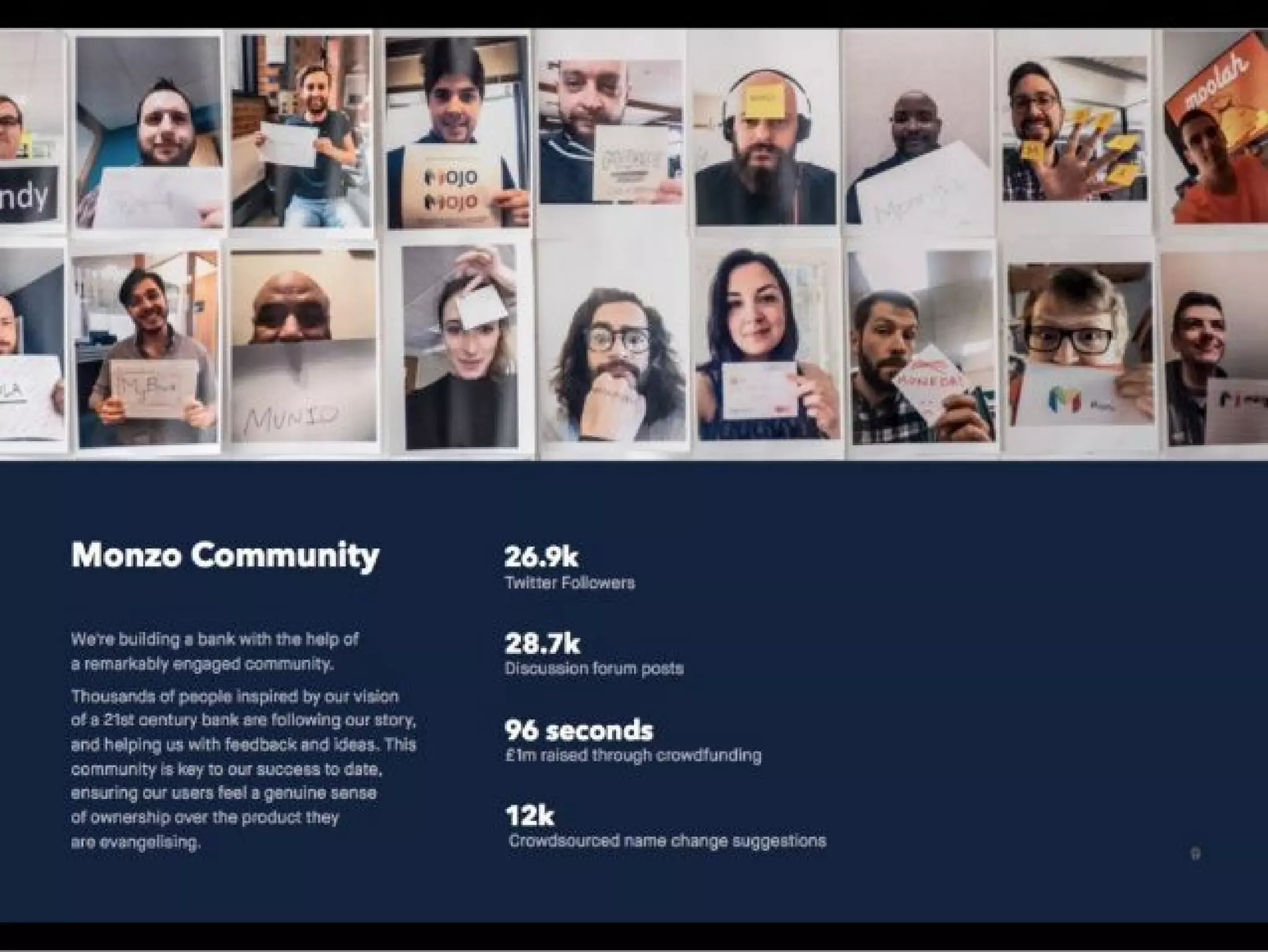
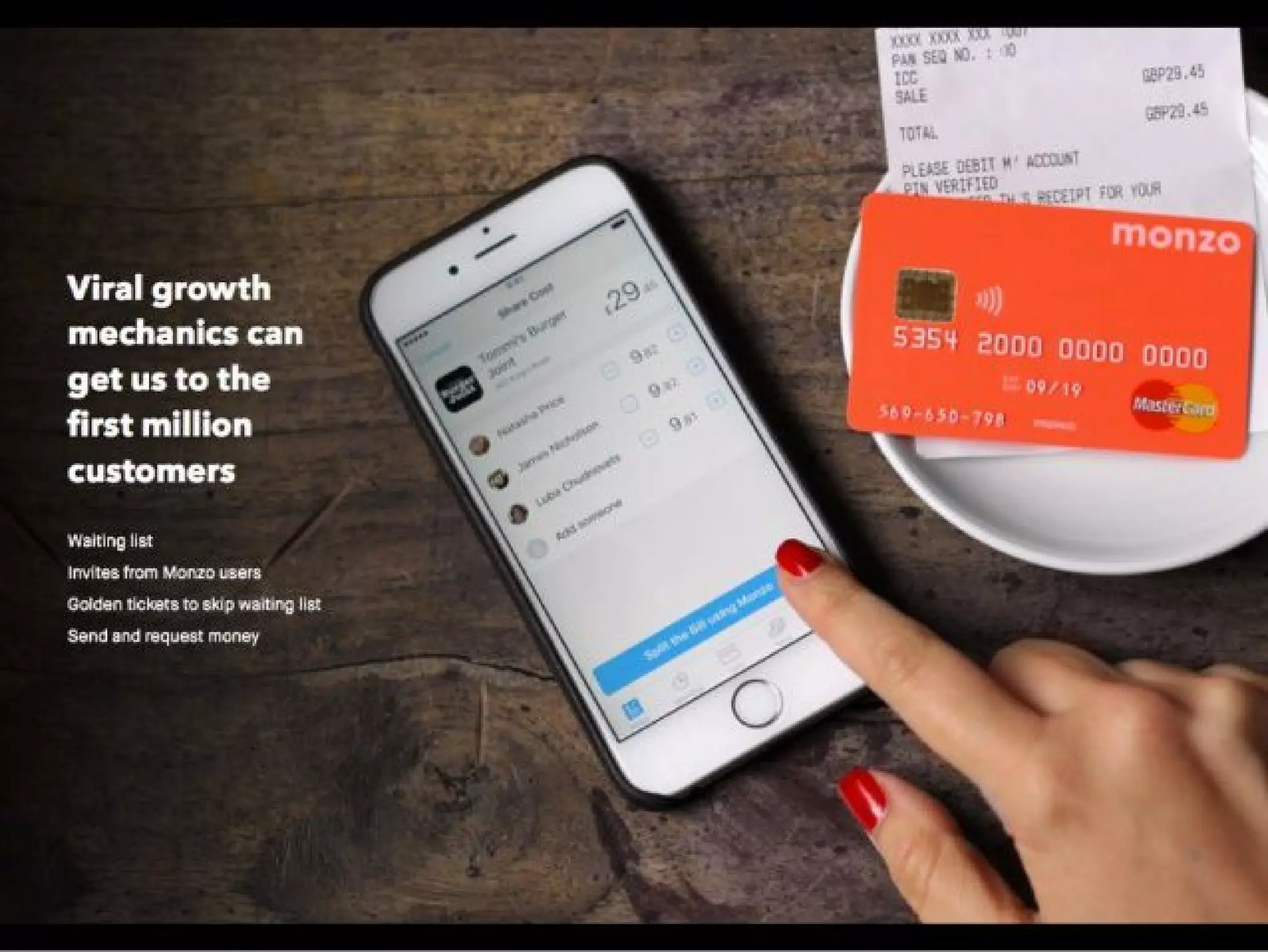
Slide 9 highlights concrete viral mechanics — waiting lists, invites, 'golden tickets' to skip queues, and peer-to-peer send/request features — while slide 10 emphasizes community stats (Twitter followers, forum posts, 96 seconds to raise £1m). Monzo ties product features to social distribution and demonstrates they leveraged scarcity and referral to scale acquisition at near-zero cost. The imagery of the card and app alongside the callouts makes the viral loops tangible for investors.

This section works because it shows product-led growth design rather than accidental virality. Founders should intentionally bake referral and scarcity mechanics into onboarding and surface community metrics to demonstrate ownership-driven growth. Outline the exact features that create viral loops and present community engagement numbers to show that the virality is real and measurable.

Key Takeaway: Design and call out the exact product mechanics that create viral loops and back them up with community engagement metrics to prove sustainable, low-cost acquisition.
Technology & Scale: Machine learning and in-house stack

Technology & Scale: Machine learning and in-house stack

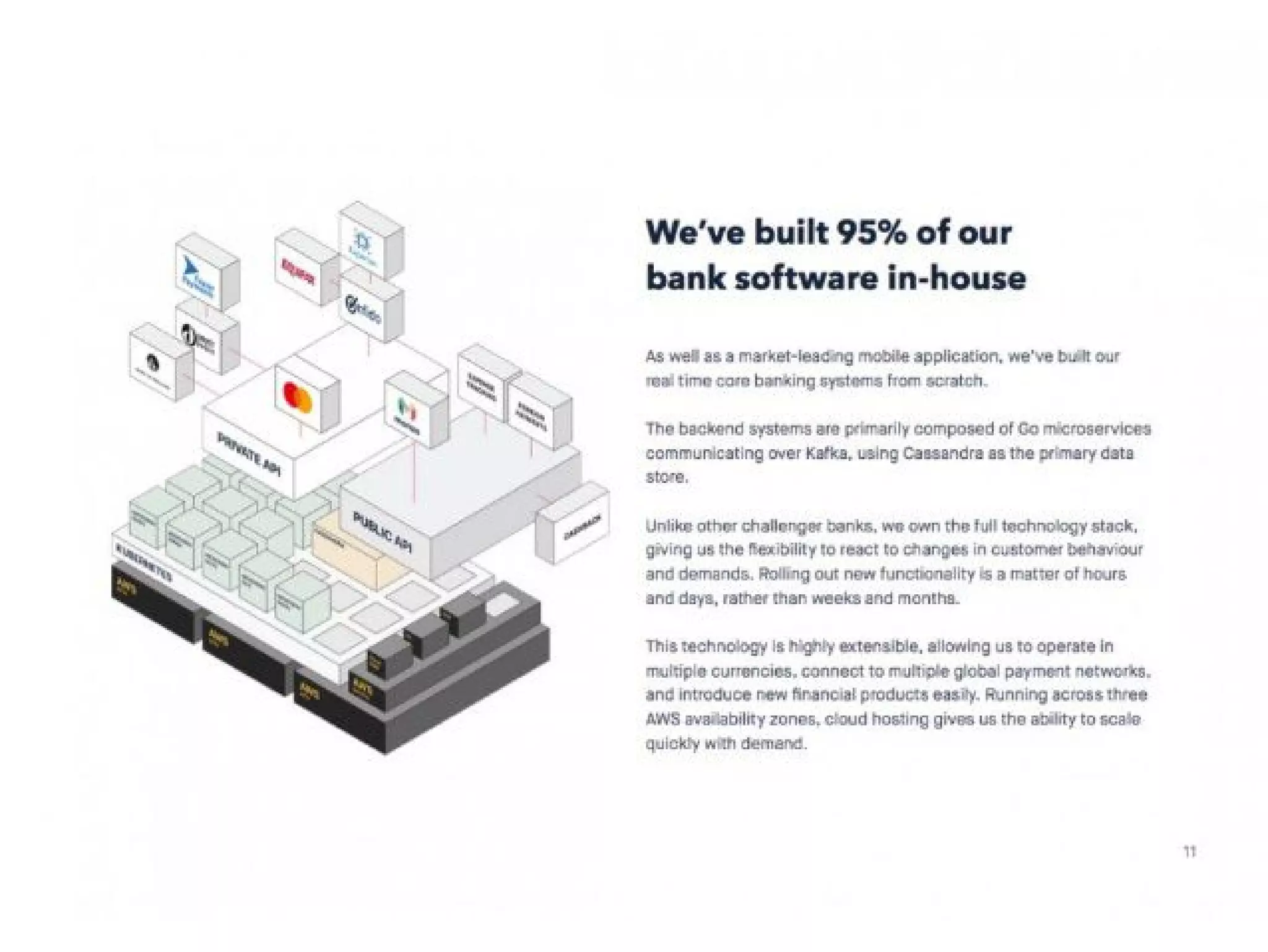
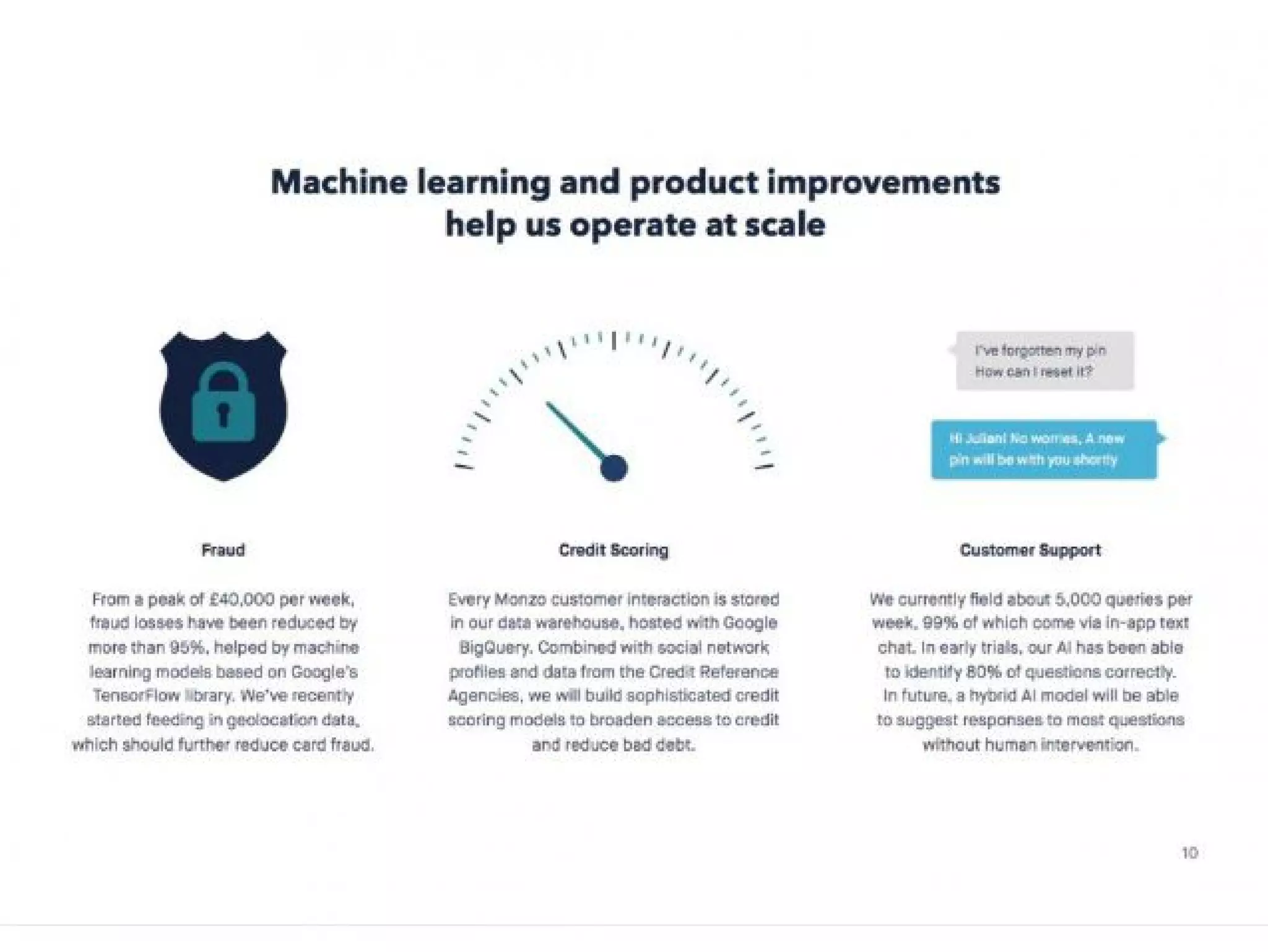
Slides 11 and 12 explain how machine learning and owning the technology stack enable Monzo to operate at scale: ML for fraud reduction, data-driven credit scoring, AI-assisted customer support, and a backend built from scratch (Go microservices, Kafka, Cassandra). The deck quantifies the impact (fraud reduced >95% from a £40k/week peak) and emphasizes speed of iteration as a competitive advantage. This positions Monzo as not just a nice app but a defensible tech-first bank.

Investors in fintech care about risk, reliability and scalability; demonstrating control over your stack and showing real outcomes from ML models directly addresses those concerns. Founders should explain the architecture at a high level, quantify operational improvements from technical work, and highlight how owning core tech reduces vendor risk and accelerates product launches.

Key Takeaway: Explain how tech choices materially reduce risk and cost (fraud, support) and accelerate product iterations — quantify impacts, not just technologies used.
Regulatory Milestone: Banking licence and expansion plans

Regulatory Milestone: Banking licence and expansion plans

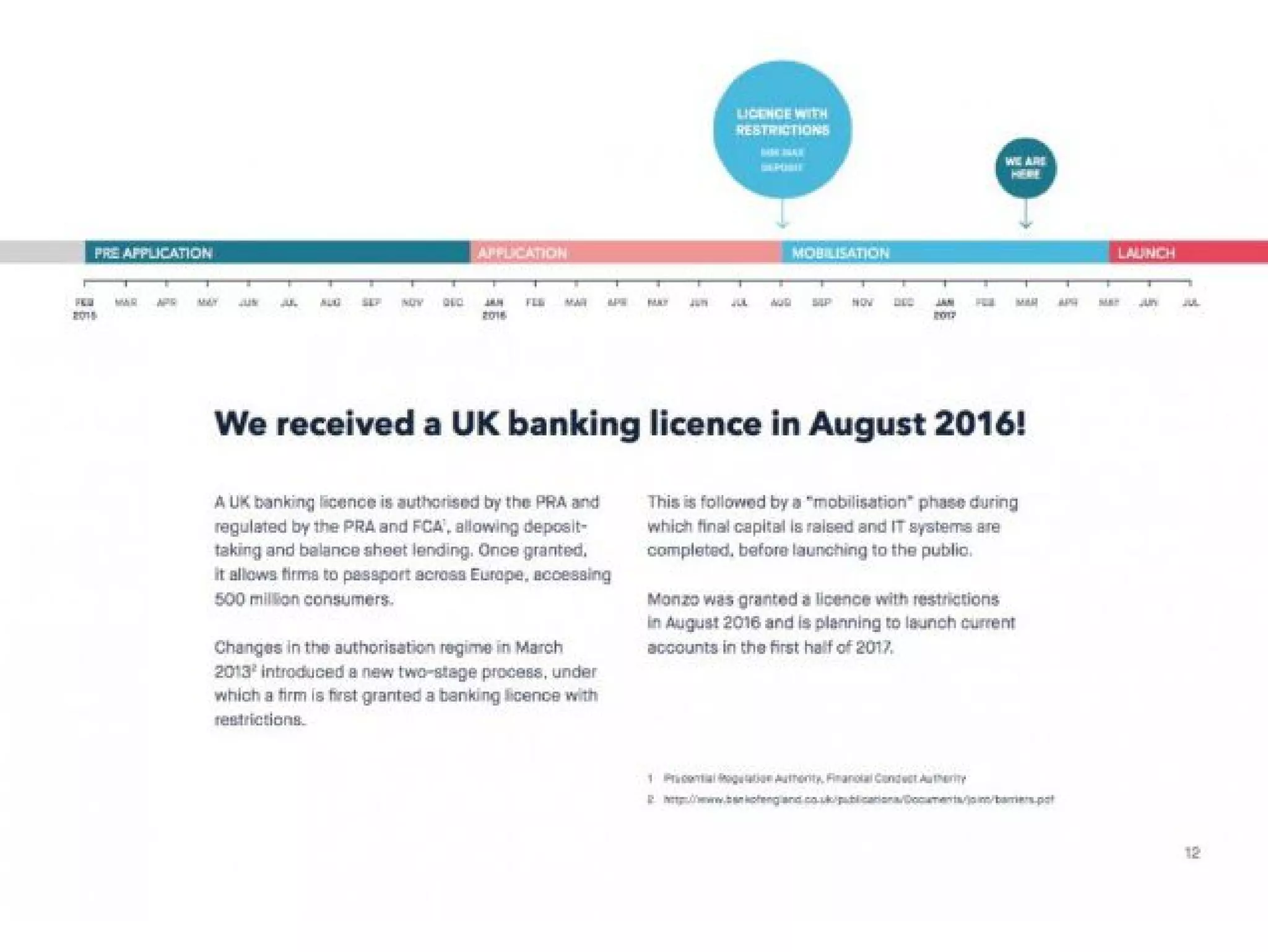
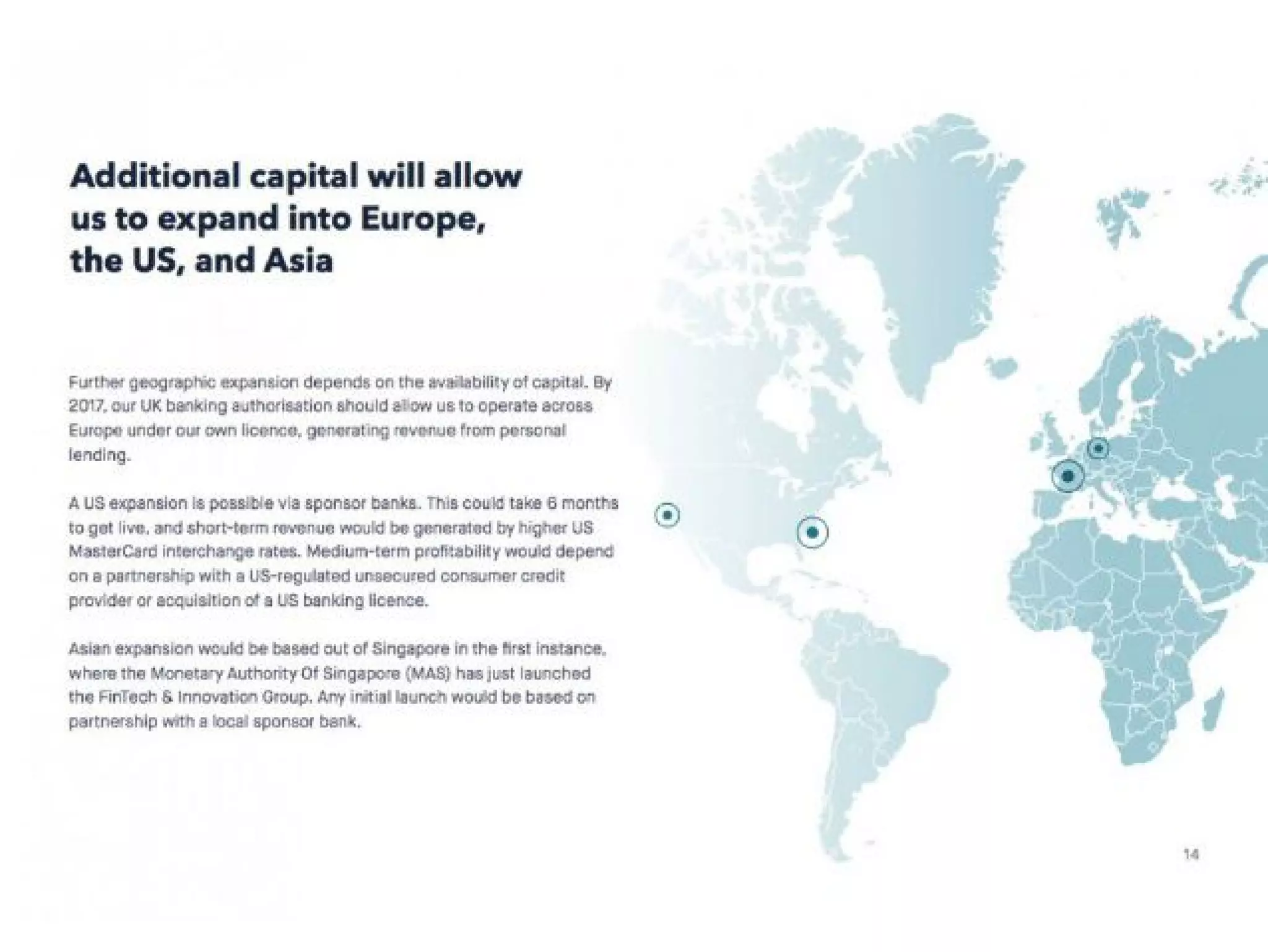
Slide 13 announces receipt of a UK banking licence in August 2016 and explains what that licence enables (deposit-taking, passporting across Europe) plus a timeline showing mobilisation and launch. Later slides (14 and 15) outline monetization (lending and affiliate revenue) and geographic expansion (Europe, US via sponsor banks, Asia via Singapore). This demonstrates maturity and reduces a major execution risk for a bank: regulatory approval.

For fintech founders, showcasing regulatory progress and realistic next steps is crucial; it transforms a product story into a scalable financial services business with legal ability to accept deposits and lend. Be explicit about the regulatory state, what it permits, and how it enables your business model and market expansion — and connect that to capital needs and timelines so investors can assess runway and timing.

Key Takeaway: Clearly communicate regulatory milestones and how they unlock revenue and expansion opportunities; investors must see legal runway as well as product traction.

Conclusion: Key Lessons

Monzo’s crowdfunding deck succeeds by balancing vision, product empathy, clear traction, community-driven growth mechanics, and technical/regulatory credibility. Strengths include strong visuals and mission, selected high-signal KPIs (engagement and spend), explicit viral mechanics tied to product features, and quantified technical wins (fraud reduction) that demonstrate operational competence. Together these create a coherent narrative: delightful product → engaged community → sustainable growth → regulatory and technical foundation for scale.

Actionable advice for founders: lead with a concise mission and product visuals; pick 3–5 metrics that map directly to monetization and retention; describe the exact product mechanisms that drive viral growth; quantify the impact of technical work on business outcomes; and clearly state regulatory or legal milestones and how they unlock the business model. That combination builds credibility with investors by showing both demand and the capacity to scale safely.

Full Deck Analysis

11 sections

Overview

Company: Monzo
Round: Crowdfunding ($2.4M)
Year: 2016
Outcome: Valued at $4.5B (as of analysis date)
Deck Length: 16 slides
Design Agency: Chagency


Executive Summary

Monzo’s 2016 crowdfunding pitch deck is a masterclass in community-driven fintech positioning, combining concrete traction metrics (120,000+ funded accounts, £100M+ collective spend) with an ambitious vision (1 billion people worldwide) and regulatory credibility (UK banking licence achieved August 2016). The deck effectively balances near-term proof of product-market fit with long-term marketplace banking ambitions, leveraging organic growth mechanics and a highly engaged community to justify a capital raise. What makes this deck particularly notable is its emphasis on community ownership and viral growth over traditional marketing, paired with technical sophistication (95% in-house software) and experienced leadership—a combination that resonated strongly enough to achieve a $4.5B valuation within years.


Problem Statement

Implicit Problem Framing (Slides 2-3):

The deck doesn’t explicitly state a “problem” in traditional pitch format. Instead, it positions an opportunity through contrast:

  • Current state: Traditional banking is slow, opaque, and disconnected from how people actually use technology
  • Monzo’s reframe: “A bank that’s as smart as your phone” (Slide 3)

Specific pain points addressed (Slide 3):

  • Account opening takes too long (Monzo: 30 seconds)
  • Money management is fragmented (Monzo: unified dashboard)
  • Fraud protection is reactive (Monzo: real-time notifications)
  • International transfers are expensive (Monzo: zero foreign exchange fees)
  • Bill splitting is manual (Monzo: single swipe)
  • Card management is inflexible (Monzo: freeze/unfreeze with single tap)

Problem articulation strategy: Rather than leading with pain, Monzo leads with vision (“1 billion people”) and then demonstrates how their product solves specific friction points. This is effective for crowdfunding (aspirational) but less explicit than traditional VC pitches.


Solution

Core Product (Slide 3):

  • Mobile-first banking app with real-time transaction visibility
  • Physical debit card (MasterCard, contactless-enabled)
  • In-app money management features (spending reports, categorization)
  • Peer-to-peer money transfer and bill splitting
  • Fraud detection and card control features

Technology Foundation (Slide 11):

  • 95% in-house software development
  • Go microservices architecture
  • Kafka for messaging, Cassandra for data storage
  • Real-time core banking systems built from scratch
  • Multi-currency, multi-payment network capable
  • AWS multi-AZ cloud infrastructure

AI/ML Capabilities (Slide 10):

  • Fraud detection: 95%+ reduction in fraud losses (from £40k/week peak)
  • Credit scoring: Sophisticated models using customer interaction data + Credit Reference Agencies
  • Customer support: AI-powered chatbot identifying 80% of questions correctly

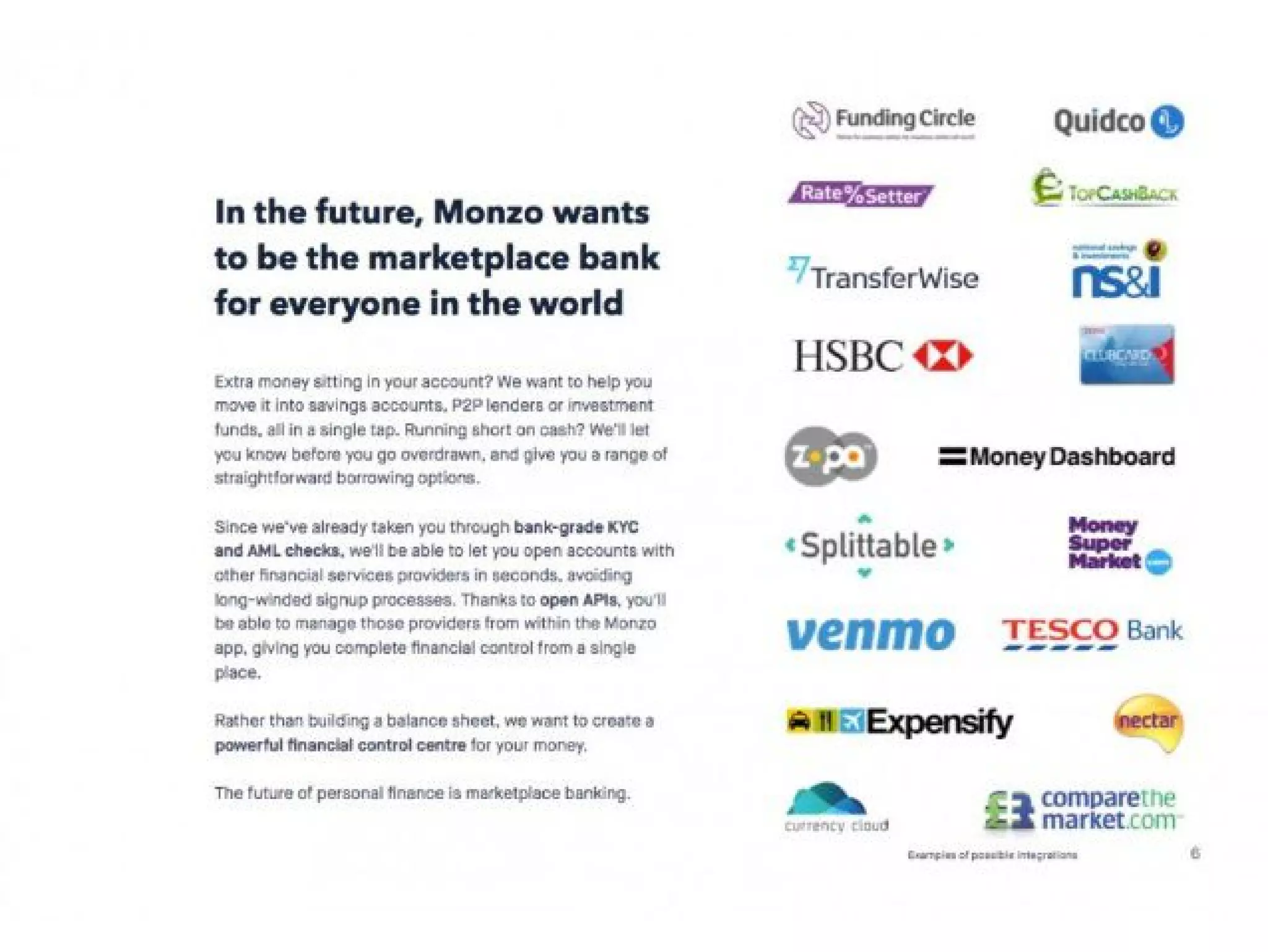
Marketplace Vision (Slide 6):

  • Integration with third-party financial services (savings, lending, investment)
  • Open APIs enabling rapid partner onboarding
  • Bank-grade KYC/AML checks enabling frictionless account opening with partners
  • Single dashboard for managing multiple financial products

Market Opportunity

Total Addressable Market (TAM):

  • Stated target: 1 billion people worldwide (Slide 2)
  • Geographic scope: UK (current), Europe, US, Asia (expansion targets)
  • European market: 500 million consumers accessible via UK banking licence passporting (Slide 12)

Market Segmentation (Implicit):

  • Primary: Digitally native consumers (millennials, Gen Z) dissatisfied with legacy banking
  • Secondary: Underbanked populations in emerging markets (Asia expansion via Singapore)
  • Tertiary: SMEs and businesses (implied through marketplace vision)

Market Size Context:

  • UK banking market: Substantial (not quantified in deck)
  • Global fintech market: Growing (not quantified in deck)
  • Personal lending market: Referenced as revenue opportunity (Slide 14)

Market Validation:

  • 120,000+ funded accounts in beta phase (Slide 4) demonstrates demand
  • 4.3-star App Store rating (Slide 5) shows product-market fit
  • 60% weekly active card usage (Slide 5) indicates strong engagement
  • Organic, zero-CAC growth (Slide 4) proves viral demand

Weakness: The deck doesn’t provide traditional TAM/SAM/SOM analysis with market sizing data, competitor market share, or addressable revenue calculations. This is acceptable for crowdfunding (community-focused) but would be a gap for institutional VC.


Business Model

Short/Medium-Term Revenue (Slide 13):

  • Primary: Net interest margin from lending out customer deposits
  • Positioning: “Without hidden fees or charges” (differentiation from legacy banks)
  • Model: Traditional banking spread model (borrow short at 0%, lend long at higher rates)

Long-Term Revenue (Slide 13):

  • Primary: Profit sharing and affiliate fees on third-party products
  • Examples (Slide 6): Savings accounts, P2P lending, investment funds, insurance, comparison services
  • Partner ecosystem: 20+ potential integration partners shown (HSBC, TransferWise, Splittable, Money Dashboard, Expensify, etc.)

Additional Revenue Streams (Implied):

  • Interchange fees: Higher US MasterCard interchange rates mentioned as short-term US revenue (Slide 14)
  • Premium features: Not explicitly mentioned but implied in marketplace model
  • Data/insights: Not mentioned (privacy-conscious positioning)

Unit Economics (Not Provided):

  • No customer acquisition cost (CAC) breakdown beyond “zero cost per acquisition” for organic channels
  • No lifetime value (LTV) calculations
  • No churn/retention metrics
  • No revenue per user projections

Business Model Strength: The dual-revenue approach (deposits + marketplace) is sound and differentiates from pure fintech players. However, the deck lacks financial projections, unit economics, or path to profitability—critical for institutional investors.


Traction & Metrics

User Growth (Slide 4)

| Metric | Value | Context |
|——–|——-|———|
| Funded accounts | 120,000+ | As of crowdfunding campaign |
| Growth trajectory | Exponential | 2016-2017 chart shows steep curve |
| Acquisition channel | Organic/word-of-mouth | Zero CAC |
| Customer acquisition cost | £0 | Entirely viral/social |

Product Engagement (Slide 5)

| Metric | Value | Benchmark |
|——–|——-|———–|
| App Store rating | 4.3 stars | Excellent (top 5% of financial apps) |
| Weekly active card usage | 60% | Exceptional for banking (typical: 20-30%) |
| Average monthly spend per active card | £370 | Strong engagement signal |
| Annual transactions per active user | 324 | 2.8x UK average (115) |
| Collective spend | £100,000,000+ | Demonstrates scale |

Community Engagement (Slide 9)

| Metric | Value | Significance |
|——–|——-|————-|
| Twitter followers | 26.9k | Strong social following |
| Discussion forum posts | 28.7k | Active community participation |
| Crowdfunding record | £1M in 96 seconds | World record (March 2016) |
| Crowdsourced name suggestions | 12k | Community co-creation |

Customer Support (Slide 10)

| Metric | Value | Implication |
|——–|——-|————-|
| Weekly support queries | 5,000 | Manageable volume |
| In-app chat usage | 99% | Channel preference |
| AI question identification accuracy | 80% | Scalable automation potential |

Fraud Prevention (Slide 10)

| Metric | Value | Impact |
|——–|——-|——–|
| Peak fraud losses | £40,000/week | Baseline |
| Current fraud reduction | 95%+ | Exceptional risk management |
| Detection method | ML (TensorFlow) | Sophisticated approach |

Traction Assessment: This is the deck’s strongest section. Monzo provides concrete, third-party validated metrics (App Store rating, transaction volumes) that demonstrate genuine product-market fit. The 60% weekly active rate and 2.8x transaction multiplier vs UK average are particularly compelling.

Competitive Positioning

Implicit Competitors (Not Named):

  • Legacy banks (Lloyds, HSBC, Barclays, etc.)
  • Challenger banks (Revolut, N26, Starling—not mentioned but implied)
  • Traditional fintech (PayPal, Square, etc.)

Monzo’s Differentiation (Slide 11):

Dimension Monzo Competitors
Technology ownership 95% in-house Outsourced/legacy systems
Deployment speed Hours/days Weeks/months
Architecture Modern microservices (Go, Kafka, Cassandra) Monolithic/legacy
Scalability Multi-currency, multi-network capable Single-market focused
Regulatory Full UK banking licence (Aug 2016) Restricted or no licence
Community 120k+ engaged users, viral growth Traditional marketing
UX Mobile-first, real-time Desktop-first, batch processing
Fraud prevention 95% reduction via ML Rule-based systems

Positioning Strategy:

  • Not positioned as: “Fintech alternative to banks”
  • Positioned as: “A bank that’s as smart as your phone” (Slide 3) + “Marketplace bank for everyone” (Slide 6)
  • Key differentiator: Full banking licence + in-house technology + community-driven growth

Competitive Gaps in Deck:

  • No direct competitor comparison (Revolut, N26, Starling not mentioned)
  • No market share analysis
  • No competitive feature matrix
  • No pricing comparison

Assessment: Monzo positions as a category creator (“marketplace bank”) rather than competing head-to-head. This is smart for crowdfunding but lacks the competitive rigor institutional VCs expect.


Team

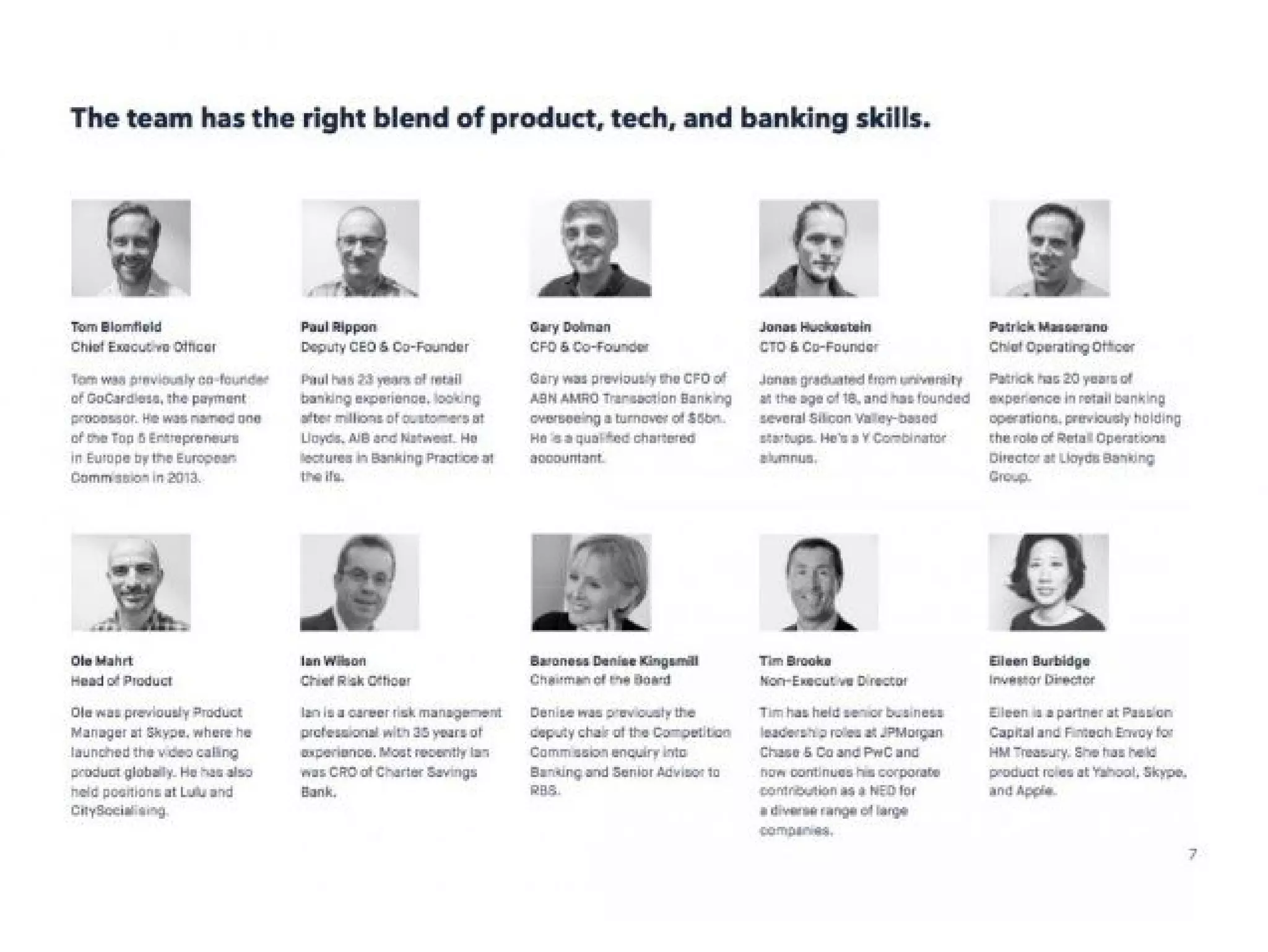
Leadership Team (Slide 7)

Executive Leadership:

Name Title Background Credibility Signal
Tom Blomfield CEO Co-founder of GoCardless (payment processor); Top 6 Entrepreneur in Europe (EC, 2013) Proven fintech founder
Paul Rippon Deputy CEO & Co-Founder 23 years retail banking; Lloyds, AIB, Natwest; Banking Practice lecturer (IFS) Deep banking expertise
Gary Dolman CFO & Co-Founder CFO of ABN-AMRO Transaction Banking (£50bn+ turnover); Qualified chartered accountant Financial rigor
Jonas Huckestain CTO & Co-Founder Founded multiple Silicon Valley startups; Y Combinator alumnus; University graduate at 18 Technical excellence
Patrick Masserano COO 20 years retail banking ops; Retail Operations Director at Lloyds Banking Group Operational expertise

Functional Leadership:

Name Title Background Credibility Signal
Ole Mahrt Head of Product Product Manager at Skype (launched video calling globally); Lulu, CitySwitch Consumer product expertise
Ian Wilson Chief Risk Officer 35 years risk management; Recently CRO of Charter Savings Bank Regulatory/risk expertise

Board & Advisors:

Name Title Background Credibility Signal
Baroness Denise Kingsmill Chairman Deputy Chair, Competition Commission; Banking advisor to RBS; NED for diverse large companies Regulatory credibility
Tim Brooke Non-Executive Director Senior roles at JPMorgan Chase & Co, PwC Financial services credibility
Eileen Burbidge Investor Director Partner at Passion Capital; Fintech Envoy for HM Treasury; Product roles at Yahoo, Skype, Apple Government/investor credibility

Team Strengths:

  1. Founder-market fit: Tom Blomfield (fintech founder) + Paul Rippon (banking expert) + Jonas Huckestain (technical founder) = ideal combination
  2. Regulatory credibility: Baroness Kingsmill and Ian Wilson provide PRA/FCA legitimacy
  3. Operational depth: 20-35 years of experience across banking, risk, and operations
  4. Product excellence: Ole Mahrt’s Skype background signals consumer product sophistication
  5. Government connections: Eileen Burbidge’s HM Treasury role signals institutional backing

Team Weaknesses:

  1. Diversity: Limited visible diversity (2 women out of 10 shown; all appear to be white/European)
  2. Team size: Only 10 people shown; no mention of broader engineering/product team
  3. No engineering depth: No CTO-level engineering leadership visible beyond Jonas (who is CTO)
  4. No head of growth/marketing: No explicit growth/marketing leader mentioned

Assessment: This is an exceptionally strong team for 2016. The combination of fintech founder (Blomfield), banking expertise (Rippon), and technical excellence (Huckestain) is rare. Board composition adds regulatory and government credibility.


Go-to-Market Strategy

Customer Acquisition (Slide 8)

Viral Growth Mechanics:

  1. Waiting list - Creates scarcity and exclusivity
  2. User invites - Existing users invite friends (network effects)
  3. Golden tickets - Gamified skip-the-line mechanic
  4. P2P money transfer - “Send and request money” creates network effects (users invite friends to receive money)

Acquisition Performance (Slide 4):

  • CAC: £0 (entirely organic)
  • Channels: Social media + word-of-mouth referral
  • Proof: 120,000+ users acquired with zero paid marketing

Community Building (Slide 9)

Community Engagement Tactics:

  • Twitter: 26.9k followers (organic growth)
  • Discussion forum: 28.7k posts (user-generated content)
  • Crowdsourcing: 12k name change suggestions (co-creation)
  • User-generated content: Photos of community members with handwritten signs (authentic evangelism)

Community Value:

  • Sense of ownership over product
  • Word-of-mouth amplification
  • Product feedback and ideas
  • Brand evangelism

Geographic Expansion (Slide 14)

Europe:

  • Method: Leverage UK banking licence for European passporting
  • Timeline: By 2017
  • Revenue: Personal lending

US:

  • Method: Sponsor bank partnerships (6 months to go live)
  • Timeline: 6 months
  • Short-term revenue: Higher MasterCard interchange rates
  • Medium-term: Partnership with US consumer credit provider OR US banking licence acquisition

Asia:

  • Hub: Singapore
  • Method: Partnership with local sponsor bank
  • Trigger: MAS Fintech & Innovation Group launch
  • Timeline: Not specified

Go-to-Market Strengths:

  1. Viral mechanics: P2P money transfer creates natural network effects
  2. Zero CAC: Organic growth is sustainable and scalable
  3. Community moat: 120k+ engaged users create switching costs
  4. Regulatory leverage: UK banking licence enables European expansion

Go-to-Market Weaknesses:

  1. No paid marketing strategy: Entirely dependent on organic growth (risky if viral loop slows)
  2. Waiting list dependency: Could create friction if not managed well
  3. Geographic expansion vague: No specific go-to-market tactics for US/Asia beyond partnerships
  4. No retention/churn strategy: Focuses on acquisition, not lifecycle management
  5. No monetization strategy: How does Monzo convert free users to paying customers?

Assessment: The GTM strategy is exceptionally well-suited for crowdfunding (community-driven, viral) but lacks the sophistication institutional VCs expect (paid channels, retention, monetization).


The Ask

Funding Amount

  • Crowdfunding target: £2.4M (approximately $2.4M USD equivalent in 2016)
  • Round type: Equity crowdfunding (via Crowdcube or similar platform)

Use of Funds (Implied, Not Explicitly Stated)

The deck doesn’t provide a detailed use-of-funds breakdown, but context clues suggest:

  1. Regulatory compliance & capital requirements (Slide 12)
    • Mobilisation phase capital raising
    • IT systems completion
    • Regulatory compliance costs
  2. Geographic expansion (Slide 14)
    • Europe: Licensing and infrastructure
    • US: Sponsor bank partnerships and infrastructure
    • Asia: Singapore hub setup
  3. Product development (Slide 10-11)
    • AI/ML capabilities (fraud, credit scoring, support)
    • Marketplace integrations (Slide 6)
    • Multi-currency and multi-payment network support
  4. Team expansion (Implied)
    • Engineering (to maintain 95% in-house development)
    • Operations (to scale from 120k to 1M users)
    • Customer support (currently 5,000 queries/week)

Funding Timeline

  • Crowdfunding campaign: 2016
  • Use period: 2016-2017 (mobilisation phase)
  • Next milestone: Current accounts launch (H1 2017)

Investor Incentives (Implied)

  • Equity stake: Not specified in deck
  • Valuation: Not specified in deck
  • Exit potential: Implied through 1 billion user vision and $4.5B eventual valuation

Assessment: The deck is notably light on use-of-funds details. This is acceptable for crowdfunding (community investors care more about vision) but would be a red flag for institutional VCs. The lack of specific capital requirements or runway projections is a weakness.


Investor Deep Dive

Executive summary, strengths & red flags

Executive Summary

Monzo's 2016 crowdfunding pitch deck is a masterclass in community-driven fintech positioning, combining concrete traction metrics (120,000+ funded accounts, £100M+ collective spend) with an ambitious vision (1 billion people worldwide) and regulatory credibility (UK banking licence achieved August 2016). The deck effectively balances near-term proof of product-market fit with long-term marketplace banking ambitions, leveraging organic growth mechanics and a highly engaged community to justify a capital raise. What makes this deck particularly notable is its emphasis on community ownership and viral growth over traditional marketing, paired with technical sophistication (95% in-house software) and experienced leadership—a combination that resonated strongly enough to achieve a $4.5B valuation within years.

Key Strengths

10 identified

1

Exceptional Traction Metrics

- 120,000+ funded accounts, £100M+ collective spend, 60% weekly active rate, 2.8x transaction multiplier vs UK average

2

Community-Driven Growth with Zero CAC

- Entirely organic acquisition via social + word-of-mouth (Slide 4), 26.9k Twitter followers, 28.7k forum posts, 12k crowdsourced name suggestions

3

Regulatory Credibility (UK Banking Licence)

- Full banking licence granted August 2016 (Slide 12), enables European passporting to 500M consumers

4

Technical Differentiation (95% In-House Software)

- Go microservices, Kafka, Cassandra, real-time core banking systems, 95% in-house development (Slide 11)

5

Exceptional Team with Founder-Market Fit

- Tom Blomfield (GoCardless founder), Paul Rippon (23 years banking), Jonas Huckestain (Y Combinator), Baroness Kingsmill (regulatory credibility)

6

AI/ML Capabilities with Proven Results

- 95% fraud reduction, 80% AI question identification accuracy, sophisticated credit scoring models (Slide 10)

7

Ambitious Yet Grounded Vision

- "1 billion people worldwide" (Slide 2) + "Marketplace bank" (Slide 6) + specific expansion roadmap (Slide 14)

8

Authentic Visual Design & Storytelling

- User-generated photos (Slide 9), product mockups (Slide 3), isometric architecture diagram (Slide 11), celebratory imagery (Slide 1)

9

Clear Differentiation from Competitors

- "Bank that's as smart as your phone" (Slide 3), full banking licence vs restricted, 95% in-house vs outsourced, marketplace vision vs single-product

10

Dual Revenue Model (Near-term + Long-term)

- Deposit lending (short/medium-term) + marketplace fees (long-term) (Slide 13)

Red Flags & Weaknesses

12 identified

1

No Financial Projections or Unit Economics

- Deck shows traction but no revenue forecasts, CAC/LTV analysis, or path to profitability

2

Vague Use of Funds

- No detailed breakdown of how £2.4M will be deployed

3

Unproven Marketplace Revenue Model

- Slide 13 positions marketplace fees as "long-term" revenue, but no partners are confirmed (Slide 6 says "examples of possible integrations")

4

No Competitive Analysis

- Revolut, N26, Starling not mentioned; no market share or competitive feature comparison

5

Regulatory Risks Understated

- Slide 12 mentions "licence with restrictions" but doesn't explain what restrictions mean

6

Deposit Lending Model Dependency

- Short/medium-term revenue entirely dependent on customer deposits (Slide 13)

7

No Retention/Churn Metrics

- Deck shows acquisition (120k users) but no retention or churn data

8

Geographic Expansion Strategy Vague

- Slide 14 outlines expansion to Europe, US, Asia but with minimal detail

9

Diversity Concerns

- Slide 7 shows 10 leadership team members; only 2 appear to be women

10

Missing Go-to-Market Details

- No paid marketing strategy, no retention/lifecycle strategy, no monetization strategy (how free users become paying customers)

11

Slides 15-16 Distraction

- Final two slides promote design agency (Chagency) instead of reinforcing investment ask

12

No Specific Valuation or Terms

- Deck doesn't state valuation, equity stake, or investment terms

More Pitch Decks To Study

Compare structure, fundraising context, and investor-facing story across similar startup decks.