Compare your deck to Mint

Compare Your Deck

Mint Pitch Deck (2007)

Fintech
Stage: Pre-launch
Raised: Seed
Year: 2007
Slides: 16
Outcome: Acquired by Intuit for $170M

Pitch Deck

1 / 16
Mint pitch deck - Opening: Clear brand and positioning
Click to expand

Deck Analysis

This deck is an early seed presentation for Mint (2007), a consumer fintech startup that built a simple, visually-driven personal finance dashboard and monetized through referrals and targeted advertising. The deck is notable for its product-first storytelling: clean branding, a tangible product mock-up, a clear go-to-market plan, and unit economics that tie user benefits to revenue. It foreshadows why Mint became attractive to acquirers — strong UX, defensible tooling around data and categorization, and a crisp monetization plan aligned with user value.

Opening: Clear brand and positioning

Opening: Clear brand and positioning

The title slide is minimal and impeccably on-brand: a succinct logo, the tagline “TAKE BACK YOUR WALLET,” the founding team and date. It sets expectations for a consumer-focused product that promises control and simplicity. By keeping the design uncluttered, the slide communicates confidence and product-first thinking rather than premature fundraising minutiae.

Founders can learn from how the slide uses a strong tagline to immediately communicate value and a clean layout to establish credibility. A title slide is an opportunity to telegraph the company’s mission and tone — Mint uses it to prime the audience for a UX-focused fintech play.

Key Takeaway: Start with a single, memorable promise and a calm, professional visual tone that reflects your product’s user experience.
Product demo: Show the product and benefits early

Product demo: Show the product and benefits early

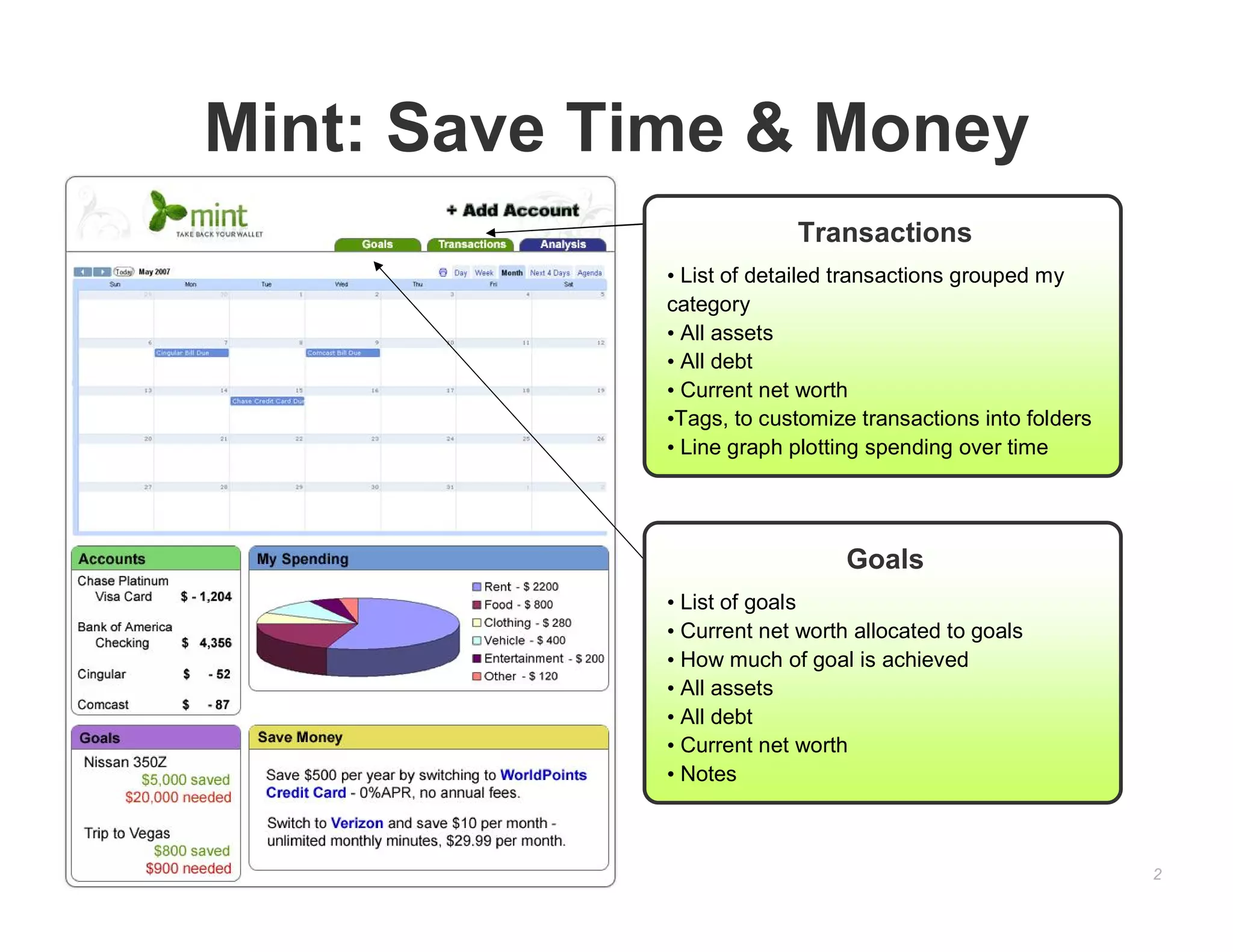
Slide 2 places the product front-and-center with a dashboard mockup and annotated callouts for key features (transactions, goals, accounts, saving suggestions). The visual demonstration of the interface plus short bullet lists of what each area does bridges the gap between concept and experience. It’s an effective use of space: investors instantly see how a user interacts with Mint and what immediate value it delivers (time/money savings, organization, goal tracking).

This slide teaches founders that showing is better than telling — a single screenshot can convey UX, complexity, and clarity of purpose faster than paragraphs. Accompany product images with concise annotations focused on benefits (not just features) to make it crystal clear why users will care.

Key Takeaway: Lead with a real product view and annotate it to highlight concrete user benefits — show the experience, don’t just describe it.
Team & credibility: Present complementary skills and advisors

Team & credibility: Present complementary skills and advisors

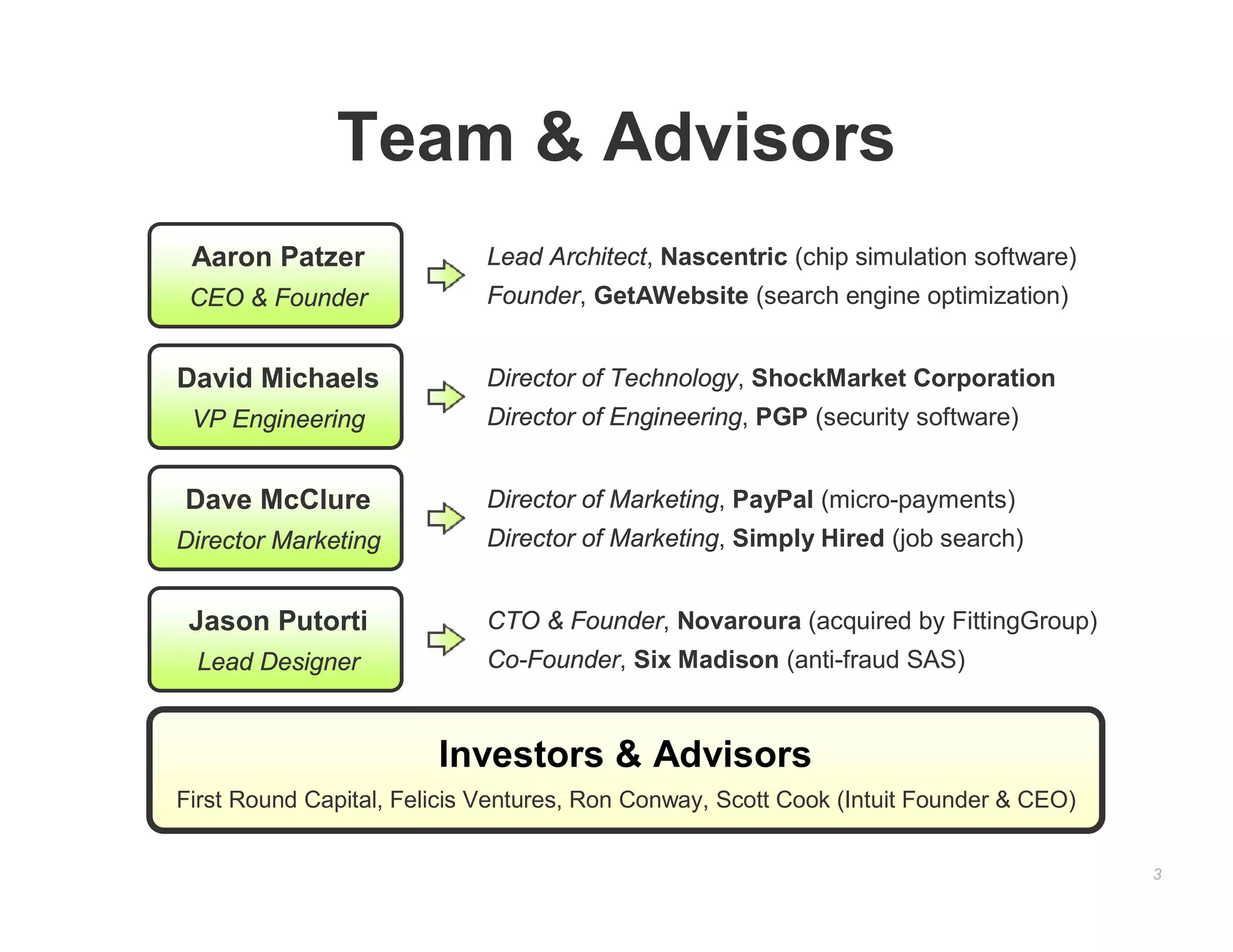
The team slide lays out roles (CEO/founder, VP engineering, marketing lead, lead designer) and pairs each with prior, relevant experience. It also lists investors and advisors from respected firms and industry founders, signaling credibility and network access. The format emphasizes complementary skill sets and external validation rather than listing bios at length.

For founders, this underlines the importance of showing both technical chops and go-to-market credibility. Investors look for teams that can build, market, and scale — presenting succinct role/experience pairs and credible advisors is a compact, persuasive way to communicate that balance.

Key Takeaway: Show how the founding team’s backgrounds cover product, engineering, design and growth — and include a few credible advisors or investors to signal external validation.
Market sizing & unit economics: Be specific and conservative

Market sizing & unit economics: Be specific and conservative

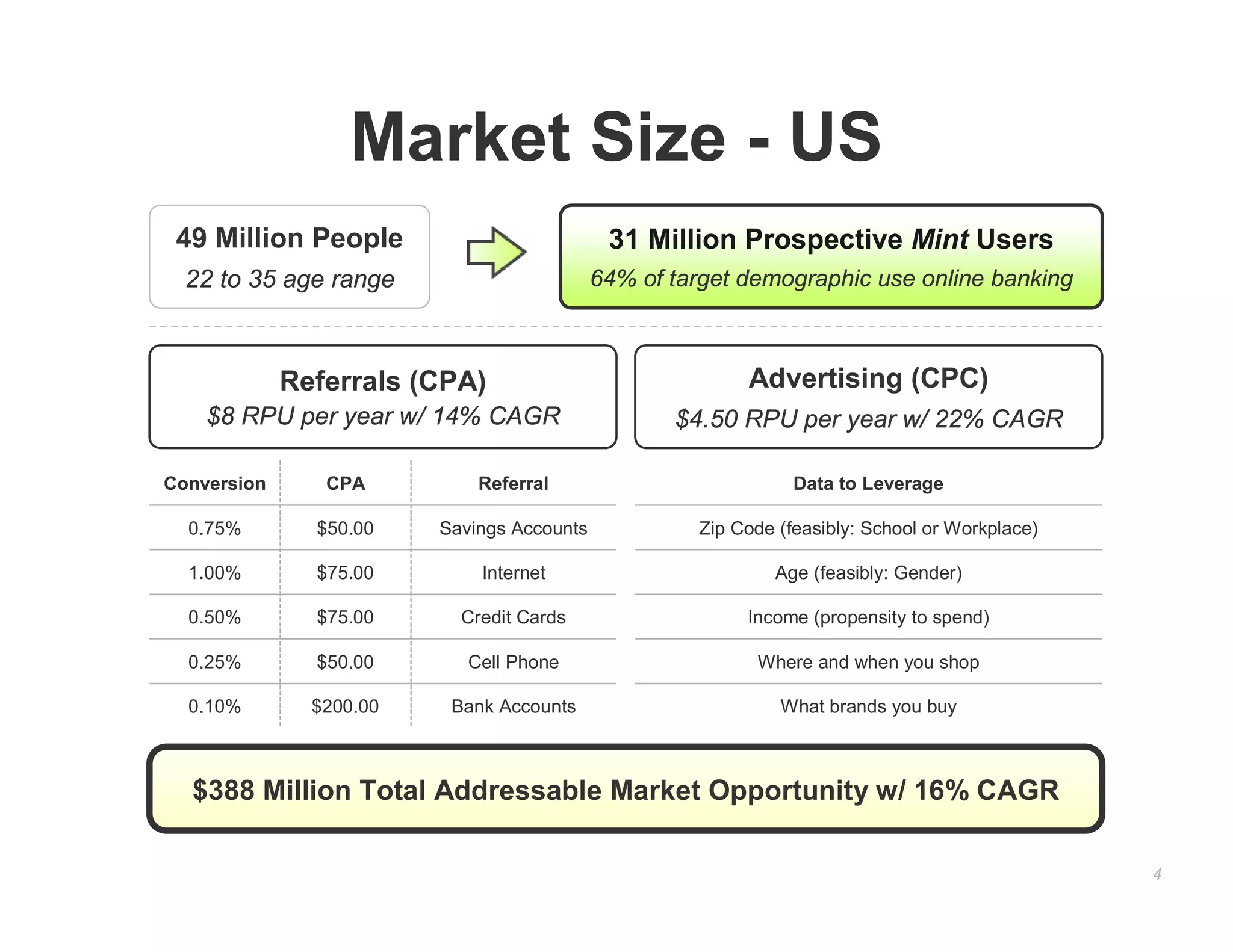
The market slide breaks down addressable users (22–35 demo), filters to prospective Mint users and then models monetization via two revenue streams (referrals/CPA and advertising/CPC) with RPU estimates and CAGR assumptions. It culminates in a quantified TAM ($388M) and growth expectation — a compact path from population to dollars that investors can follow.

This approach is instructive: combine demographic sizing with realistic conversion assumptions and per-user economics. Founders should present the funnel (users → conversions → revenue per user) transparently and be ready to defend each assumption; conservative, well-documented unit economics are far more persuasive than optimistic multipliers without a clear link to customer behavior.

Key Takeaway: Convert a top-down market number into bottom-up unit economics (conversion rates + RPU) so investors can evaluate your pathway to revenue.
Competitive positioning and defensibility

Competitive positioning and defensibility

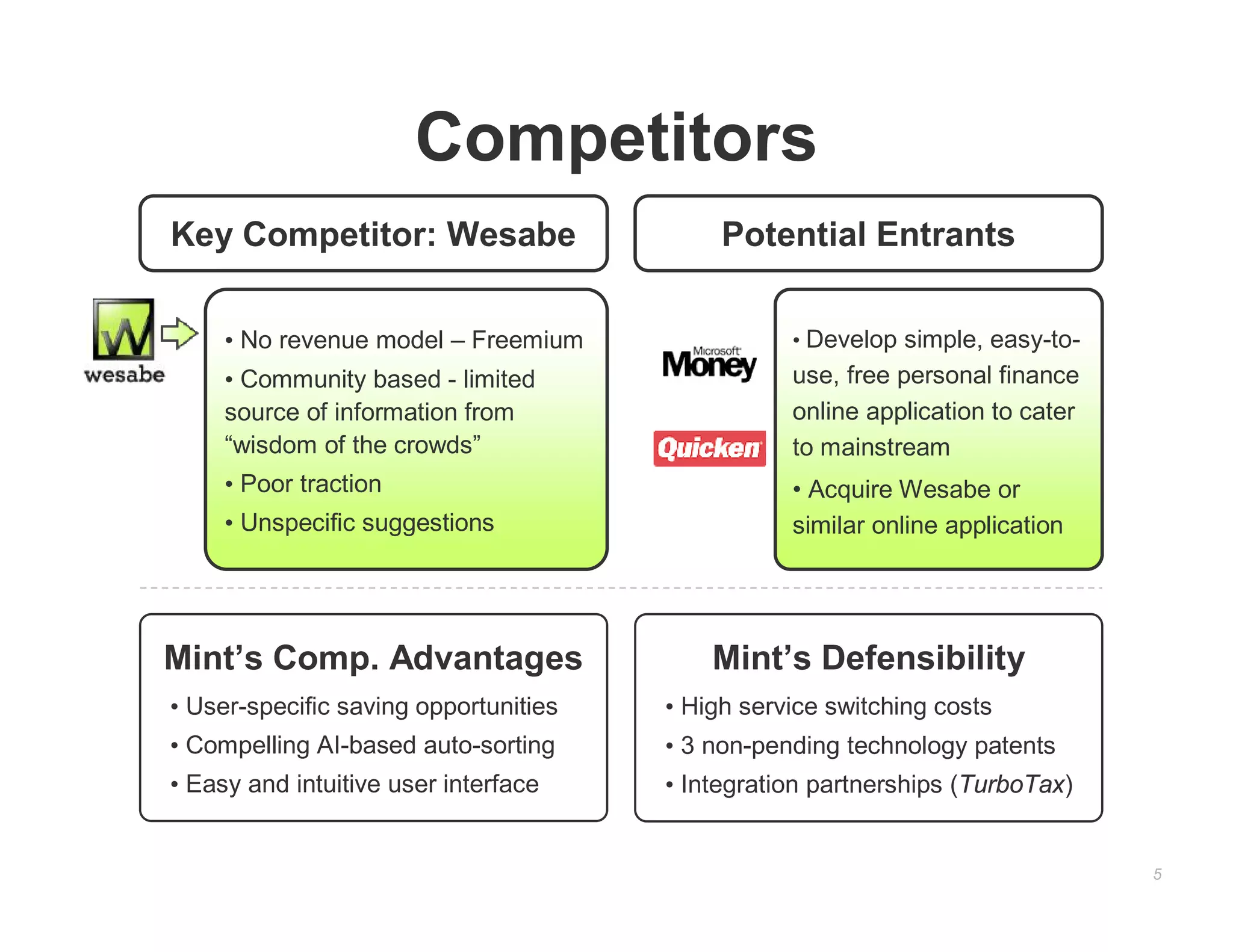
The competitor slide candidly calls out the main rival (a community-driven player) and potential entrants (big incumbents), then lists Mint’s advantages (user-specific savings, AI auto-sorting, intuitive UI) and defensibility (switching costs, patents, partnerships). The honesty about threats paired with practical defenses shows maturity: the team understands both what will attract users and what will attract competitors.

Founders should emulate this balance — openly acknowledge obvious competitors and show concrete, contestable differentiators (patents, data advantage, integrations, user experience). Framing defensibility as a portfolio (patents + partnerships + UX) is stronger than relying on a single claim.

Key Takeaway: Be explicit about threats and then tie your defensibility to concrete assets (data, tech, partnerships, UX) rather than vague assertions.
Business model: Align monetization with user value

Business model: Align monetization with user value

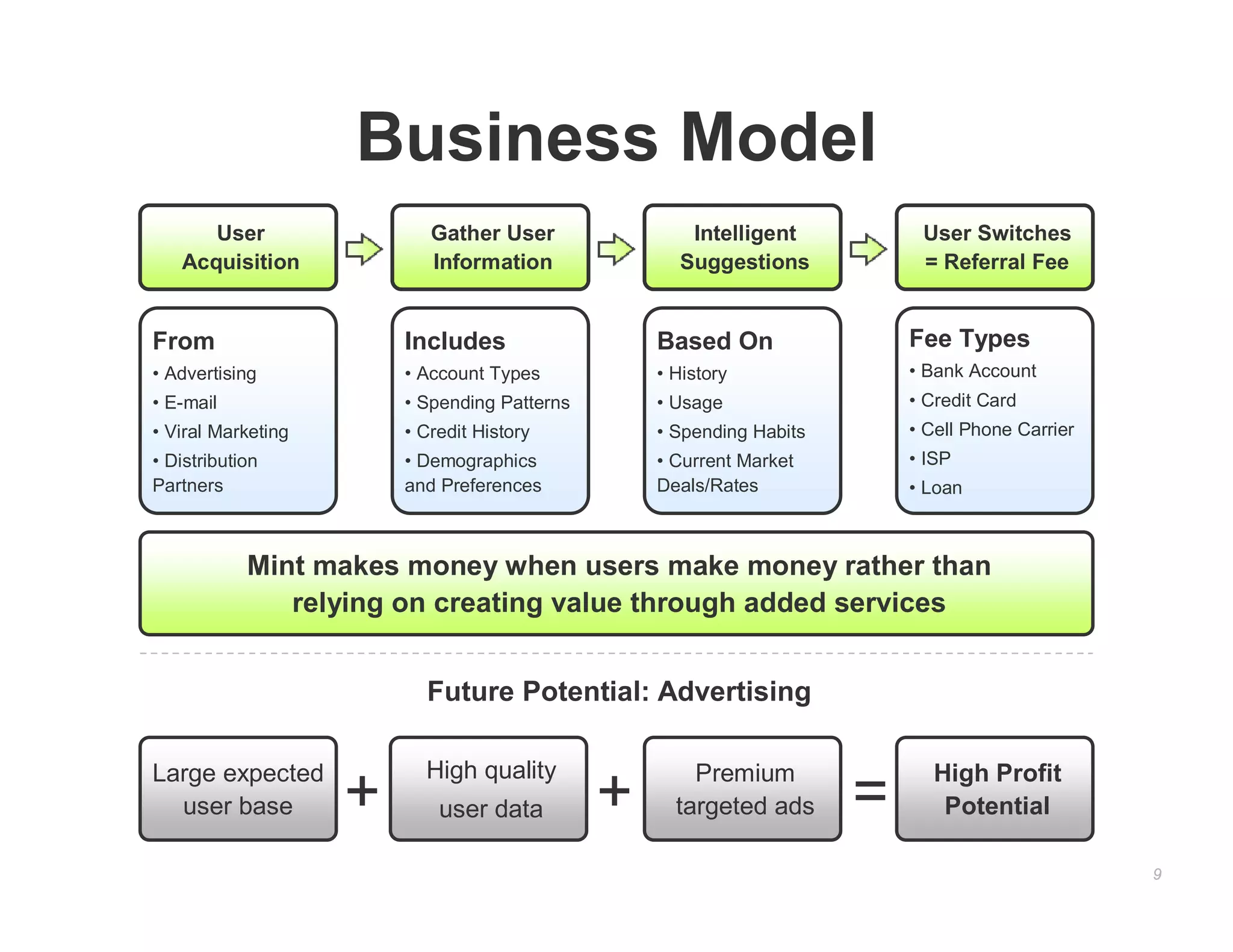
The business model slide lays out a simple conversion funnel: acquire users, gather data, offer intelligent suggestions, then monetize when users switch (referral fees), plus future advertising upside. The slide is compelling because the revenue flow is directly tied to user outcomes — Mint only profits when users save or switch, which aligns incentives and reduces the perception of exploitative monetization.

This demonstrates a smart monetization principle: design business models where customer success drives revenue. For founders, the lesson is to make the linkage explicit in the pitch — if your model depends on user behavior, map how product interactions lead to monetizable events and quantify those events where possible.

Key Takeaway: Show how product actions create monetizable events and prefer business models where user benefit and company revenue are aligned.
Financials & projections: Present clear assumptions and scenarios

Financials & projections: Present clear assumptions and scenarios

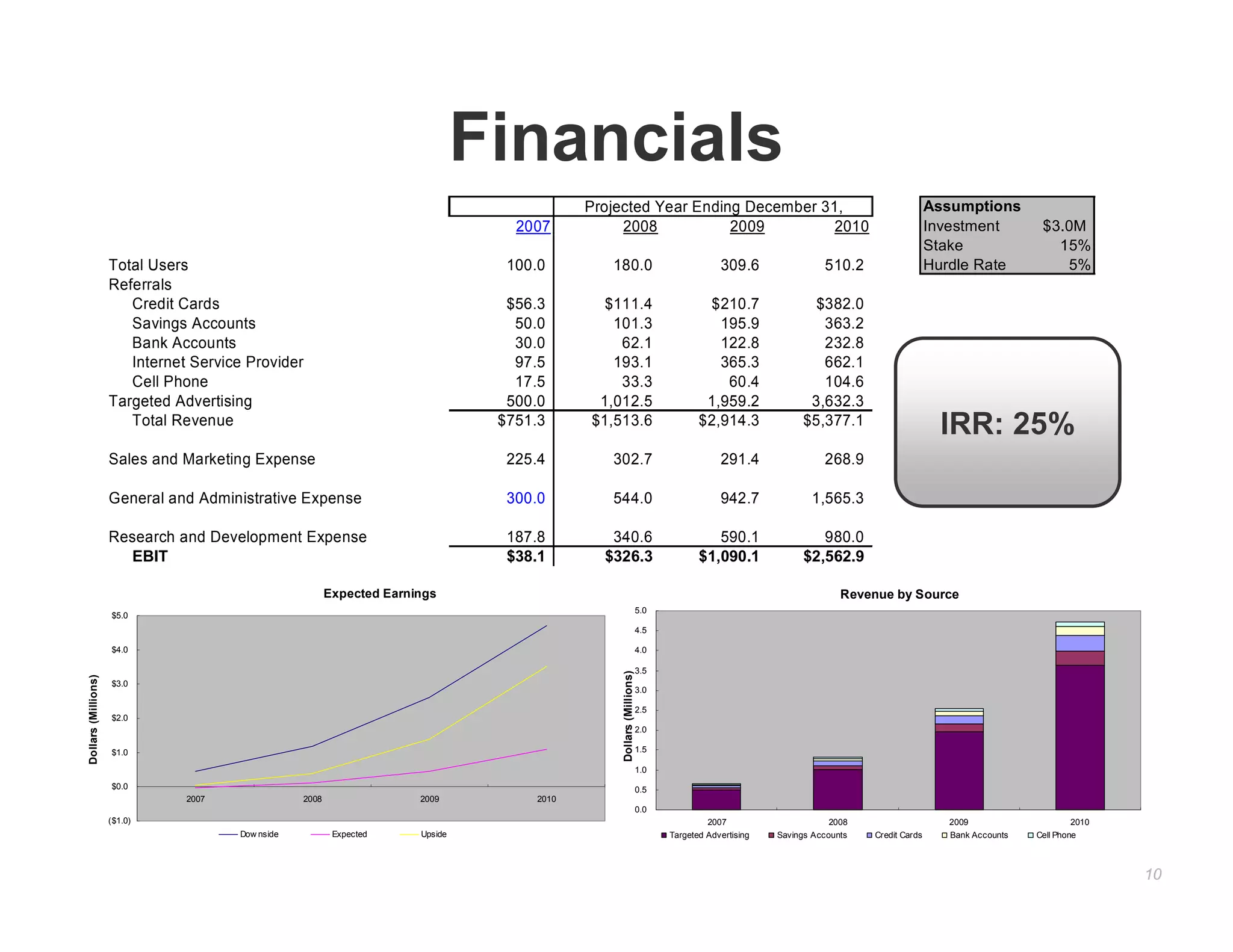
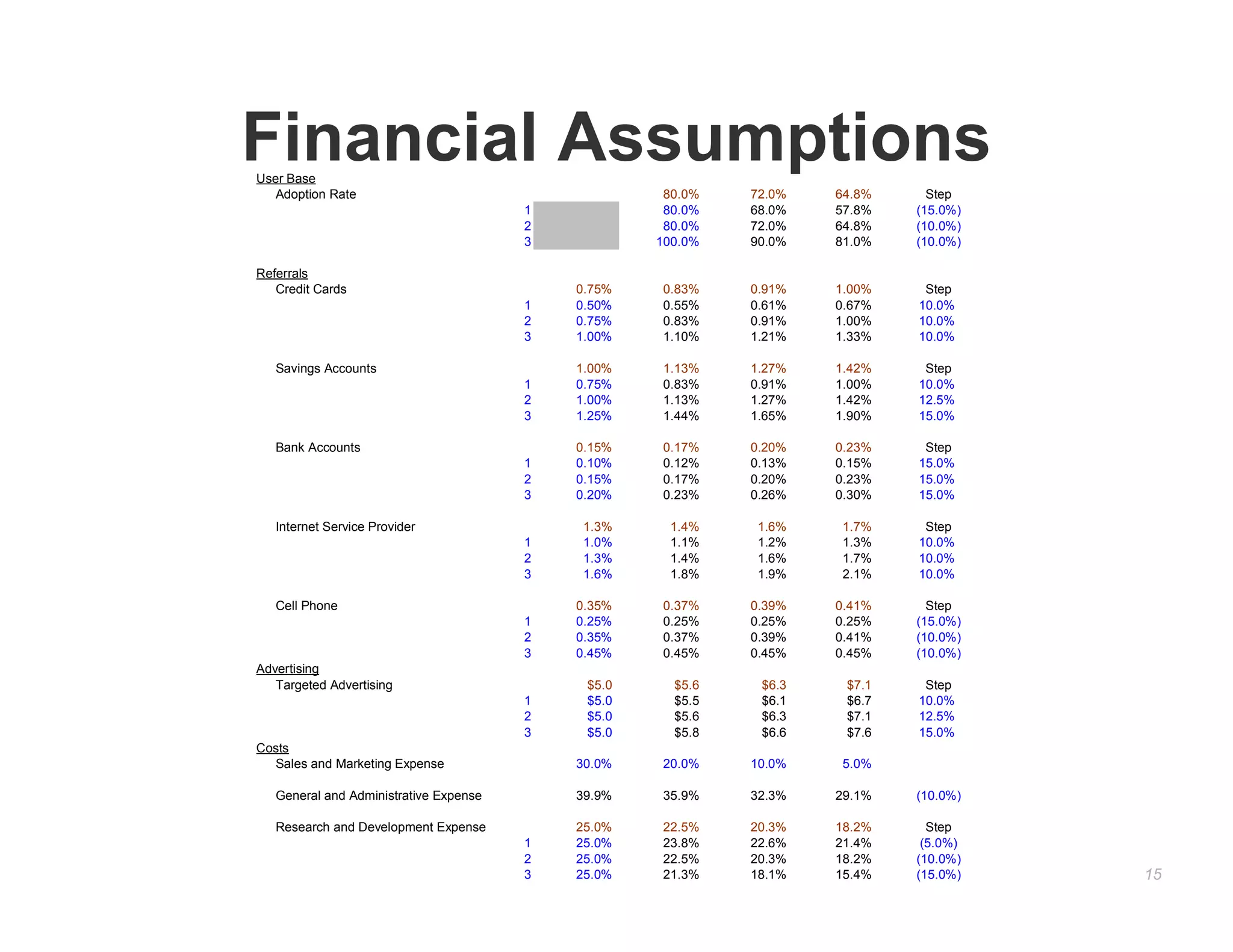
The financials slide provides projected users, revenue line items (referrals by product type and targeted advertising), expense categories, and charts with upside/expected/downside scenarios. It also states investment/assumption boxes (investment size, stake, hurdle) and highlights an IRR. By tying forecasts to specific revenue sources and showing visual growth trajectories, the slide invites scrutiny while appearing grounded.

Founders should include clear assumptions and multiple scenarios so investors can test sensitivity. Avoid over-precision: instead, make the key drivers obvious (user growth, conversion rates, RPU, CAC) and provide charts for visibility. Also call out the primary risks and which levers will most change outcomes.

Key Takeaway: Make your financial model transparent: show the key drivers, multiple scenarios, and the assumptions behind projected returns.

Conclusion: Key Lessons

Mint’s seed deck succeeds because it pairs a crisp product demonstration and brand promise with concrete unit economics and a realistic go-to-market plan. The team emphasizes user experience first, then demonstrates how that experience fuels monetization — a model that both users and acquirers can understand. The deck balances optimism with defensibility by calling out competitors, quantifying the market, and tying revenue to measurable user actions.

Actionable advice for founders: 1) Lead with product and clear user benefits (show screenshots and annotated value). 2) Translate market size into bottom-up unit economics (conversion rates and RPU). 3) Present a tightly aligned business model where customer gains drive monetization. 4) Be candid about competition and back defensibility with tangible assets. 5) Include transparent financial assumptions and scenarios so investors can evaluate risk. These elements create a narrative that is easy to follow, hard to dismiss, and attractive for strategic acquirers.

Full Deck Analysis

11 sections

Overview

Company: Mint
Round: Pre-launch (Seed)
Year: 2007
Outcome: Acquired by Intuit for $170M (2009)
Founders: Aaron Patzer (CEO), David Michaels (VP Engineering), Dave McClure (Director Marketing), Jason Putorti (Lead Designer)

Executive Summary

Mint’s 2007 seed pitch deck presents a compelling vision for democratizing personal finance management through a free, web-based aggregation platform that monetizes through referral fees and targeted advertising. The deck combines a strong founding team with relevant domain expertise (PayPal, security software, SEO), a clear value proposition (“Take Back Your Wallet”), and detailed financial projections showing a path to $5.4B revenue and $2.6B EBIT by 2010. However, the projections are extraordinarily aggressive, the business model relies heavily on unproven partner relationships and user behavior assumptions, and critical risks around regulatory compliance and data security are largely unaddressed—yet the pitch was compelling enough to attract top-tier investors (First Round Capital, Felicis Ventures, Scott Cook) and ultimately resulted in a successful acquisition.

Problem Statement

The deck articulates the problem implicitly rather than explicitly:

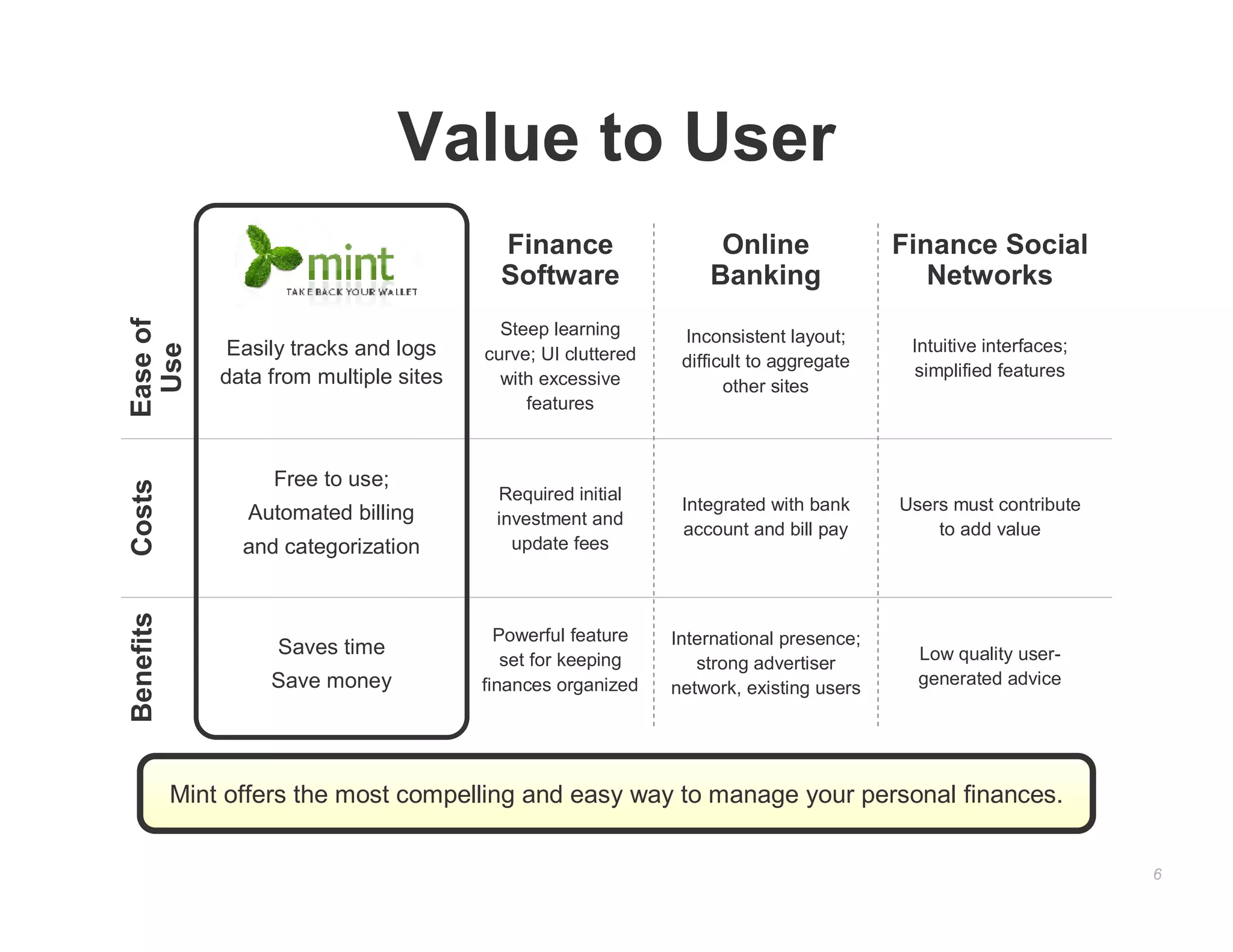
User Problem (Slide 2, 6): Consumers struggle to manage finances across multiple accounts and institutions. Existing solutions are fragmented:

  • Finance Software (Quicken, Money): Steep learning curve, cluttered UI, requires upfront investment and ongoing fees
  • Online Banking: Inconsistent layouts, difficult to aggregate across institutions
  • Finance Social Networks: Simplified but rely on low-quality user-generated advice

The tagline “Take Back Your Wallet” (Slide 1) frames the emotional problem: users feel out of control of their finances.

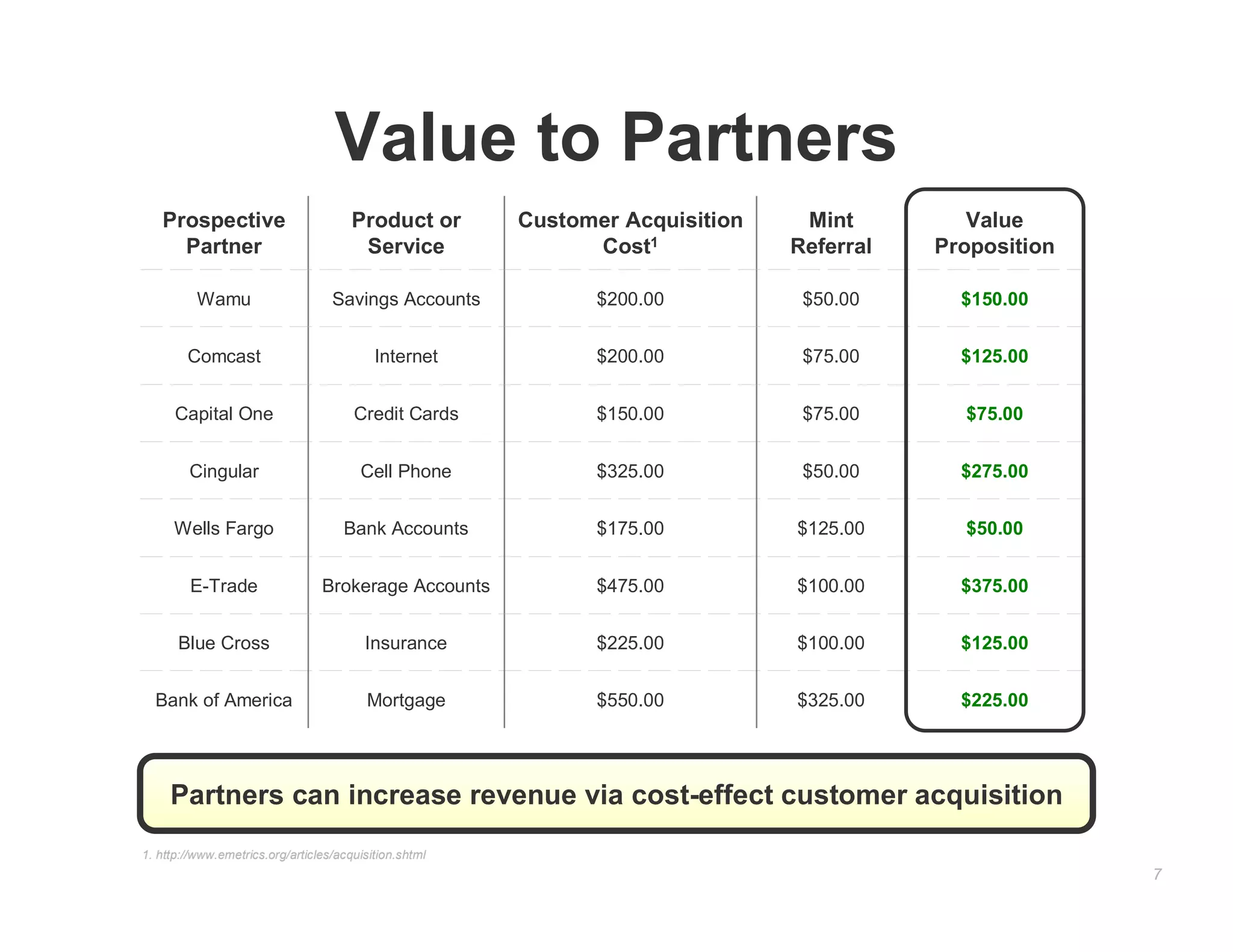
Partner Problem (Slide 7): Financial institutions face high customer acquisition costs ($150-$550 per customer) and struggle to reach target demographics efficiently.

Solution

Core Product (Slide 2): Mint is a free, web-based personal finance management platform that:

  • Aggregates accounts from multiple financial institutions (banks, credit cards, investment accounts, etc.)
  • Categorizes transactions automatically using AI-based auto-sorting
  • Visualizes spending through pie charts and trend analysis
  • Sets and tracks goals with progress monitoring
  • Provides intelligent recommendations for savings opportunities based on user’s specific financial profile

Key differentiators (Slide 6):

  • Easy multi-site tracking (vs. online banking’s inconsistent layouts)
  • Free to use with automated categorization (vs. Quicken’s complexity and fees)
  • Intuitive interface (vs. finance software’s steep learning curve)

Monetization approach (Slide 9): Mint makes money when users benefit—specifically when they act on recommendations to switch to better financial products. This aligns incentives between Mint and users.

Market Opportunity

Total Addressable Market (Slide 4):

  • Starting population: 49 million people aged 22-35 in the US
  • Addressable market: 31 million people (64% of target demographic use online banking)
  • TAM: $388 million with 16% CAGR

Revenue opportunity breakdown (Slide 4):

  • Referrals (CPA model): $8 RPU/year with 14% CAGR
    • Credit Cards: $75 CPA, 0.50% conversion
    • Savings Accounts: $50 CPA, 0.75% conversion
    • Internet: $75 CPA, 1.00% conversion
    • Cell Phone: $50 CPA, 0.25% conversion
    • Bank Accounts: $200 CPA, 0.10% conversion
  • Advertising (CPC model): $4.50 RPU/year with 22% CAGR
    • Data leverage: zip code, age, income, shopping behavior, brand preferences

Market context: The deck positions this within the broader shift to online banking adoption in 2007, when digital financial management was still nascent but growing.

Business Model

Primary Revenue Model (Slide 9): Referral-based monetization

  1. User Acquisition → 2. Gather User Information → 3. Intelligent Suggestions → 4. User Switches = Referral Fee

Revenue streams (Slide 10, projected 2010):

  • Credit Cards: $382.0M (7% of revenue)
  • Savings Accounts: $363.2M (7%)
  • Internet Service Provider: $662.1M (12%)
  • Bank Accounts: $232.8M (4%)
  • Cell Phone: $104.6M (2%)
  • Targeted Advertising: $3,632.3M (67%)

Unit Economics (Slide 4, 7):

  • Average RPU from referrals: $8/year
  • Average RPU from advertising: $4.50/year
  • Partner value proposition: Mint’s referral fees are 25-75% cheaper than partners’ CAC
    • Example: Wamu (Savings Accounts) has $200 CAC; pays Mint $50 referral = $150 value
    • Example: E-Trade (Brokerage) has $475 CAC; pays Mint $100 referral = $375 value

Key assumption: Users will actively switch services based on Mint’s recommendations, and financial institutions will pay referral fees for qualified leads.

Traction & Metrics

Pre-launch status: The deck is presented in April 2007, before public launch. No user traction is shown.

Projected growth (Slide 10):

  • 2007: 100,000 users
  • 2008: 180,000 users (80% growth)
  • 2009: 309,600 users (72% growth)
  • 2010: 510,200 users (65% growth)

Projected financials (Slide 10):

  • 2007 Revenue: $751.3M
  • 2008 Revenue: $1,513.6M (2.0x growth)
  • 2009 Revenue: $2,914.3M (1.9x growth)
  • 2010 Revenue: $5,377.1M (1.8x growth)

Profitability:

  • 2007 EBIT: $38.1M (5% margin)
  • 2008 EBIT: $326.3M (22% margin)
  • 2009 EBIT: $1,090.1M (37% margin)
  • 2010 EBIT: $2,562.9M (48% margin)

Cash flow:

  • 2007: ($3,000K) investment
  • 2008: $49M operating cash flow
  • 2009: $164M operating cash flow
  • 2010: $6,259M operating cash flow

Note: These projections proved to be extraordinarily optimistic. Actual Mint growth was much slower, and the company was acquired by Intuit in 2009 for $170M—a fraction of the projected 2009 revenue of $2.9B.

Competitive Positioning

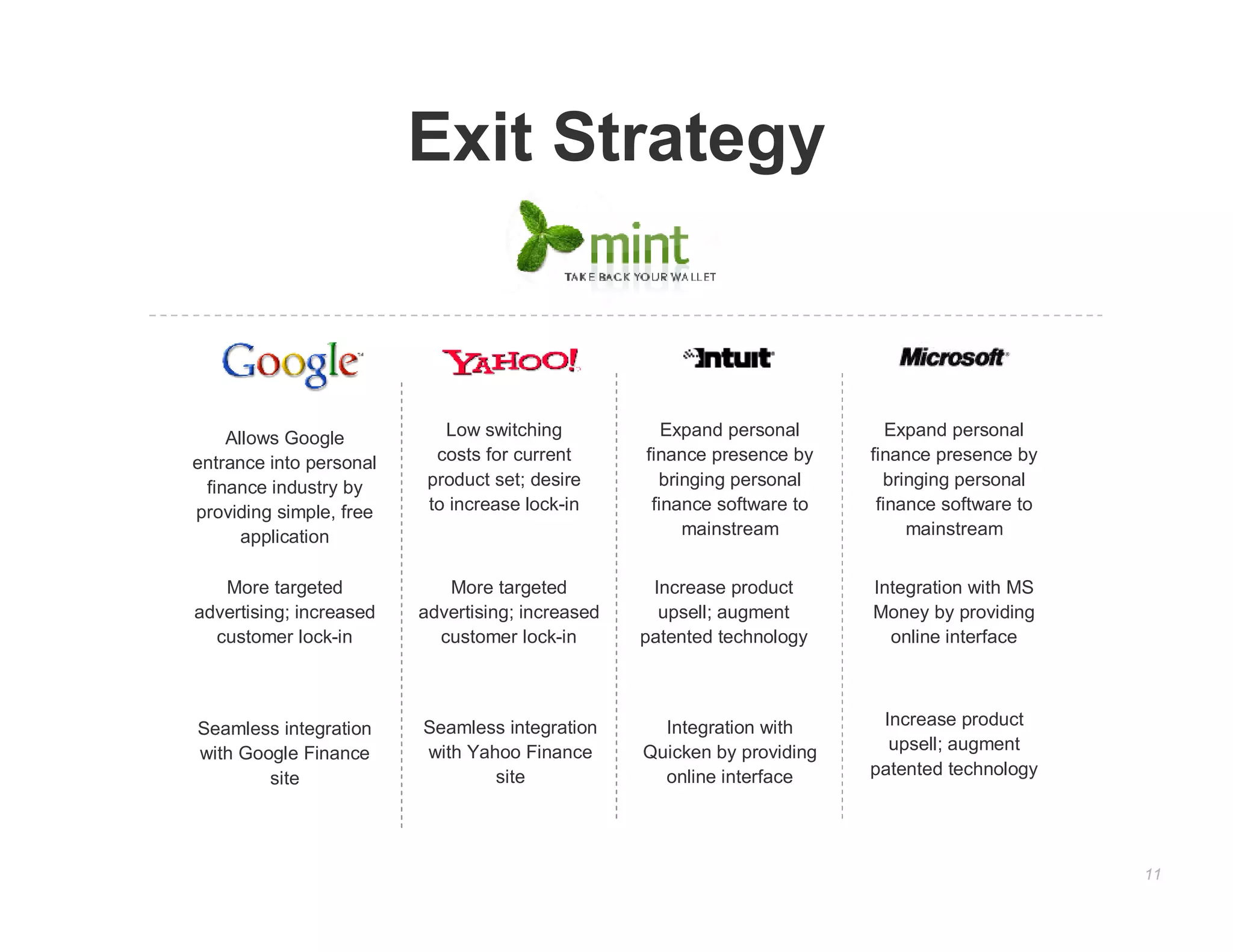
Primary competitor: Wesabe (Slide 5)

  • Weaknesses: No revenue model (freemium), community-based with limited information, poor traction, unspecific suggestions
  • Mint’s advantage: User-specific saving opportunities, AI-based auto-sorting, intuitive UI

Potential entrants: Microsoft Money and Quicken (Slide 5)

  • Strategy: Develop simple, easy-to-use free personal finance app OR acquire Wesabe/similar
  • Mint’s defensibility: High service switching costs, 3 non-pending technology patents, TurboTax integration

Competitive advantages (Slide 5, 6):

  1. Ease of use: Multi-account aggregation without the complexity of Quicken or inconsistency of online banking
  2. Cost: Free vs. Quicken’s upfront and ongoing fees
  3. Intelligence: AI-based auto-sorting and personalized recommendations vs. community wisdom
  4. Data asset: Aggregated financial data enables targeted advertising and partner referrals

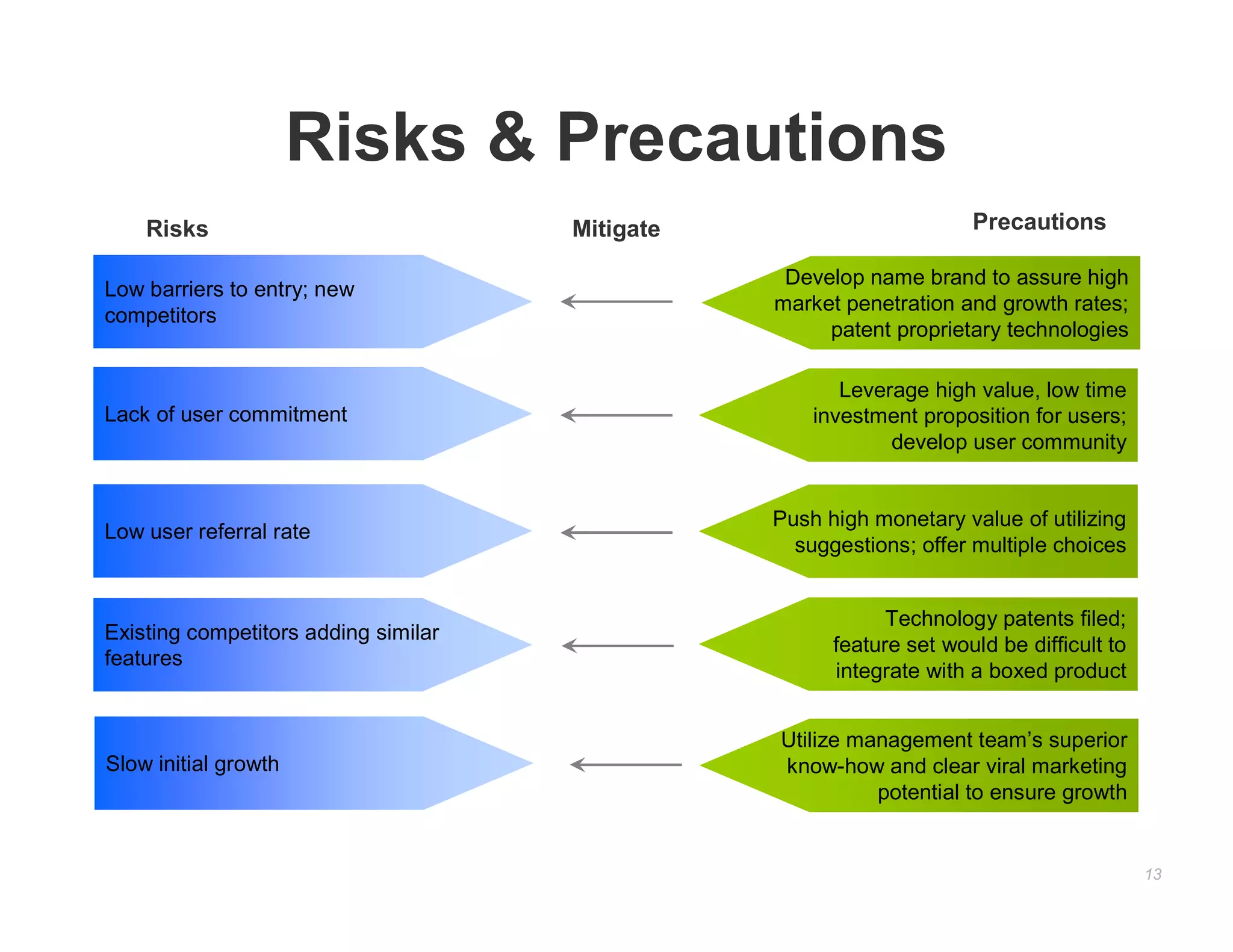
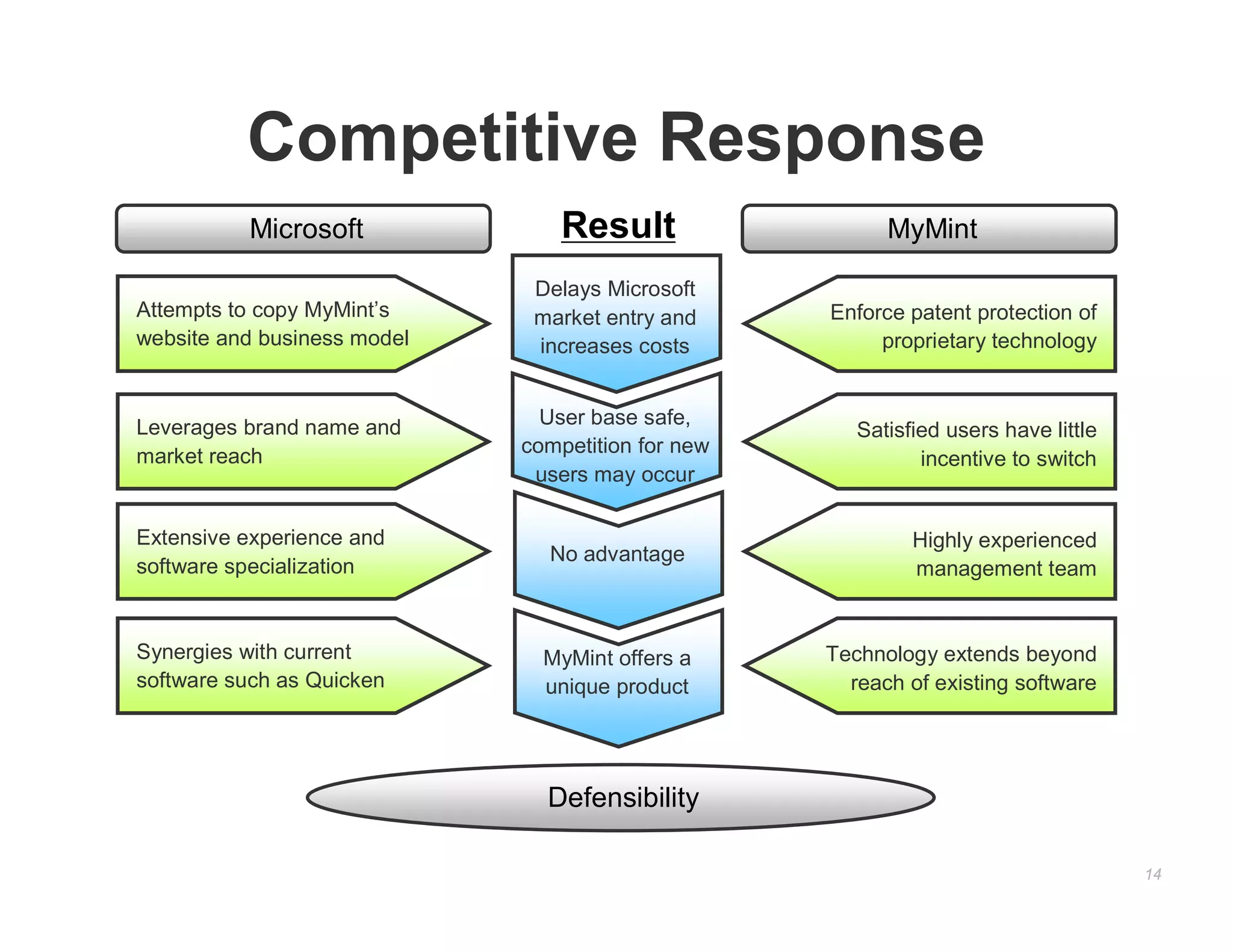
Competitive response scenario (Slide 14): If Microsoft attempts to copy Mint’s website and business model:

  • Mint’s defenses: Patent enforcement, satisfied users have low switching incentive, experienced team, technology extends beyond existing software
  • Result: Delays Microsoft entry, protects user base, offers unique product

Team

Core team (Slide 3):

  1. Aaron Patzer - CEO & Founder
    • Lead Architect at Nascentric (chip simulation software)
    • Founder of GetAWebsite (search engine optimization)
    • Expertise: Architecture, scalability, SEO/growth
  2. David Michaels - VP Engineering
    • Director of Technology at ShockMarket Corporation
    • Director of Engineering at PGP (security software)
    • Expertise: Security, financial data handling
  3. Dave McClure - Director Marketing
    • Director of Marketing at PayPal (micro-payments)
    • Director of Marketing at Simply Hired (job search)
    • Expertise: Fintech, consumer growth, viral marketing
  4. Jason Putorti - Lead Designer
    • CTO & Founder at Novaroura (acquired by FittingGroup)
    • Co-Founder at Six Madison (anti-fraud SAS)
    • Expertise: Design, user experience, fraud detection

Investors & Advisors (Slide 3):

  • Investors: First Round Capital, Felicis Ventures
  • Advisors: Ron Conway (angel superstar), Scott Cook (Intuit Founder & CEO)

Assessment: Exceptionally strong team for a seed-stage company. Each founder brings directly relevant expertise (security, fintech, growth, design). Scott Cook’s involvement as advisor is particularly significant—he founded Intuit (Quicken’s parent), suggesting insider knowledge of the personal finance market and potential acquirer relationship.

Go-to-Market Strategy

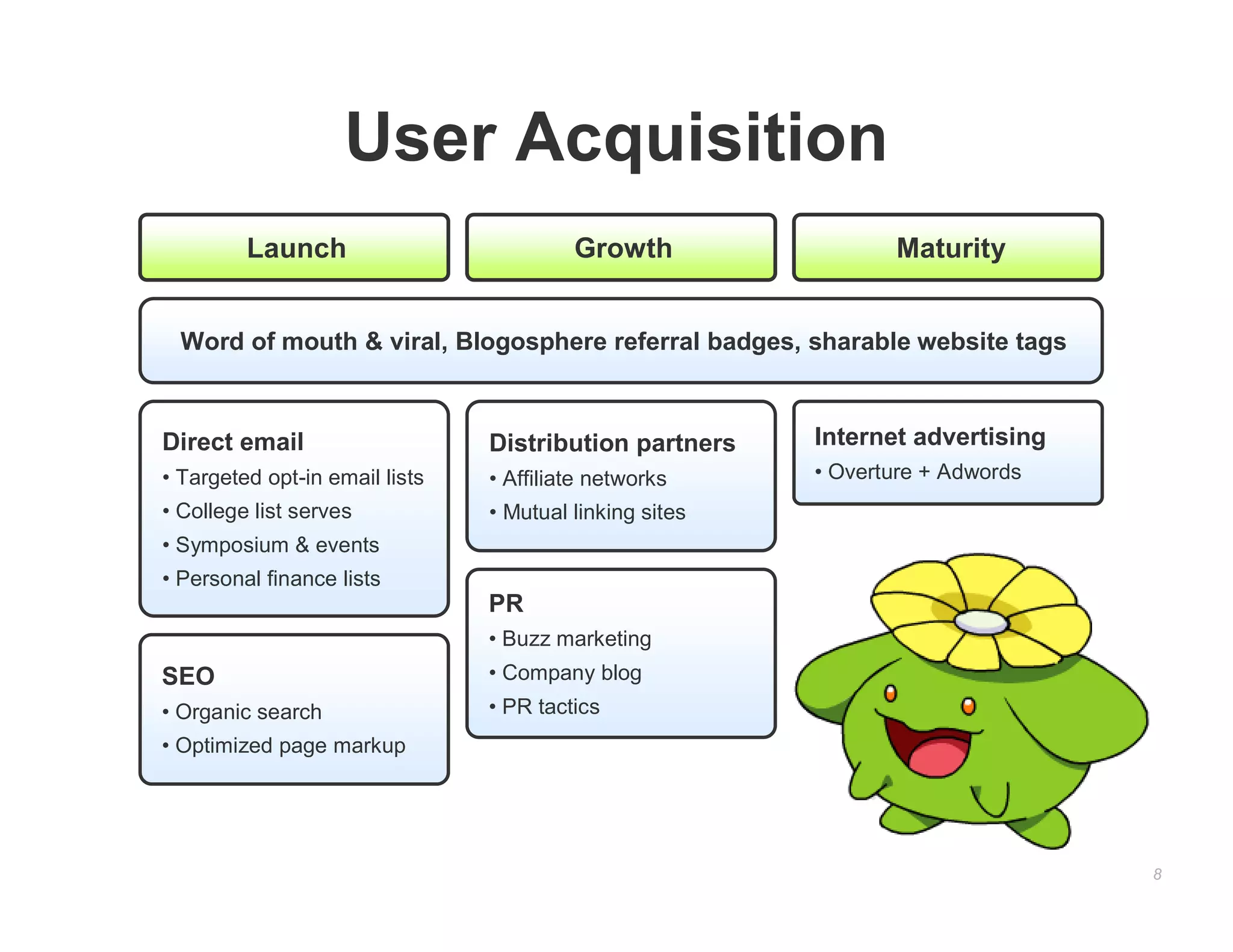
User Acquisition (Slide 8): Three-phase approach with different channels by stage

Launch phase (low-cost, organic):

  • Word of mouth & viral marketing
  • Blogosphere referral badges
  • Sharable website tags
  • Direct email (targeted opt-in lists, college list serves, symposiums, personal finance lists)
  • SEO (organic search, optimized page markup)

Growth phase (scaled channels):

  • Distribution partners (affiliate networks, mutual linking sites)
  • PR (buzz marketing, company blog, PR tactics)

Maturity phase (paid channels):

  • Internet advertising (Overture + Google Adwords)

Partner-driven acquisition (Slide 7):

  • Leverage financial institution partnerships to drive referrals
  • Partners benefit from lower CAC; Mint benefits from user volume

Key insight: The deck emphasizes viral/organic growth before paid acquisition, reflecting Web 2.0 thinking and the team’s expertise in growth marketing (Dave McClure’s background at PayPal and Simply Hired).

The Ask

Investment amount: $3.0M seed round

Investor stake: 15%

Implied valuation: $20M post-money ($17M pre-money)

Use of funds: Not explicitly detailed in the deck, but implied allocation based on expense projections:

  • Sales & Marketing: $225.4M (2007 projection)
  • General & Administrative: $300.0M (2007 projection)
  • Research & Development: $187.8M (2007 projection)

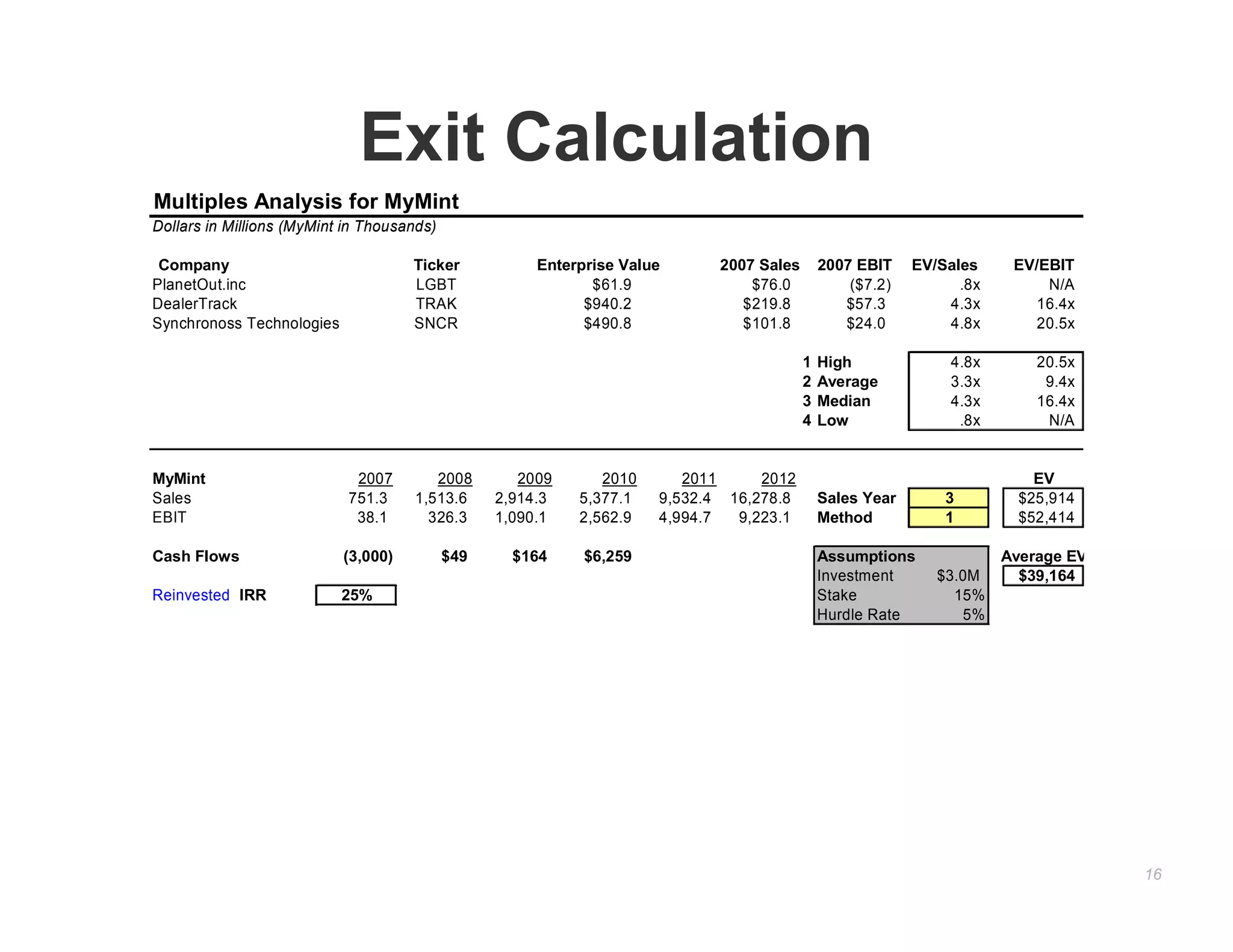
Return expectations (Slide 16):

  • Hurdle rate: 5%
  • Expected IRR: 25%
  • Exit valuation scenarios:
    • Conservative (3.3x EV/Sales on 2009 revenue): $25.9B
    • Aggressive (9.4x EV/EBIT on 2009 EBIT): $52.4B
    • Average: $39.2B
  • Exit timing: 2009 (Year 3)

Note: These valuation expectations were wildly optimistic. The actual acquisition by Intuit in 2009 was for $170M, not $25-52B. This suggests either:

  1. The projections were unrealistic
  2. Execution fell short of projections
  3. Market conditions changed (2008 financial crisis)
  4. Intuit valued the acquisition at a discount to growth potential

Investor Deep Dive

Executive summary, strengths & red flags

Executive Summary

Mint's 2007 seed pitch deck presents a compelling vision for democratizing personal finance management through a free, web-based aggregation platform that monetizes through referral fees and targeted advertising. The deck combines a strong founding team with relevant domain expertise (PayPal, security software, SEO), a clear value proposition ("Take Back Your Wallet"), and detailed financial projections showing a path to $5.4B revenue and $2.6B EBIT by 2010. However, the projections are extraordinarily aggressive, the business model relies heavily on unproven partner relationships and user behavior assumptions, and critical risks around regulatory compliance and data security are largely unaddressed—yet the pitch was compelling enough to attract top-tier investors (First Round Capital, Felicis Ventures, Scott Cook) and ultimately resulted in a successful acquisition.

Key Strengths

4 identified

1

Exceptional Team Credibility

The founding team brings directly relevant expertise from tier-one companies (PayPal, PGP, Nascentric) and includes Scott Cook (Intuit founder) as advisor. This signals:

2

Clear, Compelling Value Proposition

"Take Back Your Wallet" is emotionally resonant and action-oriented. The deck shows a concrete, relatable example (Slide 2) with real account data, spending categories, and savings opportunities. U...

3

Dual Revenue Model with Upside Optionality

The deck presents referral fees as the primary revenue model (conservative, aligned with user benefit) while advertising is positioned as future upside. This:

4

Detailed Partner Economics

Slide 7 shows specific CAC and referral fee data for 8 financial services partners, demonstrating that:

More Pitch Decks To Study

Compare structure, fundraising context, and investor-facing story across similar startup decks.